Why Source White Quartz from China in 2026?
China has become one of the world’s major manufacturing and exporting bases for engineered stone and quartz surfaces. International trade records continue to show shipments of engineered quartz slabs from China to markets including the United States, Vietnam, Malaysia, the Philippines, and other destinations. For example, trade records from 2025 show Chinese engineered quartz slab shipments under HS classifications including 681019 and 681099.
For buyers searching for a quartz supplier in China, however, the sourcing question has changed.
The old purchasing model was:
Find the cheapest quartz factory → compare slab prices → place an order.
The 2026 model is:
Verify the manufacturer → verify the material → verify quality consistency → verify compliance → verify production → verify packaging → verify logistics → then compare total landed cost.
This distinction matters because white quartz is not simply a commodity product. White surfaces are particularly sensitive to color variation, pinholes, resin distribution, gloss, veining, edge quality, and batch-to-batch consistency.
A professional China quartz buyer therefore needs to evaluate the entire supply chain rather than only the FOB price.
1. What Is a China Quartz Supplier?
A quartz supplier in China may refer to several different types of companies.
1.1 Quartz Manufacturer
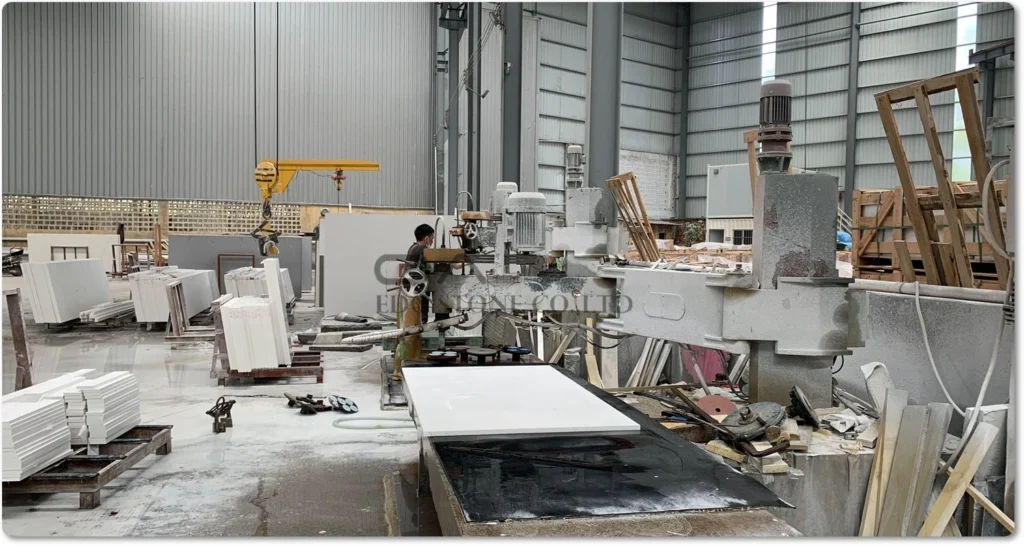
A manufacturer actually produces quartz slabs using raw materials, resin or other binders, pigments, and manufacturing processes.
Typical capabilities may include:
- Raw-material preparation
- Mixing
- Vacuum pressing
- Curing
- Thickness calibration
- Polishing
- Slab inspection
- Cutting
- Packaging
- Quality control
For large-volume buyers, a direct manufacturer can potentially provide better control over pricing, customization, and production scheduling.
1.2 Quartz Factory
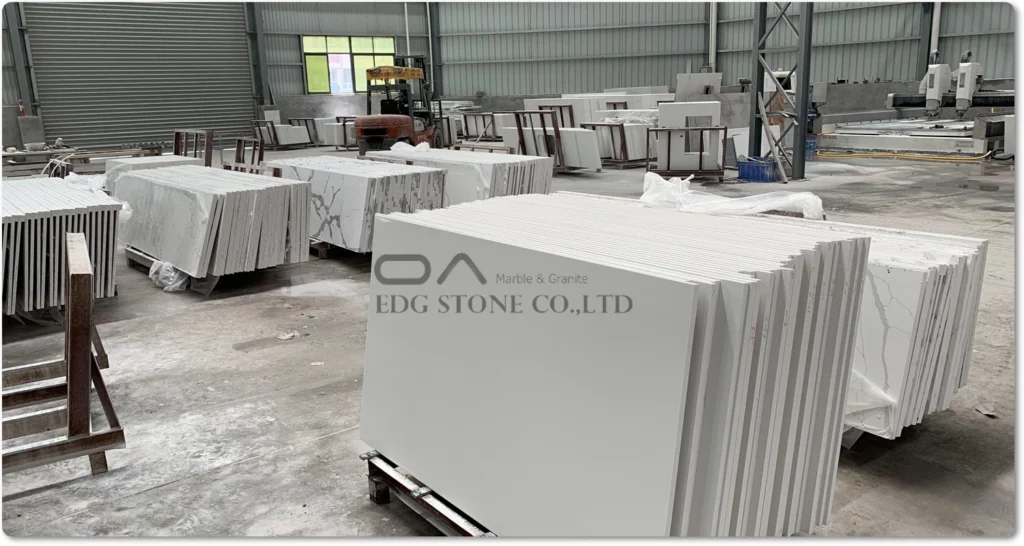
A quartz factory in China is generally more production-oriented and may operate its own manufacturing lines.
When evaluating a factory, buyers should ask:
- How many production lines are operating?
- What slab sizes are available?
- What thicknesses are standard?
- What is the monthly production capacity?
- Does the factory manufacture or outsource?
- How is raw material controlled?
- How are color batches recorded?
- What percentage of production is exported?
- Which countries are the major export destinations?
Factory size alone does not guarantee quality. A smaller factory with strong quality control can sometimes outperform a large factory with inconsistent production management.
1.3 Quartz Trading Company
A trading company may purchase quartz from several factories and consolidate products for international customers.
This can be useful when a buyer needs:
- Multiple brands
- Multiple factories
- Mixed products
- Small quantities
- Stone plus other building materials
However, buyers should know whether they are dealing directly with the manufacturer or a trading intermediary.
1.4 Quartz Exporter or Stone Supplier
Some Chinese stone companies specialize in export services and can supply both natural stone and engineered surfaces.
This model can be particularly useful for project procurement because the supplier may provide:
- Quartz slabs
- Marble
- Granite
- Quartzite
- Sintered stone
- Porcelain slabs
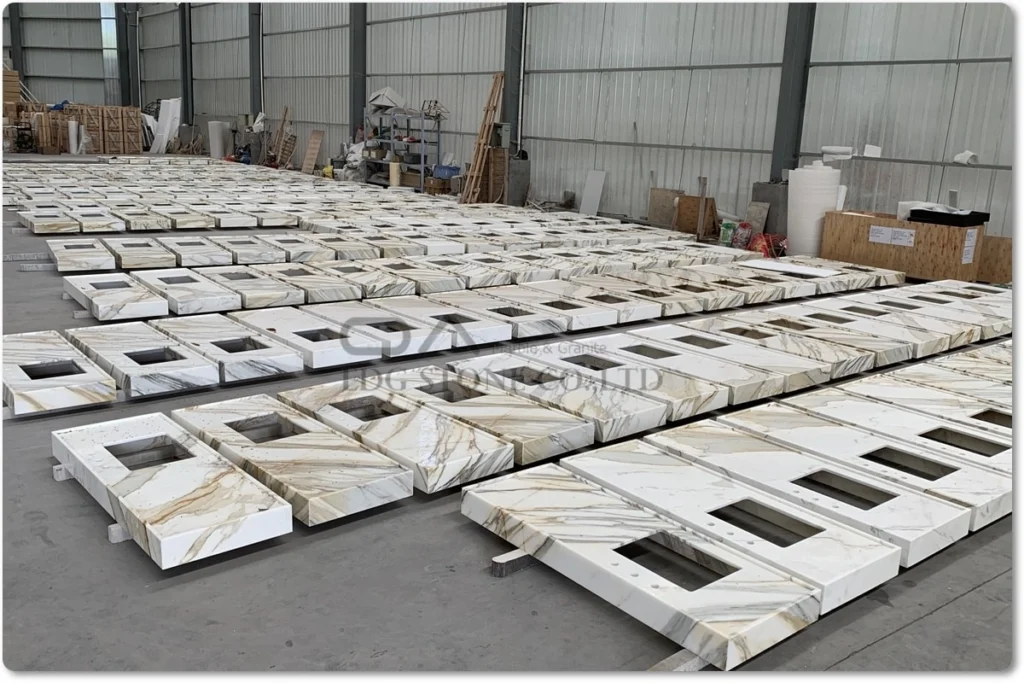
- Countertops
- Vanity tops
- Custom fabrication
- Project packaging
For a buyer managing multiple stone categories, a full-service white quartz company can sometimes reduce procurement complexity.
2. Why Is White Quartz China Popular with International Buyers?
White quartz remains attractive because it combines a clean visual appearance with the manufacturing flexibility of engineered surfaces.
2.1 Consistent Modern Aesthetics
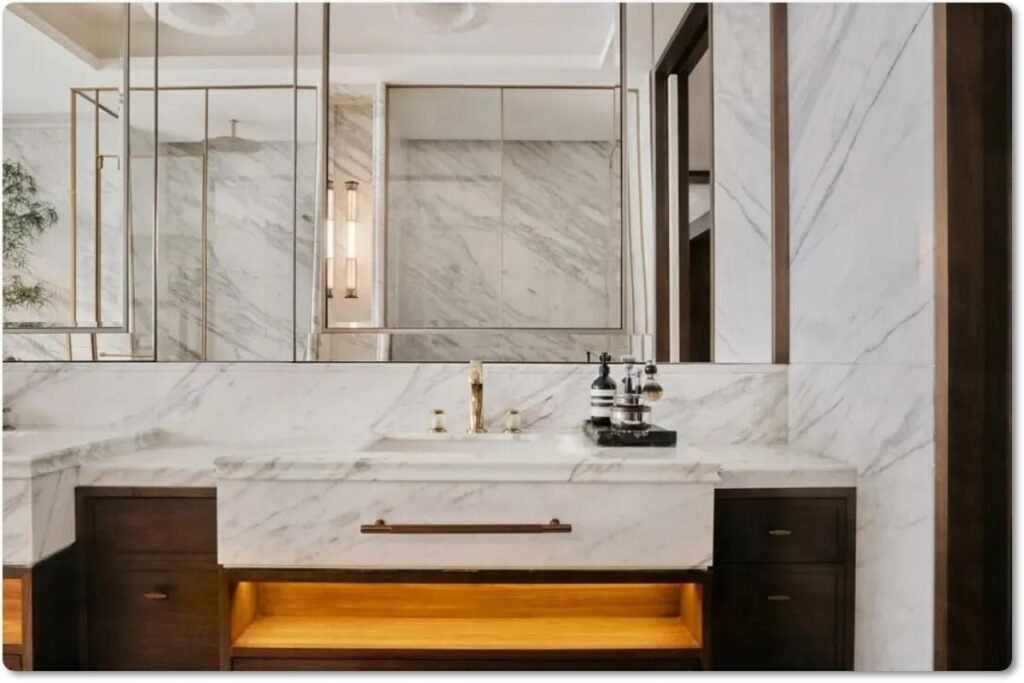
White quartz can imitate several popular natural-stone aesthetics, including:
- Pure white marble
- Carrara marble
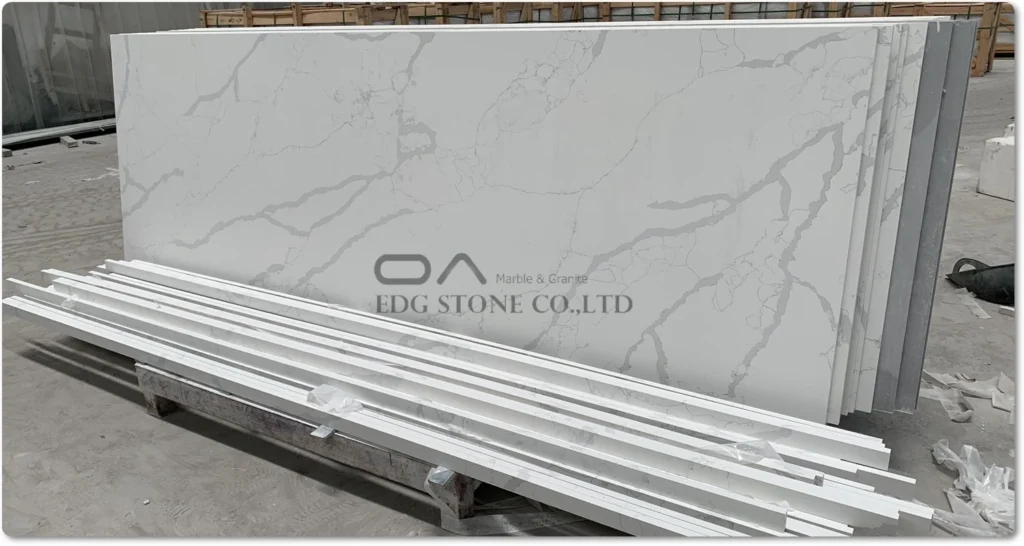
- Calacatta marble
- Statuario marble
- White quartzite
- Soft gray-veined stone
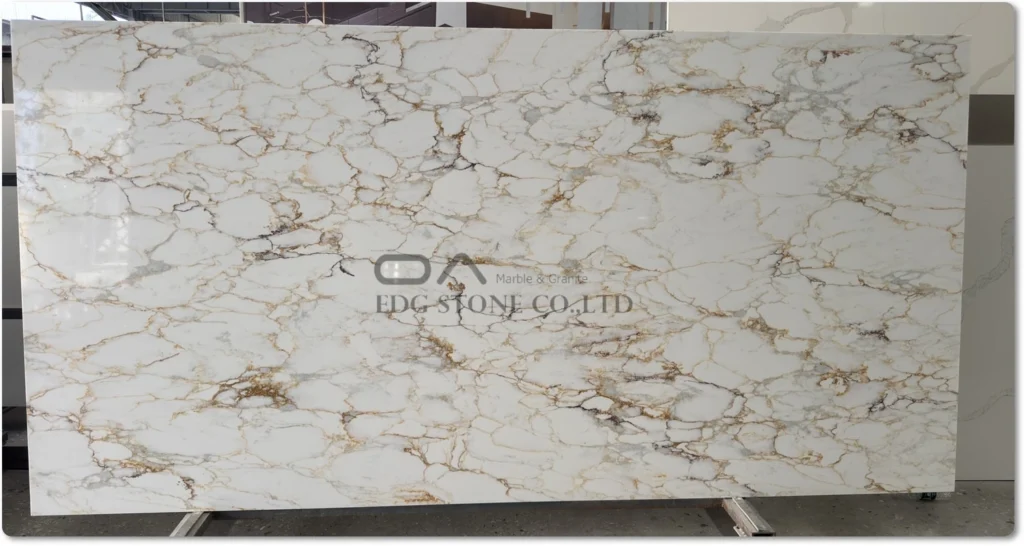
- Gold-veined luxury stone
This makes China white quartz suitable for:
- Kitchen countertops
- Bathroom vanities
- Islands
- Reception counters
- Hotel interiors
- Apartment developments
- Retail interiors
- Wall applications
- Commercial fit-outs
2.2 Large-Format Manufacturing
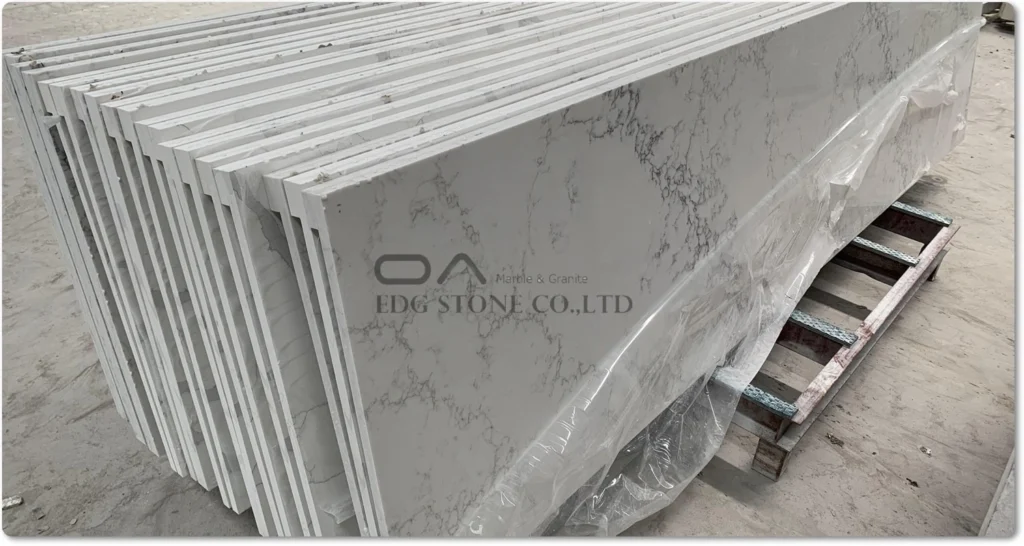
Chinese manufacturers commonly offer large slab formats and different thickness options.
Trade records demonstrate that Chinese quartz slabs are exported in formats such as approximately 3200 × 1600 mm and other large dimensions.
Large-format slabs can help fabricators reduce joints in larger countertops and islands, although actual yield depends on the project dimensions and fabrication requirements.
2.3 Customization
A major advantage of sourcing directly from a Chinese manufacturer is customization.
Buyers may request:
- Custom colors
- Custom veining
- Private-label products
- Custom slab sizes
- Surface finishes
- Special thicknesses
- Custom packaging
- Customized logos
- Exclusive collections
This can be particularly valuable for distributors and countertop companies building their own brands.
3. Which Quartz Brands Are Made in China?
This is one of the most frequently misunderstood questions in international quartz procurement.
The answer depends on the specific product, brand, collection, and manufacturing arrangement.
3.1 Brand Ownership Is Not the Same as Manufacturing Location
A quartz brand may be:
- Owned by a company in one country.
- Designed in another country.
- Manufactured in China.
- Distributed through another country.
- Sold under a private-label brand.
Therefore, asking “Which quartz brands are made in China?” should not be reduced to a simple list of brand names.
The better procurement question is:
Where was this specific quartz collection manufactured, and can the supplier document its country of origin and manufacturing source?
3.2 How to Verify Manufacturing Origin
Ask the supplier for:
- Factory address
- Certificate of origin where applicable
- Commercial invoice
- Packing list
- Product specification
- Material composition
- Factory photographs or video
- Production-line information
- Export records where available
- Third-party inspection reports
Shipment databases also demonstrate that Chinese-origin engineered quartz products are actively exported internationally. Volza, for example, currently identifies dozens of white quartz stone suppliers in China and records shipments to international buyers.
3.3 Private Label Quartz from China
For distributors, private-label manufacturing can be more important than buying an existing brand.
A Chinese quartz manufacturer may produce slabs under the buyer’s:
- Brand name
- Collection name
- SKU
- Packaging
- Color code
- Marketing materials
This model can allow a distributor to develop an exclusive white quartz collection without investing in its own manufacturing plant.
4. How to Find a Reliable Quartz Supplier in China
The best sourcing strategy is to build a supplier shortlist before requesting final pricing.
4.1 Search with Commercial-Intent Keywords
International buyers can use search terms such as:
- quartz supplier China
- China quartz manufacturer
- white quartz supplier China
- white quartz manufacturer China
- China quartz factory
- China quartz slabs wholesale
- white quartz slabs wholesale China
- engineered quartz manufacturer China
- Calacatta quartz manufacturer China
- quartz countertop manufacturer China
These keywords reveal different supplier categories.
4.2 Use B2B Platforms as Discovery Tools
B2B marketplaces can help buyers discover factories and exporters.
For example, Alibaba’s current supplier listings include Chinese companies offering white quartz, engineered quartz slabs and wholesale quartz products.
However, a marketplace profile should be considered a lead-generation source, not proof that a company is the best manufacturer.
A buyer should independently verify:
- Factory location
- Business registration
- Production capacity
- Product consistency
- Certifications
- Export history
- References
- Inspection results
4.3 Request a Factory Audit
For substantial orders, a factory audit is highly recommended.
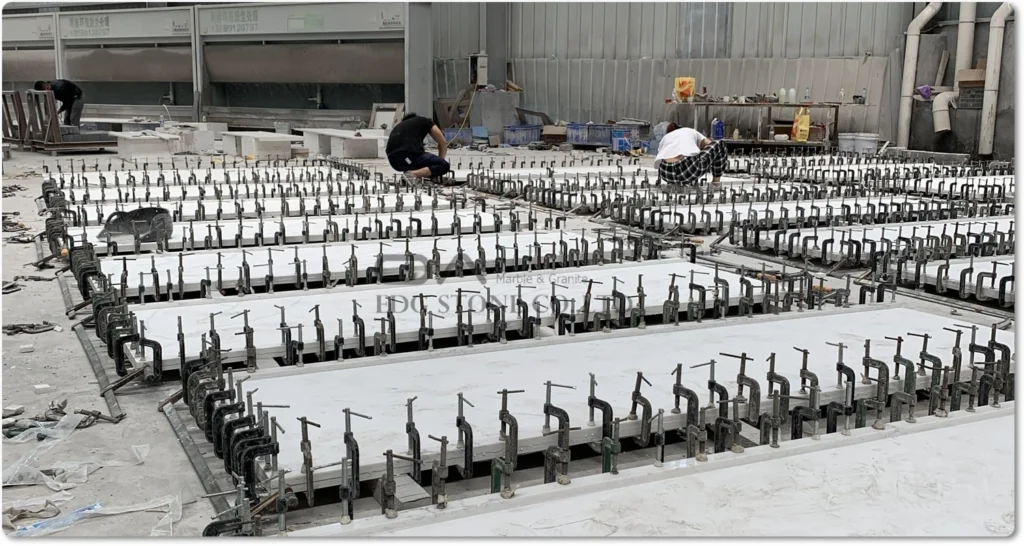
A basic audit should examine:
Production
- Production lines
- Raw-material storage
- Mixing equipment
- Pressing equipment
- Polishing lines
- Calibration equipment
- Finished-goods storage
Quality Control
- Incoming raw-material inspection
- Production inspection
- Final inspection
- Thickness measurement
- Flatness inspection
- Surface inspection
- Color comparison
Export Operations
- Packing area
- Container loading
- Export documentation
- Wooden crate production
- Slab protection system
5. What Should a China Quartz Buyer Check Before Ordering?
A professional China quartz buyer should evaluate at least eight areas.
5.1 Slab Size
Confirm:
- Length
- Width
- Thickness
- Usable area
- Tolerance
Do not evaluate suppliers using price per square meter without confirming the actual slab size.
5.2 Thickness
Common quartz slab thicknesses include approximately:
- 12 mm
- 15 mm
- 18 mm
- 20 mm
- 30 mm
Availability depends on the manufacturer and collection.
For North American countertop projects, 2 cm and 3 cm specifications are particularly important.
5.3 Color Consistency
White quartz is difficult because small differences are visually obvious.
Ask the supplier to define:
- Base color
- Vein color
- Vein density
- Vein direction
- Gloss level
- Acceptable batch variation
5.4 Water Absorption and Physical Properties
Request the manufacturer’s technical data.
Depending on the application and market, buyers may investigate:
- Water absorption
- Flexural strength
- Compressive strength
- Abrasion resistance
- Stain resistance
- Scratch resistance
- Thermal behavior
The exact test method should also be identified.
5.5 Surface Quality
Inspect samples for:
- Pinholes
- Microcracks
- Uneven polishing
- Resin marks
- Color spots
- Edge defects
- Surface waviness
- Vein discontinuity
5.6 Fabrication Performance
A good slab must also perform well during fabrication.
Test:
- Saw cutting
- CNC machining
- Edge profiling
- Drilling
- Polishing
- Sink cutouts
- Mitre fabrication
A visually beautiful slab that cracks easily during fabrication is not a good commercial product.
6. Silica, Safety and Regulatory Compliance: What Buyers Must Know in 2026
This is now one of the most important parts of international quartz procurement.
Engineered quartz can contain substantial amounts of crystalline silica. The U.S. National Institute for Occupational Safety and Health notes that engineered stone can range from less than 0.2% to as high as 95% crystalline silica depending on the product, while cutting, grinding, and polishing can generate respirable crystalline silica.
OSHA has also specifically focused enforcement activity on respirable crystalline silica exposure in engineered-stone fabrication and installation. OSHA identifies an 8-hour permissible exposure limit of 50 μg/m³ for respirable crystalline silica under its applicable standard.
This means that a modern quartz company in China serving international markets should treat silica documentation and fabrication safety as part of product quality—not as an optional marketing topic.
6.1 Australia’s Engineered Stone Ban
Australia provides the clearest example of how regulation can reshape the quartz market.
From 1 July 2024, Australia prohibited the manufacture, supply, processing and installation of engineered stone benchtops, panels and slabs across its jurisdictions. From 1 January 2025, engineered stone benchtops, panels and slabs also became prohibited imports under Australia’s customs regulations.
Importantly, the Australian definition does not cover every manufactured stone.
Safe Work Australia specifically excludes certain products such as sintered stone without resin and porcelain products without resin from the engineered-stone definition.
6.2 What This Means for Chinese Quartz Suppliers
The market is moving toward:
- Better material disclosure
- Better silica documentation
- Safer fabrication practices
- Lower-silica alternatives
- Sintered stone
- Porcelain slabs
- Resin-free surfaces
- Better technical documentation
Therefore, a supplier should not simply say:
“Our quartz is safe.”
Instead, professional buyers should request documented information regarding composition and applicable regulatory requirements.
6.3 Compliance Should Be Market-Specific
A supplier serving:
- United States
- Canada
- European Union
- United Kingdom
- Australia
- New Zealand
- Middle East
may need different documentation and compliance strategies.
The buyer should always confirm requirements for the destination market, product type, and intended application before shipment.
7. White Quartz Manufacturer vs Trading Company: Which Is Better?
There is no universal answer.
Direct Manufacturer
Best when you need:
- Large volume
- Stable collections
- Private label
- Custom colors
- Custom veining
- Long-term supply
- Factory-level pricing
Trading Company
Potentially useful when you need:
- Small quantities
- Multiple factories
- Mixed stone products
- Project consolidation
- Procurement support
Hybrid Stone Supplier
A supplier with manufacturing capability plus export/project services can be particularly useful for international construction projects.
For example, a supplier may provide both:
Quartz slabs + natural marble + granite + countertops + vanity tops + custom stone fabrication.
This can reduce the number of vendors involved in a project.
8. How Much Does White Quartz Cost from China?
There is no single “China white quartz price.”
Pricing depends on:
- Material composition
- Slab thickness
- Slab size
- Design complexity
- White base quality
- Veining
- Surface finish
- Order volume
- Packaging
- Private-label requirements
- Inspection
- Port
- Freight
- Destination
- Tariffs and duties
Online B2B listings currently show substantial price variation among Chinese quartz slab suppliers, reinforcing the importance of comparing equivalent specifications rather than headline prices alone.
The Correct Procurement Formula
Instead of comparing:
FOB Price = Supplier A vs Supplier B
compare:
Total Landed Cost = Product + Packaging + Inspection + Freight + Insurance + Duty/Tariff + Local Charges + Fabrication Risk
A supplier offering a $2/m² lower price can become more expensive if the product produces excessive fabrication waste or inconsistent batches.
9. How to Buy White Quartz Wholesale from China
For wholesalers and distributors, purchasing should be structured around a repeatable SKU system.
Step 1: Define the Collection
For example:
White Quartz Collection
- Pure White
- Carrara White
- Calacatta White
- Calacatta Gold
- Statuario White
- Soft Grey Vein
- Heavy Grey Vein
Step 2: Define Specifications
For every SKU record:
- SKU
- Slab size
- Thickness
- Finish
- Base color
- Vein type
- Weight
- Packing method
- MOQ
- Lead time
Step 3: Approve a Golden Sample
The approved sample becomes the visual reference for future production.
This is extremely important for white quartz because color and vein variation can become more noticeable in large projects.
Step 4: Establish QC Standards
Specify:
- Acceptable color tolerance
- Surface defects
- Thickness tolerance
- Edge defects
- Packaging standards
- Breakage allowance
Step 5: Pre-Shipment Inspection
For large orders, consider third-party inspection before loading.
10. What Makes EDG Stone Different as a China Quartz Supplier?
For international buyers looking for a long-term stone supply partner, EDG Stone can position itself around a broader value proposition than simply selling quartz slabs.
The strongest positioning is:
China stone manufacturing and export expertise + quartz supply + natural stone + custom fabrication + project support.
This is especially relevant for buyers who need more than standard slabs.
EDG Stone can structure its quartz offering around:
- White quartz slabs
- Calacatta quartz
- Calacatta Gold quartz
- Carrara-style quartz
- Custom quartz designs
- Quartz countertops
- Vanity tops
- Stone fabrication
- Project stone supply
- Wholesale supply
- OEM/private-label cooperation
The objective should be to help buyers move from sample approval to repeat procurement.
11. The Future of the China White Quartz Market
The market is moving in several clear directions.
11.1 From Low Price to Compliance + Traceability
Price will remain important, but professional buyers increasingly need:
Price + Quality + Compliance + Documentation + Reliability.
11.2 From Commodity White to Designer White
Basic white quartz is increasingly competitive.
Higher-value products include:
- Calacatta Gold
- Statuario
- Dramatic veining
- Bookmatch-effect designs
- Natural-stone-inspired surfaces
- Large-format luxury slabs
11.3 From Quartz Only to Multi-Material Procurement
Regulation and market preferences are encouraging suppliers to offer alternatives.
A modern stone supplier should therefore be able to discuss:
Quartz vs Sintered Stone vs Porcelain vs Natural Quartzite vs Marble
rather than selling quartz in isolation.
11.4 Lower-Silica and Alternative Surfaces Will Become More Important
Australia’s regulatory changes demonstrate that silica content and fabrication risk can directly affect market access.
This does not mean every quartz market will follow Australia’s exact model. It does mean international suppliers should monitor regulatory developments rather than treating compliance as a one-time certification exercise.
12. China Quartz Supplier Checklist for International Buyers
Before placing a purchase order, ask the supplier these questions:
Factory
- Are you a manufacturer or trading company?
- Where is the factory?
- How many production lines do you operate?
- What is your monthly capacity?
Product
- What is the exact slab size?
- What thicknesses are available?
- What is the material composition?
- What are the technical specifications?
- How consistent are different production batches?
Quality
- What QC system do you use?
- Can you provide test reports?
- Can we approve a production sample?
- Can we arrange third-party inspection?
Compliance
- What silica-content information can you provide?
- What destination-market documentation is available?
- Can you provide SDS/technical documentation where applicable?
- What compliance standards does the product meet?
Logistics
- How many slabs fit in a container?
- How are slabs packed?
- What type of crates are used?
- What is the normal lead time?
- Which ports do you use?
Commercial
- MOQ?
- FOB price?
- Payment terms?
- Sample policy?
- Private-label capability?
- Warranty/claims procedure?
13. Five Questions to Ask Before Choosing a White Quartz Company in China
Question 1: Is the supplier actually a manufacturer?
Do not assume that a company advertising itself as a “factory” actually manufactures every product it sells.
Question 2: Can the supplier maintain consistent white color?
This is one of the most important quality questions for commercial buyers.
Question 3: Can the supplier provide technical documentation?
A professional supplier should be able to provide appropriate product information for international procurement.
Question 4: Can the supplier scale production?
A supplier may produce excellent samples but struggle with a 5,000–20,000 m² project.
Always test production capacity before awarding a major contract.
Question 5: Can the supplier provide alternatives?
In the 2026 market, a strong supplier should understand the relationship between quartz, quartzite, porcelain, and sintered stone.
This allows buyers to select the right surface according to design, fabrication, regulation, and project requirements.
14. White Quartz China: Buyer Decision Matrix
| Evaluation Factor | Basic Supplier | Professional Factory | Strategic Supplier |
|---|---|---|---|
| Product range | Limited | Good | Extensive |
| Factory capability | Unclear | Verified | Verified |
| Customization | Limited | Available | Extensive |
| Private label | Sometimes | Available | Strong |
| QC system | Basic | Documented | Advanced |
| Export experience | Variable | Good | Strong |
| Technical documentation | Limited | Available | Comprehensive |
| Project support | Limited | Available | Strong |
| Natural stone capability | Rare | Sometimes | Often |
| Alternative materials | Rare | Available | Strong |
| Long-term cooperation | Uncertain | Good | Strong |
For serious importers, distributors, and project contractors, the strategic supplier model is generally the strongest long-term option.
15. Conclusion: How to Choose the Best Quartz Supplier in China
The best quartz supplier in China is not necessarily the company offering the lowest FOB quotation.
For international buyers in 2026, the better supplier is the one that can demonstrate:
- Stable manufacturing capability
- Consistent white quartz quality
- Reliable slab dimensions
- Professional quality control
- Transparent material information
- International export experience
- Appropriate regulatory documentation
- Reliable packaging and logistics
- Customization and private-label capability
- Long-term supply capacity
China remains an important source of engineered quartz slabs, and current trade data confirms ongoing international shipments of Chinese-origin quartz products.
However, the next stage of the industry will be less about simply producing inexpensive quartz and more about quality, traceability, compliance, design differentiation, manufacturing consistency, and responsible fabrication.
For buyers looking for China white quartz, white quartz slabs wholesale China, Calacatta quartz manufacturer China, or a long-term quartz company in China, supplier selection should therefore begin with factory verification and technical due diligence—not price alone.
Frequently Asked Questions About China White Quartz Suppliers
1. Is China a good place to buy white quartz?
Yes. China has a large manufacturing and export base for engineered quartz slabs and related stone products. Buyers can source standard white quartz, Calacatta-style quartz, custom designs and private-label products, but supplier verification and quality control are essential.
2. How do I find a reliable quartz supplier in China?
Search for manufacturers using terms such as quartz supplier China, white quartz manufacturer China, and quartz factory China. Then verify the factory, request samples, review technical documents, conduct QC inspections and compare total landed cost.
3. Which quartz brands are made in China?
Manufacturing origin varies by brand and collection. Brand ownership does not necessarily indicate manufacturing location. Buyers should verify the actual country of origin for the specific SKU or collection through supplier documentation.
4. Can I buy white quartz slabs wholesale directly from a Chinese factory?
Yes. Chinese manufacturers commonly supply wholesale quartz slabs to international distributors, fabricators, contractors and project buyers. Minimum order quantities, slab specifications, pricing and private-label options vary by factory. Current marketplace and trade data show active Chinese supply of white and engineered quartz slabs.
5. Is quartz from China affected by silica regulations?
Potentially, depending on the destination market, product composition, and intended use. Engineered quartz can contain substantial crystalline silica, and countries are increasingly regulating exposure during fabrication. Australia has prohibited the manufacture, supply, processing and installation of specified engineered-stone benchtops, panels and slabs and prohibited their importation from January 2025. Buyers should verify destination-specific requirements before ordering.
Semantic Closed-Loop Insight: What International Buyers Should Understand About China White Quartz
China White Quartz: What, Why, How, Options and Buying Considerations
What is China white quartz?
China white quartz generally refers to engineered quartz surfaces manufactured in China with a white or predominantly white visual appearance. Products can range from solid white surfaces to marble-inspired designs featuring gray, beige or gold veining. The term “China white quartz” describes manufacturing origin and product category; it does not automatically indicate a particular quality level or brand.
Why do international buyers source white quartz from China?
The primary reasons are manufacturing scale, product variety, customization, competitive production economics and the ability to combine quartz procurement with broader stone manufacturing services. For distributors, developers and fabricators, China can also support OEM, private-label and project-based production.
How should a buyer evaluate a Chinese quartz manufacturer?
A buyer should evaluate the manufacturer through five interconnected dimensions: product quality, manufacturing capability, commercial competitiveness, compliance and supply-chain reliability. A low quotation without reliable quality control, documentation or production capacity can create a higher total project cost.
What are the main purchasing options?
Buyers can choose from standard white quartz, Carrara-inspired quartz, Calacatta quartz, Calacatta Gold quartz, custom-designed quartz and private-label collections. For projects where silica regulations or fabrication requirements are critical, buyers should also compare quartz with porcelain and resin-free sintered stone alternatives.
What should buyers consider before placing an order?
The most important considerations are exact slab specifications, color consistency, vein control, technical performance, material composition, destination-market compliance, packaging, container utilization, inspection procedures, lead time and after-sales responsibility. A production-approved sample should become the reference standard for repeat orders.
What is changing in the global quartz industry?
The industry is moving from a price-driven sourcing model toward a more transparent, compliance-oriented and design-driven model. The Australian engineered-stone prohibition is an important example of how crystalline-silica concerns can influence product selection and market access. Meanwhile, U.S. workplace enforcement and NIOSH guidance continue to emphasize exposure controls during stone fabrication.
What is the strategic lesson for buyers?
The most competitive supplier is not necessarily the cheapest factory. The strongest long-term partner is the supplier capable of combining consistent manufacturing, technical documentation, design development, export logistics, quality control and alternative surface solutions. This changes the procurement question from “Where can I buy cheap white quartz?” to “Which supplier can reliably deliver the correct surface, quality and compliance requirements for my market?”
What does this mean for the future?
White quartz will remain relevant, but the strongest suppliers will increasingly compete through product differentiation, marble-inspired design, customization, manufacturing consistency, documentation and multi-material solutions. Suppliers that can combine quartz with natural stone, porcelain and sintered stone will be better positioned to respond to changing project specifications and regulations.