Executive introduction: Why does this report matter?
Carrara, Calacatta, and Statuario are more than marble names — they are global quality benchmarks and design currencies. Demand for these white marbles continues in luxury architecture, hospitality, and bespoke residential projects, but availability, yield, and quality grading at source determine whether a project realizes its visual and budgetary ambitions.

Geological and historical context: the Carrara massif and the white marbles it produces
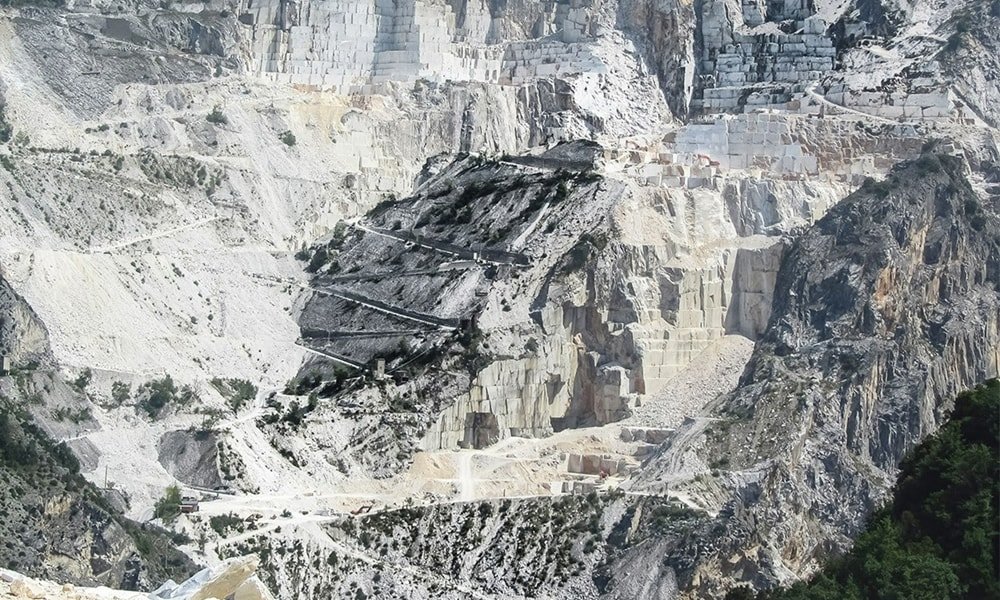
The Apuan Alps in Tuscany are the geological cradle of the world’s most famous white marble. Carrara is the regional name that includes many local varieties, while Calacatta and Statuario are trade names used to distinguish specific aesthetic and structural characteristics — Statuario is typically prized for its bright, cool white ground with refined, bold veins; Calacatta often carries broader, sometimes warmer veins and greater visual drama; Carrara is widely recognized for a softer, grayer background and more subtle veining. The cultural and historical cachet of these stones — Michelangelo famously selected Carrara blocks for sculpture — continues to feed their value on the international market.
Quarrying & block production: from mountain to block
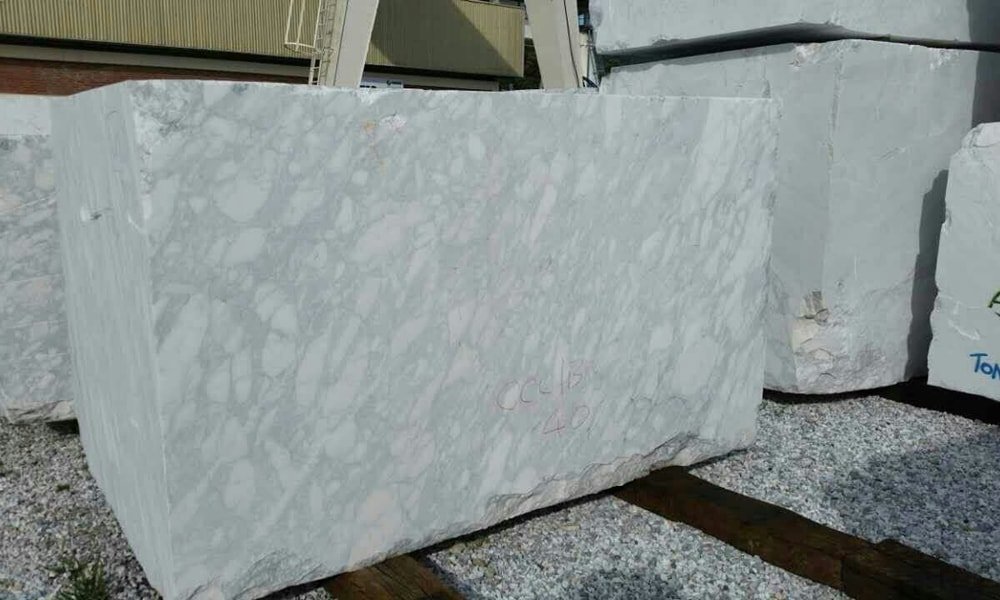
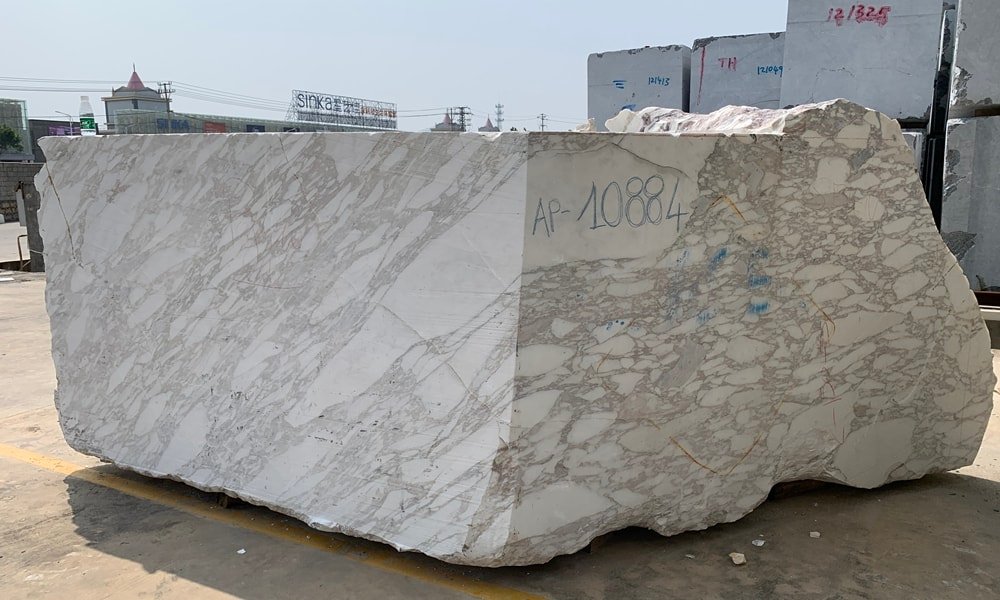
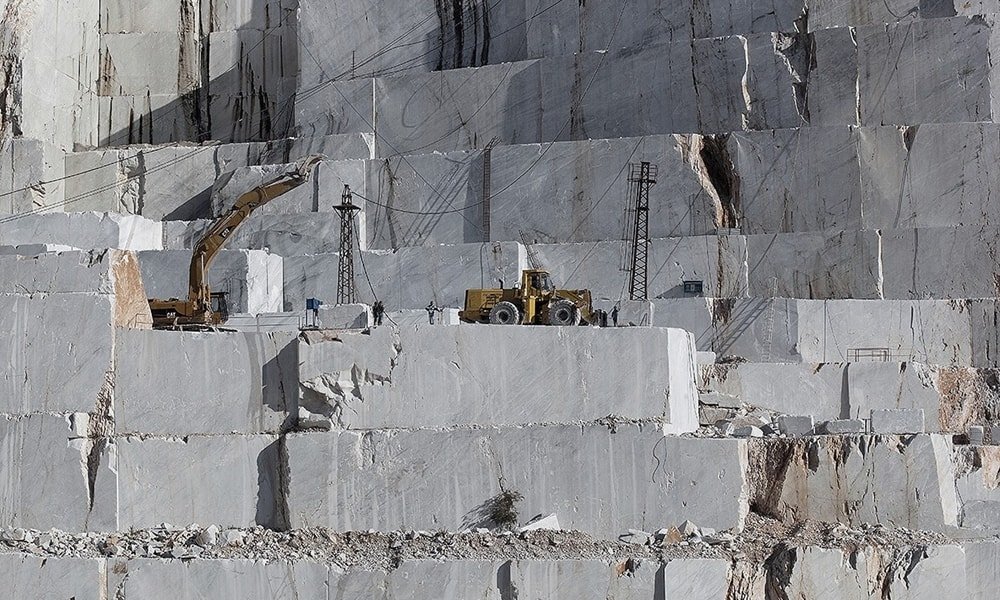
Quarrying in the Carrara region combines centuries-old skills with modern cutting technology. Blocks are typically extracted by diamond-wire and channel-saw techniques, then transported to yard stacks for preliminary grading. Typical large blocks can weigh several tons — the size and integrity of the block directly influence slab yield and the feasibility of bookmatching large panels. Recent trade reports indicate that the Carrara supply chain remains active and that exports from the region have shown notable strength in recent cycles, reflecting resilient international demand.
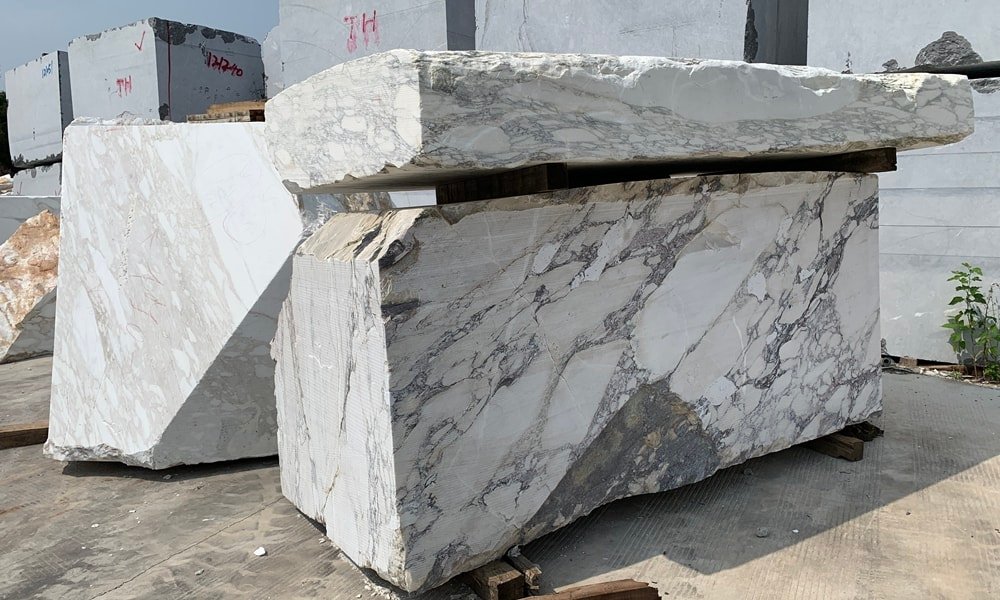
Quality at extraction is judged by several immediate flags: the ground color uniformity, the presence of micro- and macro-fissures, the continuity and orientation of veins, and the presence of inclusions or mineral stains that will affect slab aesthetics after polishing. Quarry managers grade blocks at source so buyers can select block classes (premium, A/B, commercial) according to project tolerance and budget.
Block grading & quality criteria: how Statuario, Calacatta, and Carrara are distinguished?
Procurers and fabricators use a combination of visual and technical criteria to place marble blocks into commercial grades.
Ground color and brightness: Statuario is often identified by a very bright, near-ice-white ground; Calacatta may read slightly warmer or creamier; Carrara tends to have a silvery-gray base.
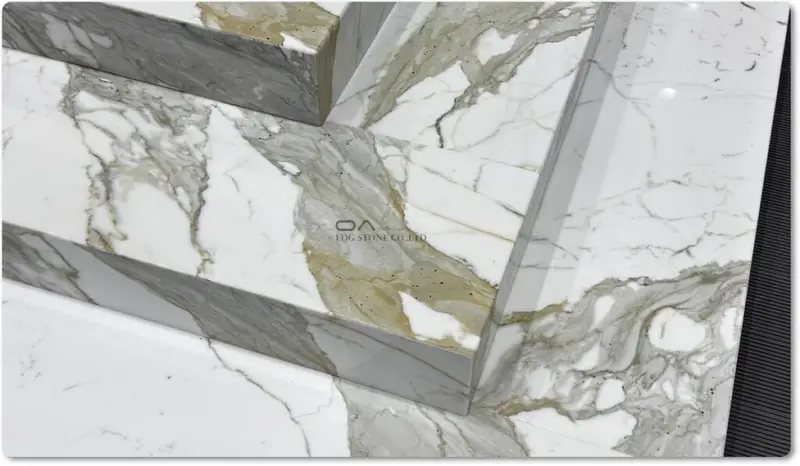
Veining character: Calacatta often shows wider, more dramatic veins in shades ranging from light to deep gray (sometimes with golden hues); Statuario’s veining can be bold but is generally more linear and monochromatic; Carrara displays finer, more dispersed veining.
Structural integrity: Blocks with pervasive micro-fissures or weakness planes are downgraded because they reduce slab yield and increase waste.
Rarity & selection: Some named Statuario varieties (and exceptional Calacatta blocks) are rare and command premium pricing due to limited block counts and high slab yield expectations.
These grading decisions are crucial to estimate block-to-slab yield accurately and to plan for book-matching or large-panel installations.
Processing and yield optimization at the factory
When a block arrives at a processing yard, the factory’s planning team applies software and hands-on expertise to orient the block for maximal usable slab yield. Key production considerations include:
Cutting technology: Diamond-wire cutting allows straighter, larger cuts and reduced kerf loss compared with older gang-saw methods; wire cutting improvements at modern yards have improved slab yield and reduced waste.
Slab thickness & purpose: Choice of slab thickness (typically 20 mm, 30 mm, or customized thickness) is guided by intended use — thin slabs for cladding and thicker slabs for countertops or heavy-duty surfaces.
Bookmatching strategy: For bookmatched panels, orientation and consistent veining across paired slabs is planned at the block stage — this reduces rework and ensures high visual continuity.
Waste minimization: Digital mapping of block flaws (vein mapping, fissure mapping) allows fabricators to position cuts to salvage premium areas and reduce unusable stone.
A skilled mill that uses modern cutting and planning tools can extract a higher yield from a given block; this capability is a competitive advantage for any manufacturer or factory. Recent industry showcases (trade fairs) underline the continuous adoption of advanced machinery that raises effective yield.
Comparative quality report: Statuario vs Calacatta vs Carrara
Below is a descriptive comparison to assist specification choices:
Statuario: Bright white ground, bold but refined gray veining, sought for sculptural applications and premium countertops. Often, the most valued in the Statuario “family” when veining and ground are ideal.
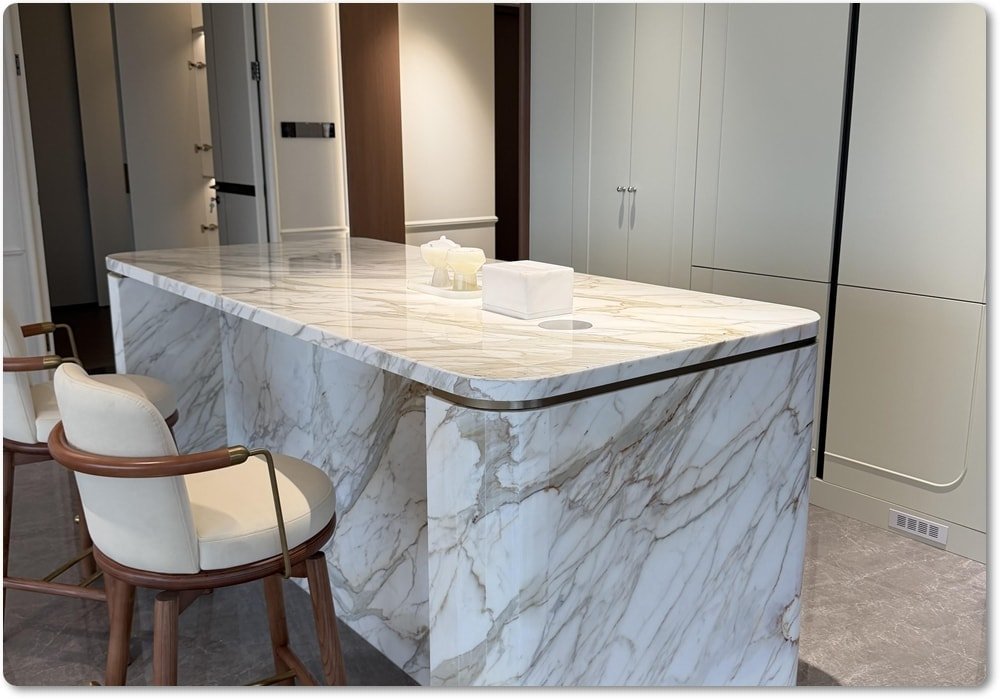
Calacatta: Creamier or warmer white background with larger, more variable veining; offers dramatic patterns suited for statement walls and luxury islands.
Carrara: Subtler, grayer ground with finer veining; excellent where a softer, classical look is desired and often more economical in typical grades.
Choose Statuario for crisp white elegance, Calacatta for bold, dramatic veining, and Carrara when a softer, traditional marble look is desired.
Market production & trade indicators: supply, demand, and pricing signals
Global market reports show steady demand for premium white marbles, driven by luxury residential, hospitality, and commercial fit-outs. The global marble market continues to expand, with market-research outputs projecting multi-year growth; Italian producers maintain a strong position for high-end supply and command premium export values for select white marbles. Recent reporting highlights robust export performance from the Carrara region, which remains a central supplier of white marble blocks to international markets.
Price drivers include block rarity, effective slab yield (blocks that produce more large, bookmatchable slabs fetch higher per-slab prices), transport and finishing costs, and the demand cycle in major importer regions. White Statuario and top-tier Calacatta slabs can carry substantial premiums in markets where authentic Italian origin and high visual quality are valued.
Sourcing & procurement: practical guidance for buyers and specifiers (EDG Stone context)
When sourcing premium Italian white marble, buyers should adopt a disciplined procurement checklist:
Block-level inspection: insist on current photos of the block in the quarry or yard, with vein mapping and defect notation.
Sample slabs and mockups: request cut slabs or full-size mockups to confirm color and veining under project lighting.
Mill documentation: obtain production records, slab IDs, and yield estimates.
Terms: negotiate MOQs, payment milestones linked to inspection, and return/acceptance terms for unacceptable slabs.
Manufacturers and factory-direct suppliers that provide transparent block-to-slab documentation reduce risk for design-led projects where color matching and bookmatching matter.
Fabrication & bookmatching best practices for premium marble
Successful large-panel installations depend on coordinated bookmatching and precise seam planning. Best practices include:
Pre-fabrication mockups: build a mockup to confirm veining flow across seams.
Tight tolerances: maintain flatness and thickness consistency to ensure seamless joints.
Reinforcement & backing: for thin or delicate panels, stabilize with appropriate backing or laminates to prevent cracking during handling.
Sealing & finishing: while marble is porous, recommended sealers and finishing protocols can protect against staining during installation.
Careful planning reduces on-site surprises and preserves the aesthetic intent created at the block selection stage.
Quality control: factory and on-site acceptance tests
QC should be both visual and technical:
Visual checks: color match, vein continuity, finish quality, visible fissures or inclusions.
Dimensional checks: slab thickness uniformity, straightness, and flatness tolerances.
Mechanical & moisture checks: simple moisture readings and, where required, non-destructive testing for delamination or internal weaknesses.
Provide buyers and installers with a photographic acceptance form and require slab ID labels to track batches through installation.
Sustainability, regulation & responsible sourcing — latest direction
Environmental pressure on quarrying activities has increased. Quarry operations are subject to local environmental regulations, and there is growing scrutiny on waste handling (slurry and sludge), water use, and landscape rehabilitation. Industry discussions at major stone events emphasize better waste management, traceability, and worker safety as urgent priorities. Buyers increasingly ask for evidence of responsible quarry management and transparent supply chains when awarding premium contracts.
Traceability and social responsibility might become procurement prerequisites in large institutional projects, and suppliers that can demonstrate rehabilitation plans, emissions control,s and documented worker-safety practices will have an advantage.
Price, value, and commercial comparison (per slab / per m² / per kg models)
Pricing for premium Italian white marbles varies widely by grade and provenance. While standard Carrara varieties are more accessible, rare Statuario and high-grade Calacatta slabs command higher per-slab prices because of rarity and yield. When comparing quotes, buyers should normalize pricing by:
Usable square meters per block (yield),
Finish and edge work included,
Shipping and customs,
Factory finishing tolerances and acceptance testing.
Strong procurement practice is to request a full landed-cost quote and an itemized breakdown so the cost drivers are transparent for negotiation.
Risk management: mitigating fissures, weathering, and long-term performance
High-value marble installations require proactive risk control:
Stabilization: resin injections and mechanical stabilization can secure fragile sections in slabs.
Seam placement: Avoid placing seams on visually critical veins or high-stress areas.
Insurance & warranty: insist on clear warranty language and consider installation-phase insurance for large or exposed panels.
Maintenance planning: define cleaning and maintenance protocols for clients to preserve marble appearance.
These steps protect investment and maintain the intended visual impact over decades.
Applications & design inspiration: where Italian icons truly shine?
These marbles are at home in:
Signature hotel lobbies — large bookmatched walls create memorable arrivals;
Luxury bathrooms — full-slab vanity walls and tub surrounds;
Custom furniture — waterfall islands and bespoke furnishings;
Architectural accents — stair treads, sculpted elements, and public art installations.
Design teams planning dramatic slab-scale installations should plan for slab availability early and secure blocks that match the visual narrative required.
Practical buyer tools: RFQ checklist and sample acceptance form (brief)
RFQ checklist highlights:
Block photos and IDs, yield estimates, intended slab thickness, finish type, lead time, shipping terms, warranty, and QC documentation.
Sample acceptance items:
Slab ID verified, visual match under site lighting, thickness and flatness tolerance met, finish quality approved, no critical fissures evident.
Use these forms to standardize procurement across projects and suppliers.
FAQ — top 5 Google hot-search questions
Q1: What’s the difference between Statuario and Calacatta marble?
A: Statuario typically displays a very bright, cool white ground with refined gray veins and is prized for sculptural clarity; Calacatta tends to offer a warmer or creamier white with larger, more dramatic veining. Both come from the Carrara region but are traded under different visual and quality expectations.
Q2: How do I verify the authenticity and quality of a Statuario block?
A: Require quarry or yard photos of the block, vein-mapping, mill test records, and a slab mockup. Authentic high-grade Statuario will show consistent bright ground color and clean, well-defined veins without pervasive micro-fissures.
Q3: Are Carrara marbles environmentally regulated?
A: Quarrying in Italy is subject to regional environmental regulations, and there is increasing attention to quarry waste, water management, and site rehabilitation; major buyers now ask suppliers for documentation of environmental and safety practices.
Q4: How much does White Statuario marble cost?
A: Prices vary by grade and slab yield; premium Statuario slabs command substantial premiums compared with standard Carrara varieties. Buyers should expect price differentials tied to slab rarity, finish, and yield — always ask suppliers for detailed per-slab or per-m² pricing and include finishing costs.
Q5: How can manufacturers maximize slab yield from a single block?
A: Adopt modern wire- or gang-saw planning, map veins digitally to orient cuts, apply tight QA controls in the mill, and plan bookmatching at the block stage to minimize unusable waste.
Semantic Closure: How / Why / What / Options / Considerations
Why: These Italian white marbles command premium status because of their unique visual fields, historical prestige, and rarity of high-yield blocks suitable for large-scale bookmatching and panel work. Buyers pay for visual continuity and certainty.
What (Options): Options include selecting higher-yield premium blocks for large bookmatched walls, choosing slightly lower-grade Carrara for cost-conscious projects, or using calibrated slabs (various thicknesses and finishes) for differing design intents.
Considerations: Prioritize block photos and vein maps, insist on sample slabs and mockups, require mill QA reporting, and confirm environmental and quarry-rehabilitation practices when sustainability matters. Expect price and availability to fluctuate with global demand and local quarry production cycles.
Trend & Regulation Snapshot: Trade fairs and industry reporting show steady demand and technology-driven yield gains, while environmental scrutiny and waste-management expectations increase obligations for quarry operators and international buyers.