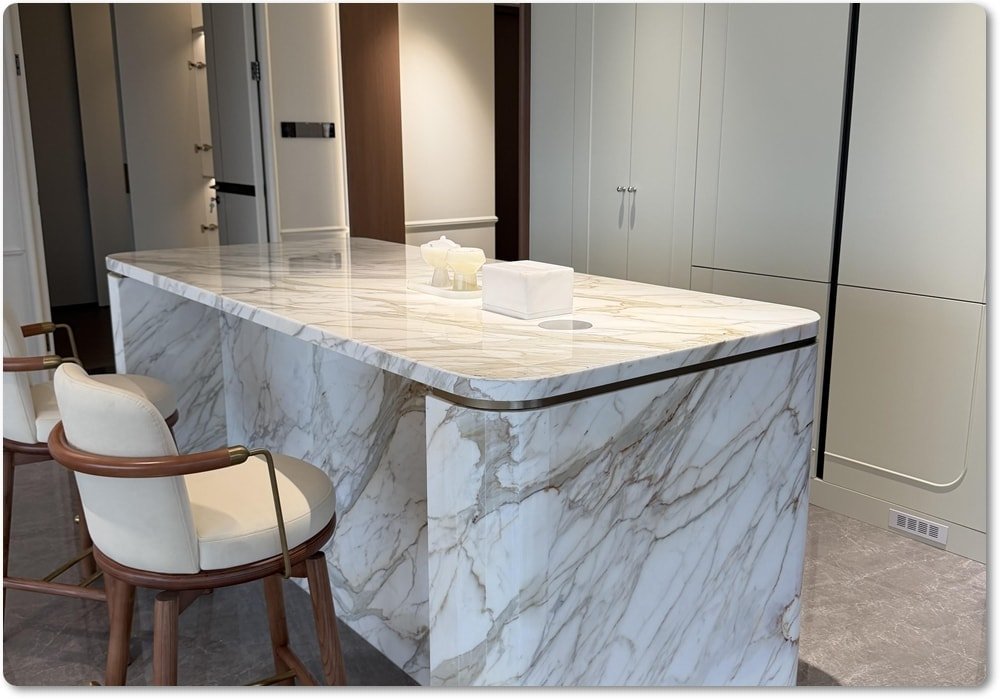
Reordered Whitepaper Architecture
Executive Summary
Quartzite is a natural dimension stone product quarried and processed into slabs that meet size, shape, finish, durability, strength, and polish requirements. That makes it a highly relevant material for premium countertops, but also one that demands disciplined fabrication and installation. In practice, the strongest quartzite projects are not won by appearance alone; they are won by correct slab selection, controlled cutting and polishing, proper support design, accurate templating, careful seam planning, and maintenance instructions that match the stone’s actual behavior in service.
1. Understanding Quartzite as a Countertop Material
What is Quartzite?
Quartzite belongs to the quartz-based stone family. The 2024 DSDM groups quartzite with other quartz-based materials and treats it as a stone type with its own standards, finish descriptions, geological and petrographic characteristics, and physical/mechanical-property considerations. This matters because quartzite should not be handled as a generic “hard stone” with one universal fabrication recipe. It must be evaluated by structure, soundness, thickness, finish, and the intended use case.
Why It Is Specified?
USGS defines dimension stone as natural rock quarried into blocks or slabs that meet size and shape requirements, with color, texture, finish, durability, strength, and polishability all acting as normal selection criteria. Quartzite is often selected because it can deliver a premium natural-stone look with strong visual movement, but the real specification decision should be based on whether the slab can satisfy the project’s mechanical, aesthetic, and maintenance requirements together.
2. Material Selection and Pre-Fabrication Evaluation
Slab Selection Criteria
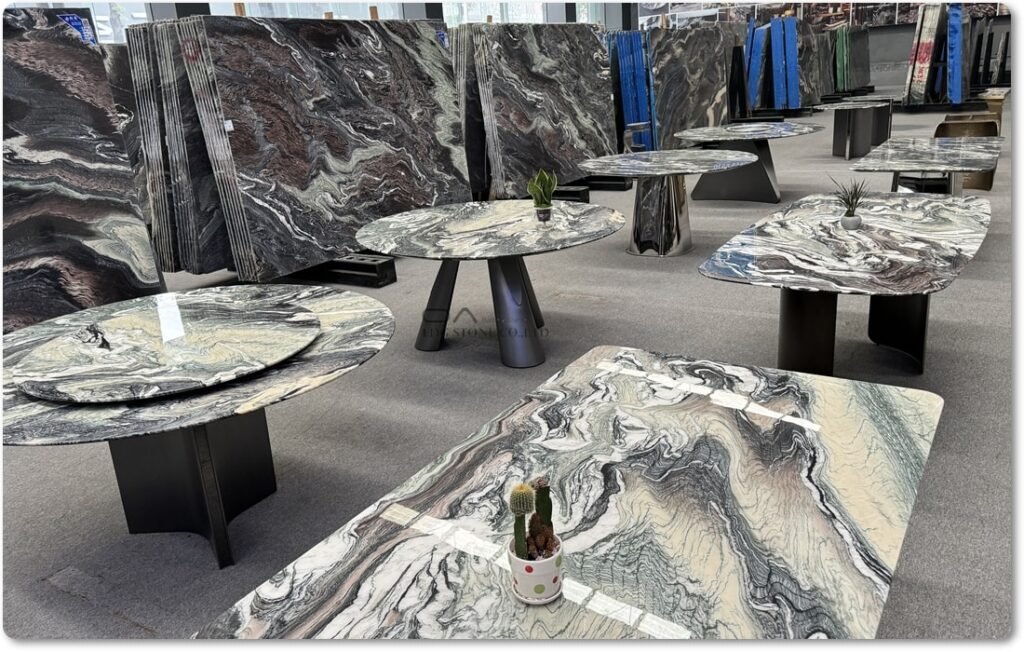
The selection stage should start with the actual project geometry, not the sample board. Review slab thickness, background uniformity, veining continuity, natural fissures, resin-filled areas, finish consistency, and expected bookmatching or seam behavior. The DSDM’s quartz-based chapter and countertop chapter both support this “application-first” logic by tying stone choice to standards, physical properties, reinforcements, seams, tolerances, and repairs.
Safety and Fabrication Readiness
Quartzite fabrication can generate respirable crystalline silica dust, so fabrication planning must include engineered controls, not just PPE. CDC/NIOSH recommends verifying silica content through SDSs, avoiding dry operations where possible, using wet methods, local exhaust ventilation, remote-controlled or water-spraying equipment where feasible, wet sweeping rather than dry sweeping, and respirators when engineering and administrative controls are not sufficient.
3. Fabrication Best Practices
Cutting
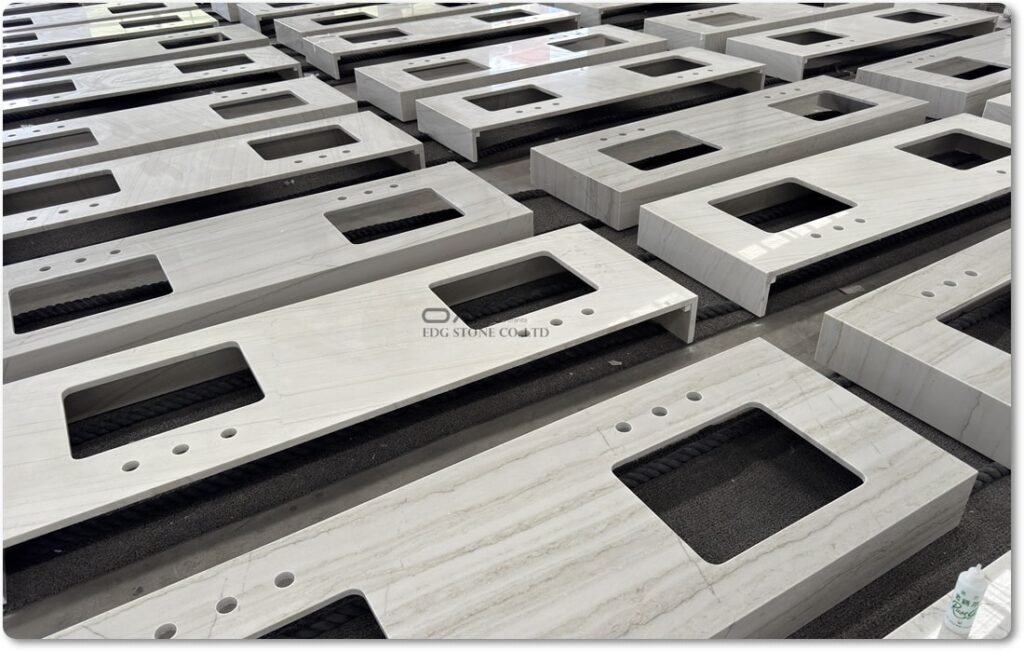
Cutting should be planned around slab integrity, edge quality, and dust control. Wet cutting and water-fed systems reduce exposure compared with dry methods, and NIOSH documents show that switching from dry to wet methods can dramatically reduce exposure levels in countertop shops. For high-value quartzite, the best fabrication shops combine controlled cutting with pre-wash, dust capture, and task-specific tooling rather than relying on post-process correction.
Polishing
Polishing should preserve edge fidelity and surface consistency without overheating or chipping the stone. NIOSH notes that handheld grinders and polishers are high-exposure tasks if unmanaged, and that combining wetting with local exhaust ventilation and correct tool setup materially lowers exposure risk. In a whitepaper context, this section should emphasize process discipline: staged grit progression, operator consistency, and final inspection under controlled lighting.
Edge Profiling
Edge profiling must be matched to slab thickness, use intensity, and overhang conditions. The Natural Stone Institute’s installation standards explicitly include seam placement, rodding sink cutouts, overhangs and cantilevers, joint widths, and tolerances; those same concerns belong in fabrication because edge detail affects both appearance and structural behavior. A simple rule: the more exposed the edge, the more the profile should be selected for durability and reduced chipping risk.

4. Countertop Engineering
Support Requirements
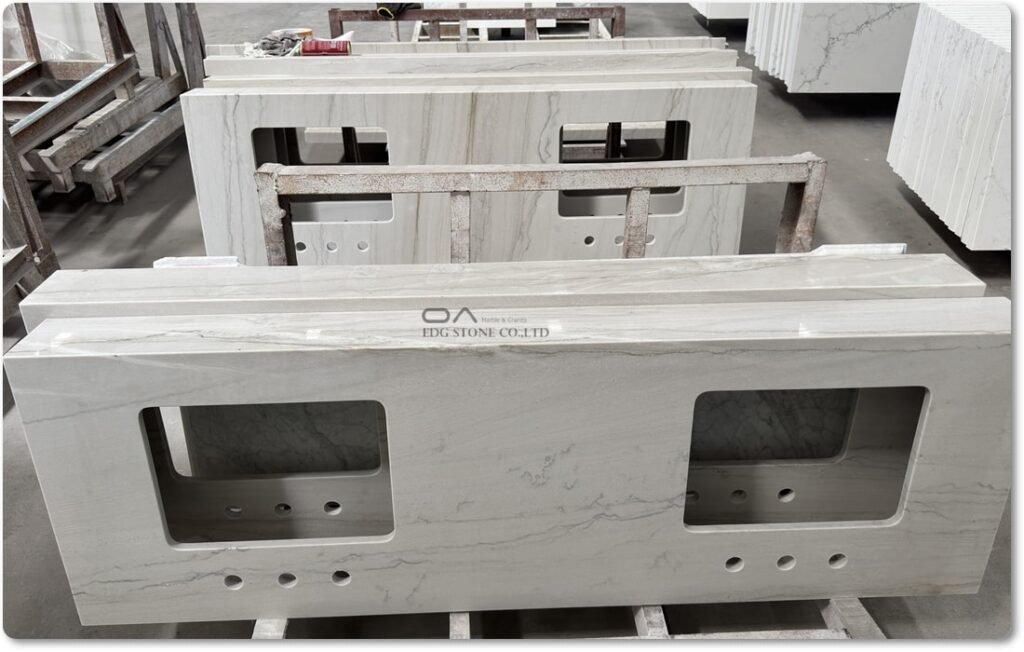
Support design should never be guesswork. The DSDM countertop chapter addresses cabinet and substrate requirements, allowable spans and cantilevers, sink mounts, seams, tolerances, reinforcements, and repairs, which is exactly the technical foundation a quartzite countertop should follow. Where the stone spans a cabinet opening, bridges a cooktop, or extends into a bar overhang, the support strategy should be engineered to the actual project geometry and not copied from a generic detail.
Overhang Calculations
Overhangs should be treated as a structural condition, not only a design preference. The installation standards explicitly call out overhangs and cantilevers, which means overhang length, stone thickness, substrate stiffness, and support type all need to be reviewed together. For a premium quartzite island or bar, the right answer is rarely “maximum overhang”; it is “adequate support for the intended load and use.”
Waterfall Construction
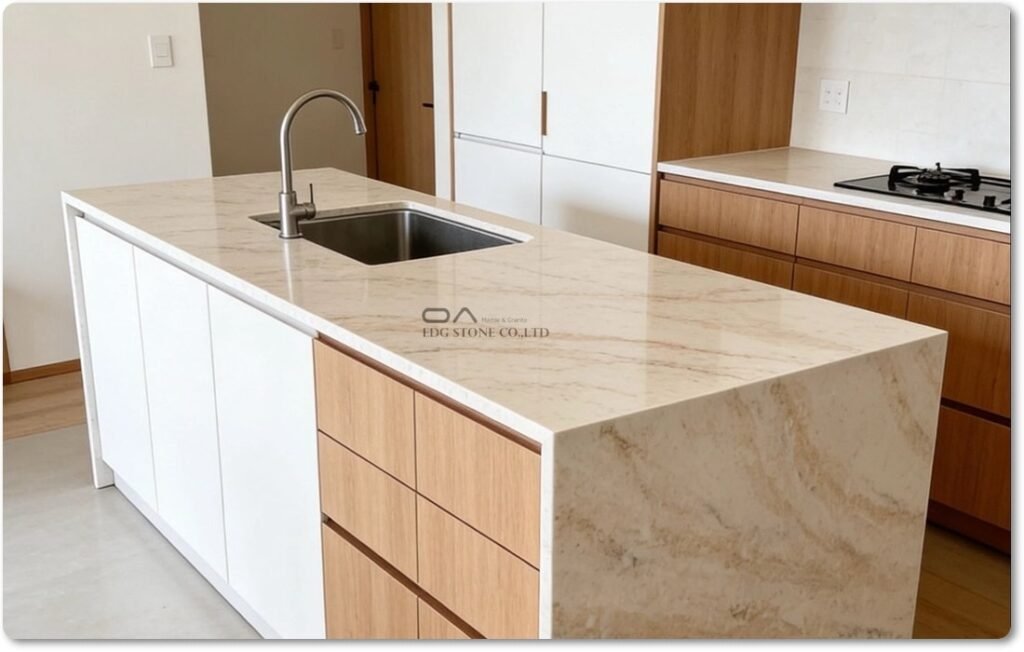
Waterfall constructions place extra stress on mitering, alignment, and edge protection because the visual joint becomes a structural and aesthetic focal point. The engineering mindset should be to treat the waterfall as a continuous architectural detail, requiring precise templating, consistent grain direction, and reinforced handling during transport and installation. The DSDM’s emphasis on reinforcements, tolerances, and repairs supports this detail-driven approach.
5. Installation Standards
Site Measurement and Templating
NIOSH explicitly recommends doing as much work as possible under controlled shop conditions, using laser measurement, and using mock models and templates so installation can proceed without onsite finishing whenever possible. That is a major best-practice principle for quartzite because every hour spent reworking stone on site increases dust, risk, and quality variation. Accurate templating also improves seam planning, sink fit, and backsplash integration.
Seam Placement
Seam placement is both a visual and structural decision. The Natural Stone Institute identifies seam placement as a core installation standard topic, and the DSDM countertop chapter includes seams, tolerances, and customer communication within its technical scope. Good seam placement minimizes stress concentration, avoids visually distracting transitions, and respects the slab’s veining and natural movement.
Cabinet and Substrate Preparation
A quartzite countertop is only as stable as the structure beneath it. The stone should be installed on prepared, level, and sufficiently rigid supports, with the substrate condition verified before setting. This is one of the reasons the DSDM treats cabinet and substrate requirements as part of the countertop chapter rather than as an afterthought.
6. Long-Term Maintenance
Sealing
Sealing should be presented honestly: it is not a substitute for good fabrication or proper cleaning. The Natural Stone Institute’s Care & Cleaning brochure includes general information about sealing, stain identification, and stain removal. The correct recommendation is to use sealing only where needed for the specific stone, finish, and end-use conditions, and to confirm the chemistry with the fabricator or manufacturer rather than assuming one sealer fits all quartzite.
Cleaning
Maintenance instructions should use neutral, stone-safe guidance and avoid harsh habits that damage finishes over time. The Natural Stone Institute’s care materials are designed to extend the life and preserve the beauty of natural stone, which is the right framing for a commercial whitepaper: regular, gentle cleaning preserves appearance better than aggressive correction later.
Repair
Repair planning should be included before installation begins. The DSDM countertop chapter and restoration chapter both address repairs, reinforcements, sealers, and troubleshooting, which is a reminder that a premium quartzite project needs an aftercare pathway, not just a handoff. Document chip repair, seam repair, stain response, and the conditions under which restoration should be escalated to a professional.
7. EDG Stone Factory Module
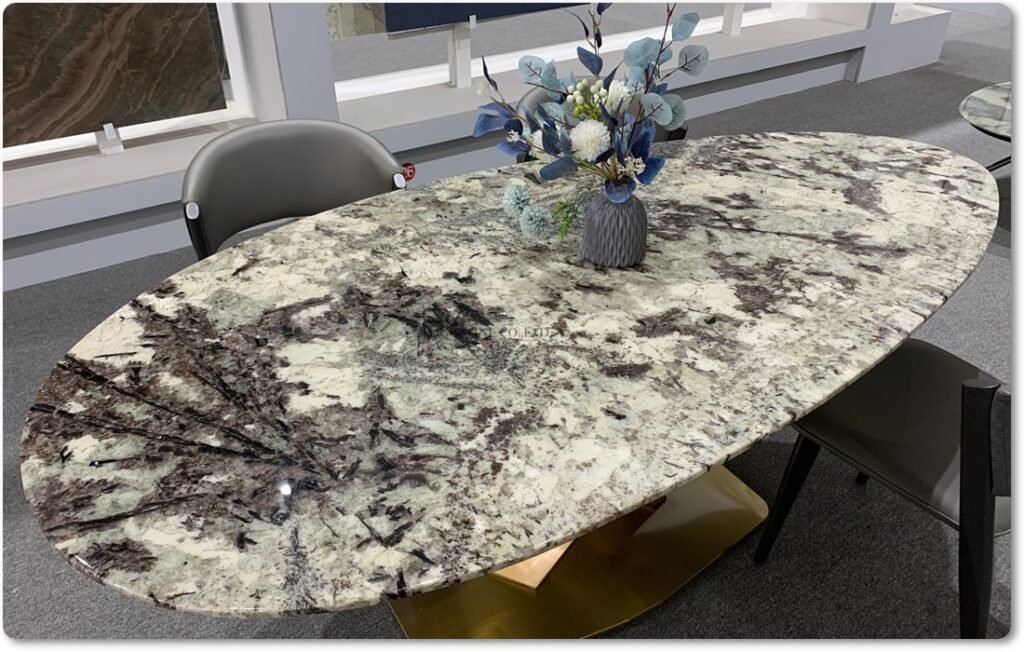
EDG Stone Factory can be positioned in the whitepaper as the practical implementation example for the global quartzite slabs and countertops supply. The case module should show how a manufacturer/exporter translates the technical principles above into real production discipline: slab selection, controlled fabrication, reinforcement decisions, export-safe packing, project coordination, and installation support. Because the page is intended to be rigorous, the case module should use only verified internal facts approved by your team and avoid unsupported claims or marketing numbers. That keeps the page credible, conversion-focused, and consistent with Google’s people-first content guidance.
15-Article Internal Link Matrix
- Quartzite Slabs Buying Guide for Luxury Projects
Primary keyword: quartzite slabs buying guide
Link to: selection criteria, slab grading, procurement checklist - How to Evaluate Quartzite Slab Quality Before Ordering
Primary keyword: quartzite slab quality evaluation
Link to: slab inspection, fissures, resin fill, finish quality - Quartzite Countertops vs Marble vs Granite
Primary keyword: quartzite vs marble vs granite
Link to: material comparison, application suitability - Quartzite Fabrication Process Explained
Primary keyword: quartzite fabrication process
Link to: cutting, polishing, profiling, QC - Quartzite Overhangs and Cantilever Support Guide
Primary keyword: quartzite overhang support
Link to: engineering, brackets, substrate prep - Quartzite Waterfall Island Design Guide
Primary keyword: quartzite waterfall countertop
Link to: mitering, grain matching, transport - Quartzite Seam Placement Best Practices
Primary keyword: quartzite seam placement
Link to: templating, visual alignment, stress management - Quartzite Countertop Installation Checklist
Primary keyword: quartzite countertop installation
Link to: site measurement, substrate, leveling, set-out - Quartzite Countertop Maintenance and Cleaning
Primary keyword: quartzite countertop maintenance
Link to: sealing, cleaning, repair - Quartzite Countertop Repair and Restoration
Primary keyword: quartzite countertop repair
Link to: chips, seams, etch-like issues, restoration scope - Quartzite for Kitchen Islands and Waterfalls
Primary keyword: quartzite kitchen island
Link to: application scenarios - Quartzite for Luxury Bathrooms and Vanities
Primary keyword: quartzite bathroom vanity top
Link to: wet-area use, sealing, edge details - Quartzite for Hotel and Hospitality Projects
Primary keyword: quartzite hospitality countertops
Link to: large-volume specification and consistency - Quartzite Export Packaging and Shipping Guide
Primary keyword: quartzite export packaging
Link to: crating, loading, breakage prevention - EDG Stone Factory Quartzite Slabs and Countertops Case Study
Primary keyword: quartzite manufacturer exporter
Authority Source Base for the Whitepaper
The following sources are strong enough to anchor the technical sections and keep the copy defensible:
- Google Search Central: people-first content guidance.
- Google Search Central: SEO Starter Guide.
- Google Search Central: structured data general guidelines.
- Google Search Central: FAQ structured data documentation.
- Schema.org FAQPage reference.
- USGS: Dimension Stone Statistics and Information.
- USGS: Dimension stone production and market statistics.
- Natural Stone Institute: Installation Standards.
- Natural Stone Institute: DSDM 2024 overview.
- Natural Stone Institute: Quartz-Based Stones chapter.
- Natural Stone Institute: Safety in the Stone Business.
- Natural Stone Institute: Care & Cleaning of Natural Stone.
- CDC/NIOSH: worker exposure to silica during countertop manufacturing, finishing, and installation.
- CDC/NIOSH: silica hazards from countertop fabrication.