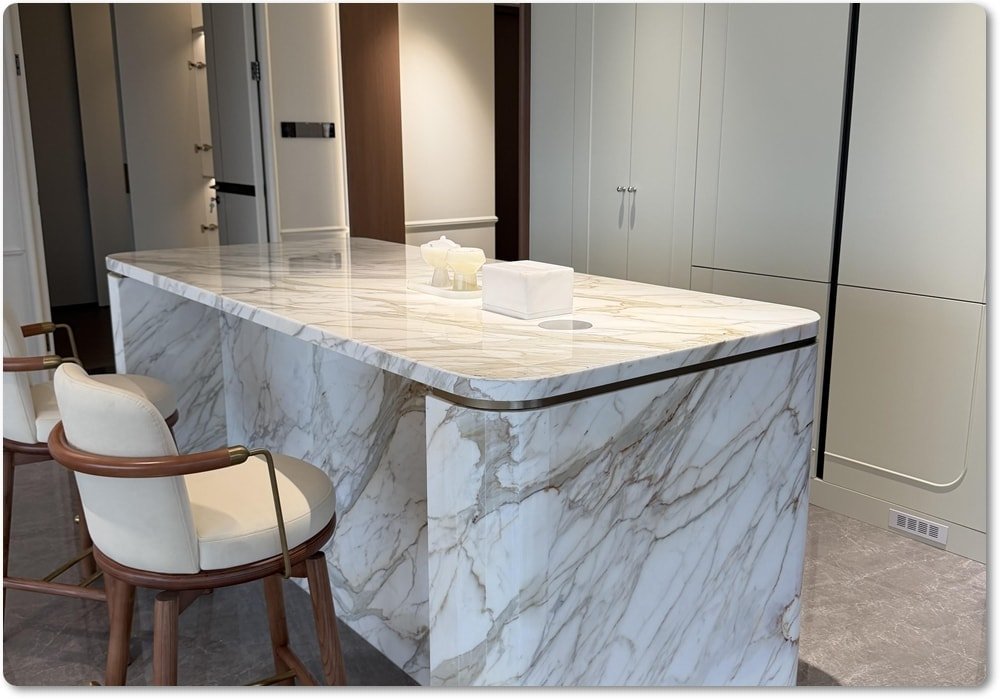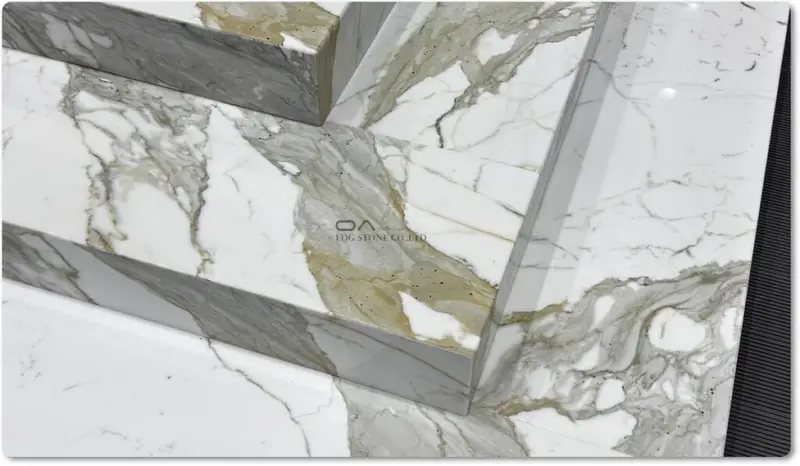
Introduction
Green quartzite has become one of the most visually distinctive natural stone choices in luxury residential, hospitality, and architectural feature applications. For procurement teams, however, “green quartzite” is not a single standardized material. It is a commercial category that may include multiple quarry origins, multiple mineral signatures, and substantial batch-to-batch variation. Quartzite itself is a quartz-rich metamorphic stone formed when sandstone undergoes heat and pressure, and the stone industry has long emphasized that quartzite is often inconsistently labeled in the marketplace, which makes testing and source verification essential. ASTM also treats quartz-based dimension stone as a specifiable category with defined physical-property testing pathways, reinforcing the need for a procurement-led, not marketing-led, buying process.
For buyers, designers, fabricators, and exporters, the commercial question is not simply “Is it beautiful?” but “Can this slab family be controlled across color, performance, lead time, and project scale?” This whitepaper reorganizes green quartzite procurement from the ground up: geology first, taxonomy second, then inspection, matching, end-use suitability, risk control, and commercial execution. The goal is to help projects move from inspiration to repeatable specification with fewer surprises.
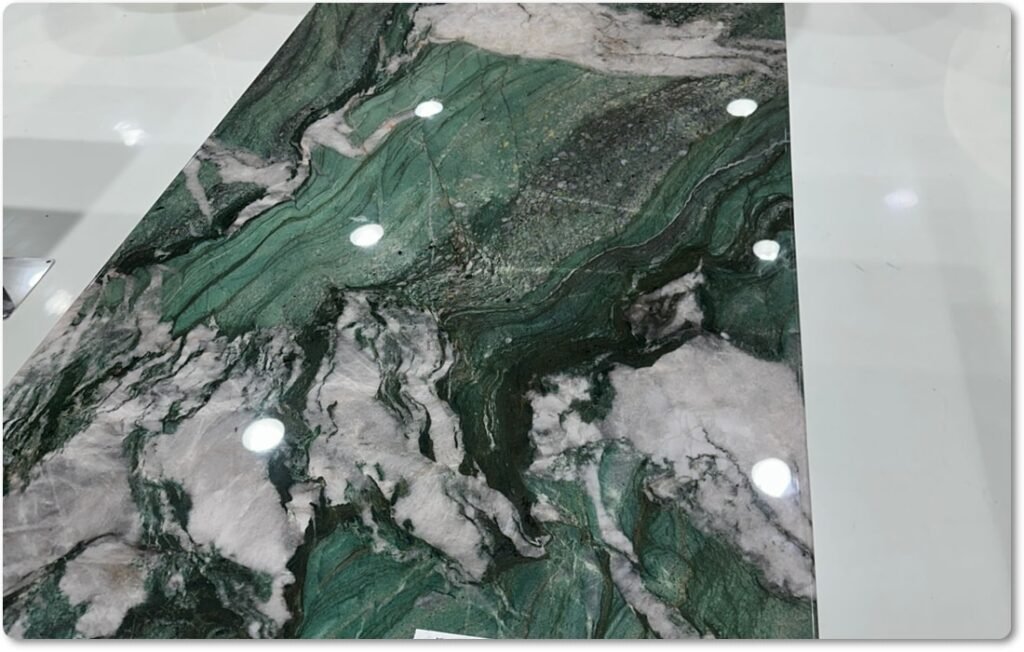
1. The Rise of Green Natural Stone Design
Green natural stone has benefited from a broader shift toward biophilic interiors, tactile materiality, and high-contrast luxury palettes. In that context, green quartzite stands out because it combines strong visual movement with the practical advantages commonly associated with quartz-rich dimension stone. The Natural Stone Institute describes quartzite as a metamorphic rock formed from sandstone and notes that it can offer exceptional strength, density, and hardness, with abrasion resistance and weathering durability that expand its use across common natural-stone applications.
For procurement, the implication is straightforward: green quartzite is attractive not only because it looks premium, but because it can be a rational specification choice when the right material is selected for the right exposure, finish, and fabrication method. The challenge is that the same category also carries wide geological and trade variability, so visual approval alone is not enough.
2. What Green Quartzite Actually Is?
Quartzite begins as sandstone and transforms under heat and pressure into a denser metamorphic rock. The Natural Stone Institute’s description, together with geological sources, supports the core point: quartzite is not engineered stone, not quartz composite, and not a simple decorative label. It is a rock type whose performance is tied to its mineral fabric, recrystallization, and accessory mineral content.
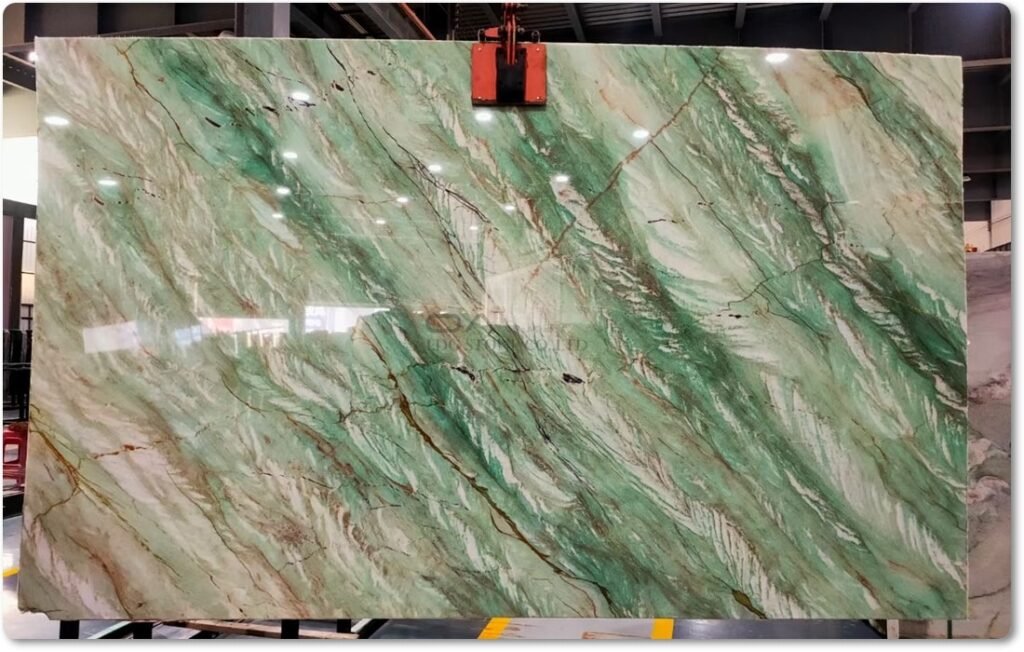
Green coloration in quartzite is usually a mineralogical story, not a dye story. Geological references show that green quartzite may owe its color to chromium-bearing mica such as fuchsite/chromian muscovite, chlorite, or related accessory minerals; exact causes vary by deposit and should be confirmed by petrography or supplier documentation rather than assumed from appearance alone. In other words, “green” is a visual outcome, not a guarantee of a specific composition.
This distinction matters because the project team is buying a geological material with a trade name attached to it. The Natural Stone Institute has explicitly warned that quartzite can be confusing in the marketplace, and ASTM’s quartz-based dimension stone category exists precisely because selection should be based on material characteristics and physical requirements, not names alone.
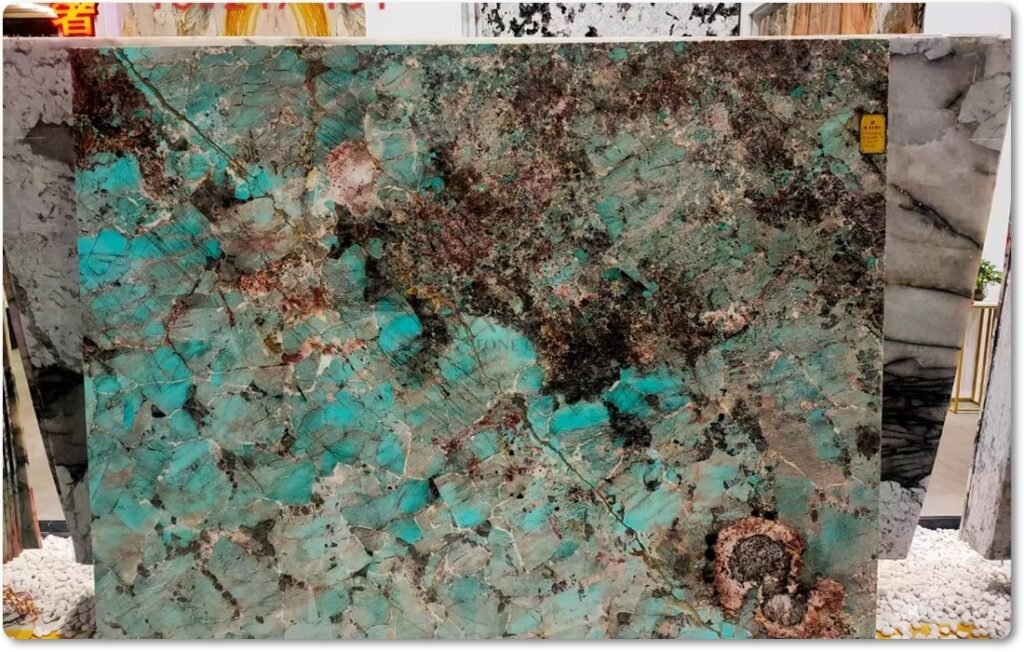
3. Popular Green Quartzite Categories: How to Read the Market?
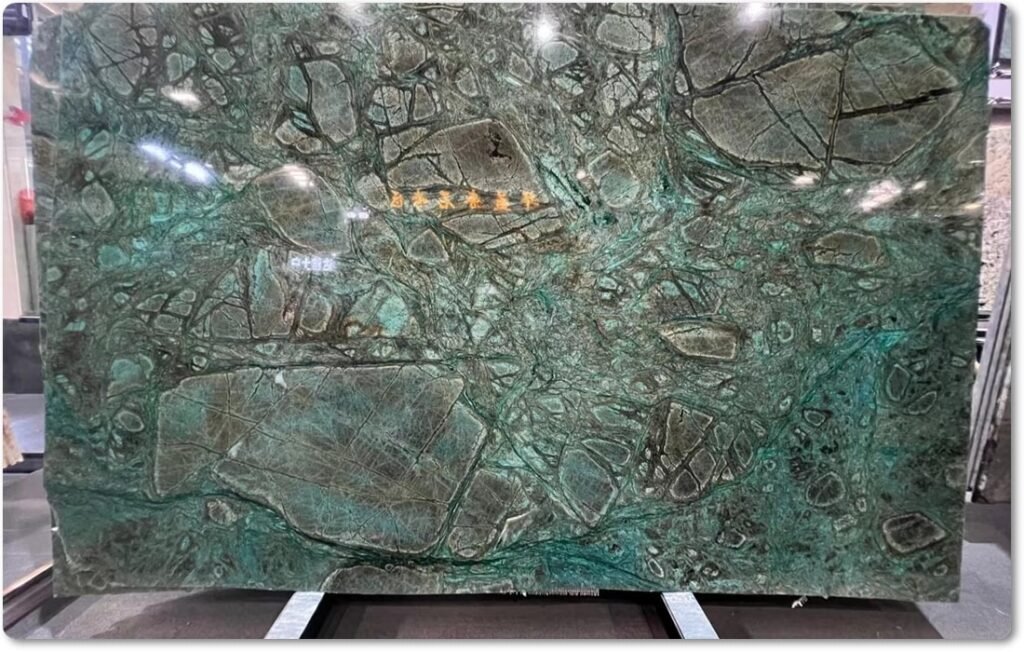
In commercial practice, names such as Emerald Green Quartzite, Fusion Green Quartzite, Avocatus Quartzite, and Amazonite Quartzite are best treated as trade names or marketing families rather than universal mineralogical standards. Because quartzite labeling can be inconsistent, the same trade name can vary by quarry, lot, or distributor, and even visually similar slabs may differ meaningfully in mineral composition, background tone, and structural movement.
For procurement teams, this means each green quartzite family should be reviewed through the same four filters:
1) Origin control — identify quarry, block source, and lot history.
2) Visual control — approve slab photos, bookmatch potential, and movement scale.
3) Technical control — request test data and a petrographic description where available.
4) Batch control — confirm how much matched material is realistically available for the project.
A useful buyer rule is this: the more exotic the visual pattern, the more important the documentation. For green quartzite, aesthetic rarity often correlates with a higher risk of variation, so the specification package must be stronger, not weaker. That is especially true when a single project requires many slabs, multiple containers, or repeated production over time. This is procurement logic derived from the known variability of natural stone and the labeling confusion documented by the Natural Stone Institute.
4. Geological Characteristics Buyers Should Care About
Color Formation
Green coloration may come from chromium-bearing mica, chlorite, or other accessory minerals. Because the exact mechanism depends on the deposit, buyers should not assume that two stones with similar green tones will behave the same under fabrication, sealing, or long-term service. Petrographic verification is the defensible way to separate visual similarity from material equivalence.
Structural Features
Quartzite is valued because recrystallization can produce a dense, durable fabric, but that does not eliminate natural variability. Grain interlock, microfractures, mineral bands, and local inclusions can affect cutting behavior, edge stability, and seam visibility. ASTM’s dimension-stone test framework exists because compressive strength, flexural strength, absorption, and abrasion resistance need to be measured rather than inferred from appearance.
What does this mean in Practice?
A slab that looks visually consistent may still behave differently under sink cutouts, miters, cantilevers, or exterior exposure. That is why the procurement team should treat every green quartzite order as a project-specific engineering decision, not a catalog purchase.
5. Procurement Challenges and How to Manage Them
Color Consistency
Green quartzite often wins the project on first impression and loses it later if the installed surface shows tonal jumps between slabs, or between the first container and the second. The practical fix is a tight approval loop: master sample, slab photos, lot tagging, and final slab sign-off before packing. This is a best-practice response to the labeling and variability concerns documented by the Natural Stone Institute.
Inventory Availability
Exotic quartzite is often sourced in smaller, less predictable runs than standard granite or common white quartzite. Buyers should therefore define the required footage, slab count, and match tolerance early, then ask the supplier to confirm whether the project should be fulfilled from one lot, one block family, or multiple synchronized lots. The more specific the requirement, the less likely the project is to fail at the container stage. This is procurement reasoning based on the way natural stone is supplied and specified.
Matching Multiple Containers
When a project crosses more than one container, the team should expect variation unless a matching strategy is built into the order. That strategy usually includes block reservation, sequential slab selection, and explicit approval of acceptable veining drift. For high-end hospitality and residential work, the tolerance should be written down before production begins.
Commercial Decision Rule
If the stone will be used in a large uninterrupted plane, prioritize consistency and repeatability. If the stone is used in smaller visual moments, such as feature walls or furniture tops, visual drama may outweigh uniformity. This is the core procurement tradeoff in green quartzite.
6. Best Applications by Scenario
Luxury Residences
Green quartzite is often strongest in kitchens, statement islands, bar counters, and primary bathroom vanities where the project wants a natural, high-value focal point. The stone’s visual depth can create a stronger design narrative than a flat or repetitive material, provided the slab set is carefully matched. Quartzite’s documented durability profile supports its role in common building and interior applications when properly specified.
Hospitality Projects
Hotels, private clubs, and branded residences often need stones that read as memorable at a distance and refined up close. Green quartzite can work well for reception desks, lobby features, and fireplace surrounds because it delivers a premium look without relying on artificial patterning. For procurement, the key is to balance aesthetics with maintainability and standardized fabrication.
Feature Walls
Vertical applications are a natural fit when the stone has strong movement and distinctive color zoning. Feature walls benefit from bookmatching, vein-flow direction, and lighting design, all of which need to be coordinated before slab cutting begins. ASTM and NSI guidance support the broader principle that stone selection and installation details should be coordinated early, not left for site improvisation.
Furniture and Bespoke Objects
Green quartzite also performs well in tables, console tops, reception furniture, and decorative surfaces where the goal is to showcase slab character. These applications reward strong visual direction and penalize inconsistent lot control, so preproduction approval is essential.
7. Quality Inspection Standards That Actually Matter
For a procurement-grade project, the quality review should be built around measurable properties and fabrication realities rather than subjective beauty alone. ASTM’s quartz-based dimension stone specification points buyers toward material characteristics, physical requirements, and sampling; related test methods cover absorption and bulk specific gravity, compressive strength, flexural strength, and abrasion resistance. The Natural Stone Institute also highlights installation standards that address seams, overhangs, cantilevers, joint widths, and tolerances.
Surface Integrity
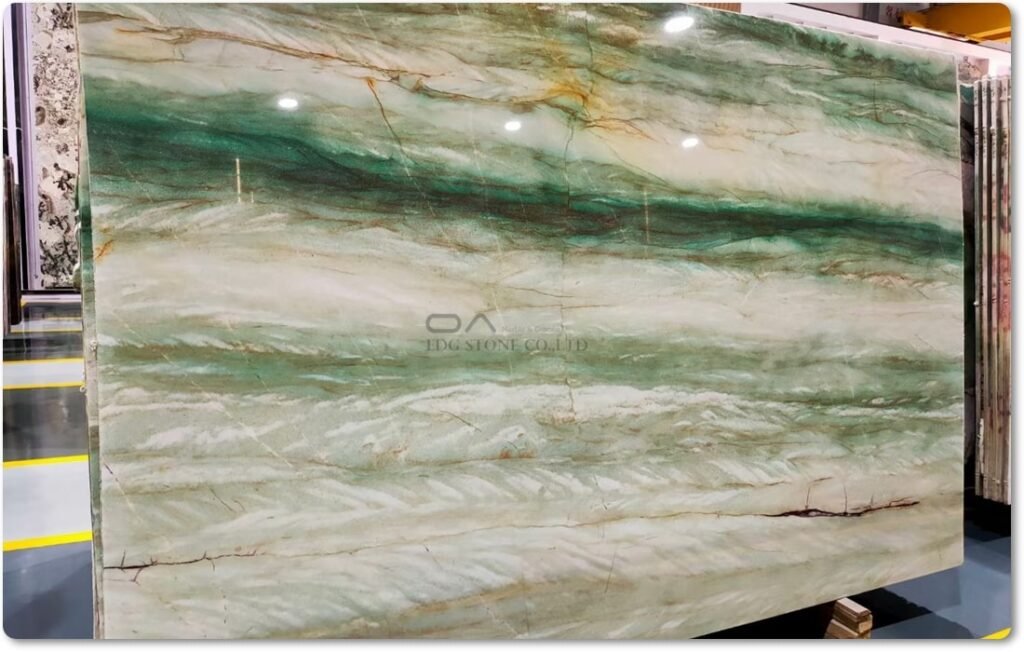
Inspect for open pits, resin concentration, fill inconsistencies, microcracks, and surface defects that may affect fabrication or in-service performance. In green quartzite, visually dramatic movement can hide local discontinuities, so bright, raking light inspection is important. That is a practical extension of dimensional-stone testing and selection logic.
Vein Movement
The buyer should define whether the project wants continuous vein flow, rhythmic movement, or a more uniform field. A slab family can look impressive in a warehouse and still fail in a bookmatched installation if the movement cannot align across panels. That is why slab mapping matters.
Reinforcement Requirements
Where the design includes thin returns, miters, sink cutouts, large spans, or cantilevers, the fabrication package should include reinforcement logic consistent with project engineering and stone standards. Natural Stone Institute installation guidance specifically addresses overhangs, cantilevers, rodding sink cutouts, and tolerances.
8. Safety, Silica, and Fabrication Compliance
Quartzite is a quartz-rich stone, and cutting, grinding, or polishing stone that contains crystalline silica creates occupational safety obligations. OSHA’s respirable crystalline silica standard sets an action level of 25 μg/m³ as an 8-hour TWA and a permissible exposure limit of 50 μg/m³ as an 8-hour TWA for covered work. OSHA and NIOSH also continue to warn about silica risks in countertop fabrication and installation, including serious respiratory disease risks from exposure.
For a procurement document, this should translate into supplier qualification questions: What dust controls are in place? Are wet-cutting and local exhaust systems used? Are workers trained? Are compliance records maintained? The buyer does not need to run the shop, but the buyer does need to avoid rewarding unsafe capacity with an order. This is especially important in countertop fabrication workflows.
9. Sustainability and Documentation
Natural stone’s sustainability case is strongest when buyers can trace quarrying, fabrication, and environmental disclosure. The Natural Stone Institute states that its sustainability resources include embodied-carbon guidance, and it has published industry-wide Environmental Product Declarations for cladding, flooring/paving, and countertops. It also describes ANSI/NSI 373 as a sustainability standard for natural dimension stone production.
For green quartzite procurement, that means sustainability should be documented, not asserted. Ask for quarry-source transparency, EPD support where available, and production practices that can be audited. This is increasingly valuable for hospitality groups, developers, and designers who need material disclosure alongside aesthetics.
10. EDG Stone Factory Case Module
EDG Stone Factory | Global Quartzite Slabs & Countertops Manufacturer and Exporter
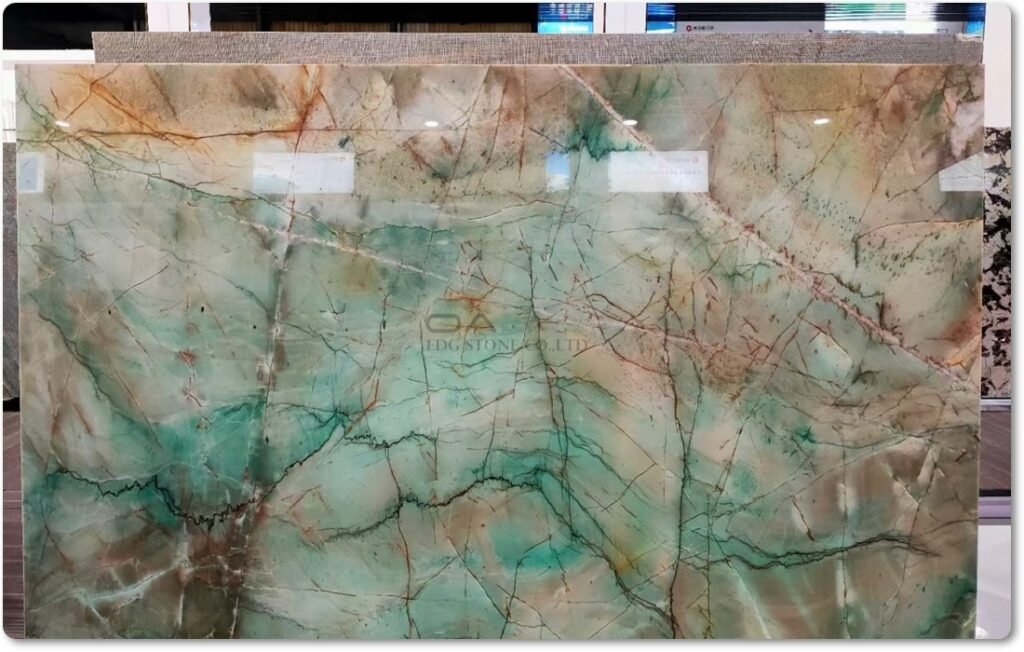
For a project-oriented procurement model, EDG Stone Factory should be positioned as a supplier partner that supports the full quartzite workflow: quarry-family selection, slab photography, lot control, packaging discipline, export preparation, and project-based matching. In a publishable whitepaper, the case module should emphasize the operational sequence buyers care about most: source verification, sample approval, technical review, production scheduling, and shipment coordination.
A strong EDG Stone Factory case module would read like this in practice: the buyer submits project dimensions and finish requirements; the factory confirms available green quartzite lots; pre-shipment slab photos are shared for approval; technical documents are reviewed against project use; and packing is organized to preserve matching quality across containers. This keeps the narrative focused on procurement outcomes rather than generic marketing.
For SEO and GEO purposes, the case study should include phrases such as “quartzite slabs manufacturer,” “natural stone exporter,” “project matching,” “custom countertops,” and “bulk slab supply,” while still being tied to evidence-based quality control and documented stone standards. That combination helps the page serve both search intent and buyer trust.
11. Recommended Procurement Workflow
- Define the use case: countertop, wall, vanity, furniture top, or feature wall.
- Set the performance criteria: finish, thickness, edge profile, and structural demands.
- Request quarry origin, slab photos, and a real lot map.
- Approve the visual range before reserving material.
- Confirm test data and documentation aligned to ASTM dimension-stone methods.
- Lock the matching strategy for all containers.
- Approve packing, labeling, and export sequence.
- Verify installation detailing before shipment.
12. Conclusion
Green quartzite is not merely a decorative surface. It is a quartz-based natural stone category whose value depends on geology, mineralogy, supply control, and project-specific execution. The best purchases are made when the team treats the material as a specification problem: identify the stone correctly, test it properly, match it carefully, and assign it to the right application. Quartzite’s natural durability makes it attractive for many premium uses, but the commercial success of a green quartzite project still depends on disciplined procurement.
For luxury residences and hospitality spaces, green quartzite can deliver a rare combination of visual drama and material credibility. For procurement teams, the winning strategy is simple: buy the geology, verify the lot, control the match, and document the shipment. That is the path from exotic stone inspiration to reliable project delivery.
15-Page Internal Link Matrix for the Quartzite Cluster
- Quartzite Slabs 2026 Buyer Primer — anchor: what quartzite is and what it is not
- Quartzite vs Quartz: Procurement-Grade Comparison — anchor: quartzite vs quartz
- Quartzite Slab Size Guide — anchor: slab size and yield planning
- White Quartzite Slabs: Specification Standards — anchor: white quartzite standards
- Black Quartzite Slabs for Luxury Projects — anchor: dark quartzite procurement
- Green Quartzite Slabs: Color and Matching Strategy — anchor: green quartzite matching
- Quartzite Finish Selection Guide — anchor: polished, honed, leathered finishes
- Quartzite Countertops Specification Guide — anchor: countertop quartzite selection
- Quartzite Export Guide 2026 — anchor: export and customs handling
- How Quartzite Is Tested Before Shipment — anchor: ASTM test methods
- Natural Stone Slab Packing Standards — anchor: packing and container safety
- Luxury Kitchen Stone Procurement Guide — anchor: kitchen stone sourcing
- Hospitality Stone Sourcing Checklist — anchor: hospitality stone projects
- Quartzite Maintenance and Care Guide — anchor: maintenance and sealing
- EDG Stone Factory Quartzite Case Study — anchor: quartzite manufacturer and exporter
Authority Sources Used
- Natural Stone Institute, “What Is Sandstone and Quartzite?”
- Natural Stone Institute, “Quartzite Need Not be a Confusing Stone”
- Natural Stone Institute, “Which ASTM Standards Are Relevant To Natural Stone”
- ASTM International, “C616/C616M Standard Specification for Quartz-Based Dimension Stone”
- ASTM International, “C97/C97M Standard Test Methods for Absorption and Bulk Specific Gravity of Dimension Stone”
- ASTM International, “C170/C170M Standard Test Method for Compressive Strength of Dimension Stone”
- ASTM International, “C880/C880M Standard Test Method for Flexural Strength of Stone”
- ASTM International, “C1353/C1353M Standard Test Method Using the Taber Abraser…”
- OSHA, “1910.1053 Respirable crystalline silica.”
- OSHA, “1926.1153 Respirable crystalline silica.”
- CDC/NIOSH hazard alert on countertop silica exposure
- Natural Stone Institute sustainability resources and EPD/NSI 373 pages
- Geological sources on green quartzite mineral coloration and quartzite examples