Quick Summary:
Quick Summary: Engineered quartz **can** be used outdoors — but **only** specialized UV-stable lines and mineral-composite products with UV stabilizers are appropriate. Most standard indoor quartz will fade or yellow under prolonged sun and high heat; natural stones like granite and quartzite, and large-format porcelain slabs remain the safest, low-maintenance outdoor choices in many climates. Choose outdoor-rated quartz SKUs with published xenon/QUV test results, Delta E color-change data, and a written outdoor warranty from the manufacturer or factory to ensure long-term performance.
Materials science in plain English
Engineered quartz is roughly 90–95% crushed quartz (a hard mineral) and 5–10% polymeric binder and pigments. “UV resistance” is not a single ingredient — it is a formulation strategy. To withstand prolonged sun exposure, outdoor-rated engineered quartz uses:
UV-stable resins (polymers designed to resist photodegradation),
UV absorbers and hindered amine light stabilizers (HALS) that neutralize energy from sunlight before it breaks chemical bonds,
Inert mineral fillers or modifications to reduce total organic binder content, and
Pigment systems that are inherently less prone to fading or yellowing.
Only when the full system (aggregate + resin + pigment + curing) is engineered for outdoor exposure will a slab keep color fidelity and surface integrity over time.
How do producers validate UV performance?
Manufacturers validate outdoor claims with accelerated weathering tests that simulate years of sun exposure in weeks or months. Common methods include xenon-arc exposure and QUV fluorescent UV testing. Results are typically reported as color change in Delta E units (ΔE): the lower the ΔE after a defined exposure, the better the color stability. Manufacturers who publish test methods, exposure durations, and ΔE results provide the objective evidence buyers should demand.
Outdoor-rated quartz series: brand and technology overview
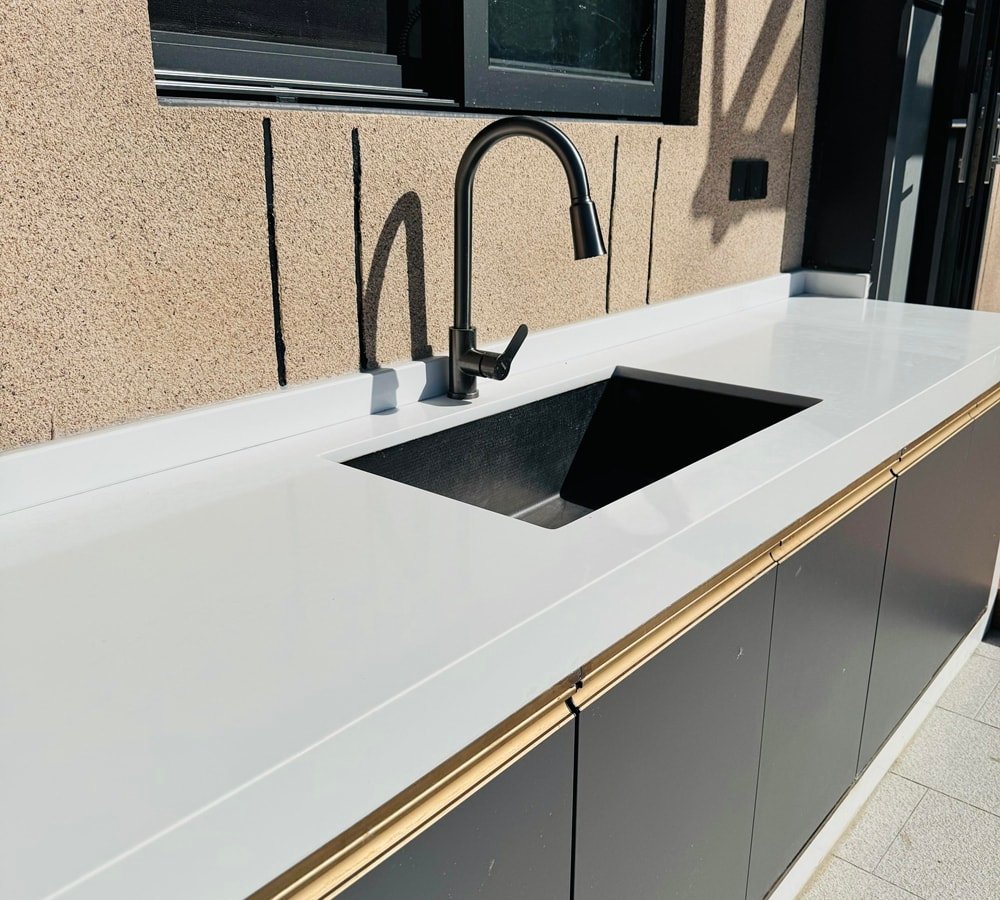
Some global manufacturers now offer dedicated outdoor quartz collections or mineral-composite alternatives specifically formulated for exterior use. When you need engineered quartz to match interior finishes or when design continuity is critical across indoor/outdoor transitions, these lines are the right starting point — but SKU-level verification is essential.
Key product approaches you will encounter:
Outdoor-specific quartz collections — slabs marketed and tested for exterior use with published data and outdoor warranties. These products are engineered from the ground up to resist UV and thermal stress.
Mineral-composite / low-resin formulations — higher mineral loading and alternative binders (sometimes plant-based or specially stabilized chemistries) reduce organic content and improve UV tolerance.
Porcelain panels and large-format tiles — not quartz, but commonly offered as matchable exterior counters; they are intrinsically UV-stable and heat resistant.
Natural stone (granite/quartzite) — inherently mineral and UV-stable; typically recommended where long-term exposure and variable thermal loads are expected.
What to look for on product datasheets from manufacturers/factories/wholesalers:
A statement that the SKU is “suitable for outdoor use.”
A summary of the accelerated weathering test used (xenon arc, QUV) and ΔE values over a defined exposure period.
Warranty terms that explicitly cover outdoor color stability and structural integrity.
Installation and maintenance guidance for outdoor settings.
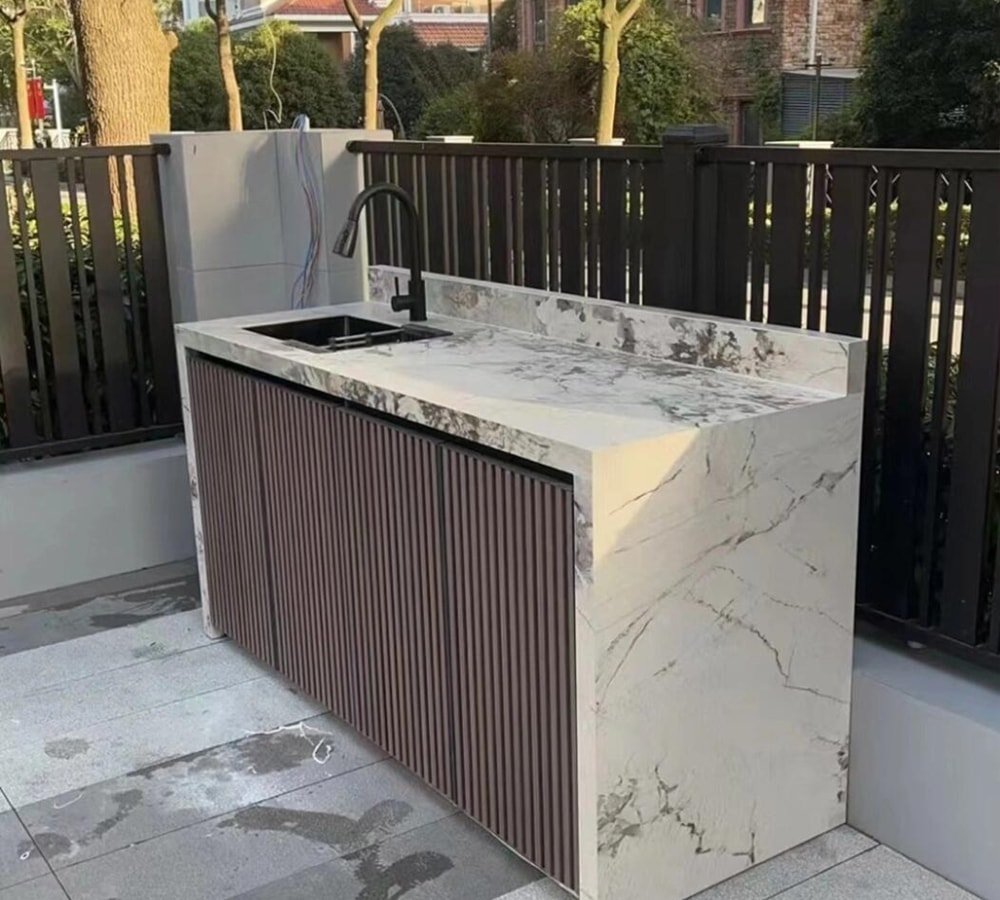
Natural stone and porcelain alternatives: why many pros still prefer them outdoors?
Granite and quartzite are natural stones with mineral compositions that are UV-stable by nature; they do not contain organic resins that can yellow. Granite, in particular, has decades of documented service as exterior cladding and countertop material. Quartzite — often mistaken for engineered quartz — offers excellent outdoor performance with striking, varied aesthetics.
Porcelain slabs are industrially fired ceramic panels with extremely low porosity, high hardness, and excellent UV stability. Porcelain’s thermal stability and resistance to sun-driven color change make it a reliable choice next to grills or overhangs. Porcelain can also be produced in very large formats that help reduce seams.
Design trade-offs: natural stone and porcelain often require specific fabrication techniques, may need periodic sealing (natural stone), and can be heavier or more brittle depending on thickness and finish. Engineered outdoor quartz provides a narrower, more uniform color and texture palette and can allow easier inventory and sample matching for product lines — but only when truly formulated and tested for outdoor use.
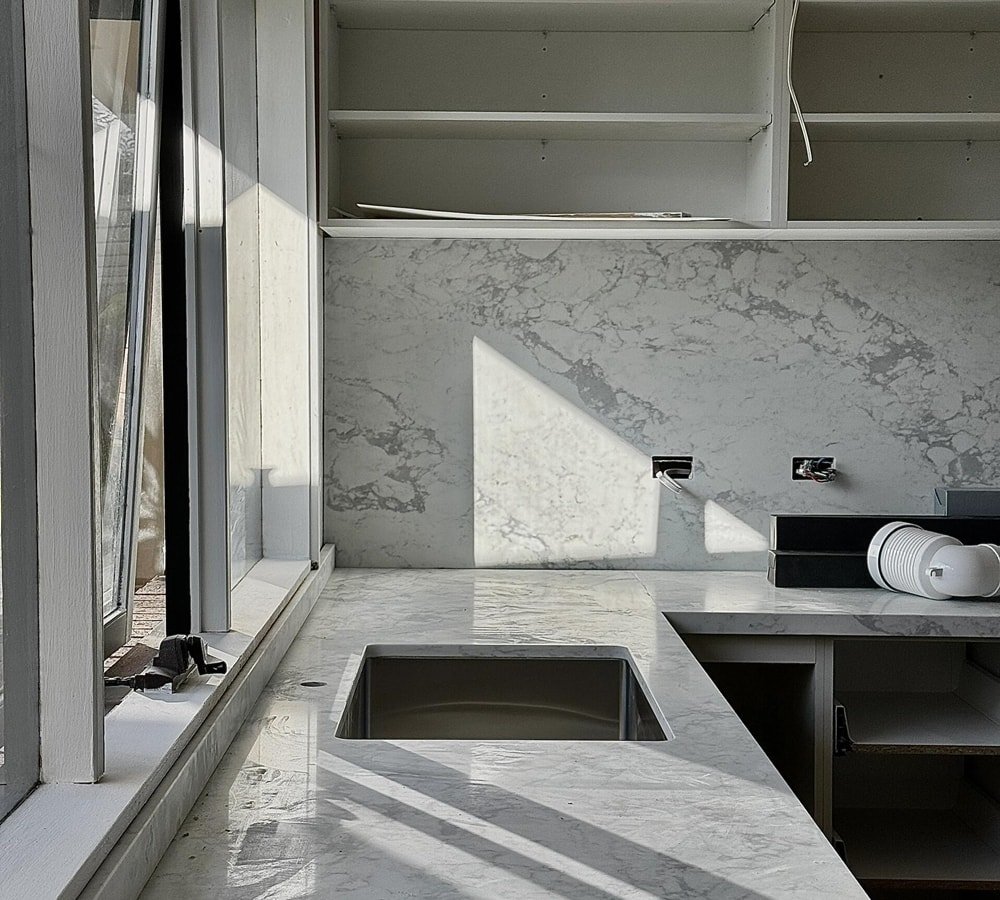
Performance: UV, heat, stain, and abrasion — lab tests vs. field reality
UV/weathering performance
Accelerated xenon or QUV tests are the industry standard for predicting long-term color change. Expect credible outdoor products to cite ΔE after a specified number of hours (e.g., 1,000–2,000 hours). A small ΔE (typically under about 3–4 in many product claims) indicates acceptable visual stability over many years in most climates. Buyers should insist on SKU-specific data rather than general brand statements.
Heat resistance and proximity to grills
Heat is a separate challenge from UV. Engineered quartz usually tolerates moderate radiant heat but can suffer damage from sustained direct contact with extremely high temperatures (for example, a raging gas flame directly beneath a slab edge). Porcelain and natural stone offer far higher tolerance for direct heat and are preferred next to high-output grills or pizza ovens. Regardless of material, installation details (heat breaks, protrusions, proper clearance) matter.
Stain and abrasion resistance outdoors
Outdoor-rated quartz still benefits from engineered non-porosity, which minimizes staining from oils, marinades, and plant resins. Abrasion resistance is generally excellent across quartz, porcelain, and granite, although surface finishes (polished vs. textured) will affect scratch visibility and cleaning. Outdoor environments also increase exposure to biological growth (mildew, pollen), so ease of cleaning and chemical compatibility are practical considerations.
Field reality & warranty alignment
Field reports from fabricators and wholesale distributors consistently show that interior-only quartz used outdoors will often show color shift or loss of gloss within a few years in hot, sunny climates. Conversely, products tested and warranted for outdoor use perform as promised when installed according to manufacturer instructions. Always secure written warranties that list outdoor use explicitly.
Regulations and market forces shaping outdoor product availability
In recent years, workplace safety and product regulations have affected manufacturer practices, labeling, and international trade — and these forces can directly influence what outdoor products are available in certain markets.
Worker safety & silica enforcement: Regulatory agencies have stepped up enforcement and adopted new respirable crystalline silica rules for stone fabrication. This has driven manufacturers and factories to invest in safer production and documentation, and sometimes to reformulate or alter manufacturing locations.
National bans and import controls: Some countries have moved to ban or restrict engineered stone manufacture and supply because of silica-related occupational health risks, triggering import restrictions and heightened compliance requirements for exporters and wholesalers.
Construction product rules & sustainability labeling: New construction product regulations in global markets emphasize life-cycle data, product declarations, and harmonized performance claims. Suppliers who can provide independent test data for outdoor durability, environmental credentials, and worker-safety compliance will have a competitive advantage in large projects and public procurement.
Commercial implication: Manufacturers and wholesalers should be ready to deliver SKU-level compliance documents, outdoor weathering test reports, and clear warranty language to satisfy procurement teams and specifiers in regulated markets.
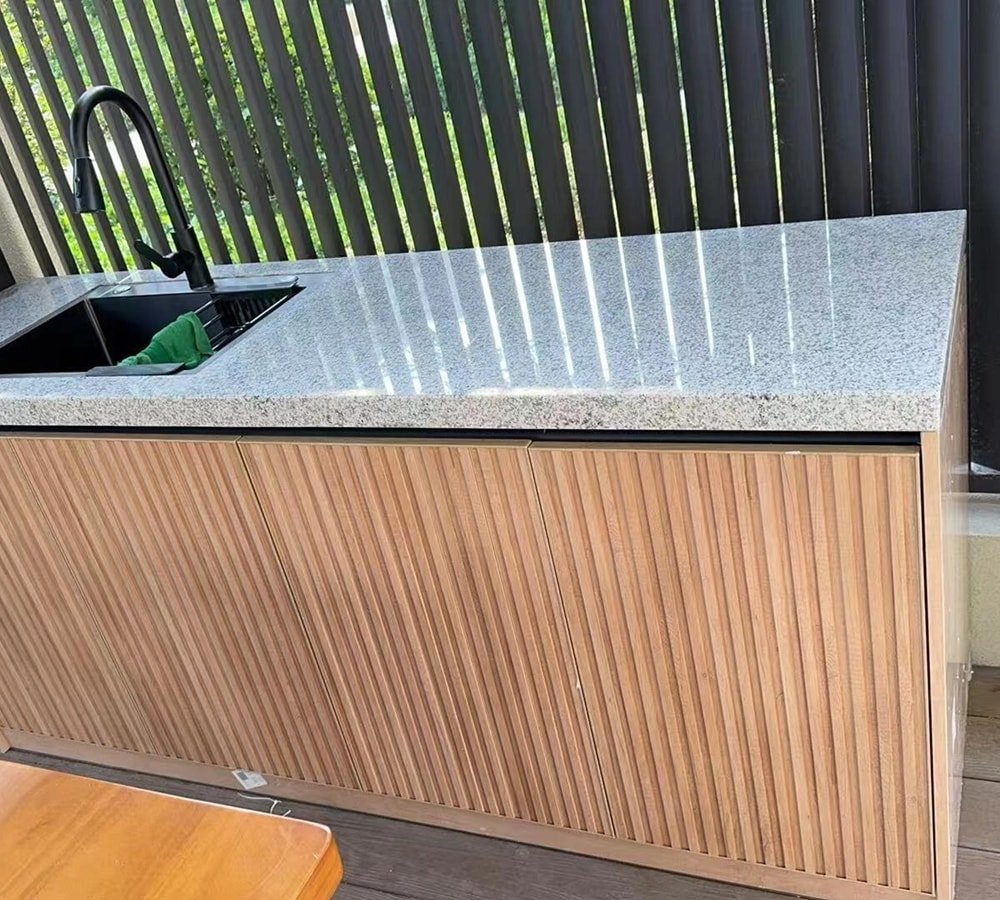
Buying guide & long-tail buyer-intent keywords for procurement
UV-resistant outdoor quartz manufacturer
Outdoor quartz countertops wholesale supplier
Buy outdoor quartz slabs factory direct
Outdoor quartz distributor [region]
Quartz outdoor kitchen supplier manufacturer
Use these phrases in meta titles, H2s, product metadata, and anchor text for spec sheets to capture trade buyer searches. On product pages, include a dedicated “Outdoor Use Technical Sheet” downloadable as a PDF for wholesalers and fabricators.
Installation best practices for longevity in outdoor kitchens
Practical installation choices matter as much as material selection for outdoor longevity:
Substructure & expansion allowance: Provide rigid, weatherproof substrate and include thermal expansion joints for large span installations.
Edge profile & protection: Choose robust edge profiles and consider metal capping where edges will be exposed to impacts or heavy use.
Seaming & adhesives: Use exterior-rated adhesives and seam fillers that remain flexible under temperature swings and are UV-stable.
Clearance to heat sources: Respect manufacturer guidance for clearance near grills and direct heat. Add heat shields or insulating layers when necessary.
Routine maintenance plan: Even outdoor-rated engineered products benefit from seasonal inspections for joints, sealant condition, and surface cleanliness. Document maintenance recommendations for your buyer or client.
Documentation & warranty registration: Register installations with the manufacturer (if required) to validate any outdoor warranty and keep a copy of the SKU-specific test datasheet on file.
Semantic closure content block — How / Why / What / Options / Considerations
Semantic closure content block
How: Outdoor-grade quartz is produced by combining standard quartz aggregates with UV-stabilized polymer binders, UV absorbers, HALS stabilizers, and weather-resistant pigments, and by curing processes that reduce residual stresses and discoloration risks. Producers verify performance using standardized accelerated weathering chambers (xenon-arc or QUV) and report color stability as Delta E values over defined exposure hours.
Why: Non-UV-stable polymer binders and certain pigments degrade under sunlight and thermal cycling. This leads to yellowing, loss of gloss, or subtle color shifts that are unacceptable in long-term exterior applications. Outdoor-rated product lines mitigate these failures and commonly include explicit outdoor warranties.
What to choose: For full-sun, high-heat environments where absolute color stability is mission-critical, choose either natural stone (granite/quartzite) or industrial porcelain slabs. If design continuity or matching indoor finishes matters more than absolute weatherproofing, choose a verified outdoor-rated engineered quartz SKU and demand the manufacturer’s test data.
Options:
Porcelain: highest thermal/UV stability, wide color variety, thin-slab options.
Granite/Quartzite: excellent natural UV/heat resistance, variable aesthetics, and heavier.
Outdoor-rated engineered quartz: consistent color, ease of inventory, narrower color range, but matched interior/exterior visuals; pick only tested & warranted SKUs.
Considerations for manufacturers and wholesalers: Publish SKU-level test results (xenon/QUV, ΔE), provide explicit outdoor warranty language, ensure fabrication guidance for heat and support, and maintain transparent health/safety/compliance documentation to succeed in regulated export markets.
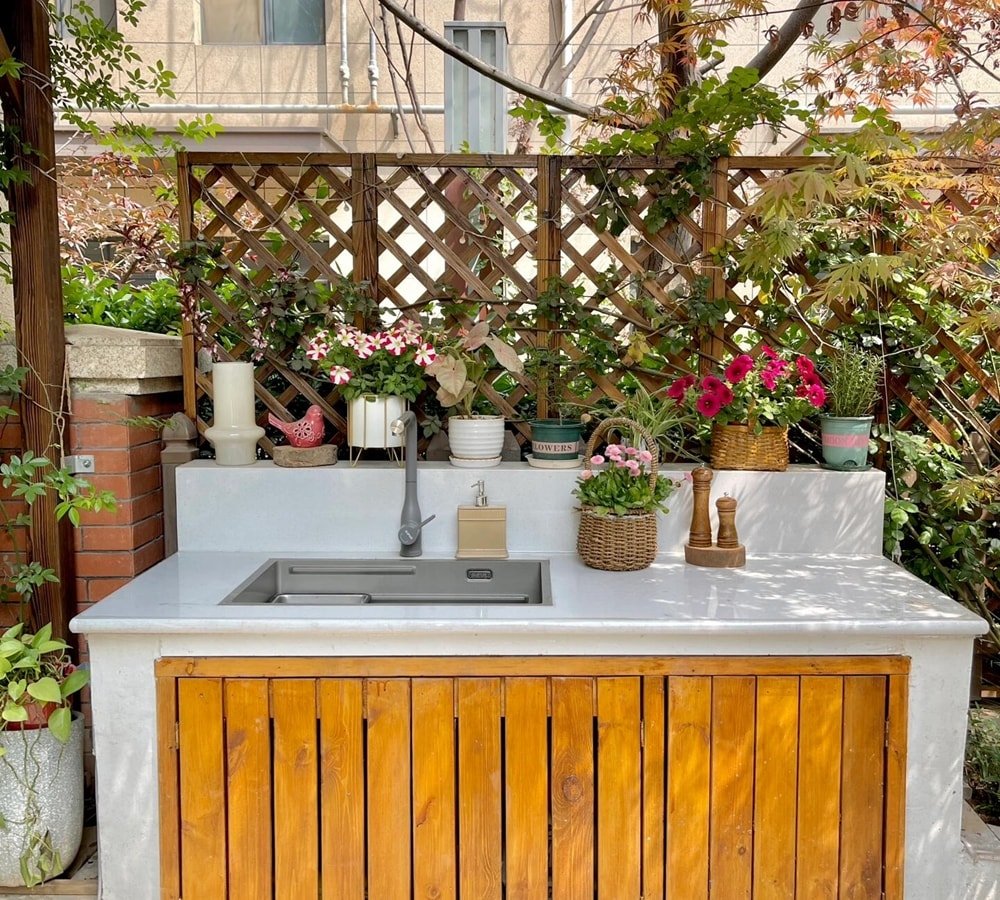
FAQ — Google hot-search style (full text; each answer 2–4 sentences)
Q1: Is quartz suitable for outdoor kitchens?
A1: Engineered quartz can be suitable for outdoor kitchens only when the specific SKU is formulated and tested for exterior use. Many standard indoor quartz products contain resins and pigments that will yellow or fade over time in direct sunlight; insist on outdoor-rated product datasheets and written warranties before specifying quartz for exterior installations.
Q2: Which quartz brands make outdoor quartz?
A2: Several leading producers and specialized manufacturers offer outdoor-rated or mineral-composite product lines designed for exterior use. Look for product lines explicitly labeled for outdoor use with published weathering test results and outdoor warranty coverage.
Q3: Should I choose quartz or granite for an outdoor kitchen?
A3: Granite is generally more UV- and heat-stable than standard engineered quartz and is a safer choice in very sunny or high-heat environments. If you require engineered quartz for design continuity, select a verified outdoor-rated collection or consider porcelain as an alternative.
Q4: How do manufacturers test quartz for outdoor exposure?
A4: Manufacturers typically use accelerated weathering tests such as xenon-arc or QUV exposure chambers and report color change as Delta E after a specified number of hours. These tests help predict long-term color stability, but buyers should request the exact method and ΔE values for the specific SKU.
Q5: What should wholesalers and buyers ask manufacturers before purchasing outdoor quartz?
A5: Request SKU-level confirmation of outdoor suitability, the specific accelerated weathering method, and ΔE results, written outdoor warranty terms, and installation guidance for heat clearance and joints. Also, check compliance and health/safety documentation that may be required in regulated markets.
References (author, article title, source — no links)
Caesarstone Technical Team — “Caesarstone Outdoor Collection: Technical Guide” — Manufacturer’s technical guide.
Diresco Marketing — “Diresco mineral composite: Indoor and Outdoor Use” — Manufacturer product information.
Safe Work Australia — “Review of the Engineered Stone Prohibition” — Government workplace safety agency report.
AIHA — “Australia’s New Engineered Stone Ban to Begin in July” — Professional association briefing.
California Department of Industrial Relations — “Standards Board Votes to Adopt Permanent Standard Protecting Workers” — Government regulatory notice.
European Commission — “Construction Products Regulation (CPR) overview” — EU policymaking and standards resource.
Natural Stone Institute — “Granite: Characteristics and Applications” — Industry association resource.
Q-Lab Corporation — “Xenon Arc Exposure Results and Delta E testing” — Test lab technical bulletin.
Outercle / Industry Education — “Porcelain Outdoor Countertops: Durability and Installation Considerations” — Industry trade guidance.