Indoor Air Quality: Low-VOC Quartz Surfaces & North American Compliance
Why does indoor air quality (IAQ) matter for countertops?
Indoor air quality directly affects occupant health, comfort, and perceived well-being. Countertops and other interior surfaces are contributors to the built environment’s chemical load: depending on material formulation, adhesives, and finishes, surfaces can emit volatile organic compounds (VOCs) that raise measured indoor concentrations and, in some sensitive populations, exacerbate headaches, irritation, or other symptoms. For material specifiers, the goal is twofold: choose low-emitting products and control installation and maintenance activities to avoid adding avoidable VOC burdens to occupied spaces.
Key stakeholders in this decision include homeowners (health & resale value), architects and designers (code and client requirements), facility managers (long-term maintenance and occupant health), and procurement teams (documented compliance and liability mitigation). The countertop material is often a visible and long-lived element — selecting a low-emitting quartz surface reduces health risk and aligns with green building goals.
Quick definitions: VOC, TVOC, formaldehyde, and emission metrics
VOCs are organic chemicals that can vaporize into indoor air. TVOC (total VOC) aggregates many individual compounds into a single concentration metric, typically reported in micrograms per cubic meter (µg/m³) or parts per billion (ppb). Regulators and testing bodies also track single-compound risks — formaldehyde, for example, is frequently regulated because of its known irritant and classification concerns.
Emission test results are usually reported as chamber emission rates (mass per area per time) or steady-state concentrations under defined air change rates. These metrics are the basis for pass/fail thresholds used by certification programs and buyer specifications; understanding units and test assumptions is essential for comparing products meaningfully.
What is engineered quartz? Composition and resin chemistry
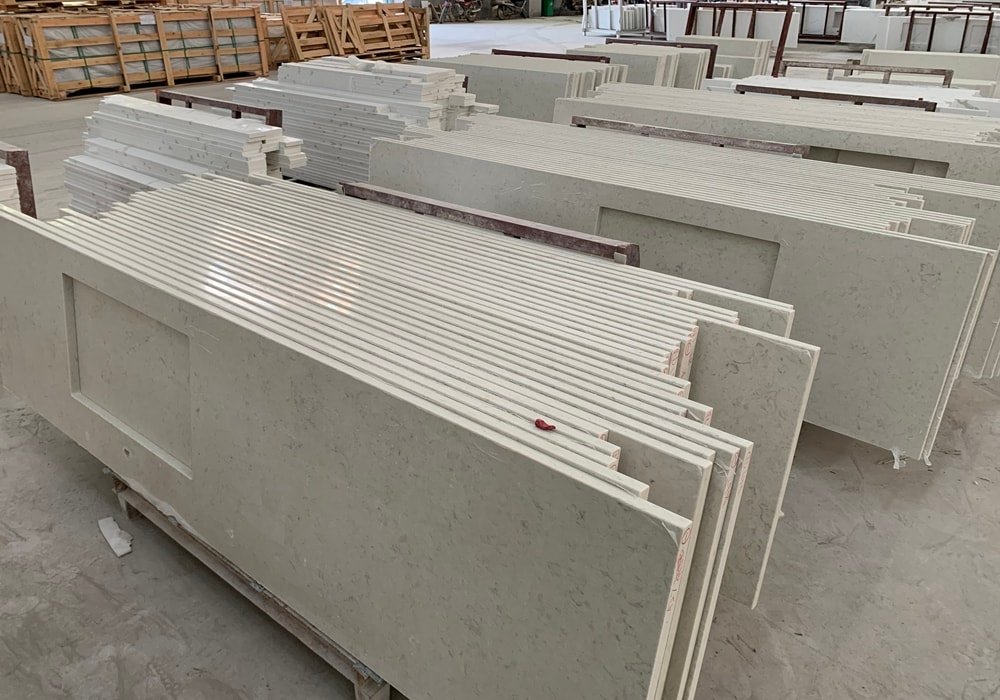
Engineered quartz (often shortened to “quartz”) is a manufactured surface composed primarily of natural quartz aggregates (typically 85–95% by mass) bound by a polymer resin matrix, plus pigments, fillers, and additives that create color and performance properties. The high mineral fraction gives engineered quartz its hardness and low porosity compared with many natural stones. Common polymer binders historically include polyester resins; modern formulations may use modified polyesters or alternative binder systems engineered to reduce emissions and improve cure performance. The specific binder chemistry matters for VOC potential: different resins, catalysts, and solventborne additives can produce different emission profiles during manufacture and early in-service life.
How do manufacturing controls reduce VOC emissions? (manufacturer & factory focus)
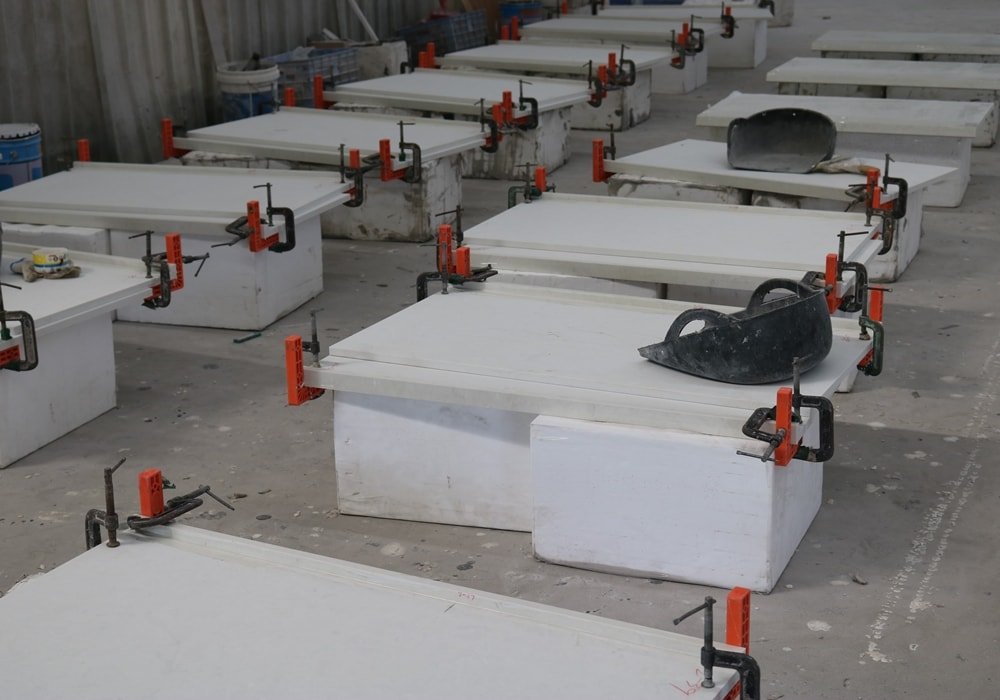
A low-emission quartz product is the result of a systems approach in the factory. Key factory controls include:
Raw material selection: specifying low-VOC or solvent-free resin systems, pre-qualified pigments, and low-emitting additives reduces the upstream chemical burden.
Process control: accurate resin dosing, vacuum de-airing to remove entrapped volatiles, and tightly controlled curing/heat-cycle schedules minimize incomplete cure conditions that can leave free monomers or solvents.
Post-cure conditioning: allowing parts to complete off-gassing in controlled conditioning rooms before packaging reduces field emissions.
Engineering controls: local exhaust and capture, VOC abatement (carbon adsorption or regenerative thermal oxidizers where needed), and good housekeeping reduce fugitive emissions from the plant, and help produce more consistent product lots.
Quality assurance: maintain batch records, Certificates of Analysis (COAs) for incoming materials, and spot emission testing to detect raw material changes or manufacturing drift.
When factories document these controls, they can provide specifiers with verifiable evidence — COAs, chamber test reports, and declarations — that demonstrate consistent manufacturing practice.
Emissions testing and certification pathways for North America
There are established, widely referenced test methods and certification routes used to verify low-emitting materials in North America:
CDPH / Section 01350 (Standard Method): California’s Section 01350 defines small-chamber test methods and health-based screening levels widely used for low-emitting material certification and procurement specifications. It is commonly requested by institutional buyers and referenced in procurement guidance.
LEED (USGBC) low-emitting materials credit: LEED v4.x and subsequent guidance recognize low-emitting product categories and accept recognized test methods and certifications for project credit. Products that meet the LEED low-emitting thresholds contribute to Indoor Environmental Quality (EQ) credits.
GREENGUARD / UL GREENGUARD Gold: GREENGUARD certifies products for low chemical emissions against explicit tables of compounds and thresholds and is commonly accepted by specifiers seeking reduced indoor emissions for schools, healthcare, and homes.
WELL Building Standard & other programs: WELL recognizes low-emitting materials and uses similar test evidence and product declarations as proof of compliance.
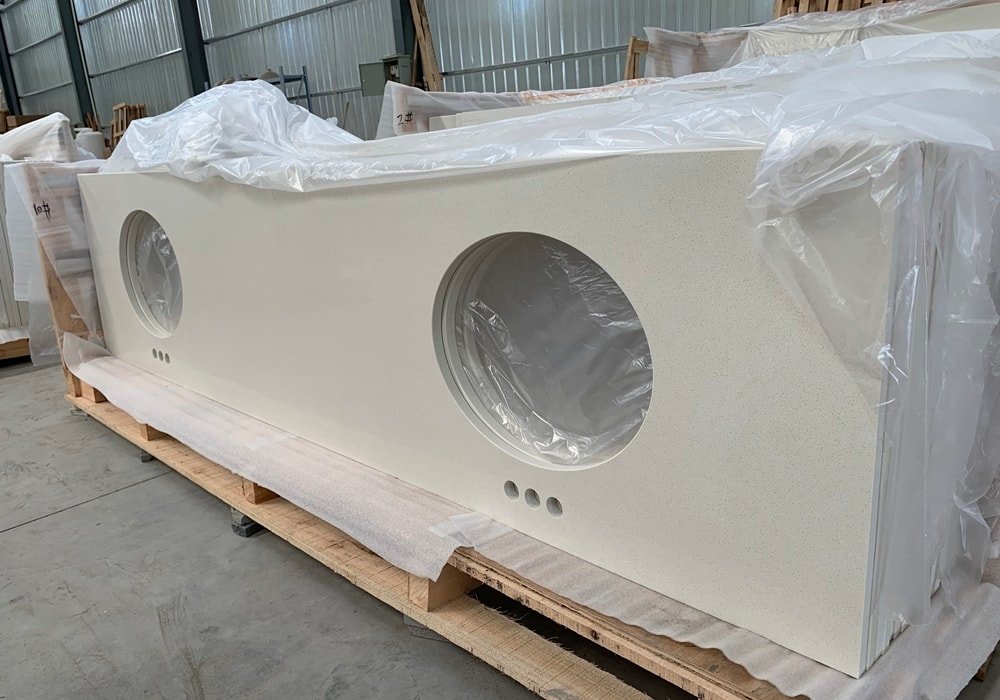
Manufacturers typically pursue one or more of these pathways. The most robust spec packages include chamber test reports conducted to Section 01350 or equivalent, a GREENGUARD certificate where available, and material declarations such as HPDs or EPDs for transparency.
Quartz grade levels and how they map to IAQ outcomes?
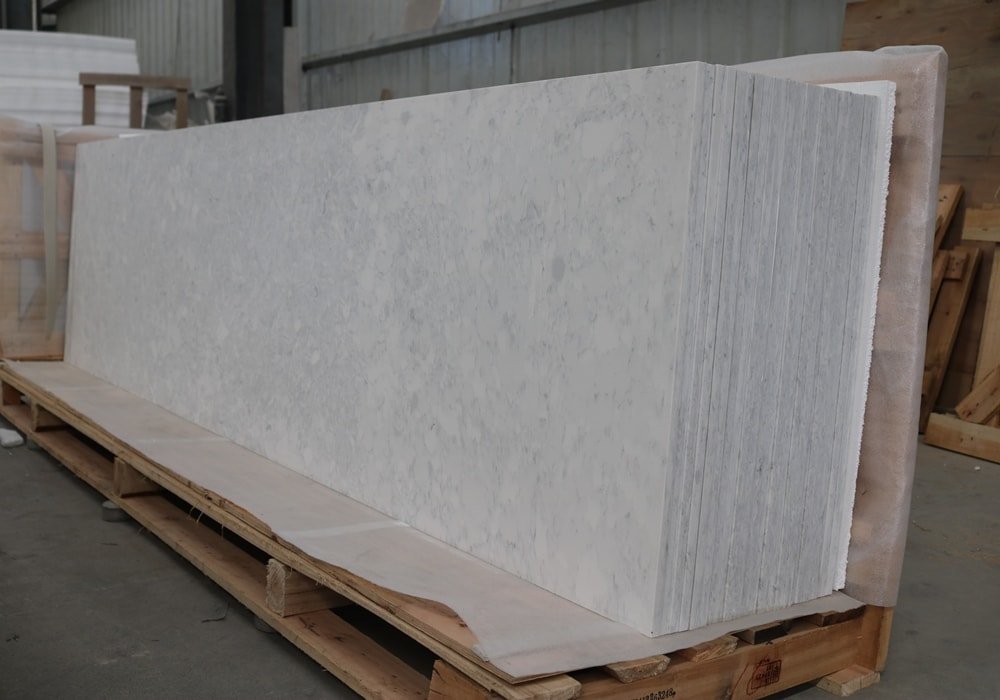
Manufacturers sometimes describe “grade levels” (A–D or Level 1–Level 3) to help buyers understand visual quality, performance, or production tiers. These grade labels are not standardized across the industry for IAQ; instead, buyers should look at test results rather than promotional grade names when evaluating emissions. That said, practical correlations often exist: higher-grade product lines may use purer raw materials and stricter process controls, which can translate to lower emission risk.
Surface roughness and finish can influence the practical exposure pathway for semi-volatile organics (SVOCs) that adhere to finishes: smoother, lower-porosity surfaces shed contaminants more easily and are easier to clean, reducing the probability of VOC-bearing residues accumulating on the surface. But emission potential is still driven primarily by the binder chemistry and any volatile additives used during fabrication. Always request chamber emission data (air concentrations at defined time points) and the product’s COA and HPD to verify claims.
Case studies & illustrative data snapshots (factory vs field)
Below are illustrative, generalized examples that clarify how process changes affect emissions (numeric values are for demonstration and should be validated with lab tests for each product line):
Factory baseline scenario: product using conventional polyester resin, minimal post-cure → initial 7-day TVOC chamber result: 200 µg/m³ (under test conditions).
Mitigated process scenario: switch to low-VOC resin + post-cure conditioning → initial 7-day TVOC chamber result: 40 µg/m³.
These kinds of reductions are achievable by modifying binder chemistry and adding controlled post-cure steps. In-field monitoring typically shows that properly conditioned, certified products contribute negligible additional VOC load to a well-ventilated home, while uncontrolled installs with solvent-heavy adhesives can temporarily spike indoor VOCs.
Comparative risk snapshot (qualitative):
Engineered quartz (certified low-VOC) — low in-service emissions when verified by chamber testing and installed with low-VOC seam materials.
Natural quartzite — inert mineral mass; little direct VOC emission risk from stone itself but may require sealants/adhesives that affect IAQ.
Solid surface (acrylic/PMMA) — depends on binder; some formulations have low emissions and are commonly GREENGUARD certified.
Always verify with test reports for the specific SKU and lot.
Installation, adhesives, and field practices that affect IAQ
The final IAQ performance of a countertop system depends not only on the slab but on the installation materials and practices:
Adhesives & seam fillers: Choose low-VOC, low-odor adhesives and epoxies certified to SCAQMD Rule 1168 or equivalent; where possible, specify adhesives with documented low emissions and allow adhesives to cure in ventilated conditions.
Sealants & silicones: Use neutral-cure silicones and low-VOC caulks for backsplash junctions. Avoid solvent-based sealants in occupied spaces without ventilation.
Ventilation during install: Ensure mechanical ventilation and, where possible, perform critical adhesive curing before full re-occupation; post-installation flush ventilation for 24–72 hours reduces residual VOC concentrations.
Cleaning & maintenance: Recommend manufacturer-approved, pH-neutral cleaners that do not reintroduce high-VOC fragrances or solvents.
These steps prevent installation from negating the benefits of a low-emitting slab and are a required line item in good spec language.
Regulatory & market trends driving low-VOC demand in North America
Buyers and specifiers increasingly demand verified low-emitting products because of regulatory drivers (codes and procurement requirements), institutional purchasing standards (schools, hospitals), and corporate ESG policies. LEED, WELL, and local procurement rules frequently require documented low-emitting products or prefer GREENGUARD and Section 01350 evidence. Additionally, retailers and wholesalers are requesting HPDs and EPDs for transparency in supply chains, and public procurement teams may require Section 01350 or equivalent testing in contract language for interior materials. These market dynamics incentivize manufacturers to invest in low-VOC formulations and transparent documentation.
Decision matrix: how to specify low-VOC quartz for your project
Use the following checklist when specifying or buying quartz surfaces:
Request test evidence: ask for recent chamber test results (Section 01350 or equivalent) for the exact product SKU and production lot, if possible.
Certifications: Request GREENGUARD / GREENGUARD Gold certificates and verify the product family and SKU.
Material declarations: request HPD (Health Product Declaration) and EPD (Environmental Product Declaration) for transparency on ingredients and embodied impacts.
Factory QA evidence: COAs for resin batches, process control records, and a documented post-cure protocol.
Installation materials: specify low-VOC adhesives and sealants in the contract; require installer to document product names and VOC content (SDS/COA).
Ventilation & flush: for occupied installations, include a post-installation ventilation plan in the scope (ventilate and measure or allow a 24–72 hour flush).
Following this flow ensures the product’s lab performance carries through to in-service IAQ.
FAQ
Q1: What does “low-VOC quartz” actually mean for indoor air quality?
A1: “Low-VOC” means the product has been manufactured and conditioned so that it emits only small quantities of volatile organic compounds under typical test conditions; the claim should be supported by chamber testing (for example, to California’s Section 01350) or third-party certification such as GREENGUARD Gold. Low-VOC slabs that are properly installed contribute minimally to indoor VOC concentrations in well-ventilated homes.
Q2: How do quartz countertops compare to quartzite or solid surfaces in terms of VOC emissions?
A2: Natural quartzite (a natural stone) is primarily mineral and has minimal intrinsic VOC emission risk; any IAQ impact usually comes from sealers or adhesives used with it. Solid surface (acrylic/PMMA) products vary by binder chemistry — many are low-emitting and GREENGUARD certified. Engineered quartz’s IAQ profile depends mainly on the polymer binder and manufacturing process; certified, conditioned quartz can be as low-emitting as other low-VOC surfaces.
Q3: What certifications or tests should I request to verify that a quartz product is low-emitting?
A3: Ask for small chamber test reports to Section 01350 (or equivalent), GREENGUARD / GREENGUARD Gold certification, and any HPD/EPD documents the manufacturer can provide. These documents collectively show the product’s emission behavior and ingredient transparency.
Q4: Does surface roughness or finish affect VOC emissions or chemical retention?
A4: Surface roughness impacts how easily residues and cleaning products are retained on a surface; smoother, less porous finishes are easier to clean and less likely to harbor VOC-bearing residues. However, the slab’s emission potential is still determined primarily by binder chemistry and manufacturing cure.
Q5: What should installers and homeowners do after installation to minimize indoor emissions?
A5: Use low-VOC adhesives and sealants, ventilate the space during and after installation, allow adhesives to cure fully before full occupancy, and perform an initial flush of the space. Maintain the surface with manufacturer-approved cleaners to avoid reintroducing high-VOC cleaners or scented products.
Semantic closure content block — (How / Why / What / Options / Considerations)
How EDG Stone achieves low emissions: EDG Stone integrates low-VOC resin suppliers, precise metering and vacuum de-airing processes, controlled thermal cure schedules, and an explicit post-cure conditioning stage. These steps remove or polymerize free monomers and solvents that would otherwise outgas in early service life. Factory QA and spot chamber testing verify each production lot’s consistency.
Why this matters for specifiers and occupants: Verified low emissions reduce near-term exposure risk and help projects meet LEED, WELL, or institutional procurement requirements. For homeowners, low-VOC products reduce the chance of odor complaints and occupant irritation immediately after renovation, improving comfort and perceived quality.
What options exist for buyers: Request GREENGUARD-certified SKUs, Section 01350 chamber test reports, HPDs for ingredient transparency, and EPDs for life-cycle context. For low-emitting installations, require low-VOC adhesives and a documented ventilation plan in the contract.
Considerations & tradeoffs: Some ultra-low-emitting binder systems may increase cost or slightly change handling characteristics; however, for projects with health-sensitive occupants or institutional buyers, the incremental cost is typically justified by decreased risk and compliance value. Also, surface finish and cleaning regimen matter: even a certified slab can underperform if field adhesives are solvent-heavy or if cleaning products reintroduce VOCs.