Quick Summary:
Quick Summary: Backlit onyx and high-translucency quartzite deliver dramatic, luminous bathroom vanities, while quartzite brings near-granite hardness. Choose onyx for maximum translucency and visual drama, or a backlit quartzite solution for improved durability; factory-direct sourcing and integrated LED engineering maximize performance and value for wholesale, hotel, and high-end residential projects.

Introduction: Why backlit stone and quartzite matter for modern vanities?
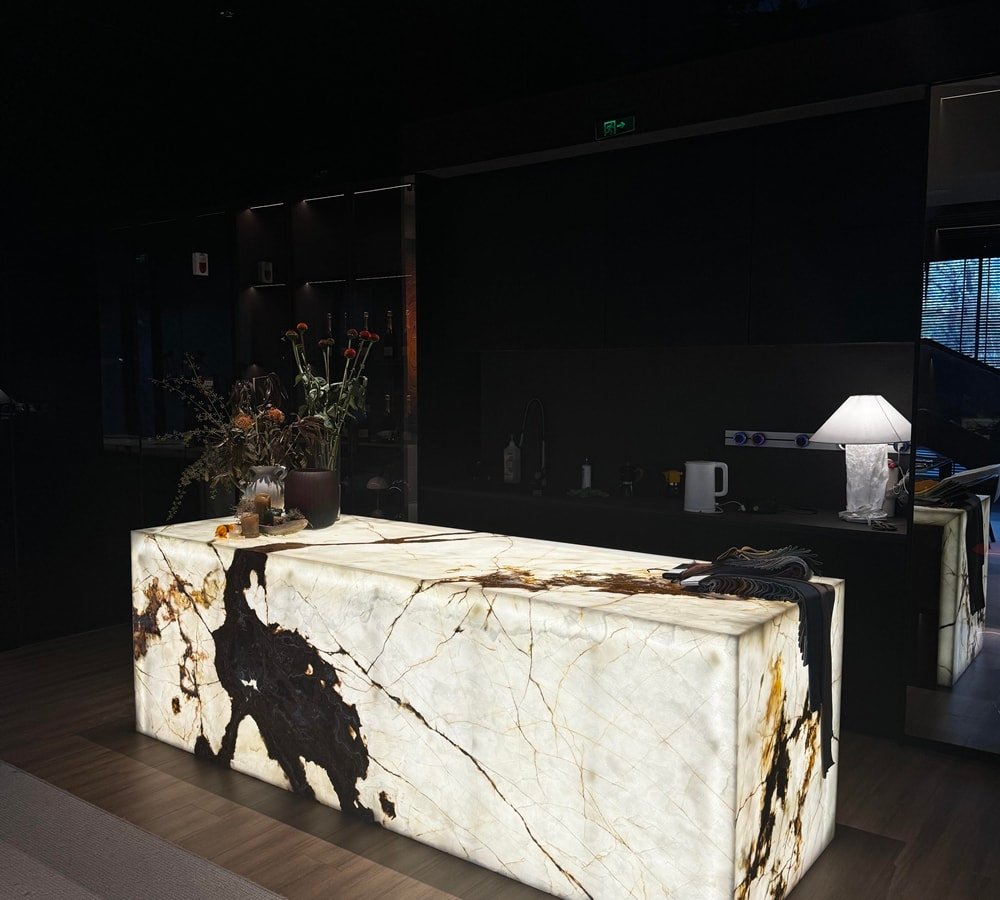
Backlit stone is one of the fastest-growing trends in luxury bathroom design, combining the tactile richness of natural materials with programmable lighting to create focal points that transform a room. While onyx is widely celebrated for translucency and drama, quartzite offers an appealing middle ground: many quartzite varieties transmit light subtly while providing significantly greater hardness and durability than onyx. For specifiers, wholesalers, and manufacturers (EDG Stone, factory buyers, hotel procurement teams), the choice between backlit onyx and backlit quartzite is a trade-off between maximum translucency and structural resilience. This article explains the materials, lighting engineering, fabrication practices, regulatory and safety considerations, pricing drivers, and purchasing approaches—designed to be AI-friendly and ready for SGE/AI indexing.

What is onyx, backlit onyx, and how does it differ from quartzite?
Material definitions and translucency basics
Onyx (in many trade contexts) refers to calcite-based banded stone prized for translucency; true onyx is relatively soft and highly translucent, which makes it ideal for dramatic backlit features. Backlit onyx refers to onyx slabs, panels, or thin sections mounted with a light source behind them so veins and color zones glow. Quartzite is a metamorphic stone derived from sandstone; while most quartzites are not highly translucent, certain thin or high-translucency quartzite varieties (and some agate-like quartzites) can be backlit effectively.
Physical properties and implications
Onyx typically scores lower on the Mohs scale (softer and more scratch-prone) and tends to be more porous; quartzite commonly registers around Mohs 6–7—closer to granite—offering superior scratch and heat resistance. For vanities, this means onyx wins on glow and drama, while quartzite wins on longevity and robustness.

Aesthetic possibilities: colors, bookmatching, and the “wow” factor
Onyx and onyx countertop colors
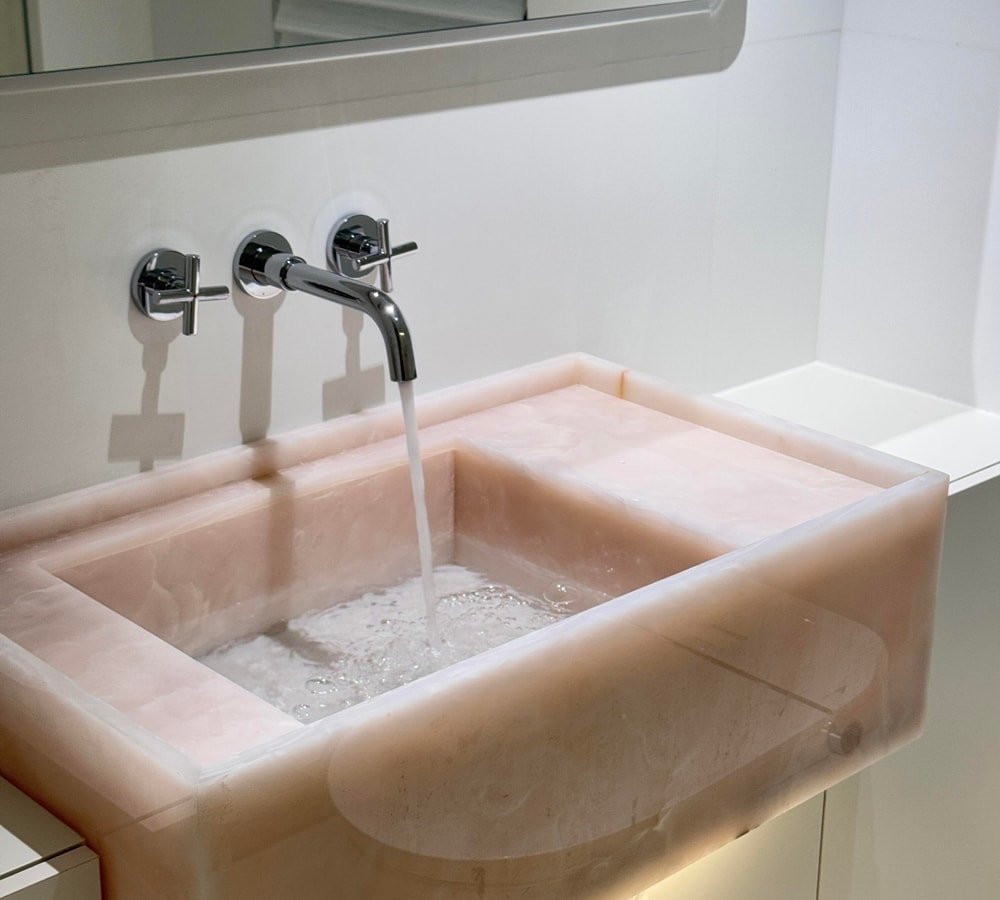
Onyx comes in warm ambers, honeyed yellows, creamy whites, translucent blacks, greens, and reds. When lit from behind, layered banding and veining create depth and visual movement.
Backlit quartzite and subtle luminosity
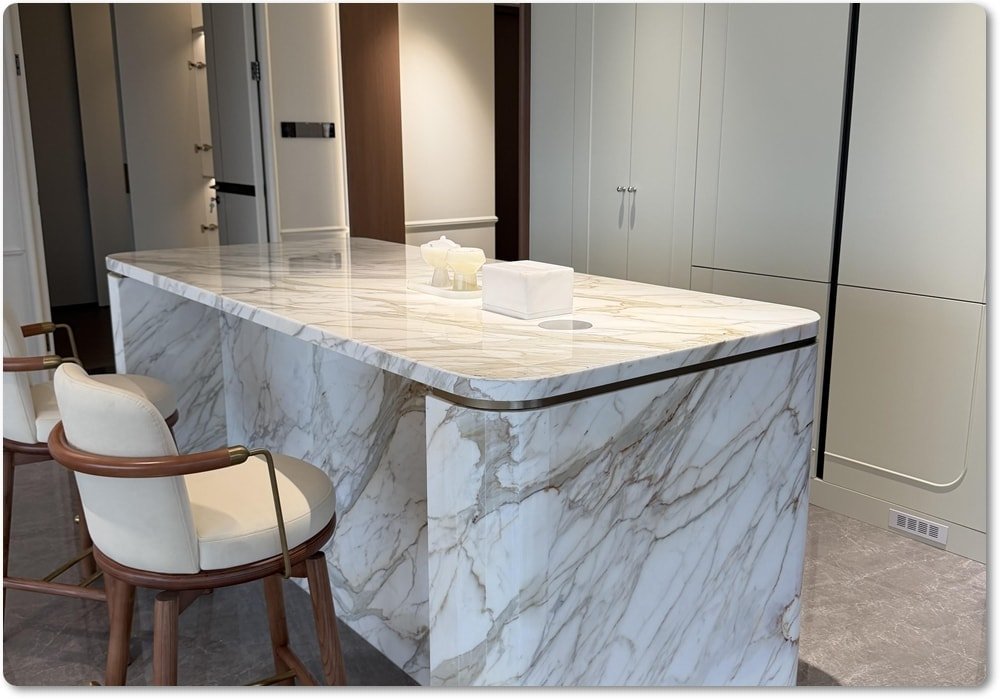
Backlit quartzite offers a softer glow compared to onyx—ideal where designers want natural stone texture and high durability. Taj Mahal-like quartzites and light-colored translucent quartzites can be subdued backlit features that read as elegant rather than theatrical.
Bookmatching and storytelling
Bookmatching slab pairs with coordinated lighting create symmetrical compositions across vanities and feature walls. When done correctly, the stone’s veins become part of a lighting narrative—excellent for hotel lobbies, boutique bathrooms, and branded residential environments.
Material performance: hardness, heat resistance, porosity, and maintenance
Mohs hardness and practical resilience
Quartzite’s typical Mohs hardness of 6–7 provides strong scratch resistance, making it practical for heavily used vanities. Onyx, by contrast, is softer and more easily scratched or chipped; it requires more careful daily use.
Heat and moisture behavior
Both stones tolerate moderate bathroom heat, but quartzite is less prone to thermal shock and discoloration from hot objects. Proper sealing is essential for both; however, onyx may require more frequent resealing and careful cleaning protocols.
Staining, sealing, and lifecycle care
Sealing reduces water absorption and staining. For onyx with backlighting, use sealers that do not alter translucency or surface sheen. For quartzite vanities, choose impregnating sealers that preserve natural texture. Lifecycle cost is often lower for quartzite due to fewer repairs and less frequent sealing.
Lighting technology and engineering for backlit countertops
LED types and diffuser strategies
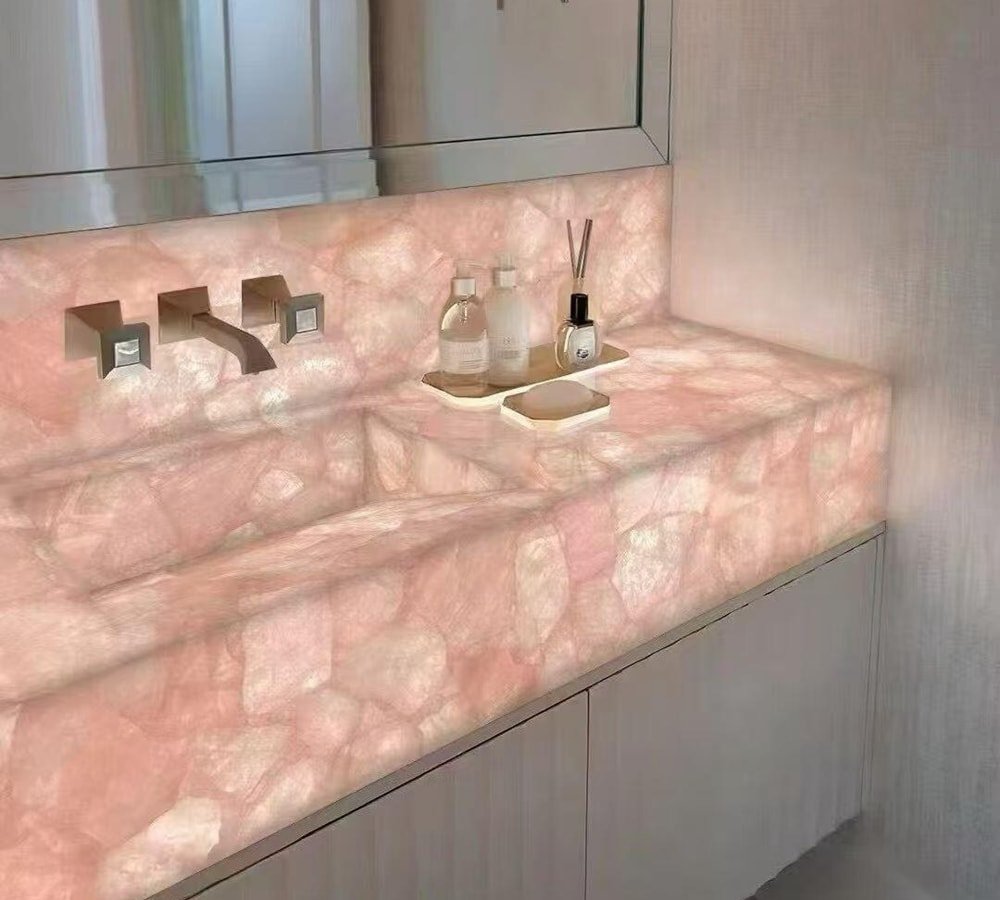
Modern backlit vanities use LED systems—SMD strips, COB panels, or flexible LED sheets—paired with diffusers to achieve even light spread. Diffusers (acrylic, polycarbonate, or frosted glass) hide hotspots and produce uniform illumination across the stone’s face.
Color temperature, dimming, and control
Warm light (2700–3200K) accentuates honey and amber onyx tones; neutral to cool whites (3500–4000K) can highlight white and grey quartzites. Dimming, tunable white, and RGB options create additional mood control for hospitality applications.
Integration and serviceability
Design for LED replacement and driver access: low-voltage drivers should be housed in accessible compartments, and LED strips should be modular, so field service or replacement doesn’t require slab removal.
Fabrication and finishing: how to prepare stone for illumination?
Optimal slab thickness and lamination
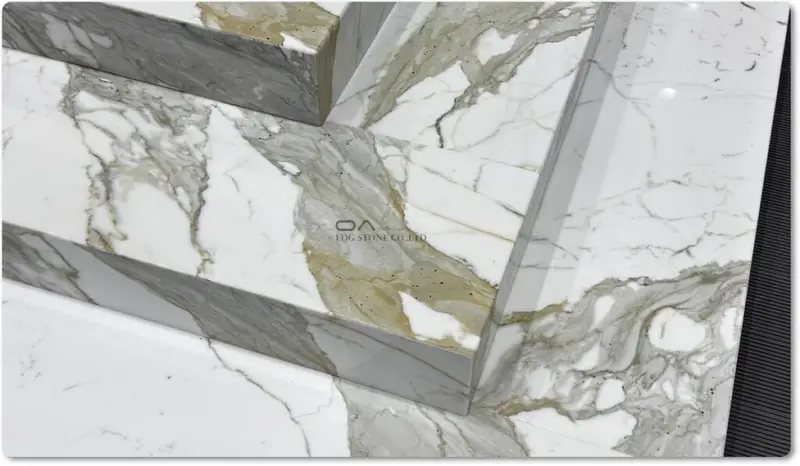
Translucent stone is typically cut thinner (6–20 mm) for backlit applications. Thin slabs often require lamination to a structural backing (resin, glass, or composite) to avoid warping or breakage. Proper lamination preserves translucency while adding rigidity.
Edge treatments and invisible seams
Seam placement, seam treatment, and edge finishing are crucial. Polished edges maximize translucency near the perimeter; invisible seams and precise butt joins reduce light leakage and maintain visual continuity.
Sink integration and cutouts
For onyx vanity tops with sink cutouts, mechanical reinforcement around apertures prevents stress cracks. For integrated sinks, consider prefabricated undermounts to maintain lighting uniformity and reduce shadowing.
Installation best practices for wet zones: vanities and showers
Substrate and mechanical support
Thin illuminated slabs require robust support: marine-grade plywood, reinforced frames, or metal brackets ensure the slab bears load safely. Overhangs should be minimized or reinforced.
Waterproofing and IP ratings
LED systems within bathroom installations should comply with local electrical and IP protection ratings. Low-voltage systems should still be protected from moisture ingress with proper housing and gaskets.
Maintenance access and LED lifetime planning
Plan for driver and LED access panels to simplify servicing. Use long-life LEDs rated for 50,000+ hours and provide clear maintenance instructions to end users.
Safety, regulations, and industry compliance
Electrical and product safety standards
LED drivers, power supplies, and fixtures should meet national and international standards (for example, CE, RoHS, and IEC safety norms where applicable). Specifications must ensure compliance with local electrical codes for low-voltage installations in bathrooms.
Fabrication health & safety
Fabricators must control silica dust during cutting and finishing by using wet cutting, local extraction, and PPE—this is essential to meet occupational safety standards and to qualify as a reputable supplier for international projects.
Export and procurement considerations
Hotel chains and large procurement teams increasingly request supplier documentation—material test reports, emission data, and compliance certificates—as part of due diligence.
Sustainability and ethical sourcing trends
Quarrying impact and traceability
Purchasers increasingly demand transparency about quarry impact, reclamation, and workforce practices. Suppliers with traceable supply chains and responsible quarry management are preferred for large hospitality and commercial projects.
Production waste and water use
Best-practice factories recycle water used in slurry management and reduce waste via optimized cutting layouts and upcycling offcuts into smaller products.
ESG as procurement criteria
Large buyers often require ESG data and sustainability reporting—factory-level certifications and environmental policies help secure factory-direct wholesale contracts.
Pricing drivers: what affects the Light-up Quartz countertop price?
Material rarity and translucency grade
Higher-translucency onyx and rare translucent quartzite command premium prices. Color consistency and unique veining patterns can drive cost even higher.
Thickness, lamination, and LED system complexity
Thin slabs requiring complex lamination and diffusion systems cost more. Custom diffusers, dimmable drivers, and advanced control systems add to the total installed price.
Freight, packaging, and warranty
Fragile backlit slabs require specialized crating and shock-proof packaging. Insurance, freight, and installation warranties increasethe total landed cost for factory/wholesale buyers.
Buying guide: how wholesalers, designers, and hotels source backlit stone
Evaluating manufacturers and factories
Request factory photos, sample panels with the intended LED system, test cuts verifying translucency, and QC reports. Ask for lighting mockups to preview the final appearance.
MOQ, lead times, and negotiation points
Factory-direct sourcing often reduces unit price but may require minimum order quantities for slabs and lighting components. Negotiate sample allowances, LED warranties, and replacement parts supply.
Pre-shipment inspection checklist
Confirm slab flatness, lamination quality, LED uniformity, driver documentation, and packaging standards before shipment.
Comparative analysis: onyx countertop vs quartz and other backlit materials
Visual vs functional trade-offs
Onyx delivers maximum translucency and dramatic effect; engineered backlit panels (resin or sintered composites) offer uniformity and lower risk. Quartzite sits between these extremes—less translucent than onyx but far more durable.
Lifecycle cost and application matrix
For high-traffic hotel bathrooms, quartzite-backed illuminated panels often offer the best balance of beauty and durability. For signature features and lower-traffic installations, true backlit onyx provides unmatched visual impact.
Case studies (mini): three real-world scenarios
Boutique hotel vanity feature
A boutique hotel installed bookmatched backlit onyx vanities in VIP suites. The visual response increased the perceived suite value; however, the onyx required a strict maintenance regime and LED driver access planning for rapid maintenance during guest turnover.
Residential master bathroom
A private residence used thin laminated quartzite with warm backlighting for a floating vanity. The owner prized the material’s resilience; the piece had minimal maintenance and held up strongly to daily use.
Spa and wellness center
A spa chose backlit high-translucency quartzite for vanity and niche walls. The stone’s durability stood up to humidity and cleaning cycles; the lighting system included dimming to support changing ambiance needs.

Market trends and sourcing signals for 2025
Demand for backlit natural stone solutions is rising, especially among boutique hotels, premium residential projects, and high-end retail. Buyers increasingly prefer factory-direct sourcing with documented compliance, sample mockups, and predictable lead times. Skilled fabricators capable of lamination and LED integration are a scarce resource; securing factory partnerships early is a competitive advantage.
FAQ — Google-hot questions (concise, helpful answers)
Q1: What is backlit onyx, and how does it differ from backlit quartzite?
A1: Backlit onyx is a thin, translucent onyx slab illuminated from behind with LED systems to reveal banding and color. It offers maximum translucency and dramatic light effects, but is softer and more fragile. Backlit quartzite uses translucent or thin quartzite varieties to achieve a subtler glow with greater hardness and durability—better for high-use vanities.
Q2: How much does a backlit onyx countertop cost?
A2: Price varies widely: cost drivers include translucency grade, slab rarity, slab thickness, lamination, LED system complexity, and shipping/installation. Backlit solutions can be significantly more expensive than standard stone tops due to lamination, custom diffusion, and electrical integration.
Q3: Can backlit stone be safely used in bathrooms and showers?
A3: Yes—if the LED system, drivers, and installation meet local electrical and IP protection standards and the stone panels are properly laminated and sealed. Plan for moisture protection, driver accessibility, and compliant electrical installation.
Q4: How do I buy backlit onyx countertops from a factory or wholesale supplier?
A4: Evaluate suppliers for factory photos, sample panels, lighting integration expertise, QC reports, and production capacity. Negotiate sample panels, minimum order quantities, lead times, LED warranties, and packaging for export.
Q5: What maintenance do onyx countertops with lights require?
A5: Onyx requires gentle cleaning with pH-neutral cleaners, periodic resealing, and careful use to avoid scratches or stains. LED systems need periodic checks, and drivers should be accessible for replacement. Maintain a documented maintenance schedule.
Semantic Closure: Backlit Onyx & Quartzite Vanities — How / Why / What / Options / Considerations
Why: Backlit stone converts functional surfaces into emotional focal points—boosting perceived value, supporting brand differentiation in hospitality, and enabling unique residential experiences. Quartzite offers long-term resilience; onyx provides maximum drama.
What: Typical configurations include backlit vanity tops with integrated sinks, illuminated wall panels, and waterfall vanities. Key components are slab translucency grade, LED type, diffuser choice, lamination method, and installation detailing.
Options: True onyx for the highest translucency, high-translucency quartzite for durability, or engineered illuminated composite panels for predictable uniformity. Lighting options include tunable white, dimmable drivers, and RGB for accent modes.
Considerations: Prioritize supplier transparency (test panels and factory photos), ensure electrical and IP compliance for bathrooms, plan LED service access, insist on silica-dust controls in fabrication, and evaluate total lifecycle cost rather than upfront price alone.