Executive Summary
The global engineered quartz stone market is transitioning toward high-purity silica formulations, automated slab compaction, and strict environmental compliance. Procurement managers, commercial project directors, and stone distributors face volatile shipping costs, shifting international trade tariffs, and variable manufacturing standards.
This comprehensive guide serves as the definitive 2026 pillar framework for sourcing engineered white quartz slabs and fabricated countertops. It outlines exact material specifications, factory evaluation metrics, contract protection strategies, quality control (QC) protocols, and global supply chain logistics. By applying these standards, commercial buyers can mitigate procurement risks, ensure structural compliance, and optimize landed costs across large-scale developments.
Key Takeaways
Material Specification Balance: Premium engineered quartz requires a precise ratio of 90–93% natural quartz aggregate to 7–10% unsaturated polyester resin by weight. Deviations cause yellowing or brittle slabs.
Standardization Standards: Specify compliance with ASTM C97 (Absorption/Density), ASTM C170 (Compressive Strength), and European EN 15388 benchmark testing.
Slab Inspection Rule: Enforce a maximum batch variance of $\Delta E < 0.5$ for white quartz backgrounds across all project phases to eliminate visible color shifting.
Tariff & Logistics Optimization: Mitigate regional trade barriers by utilizing anti-dumping compliant sourcing routes and optimized 20ft container loadouts (typically 7 slabs of 20mm or 4 slabs of 30mm per bundle, totaling up to 105–115 slabs per container based on weight limits).
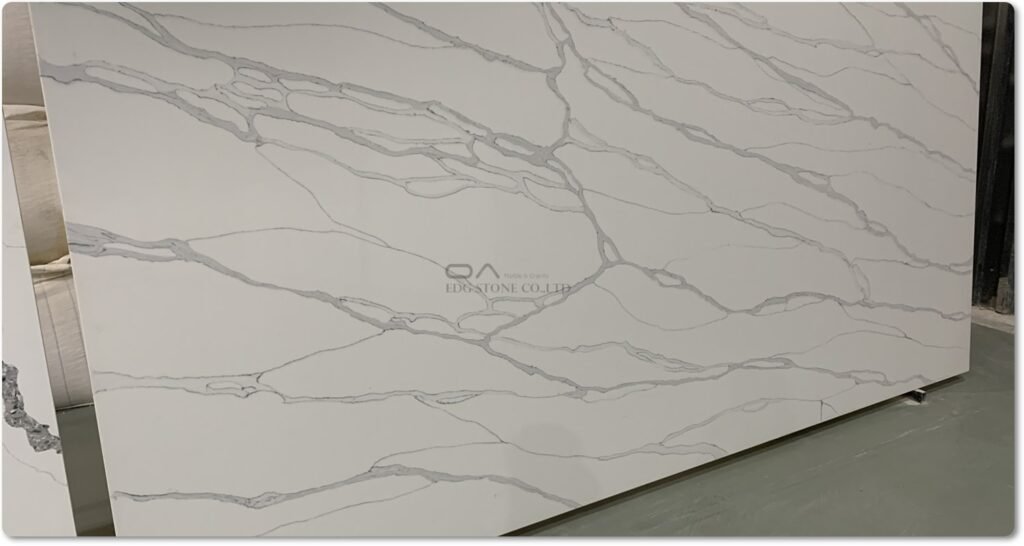
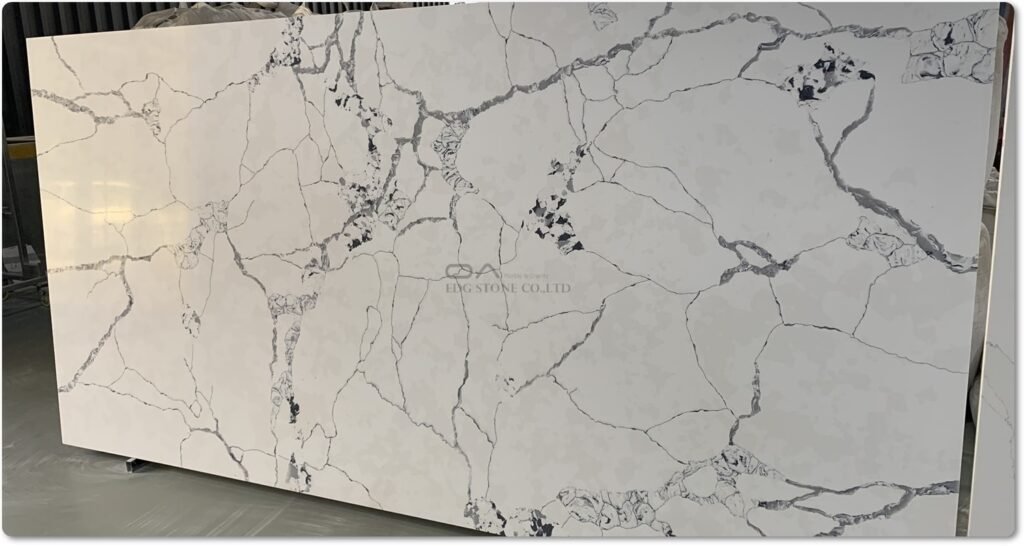
OEM Customization: Partner with direct manufacturers capable of custom vector-matching for calacatta and carrara veining using automated digital jet printing combined with deep-vein pressing.
Definition: Engineered White Quartz Stone
Engineered White Quartz is a composite material manufactured by vacuum-compacting high-purity natural quartz silica aggregates ($SiO_2 \ge 99.5\%$), unsaturated polyester resins, pigments, and binding agents under heavy vibro-compaction pressure (typically $\ge 100$ tons) and elevated thermal curing temperatures ($80^\circ\text{C} – 100^\circ\text{C}$).
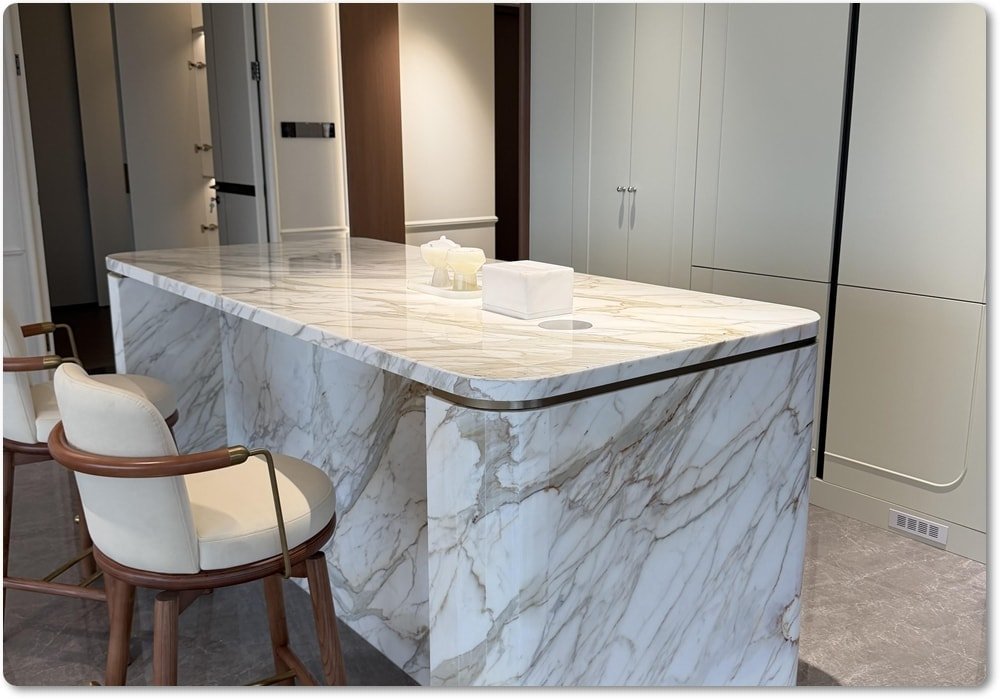
Unlike natural quartzite or granite, engineered quartz is non-porous, highly stain-resistant, and chemically stable. Commercial procurement focuses heavily on pure white base tones (e.g., Pure White, Super White) and veined aesthetics (e.g., Calacatta White, Carrara White).
   Raw Quartz Aggregate (90-93%) ──┐
   Polyester Resin (7-10%)       ──┼─► [Vibro-Compaction Press] ──► [Thermal Cure] ──► [Calibration & Polish]
   Pigments & Additives (<1%)    ──┘       (100+ Tons Vacuum)           (80-100°C)          (Waterjet/Grit)
Material & Market Statistics
Commercial buyers must ground strategic procurement decisions in hard industry data. Below are verified performance indicators and market figures for 2026:
| Parameter / Metric | Industry Standard Value | Source / Benchmark |
| Global Quartz Market Size (2026 Est.) | $11.2 Billion | Grand View Research / Freedonia Group |
| Required Silica Content ($SiO_2$) | $\ge 99.5\%$ Pure Silica Aggregates | ASTM C170 Material Guidelines |
| Water Absorption Rate | $\le 0.03\%$ by weight | EN 14617-2 Test Standards |
| Mohs Hardness Rating | 6.5 to 7.0 | Mohs Hardness Scale Criteria |
| Flexural Strength | $40 – 55 \text{ MPa}$ | ASTM C880 Flexural Testing |
| Density | $2,350 – 2,450 \text{ kg/m}^3$ | ISO 10545 Physical Testing |
| Allowable Color Difference ($\Delta E$) | $< 0.5$ across a single production batch | CIELAB Color Space Standard |
Core Knowledge Cluster: Sourcing Modules
1. White Quartz Basics & Material Comparison
Understanding the structural and chemical differences between surface materials prevents premature failure on commercial job sites.
+---------------------------------------------------------------------------------------+
|                                  MATERIAL COMPARISON                                  |
+----------------───────+───────────────────────+───────────────────+───────────────────+
| Feature               | Engineered Quartz     | Natural Granite   | Natural Quartzite |
+----------------───────+───────────────────────+───────────────────+───────────────────+
| Composition           | 90-93% Quartz + Resin | Natural Igneous   | Metamorphic Quartz|
| Water Absorption      | < 0.03% (Non-porous)  | 0.1% - 0.5%       | 0.05% - 0.2%      |
| Stain Resistance      | Very High             | Moderate          | High              |
| UV Resistance         | Low to Moderate       | High              | High              |
| Mohs Hardness         | 6.5 - 7.0             | 6.0 - 6.5         | 7.0               |
| Chemical Resistance   | Resistant to acids    | Vulnerable to acid| High              |
| Maintenance           | Zero Sealing          | Periodic Sealing  | Periodic Sealing  |
+----------------───────+───────────────────────+───────────────────+───────────────────+
Pros and Cons of Engineered White Quartz
Pros
Non-Porous Surface: Does not harbor bacteria or absorb spillages such as wine, coffee, or oil.
Color Consistency: Uniform aesthetics make large-scale, multi-unit project installation predictable.
Low Maintenance: Requires no periodic sealants, specialized stone soaps, or wax coatings.
High Mechanical Strength: Resists chipping, cracking, and scratching during transit and installation.
Cons
UV Sensitivity: Direct sunlight exposure breaks down resin bonds, causing yellowing over time.
Thermal Shock Limit: Sudden placement of hot pots ($> 150^\circ\text{C} / 300^\circ\text{F}$) can thermal-crack the resin matrix.
Weight Limits: Heavy slabs require strong cabinetry substructures during architectural integration.
2. Color Selection & Aesthetics
Commercial quartz procurement centers on three primary color aesthetics:
Pure/Super White: Monochromatic, ultra-clean aesthetic requiring zero black spots or resin pooling.
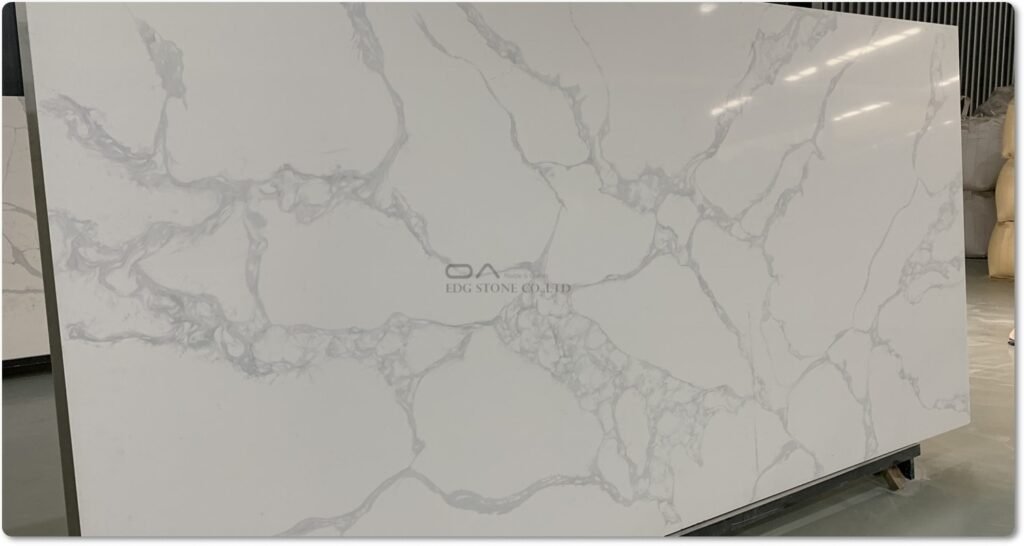
Carrara Quartz: Soft, micro-feathered grey veining across a warm-white background.
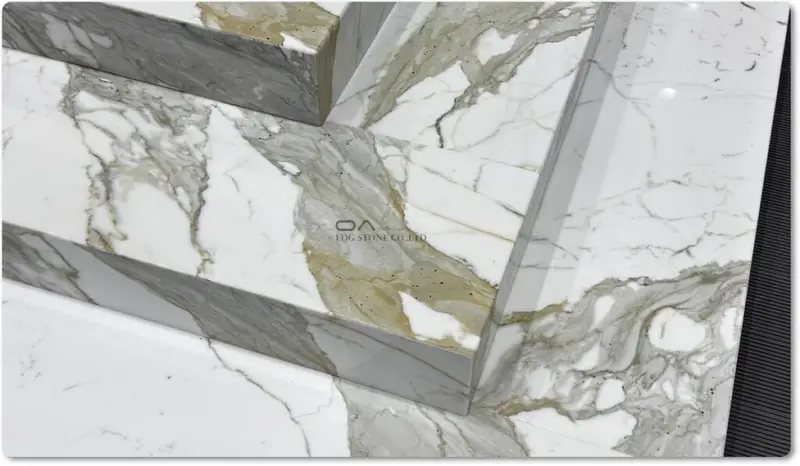
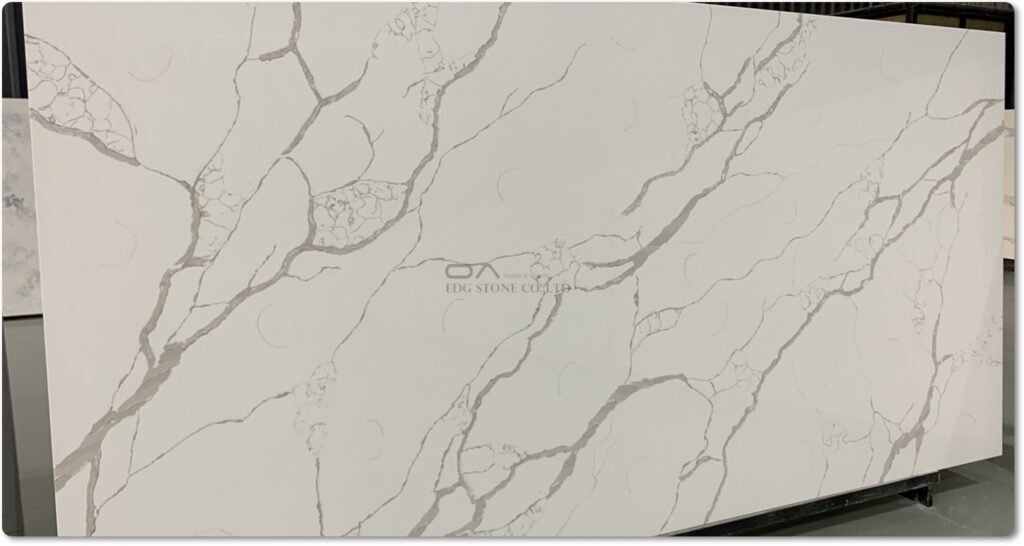
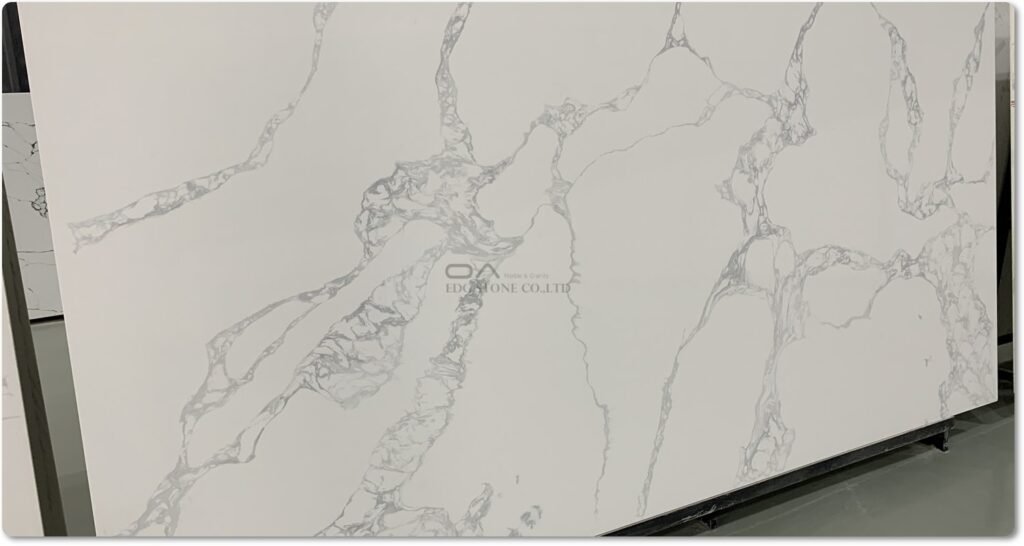
Calacatta Quartz: Bold, dramatically defined veining with warm or grey undertones mirroring natural Italian marble.
  [ Pure White ]           [ Carrara Quartz ]           [ Calacatta Quartz ]
 ┌──────────────┐         ┌──────────────────┐         ┌────────────────────┐
 │  Solid Bright│         │ Fine Soft Veins  │         │ Bold Striking Veins│
 │  Clean Look  │         │ Subtle Grey Tone │         │ Dramatic Contrast  │
 └──────────────┘         └──────────────────┘         └────────────────────┘
Color Difference Control Protocol ($\Delta E$)
To maintain color uniformity across thousands of square meters, enforce the CIELAB Color Scale:
Where:
$L^*$ represents lightness ($0 = \text{black}, 100 = \text{pure white}$)
$a^*$ represents the red/green axis
$b^*$ represents the yellow/blue axis
A threshold of $\Delta E < 0.5$ ensures that adjacent countertop slabs reveal no visible shade difference under standard architectural illumination ($500 \text{ Lux}$, $4000\text{K}$ color temperature).
3. Countertop Buying & Commercial Projects
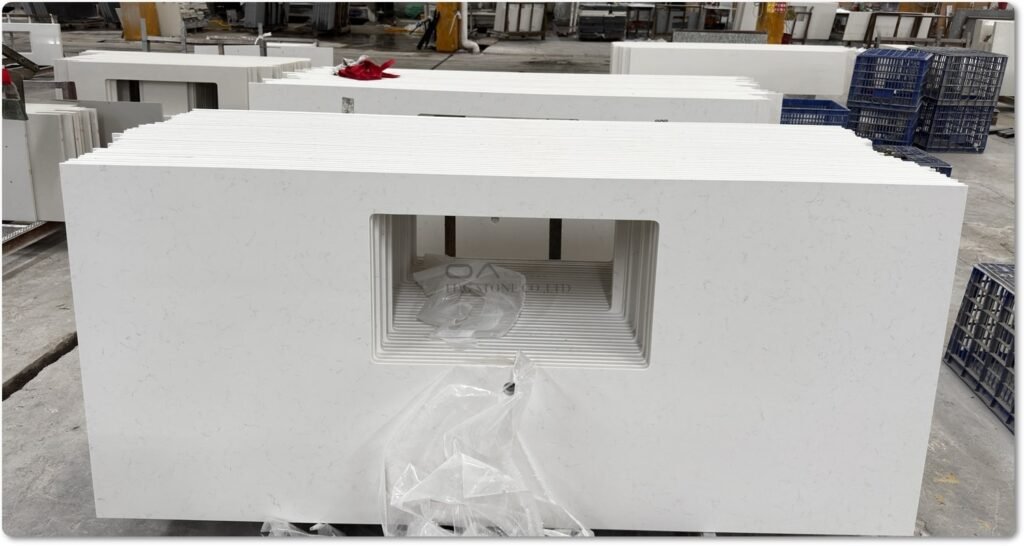
When specifying countertops for hotels, multi-family residential towers, or healthcare facilities, procurement managers must evaluate edge profiles, cutout tolerances, and slab yields.
       Eased Edge              Beveled Edge             Bullnose Edge
     ┌──────────────┐         ┌──────────────┐         ┌──────────────┐
     │              │         │ /            │         │ (            │
     │              │         │/             │         │  )           │
     └──────────────┘         └──────────────┘         └──────────────┘
Standard Edge Profiles & Fabrication Tolerances
Eased (Flat) Edge: Standard cost-effective profile for high-density multi-family projects.
Beveled Edge ($45^\circ$): Reduces edge-chipping risks in high-traffic commercial environments.
Laminated Mitered Edge ($40\text{mm} – 50\text{mm}$): Creates the visual appearance of a thick monolithic stone block without excessive weight.
Fabrication Tolerances
Length and Width Variance: $\pm 1.0\text{ mm}$
Diagonal Variance: $\pm 1.5\text{ mm}$
Sink Cutout Radius: $\pm 0.5\text{ mm}$ (CNC waterjet cut)
Flatness Warpage: $< 0.1\%$ across total slab length
4. Factory Manufacturing & QC Standards
Factory inspection requires evaluating both raw material quality and machine technology.
Raw Material Inspection
       │
       ▼
Automated Batching & Mixing
       │
       ▼
Vibro-Compaction Pressing (Vacuum ≥ 100 Tons)
       │
       ▼
Thermal Curing Tunnel (80-100°C)
       │
       ▼
Thickness Calibration & Multi-Head Polishing
       │
       ▼
Final QC (Defect Inspection & Color Matching)
Critical Production Audit Checkpoints
Vibro-Compaction System: Ensure the factory operates heavy-duty presses that achieve complete air evacuation to prevent internal micro-voids.
Polishing Lines: Facilities with 20+ automated polishing heads deliver a surface gloss reading above 85-90 GU (Gloss Units) without chemical waxes.
Resin-Treated Backing: Verify high-purity backing resins that resist warping during calibration.
5. International Shipping & Logistics Strategy
Transporting quartz slabs involves high payload weights and fragile cargo handling.
  Top View: 20ft Container Load Distribution
  ┌──────────────────────────────────────────┐
  │ [Bundle 1]  [Bundle 2]  [Bundle 3]       │ ◄── A-Frame Steel Racks
  │   (20mm)      (20mm)      (20mm)         │
  │ ══════════  ══════════  ══════════       │ ◄── Heavy Duty Wood Blocking
  └──────────────────────────────────────────┘
Container Loading Capacity Guidelines (20ft Heavy Container)
| Slab Thickness | Weight Per Slab (3200×1600mm) | Slabs Per Bundle | Total Slabs Per 20ft Box | Total Weight (Approx.) |
| 15 mm | $\approx 185 \text{ kg}$ | 10 Slabs | 140 Slabs | 25,900 kg |
| 20 mm | $\approx 245 \text{ kg}$ | 7 Slabs | 105 Slabs | 25,725 kg |
| 30 mm | $\approx 368 \text{ kg}$ | 4 Slabs | 70 Slabs | 25,760 kg |
Note: Verify maximum road weight limits in the destination country (e.g., U.S. Federal Bridge Formula limits vs. European port limits).
6. Procurement Checklist, Contracts & Risk Management
To prevent commercial disputes, include these critical technical specifications in every Purchase Order (PO):
1. Specify Material Performance Standards:
Mandate $SiO_2 \ge 99.5\%$, resin ratio $\le 9\%$, water absorption $\le 0.03\%$, and Mohs hardness $\ge 6.5$.
2. Lockdown Surface Defect Limits:
Zero pinholes $> 0.5\text{mm}$, no resin spots $> 2.0\text{mm}$, maximum 1 contamination spot per $5\text{m}^2$.
3. Establish Color Matching Thresholds:
Mandate $\Delta E < 0.5$ between slabs within the same batch. Require dry-lay batch matching before container loading.
4. Define Crate & Shipping Requirements:
Enforce I15-compliant heat-treated wood A-frames, fumigation certification, and rust-proof steel strapping.
5. Structure Milestone Payment Terms:
30% Deposit upon PO confirmation, 60% upon third-party factory QC pass, and 10% against clean Bill of Lading (B/L) presentation.
7. Import Documentation & OEM / Private Label
Mandatory Import Documents
Commercial Invoice & Packing List: Accurate net/gross weights and square meter totals.
Bill of Lading (B/L): Clean on-board ocean shipment documentation.
Certificate of Origin (Form E / CO): Critical for determining preferential tariff rates.
Fumigation Certificate: Mandatory for raw timber crates under ISPM 15 rules.
Material Safety Data Sheet (MSDS): Outlines crystalline silica content and handling safety protocols.
OEM & Private Label Solutions
Custom distributors can request custom bundle stamping, protective film branding, and specific slab sizing (e.g., Jumbo Slabs $3300 \times 1900\text{mm}$) to build brand equity and optimize local fab yields.
EDG Stone Factory: Global Sourcing Case Study
When sourcing quartz globally, choosing the right manufacturing partner dictates project success. EDG Stone Factory serves as a premier manufacturer and exporter of quartz slabs and fabricated countertops for international developers and stone wholesalers.
                    ┌─────────────────────────────────────────┐
                    │            EDG STONE FACTORY            │
                    └────────────────────┬────────────────────┘
                                         │
        ┌────────────────────────────────┼────────────────────────────────┐
        ▼                                ▼                                ▼
┌──────────────────┐            ┌──────────────────┐            ┌──────────────────┐
│ Advanced Tech    │            │ Rigorous QC      │            │ Commercial OEM   │
│  • Italian Press │            │  • ΔE < 0.3      │            │  • Custom Cut    │
│  • 90-93% Silica │            │  • Zero-Pinhole  │            │  • Private Label │
└──────────────────┘            └──────────────────┘            └──────────────────┘
Factory Manufacturing Excellence
Advanced Machinery: Operates automated vibro-compaction presses generating over 100 tons of pressure, eliminating micro-voids and achieving structural density up to $2,420 \text{ kg/m}^3$.
Color Consistency: Maintains precise raw material dosing equipment to achieve a strict color variance rating of $\Delta E < 0.3$ between production lots.
Precision Fabrication: Features multi-axis CNC waterjets and automated edge-polishing lines capable of handling large-scale commercial hotel and apartment orders.
Commercial Compliance & Delivery
EDG Stone Factory provides complete documentation packages—including ASTM, EN, and ISO testing reports—along with customized ISPM 15 wooden bundle packaging for secure ocean shipping.
Step-by-Step Practical Sourcing Workflow
Step 1: Specification
  └─ Define ASTM/EN specs, color matching (ΔE < 0.5), slab size, and edge profiles.
Step 2: Supplier Vetting
  └─ Audit factory machinery, resin/silica ratios, and third-party certifications.
Step 3: Sample Approval
  └─ Confirm physical sample, verify gloss levels (≥85 GU), and run acid-stain testing.
Step 4: Contract & PO
  └─ Include defect limits, milestone payment terms, and ISPM 15 packing rules.
Step 5: QC Inspection
  └─ Perform pre-shipment inspection: thickness calibration, dry-lay, and warpage check.
Step 6: Logistics & Customs
└─ Review B/L, Certificate of Origin, packing list, and manage port weight limits.Detailed Knowledge Cluster Q&A
Question 1: How do I prevent yellowing in pure white quartz slabs?
Answer
Select engineered quartz manufactured with high-purity, UV-stabilized unsaturated polyester resins, and maintain silica aggregate purity at $\ge 99.5\%$. Avoid placing white quartz in direct outdoor sunlight.
Evidence
Resin degradation occurs when ultraviolet radiation breaks down unlinked polymer chains within lower-grade resins. Studies according to EN 14617-10 show that acrylic-modified polyester resins with added UV absorbers resist color shifting up to 3x longer than low-grade industrial resins.
Summary
Yellowing is prevented at the raw-material level through UV-stabilized resins and proper indoor application.
Question 2: What is the optimal slab thickness for commercial countertop projects?
Answer
For North American and European commercial projects, 20mm ($3/4″$) and 30mm ($1-1/4″$) are the industry standards. 20mm is preferred for cost and weight efficiency in multi-family apartments, while 30mm is preferred for high-end luxury hospitality.
Evidence
ASTM C880 tests show that 20mm engineered quartz achieves flexural strength exceeding $45 \text{ MPa}$, which easily supports standard counter spans when installed over perimeter cabinet framing.
Summary
Use 20mm for high-yield multi-family builds and 30mm for premium installations requiring solid edge profiles without lamination.
Question 3: How do I calculate total container payload limits for engineered quartz?
Answer
Determine the slab weight using the formula: $\text{Weight} = \text{Length} \times \text{Width} \times \text{Thickness} \times \text{Density}$. Then check the ocean liner and port transit weight restrictions (typically 21,000 kg to 26,000 kg max net weight).
Evidence
For a standard $3200 \times 1600 \times 20\text{mm}$ slab with a density of $2400 \text{ kg/m}^3$:
Summary
Divide maximum allowable net freight weight by single-slab weight to determine maximum container loading capacity.
Frequently Asked Questions (FAQ)
What is the standard silica content in high-quality engineered quartz?
High-quality engineered quartz contains between 90% and 93% pure natural quartz aggregates by weight, bound together by 7% to 10% polyester resin and pigments.
How does engineered quartz compare to natural quartzite in cost?
Engineered quartz offers lower material and fabrication costs compared to natural quartzite. It provides consistent patterning and lower breakage rates during transport and cutting.
What causes pinholes or dark spots on pure white quartz slabs?
Pinholes result from incomplete air evacuation during the vibro-compaction process. Dark spots are caused by cross-contamination during raw silica grading. Advanced factories use magnetic separators and high-vacuum pressing to prevent these defects.
Is engineered quartz suitable for outdoor kitchens?
No. Standard engineered quartz resins degrade under direct outdoor UV light, causing color fading, yellowing, and surface dulling. Use specialized outdoor quartz formulations or porcelain for exterior applications.
What packing requirements prevent breakage during sea freight?
Slabs should be loaded on custom-built, heavy-duty wooden A-frames treated according to ISPM 15 standards. Bundles must be bound with rust-proof steel straps and braced inside the container using wood blocking to resist ocean motion.
Institutional References & Data Sources
ASTM International: ASTM C170 Standard Test Method for Compressive Strength of Dimension Stone.
European Committee for Standardization: EN 15388 Engineered Stone – Slabs and Cut-to-Size Products for Vanity and Kitchen Tops.
Natural Stone Institute (NSI): Dimension Stone Design Manual, Architectural Quartz Criteria.
ISO Standards: ISO 10545 Determination of Water Absorption and Density for Dense Mineral Materials.
Grand View Research: Engineered Stone Market Size, Share & Trends Analysis Report 2026.