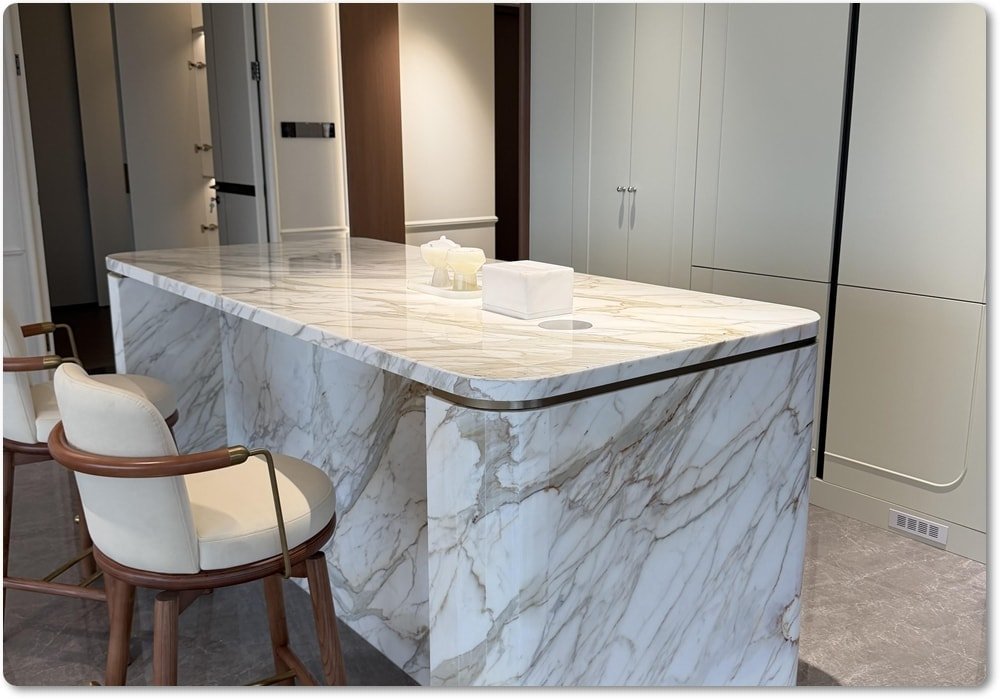
Commercial architects, interior designers, and real estate developers face high stakes when sourcing surface materials for mega-projects. Sintered stone has emerged as a premier choice for high-traffic flooring, exterior facades, and heavy-duty countertops. However, managing the supply chain for tens of thousands of square meters requires more than just picking a beautiful slab. A single supply failure, color mismatch, or structural crack can derail a multi-million-dollar project timeline.
This comprehensive white paper provides a data-driven blueprint for evaluating and choosing a sintered stone supplier for large commercial developments. It outlines critical engineering metrics, factory auditing protocols, quality control standards, and international logistics strategies required to secure an enterprise-grade partner.
1. Executive Summary: The Commercial Stakes of Sintered Stone Sourcing
Large-scale commercial projects operate under rigid timelines, strict building codes, and tight financial margins. Sintered stone—an advanced engineered material made from 100% natural minerals processed under extreme pressure ($>15,000\text{ tons}$) and temperatures ($>1200^\circ\text{C}$)—offers exceptional durability, zero porosity, and UV resistance.
Yet, the performance of the material is only as reliable as the factory that produces it. Selecting the wrong wholesale partner introduces massive financial and structural risks, including batch-to-batch color variation, warping, internal tension cracks, and catastrophic customs delays.
[Mineral Raw Materials]
         │
         ▼
[System Gea Pressing] ──► (Min. 15,000 Tons of Pressure)
         │
         ▼
[Kiln Sintering]       ──► (Controlled Heating >1200°C)
         │
         ▼
[Finished Sintered Stone Slab]
Key Procurement Risk Matrix
| Risk Factor | Commercial Impact | Mitigation Strategy |
| Batch Color Variation ($\Delta E_{ab} > 1.0$) | Rejected handovers, mismatched panels. | Enforce spectrophotometer testing per batch. |
| Internal Tension & Warping | Slabs crack during on-site fabrication or cutting. | Verify extended annealing Lehr runtime in kilns. |
| Delays in the Port of Discharge | Liquidated damages from general contractors. | Partner with suppliers holding verified export experience. |
| Structural Facade Failure | Life safety hazards, massive liability lawsuits. | Mandate ASTM/EN mechanical testing certificates. |
2. Supplier Evaluation Framework: Auditing the Manufacturer
Procurement teams must separate front-end trading companies from true original equipment manufacturers (OEM). While trading entities offer variety, they cannot control production schedules, raw material consistency, or custom technical specifications.
The Three-Tier Supplier Audit Hierarchy
Tier 1: Primary Producers (The Factory): Owns continuous press systems (e.g., Sacmi Continua+), operates multi-layer drying kilns, and controls raw material quarries. Best for wholesale pricing and massive volume stability.
Tier 2: OEM/Customization Specialists: Utilize primary press lines but specialize in advanced surface finishing, CNC cutting, and pre-drilled mechanical anchoring systems for facades.
Tier 3: Distributors & Local Wholesalers: Best for small fills or immediate local stock, but unsuitable for large-scale, cost-optimized commercial contract procurement.
When vetting a sintered stone supplier, your engineering and procurement teams should utilize a standardized scoring matrix:
Supplier Evaluation Score (100 pts) =
  (Production Capacity × 0.25) +
  (Quality Control Systems × 0.25) +
  (Certificates & Compliance × 0.20) +
  (Project & Export Experience × 0.20) +
  (Customization Flexibility × 0.10)
3. Production Capacity and Factory Technology Standards
A sintered stone supplier cannot support a commercial skyscraper or airport terminal without massive, automated output. If a production line stops due to equipment failure, your project schedule collapses.
Press Machine Engineering
True sintered stone requires a belt-pressing system or a high-tonnage moldless press. Look for factories operating Sacmi Continua+ 2000, 3000, or 5200 systems or System Lamgea presses. These machines exert a minimum specific pressure of $450\text{ kg/cm}^2$, eliminating internal air pockets and ensuring a uniform density of approximately $2.4\text{ to }2.5\text{ g/cm}^3$.
Kiln Length and Annealing Time
The length of the roller hearth kiln directly dictates the structural stability of the slabs.
Short kilns ($<200\text{ meters}$) force slabs through rapid heating and cooling cycles, trapping internal stress. When workers cut these slabs on-site, they crack instantly.
Advanced factories utilize kilns spanning 400 to 700 meters. This extended path allows for a precise, gradual cooling zone (annealing Lehr), eliminating internal tension.
[Kiln Entrance] ──► [Rapid Heating Zone] ──► [Sintering Peak (1200°C)] ──► [Slow Annealing Zone (Stress Relief)] ──► [Exit]
   (0 meters)           (150 meters)              (350 meters)                 (550 meters)              (700 meters)
Daily Output Verification
Ensure the plant runs at least two dedicated sintered stone lines with a verified daily capacity exceeding 10,000 square meters per line. This ensures they can fulfill large commercial orders without delaying existing wholesale accounts.
4. Certification and Technical Compliance Matrix
Commercial buildings require absolute compliance with regional building codes. Never accept a supplier’s internal test reports. Demand third-party certifications from accredited international bodies such as SGS, Intertek, or TÜV Rheinland.
Critical Engineering Standards for Sintered Stone
| Physical Property | Required Standard (US) | Required Standard (EU) | Target Commercial Metric |
| Water Absorption | ASTM C373 | EN ISO 10545-3 | $\le 0.05\%$ (Impervious) |
| Flexural Strength (Modulus of Rupture) | ASTM C648 | EN ISO 10545-4 | $\ge 45\text{ N/mm}^2$ |
| Mohs Hardness | – | EN 101 | Grade 6 – 7 |
| Chemical Resistance | ASTM C650 | EN ISO 10545-13 | Class UA / ULA (High Resistance) |
| Slip Resistance (Flooring) | ANSI A326.3 (DCOF) | DIN 51130 | $\text{DCOF} \ge 0.42$ (Wet environments) / R10-R11 |
| Linear Thermal Expansion | ASTM C372 | EN ISO 10545-8 | $\le 6.5 \times 10^{-6}\text{ K}^{-1}$ |
Environmental and Structural Certifications
Greenguard Gold: Validates zero VOC emissions for interior healthcare and educational facilities.
CE Marking: Mandatory for European structural and wall cladding applications.
NSF/ANSI 51: Critical if the sintered stone serves as countertops or food preparation zones in commercial kitchens and hotels.
5. Quality Control (QC) Protocols and Batch Consistency
For large commercial jobs, consistency across $50,000\text{ square meters}$ is paramount. A high-quality factory deploys continuous inline scanning alongside manual inspection teams.
Production Flow ──► [Inline Laser Thickness Scan] ──► [Digital Color Spectrophotometer] ──► [Ultrasonic Flaw Detector] ──► [Final Packing]
Three-Step QC Inspection Workflow
1. Color Consistency ($\Delta E$ Control)
Natural mineral variations alter slab shade colors between production batches. Elite suppliers track color drift with electronic spectrophotometers. For commercial handovers, enforce a contract clause stating:
Any variation above this threshold is visible to the naked human eye under ambient architectural lighting.
2. Dimensional Tolerance Check
Slabs must display near-perfect flatness to prevent lippage during large-format floor installations.
Thickness Tolerance: Within $\pm 0.3\text{ mm}$.
Edge Straightness: Within $\pm 0.2\%$.
Surface Flatness (Warping): Within $\pm 0.2\%$.
3. Internal Fissure Detection
High-end factories route finished slabs through automated ultrasonic or laser scanning booths to detect micro-cracks or internal air bubbles hidden beneath the surface glaze.
6. Project and Export Experience: Navigating International Logistics
Production capability means nothing if the material arrives at the job site shattered or delayed by customs disputes.
Heavy-Duty Packaging Design
Sintered stone slabs are massive; an $11\text{ mm}$ thick $1600 \times 3200\text{ mm}$ slab weighs approximately $140\text{ kg}$. Suppliers must use heavy-duty, fumigated A-frame wood or steel racks lined with high-density EPE foam padding. Racks must feature secure steel strapping to prevent movement inside ocean containers during transit.
Structural Loading Limits
20GP Container: Typically holds 3 to 4 A-frames (approx. 150 to 200 slabs of 12mm thickness, depending on port weight limits).
Ensure the vendor understands regional highway load limits (e.g., the United States Overweight Corridor limits for specific ports like Los Angeles or Houston).
+------------------------------------------+
|  [A-Frame Rack]  [A-Frame Rack]  [Foam]  |  <-- Reinforced Steel Strapping
|  <-Slabs Side->  <-Slabs Side->          |  <-- Timber Bracing to Container Walls
+------------------------------------------+
|============== 20GP Container ============|
Documentation and Customs Compliance
Experienced global exporters provide complete, transparent documentation to prevent port holds:
Clean Bills of Lading (BL)
Itemized Packing Lists with explicit batch/crate correlation
Certificates of Origin (CO) for regional tariff optimization
Material Safety Data Sheets (MSDS) detailing crystalline silica management metrics
7. Customization and OEM Capabilities
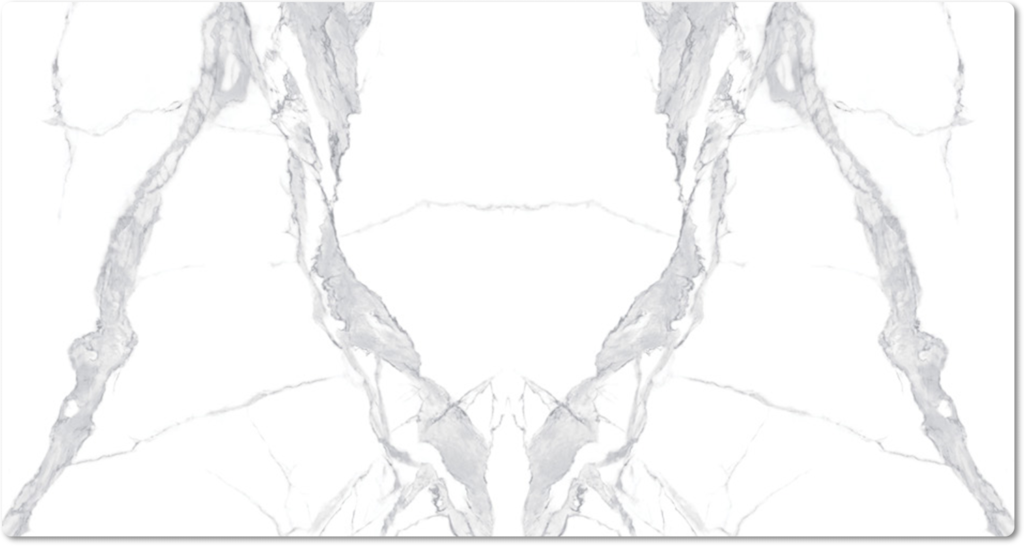
Every iconic commercial project requires unique architectural touches—whether it is a custom book-matched feature wall for a luxury hotel lobby or specific dimensions for prefabricated exterior rainscreen panels.
Aesthetic Customization
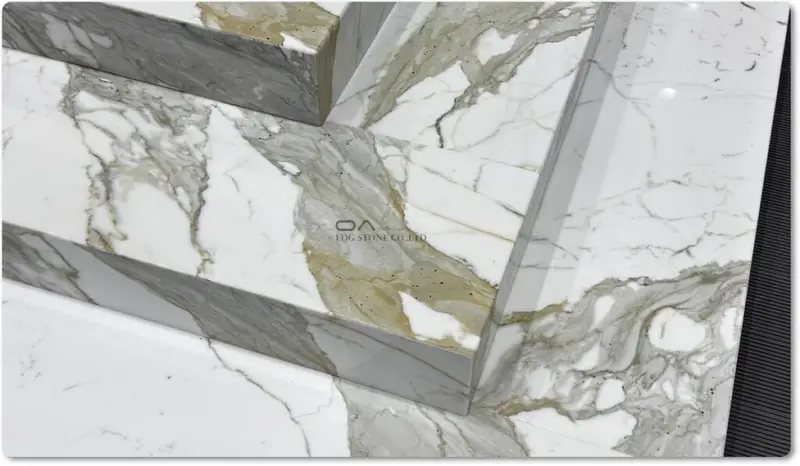
Ensure your sintered stone supplier utilizes high-resolution digital inkjet printers (e.g., System Electronics or Durst) capable of True 3D through-body veining. Avoid surfaces where the pattern sits only on the top glaze layer; exposed edges on stairs, drop aprons, and countertops will show an unpatterned blank core.
Surface Only Pattern (Low-End):       [ Vein Pattern Layer ] / [ Solid Blank Mineral Core ]
True Through-Body Sintered (High-End): [ Vein Pattern Runs Fully Through Continuous Slices ]
Fabricator-Ready Pre-Processing
Top-tier OEM factories streamline on-site labor by handling raw structural alterations inside their facilities:
Pre-cut to Size (CTS): Waterjet cutting complex panel geometries from master slabs.
Mechanical Kerf/Anchor Drilling: Preparing hidden anchors for ventilated facade systems (e.g., Fischer or Keil undercut anchor grooves).
Edge Profiles: Pre-milled mitered, eased, or bullnose profiles using precise industrial CNC machinery.
8. Case Study Module: EDG Stone Factory’s Global Supply Model
While sintered stone represents the pinnacle of modern mineral engineering, premier global projects often pair synthetic surfaces with natural stone elements to achieve maximum luxury, texture depth, and structural performance. Evaluating an industrial stone manufacturer’s capabilities across multiple materials provides a reliable indicator of their engineering precision.
A prime example of high-capacity global supply infrastructure is EDG Stone Factory, a premier global Sintered Stone Slabs & Countertops Manufacturer and Exporter.
                                [ EDG Stone Factory ]
                                          │
                  ┌───────────────────────┴───────────────────────┐
                  ▼                                               ▼
     [Premium Quartzite Slabs]                       [Commercial Prefabrication]
 - Taj Mahal, Azul Macaubas, Perla Venata        - Multi-Family Housing Units
 - Exotic Natural Veining                       - High-Traffic Hotel Countertops
 - Zero-Defect Polishing Lines                   - Advanced CNC Mitered Edges
Operational Synergy: Natural Quartzite vs. Sintered Stone
Large-scale commercial developments frequently specify both premium natural quartzite (for high-end executive boardrooms, presidential suites, and statement lobby reception desks) and engineered surfaces (for high-traffic commercial flooring and exterior walls).
EDG Stone Factory utilizes advanced block-sawing and resin-setting technologies to process dense natural quartzite materials like Taj Mahal, Perla Venata, and Azul Macaubas. The rigorous quality control matrix they use—such as robotic flat-bed polishing, strict batch sorting, and reinforced ocean-crating systems—mirrors the exact manufacturing precision required to handle and distribute elite sintered stone orders globally. Partnering with a manufacturer that commands this dual expertise ensures cross-material consistency, unified logistics routing, and reduced procurement overhead for complex, multi-material real estate developments.
9. Comprehensive After-Sales Service and Field Support
The supplier’s responsibility cannot end once the ocean freight container leaves their shipping bay. Large commercial developments require long-term operational guarantees.
Material Warranty Protection
Insist on a written commercial warranty covering 10 to 15 years. This warranty must explicitly cover structural failures like spontaneous cracking, delamination, or UV-induced fading under normal environmental exposure.
Technical On-Site Support
Top-tier enterprise vendors provide digital or in-person technical support programs:
Fabrication Guides: Providing localized fabrication shops with recommended diamond blade RPM speeds and water flow rates to cut high-density slabs without chipping.
Adhesive Compatibility Certification: Providing lists of approved structural epoxies and flexible thin-set mortars (e.g., Mapei, Laticrete) verified to bond with zero-porosity surfaces.
Claim Resolution Protocols: A transparent, contractual timeline (e.g., response within 48 hours, field inspection within 7 days) for replacing materials damaged during shipping or showing manufacturing defects.
10. Internal Knowledge Matrix: Connected Sourcing Strategies
To build a truly bulletproof supply chain, your procurement team should consult our comprehensive engineering library. Review these detailed deep dives to align your sintered stone sourcing with broader commercial interior and exterior installation strategies:
Material Logic & Technical Engineering Specs Breakdown: Discover the molecular properties, pressure tolerances, and firing profiles that differentiate architectural-grade surfaces from standard porcelain.
Comprehensive Guide to Custom Commercial Quartzite Fabrication: Read a detailed engineering breakdown of how custom natural stone slabs match up against high-performance engineered materials in high-traffic applications.
Global Logistics, Tariff Mitigation, and Port Strategy for Enterprise Buyers: Master the exact container packing configurations, international customs frameworks, and delivery protocols needed to keep commercial builds running smoothly.
11. Frequently Asked Questions (FAQ)
What is the difference between sintered stone and traditional porcelain tiles?
Sintered stone utilizes completely pure natural minerals without added resins or binding agents. It undergoes much higher mechanical pressure ($>15,000\text{ tons}$) and a longer kiln firing cycle than standard porcelain. This makes it significantly denser, harder, less brittle, and capable of true through-body patterning.
Can sintered stone be used for exterior wall cladding in freezing climates?
Yes. Thanks to its incredibly low water absorption rate ($\le 0.05\%$), moisture cannot penetrate the slabs. This eliminates the risk of water freezing, expanding, and cracking the material, making it completely frost-resistant and ideal for outdoor commercial rainscreen facades.
What is the typical lead time for a custom wholesale order of 20,000 square meters?
A high-capacity tier-1 factory generally requires 30 to 45 days for raw manufacturing, custom color formulation, and quality control processing. You should always factor in an additional 20 to 40 days for ocean transit, customs clearance, and local ground delivery to your job site.
How do you prevent lippage when installing large-format sintered stone floors?
Installers must use specialized mechanical tile leveling clip systems alongside high-performance, polymer-modified thin-set mortars (ISO 13007 Class C2S2 highly deformable adhesives). Subfloors must be leveled to a strict tolerance of less than $3\text{ mm}$ of variation across a $3\text{ meter}$ radius.
How do structural engineers secure sintered stone slabs to exterior skyscraper walls?
Architects use open or concealed mechanical fixing systems. Slabs are pre-engineered with undercut slots or kerfs at the factory, allowing them to hook securely onto aluminum alloy horizontal rail profiles. This creates a structurally sound, ventilated curtain wall that allows for natural thermal expansion and contraction.
12. Final Checklist for Commercial Procurement Managers
Before issuing a deposit wire or opening a Letter of Credit (LC) for a major commercial order, confirm that your chosen sintered stone supplier ticks every box below:
[ ] Equipment Verification: Does the factory operate a press system rated at a minimum of 15,000 tons (e.g., Sacmi Continua+)?
[ ] Independent Technical Verification: Have they provided fresh, third-party SGS or Intertek compliance test reports for ASTM and EN structural standards?
[ ] Color Management: Is there a contractually guaranteed $\Delta E_{ab}$ metric of less than 1.0 across different production batches?
[ ] Project Background: Can they provide verified case studies or bills of lading for completed commercial shipments exceeding 10,000 square meters?
[ ] Logistics Engineering: Do they use heavy-duty, reinforced A-frame crating along with integrated container wall bracing?
[ ] Warranty and Field Support: Do they back their materials with a written 10+ year commercial warranty alongside clear fabrication guidance?