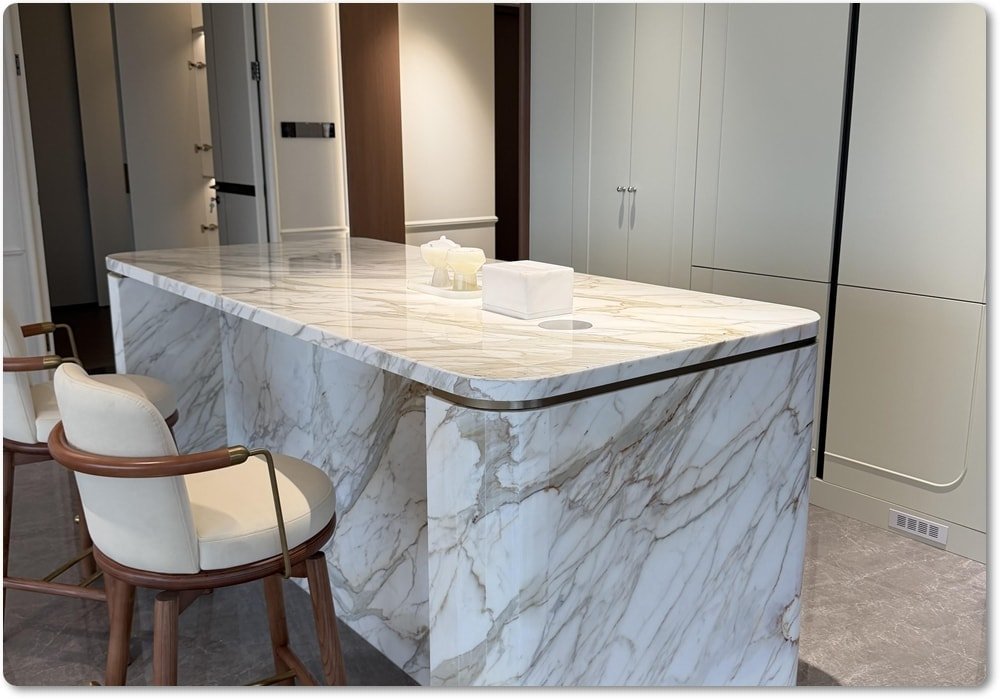
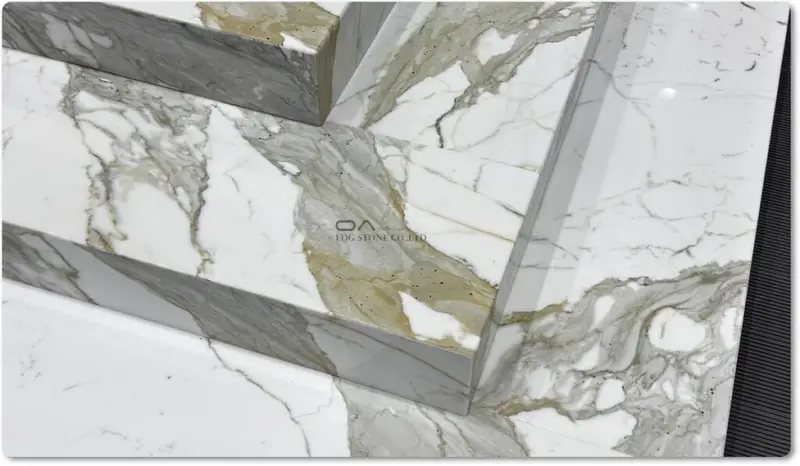
Executive Summary
Luxury interior architecture is undergoing a significant transformation as designers, developers, and procurement professionals seek materials that combine timeless aesthetics with high technical performance. While natural stones such as travertine and marble continue to symbolize elegance, modern construction increasingly demands surfaces that offer superior durability, easier maintenance, and greater consistency for large-scale projects. As a result, Travertine Sintered Stone has emerged as one of the fastest-growing categories in premium architectural surface materials.
Manufactured through advanced sintering technology using natural minerals subjected to extremely high pressure and temperatures exceeding 1,200°C, sintered stone replicates the visual characteristics of natural stone while overcoming many of its traditional limitations. Compared with conventional marble and porous travertine, travertine-look sintered stone demonstrates excellent resistance to scratches, UV exposure, stains, chemicals, and thermal shock, making it suitable for both residential and commercial environments.
According to market analyses published by organizations including Grand View Research, Fortune Business Insights, and Mordor Intelligence, the global engineered surface market—including sintered stone—is experiencing sustained growth, driven by demand from luxury residential projects, hospitality developments, healthcare facilities, retail environments, and commercial architecture. Designers increasingly specify large-format sintered stone slabs because they enable seamless installations with reduced grout lines while maintaining visual continuity throughout interior spaces.
Among the most influential design trends for 2026 are collections inspired by natural materials. Travertine-look, marble-look, concrete-look, and wood-look sintered stone offer architects the flexibility to achieve sophisticated aesthetics while meeting the stringent performance requirements of modern buildings. Bookmatched designs, ultra-large slabs, and digitally synchronized veining further enhance the ability to create visually striking feature walls, reception counters, luxury bathrooms, and premium hospitality interiors.
This white paper provides a comprehensive analysis of Travertine Sintered Stone, focusing on:
- Material science and manufacturing principles.
- The evolution of travertine-inspired architectural surfaces.
- Design applications for luxury interiors.
- Comparisons between travertine-look and marble-look collections.
- Practical considerations for architects, designers, contractors, and international buyers.
- Procurement recommendations for large commercial and hospitality projects.
Throughout this paper, technical discussions are grounded in publicly available standards and industry guidance rather than marketing claims, ensuring that readers can make informed decisions based on verified information and internationally recognized best practices.
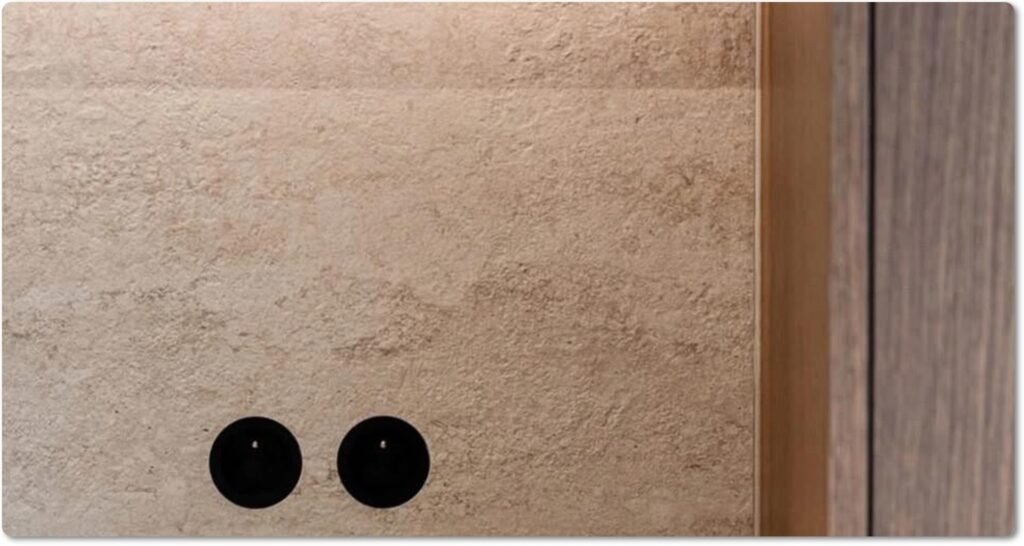
Understanding Travertine Sintered Stone
What Is Travertine Sintered Stone?
Travertine Sintered Stone is an engineered architectural surface designed to reproduce the visual appearance of natural travertine while significantly improving functional performance.
Unlike traditional ceramic tiles, sintered stone is manufactured using carefully selected mineral raw materials, including feldspar, quartz, silica, and natural clays. These materials are finely milled, pressed under extremely high pressure, and fired at temperatures exceeding approximately 1,200°C. During this process, mineral particles fuse together through sintering rather than melting completely, producing a dense and highly stable structure.
The finished slab retains the elegant linear movement, subtle pores, and warm earthy tones associated with natural travertine but exhibits substantially lower porosity and greater mechanical strength.
Why Are Designers Choosing Travertine-Look Collections?
Luxury interior design increasingly prioritizes materials that balance aesthetics with practicality. While authentic travertine remains highly valued, it presents several challenges:
- Natural pores may require filling.
- Periodic sealing is recommended.
- Acid-sensitive surfaces can etch.
- Color variation may complicate large installations.
- Large projects require consistent slab matching.
Travertine-look sintered stone addresses many of these concerns by providing:
- Consistent visual appearance.
- Predictable color control.
- Large-format production.
- Lower maintenance.
- Excellent dimensional stability.
- Improved installation efficiency.
For developers managing hotel chains or luxury residential complexes, these advantages often translate into reduced lifecycle maintenance costs while preserving premium design aesthetics.
Material Science Behind Travertine Sintered Stone
Manufacturing Technology
Modern sintered stone manufacturing combines digital surface design with advanced ceramic engineering.
The production process generally includes:
1. Raw Mineral Selection
Manufacturers begin by selecting naturally occurring minerals such as:
- Quartz
- Feldspar
- Kaolin
- Silica
- Natural pigments
Unlike resin-based engineered surfaces, these mineral compositions contain little to no organic binders in many formulations, contributing to high thermal stability.
2. Fine Milling
Raw materials are milled into micron-scale particles to achieve uniform density and color distribution.
Particle consistency directly influences:
- Surface homogeneity
- Mechanical strength
- Dimensional accuracy
- Digital print quality
3. High-Pressure Compaction
Advanced hydraulic presses compact the mineral mixture under extremely high pressure.
This process minimizes internal voids before firing and contributes to:
- Higher density
- Reduced water absorption
- Improved structural integrity
4. High-Temperature Sintering
The compacted slab passes through industrial kilns operating at temperatures typically above 1,200°C.
During firing:
- Mineral particles fuse.
- Crystalline structures stabilize.
- Mechanical properties improve.
- Internal stresses decrease.
The resulting surface closely resembles the natural geological processes that form stone over geological time, but within a controlled industrial environment.
Physical Performance
Although technical properties vary among manufacturers and product lines, high-quality sintered stone generally demonstrates:
Low Water Absorption
Very low water absorption contributes to:
- Improved freeze-thaw resistance.
- Better stain resistance.
- Enhanced hygienic performance.
- Reduced moisture-related deterioration.
Scratch Resistance
Dense mineral structures provide excellent resistance to surface abrasion during everyday use, making travertine-look collections suitable for:
- Hotel reception desks
- Kitchen countertops
- Commercial flooring
- Retail environments
UV Stability
Because color is created using inorganic pigments fired into the slab, high-quality sintered stone typically exhibits excellent resistance to ultraviolet degradation, enabling applications in both indoor and outdoor environments.
Thermal Resistance
Sintered stone tolerates high service temperatures significantly better than many polymer-based engineered materials.
Common applications include:
- Fireplace surrounds
- Outdoor kitchens
- Commercial food preparation areas
- Restaurant countertops
Chemical Resistance
Dense surfaces reduce susceptibility to many household chemicals and common cleaning agents.
However, manufacturers should always be consulted regarding compatibility with concentrated industrial chemicals.
Environmental Performance
Sustainability has become a central consideration in contemporary architecture.
Travertine-look sintered stone contributes to environmental objectives through several characteristics:
- Long service life.
- Low maintenance requirements.
- Reduced replacement frequency.
- Potential compatibility with green building certifications depends on manufacturer documentation.
- Efficient use of mineral resources during production.
Many manufacturers also publish Environmental Product Declarations (EPDs) and Life Cycle Assessments (LCAs), allowing architects to evaluate products within broader sustainability frameworks.
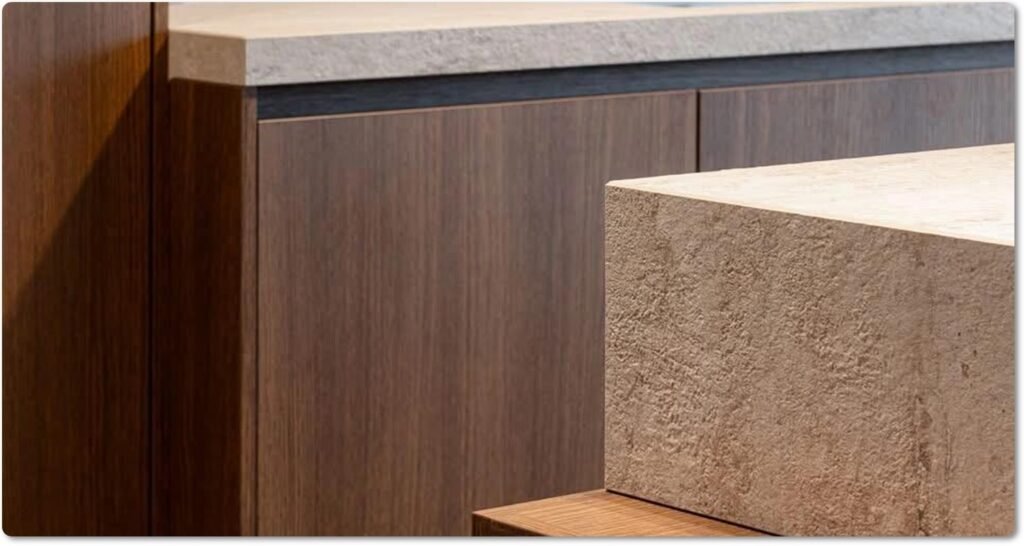
Travertine Look Collections
The Timeless Appeal of Travertine
Travertine has been used in architecture for thousands of years.
Its distinctive characteristics include:
- Linear veining
- Soft neutral colors
- Natural cavities
- Organic movement
- Warm Mediterranean appearance
Historically, travertine has appeared in:
- Classical architecture
- Luxury villas
- Hotels
- Museums
- Public buildings
- Contemporary minimalist interiors
Its enduring popularity stems from its ability to create calm, sophisticated spaces that complement a wide range of architectural styles.
Modern Interpretation Through Digital Design
Today’s travertine-look sintered stone uses advanced digital printing technologies capable of reproducing:
- Filled travertine
- Vein-cut travertine
- Cross-cut travertine
- Silver travertine
- Ivory travertine
- Beige travertine
- Walnut travertine
Unlike repetitive printed ceramics of earlier generations, premium collections feature randomized pattern libraries that reduce visual repetition across multiple slabs, enhancing realism in large installations.
Popular Color Directions
Current luxury interior trends emphasize neutral palettes inspired by natural landscapes.
Popular travertine-look colors include:
- Warm ivory
- Sand beige
- Limestone cream
- Soft taupe
- Light walnut
- Pearl grey
- Desert stone
- Warm white
These colors pair effectively with:
- Natural oak
- Bronze metal
- Brushed brass
- Matte black fixtures
- Textured fabrics
- Linen finishes
Applications in Luxury Interiors
Travertine-look sintered stone is increasingly specified for:
Living Rooms
Large-format wall panels create elegant feature walls with minimal grout lines, enhancing spatial continuity.
Bathrooms
Because of its low porosity and ease of maintenance, travertine-look sintered stone is well suited for:
- Vanity tops
- Shower walls
- Wet room cladding
- Bathtub surrounds
Kitchens
Large slabs provide durable work surfaces while maintaining the timeless appearance of natural stone.
Luxury Retail
Boutiques often combine travertine-look walls with brass detailing to create refined customer experiences.
Hospitality
Hotels increasingly utilize travertine-look collections for:
- Reception desks
- Elevator lobbies
- Guest bathrooms
- Restaurant interiors
- Executive lounges
The material’s consistent appearance simplifies specification across multiple properties while maintaining a premium visual identity.
Marble-Look Collections
Why Marble Remains the Benchmark for Luxury?
Marble has long been associated with prestige, craftsmanship, and architectural excellence. From classical monuments to contemporary penthouses, its dramatic veining and luminous depth continue to define luxury interiors. However, natural marble also presents practical challenges, including porosity, susceptibility to acidic substances, and ongoing maintenance requirements.
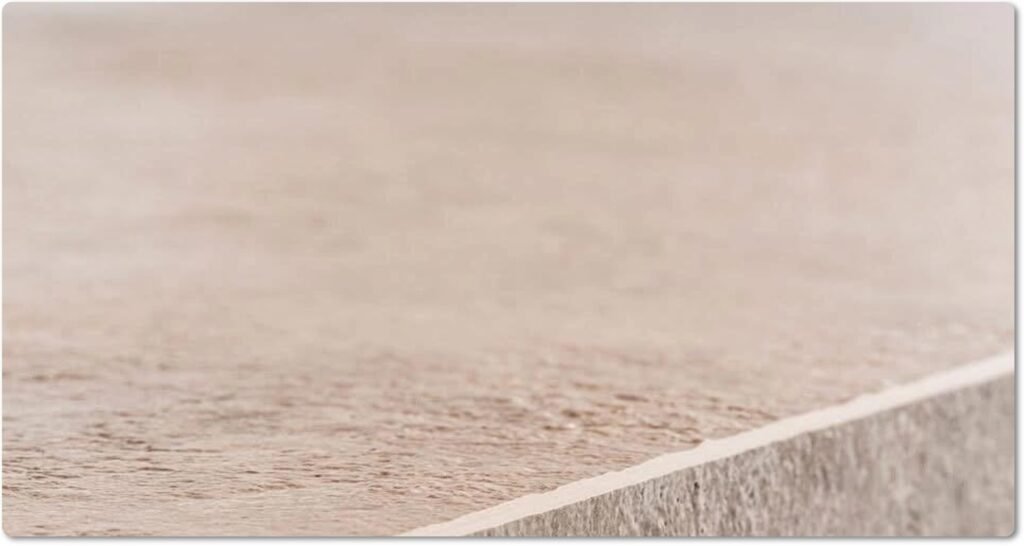
Marble-look sintered stone addresses these issues by recreating the visual language of iconic marbles through advanced digital decoration and full-body or surface-layer technologies. The result is a surface that delivers the elegance of marble while offering improved durability and easier care for demanding residential and commercial environments.
Among the most popular inspirations are white marbles with bold veining, soft grey marbles, and warm beige stones that complement modern minimalist design. These collections are widely specified for kitchen islands, bathroom vanity tops, wall cladding, reception desks, and luxury furniture, where consistent appearance and large-format installation are essential.
In addition to aesthetics, marble-look sintered stone allows designers to coordinate floors, walls, countertops, and custom furnishings within a unified material palette—an increasingly important consideration in high-end hospitality and mixed-use developments.
Concrete-Look Collections
Why do Concrete Aesthetics Continue to Influence Luxury Architecture?
Concrete has evolved far beyond its traditional association with industrial construction. Over the past decade, exposed concrete has become one of the defining materials of minimalist, Scandinavian, Japanese, and contemporary European interior design.
However, cast-in-place concrete presents several practical limitations:
- Surface cracking caused by shrinkage.
- Color inconsistency between pours.
- Moisture absorption.
- Dusting over time.
- Labor-intensive installation.
- Difficult maintenance.
- Significant structural weight.
Concrete-look Luxury Sintered Stone addresses these challenges by recreating the visual texture of architectural concrete while providing the technical advantages of a sintered ceramic surface.
Design Characteristics
Modern concrete-look collections feature subtle tonal variation rather than dramatic veining.
Typical visual characteristics include:
- Soft cement textures
- Cloud-like mineral movement
- Matte finishes
- Fine aggregate appearance
- Neutral gray palettes
- Warm greige tones
- Charcoal architectural finishes
- Minimal visual repetition
Rather than imitating unfinished concrete exactly, premium collections interpret concrete through refined digital decoration intended for luxury environments.
Performance Advantages
Compared with exposed concrete, sintered stone generally provides:
| Property | Architectural Concrete | Concrete-Look Sintered Stone |
|---|---|---|
| Water Absorption | Moderate | Very Low |
| Maintenance | Periodic sealing | Minimal |
| Color Consistency | Variable | Highly Consistent |
| Surface Dusting | Possible | None |
| Chemical Resistance | Moderate | Excellent |
| Cleaning | Difficult | Easy |
| Installation | Structural | Cladding System |
These characteristics explain why many architects increasingly specify concrete-look slabs for projects where visual continuity and long-term durability are priorities.
Typical Applications
Concrete-look collections are widely used in:
Luxury Apartments
- TV feature walls
- Kitchen backsplashes
- Fireplace surrounds
- Floating furniture
Commercial Offices
- Reception counters
- Executive meeting rooms
- Elevator lobbies
- Collaboration spaces
Retail Architecture
Luxury brands often combine concrete-look walls with:
- Bronze metals
- Black steel
- Oak veneer
- Warm LED lighting
The resulting aesthetic feels contemporary while remaining timeless.
Wood-Look Collections
Bringing Nature into Contemporary Architecture
Biophilic design continues to influence global interior architecture. Designers increasingly seek natural materials that strengthen the visual connection between buildings and nature.
Natural timber provides warmth and texture but may present limitations, including:
- Moisture sensitivity.
- Surface scratching.
- UV discoloration.
- Expansion and contraction.
- Fire performance considerations.
Wood-look sintered stone reproduces the appearance of premium hardwood species while offering significantly greater dimensional stability and durability.
Digital Texture Technology
Modern production technologies synchronize digital printing with textured surface finishes.
As a result, grain patterns align closely with tactile textures, creating remarkably realistic wood appearances.
Popular inspirations include:
- European Oak
- American Walnut
- White Ash
- Teak
- Smoked Oak
- Elm
- Chestnut
Long plank formats further enhance realism in flooring and wall installations.
Functional Advantages
Wood-look sintered stone is especially suitable for:
Bathrooms
Unlike natural wood, sintered stone is unaffected by:
- Standing water
- Steam
- Frequent cleaning
- High humidity
Spa Facilities
Luxury wellness centers increasingly combine wood-look floors with travertine-look walls to create calming environments requiring minimal maintenance.
Outdoor Spaces
UV stability allows designers to maintain a consistent appearance across indoor and outdoor transitions.
Combining Wood and Travertine
One of the strongest design trends involves pairing:
- Travertine-look walls
- Oak-look cabinetry
- Bronze hardware
- Neutral textiles
- Warm indirect lighting
This material palette creates interiors that feel both luxurious and approachable.
Bookmatched Designs
The Evolution of Feature Walls
Bookmatching has traditionally been associated with premium natural marble.
Large slabs cut sequentially from the same stone block are mirrored to create symmetrical veining.
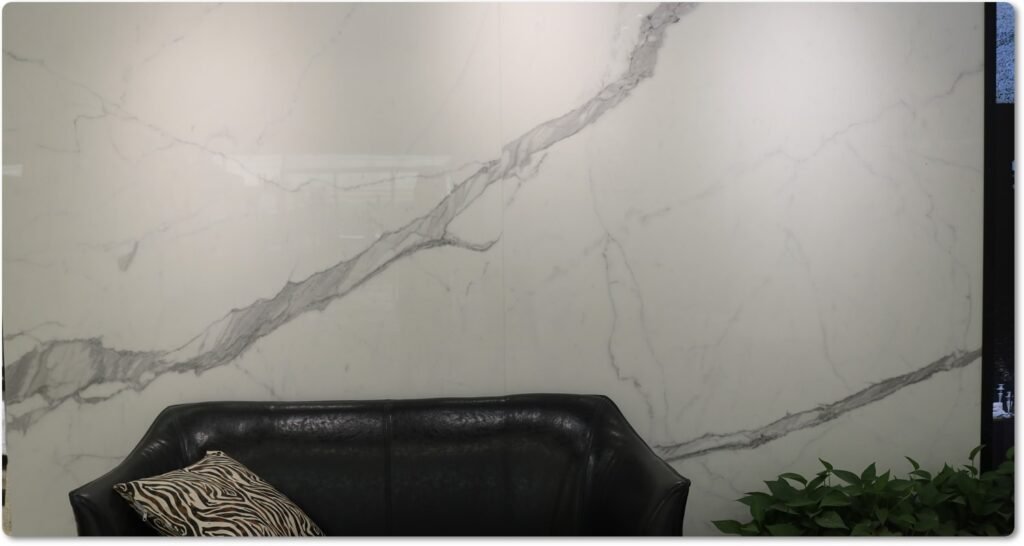
Advances in digital design now enable bookmatched compositions within sintered stone collections, extending this dramatic visual effect to travertine, marble, and other stone-inspired surfaces.
What Is Digital Bookmatching?
Digital bookmatching uses carefully mirrored high-resolution surface graphics.
Manufacturers create complementary slab pairs that reproduce the appearance of naturally mirrored stone while maintaining production consistency.
Unlike natural stone, where perfect matching depends on geological formation, digital engineering enables repeatable layouts for large commercial projects.
Large Format Design
Bookmatched slabs are commonly available in formats exceeding:
- 3200 × 1600 mm
- 3240 × 1620 mm
Large dimensions reduce visible joints while emphasizing continuous veining.
Architectural Applications
Bookmatched installations are frequently specified for:
Hotel Lobbies
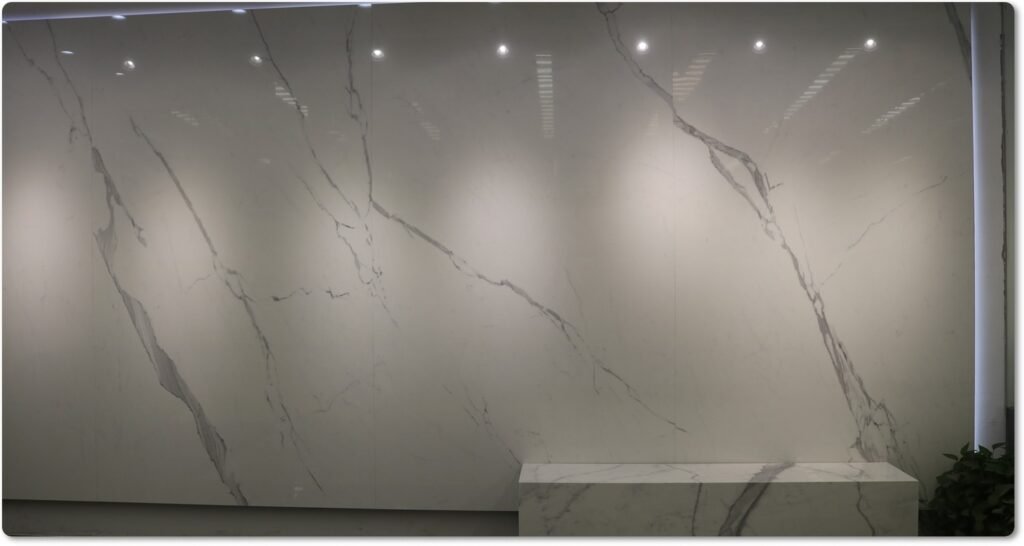
A full-height bookmatched wall creates an immediate visual statement in reception areas.
Luxury Bathrooms
Symmetrical shower walls emphasize elegance and spatial balance.
Executive Offices
Feature walls behind reception desks communicate prestige and sophistication.
Private Residences
Applications include:
- Double-height entrances
- Fireplace surrounds
- Wine rooms
- Staircase feature walls
Installation Considerations
Successful bookmatched installations require:
- Digital layout planning.
- Accurate slab numbering.
- Precise fabrication.
- Experienced installers.
- Careful joint alignment.
- High-quality lighting design.
Early collaboration among architects, fabricators, and installers is essential to preserve design intent.
Hospitality Projects
Why is Hospitality Driving Demand?
The hospitality industry continues to prioritize materials that combine luxury aesthetics with operational efficiency.
Hotels must balance:
- Guest experience.
- Brand identity.
- Long service life.
- Easy maintenance.
- Sustainable operation.
- Rapid renovation cycles.
Travertine-look and marble-look sintered stone satisfy these requirements while offering a consistent appearance across multiple properties.
Hotel Reception Areas
Reception spaces create first impressions.
Large-format sintered stone enables:
- Seamless feature walls.
- Dramatic reception desks.
- Integrated signage.
- Minimal maintenance.
The reduced number of joints contributes to a cleaner, more premium appearance.
Guest Bathrooms
Bathrooms represent one of the most demanding environments within hospitality projects.
Designers increasingly specify sintered stone for:
- Vanity tops
- Shower walls
- Wet room panels
- Bathtub surrounds
- Shelving
- Window reveals
Low porosity supports hygiene while simplifying cleaning procedures.
Restaurants and Bars
Food service environments require surfaces capable of withstanding:
- Heavy daily use.
- Frequent cleaning.
- Hot serving equipment.
- Beverage spills.
- UV exposure near glazing.
Sintered stone’s durability makes it suitable for countertops, buffet stations, bar fronts, and decorative wall cladding.
Luxury Retail Within Hotels
Many five-star hotels include:
- Boutique shopping
- Executive lounges
- VIP waiting areas
- Spa receptions
Travertine-look collections provide an elegant background that complements premium furnishings without overwhelming the space.
Wellness and Spa Facilities
Nature-inspired materials promote relaxation.
Popular combinations include:
- Travertine-look walls
- Wood-look flooring
- Limestone-inspired furniture
- Soft indirect lighting
- Water features
These environments communicate wellness while reducing long-term maintenance requirements.
Interior Trends for 2026
Trend 1: Quiet Luxury
Quiet Luxury emphasizes understated sophistication over visual excess.
Preferred materials include:
- Travertine-look slabs
- Soft beige marble-look surfaces
- Neutral limestone tones
- Matte finishes
- Warm metallic accents
Rather than dramatic contrasts, designers favor subtle texture and refined detailing.
Trend 2: Natural Material Palettes
Earth-inspired interiors continue gaining popularity.
Frequently combined materials include:
- Travertine
- Oak
- Linen
- Bronze
- Leather
- Handmade ceramics
- Natural textiles
These combinations create timeless interiors less influenced by short-term design trends.
Trend 3: Large Continuous Surfaces
Designers increasingly specify:
- Full-height walls
- Integrated countertops
- Hidden joints
- Continuous flooring
- Seamless shower systems
Large-format sintered stone supports this architectural direction by minimizing grout lines and enhancing visual continuity.
Trend 4: Wellness-Oriented Spaces
Wellness has become a central design objective across residential and hospitality sectors.
Materials that evoke nature through color, texture, and pattern contribute to calming environments.
Travertine-inspired collections align particularly well with this movement due to their soft tones and organic appearance.
Trend 5: Sustainable Material Selection
Architects increasingly evaluate materials based on:
- Product transparency.
- Environmental Product Declarations (EPDs), where available.
- Life Cycle Assessments (LCAs), where available.
- Durability.
- Maintenance requirements.
- Long service life.
- Compatibility with green building certification systems.
Because sintered stone is highly durable and often requires less maintenance than many natural materials, it is frequently considered in projects pursuing sustainable design objectives. Specific environmental credentials, however, depend on the manufacturer and should always be verified through current technical documentation.
Trend 6: Integrated Material Language
Rather than mixing many unrelated finishes, designers increasingly use a cohesive palette of complementary surfaces throughout a project.
A typical luxury specification may include:
- Travertine-look wall cladding
- Marble-look vanity tops
- Concrete-look feature walls
- Wood-look cabinetry
- Matching sintered stone furniture
- Coordinated outdoor paving
This integrated approach creates visual harmony while simplifying material coordination and maintenance.
Procurement Guide: How to Source Travertine Sintered Stone for International Projects?
Selecting the right Travertine Sintered Stone supplier involves much more than comparing prices. For architects, developers, distributors, fabricators, and contractors, procurement decisions directly influence project quality, installation efficiency, lifecycle costs, and client satisfaction. A structured procurement strategy helps minimize risks while ensuring that the specified material meets technical, aesthetic, and commercial expectations.
1. Define the Project Requirements
Before requesting quotations, establish a detailed project specification. At a minimum, the following information should be documented:
Project Type
- Luxury residential villa
- High-rise apartment
- Five-star hotel
- Resort
- Commercial office
- Retail flagship store
- Healthcare facility
- Airport or transportation hub
Different environments require different technical priorities. For example, hotel bathrooms emphasize stain resistance and hygiene, while exterior façades require UV stability, frost resistance, and compliance with local building codes.
Intended Applications
Specify where the material will be installed, such as:
- Kitchen countertops
- Bathroom vanity tops
- Shower walls
- Wall cladding
- Flooring
- Stair treads
- Reception desks
- Furniture
- Elevator interiors
- Exterior façades
Each application may require different slab thicknesses, surface finishes, and edge details.
Technical Specifications
Prepare a comprehensive specification covering:
- Slab dimensions
- Nominal thickness
- Surface finish (polished, matte, satin, textured)
- Edge profile requirements
- Color tolerance
- Pattern continuity
- Bookmatching requirements
- Fabrication tolerances
- Quantity
- Delivery schedule
Providing complete technical information enables suppliers to prepare accurate quotations and production plans.
2. Evaluate Material Performance
Do not rely solely on visual appearance. Request technical documentation that demonstrates compliance with applicable standards.
Important properties include:
Water Absorption
Low water absorption contributes to:
- Better stain resistance
- Improved hygiene
- Enhanced freeze–thaw performance
- Reduced long-term maintenance
Many premium sintered stone products achieve water absorption values significantly lower than many natural stones, although exact performance varies by manufacturer.
Flexural Strength
Flexural strength is particularly important for:
- Large-format wall panels
- Floating furniture
- Countertops
- Cantilevered installations
Request laboratory test reports prepared according to recognized international standards where applicable.
Abrasion Resistance
Commercial environments such as hotels, airports, and shopping centers require surfaces capable of withstanding continuous pedestrian traffic without significant wear.
Thermal Stability
For kitchens, fireplaces, and outdoor environments, verify resistance to:
- Rapid temperature changes
- High service temperatures
- Thermal shock
Chemical Resistance
Commercial cleaning protocols often involve disinfectants and specialty cleaners. Confirm compatibility with recommended maintenance procedures.
3. Assess Visual Quality
Luxury projects demand consistency.
Request:
- High-resolution slab photography
- Entire slab scans
- Batch photographs
- Digital layout drawings
- Bookmatch previews
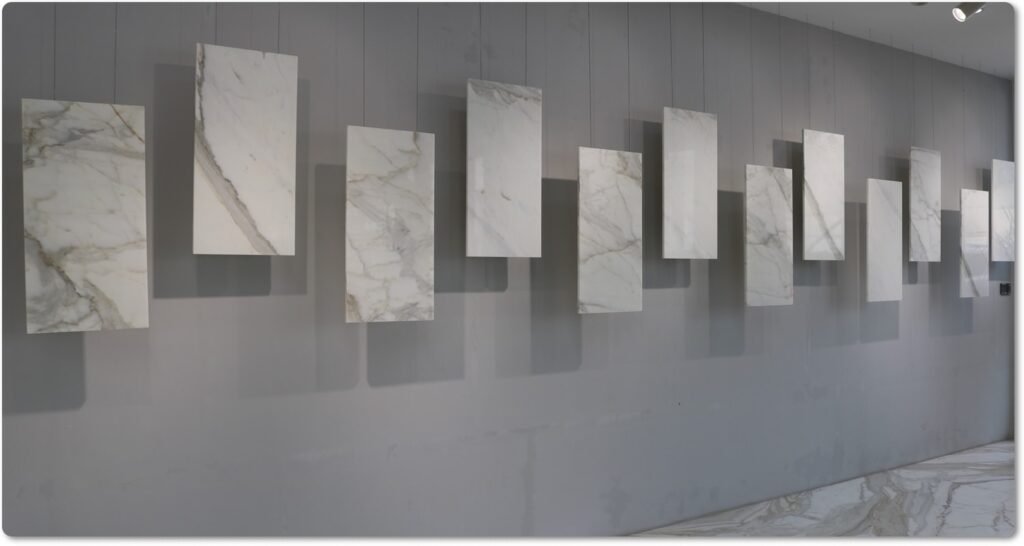
- Sample panels
This allows architects and designers to approve layouts before fabrication begins.
Color Consistency
For large hospitality projects involving hundreds of slabs, evaluate:
- Shade variation
- Vein continuity
- Digital print consistency
- Batch-to-batch reproducibility
Consistent production minimizes installation issues and ensures a unified design language across multiple spaces.
4. Review Manufacturing Capability
Not every supplier is a manufacturer. Some companies operate as trading firms, while others control the entire production process.
When evaluating a factory, consider:
- Production capacity
- Number of production lines
- Automation level
- CNC fabrication capability
- Waterjet cutting equipment
- Quality inspection procedures
- Packaging facilities
- Export experience
Manufacturers with integrated fabrication capabilities can often provide better coordination for customized architectural projects.
5. Quality Control Procedures
A reliable supplier should maintain documented quality control throughout production.
Typical inspection stages include:
Raw Material Inspection
Verification of incoming mineral composition and color consistency.
Production Monitoring
Inspection during pressing, firing, polishing, and finishing.
Finished Slab Inspection
Evaluation of:
- Dimensions
- Thickness
- Flatness
- Surface quality
- Edge integrity
- Color consistency
- Pattern accuracy
Packaging Inspection
Before shipment, packaging should be checked for structural stability, moisture protection, labeling, and loading safety.
6. Fabrication Services
Many international buyers prefer suppliers capable of delivering finished architectural components rather than raw slabs alone.
Value-added services may include:
- CNC profiling
- Sink cutouts
- Faucet drilling
- Mitred edges
- Waterjet medallions
- Bookmatched wall sets
- Stair fabrication
- Vanity fabrication
- Furniture panels
Integrated fabrication reduces handling between multiple suppliers and can improve project coordination.
7. Export Packaging
Large-format sintered stone requires robust packaging to minimize transport damage.
Professional export packaging generally includes:
- Heat-treated wooden crates (where required for international compliance)
- Internal foam protection
- Corner guards
- Waterproof wrapping
- Protective separators
- Secure palletization
- Container load planning
Proper packaging is especially important for long-distance sea freight.
8. Supplier Communication
Successful international procurement depends on clear communication.
Choose suppliers capable of providing:
- Technical drawings
- CAD support
- Installation guidance
- Inspection reports
- Production updates
- Container loading photographs
- After-sales assistance
Transparent communication reduces project risk and improves scheduling accuracy.
Case Study: EDG Stone Factory
A Global Manufacturing Partner for Premium Architectural Stone
For international developers seeking a reliable supply partner, manufacturing capability is as important as product quality. EDG Stone Factory has positioned itself as a professional manufacturer and exporter serving residential, commercial, and hospitality projects with a broad portfolio of natural stone and engineered surface materials.
In addition to Quartzite Slabs & Countertops, EDG Stone Factory supplies marble, granite, quartz, sintered stone, porcelain slabs, limestone, travertine, onyx, semi-precious stone, and customized architectural stone products for projects across North America, Europe, the Middle East, Australia, and Asia.
Integrated Manufacturing Capabilities
A key advantage of an integrated manufacturer is the ability to manage the production process from raw slab selection through final fabrication. Depending on project requirements, EDG Stone Factory offers capabilities including:
- Large-format slab processing
- CNC edge profiling
- Waterjet cutting
- Mitre fabrication
- Custom kitchen countertops
- Bathroom vanity tops
- Reception counters
- Stair components
- Wall cladding panels
- Tabletops
- Fireplace surrounds
- Bespoke architectural stone elements
This integrated approach helps reduce coordination complexity for developers and contractors sourcing multiple finished components from a single supplier.
Quality Management
For export-oriented projects, quality management typically includes multiple inspection stages, such as:
- Raw material selection
- Dimensional verification
- Surface inspection
- Color and pattern matching
- Edge finishing checks
- Dry layout reviews for bookmatched projects
- Protective packaging inspection before shipment
Systematic quality control can reduce the likelihood of installation delays and replacement costs on site.
Customization for Hospitality Projects
Hotels, luxury residences, and commercial developments frequently require project-specific fabrication rather than standard stock products. EDG Stone Factory supports customized production for applications including:
- Hotel reception desks
- Lobby feature walls
- Bathroom vanity tops
- Shower wall systems
- Elevator interiors
- Restaurant tabletops
- Retail display fixtures
- Luxury apartment kitchens
By coordinating slab selection, fabrication, and export packaging, manufacturers can simplify procurement workflows for international buyers managing complex projects.
Global Logistics Support
Large architectural projects often require staged deliveries aligned with construction schedules. Experienced exporters typically assist with:
- Consolidated container loading
- Export documentation
- Packing lists
- Commercial invoices
- Customs documentation
- Shipment tracking
- Coordination with freight forwarders
Effective logistics planning helps ensure that materials arrive in sequence with project installation timelines.
Conclusion
Travertine-inspired design remains one of the defining themes in luxury architecture, but today’s projects require more than visual appeal. Architects, developers, and procurement professionals increasingly seek materials that combine timeless aesthetics with measurable technical performance, consistent quality, and long-term value.
Travertine Sintered Stone answers this demand by offering the natural elegance of classic travertine alongside the durability, dimensional stability, and ease of maintenance associated with advanced sintered materials. When paired with complementary marble-look, concrete-look, and wood-look collections, it enables designers to create cohesive, sophisticated interiors that meet the functional demands of modern hospitality, residential, retail, and commercial environments.
From a procurement perspective, successful projects depend on rigorous supplier evaluation, verified technical documentation, disciplined quality control, and experienced fabrication capabilities. Selecting manufacturing partners that provide integrated production, customization, and export support can significantly reduce project risks while improving installation efficiency and lifecycle performance.
As luxury design continues to emphasize sustainability, wellness, and seamless architectural expression, large-format sintered stone is expected to remain a preferred specification for premium developments worldwide.