Executive Summary
As architectural demands shift toward high-performance, carbon-neutral, and ultra-durable surfaces, Sintered Stone Slabs have emerged as the premier material for modern surfacing. This comprehensive white paper serves as an industrial-grade technical guide detailing the material science, finish mechanics, dimensional engineering, fabrication protocols, and commercial applications of sintered stone. Designed for architects, interior designers, stone fabricators, and global procurement officers, this document incorporates real-world manufacturing insights from EDG Stone Factory, a premier global Quartzite and Sintered Stone manufacturer and exporter.
1. Material Science & Sintering Technology
Sintered stone is not porcelain, nor is it synthetic quartz. It is an advanced metamorphic material engineered through proprietary Metamorphic Sintering Technology (MST).
The Sintering Process
The manufacturing process replicates the natural formation of granite over millions of years within a highly controlled industrial environment:
Raw Material Selection: 100% natural minerals, including quartz, feldspar, silica, and mineral oxides, are wet-milled into a fine slurry.
Ultra-Compaction: The slurry is dried and pressed under a vacuum press at pressures exceeding 400–480 bar (40,000 to 48,000 metric tons per square meter). This eliminates internal micro-air pockets and structural voids.
Thermal Sintering: The compacted slab passes through a kiln exceeding 1,200°C (2,192°F). At this peak temperature, the mineral particles partially melt and fuse at a molecular level, altering the internal crystalline structure into a hyper-dense, non-porous matrix.
Comparative Technical Analysis
Unlike quartz (which relies on polymer resins) or traditional ceramics (fired at lower pressures/temperatures), sintered stone possesses superior thermal and mechanical properties.
| Physical/Chemical Property | Sintered Stone (12mm/20mm) | Engineered Quartz | Natural Granite |
| Water Absorption Rate | $\le 0.05\%$ | $\le 0.05\%$ | $0.2\% – 0.7\%$ |
| Mohs Hardness Scale | 7 – 8 | 6 – 7 | 6 – 7 |
| Flexural Strength | $\ge 45\text{ N/mm}^2$ | $40 – 50\text{ N/mm}^2$ | $10 – 20\text{ N/mm}^2$ |
| UV Resistance | Excellent (Delta E $\approx 0$) | Poor (Resin yellows) | Excellent |
| Fire/Heat Rating | Class A1 (Non-combustible) | Scorches $> 150^\circ\text{C}$ | Thermal shock risk |
| Chemical Resistance | Class UA (High resistance) | Susceptible to solvents | Susceptible to acids |
Data Source Reference: European Committee for Standardization (CEN) – EN 14617-2 (Determination of flexural strength in agglomerated stone).
2. Advanced Surface Finishes & Optical Engineering
The aesthetic and functional versatility of sintered stone is dictated by its surface treatment. Industrial texturing processes alter both the coefficient of friction and light reflectance.
Polished Finish
Fabrication Process: Achieved via mechanical diamond-head polishing lines using sequentially finer abrasive grits.
Specular Gloss: Greater than 85–90 gloss units (GU).
Key Applications: High-end vertical cladding, feature walls, luxury residential bathroom vanities.
Technical Limitation: Susceptible to micro-scratching under intense abrasive wear. Not recommended for high-traffic commercial flooring due to slip hazards when wet.
Matte / Satin Finish
Fabrication Process: Created by applying a specialized ceramic glaze before firing or through a light acid-etching/blasting process post-kiln.
Specular Gloss: Less than 10–15 GU.
Key Applications: Commercial flooring, kitchen countertops, heavy-use work surfaces.
Slip Resistance: Typically achieves a Pendulum Test Value (PTV) > 36 or a DIN 51130 R9–R10 rating, making it compliant with public safety codes for wet environments.
Bookmatch & Continuous Patterning
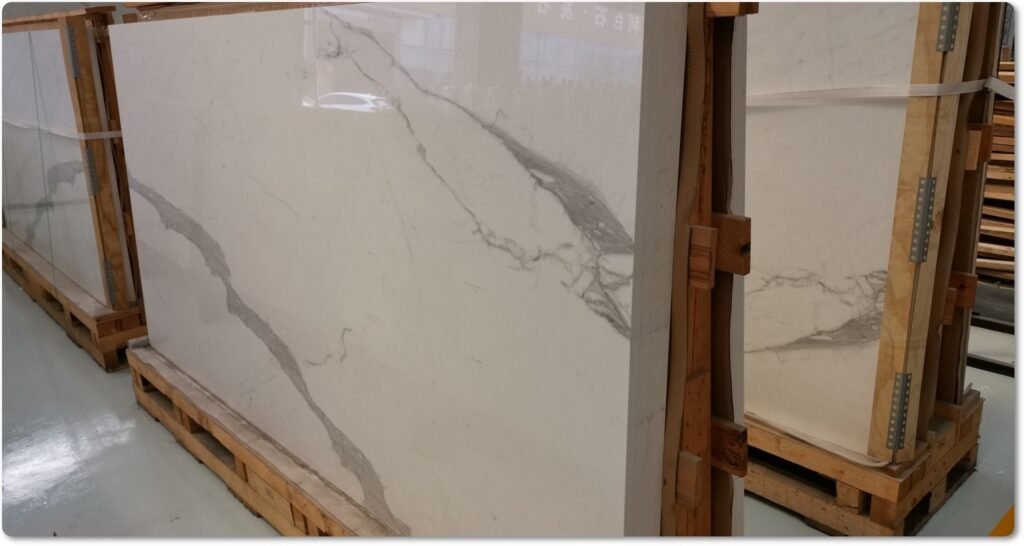
Bookmatching requires precise digital inkjet printing systems capable of firing high-definition mineral inks at a resolution of 360–400 DPI directly onto the compacted slab before firing.
Bookmatch (Mirror Image): Slabs are printed in ‘A’ and ‘B’ pairs, where the vein patterns mirror each other horizontally or vertically along the seam line.
Endmatch (Continuous): Slabs feature continuous veining that runs seamlessly across 3 to 6 sequential slabs, ideal for expansive commercial facades and waterfall islands.
3. Dimensional Engineering & Thickness Optimization
Selecting the correct nominal thickness is vital to ensuring structural integrity while controlling raw material costs and structural load.
       [Sintered Stone Thickness Optimization Guide]
+-------------------------------------------------------------+
|  6mm Thickness   -->  Lightweight Cladding & Furniture      |
|                       (Façades, Cabinet Doors, Overlays)    |
+-------------------------------------------------------------+
|  12mm Thickness  -->  Standard Residential Countertops      |
|                       (Supported Islands, Vanity Tops)      |
+-------------------------------------------------------------+
|  20mm Thickness  -->  Heavy-Duty Commercial Surfaces        |
|                       (Unsupported Overhangs, High-Traffic) |
+-------------------------------------------------------------+
6mm Slabs: Lightweight Engineering
Weight Metric: Approximately $15\text{ kg/m}^2$.
Primary Scope: Exterior ventilated curtain walls, interior wall linings, elevator cab interiors, and furniture skins (cabinet doors, tabletops).
Structural Note: Must be bonded to a secondary rigid substrate (e.g., aluminum honeycomb or cement-board backer) when used in high-impact horizontal applications.
12mm Slabs: The Residential Countertop Standard
Weight Metric: Approximately $30\text{ kg/m}^2$.
Primary Scope: Residential kitchen countertops, integrated sinks, bar tops.
Engineering Benefit: Offers the optimal balance between high structural flexural strength and manageable dead-load on cabinetry frameworks.
20mm Slabs: Heavy-Duty Structural Performance
Weight Metric: Approximately $50\text{ kg/m}^2$.
Primary Scope: Commercial food prep stations, heavy-duty work surfaces, outdoor steps, and unsupported countertop overhangs up to 300mm.
Engineering Benefit: Eliminates the need for substrate reinforcement in standard countertop installations.
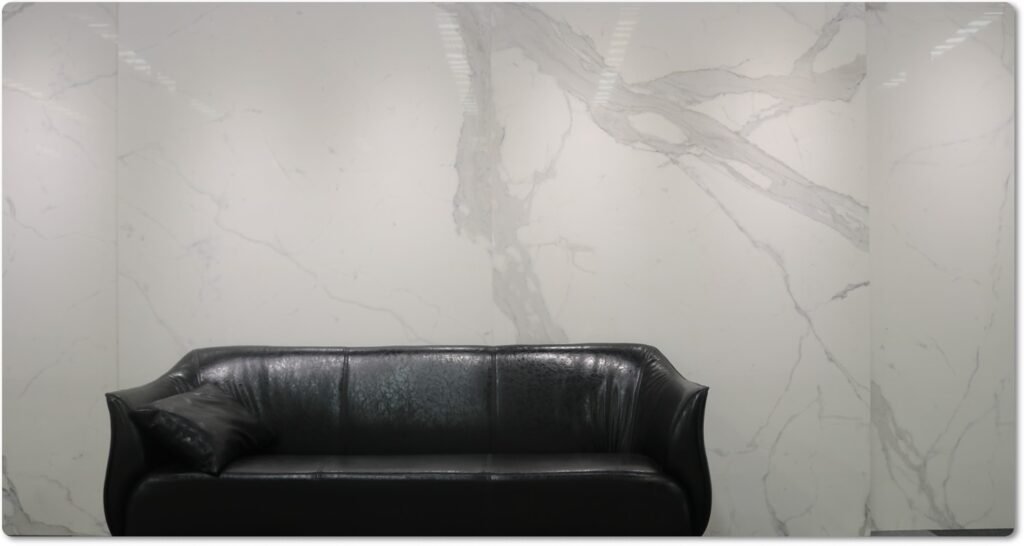
Large Slab Size Advantages
Standard industrial dimensions include 3200mm × 1600mm and 1600mm × 1600mm. These massive formats allow for:
Minimization of grout lines in commercial flooring reduces microbial accumulation points.
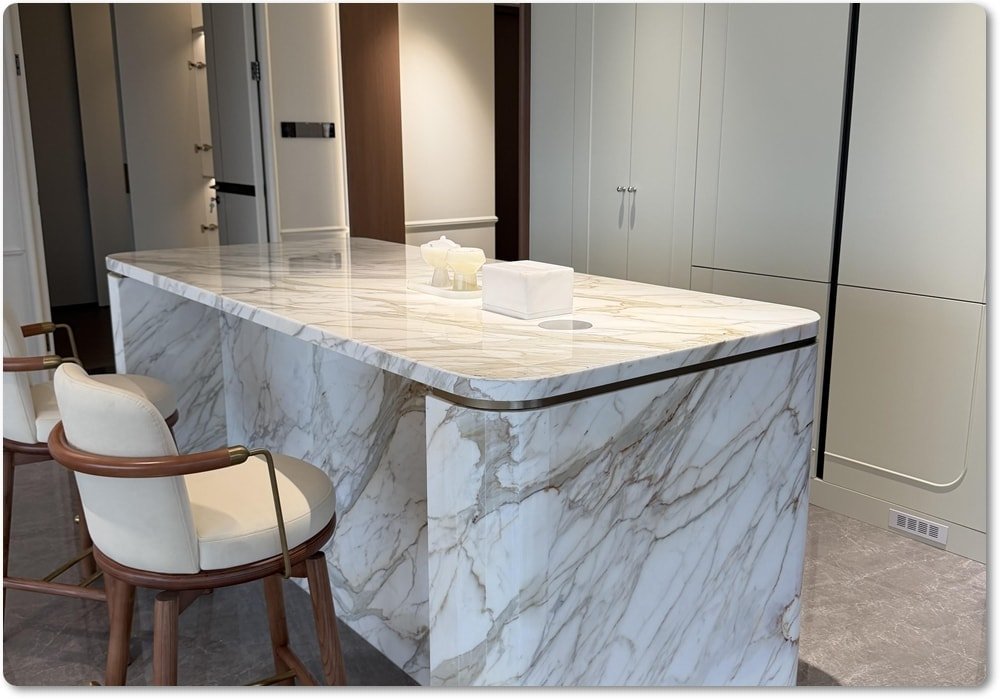
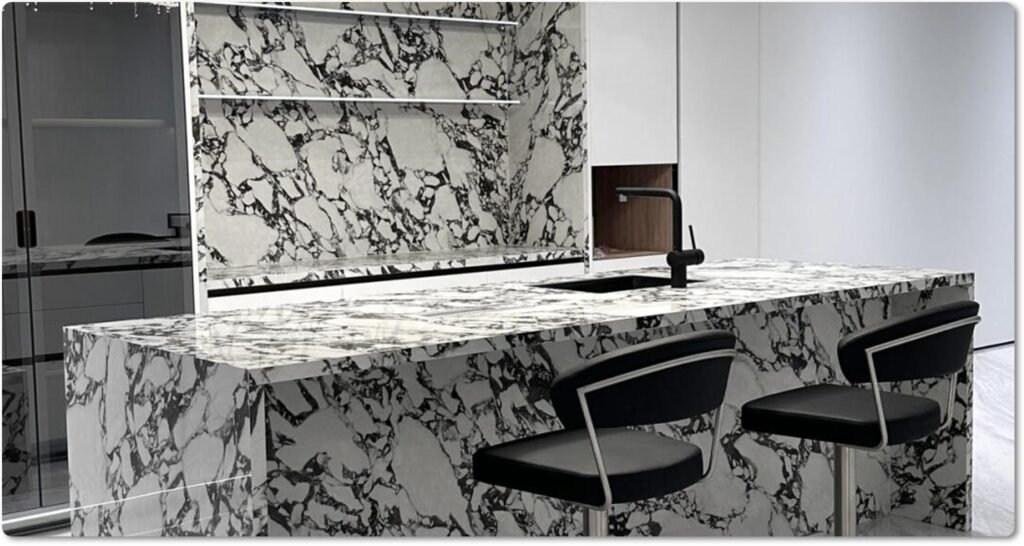
Single-piece kitchen island installations without structural or aesthetic seams.
4. Fabrication & Installation Protocol
Sintered stone retains massive internal tension from the ultra-compaction process. Fabricators must strictly adhere to specific machining parameters to prevent micro-cracking and catastrophic slab failure.
Cutting Mechanics
Stress Relief: Before cutting specific shapes, the fabricator must trim 20–30mm off all four edges of the slab to relieve perimeter residual stress.
Tooling Selection: Only use bridge saws or CNC waterjet systems fitted with continuous-rim diamond blades specifically engineered for sintered stone or glass matrices. Standard granite or quartz blades will bind and fracture the material.
Speed and Feed Rates: * Straight Cuts (12mm): Feed rate of $1.2 – 1.5\text{ m/min}$ with a rotational blade speed of 2,200–2,600 RPM.
Mitered/45° Cuts: Reduce feed rate by $50\%$ to prevent blade deflection and edge chipping.
Cooling: Continuous, high-volume water cooling directed precisely at the cutting point is mandatory. Dry cutting is strictly prohibited.
Edge Processing & Profiling
Sintered stone is a vitrified, through-body material, but micro-chipping can occur if edges are left sharp.
Arris/Eased Edge: A minimum $2\text{mm}$ bevel or radius must be applied to all exposed edges to displace impact energy.
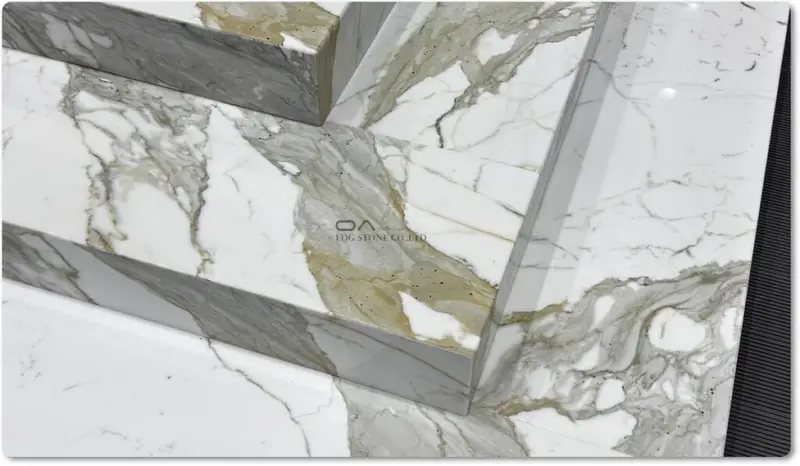
Mitered Apron (Drop Edge): When executing a 45-degree miter for a thick-apron appearance, a high-quality, color-matched epoxy resin or structural acrylic adhesive must be used. Ensure the adhesive layer is uniform ($0.1-0.2\text{mm}$) to absorb localized mechanical shock.
5. Architectural Applications Across Sectors
Residential Kitchens & Bathrooms
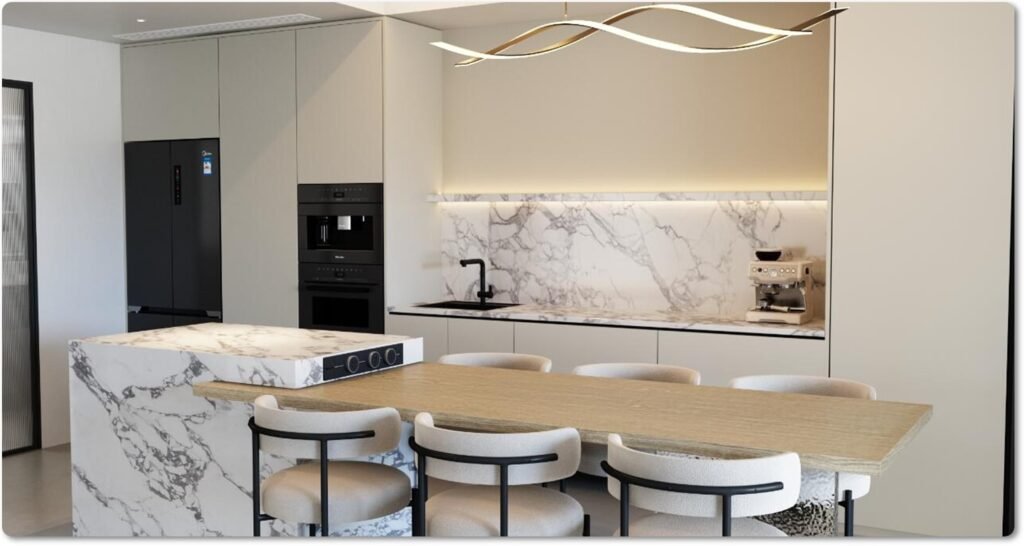
Sintered stone’s complete resistance to heat allows pots straight from the stove ($>200^\circ\text{C}$) to be placed directly on the surface without risk of thermal shock or discoloration. Its zero-porosity surface makes it completely stain-resistant to acidic substances like lemon juice, red wine, and vinegar.
Commercial Flooring & High-Traffic Public Spaces
Due to its high scratch resistance (Mohs Hardness 7–8), sintered stone withstands heavy pedestrian traffic, luggage wheels, and cart traffic without losing its surface finish. It is ideal for airport terminals, hotel lobbies, and corporate headquarters.
Exterior Ventilated Facades
Sintered stone is immune to UV degradation (Delta E color drift $< 0.5$ over 20 years). Coupled with a lightweight 6mm profile and mechanical anchoring systems, it forms highly durable, non-combustible ventilated building envelopes that resist extreme freeze-thaw cycles.
6. Industrial Case Study: EDG Stone Factory
To understand the global supply chain dynamics of high-performance surfaces, look no further than EDG Stone Factory, an industry-leading global Quartzite Slabs & Countertops Manufacturer and Exporter.
       [Global Supply Chain Workflow - EDG Stone Factory]
[Raw Material Extraction]
       │
       ▼
[Advanced Processing Plant] ──► Rigid Dual-Track QA Testing
       │
       ▼
[Custom CNC Cutting & Fabrication]
       │
       ▼
[Isothermal ISPM-15 Export Packaging] ──► Global Distribution
While traditionally renowned for processing premium natural stone like quartzite, EDG Stone Factory has integrated advanced sintered stone processing lines into its state-of-the-art facilities. This hybrid expertise bridges the gap between natural aesthetic value and engineered performance.
Material Engineering Synergy
EDG Stone Factory leverages its deep geological experience with quartzite—one of the hardest natural stones available—to solve common fabrication bottlenecks in the engineered stone market. By applying the same rigorous diamond-tooling calibration and stress-relief protocols required for premium quartzite to sintered stone slabs, EDG achieves edge finishes with zero micro-fracturing.
Global B2B Export Infrastructure
Catering to tier-1 architectural projects across North America, Europe, and the Middle East, EDG Stone Factory implements a rigid quality control framework:
Slab Recting & Planarity Control: Slabs are measured using automated laser gauges to ensure thickness deviations stay under $\pm0.5\text{mm}$ across a 3200mm span.
Custom Commercial Fabrication: Utilizing multi-axis CNC machines, EDG delivers pre-cut, edge-profiled, and cut-to-size countertops and facade panels directly to project sites, significantly reducing local labor costs and field errors.
7. Internal Cross-Reference Matrix (Knowledge Cluster)
To explore detailed engineering aspects related to surfacing options, reference our integrated knowledge network:
For an in-depth analysis of natural alternatives, review [Article 6: Geological Composition and Flexural Yield of Premium Quartzite Slabs].
To evaluate load-bearing engineering calculations for heavy stone installations, refer to [Article 10: Structural Substrate Design for Large Format Commercial Surfaces].
For architectural facade mechanical anchoring details, see [Article 15: Ventilated Curtain Wall Installation Protocols for Thin Mineral Panels].
8. Verified Analytical Data Sources & Technical Citations
ASTM International: ASTM C97/C97M-18 – Standard Test Methods for Absorption and Bulk Specific Gravity of Dimension Stone.
European Committee for Standardization: EN 14617-2: Agglomerated stone – Test methods – Part 2: Determination of flexural strength (bending strength).
International Organization for Standardization: ISO 10545-3: Ceramic tiles — Part 3: Determination of water absorption, apparent porosity, apparent relative density and bulk density.
National Kitchen & Bath Association (NKBA): 2025-2026 Surface Performance Benchmarks and Material Safety Reports.
Marble Institute of America (MIA) / Natural Stone Institute: Dimension Stone Design Manual, Version 8.0 – Structural Engineering & Jointing Guidelines.
DIN Standards (Deutsches Institut für Normung): DIN 51130: Testing of floor coverings – Determination of the anti-slip property – Workrooms and fields of activities with slip danger.
American National Standards Institute: ANSI A326.3 – Standard Test Method for Measuring Dynamic Coefficient of Friction of Hard Surface Flooring Materials.
LEED v4.1 Credit Reference Manual: Low-Emitting Materials & Environmental Product Declarations (EPD) for Sintered Mineral Matrices.
EDG Stone Factory Engineering Archives: Internal Mechanical Testing Reports for Quartzite and Sintered Stone Flexural Stress Analysis (2024–2026).
Tile Council of North America (TCNA): Handbook for Ceramic, Glass, and Stone Tile Installation – Section Structural Deflection Requirements.