Introduction
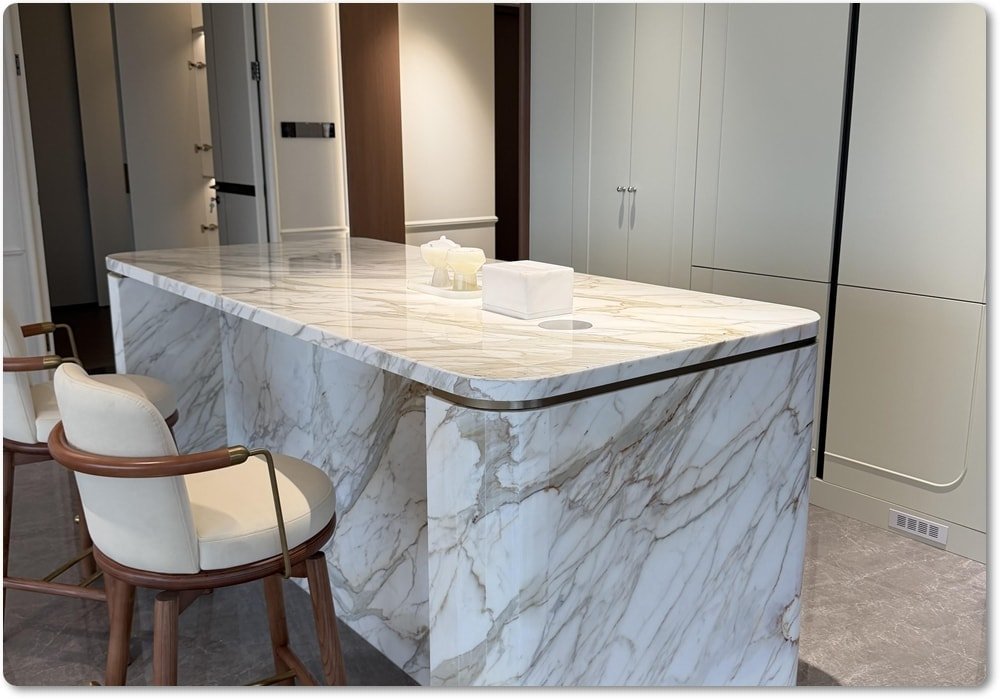
Carrara White Marble continues to dominate high-end architectural and interior design projects—not just because of its elegant appearance, but because it can be transformed into a wide range of engineered stone products.
From slabs to countertops, wall panels to staircases, vanities to façade systems, the outcome depends less on the raw material and more on one critical factor:
👉 Fabrication capability
The same slab of Carrara White Marble can produce dramatically different results depending on the supplier’s processing expertise. A professional factory delivers:
- Precision cutting
- Clean edges
- Consistent polishing
- Accurate cutouts
- Seamless installation integration
Meanwhile, inexperienced fabrication often leads to:
- Incorrect dimensions
- Edge chipping
- Uneven polishing
- Misaligned cutouts
- Poor joint alignment
- Installation failure
This guide focuses on one essential question:
👉 How to transform Carrara White Marble into a fully installation-ready, project-grade product?
Why Fabrication Determines Project Success?
Natural Stone Is Not Plug-and-Play
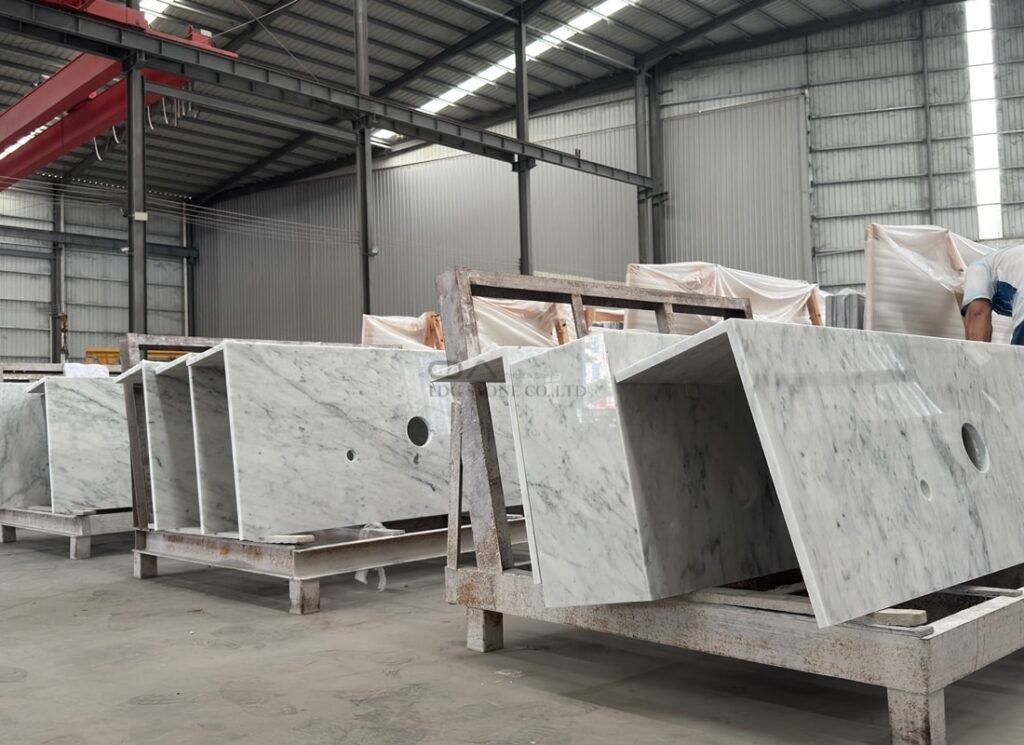
Carrara White Marble is a natural material. Between quarry extraction and final installation, it must pass through multiple fabrication stages. Without standardization, results become unpredictable.
Fabrication Impacts Three Critical Outcomes
1. Visual Quality
Grain continuity, surface gloss, edge detailing, and overall luxury feel.
2. Installation Efficiency
Accurate fabrication reduces onsite adjustments and speeds up installation.
3. Project Risk Control
Most issues—dimension errors, breakage, misalignment—originate during fabrication.
Core Fabrication Process for Carrara White Marble
A professional workflow typically includes:
Slab Selection → Layout Planning → Cutting → Polishing → Edge Profiling → Cutouts → Dry Fit → QC → Packaging → Delivery → Installation
Step 1: Slab Selection & Layout Planning
Why Slab Selection Comes First?
Natural marble varies in tone, veining, and structure. Without proper selection, all downstream fabrication decisions may be flawed.
What to Check?
- Color consistency
- Vein pattern stability
- Presence of cracks, stains, or black spots
- Structural integrity
- Suitability for bookmatching or directional layout
Purpose of Layout Planning
Layout planning ensures:
- Correct slab allocation
- Controlled vein direction
- Logical joint placement
- Mirror matching for feature areas
Especially critical for:
- Feature walls
- Lobby installations
- Kitchen islands
- Façade systems
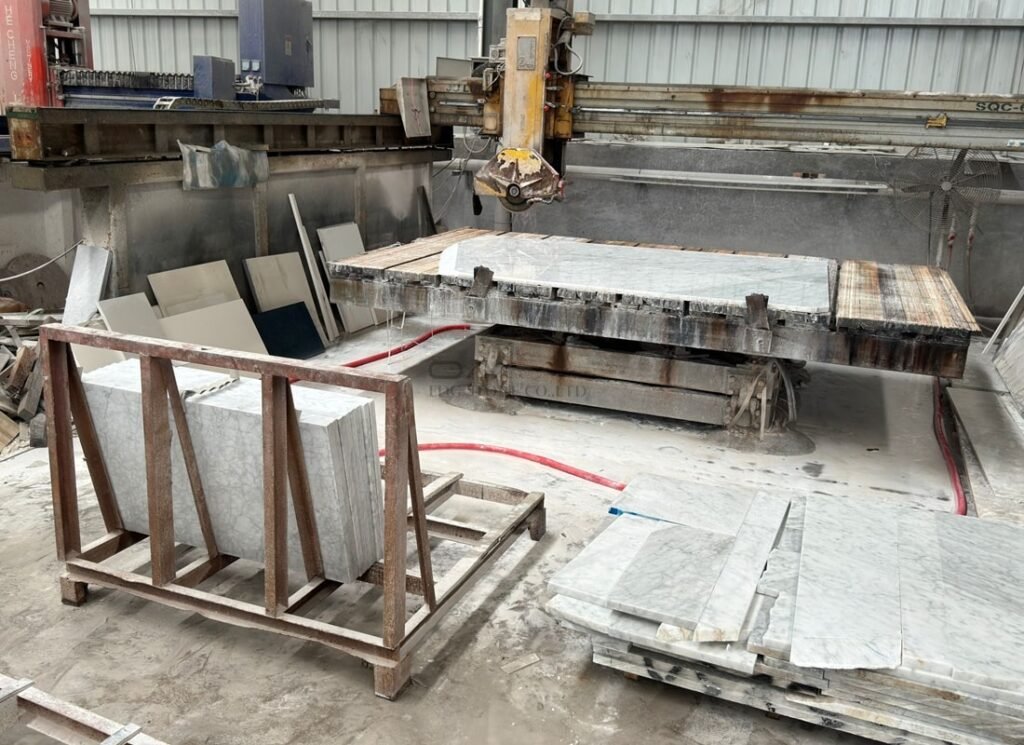
Step 2: Cutting (Precision Foundation)
Cutting Defines Accuracy
Once Carrara marble is cut incorrectly, no later process can fully correct it.
Common Cutting Methods
- Straight Cutting – Standard panels, tiles, countertops
- Curved / Custom Cutting – Arches, corners, bespoke designs
- CNC Cutting – High-precision fabrication for complex projects
Key Control Factors
- Dimensional accuracy
- Edge integrity (no chipping)
- Vein direction alignment
- Material optimization
Step 3: Polishing (Surface Quality Control)
Why Polishing Matters?
Polishing defines the final perception of quality. For Carrara White Marble, it directly affects the luxury appeal.
Functions of Polishing
- Enhances brightness
- Highlights veining
- Improves surface smoothness
- Creates visual consistency
Risks of Poor Polishing
- Dull or grey patches
- Uneven gloss levels
- “Dirty” appearance
- Mismatch between panels
Common Finishes
- Polished – High gloss, premium look
- Honed – Soft matte, natural aesthetic
- Leathered – Textured, design-focused
Step 4: Edge Profiling & Finishing
Edge Profiles Define Design Language
Edge details are not minor—they determine style, safety, and perceived quality.
Common Edge Types
- Straight Edge – Minimalist, modern
- Beveled Edge – Soft and safe
- Bullnose Edge – Rounded, user-friendly
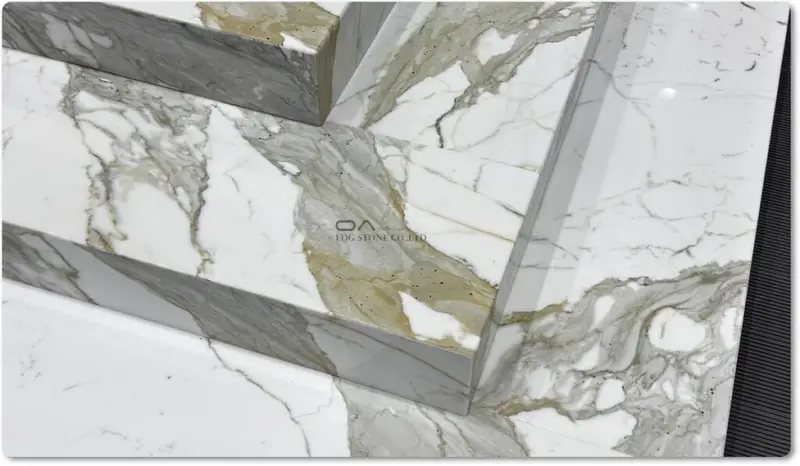
- Mitered Edge – Thick, luxury appearance
Why Edge Consistency Matters?
Inconsistent edges lead to:
- Poor visual cohesion
- Visible joints
- Reduced perceived quality
- Installation complications
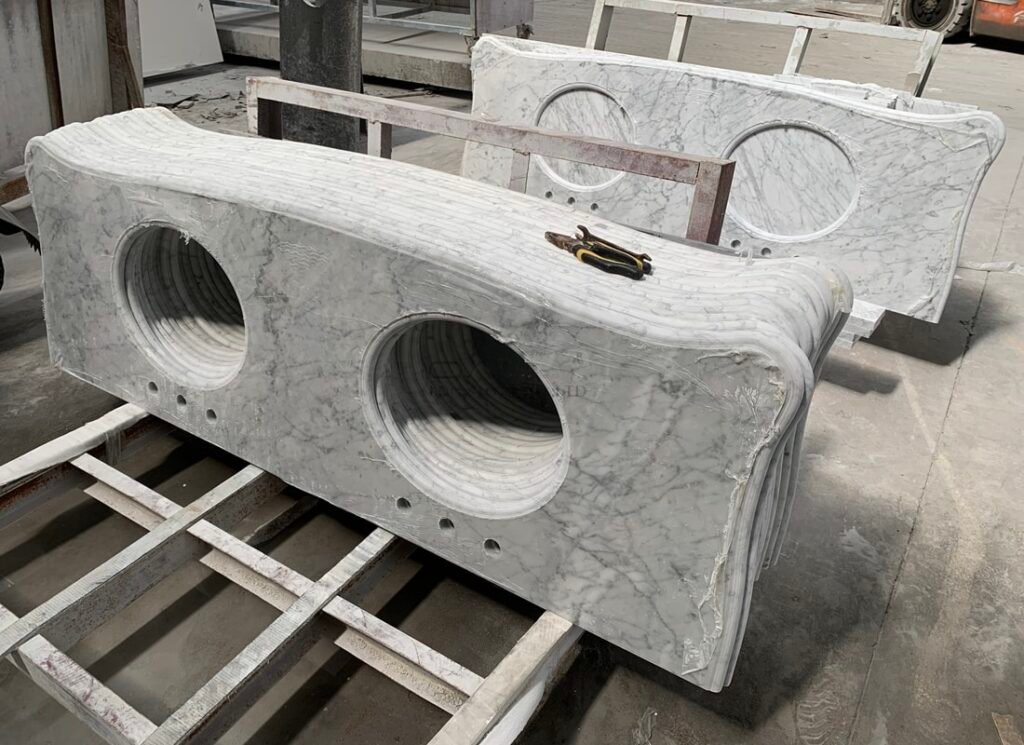
Step 5: Cutouts (High-Risk Precision Work)
Most Error-Prone Step
Cutouts directly affect usability and installation accuracy.
Typical Cutouts
- Sink openings
- Faucet holes
- Cooktop cutouts
- Functional holes (sockets, dispensers, drains)
Pre-Cutout Requirements
- Technical drawings
- Centerline positioning
- Edge clearance
- Reinforcement planning
- Appliance specifications
Why Accuracy Is Critical?
Unlike other processes, cutout errors are often irreversible.
Step 6: Dry Fit & Pre-Assembly
Purpose of Dry Fitting
Before shipping, components are assembled to verify:
- Dimensional accuracy
- Seam alignment
- Vein continuity
- Cutout correctness
- Edge consistency
Ideal Applications
- Countertop systems
- Feature walls
- Staircases
- Complex geometries
Benefits
- Reduces rework
- Minimizes onsite adjustments
- Improves delivery reliability
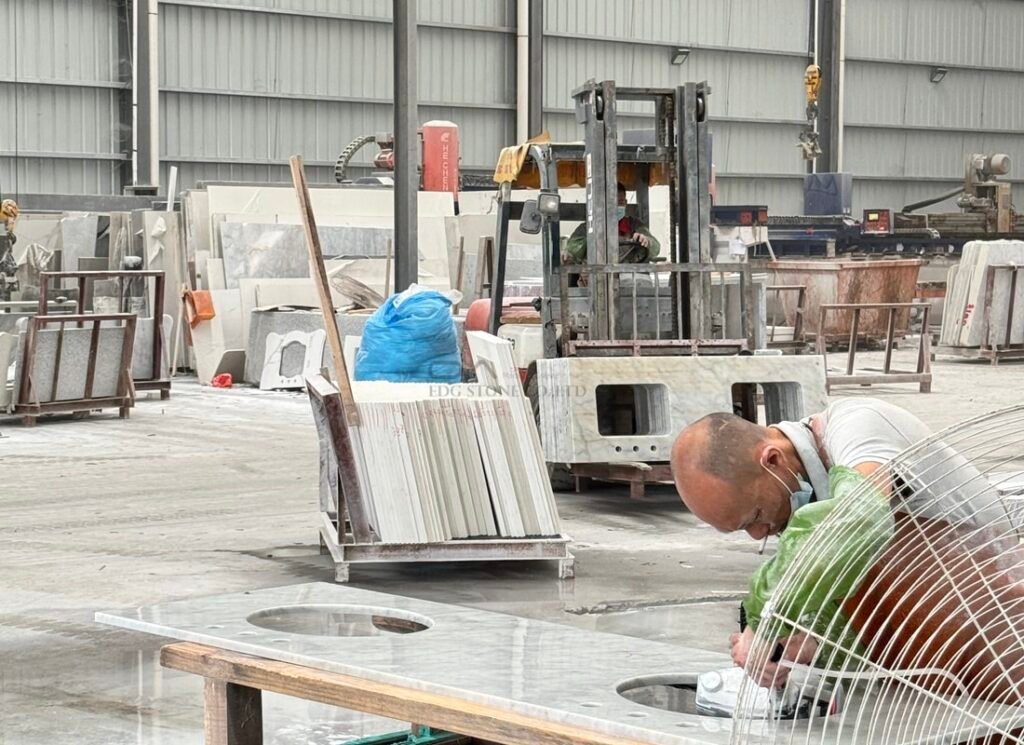
Step 7: Quality Inspection (QC)
Mandatory Checks
- Dimensions and tolerances
- Thickness consistency
- Surface flatness
- Crack detection
- Edge condition
- Polishing uniformity
- Vein direction
- Cutout accuracy
Why QC Is Non-Negotiable?
The later a defect is discovered, the higher the cost impact.
Step 8: Packaging & Shipping Preparation
Why Professional Packaging Matters?
Natural stone is vulnerable to:
- Impact
- Tilting
- Compression
- Friction
- Breakage
Standard Packaging Methods
- Wooden crates
- A-frame supports
- Foam protection
- Reinforced corners
- Labeling & coding
Packaging as Logistics Management
Good packaging ensures:
- Correct installation mapping
- Faster unloading
- Reduced confusion onsite
- Improved project coordination
Step 9: Installation-Ready Delivery
Installation Is Part of Fabrication
Even perfect fabrication fails without proper installation coordination.
Pre-Installation Checklist
- Panel numbering system
- Installation sequence
- Joint alignment plan
- Vein direction control
- Fixing method
- Site measurement verification
Common Installation Issues
- Misaligned seams
- Incorrect vein flow
- Uneven leveling
- Poor finishing joints
- Cutout mismatch
Fabrication Requirements by Application
Kitchen Countertops
Focus: cutout precision, edge detailing, stain resistance
Bathroom Vanities
Focus: waterproofing, sealing, sink integration
Wall Cladding & Feature Walls
Focus: layout planning, vein matching, joint control
Staircases
Focus: dimensional consistency, edge strength, anti-slip treatment
Commercial Projects
Focus: batch consistency, packaging system, delivery scheduling
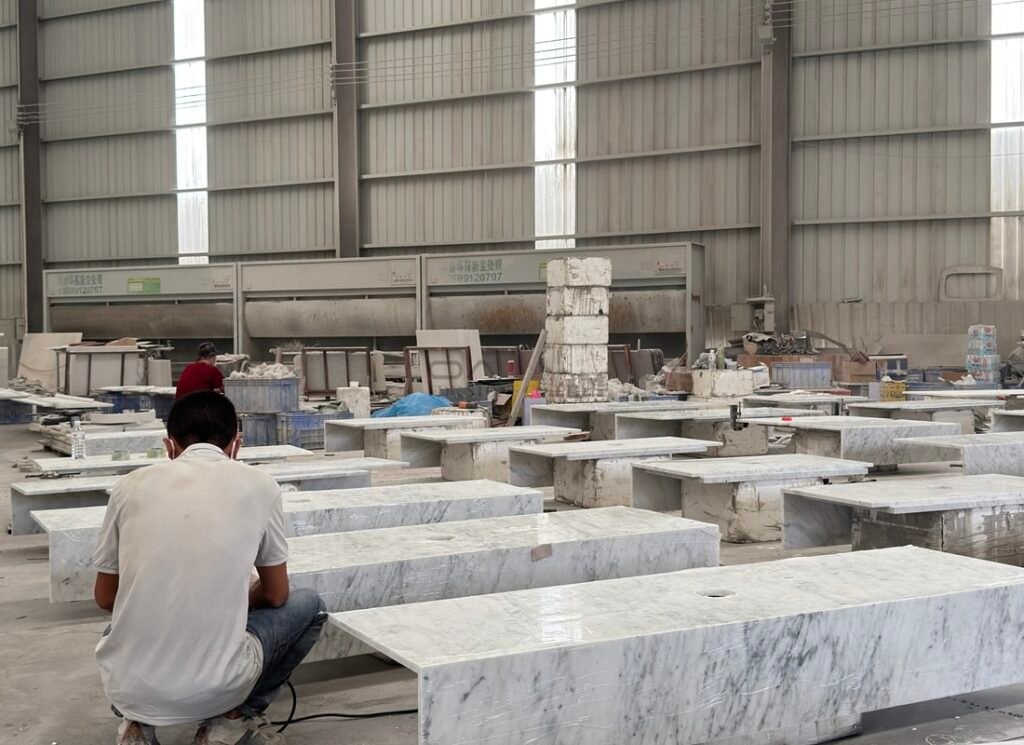
8 Common Fabrication Mistakes
- Fabrication before final measurements
- Missing cutout drawings
- Inconsistent edge profiles
- Uneven polishing
- No layout planning
- Poor joint logic
- Skipping dry fit
- Weak packaging
How to Evaluate a Professional Fabricator?
A qualified supplier should be able to:
- Interpret technical drawings
- Provide layout/shop drawings
- Explain fabrication details
- Define edge and cutout logic
- Offer packaging solutions
- Coordinate with installation teams
👉 A real supplier delivers finished, installable products—not just raw stone

Conclusion
Carrara White Marble fabrication is not just a sequence of processes—it is a transformation:
👉 From natural material → to engineered, installation-ready product
The success of your project depends on:
- Cutting precision
- Polishing consistency
- Edge uniformity
- Cutout accuracy
- Packaging reliability
- Installation coordination
For project procurement, the most important capability is not stock availability, but:
👉 The ability to deliver standardized, consistent, and fully fabricated stone products
FAQ (Featured Snippets Ready)
What is marble fabrication?
Marble fabrication is the process of cutting, polishing, edging, drilling, and preparing stone for installation.
Why is edge profiling important in marble?
It affects both aesthetics and safety, especially for countertops and stairs.
What is the most common marble finish?
Polished is most common for luxury interiors, while honed is preferred for softer designs.
Can marble be custom-fabricated?
Yes, marble can be CNC cut into custom shapes, cutouts, and complex components.
Why is dry-fitting important?
It identifies alignment and sizing issues before installation, reducing costly rework.
Internal Linking Strategy
- What is Carrara marble → Guide 01
- marble vs granite vs quartz → Guide 02
- Marble Quality Grading → Guide 03
- Carrara marble slab guide → Guide 04
- cut-to-size marble panels → Guide 05
- kitchen countertop guide → Guide 06
- bathroom vanity guide → Guide 07
- commercial countertop guide → Guide 08
- commercial vanity guide → Guide 09
- wall cladding guide → Guide 10
- flooring and stairs guide → Guide 11
- project procurement process → Guide 12
- cost optimization guide → Guide 14
- bulk logistics guide → Guide 15