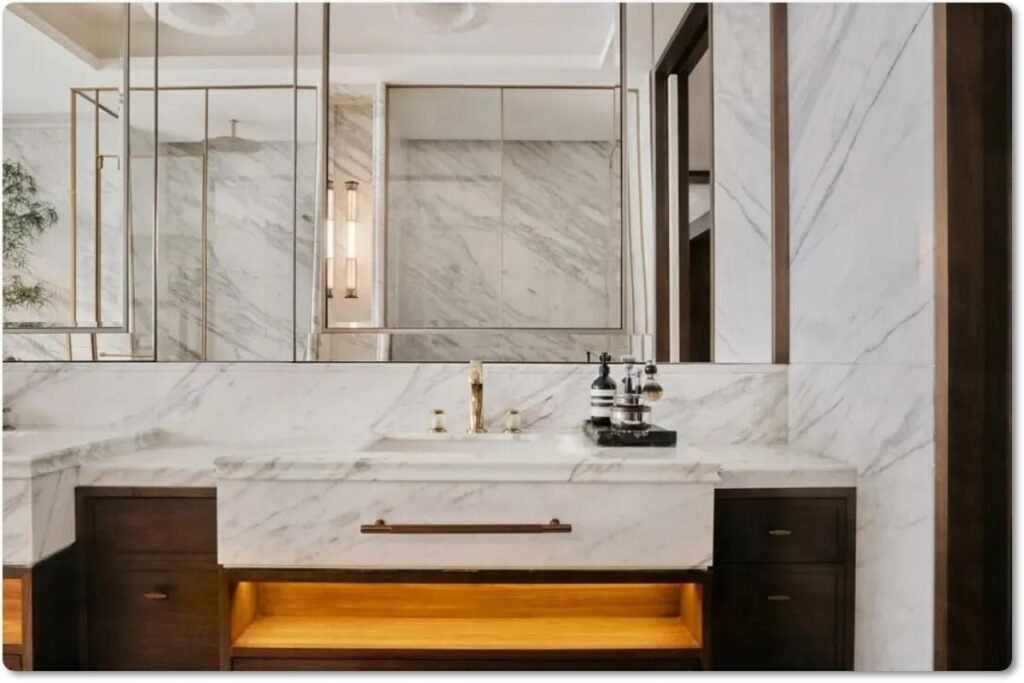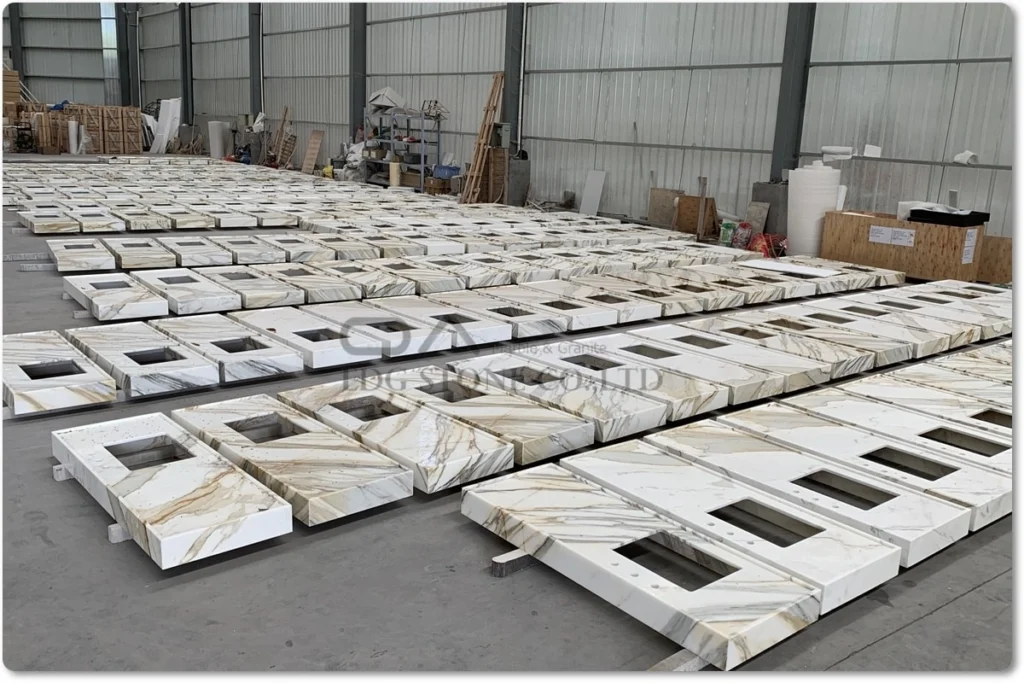
Marble Countertops Manufacturer & Supplier
Natural Marble Countertops, Custom Fabrication & Wholesale Project Supply from China
Looking for a reliable marble countertops manufacturer and supplier for your residential, hospitality, multifamily, commercial, or wholesale project?
EDG Stone manufactures and supplies natural marble countertops, marble vanity tops, and custom-fabricated stone products for international B2B customers.
Our capabilities cover the complete process from marble slab selection and CAD review to cutting, CNC processing, waterjet fabrication, edge processing, polishing, quality control, export packaging, and container loading.
Whether you need a small batch of custom marble countertops or a larger project involving hundreds of fabricated pieces, EDG Stone can review your drawings, dimensions, material requirements,s and quantities to develop a project-specific production and quotation plan.
Request a Marble Countertop Quote →
Marble Countertops Manufacturer at a Glance
| Item | EDG Stone Capability |
|---|---|
| Product | Natural Marble Countertops |
| Related Products | Marble Vanity Tops, Marble Slabs & Custom Stone Products |
| Materials | Marble and other natural & engineered stone options |
| Fabrication | Cut-to-Size, CNC, Waterjet & Edge Processing |
| Customization | Dimensions, Cutouts, Edges, Backsplashes & Special Shapes |
| Applications | Kitchens, Bathrooms, Hotels, Multifamily, Commercial & Residential |
| Customers | Wholesalers, Distributors, Contractors, Designers & Project Buyers |
| Production | Factory-Based Custom Manufacturing |
| Quality Control | Material, Dimensions, Surface, Edges & Fabrication Inspection |
| Packaging | Export Wooden Crates & Protective Packaging |
| Shipping | Container Loading & International Export |
EDG Stone’s current manufacturing and fabrication capabilities include custom countertops, vanity tops, CNC stone fabrication, waterjet cutting, marble and granite fabrication, OEM/ODM production, and export packaging.
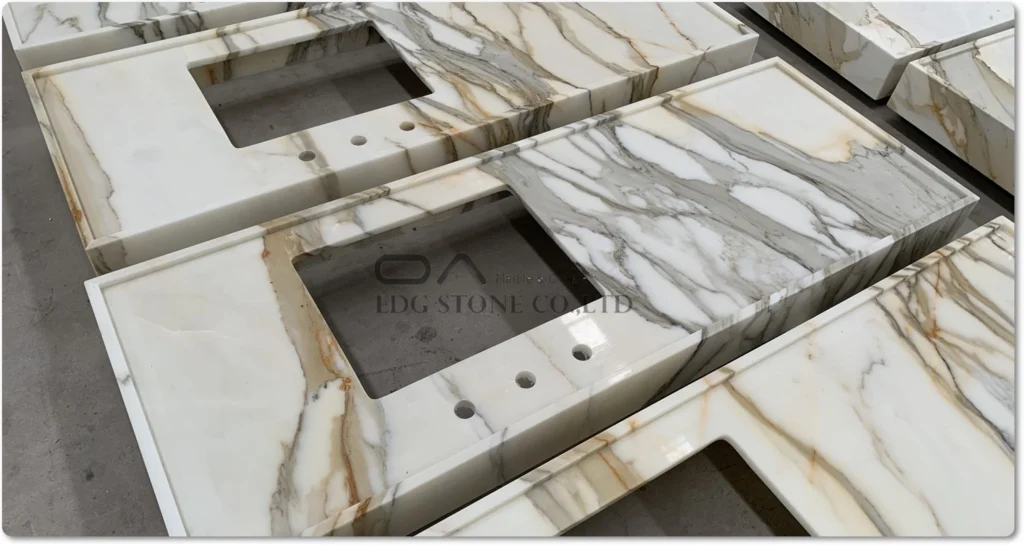
What Are Marble Countertops?
Marble countertops are fabricated natural-stone surfaces produced from marble slabs and customized for kitchens, bathrooms, hospitality interiors, commercial spaces, and other architectural applications.
Unlike mass-produced synthetic surfaces, natural marble has geological variation in color, veining, crystal structure, and pattern. This means that selecting the right slab is an important part of manufacturing a high-quality marble countertop.
For project buyers, purchasing marble countertops involves more than selecting a color.
The complete process may include:
- Marble selection
- Slab inspection
- Project drawing review
- CAD layout
- Cutting
- CNC or waterjet processing
- Sink and faucet cutouts
- Edge processing
- Surface finishing
- Quality control
- Packaging
- Container loading and shipment
For this reason, choosing a capable marble countertop manufacturer can be particularly important for custom and project orders.
Marble Countertop Products
EDG Stone manufactures custom marble countertops for different applications and project requirements.
Marble Kitchen Countertops
Natural marble can be fabricated into kitchen countertops according to approved dimensions and drawings.
Available fabrication may include:
- Custom dimensions
- Sink cutouts
- Faucet holes
- Backsplash
- Waterfall edges
- Mitered edges
- Custom edge profiles
- Special shapes
- Bookmatched layouts
Marble Bathroom Countertops
Marble can also be fabricated for bathroom surfaces and vanity applications.
Typical products include:
- Marble vanity tops
- Single-sink vanity tops
- Double-sink vanity tops
- Floating vanity tops
- Hotel bathroom countertops
- Custom bathroom surfaces
- Matching backsplashes
EDG’s existing Stone Vanity Tops manufacturing program already supports project-specific dimensions, sink cutouts, faucet holes, backsplashes, edge profiles, QC, export packaging, and container loading.
Custom Marble Countertops
For non-standard projects, EDG Stone can work from:
- CAD drawings
- PDF drawings
- Dimensioned sketches
- Templates
- Bathroom schedules
- Architectural drawings
- Sink specifications
- Project material specifications
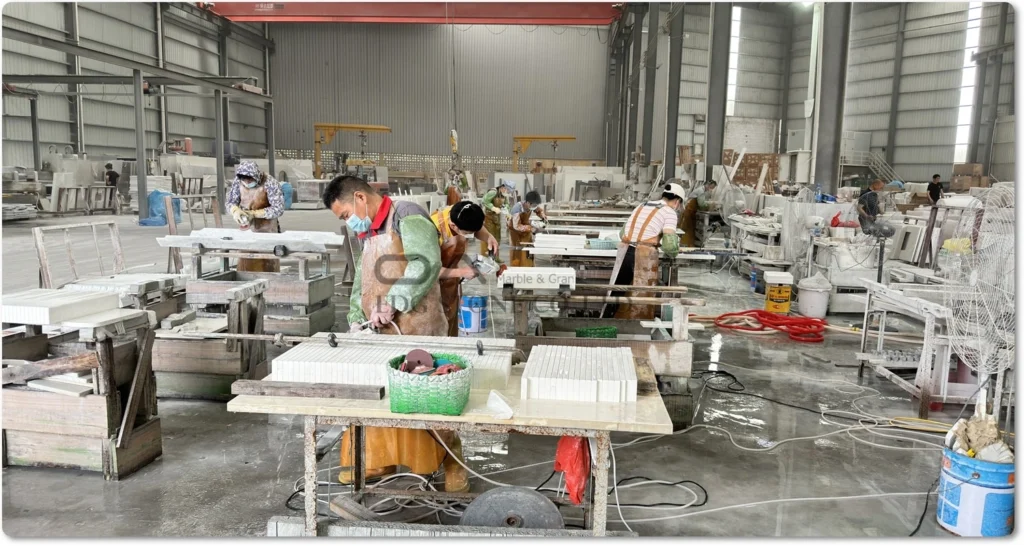
Marble Types for Countertops
Different marble varieties create very different visual results.
EDG Stone can work with different natural marble selections according to project specifications, availability, and required appearance.
White Marble Countertops
White marble remains widely used for kitchens, bathrooms, hospitality interiors, and luxury residential projects.
Commonly specified styles include:
- Carrara-style marble
- Calacatta-style marble
- Statuario-style marble
- Arabescato-style marble
- Other selected white marble
White marble can range from relatively subtle gray veining to dramatic gold or gray patterns.
Black Marble Countertops
Black marble provides a stronger visual contrast and can be used for:
- Luxury kitchens
- Bathroom vanities
- Hotel interiors
- Bar counters
- Feature surfaces
- Furniture applications
Green Marble Countertops
Green marble can be used when the project requires a more distinctive natural-stone appearance.
Depending on the material, green marble may display:
- Dark green backgrounds
- Light green tones
- White veining
- Cloud-like patterns
- Forest-style patterns
- Brecciated patterns
Beige & Cream Marble
Beige and cream marble can be suitable for projects requiring a warmer palette.
These materials are frequently considered for:
- Traditional interiors
- Luxury residences
- Hotel bathrooms
- Commercial interiors
- Wall and countertop coordination
Premium & Bookmatched Marble
For feature installations, buyers may require carefully selected slabs with compatible veining.
Bookmatching involves arranging slabs so that their patterns create a coordinated visual composition.
This requires planning during:
slab selection → layout → cutting → fabrication
rather than treating each countertop as an isolated piece.
Custom Marble Countertop Fabrication
CNC, waterjet, cut-to-size, edge processing and project fabrication.
EDG Stone’s custom fabrication capability allows marble slabs to be transformed into finished countertop components according to project specifications.
Cut-to-Size
Countertops are cut according to approved dimensions and layouts.
CNC Fabrication
CNC processing can be used for:
- Sink openings
- Faucet holes
- Curved corners
- Grooves
- Special shapes
- Edge profiles
Waterjet Cutting
Waterjet technology can be used for complex shapes, decorative patterns, medallions, inlays and architectural components.
Edge Processing
Depending on the project, edge treatments may include:
- Eased edges
- Bullnose
- Beveled edges
- Mitered edges
- Laminated edges
- Custom profiles
Sink Cutouts
Sink openings can be fabricated according to approved sink specifications.
Faucet Holes
Faucet-hole positions can be incorporated into the fabrication drawings before production.
Bookmatching
Selected marble slabs can be arranged according to the approved layout when coordinated veining is required.
EDG’s current custom fabrication program specifically covers CNC, waterjet, cut-to-size, edge processing, stone carving, and bookmatching.
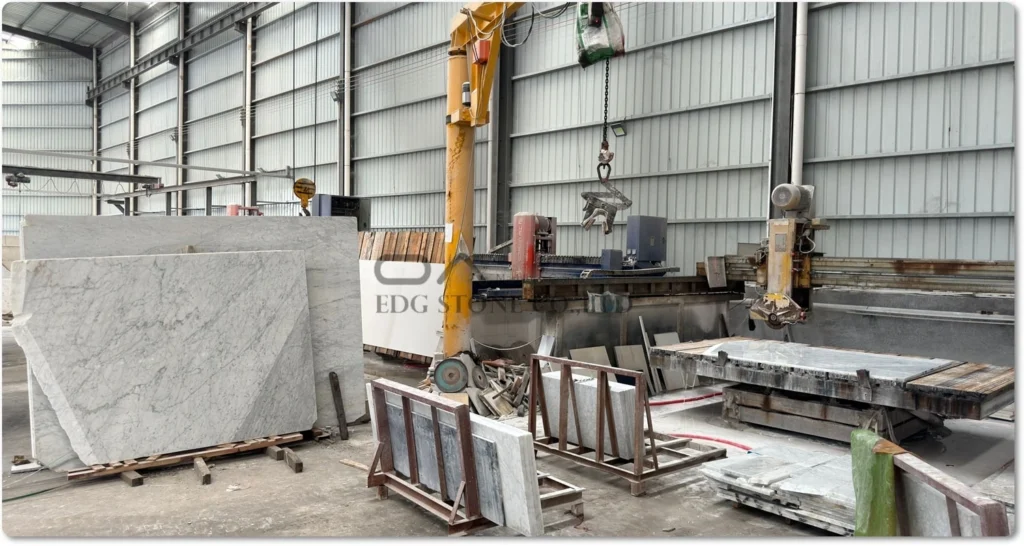
Marble Countertops for Wholesale & Project Buyers
EDG Stone works with different types of international B2B customers.
Wholesalers & Distributors
For stone importers and distributors, factory production can provide customized dimensions and fabrication rather than only standard slabs.
Contractors
Contractors can submit project drawings, quantities and specifications for quotation and production review.
Architects & Interior Designers
Design teams can specify marble selection, dimensions, finishes, edge profiles and fabrication details according to project requirements.
Hotels & Hospitality
Hospitality projects often require repeated products with controlled dimensions and appearance.
Multifamily & Apartment Projects
Multifamily projects can involve large numbers of standardized countertops or vanity tops.
The key requirement is often repeatability, not simply individual-piece fabrication.
EDG’s existing project content demonstrates this manufacturing approach through a 500-set luxury hotel marble vanity-top production program involving CAD drawings, cutting, CNC processing, polishing, QC, packaging and export preparation.
Marble Countertops Cost & Pricing Guide
Although this page is now focused on marble countertops manufacturing and supply, marble countertop cost remains an important consideration for buyers.
There is no single universal price for marble countertops.
The final quotation can depend on:
| Pricing Factor | How It Affects Cost |
|---|---|
| Marble Type | Different materials have different market prices |
| Marble Grade | Selection and appearance affect material value |
| Slab Size | Larger slabs can affect material utilization |
| Thickness | Thickness changes material requirements |
| Countertop Dimensions | Larger surfaces require more material |
| Waste | Cutting layout affects slab utilization |
| Edge Profile | More complex edges require additional fabrication |
| Sink Cutouts | Additional fabrication is required |
| Faucet Holes | Additional processing may apply |
| Backsplash | Additional stone components increase material and fabrication |
| Bookmatching | Requires slab selection and layout planning |
| Quantity | Project volume affects production planning |
| Packaging | Export packaging requirements affect logistics |
| Destination | Shipping and delivery requirements vary by market |
For B2B buyers, factory quotation is normally more useful than a generic retail price-per-square-foot estimate.
A project quotation can take into account the actual:
marble + dimensions + quantity + fabrication + packaging + shipping requirements
instead of relying on a generalized online price.
Request a Project-Specific Marble Countertop Quote →
Marble Countertop Specifications
Specifications should be confirmed according to the actual project.
| Specification | Options / Considerations |
|---|---|
| Material | Natural Marble |
| Thickness | Project Dependent |
| Finish | Polished / Honed / Other Specified Finish |
| Dimensions | Custom |
| Sink | Single / Double / Custom |
| Faucet Holes | Custom |
| Edge | Eased / Bullnose / Miter / Custom |
| Backsplash | Optional |
| Side Splash | Optional |
| Shape | Standard / Curved / Special Shape |
| Drawings | CAD / PDF / Shop Drawings |
| Quantity | Project Dependent |
| Packaging | Export Wooden Crates / Protective Packaging |
For a production quotation, buyers should provide as much technical information as possible.
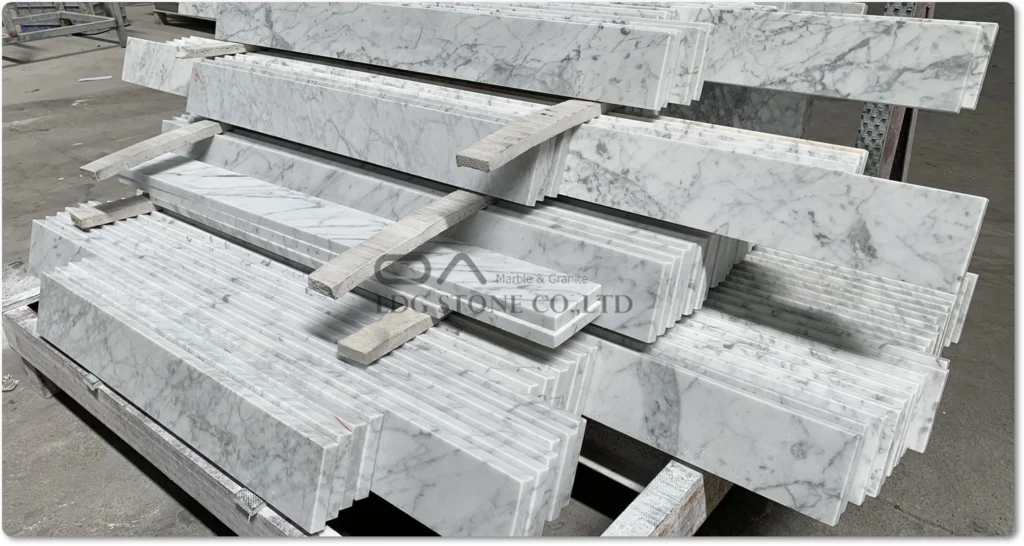
Marble Countertop Quality Control
Natural stone requires both material inspection and fabrication inspection.
A project QC process may include:
Material Inspection
- Marble color
- Veining
- Natural characteristics
- Surface condition
- Slab dimensions
Dimensional Inspection
- Length
- Width
- Thickness
- Corner dimensions
- Cutout dimensions
Fabrication Inspection
- Sink openings
- Faucet holes
- Edge profiles
- Surface finish
- Polishing
- Special shapes
Final Inspection
- Quantity
- Product identification
- Surface protection
- Packaging condition
- Labeling
For larger projects, QC should be integrated into the production workflow rather than performed only at the end.
Marble Countertop Manufacturing Process
Step 1 — Project Consultation
Provide:
- Drawings
- Dimensions
- Material requirements
- Quantity
- Application
- Destination
Step 2 — Marble Selection
Review suitable marble options according to the project requirements.
Step 3 — Slab Inspection
Inspect the selected slabs for appearance, dimensions, and relevant natural characteristics.
Step 4 — CAD & Layout
Review:
- Dimensions
- Cutouts
- Edges
- Vein direction
- Slab utilization
- Special requirements
Step 5 — Cutting
Cut the marble according to the approved production drawings.
Step 6 — CNC / Waterjet Processing
Complete sink cutouts, holes, curves, profiles, and other precision fabrication.
Step 7 — Edge Processing & Polishing
Process the specified edges and finish the surfaces.
Step 8 — Quality Control
Inspect the finished products according to project requirements.
Step 9 — Export Packaging
Finished countertops are protected and organized for international transportation.
Step 10 — Container Loading
Products are organized for shipment according to the packaging and loading plan.
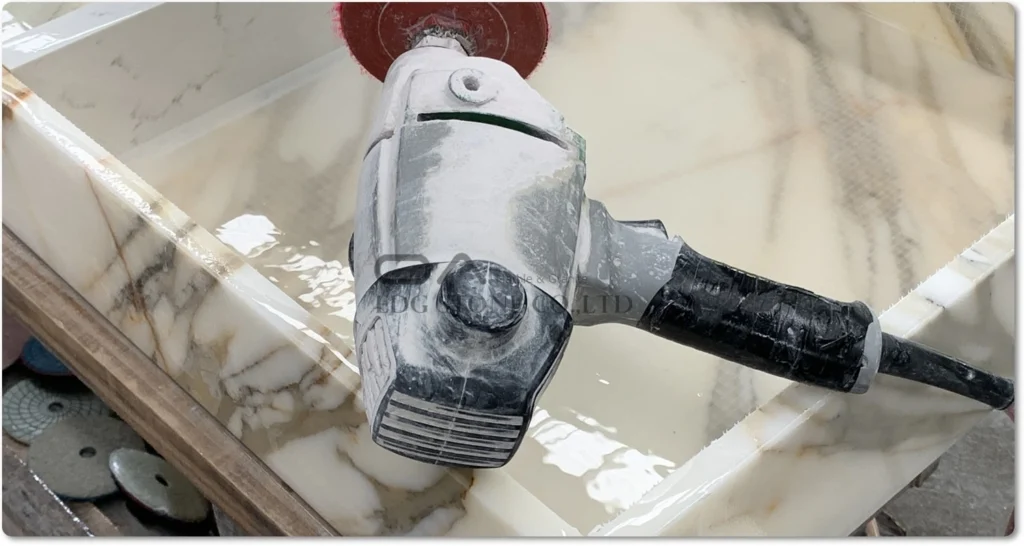
Marble Countertop Packaging & Export
For international B2B projects, manufacturing is only one part of the supply chain.
Finished marble countertops can have:
- Large dimensions
- Thin sections
- Finished edges
- Sink openings
- Special shapes
- Highly polished surfaces
Therefore, packaging requires careful planning.
EDG Stone’s export-oriented fabrication workflow can include:
- Wooden crates
- Internal protection
- Foam protection
- Corner protection
- Surface protection
- Product labeling
- Crate identification
- Loading sequence
- Container loading
The objective is to protect the fabricated stone products during international transportation and make project unloading and identification more organized.
EDG’s existing fabrication page also emphasizes export packaging and container loading as part of the custom-stone manufacturing workflow.
Marble Countertop Applications
Natural marble countertops can be fabricated for:
Residential
- Kitchens
- Bathrooms
- Luxury homes
- Villas
- Renovation projects
Hospitality
- Hotel bathrooms
- Hotel suites
- Restaurants
- Bars
- Guest facilities
Multifamily
- Apartment kitchens
- Apartment bathrooms
- Repeated unit types
- Property renovation
Commercial
- Offices
- Retail
- Restaurants
- Showrooms
- Amenity spaces
Luxury Interior
- Feature countertops
- Bookmatched surfaces
- Custom furniture
- Decorative stone components
Why Source Marble Countertops from EDG Stone?
Factory-Based Manufacturing
EDG Stone provides custom stone manufacturing and fabrication for international B2B customers.
35+ Years of Stone Manufacturing Experience
EDG Stone’s current company materials position the business around more than three decades of stone manufacturing and international export experience.
Custom Fabrication
Production can include:
CNC + waterjet + cut-to-size + edge processing + project fabrication
Multiple Stone Materials
In addition to marble, EDG’s fabrication operation works with materials including granite, quartzite, quartz, limestone, travertine, porcelain, and sintered stone.
Project Production
EDG can review project drawings, quantities, specifications, and production requirements for larger orders.
Export Packaging
Custom-fabricated products can be prepared in export-oriented wooden crates and protective packaging.
International B2B Supply
The production model is suitable for:
- Importers
- Distributors
- Wholesalers
- Contractors
- Designers
- Architects
- Developers
- Hospitality buyers
Marble Countertop Projects
A manufacturer should be evaluated not only by the appearance of individual samples, but also by its ability to manage repeatable project production.
For example, EDG Stone has published a case study covering a 500-set luxury hotel marble vanity-top project, with production involving material selection, CAD drawings, cutting, CNC machining, edge processing, polishing, QC, packaging, and export preparation.
This type of project demonstrates why hospitality and multifamily buyers should evaluate:
- Drawing control
- Material consistency
- Production repeatability
- Dimensional accuracy
- QC procedures
- Packaging
- Labeling
- Shipment organization
rather than evaluating factory capability based only on individual product photographs.
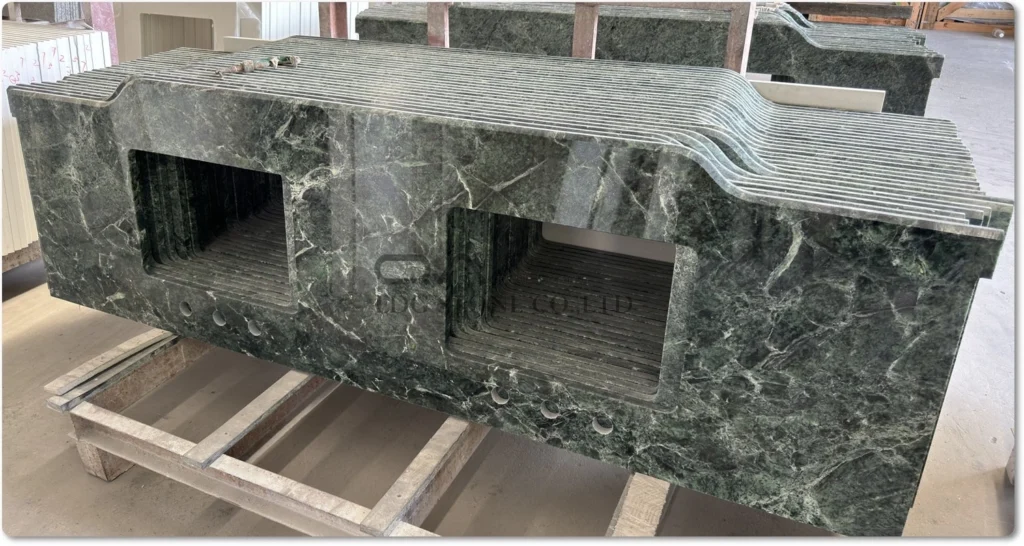
How to Order Marble Countertops from EDG Stone?
1. Send Your Requirements
Tell us your:
- Product type
- Marble preference
- Dimensions
- Quantity
- Application
- Destination
2. Send Drawings
CAD, PDF, shop drawings, dimensioned drawings, or templates can be reviewed.
3. Confirm Material
Specify your preferred marble or ask EDG Stone to provide suitable options.
4. Confirm Fabrication
Specify:
- Sink cutouts
- Faucet holes
- Edges
- Backsplash
- Special shapes
- Bookmatching
- Finish
5. Review the Quotation
EDG Stone reviews the project requirements and prepares a project-specific quotation.
6. Production
After approval, the project proceeds through cutting, fabrication, finishing, and QC.
7. Packing & Shipment
Finished products are protected, packed, and organized for international shipment.
Frequently Asked Questions
Is EDG Stone a marble countertop manufacturer?
Yes. EDG Stone manufactures custom marble countertops and other fabricated stone products for international B2B customers, including wholesalers, distributors, contractors, designers, and project buyers.
Can EDG Stone manufacture custom marble countertops?
Yes. Custom production can include dimensions, sink cutouts, faucet holes, backsplashes, edge profiles, special shapes,s and other project-specific requirements.
Does EDG Stone supply marble countertops wholesale?
Yes. EDG Stone’s manufacturing model is designed for international B2B and project orders, including wholesale, hospitality, multifamily, and commercial requirements.
Can I send CAD drawings for a marble countertop quotation?
Yes. CAD drawings, PDF drawings, dimensions, templates,s and project specifications can be provided for technical review and quotation.
What marble types can be used for countertops?
Depending on availability and project requirements, marble countertops can be produced from different white, black, green, beige,ge and other natural marble varieties.
How much do marble countertops cost?
Marble countertop cost depends on the material, grade, slab dimensions, thickness, countertop size, fabrication, edge profile, cutouts, quantity, packaging, ing and shipping requirements. A project-specific factory quotation is therefore more useful than relying on a single generic price.
Can you manufacture marble vanity tops together with countertops?
Yes. Marble vanity tops can be manufactured as part of bathroom, hospitality, multi-family,mily and residential projects. EDG’s existing vanity-top production workflow includes material selection, CAD review, cutting, sink cutouts, edge processing, QC, export packing, staging, and container loading.
Can EDG Stone handle large hotel or multifamily orders?
Yes. EDG Stone has published a case study covering a 500-set marble vanity-top hotel project, demonstrating a factory-based approach to repetitive production, packaging,g and export preparation.
Does EDG Stone provide CNC and waterjet marble fabrication?
Yes. CNC and waterjet fabrication are part of EDG Stone’s current custom stone fabrication capabilities.
Request a Marble Countertop Quote
Planning a residential, hospitality, multifamily, or commercial marble countertop project?
Send EDG Stone your:
Material + Dimensions + Drawings + Quantity + Fabrication Requirements + Destination
Our team can review your requirements and prepare a project-specific quotation.