Technical Procurement, Engineering Specifications, and Global Supply Chain White Paper
Executive Summary & Industry Context
Natural white granite remains a dominant material in global commercial architecture, high-end hospitality projects, and multi-family developments. Its high compressive strength, low porosity, and timeless visual appeal make it the material of choice for exterior rainscreen cladding, heavy-traffic flooring, and hotel vanity tops. However, procuring white granite at scale presents major engineering and supply-chain challenges. Feldspar oxidation, iron vein rust, color variation across quarry benches, and shipping delays can compromise project budgets and installation schedules.
This white paper gives procurement officers, commercial contractors, stone importers, and architects an end-to-end technical roadmap. We provide empirical benchmarks based on ASTM International standards (ASTM C615 / ASTM C97), European Norms (EN 1469 / EN 12057), and field data from major commercial projects. By structuring sourcing decisions around physical material logic, rigorous tender specifications, container logistics math, and quality control protocols, commercial buyers can mitigate procurement risks and secure project margins.
Key Takeaway for B2B Buyers: White granite procurement requires strict specification management. Standard commercial grades exhibit up to 15% color variance. Specifying technical parameters—such as water absorption below 0.20%, flexural strength exceeding 12 MPa, and batch-matched slab numbering—prevents project disputes, structural failures, and costly on-site re-work.
Table of Contents
Executive Summary & Industry Context
White Granite Geology & ASTM/EN Specification Standards
Tender Specifications, Bidding Architecture, and Cut-To-Size Engineering
Sample Approvals, Range Boards, and Mandatory Dry-Lay Protocols
Lead Time Mathematics, Capacity Planning, and Production Workflows
Quality Control, Factory Inspection, and Defect Criteria (AQL 1.5)
Logistics, Fumigated Wooden Crating, and Container Loading Math
Global Sourcing Case Study: EDG Stone Factory
Installation Protocols, Penetrating Sealers, and After-Sales Claims
Frequently Asked Questions (FAQ Cluster)
Internal Topic Cluster Matrix & Resource Hub
Authoritative Data Sources and Technical Standards
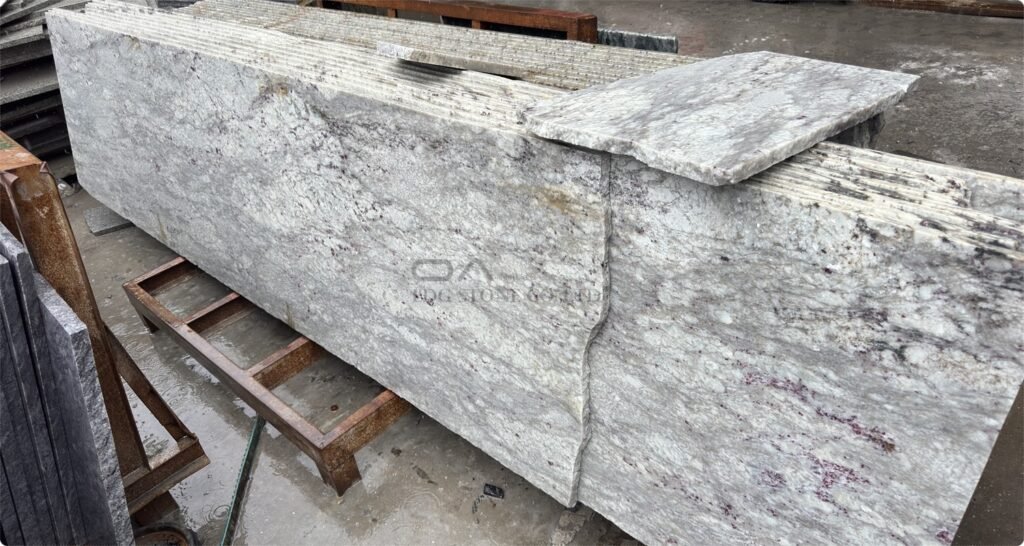
1. White Granite Material Geology & ASTM/EN Specification Standards
Geologically, granite is an intrusive igneous rock composed primarily of quartz (20% to 60%), alkali feldspar, and plagioclase feldspar. White granite achieves its pale hue when plagioclase feldspar dominates, and biotite mica remains minimal. Understanding the mineral composition allows engineers to predict how the stone performs under mechanical stress and environmental exposure.
1.1 Chemical Composition and Mineral Stability
The primary structural matrix consists of silicon dioxide ($\text{SiO}_2$, 68%–75%), aluminum oxide ($\text{Al}_2\text{O}_3$, 12%–15%), and potassium/sodium oxides ($\text{K}_2\text{O} / \text{Na}_2\text{O}$, 6%–8%). Small amounts of iron sulfide ($\text{FeS}_2$, pyrite) or free iron oxides ($\text{Fe}_2\text{O}_3$) create major risks for white granite. When exposed to water and atmospheric oxygen, pyrite oxidizes into ferric hydroxide [$\text{Fe(OH)}_3$], causing orange-rust leaching on building facades.
1.2 ASTM and EN Physical Performance Standards
Commercial architectural specifications must require physical test results from accredited ISO 17025 testing laboratories. Project managers should compare supplier test certificates directly against the benchmark values in Table 1.
Table 1: Physical Performance Specifications for Architectural Grade White Granite
| Physical Property | ASTM Test Standard | EN Test Standard | Minimum ASTM Specification | High-Traffic Commercial Grade Standard |
| Absorption by Weight | ASTM C97 / C97M | EN 13755 | Max 0.40% | $\le 0.18\%$ (High-density) |
| Density (Bulk Specific Gravity) | ASTM C97 / C97M | EN 1936 | Min 2,560 kg/m³ (160 lbs/ft³) | $\ge 2,680\text{ kg/m}^3$ |
| Compressive Strength | ASTM C170 / C170M | EN 1926 | Min 131 MPa (19,000 psi) | $\ge 165\text{ MPa (23,930 psi)}$ |
| Flexural Strength | ASTM C880 / C880M | EN 12372 | Min 8.3 MPa (1,200 psi) | $\ge 12.5\text{ MPa (1,810 psi)}$ |
| Modulus of Rupture | ASTM C99 / C99M | EN 13161 | Min 10.3 MPa (1,500 psi) | $\ge 14.0\text{ MPa}$ |
| Abrasion Resistance | ASTM C241 / C1353 | EN 14157 | $H_a$ Index $\ge 25.0$ | $H_a\text{ Index} \ge 38.0$ |
For more details on material performance under freeze-thaw cycles, review our internal technical whitepaper on Granite Durability and Freeze-Thaw Resistance Metrics.
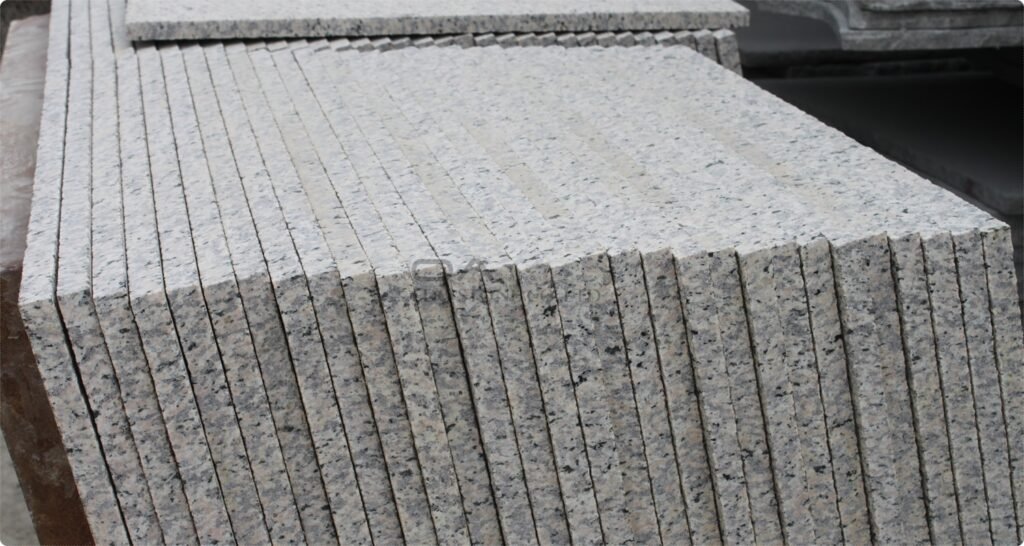
2. Tender Specifications, Bidding Architecture, and Cut-To-Size Engineering
Contractors and developers lose substantial margin when tender documents contain ambiguous descriptions. Simply stating “White Granite Countertops” or “G655 White Granite” in a bill of quantities (BOQ) leads to mismatched color tones, varying slab thicknesses, and rejected shipments on site.
2.1 Structuring MasterFormat Section 04 42 00 (Exterior Stone Cladding)
When drafting technical specs for architectural tenders, engineers must enforce specific tolerances and testing protocols. Below is the mandatory structural clause recommended for high-rise commercial exterior cladding and hotel vanity programs:
Plaintext
SECTION 04 42 00 - EXTERIOR ANCHORED STONE CLADDING / INTERIOR VANITIES
1.1 MATERIAL REQUIREMENTS
    A. Stone Type: Natural Quartz-Feldspar Granite.
    B. Commercial Grade: Extra-First Grade, uniform grain structure, free from open fissures,
       soft veins, and rust-forming iron pyrite inclusions.
    C. Water Absorption (ASTM C97): Not exceeding 0.18%.
    D. Flexural Strength (ASTM C880): Minimum 12.5 MPa in dry state; minimum 11.0 MPa in wet state.
    E. Finish: Flamed and Waterjet Brushed for exterior wall panels; Polished (85+ Gloss Unit) for vanity tops.
1.2 TOLERANCES
    A. Tile Cut-to-Size Dimensions: Length & Width: +/- 1.0 mm; Thickness: +/- 1.0 mm for panels <= 30mm thickness.
    B. Slab Flatness & Bowing: Maximum 0.5 mm variance across a 1,000 mm straightedge.
    C. Diagonal Squareness Tolerance: Maximum 1.5 mm difference between diagonal measurements.
2.2 Cut-to-Size Optimization and Yield Calculations
Block yield governs project pricing. Standard gangsaw blocks measure approximately $2800\text{ mm} \times 1600\text{ mm} \times 1500\text{ mm}$. To calculate raw block requirements for a project, contractors must account for kerf blade loss, edge trimming, and stone yield factors. The blade cut thickness consumes $6.5\text{ mm}$ to $8.0\text{ mm}$ of stone material per slab.
Yield Calculation Formula:
The net slab volume yielded from a raw block is given by:
$$V_{\text{usable}} = V_{\text{gross}} \times \eta_{\text{cutting}} \times (1 – L_{\text{waste}})$$Where $V_{\text{gross}}$ is raw block volume, $\eta_{\text{cutting}}$ is gangsaw yield efficiency (0.78 to 0.82), and $L_{\text{waste}}$ is cutting waste factor (10% to 18% depending on cut-to-size dimensions).
To evaluate alternative dense natural surface options for high-traffic hotel lobbies, explore our guide on White Quartzite vs. White Granite for High-Traffic Commercial Spaces.
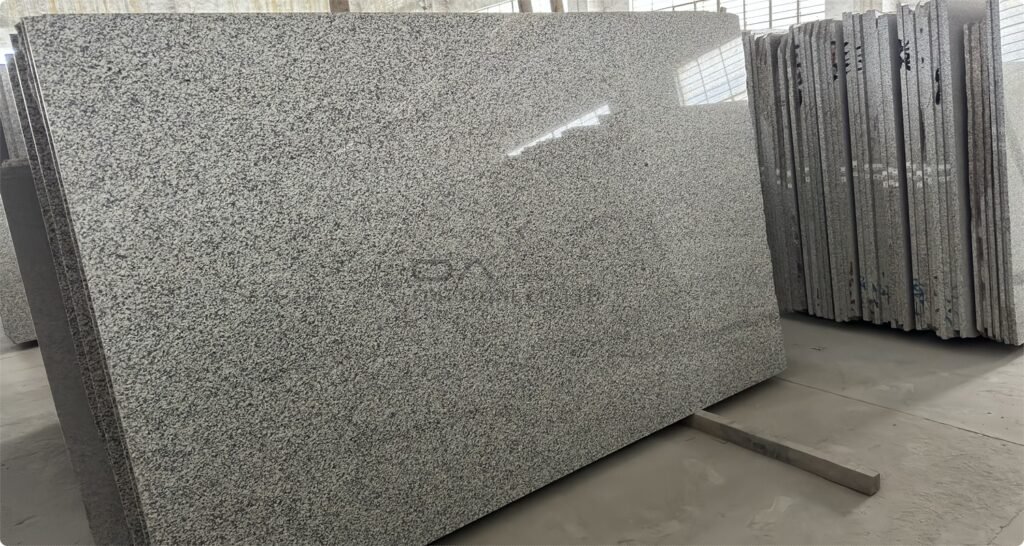
3. Sample Approvals, Range Boards, and Mandatory Dry-Lay Protocols
Natural stone features inherent variation. Approvals based on a single $100\text{ mm} \times 100\text{ mm}$ sample tile frequently result in project disputes when 10,000 square meters arrive on site. Procurement managers must implement a formal Range Board and Dry-Lay strategy.
3.1 Range Board Establishment
Before mass processing, the fabricator must supply a set of three full-sized slab samples representing the exact range acceptable for the project:
Sample A (Light Limit): The minimum density of background veining/speckling permitted.
Sample B (Control Target): The ideal visual baseline for the project.
Sample C (Dark/Veined Limit): The maximum dark mineral concentration or veining allowable.
Once signed off by the Architect of Record (AOR) and General Contractor (GC), these boards serve as the binding quality baseline for all factory inspections.
3.2 Factory Dry-Lay and Mock-Up Inspection
For projects exceeding 2,000 square meters, the contract must mandate a full factory dry-lay inspection. The factory lays out 100% of the cut-to-size tiles or slabs on a level floor in sequence according to the shop drawings.
Key inspection criteria during dry-lay include:
Color Grading & Flow: Ensuring smooth visual transitions between adjacent wall or floor panels.
Vein Alignment: Matching natural directional veining across expansion joints.
Numbering System: Marking each tile on the back with grid coordinates (e.g., Grid A-102-1) corresponding directly to the field installation shop drawings.
For more information on field inspection techniques, refer to our protocol on Factory Dry-Lay and Quality Control Sign-Off Procedures.
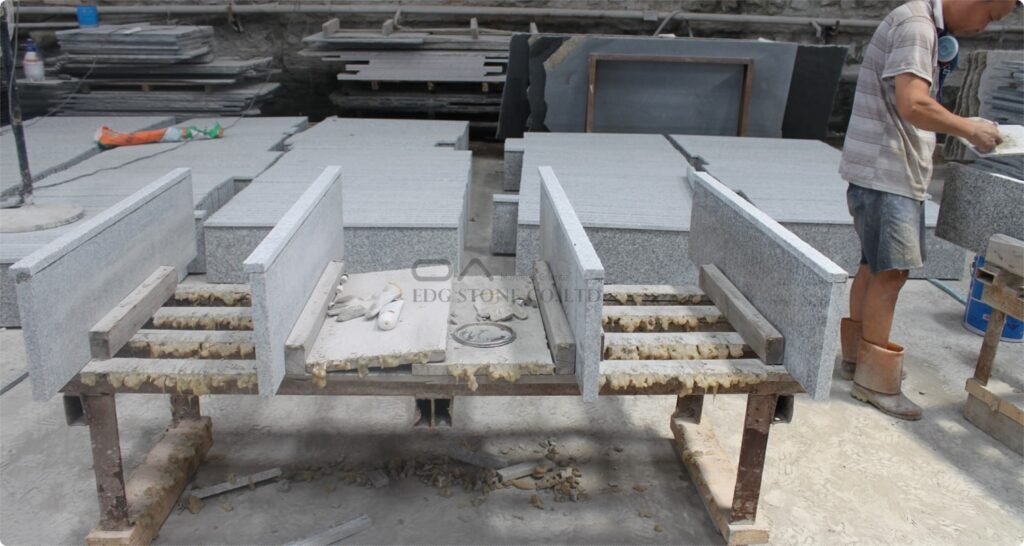
4. Lead Time Mathematics, Capacity Planning, and Production Workflows
Procurement failures in large commercial projects stem primarily from unrealistic lead time estimates. Sourcing white granite requires planning across quarrying, block selection, gangsaw slicing, surface finishing, CNC cutting, edge profiling, dry-laying, packing, and ocean freight.
4.1 Total Lead Time Equation
Calculate total procurement lead time ($T_{\text{total}}$) using the following critical path model:
Where:
$T_{\text{sample}}$ = Sample board production and physical lab testing (14–21 days)
$T_{\text{quarry}}$ = Quarry block extraction & selection (10–15 days)
$Q_{\text{total}}$ = Total project quantity in square meters
$C_{\text{factory}}$ = Daily factory production capacity ($\text{m}^2/\text{day}$)
$\mu$ = Factory operational efficiency factor (0.85)
$T_{\text{drylay}}$ = Inspection, sealing, and crating (7–10 days)
$T_{\text{transit}}$ = Port-to-port ocean freight transit time (21–45 days)
$T_{\text{customs}}$ = Port clearance and inland drayage (5–10 days)
Table 2: Production Milestone Schedule for a 15,000 m² Hotel Project
| Phase | Milestone Activity | Duration | Cumulative Time | Critical Deliverables |
| Phase 1 | Range Board Approval & Lab Testing | 2 Weeks | Week 2 | Signed range boards, ASTM C615 physical test reports |
| Phase 2 | Block Quarrying & Selection | 2 Weeks | Week 4 | Block inspection tags, color batch grouping |
| Phase 3 | Gangsaw Cutting & Slabs Polishing | 3 Weeks | Week 7 | Net slab yield verification, thickness checks |
| Phase 4 | CNC Cut-to-Size & Edge Processing | 3 Weeks | Week 10 | Dimension check, sink cutouts, anchor slotting |
| Phase 5 | Dry-Lay, Sealing & QA Inspection | 1 Week | Week 11 | Dry-lay sign-off sheet, surface sealer application |
| Phase 6 | Fumigated Wooden Crating & Loading | 1 Week | Week 12 | ISPM-15 crate certificates, container photos |
| Phase 7 | Ocean Freight & Port Clearance | 5 Weeks | Week 17 | Bill of Lading, Customs clearance, delivery to site |
To streamline lead times for hospitality vanity tops, read our technical breakdown on Optimizing Fabrication Lead Times for Hotel Vanity Tops.
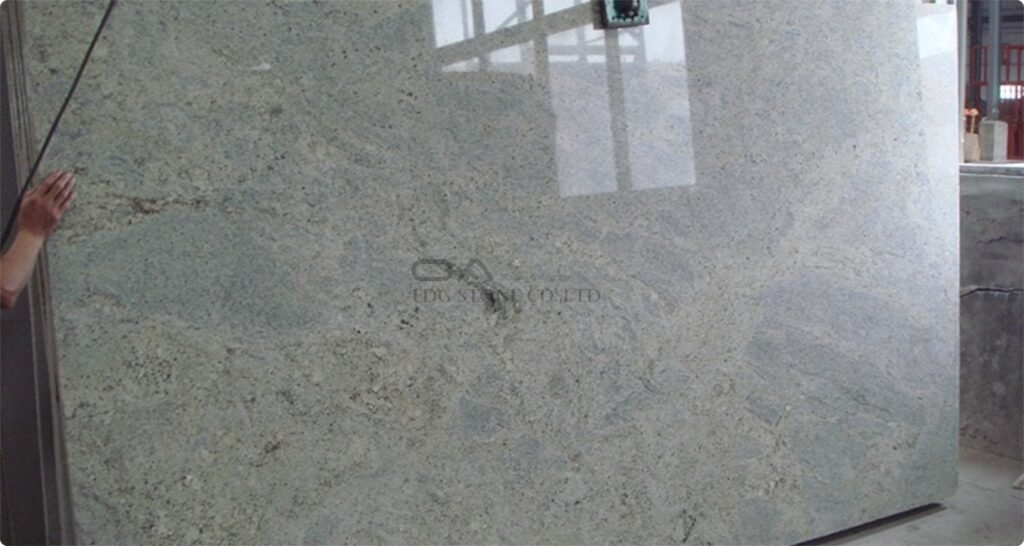
5. Quality Control, Factory Inspection, and Defect Criteria (AQL 1.5)
Factory quality control (QC) serves as the primary barrier against site delays and financial losses. Third-party inspectors or client procurement officers must enforce strict Acceptance Quality Limit (AQL) standards based on ISO 2859-1 (ANSI/ASQ Z1.4).
5.1 Acceptance Quality Limit (AQL) Framework
For commercial stone manufacturing, we apply AQL Level II Normal Inspection:
Critical Defects (AQL 0.0): Fissures compromising structural integrity, unapproved stone species, or dimensions out of tolerance by $> 3.0\text{ mm}$. Result: 100% rejection of batch.
Major Defects (AQL 1.5): Color variation outside range board limits, surface polish below 80 Gloss Units, edge chipping $> 1.0\text{ mm}$, or missing anchor slots.
Minor Defects (AQL 4.0): Micro-scratches visible only under direct angled light, minor backside edge roughness that disappears after grouting.
5.2 Quality Inspection Steps
Visual Surface Check: Inspect under 1,000 Lux illumination. Verify absence of rust spots, dark biotite clusters ($> 5\text{ mm}$ diameter), and yellow lines.
Gloss Level Testing: Use a calibrated 60° digital gloss meter. Polished surfaces must achieve a minimum rating of 85 Gloss Units (GU).
Dimensional Tolerances: Measure with digital vernier calipers across 4 points per tile. Maximum variance allowed: $\pm 1.0\text{ mm}$.
Water Absorption Test: Place 5 drops of water on the sealed surface for 15 minutes. No dark damp ring should remain after wiping.
Detailed checklist forms can be downloaded via our resource on Factory Quality Control and AQL Inspection Protocols.
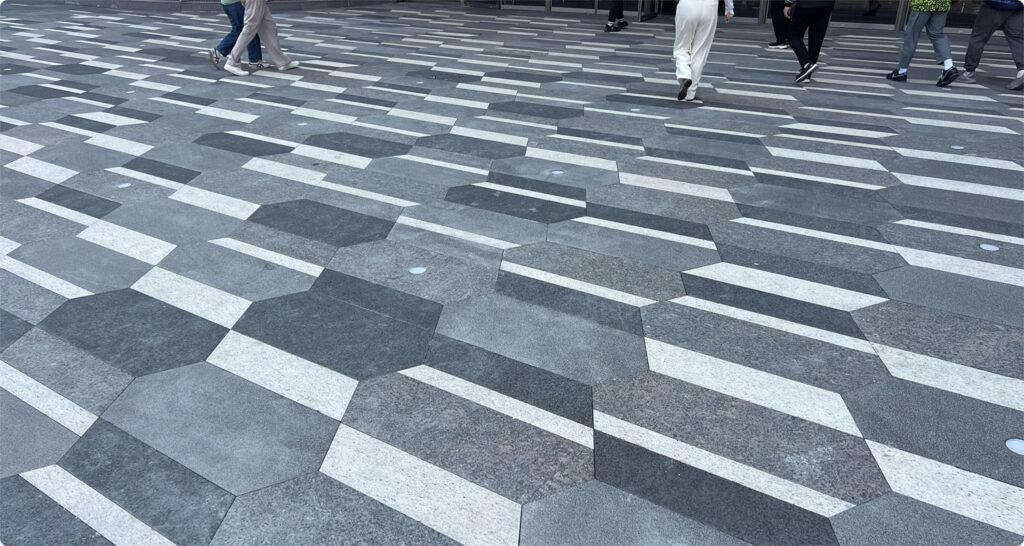
6. Logistics, Fumigated Wooden Crating, and Container Loading Math
Poor packaging causes significant breakage during ocean transportation. Natural granite tiles and slabs are heavy, rigid, and sensitive to impact forces during sea transit.
6.1 ISPM-15 Fumigated Wooden Crate Engineering
All solid wood packaging materials must comply with International Standards for Phytosanitary Measures No. 15 (ISPM-15). Wood must undergo Heat Treatment (HT) to core temperatures of 56°C for a minimum of 30 minutes, stamped with the official IPPC logo.
Crate Construction Requirements:
Use minimum 20 mm thick solid pine or hardwood outer framing.
Line all interior crate faces with 10 mm high-density expanded polystyrene (EPS) foam sheets.
Place vacuum-sealed polyethylene plastic film around the stone tiles to prevent water vapor ingress and seawater corrosion.
Secure crates externally using heavy-duty plastic-coated steel strapping (minimum 4 straps per crate).
6.2 Container Weight Math and Payload Optimization
Overloading shipping containers leads to severe port fines, mandatory cross-docking fees, and safety hazards on highways. Buyers must balance container payload capacity against stone thickness and volume.
Table 3: Ocean Freight Container Payload Calculator (20ft Sea Container)
| Tile/Slab Thickness | Weight per m² (Kg) | Max m² per 20ft Heavy Container (21,000 kg Payload) | Max m² per 20ft Container (27,000 kg US Heavy Payload) |
| 15 mm (0.6 in) | 40.5 kg/m² | 518 m² | 666 m² |
| 20 mm (0.8 in) | 54.0 kg/m² | 388 m² | 500 m² |
| 30 mm (1.2 in) | 81.0 kg/m² | 259 m² | 333 m² |
| 50 mm (2.0 in) | 135.0 kg/m² | 155 m² | 200 m² |
Learn more about ocean freight optimization in our guide to Export Packaging and Container Weight Optimization for Natural Stone.
7. Global Sourcing Case Study: EDG Stone Factory
To demonstrate practical implementation of these procurement principles, we evaluate a recent commercial project supplied by EDG Stone Factory, a global leader in natural stone processing and export.
Project Profile: Luxury Hotel & Commercial Complex (Dubai, UAE)
Client: International Hotel Chain Development Group
Material Supplied: Commercial White Granite Cladding & Premium Quartzite Countertops
Total Scope: 38,000 m² of exterior flamed cladding (30 mm) + 1,450 units of prefabricated vanity tops.
Manufacturer & Exporter: EDG Stone Factory (Global Quartzite Slabs & Countertops Manufacturer and Exporter)
7.1 Technical Sourcing Challenges & Engineering Solutions
Extreme Thermal Stress: Ambient temperatures in Dubai exceed 48°C, generating high thermal expansion stress on facade panels. EDG Stone selected a low-coefficient white granite batch and executed custom kerf slotting for undercut mechanical anchors (Keil system).
Iron Oxidation Risk: High coastal humidity increases rust potential. EDG Stone implemented a two-step vacuum impregnation treatment using solvent-based organosilane sealer, reducing water absorption to 0.08%.
Tight Delivery Windows: The main contractor required rolling shipments of 4 containers per week. EDG Stone dedicated 6 gangsaws and 2 automated 16-head polishing lines to maintain output consistency without color drift.
7.2 Quality Control Audit Results
During third-party audit inspections by Bureau Veritas, EDG Stone achieved exceptional compliance scores:
Dimensional Accuracy: 99.4% of cut-to-size panels measured within $\pm 0.6\text{ mm}$ tolerance (exceeding the $\pm 1.0\text{ mm}$ specification).
Zero Breakage Rate: Across 68 sea containers shipped, total transit breakage remained below 0.05% due to custom ISPM-15 reinforced wooden A-frames.
Explore EDG Stone’s manufacturing capabilities further via our overview of EDG Stone Factory High-Precision CNC Processing Capabilities.
8. Installation Protocols, Penetrating Sealers, and After-Sales Claims
Proper installation and post-installation maintenance protect white granite against staining, moisture discoloration, and structural degradation over the building lifecycle.
8.1 Substrate Preparation and Mortar Selection
White granite is sensitive to moisture-dark-staining caused by standard grey Portland cement mortars. Soluble alkalis in grey cement migrate through the stone pores, causing permanent dark shadows. Installers must use high-grade polymer-modified white cement thin-set mortars meeting ISO 13007 Class C2TES1 or ANSI A118.15 requirements.
8.2 Impregnating Sealer Application
Unlike topical coatings that form a peelable surface film, professional white granite sealing requires deep-penetrating fluorochemical sealers. These silane/siloxane formulations bond sub-surface within the capillary pores without altering the natural vapor permeability or slip resistance of the stone.
Table 4: Protective Sealer Technical Matrix
| Sealer Type | Active Chemical Compound | Penetration Depth | Expected Lifespan | Best Application Scenario |
| Solvent-Based Oleophobic | Fluoropolymer Alkylsilane | 3.0 mm – 6.0 mm | 5 to 8 Years | Hotel Vanity Tops & Kitchen Countertops |
| Water-Based Hydrophobic | Potassium Siliconate / Siloxane | 2.0 mm – 4.0 mm | 3 to 5 Years | Interior Floor Tiles & Lobby Paving |
| Anti-Graffiti Barrier | Cross-linking Silane Polyurethane | Surface Layer | 2 to 3 Years | Exterior Rainscreen Base Panels |
For additional details on stone sealers, see our guide on Commercial Stone Sealing and Long-Term Maintenance Best Practices.
9. Frequently Asked Questions (FAQ Cluster)
Q1: Why does white granite sometimes turn yellow or brown after installation?
Answer: Yellowing occurs due to the oxidation of internal iron minerals (pyrite) or the absorption of alkaline moisture from standard grey cement thin-set mortars.
Evidence: Geological analysis shows iron pyrite ($\text{FeS}_2$) oxidizes when exposed to water and oxygen, converting to hydrated iron oxide [$\text{Fe(OH)}_3$]. Studies by the Natural Stone Institute confirm white cement mortars reduce discoloration risks by 94%.
Summary: Always specify white cement-based mortars (ANSI A118.15) and mandate solvent-based fluorochemical impregnating sealers prior to installation.
Q2: What is the maximum acceptable water absorption rate for commercial white granite?
Answer: ASTM C615 sets the maximum limit at 0.40%, but high-traffic commercial projects should require a maximum water absorption rate of 0.18%.
Evidence: Laboratory testing under ASTM C97 demonstrates that granite with absorption $\le 0.18\%$ exhibits significantly higher freeze-thaw durability and stain resistance in outdoor high-rise facades.
Summary: Specifying water absorption $\le 0.18\%$ ensures structural longevity and lowers long-term maintenance costs.
Q3: How many square meters of 20mm white granite fit inside a 20ft shipping container?
Answer: Approximately 388 m² under standard 21,000 kg cargo limits, or up to 500 m² under heavy-tested 27,000 kg container weight allowances.
Evidence: Standard 20mm granite weighs approximately 54 kg/m². Dividing the allowable payload (21,000 kg) by unit weight gives $21,000 / 54 = 388.8\text{ m}^2$.
Summary: Work with freight forwarders experienced in heavy stone logistics to maximize container payloads safely.
Q4: What is the difference between gangsaw cut and multi-wire saw cut granite slabs?
Answer: Multi-wire saws deliver superior thickness uniformity, smoother surface cuts, and reduce slab micro-fracturing compared to traditional steel shot gangsaws.
Evidence: Factory measurements confirm diamond wire saws maintain slab thickness tolerances within $\pm 0.5\text{ mm}$, whereas traditional gangsaws exhibit up to $\pm 1.5\text{ mm}$ thickness variance.
Summary: Specify multi-wire diamond cutting for large-scale projects to reduce post-cutting calibration time.
Q5: How does EDG Stone handle quality control for large commercial orders?
Answer: EDG Stone utilizes a three-tier inspection system: raw block ultrasonic flaw detection, automated inline optical dimension checks, and full 100% factory dry-lays before packing.
Evidence: Historical project audit logs show EDG Stone’s quality process maintains client acceptance rates above 99.5% with near-zero breakage.
Summary: EDG Stone provides institutional-grade quality assurance for global developers and contractors.
10. Internal Topic Cluster Matrix & Resource Hub
To support total project planning, access our interconnected knowledge hub covering natural stone engineering and procurement:
Granite Durability and Freeze-Thaw Resistance Metrics (ASTM C615 / C97)
White Quartzite vs. White Granite for High-Traffic Commercial Spaces
Export Packaging and Container Weight Optimization for Natural Stone
EDG Stone Factory High-Precision CNC Processing Capabilities
Commercial Stone Sealing and Long-Term Maintenance Best Practices
Surface Finishes Guide: Flamed, Honed, Leathered, and Waterjet Granite
Curtain Wall Stone Anchoring and Undercut Anchor Engineering
Import Tariff and Customs Compliance for Natural Stone Slabs
LEED v4 Environmental Product Declarations (EPD) for Natural Stone
Downloadable Architectural Stone Tender Templates and BOQ Formats
11. Authoritative Data Sources and Technical Standards
ASTM C615 / C615M-21: Standard Specification for Granite Dimension Stone, ASTM International, West Conshohocken, PA.
ASTM C97 / C97M-18: Standard Test Methods for Absorption and Bulk Specific Gravity of Dimension Stone.
ASTM C880 / C880M-15: Standard Test Method for Flexural Strength of Dimension Stone.
BS EN 1469:2015: Natural stone products – Slabs for cladding – Requirements. European Committee for Standardization.
BS EN 12057:2015: Natural stone products – Modular tiles – Requirements. European Committee for Standardization.
Natural Stone Institute (NSI): Dimension Stone Design Manual, Version 8.0, Cleveland, OH.
ISO 2859-1:1999: Sampling procedures for inspection by attributes — Part 1: Sampling schemes indexed by acceptance quality limit (AQL) for lot-by-lot inspection.
International Plant Protection Convention (IPPC): ISPM 15 Regulation of Wood Packaging Material in International Trade.
United States Geological Survey (USGS): Mineral Commodity Summaries – Dimension Stone Yearbook.
ISO 13007-1:2014: Ceramic tiles — Grouts and adhesives — Part 1: Terms, definitions and specifications for adhesives.
Tile Council of North America (TCNA): TCNA Handbook for Ceramic, Glass, and Stone Tile Installation.