Executive Summary & Industry Overview
Architects, fabricators, and commercial developers face a persistent challenge when specifying natural stone: balancing architectural aesthetics with long-term material durability. White granite remains a staple across North American and European residential and commercial projects. However, “white granite” is not a single material grade. It encompasses distinct geological classifications, varying absorption rates, and unique structural behaviors.
This comprehensive white paper systematically evaluates six industry-standard white granite varieties:
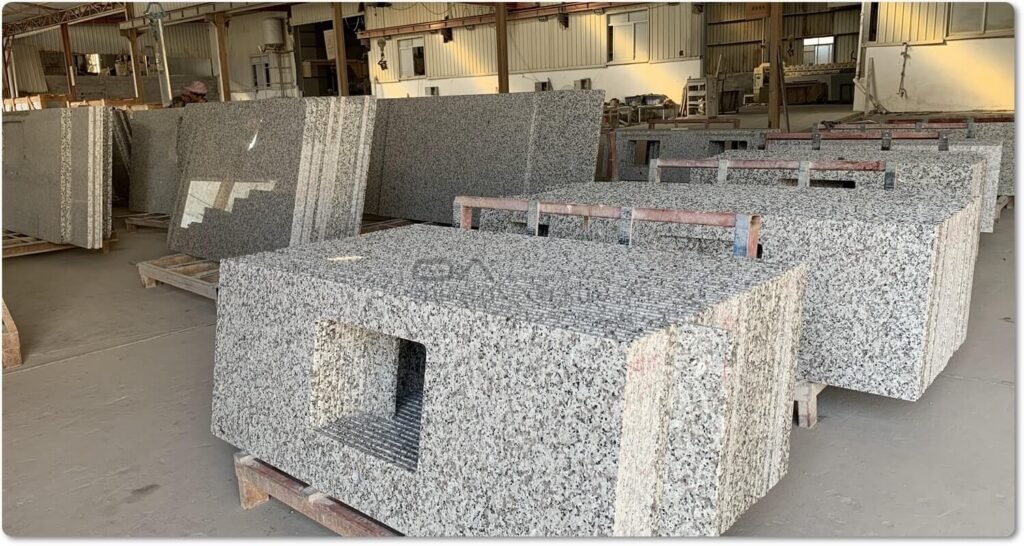
Alaska White Granite
Colonial White Granite
River White Granite
Kashmir White Granite
Dallas White Granite
Moon White Granite
We evaluate these materials across technical metrics including petrographic composition, flexural strength, Mohs hardness, water absorption coefficients, and total cost of ownership (TCO).
   [Geological Extraction]
              │
              ▼
   [Slab Processing & Resin Coating] (Vacuum-assisted epoxy resin treatment)
              │
              ▼
   [Technical Testing & Grading]
              ├── Water Absorption Test (ASTM C97)
              ├── Flexural Strength (ASTM C880)
              └── Abrasion Resistance (ASTM C241)
              │
              ▼
   [Architectural Specification & Application]
              ├── Residential Countertops
              ├── Commercial High-Traffic Flooring
              └── Exterior Ventilated Cladding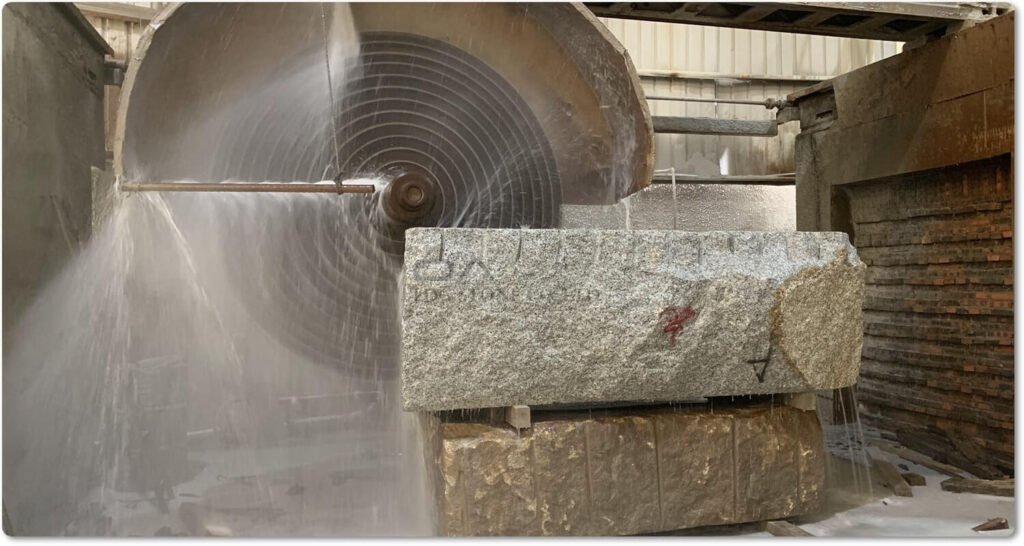
Technical Comparison Framework & Geological Profiling
Petrographic Composition & Origin Analysis
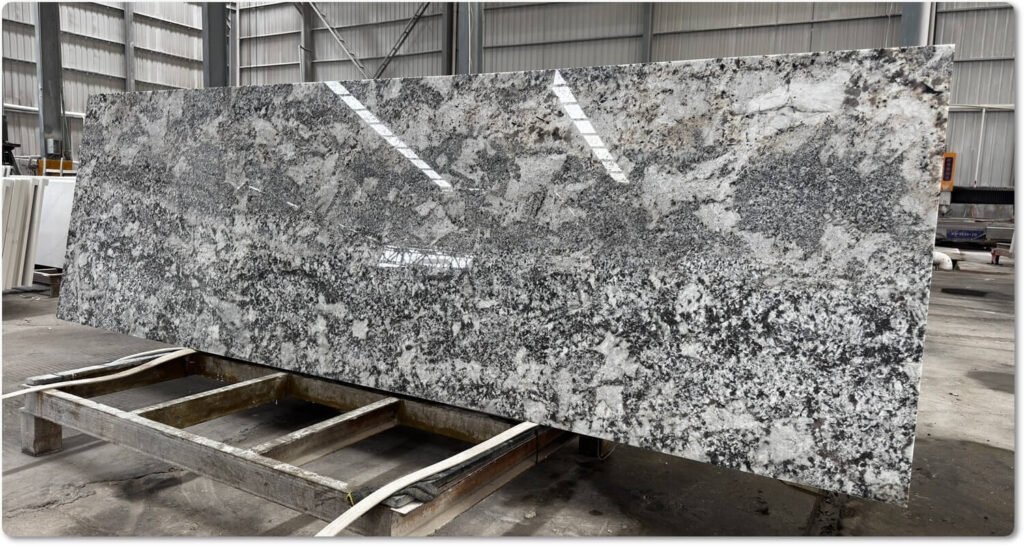
Natural white granites are intrusive igneous rocks formed by the slow cooling of magma beneath the Earth’s crust. Their characteristic white and grey backgrounds stem from a matrix dominated by quartz and alkali feldspar. Dark inclusions, veining, and movement occur due to amphibole, biotite, mica, and garnet trace minerals.
Alaska White Granite: Quarried primarily in Brazil (despite its regional name), Alaska White features a high quartz density interspersed with feldspar, muscovite, and dark biotite clusters. The irregular quartz distribution creates dramatic visual depth and high structural density.
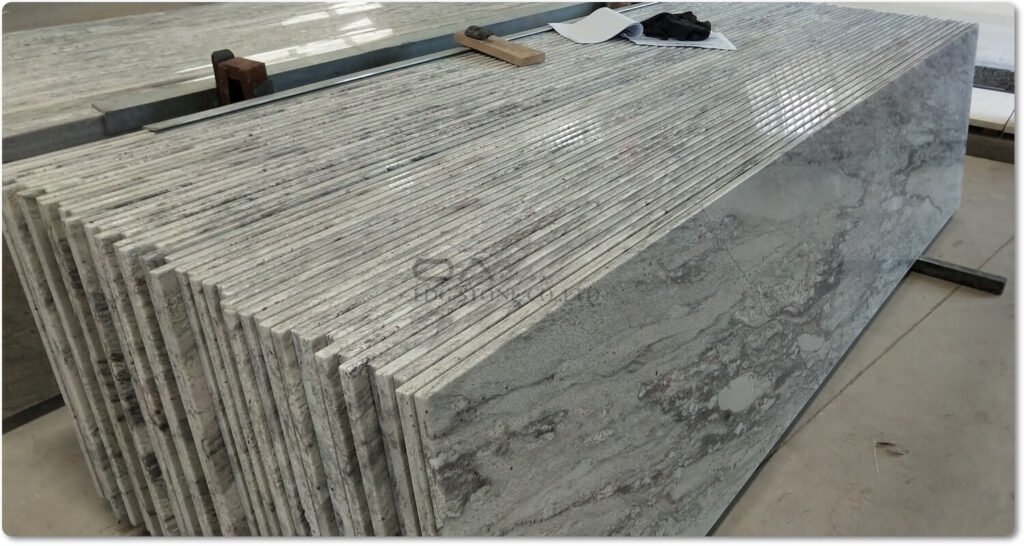
Colonial White Granite: Extracted from quarries in Southern India (specifically Tamil Nadu), Colonial White consists of a uniform cream-to-pale-grey feldspar base sprinkled with dark brown to reddish-black garnet deposits.
River White Granite: Also quarried in India (Andhra Pradesh region), River White exhibits a dynamic linear flow. Gray and burgundy mineral veins run horizontally through a soft white feldspar matrix, imitating fluid motion.
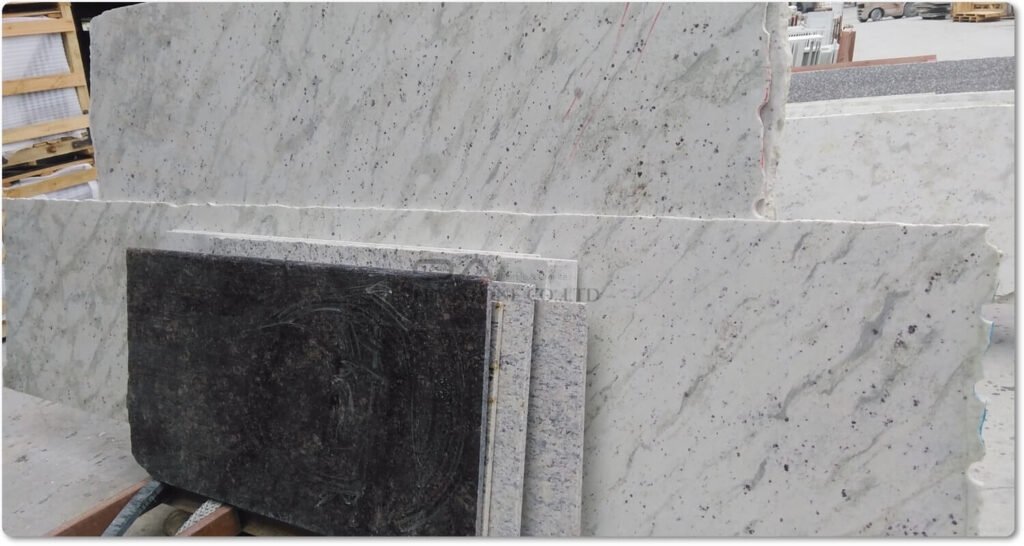
Kashmir White Granite: Sourced from historical quarries in Tamil Nadu, India, Kashmir White features a soft grey-white background with distinctive mint-grey shading and deep red-to-burgundy garnet pinpoints.
Dallas White Granite: Quarried in Brazil, Dallas White displays a tight, fine-grained matrix with light grey background tones, white feldspar clusters, and evenly distributed dark charcoal and deep violet garnets.
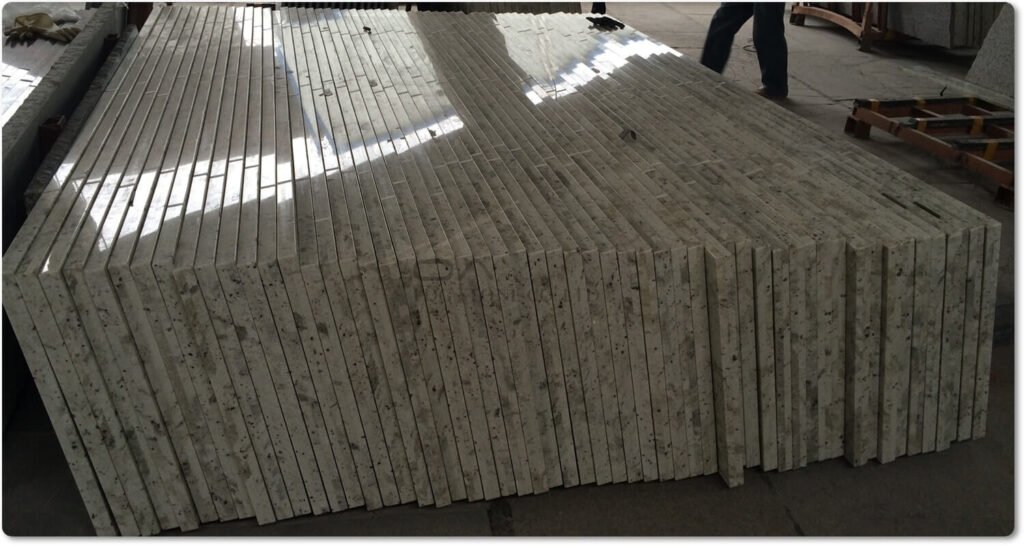
Moon White Granite: Quarried in Andhra Pradesh, India, Moon White possesses a fine-grained structure characterized by light ivory and white background tones, punctuated by small dark garnet specks and subtle silver-grey swirls.
Comparative Material Performance Matrix
The following data summarizes laboratory physical property tests conducted in accordance with ASTM (American Society for Testing and Materials) standard testing protocols.
| Granite Variety | Primary Origin | Mohs Hardness | Average Density (g/cm3) | Water Absorption Rate (ASTM C97) | Compressive Strength (ASTM C170) | Flexural Strength (ASTM C880) |
| Alaska White | Brazil | 6.5 – 7.0 | 2.65 | 0.20% – 0.35% | 190 MPa | 14.5 MPa |
| Colonial White | India | 6.0 – 6.5 | 2.62 | 0.35% – 0.45% | 175 MPa | 12.8 MPa |
| River White | India | 6.0 – 6.5 | 2.63 | 0.30% – 0.40% | 180 MPa | 13.2 MPa |
| Kashmir White | India | 5.5 – 6.0 | 2.58 | 0.45% – 0.60% | 160 MPa | 11.5 MPa |
| Dallas White | Brazil | 6.5 – 7.0 | 2.68 | 0.15% – 0.25% | 205 MPa | 15.1 MPa |
| Moon White | India | 6.5 – 7.0 | 2.66 |
Detailed Material Deep Dives
Alaska White Granite
Color Profile & Visual Dynamics
Alaska White features a striking high-contrast aesthetic. Large, translucent quartz crystals nestle beside frosty white feldspar, deep grey veins, and dark black mica clusters. Its variable movement means no two slabs look identical.
+-------------------------------------------------------+
|  [Translucent Quartz]    [Frost-White Feldspar Matrix] |
|            \                     /                    |
|             \                   /                     |
|         [Dark Biotite Mica / Black Inclusions]         |
+-------------------------------------------------------+
Maintenance Requirements & Porosity Profile
With a moderate absorption profile (0.20% – 0.35%), Alaska White requires dual-coat impregnating sealer application upon installation. The high concentration of natural quartz crystals renders the stone exceptionally resistant to surface scratching.
Initial Sealing: Apply solvent-based impregnating sealer.
Resealing Schedule: Every 24 to 36 months for residential applications.
Cleaning Protocol: Neutral pH stone cleaners; avoid acidic solutions.
Ideal Project Applications
High-end residential kitchen island countertops.
Full-height vertical kitchen backsplashes.
Commercial reception desks and luxury hospitality foyers.
Colonial White Granite
Color Profile & Visual Dynamics
Colonial White offers a subtle, warm-toned alternative to high-contrast granites. It presents an off-white to pale cream background sprinkled with light grey smoke-veining and tiny, pinhead-sized burgundy or dark brown garnets.
+-------------------------------------------------------+
|  [Cream / Off-White Feldspar]   [Smoke-Grey Veining]  |
|            \                     /                    |
|             \                   /                     |
|           [Speckled Dark Garnet Inclusions]           |
+-------------------------------------------------------+
Maintenance Requirements & Porosity Profile
Colonial White exhibits higher porosity (0.35% – 0.45%) than its Brazilian counterparts. Unsealed slabs absorb oils and dark liquids rapidly.
Initial Sealing: Apply two coats of high-grade fluorochemical penetrating sealer.
Resealing Schedule: Every 12 to 18 months.
Stain Vulnerability: High susceptibility to uncleaned coffee, red wine, and cooking oils.
Ideal Project Applications
Traditional and transitional kitchen designs.
Multi-family residential unit countertop packages.
Low-traffic commercial wall cladding.
River White Granite
Color Profile & Visual Dynamics
River White is defined by its fluid linear patterns. Deep blue-grey and soft grey bands sweep across a bright white base, accented by deep red garnet spots. The directional flow requires careful slab matching during fabrication.
+-------------------------------------------------------+
|  [Bright White Feldspar]      [Linear Grey Veining]   |
|            \                     /                    |
|             \                   /                     |
|           [Red / Cranberry Garnet Clusters]           |
+-------------------------------------------------------+
Maintenance Requirements & Porosity Profile
River White falls into a medium porosity range (0.30% – 0.40%). Because of its lighter overall tone, liquid penetration leaves visible dark shadows until fully dry or chemically extracted.
Initial Sealing: Apply premium oleophobic penetrating sealer prior to grouting or fabrication.
Resealing Schedule: Every 12 to 24 months.
Special Considerations: Requires vein-matching and book-matching layout planning during cutting.
Ideal Project Applications
Waterfalls and large-format kitchen islands.
Master bathroom vanity tops and walk-in shower walls.
Continuous horizontal perimeter countertops.
Kashmir White Granite
Color Profile & Visual Dynamics
Kashmir White is an iconic, classic granite featuring a soft white-and-grey field dotted with dark garnet specks.
Important Supply Note: Traditional Kashmir White quarries in Tamil Nadu have faced ongoing regulatory suspensions and supply restrictions. As a result, authentic Kashmir White exhibits variable availability, and prices have risen relative to performance equivalents like Moon White or Dallas White.
+-------------------------------------------------------+
|  [Soft Mint-Grey Matrix]     [Uniform Off-White Base] |
|            \                     /                    |
|             \                   /                     |
|          [Concentrated Burgundy Garnet Specks]        |
+-------------------------------------------------------+
Maintenance Requirements & Porosity Profile
Kashmir White possesses a high porosity profile (0.45% – 0.60%). It demands rigorous sealing protocols to prevent liquid absorption and staining.
Initial Sealing: Requires multi-layer vacuum resin treatments during slab factory processing, followed by deep-penetrating sealing after installation.
Resealing Schedule: Every 6 to 12 months.
Caution: Prone to water rings if liquid rests on the surface for extended periods.
Ideal Project Applications
Classic residential kitchen remodels (where authentic material is specified).
Low-moisture interior wall features.
Dallas White Granite
Color Profile & Visual Dynamics
Dallas White is a reliable workhorse in commercial and residential stone specification. It features a tight, uniform visual pattern with a light grey and white base, charcoal specks, and dark purple-red garnets. It offers exceptional color consistency across large quarry blocks.
+-------------------------------------------------------+
|  [Uniform Light Grey Base]    [Fine Charcoal Specks]  |
|            \                     /                    |
|             \                   /                     |
|            [Scattered Dark Purple Garnets]            |
+-------------------------------------------------------+
Maintenance Requirements & Porosity Profile
With a low water absorption coefficient (0.15% – 0.25%) and high compressive strength (205 MPa), Dallas White resists liquid penetration and mechanical wear effectively.
Initial Sealing: Standard penetrating seal application.
Resealing Schedule: Every 36 to 48 months.
Durability: Excellent resistance to scratching, chipping, and thermal shock.
Ideal Project Applications
Large-scale commercial developments and multi-family residential towers.
High-traffic commercial flooring and elevator lobbies.
Outdoor kitchens and exterior building facade cladding.
Moon White Granite
Color Profile & Visual Dynamics
Moon White offers a fine-grained, consistent aesthetic dominated by bright ivory, silvery-grey tones, and tiny dark burgundy garnet pinpoints. Its uniform matrix makes seam integration virtually invisible compared to large-veined granites.
+-------------------------------------------------------+
|  [Bright Ivory / White Base]   [Silver-Grey Swirls]   |
|            \                     /                    |
|             \                   /                     |
|           [Fine Pinpoint Burgundy Garnets]            |
+-------------------------------------------------------+
Maintenance Requirements & Porosity Profile
Moon White features balanced physical properties, with an absorption rate of 0.22% – 0.30%. Its dense grain structure prevents deep stain penetration when basic maintenance protocols are followed.
Initial Sealing: Standard fluorochemical penetrating sealer.
Resealing Schedule: Every 24 to 36 months.
Ease of Maintenance: High visual tolerance for everyday dust and light water spots due to its fine-grained texture.
Ideal Project Applications
Contemporary kitchen countertops and bathroom vanities.
High-volume prefabricated countertop programs.
Interior floor tiles and stair treads.
Price & Commercial Viability Analysis
The figures below represent estimated wholesale slab costs and installed retail price ranges across North America as of recent market benchmarks.
Note: Pricing fluctuates based on block availability, freight costs, slab thickness ($2\text{ cm}$ vs. $3\text{ cm}$), and surface finish.
Cost Index per Square Foot (Installed Base)
┌───────────────────┬───────────────────────────────────────────┐
| Material          | Price Range (USD / sq. ft. Installed)     |
├───────────────────┼───────────────────────────────────────────┤
| Dallas White      | $40 - $55  ████████████                   |
| Moon White        | $45 - $60  █████████████                  |
| Colonial White    | $45 - $65  ██████████████                 |
| River White       | $55 - $75  █████████████████              |
| Alaska White      | $65 - $90  █████████████████████          |
| Kashmir White     | $70 - $100 ███████████████████████        |
└───────────────────┴───────────────────────────────────────────┘
Architectural & Project Application Guide
                            [Project Specification]
                                       │
            ┌──────────────────────────┴──────────────────────────┐
            ▼                                                     ▼
   [Residential Application]                             [Commercial Application]
            │                                                     │
  ┌─────────┴─────────┐                                 ┌─────────┴─────────┐
  ▼                   ▼                                 ▼                   ▼
[High Visual Impact] [Budget / Uniform]              [High Traffic Footwear] [Facade / Exterior]
  │                   │                                 │                   │
  ▼                   ▼                                 ▼                   ▼
• Alaska White      • Moon White                      • Dallas White      • Dallas White
• River White       • Colonial White                  • Moon White        • Alaska White
1. High-End Residential Kitchens
Recommended: Alaska White, River White
Rationale: These materials deliver a dynamic visual impact and statement veining desired for focal islands and waterfall edges. Alaska White provides higher scratch and heat resistance for heavy culinary use.
2. Multi-Family Housing & Production Building
Recommended: Dallas White, Moon White
Rationale: Tight grain patterns ensure color uniformity across hundreds of units. Lower cost per square foot and minimal porosity minimize post-occupancy warranty claims.
3. High-Traffic Commercial Spaces (Lobbies, Airports, Retail)
Recommended: Dallas White
Rationale: Exceptional compressive strength ($205\text{ MPa}$) and low absorption ($0.15\%\text{–}0.25\%$) withstand heavy foot traffic, commercial cleaning chemicals, and mechanical wear.
4. Wet Environments & Bathrooms
Recommended: Moon White, Dallas White
Rationale: Lower porosity reduces the risk of moisture retention, dark water shadows, and biological growth behind vanities and wet walls.
Commercial Case Study: EDG Stone Factory Integration
To illustrate successful bulk specification, material selection, and fabrication execution, consider the deployment profile of EDG Stone Factory, a global Quartzite Slabs & Countertops Manufacturer and Exporter.
+---------------------------------------------------------------------------------+
|                         EDG STONE FACTORY CASE STUDY                            |
|                                                                                 |
|  [Block Selection] ──► [Vacuum Epoxy Resin] ──► [CNC Cutting] ──► [Global Export] |
|   Quarry direct        5-Step treatment          Tolerance:        500+ Crates /|
|   inspection           for micro-fissures        ±0.5 mm           month        |
+---------------------------------------------------------------------------------+
Procurement & Processing Methodology
In a recent 450-unit luxury multi-family project in Miami, Florida, the specification team required a bright, high-clarity white natural stone capable of withstanding humid coastal environments without discoloring.
Material Specification: Moon White Granite and specialized Hard White Quartzite were selected over higher-porosity options.
Factory Treatment: EDG Stone Factory processed $3\text{ cm}$ slabs using vacuum-assisted epoxy resin. This process fills micro-fissures and stabilizes structural integrity before diamond-gangsaw cutting.
Precision Fabrication: Automated CNC bridge saws calibrated to edge profiles with a tolerance of $\pm 0.5\text{ mm}$, minimizing installation alignment delays on-site.
Quality Control Results: Water absorption rates dropped below $0.18\%$ post-resination, passing strict commercial humidity endurance tests.
Technical Maintenance, Restoration, and Care Protocol
To preserve structural integrity and visual clarity, maintenance teams must follow standardized care workflows:
[Daily Cleaning] ──► [Periodic Sealing Check] ──► [Stain Removal (Poultice)] ──► [Mechanical Re-Polishing]
Neutral pH cleaner   Water droplet test           Mep-based absorption        Diamond pad honing
(Everyday)           (Every 6-12 Months)          (As needed)                 (5-10 Year cycle)
1. Daily Cleaning Protocols
Use warm water paired with neutral pH liquid cleaners ($pH\text{ 7.0 — 8.5}$).
Avoid acidic formulas containing vinegar, lemon juice, hydrofluoric acid, or bleach.
Wipe spills immediately using microfiber towels to minimize dwell time on light feldspar zones.
2. Sealing Execution (The Hydrophobic Test)
Perform the Water Droplet Test every six months:
Deposit $5\text{ ml}$ of water on the sealed granite surface.
Let sit for 15 minutes.
If the water beads tightly, the seal remains intact.
If the stone darkens underneath, re-apply a fluorochemical penetrating sealer immediately.
3. Stain Remediation Procedure
For deep oil or wine stains that penetrate unsealed areas, apply an industrial poultice:
Mix diatomaceous earth or baking soda with technical-grade hydrogen peroxide ($30\%$) for organic stains, or acetone for oil stains, forming a peanut-butter-like paste.
Apply a $1/4\text{-inch}$ layer over the stain.
Cover with plastic wrap, tape edges, and leave for 24 hours.
Remove wrap and allow paste to dry completely (another 24 hours) to draw the contaminant out of the capillaries.
Rinse with clean water and re-seal the area.
Authoritative Technical Citations & Data Sources
ASTM International: ASTM C97/C97M Standard Test Methods for Absorption and Bulk Specific Gravity of Dimension Stone. https://www.astm.org/c0097_c0097m-18.html
ASTM International: ASTM C170/C170M Standard Test Method for Compressive Strength of Dimension Stone. https://www.astm.org/c0170_c0170m-17.html
ASTM International: ASTM C880/C880M Standard Test Method for Flexural Strength of Dimension Stone. https://www.astm.org/c0880_c0880m-18.html
Natural Stone Institute (NSI): Dimension Stone Design Manual, Version 2023. https://www.naturalstoneinstitute.org
United States Geological Survey (USGS): Minerals Yearbook: Dimension Stone Technical Report. https://www.usgs.gov/centers/national-minerals-information-center/dimension-stone-statistics-and-information
Centre for Development of Stones (CDOS – India): Technical Specifications of Indian Natural Granites. http://cdos-india.com
ABI (Associação Brasileira da Indústria de Rochas Ornamentais): Brazilian Natural Stone Export & Physical Properties Index. https://abirochas.com.br
European Committee for Standardization (CEN): EN 1469: Natural stone products – Slabs for cladding – Requirements. https://www.en-standard.eu
Interlinked Knowledge Graph Matrix
Evaluating Edge Profiles for High-Traffic Commercial Counters
Complete Guide to Sealer Chemistry: Silanes, Siloxanes, and Fluoropolymers
Comparing Slab Thickness: 2cm vs 3cm Architectural Guidelines
Subsurface Moisture Issues in Bathroom Counter Installations
Sourcing Sustainable Natural Stone: Quarry Environmental Impact Assessment
Fabrication Manual: Diamond Tooling Selection for Dense Quartz Matrixes
EDG Stone Factory Quality Assurance & Export Compliance Guide
Structured Knowledge & Question-Answer Framework
Question 1: What causes grey water spots around sink cutouts on Kashmir White and Colonial White granites?
Answer
Grey water spots around sink cutouts occur when standing water penetrates the open capillary matrix of higher-porosity granites. This occurs when the initial impregnating sealer breaks down or when silicone caulk seals degrade, letting water soak into the unsealed cut edges of the slab.
Evidence
According to testing criteria in ASTM C97, Kashmir White ($0.45\%\text{–}0.60\%$ absorption) and Colonial White ($0.35\%\text{–}0.45\%$ absorption) display higher porosity than denser varieties like Dallas White ($0.15\%\text{–}0.25\%$). Unsealed edges around sinks allow moisture to wick horizontally along mineral planes.
Summary
Water spots stem from moisture absorption in high-porosity stone. Prevent this issue by thoroughly sealing raw cutout edges during fabrication and maintaining intact silicone seal barriers around sinks.
Question 2: Is Alaska White granite prone to cracking during CNC fabrication?
Answer
Alaska White contains large, isolated quartz deposits adjacent to softer mica clusters, creating uneven internal stress distributions across slabs. Standard cutting feeds can trigger micro-fissure expansion if slabs are cut without proper support or stress-relief cuts.
Evidence
Physical testing under ASTM C880 shows that while Alaska White has a high average flexural strength ($14.5\text{ MPa}$), its heterogeneous mineral structure creates local strength variations. Fabricators report higher vibration sensitivity during high-speed bridge saw cutting compared to uniform stones like Dallas White.
Summary
Alaska White requires calibrated diamond blades, adjusted feed speeds, and factory-applied vacuum epoxy resin (such as the processing systems used by EDG Stone Factory) to ensure clean, crack-free fabrication.
Question 3: Why is Kashmir White granite becoming harder to source in the global market?
Answer
Kashmir White granite availability has dropped significantly due to environmental regulatory enforcement, quarry closures, and mining quota limits enforced by local government authorities in Tamil Nadu, India.
Evidence
Reports from the Centre for Development of Stones (CDOS) highlight strict environmental regulations and quarrying suspensions in major producing regions since the mid-2010s. This supply constraint has driven specifiers to choose visually similar alternatives like Moon White or Dallas White.
Summary
Environmental restrictions have reduced Kashmir White production. Designers looking for reliable lead times often specify Moon White or Dallas White as durable, readily available substitutes.