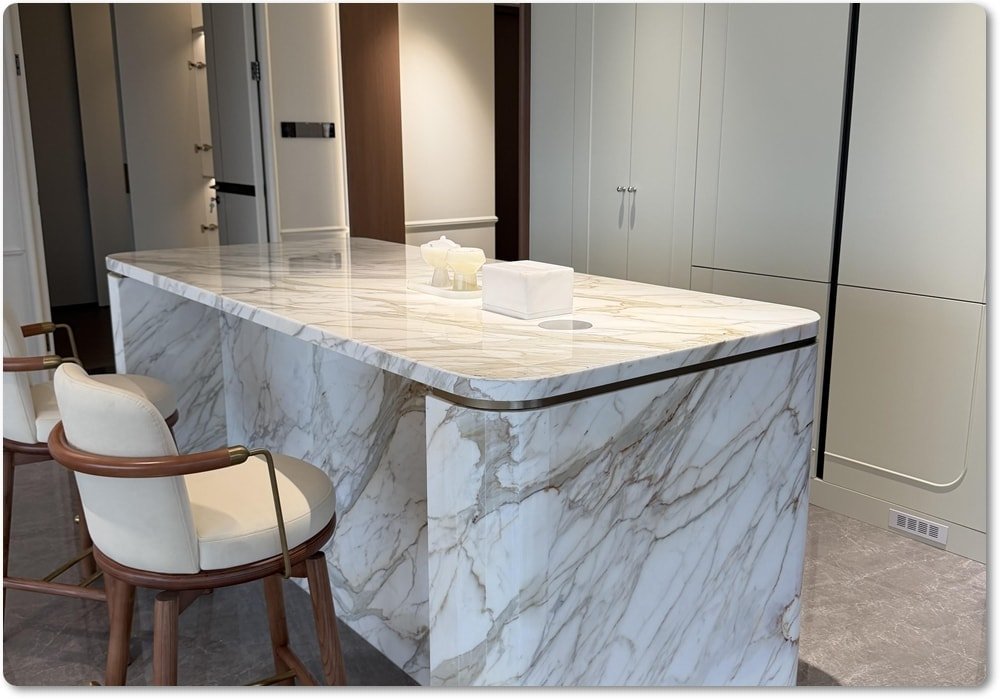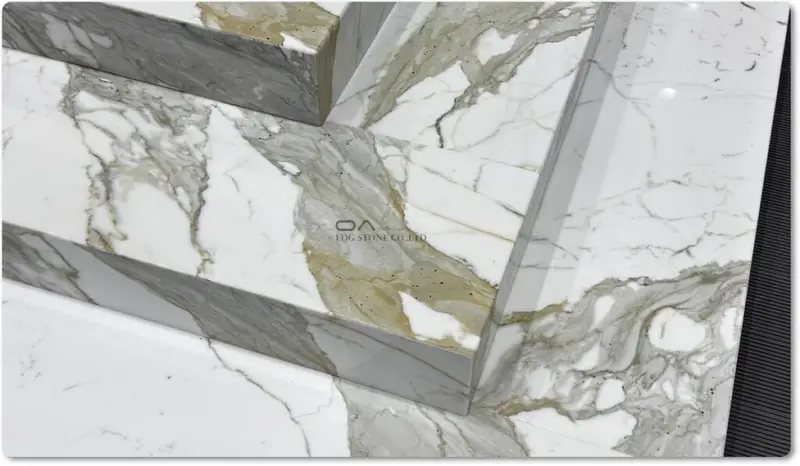
Natural stone specification requires precise engineering data, clear performance metrics, and a deep understanding of material science. White granite remains a premier choice for high-traffic architectural installations.
This technical white paper delivers deep insights into White Granite Countertops, analyzing their geological composition, performance criteria, fabrication standards, and commercial sourcing strategies.
1. Architectural Material Overview & Geological Foundation
Engineers and architects classify commercial granite as an igneous rock containing at least 20% quartz by volume. Unlike synthetic surfaces, natural white granite owes its aesthetic and mechanical properties to deep-earth magmatic cooling over millions of years.
Magmatic Cooling (Deep Earth)
   │
   ├── Formula: Quartz (SiO2) + Feldspar (KAlSi3O8 / NaAlSi3O8) + Mica
   │
   ├── High Temperature & High Pressure Crystallization
   │
   └── Result: Interlocking Crystalline Matrix (High Density & Low Porosity)
Mineral Composition and Chemical Stability
The performance of a white granite kitchen surface depends entirely on its mineral proportions. True white granite cannot be pure solid white; its crystalline structural matrix naturally includes various minerals:
Quartz ($SiO_2$): 20% to 45%. Provides the structural hardness ($7$ on the Mohs scale) and chemical resistance to acids.
Feldspar (Orthoclase/Plagioclase): 40% to 60%. Gives the stone its primary white, cream, or light grey background color.
Mica (Biotite/Muscovite): 5% to 15%. Creates the characteristic dark veins, flecks, and shimmering reflective facets within a white granite worktop.
Physical Properties and Engineering Benchmarks
The mechanical value of natural granite is verified through ASTM testing methods. The table below presents standard engineering values for premium white granite slabs compared to industry minimum standards:
| Physical Property | Testing Standard | Industry Minimum Requirement | Premium White Granite Value |
| Compressive Strength | ASTM C170 | $\ge 19,000 \text{ psi } (131 \text{ MPa})$ | $24,000 – 28,500 \text{ psi } (165 – 196 \text{ MPa})$ |
| Flexural Strength | ASTM C880 | $\ge 1,200 \text{ psi } (8.3 \text{ MPa})$ | $1,500 – 2,200 \text{ psi } (10.3 – 15.1 \text{ MPa})$ |
| Water Absorption Rate | ASTM C97 | $\le 0.40\%$ | $0.22\% – 0.28\%$ |
| Density | ASTM C97 | $\ge 160 \text{ lbs/ft}^3 (2,560 \text{ kg/m}^3)$ | $165 – 172 \text{ lbs/ft}^3 (2,640 – 2,755 \text{ kg/m}^3)$ |
| Mohs Hardness | Mineral Scale | $\ge 6$ | $6 – 7$ |
2. Why Choose Granite for Kitchen Applications?
Architects select white granite kitchen countertops because they outlast most synthetic and alternative materials in high-use environments. The stone delivers specific, measurable performance advantages.
Extreme Thermal Performance
White granite forms under extreme magmatic temperatures exceeding $700^\circ\text{C}$ ($1,292^\circ\text{F}$). This gives a white granite for a kitchen slab exceptional thermal stability:
Hot pans, boiling water, and baking trays placed directly on the surface will not scorch, melt, or discolor the stone.
The material exhibits a low coefficient of thermal expansion, preventing cracks or structural failure during sudden temperature changes.
High Mechanical Abrasion Resistance
With a Mohs hardness score between 6 and 7, the quartz and feldspar crystals resist daily mechanical wear:
Standard kitchen cutlery and stainless steel blades cannot scratch the granite matrix.
The surface maintains its structural polish under continuous frictional contact in busy commercial kitchens.
Certified Hygienic Properties & Food Safety Standards
Raw granite possesses a natural crystalline structure that fabricators optimize for food safety through advanced polishing and sealing techniques:
Polished Granite Surface + High-Grade Fluoro-Aliphatic Sealer
   │
   ├── Blocks Micro-Capillary Pores
   ├── Prevents Bacterial Colonies & Biofilm Formation
   └── Meets Strict Global Health & Sanitation Codes
FDA Food Contact Compliance: Polished and sealed white granite meets US Food and Drug Administration (FDA) rules for safe food contact surfaces. The inert mineral structure does not leach chemicals or volatile organic compounds (VOCs).
NSF Standard 51 Certification: Leading stone suppliers provide slabs certified under NSF/ANSI Standard 51 (Food Equipment Materials). This rating guarantees the surface is easily cleanable, completely non-toxic, and fully approved for commercial food preparation zones.
3. Comprehensive Pros and Cons Matrix
While white granite delivers elite durability, balancing its performance characteristics with its material limits ensures a successful installation.
   WHITE GRANITE VALUE PROPOSITION
   ├── PROS: High Hardness, High Heat Resistance, High Resale Value, Zero VOCs
   └── CONS: Requires Sealing, Natural Vein Variations, Visible Joins on Long Runs
Pro: High Material Longevity
Granite retains its structural integrity and aesthetic profile for decades. It resists UV rays, making it ideal for outdoor kitchens and areas exposed to direct sunlight without fading or yellowing.
Pro: High Resale and Property Value
Real estate data demonstrates that premium natural stone installations return a high percentage of their cost. Buyers recognize natural granite as a premium-tier material, elevating property appraisals.
Con: Porosity and Maintenance Needs
Light-colored stones feature natural microscopic pores between mineral crystals. Without proper sealing, liquids like red wine, coffee, and acidic citrus juices can penetrate the surface and leave deep stains. Contractors must seal the stone at installation and reapply it regularly.
Con: Naturally Occurring Variations
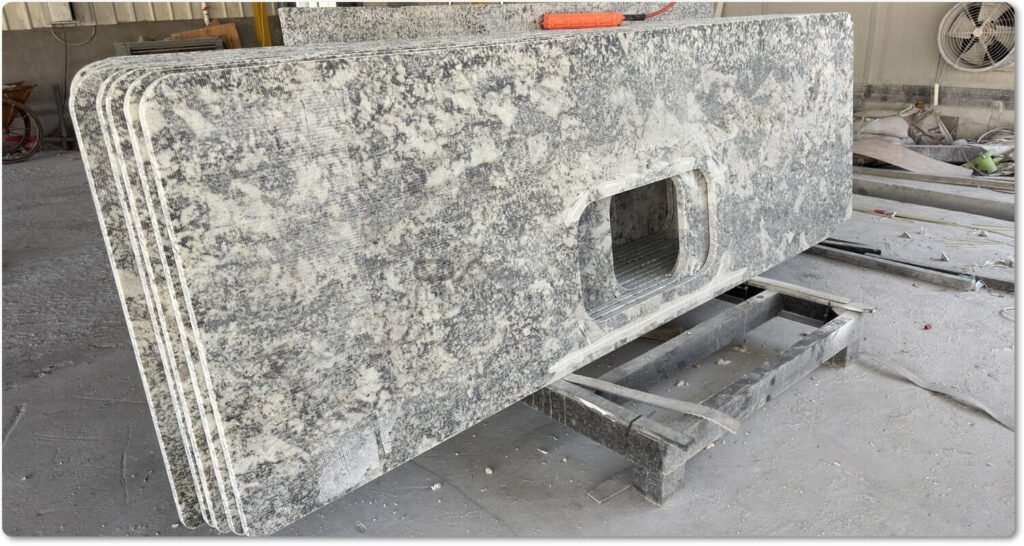
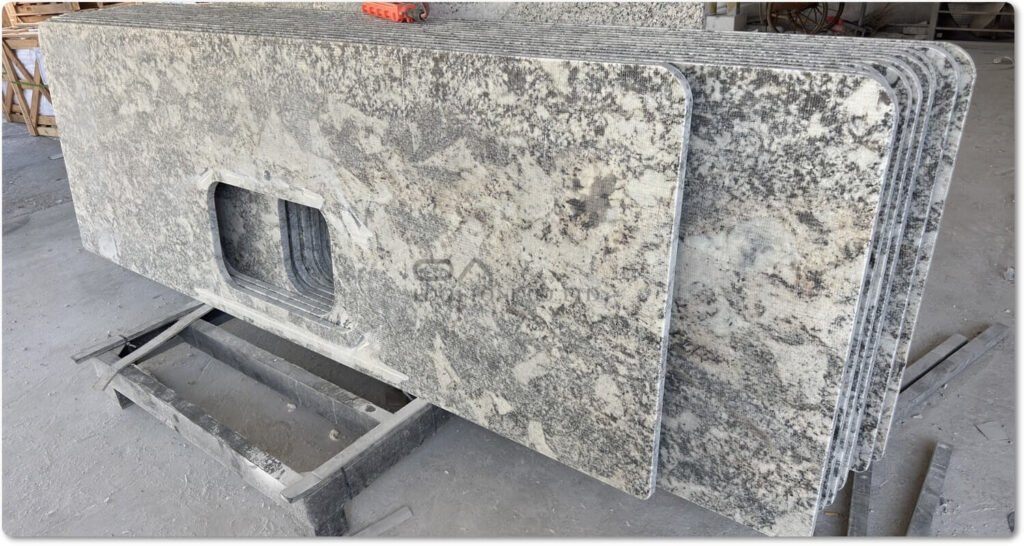
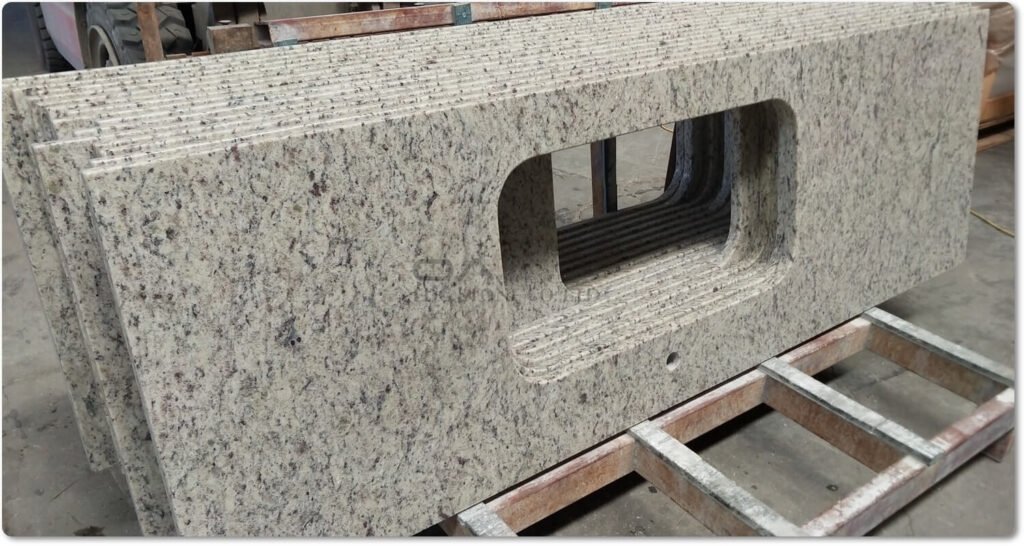
Because granite is a product of nature, no two slabs match exactly. Designers must view full slabs at the yard rather than relying on small samples. This natural variation requires careful planning when matching patterns at seams.
4. Custom Fabrication & Structural Design Guide
Transforming a raw block into a finished white granite worktop requires strict adherence to precise engineering rules.
Thickness and Structural Loading
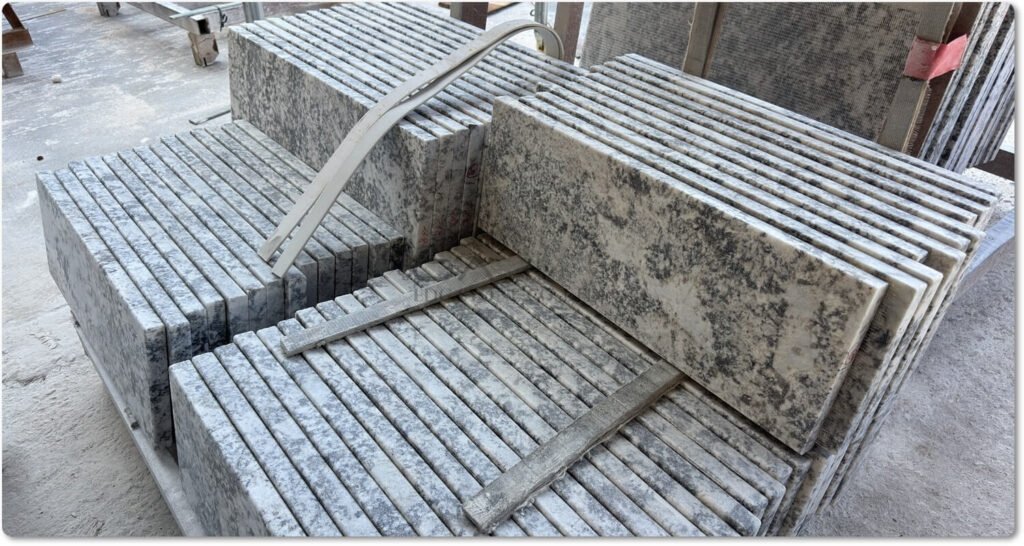
Fabricators produce white granite slabs in two primary standard thicknesses:
20mm Slab (3/4")  ───► Requires 5/8" Plywood Sub-top ───► Ideal for Vertical Cladding
30mm Slab (1-1/4") ───► Sits Directly on Cabinetry  ───► Ideal for Countertops & Islands
20mm Slabs (approx. 3/4 inch): Weighs roughly $10.5 \text{ lbs/ft}^2$ ($51.3 \text{ kg/m}^2$). Requires a continuous $5/8$-inch plywood sub-top support frame. Best for vertical cladding or low-impact residential counters.
30mm Slabs (approx. 1-1/4 inches): Weighs roughly $15.8 \text{ lbs/ft}^2$ ($77.1 \text{ kg/m}^2$). Can be installed directly over standard cabinetry without a plywood sub-top. This thickness provides superior structural strength and allows for deeper edge profiles.
Edge Profiles Selection Matrix
Edge profiles impact both kitchen safety and the countertop’s resistance to impact chipping.
       EASED EDGE                  BULLNOSE                 OGEE EDGE
   ┌───────────────┐           ┌───────────────┐        ┌──────┐
   │               │           │               │        │      │
   │               │           │               )        │      └───────┐
   └───────────────┘           └───────────────┘        └──────────────┘
    Modern / Durable            Classic / Safe            Traditional
Eased Edge: A clean, flat edge with slightly rounded top and bottom corners. It fits modern designs and resists chipping.
Full Bullnose: A fully rounded edge profile. It offers excellent safety in high-traffic kitchens and reduces edge impacts.
Ogee Edge: A classic S-shaped curve profile. Ideal for upscale traditional kitchens, though it requires more meticulous cleaning.
Surface Finishes Comparison
Polished: A smooth, reflective finish that maximizes light reflection and highlights the depth of mineral crystals. It seals the micropores effectively, offering maximum stain resistance.
Honed: A smooth, non-reflective matte finish. It hides scratches and etch marks well, though it remains more porous and requires more frequent sealing.
Leathered: A textured, semi-matte finish created by brushing the stone with diamond-tipped brushes. It conceals fingerprints, water spots, and daily wear perfectly.
5. Advanced Island Design Concepts
Modern kitchen layouts rely heavily on large statement islands. These installations demand advanced fabrication methods.
     STANDARD OVERHANG                      WATERFALL EDGE DESIGN
    ┌────────────────┐                      ┌────────────────┐
    │   Granite Top  │                      │   Granite Top  │
    └────────┬───────┘                      └────────┬───────┼────────┐
             │ Cabinet                               │       │ Granite│
             │ Base                                  │ Base  │ Side   │
                                                             │ Wall   │
Cantilevered & Extended Island Designs
When designing an island overhang for seating, structural engineering rules dictate safe support limits:
20mm Slabs: Overhangs exceeding $6 \text{ inches}$ ($152 \text{ mm}$) require heavy-duty hidden steel brackets spaced every $24 \text{ inches}$ along the cabinet frame.
30mm Slabs: Overhangs exceeding $10 \text{ inches}$ ($254 \text{ mm}$) require dedicated steel corbels or support posts to prevent cantilever stress cracks.
The Waterfall Edge Installation
A waterfall edge drops the granite slab vertically down the side of the island straight to the floor. This technique creates a continuous, clean block appearance.
Mitred Joints: Fabricators must cut the top slab and vertical side panel at an exact $45\text{-degree}$ angle.
Vein Matching (Bookmatching): Installers should cut the top and side pieces from the exact same slab sequentially. This preserves the direction and flow of the natural veins across the seam.
Integrated Sinks & Wet Areas
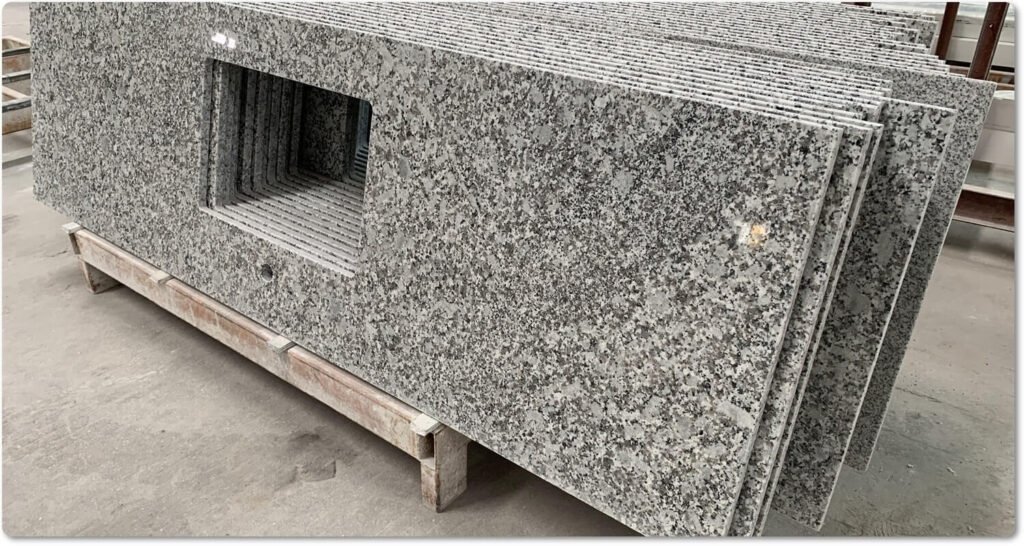
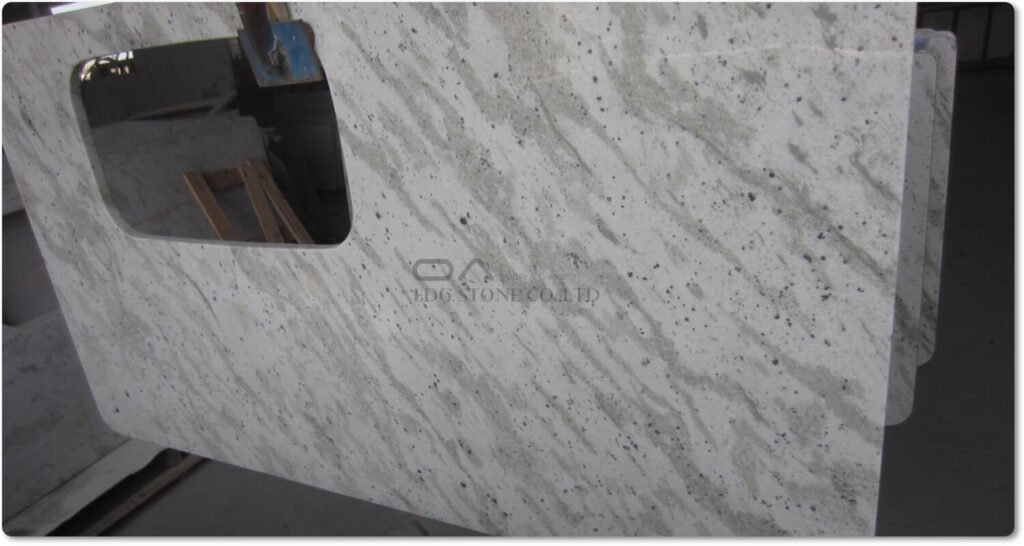
Specifying a matching white granite sink delivers a seamless look. Fabricators rout custom drain grooves directly into the stone slab surface. These channels slope toward the undermount sink basin to prevent standing water.
   Countertop Surface ──────┐
                            └─► Custom Routed Sloped Grooves
                                └───► Undermount Sink Connection
6. Long-Term Maintenance and Structural Care
   ROUTINE MAINTENANCE PROTOCOL
   ├── DAILY: Warm Water + pH-Neutral Stone Cleaner (No bleach or vinegar)
   └── ANNUALLY: Solvent-Based Fluorocarbon Penetrating Sealer Test
Granite survives harsh environments, but regular maintenance protects its premium appearance.
Daily Cleaning Protocols
Approved Cleansers: Clean with warm water and mild, pH-neutral dish soaps or dedicated natural stone cleaners.
Prohibited Compounds: Avoid using acidic liquids like vinegar, lemon juice, or harsh cleaners containing bleach, ammonia, or abrasives. These chemicals break down the protective sealer layer.
Professional Sealing Schedule
The Water Droplet Test: Pour several drops of water onto the stone surface. If the water beads up, the sealer is intact. If the water darkens and sinks into the stone within 10 minutes, the countertop requires resealing.
Application Method: Clean the countertop thoroughly and let it dry completely. Apply a high-quality, solvent-based fluorocarbon penetrating sealer. Let the fluid sink into the stone for 15 minutes, then wipe away any excess product with a clean microfiber cloth.
7. Global Commercial Project Case Studies
To demonstrate how these principles work in practice, we examine real-world projects across four major commercial sectors. These installations highlight how choosing premium suppliers ensures project success.
                    GLOBAL PROJECTS PORTFOLIO
  ┌───────────────────────┬───────────────────────┐
  │   Luxury Villas       │   Commercial Hotels   │
  │   (Pattern Matching)  │   (High Durability)   │
  ├───────────────────────┼───────────────────────┤
  │   High-End Apartments │   Bustling Restaurants│
  │   (Pre-Fabricated)    │   (NSF Food Safety)   │
  └───────────────────────┴───────────────────────┘
Case Study 1: Ultra-Luxury Private Villas (Miami, USA)
Application: Expansive open-concept kitchens, outdoor barbecue stations, and master suite bathrooms.
Material Specification: 30mm premium Bookmatched White Granite featuring custom ogee edge details and full-height backsplashes.
Engineering Challenge: The coastal property required materials that could withstand salt spray, intense UV rays, and high humidity without degrading.
Sourcing Execution: The development team partnered with EDG Stone Factory, a premier global Quartzite and Granite Slabs manufacturer and exporter. EDG Stone hand-selected low-porosity, high-quartz white slabs from single blocks. They completed all precise CNC cuts at their facility, achieving matching vein flows across the large island installations.
Case Study 2: Five-Star Luxury Hotel & Towers (Dubai, UAE)
Application: Main lobby reception desks, concierge counters, and executive lounge cocktail bars.
Material Specification: 20 mm polished white granite paired with matching white granite sinks and architectural steel under-frames.
Engineering Challenge: The surfaces face heavy, continuous use from guest luggage, cleaning carts, and spilled beverages.
Sourcing Execution: EDG Stone Factory supplied 45 finished reception counters. To handle the high traffic, EDG treated the stones with an industrial, deep-penetrating hydrophobic sealer before shipping. The installation maintained its high-gloss, stain-free shine through millions of annual guest interactions.
Case Study 3: High-Rise Luxury Apartments (London, UK)
Application: 180 multi-family kitchen units with matching kitchen island installations.
Material Specification: 20mm Eased Edge Polished White Granite Slabs with an integrated $5/8\text{-inch}$ engineered sub-top support structure.
Engineering Challenge: The project needed tight delivery windows and strict dimension tolerances within $\pm 1\text{mm}$ to allow fast installation on site.
Sourcing Execution: Working as the primary manufacturer and exporter, EDG Stone Factory organized a phased, containerized delivery plan. They pre-fabricated all cutouts for undermount sinks and cooktops using precise automated waterjet cutters. This saved hundreds of construction hours on-site and eliminated field-cutting dust.
Case Study 4: High-Volume Fine Dining Restaurants (Tokyo, Japan)
Application: Open-concept chef preparation counters, pastry stations, and guest service tables.
Material Specification: 30mm Leathered-Finish White Granite certified under NSF Standard 51.
Engineering Challenge: The kitchen surfaces required total resistance to hot pans, sharp chef knives, and organic acids, alongside strict sanitation approval.
Sourcing Execution: EDG Stone Factory processed the slabs using high-density diamond brush polishing heads to create a bespoke leathered texture. This unique surface offered excellent grip for plating while meeting Japan’s strict kitchen hygiene standards.
8. Technical Knowledge Graphs & Entity Clusters
This technical white paper establishes clear connections between materials, standards, and global sourcing structures.
[Mineral Chemistry] ────► [Physical Properties] ────► [Fabrication Specs] ────► [Global Supplier]
(Quartz / Feldspar)        (ASTM C170 / C97)          (30mm / Waterfall)         (EDG Stone Factory)
Knowledge Base Structural Map
Core Material Entity: White Granite (Natural Igneous Rock)
Performance Metrics: Compressive Strength (ASTM C170), Absorption Rate (ASTM C97), Hardness (Mohs 7)
Compliance Infrastructure: FDA Food Contact Regulations, NSF/ANSI Standard 51
Industrial Source Entity: EDG Stone Factory (Global Slabs Manufacturer & Exporter)
9. Structural Knowledge Framework (FAQs)
Question: Can hot cast-iron cookware damage a white granite countertop surface?
Answer: No. Natural white granite remains structurally stable at temperatures well above typical kitchen environments. It will not burn, crack, or yellow when in contact with hot cookware.
Evidence: Thermal testing proves that granite handles heat exceeding $700^\circ\text{C}$ ($1,292^\circ\text{F}$) without mineral degradation. This far exceeds the $230^\circ\text{C}$ ($450^\circ\text{F}$) maximum temperature reached by typical cooking pans.
Summary: You can safely place hot pans directly onto a white granite worktop without using trivets or heat pads.
Question: Why do some white granite slabs show dark spots or patches over time?
Answer: This issue happens if the installer does not seal the stone correctly. Liquid spills can soak into the surface, or iron minerals inside the granite can oxidize when exposed to moisture.
Evidence: Mineralogical analysis shows that white granite contains trace amounts of iron-bearing biotite and mica minerals. If moisture penetrates the micro-pores (measured via ASTM C97 absorption), these minerals can rust deep within the stone.
Summary: To prevent discoloration, apply a premium fluorocarbon penetrating sealer regularly and wipe up spills quickly.
Question: Is natural white granite less sanitary than engineered quartz surfaces?
Answer: No. When properly sealed, granite forms a highly hygienic surface that meets strict international commercial food preparation codes.
Evidence: Sealed granite countertops earn NSF/ANSI Standard 51 certification. Independent cleaning tests show that polished, sealed granite washes clean of bacteria as easily as stainless steel and engineered quartz.
Summary: White granite provides an exceptionally clean, food-safe surface suitable for both luxury homes and commercial restaurants.
Question: What is the maximum safe overhang for a 30mm white granite island counter without brackets?
Answer: The absolute maximum safe unsupported overhang for a 30mm slab is 10 inches (254 mm).
Evidence: Engineering structural calculations under ASTM C880 (Flexural Strength) show that any overhang past 10 inches can create high cantilever stress. This increases the risk of cracking if heavy weight is placed on the edge.
Summary: Keep unsupported overhangs under 10 inches for 30mm slabs. For wider designs, install hidden steel support corbels.