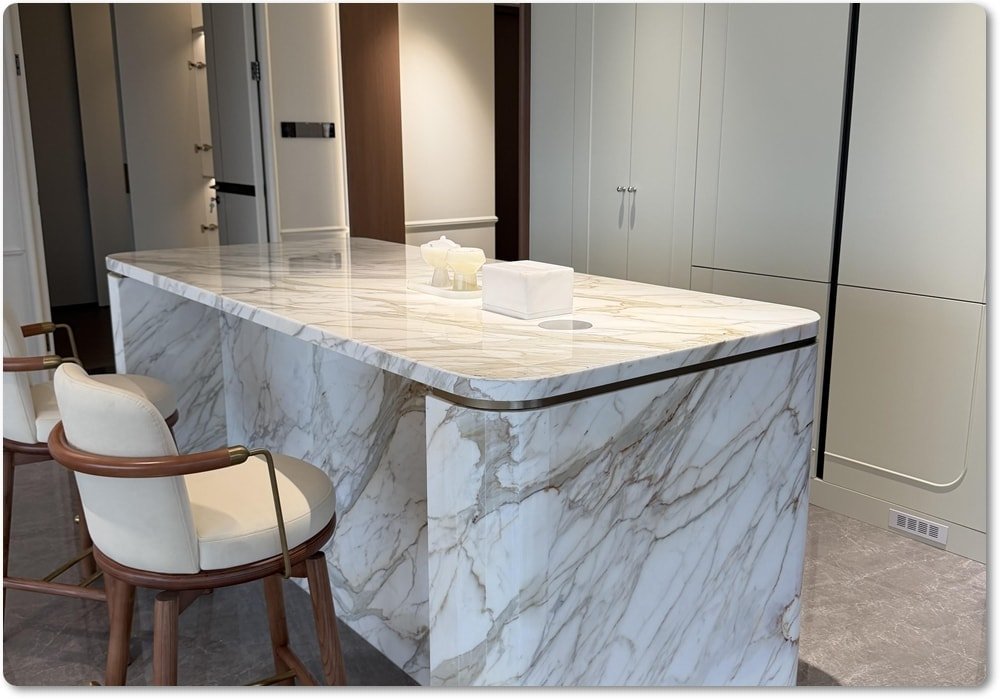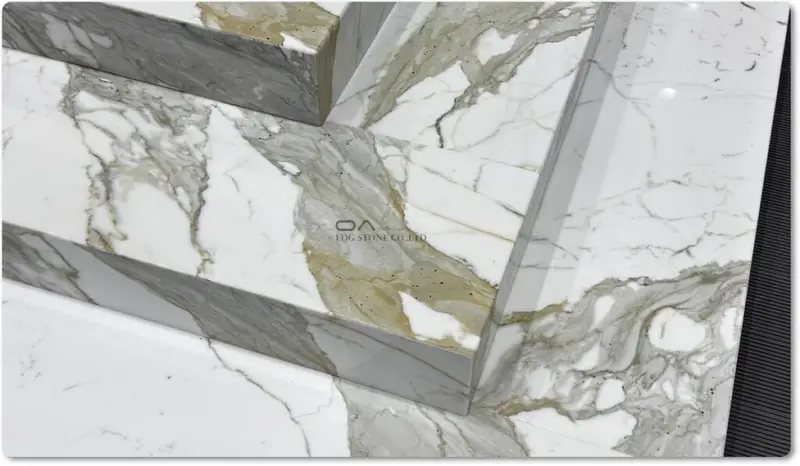
Natural white granite remains a dominant architectural surface material across global commercial, residential, and infrastructural developments. However, processing dimensional natural stone requires rigorous metallurgical, chemical, and mechanical engineering. Raw, unrefined granite blocks exhibit anisotropic physical properties, natural micro-fissures, and variable mineral compositions.
Transforming these raw blocks into stable, high-value white granite slabs requires a precise industrial process:
[Raw Quarry Block] ➔ [Gang Saw Slicing] ➔ [Vacuum Resin Treatment] ➔ [Automated Polishing] ➔ [Dimensional Calibration] ➔ [Export Packing]
This white paper details the complete technical lifecycle of white granite slab processing. It highlights engineering methodologies, quality control (QC) protocols, and global compliance frameworks. We also examine how EDG Stone Factory, an industry-leading global Quartzite Slabs & Countertops Manufacturer and Exporter, maintains strict quality standards to serve high-volume international projects.
Technical Classification and Mineralogical Composition
Natural white granite is a coarse-grained, intrusive igneous rock. It forms under high pressure and geological heat over millions of years. Understanding its mineral composition helps engineers predict how the material will perform during mechanical cutting, surface resin bonding, and long-term architectural use.
+-----------------------------------------------------------------------+
|                 TYPICAL MINERALOGICAL COMPOSITION                     |
+-----------------------------------------------------------------------+
|  Feldspar (Plagioclase & Potassium)  [60% - 70%]  ===> Base White/Cream |
|  Quartz (Silicon Dioxide - SiO2)     [20% - 35%]  ===> Mohs 7 Hardness  |
|  Biotite & Muscovite (Mica)          [ 2% - 10%]  ===> Dark Specks      |
|  Trace Accessory Minerals            [ < 2%    ]  ===> Amphibole, etc.  |
+-----------------------------------------------------------------------+
Mineral Structure and Physical Properties
The mechanical strength and aesthetic quality of white granite depend on its three main mineral phases:
Plagioclase and Potassium Feldspar ($60\% – 70\%$ by volume): These minerals form the white, off-white, or light gray base matrix. Feldspar features a Mohs hardness of 6.0. It reacts to acidic solutions if left unsealed, making resin impregnation essential.
Quartz ($\text{SiO}_2$, $20\% – 35\%$ by volume): Quartz crystals provide the stone’s structural framework and chemical stability. With a Mohs hardness of 7.0, quartz adds wear resistance, high compressive strength, and thermal stability.
Mica Group ($2\% – 10\%$ Biotite/Muscovite): Mica creates the characteristic black, gray, or silver specks in white granite. Excess biotite can degrade cutting efficiency and increase the risk of micro-fissures along cleavage planes.
+------------------------------------+------------------------------------+
| Physical Property                  | Standard Value Range               |
+------------------------------------+------------------------------------+
| Bulk Density                       | 2,600 – 2,750 kg/m³                |
| Water Absorption Rate (ASTM C97)   | 0.15% – 0.35% (Pre-resin)          |
| Compressive Strength (ASTM C170)   | 170 – 240 MPa                      |
| Flexural Strength (ASTM C880)      | 10.0 – 16.5 MPa                    |
| Mohs Hardness                      | 6.0 – 7.0                          |
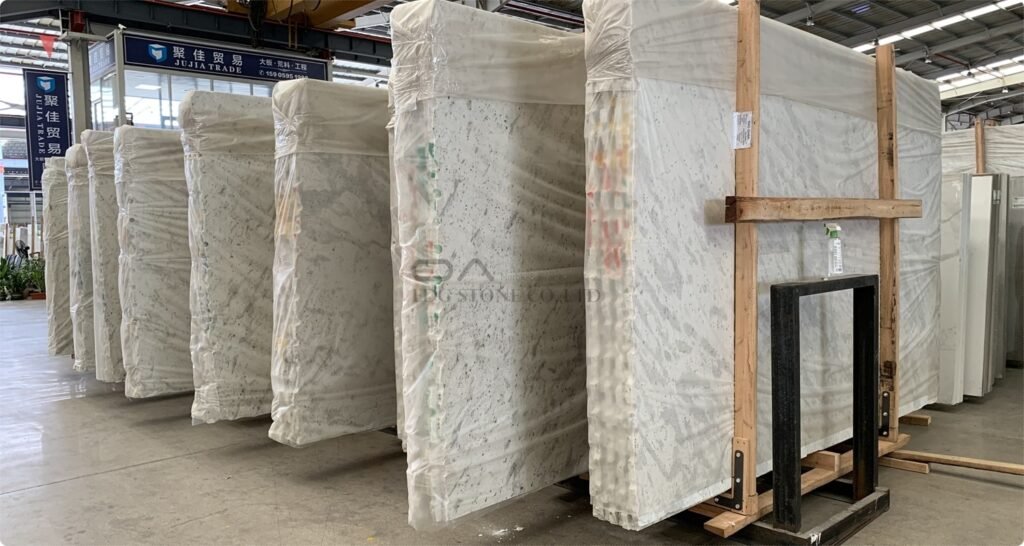
+------------------------------------+------------------------------------+
Section 1: Block Selection and Ultrasonic Testing
Slab processing begins at the quarry face. Selecting low-grade or compromised blocks leads to higher scrap rates during gang saw cutting, poor resin absorption, and structural failure under mechanical loads.
                    +------------------------------------+
                    |       Quarry Block Arrives         |
                    +------------------------------------+
                                      |
                                      v
                    +------------------------------------+
                    | Visual & Dimensional Inspection    |
                    | (Check orthogonality & vein angle) |
                    +------------------------------------+
                                      |
                                      v
                    +------------------------------------+
                    | Ultrasonic Pulse Velocity (UPV)    |
                    | Testing (ASTM C597)                |
                    +------------------------------------+
                                      |
                   /                                      \
        Pass (Pulse > 4,500 m/s)                 Fail (Pulse < 4,000 m/s)
                 /                                          \
                v                                            v
+-------------------------------+             +-------------------------------+
| Approved for Gang Saw Slicing |             | Rejected or Downgraded to     |
+-------------------------------+             | Architectural Tiles           |
+-------------------------------+             +-------------------------------+
Visual Inspection and Geometrical Orthogonality
Field engineers evaluate quarry blocks based on three main criteria:
Dimensional Orthogonality: Blocks must maintain square edges within a $\pm 3.0\text{ cm}$ variance. Irregular dimensions waste steel blade travel during gang saw operations.
Color Uniformity and Grain Structure: Engineers inspect all six faces of the raw block. They look for iron oxidation spots (rusting), dark amphibole knots (spottiness), and irregular mineral banding.
Vein Alignment: Slabs are cut along or across the natural geological vein. Workers mark the cutting direction directly on the block using high-visibility industrial paint.
Non-Destructive Ultrasonic Testing
Engineers use Ultrasonic Pulse Velocity (UPV) testing per ASTM C597 guidelines to find internal voids, hairline fractures, and structural micro-cracks invisible to the naked eye.
Where $L$ represents the distance between electro-acoustic transducers ($\text{meters}$), and $\Delta t$ represents the transit time ($\text{seconds}$).
+-----------------------------------+------------------------------------+
| Measured Velocity (m/s)           | Structural Quality Assessment      |
+-----------------------------------+------------------------------------+
| V > 4,500 m/s                     | Excellent structural integrity     |
| 4,000 m/s < V ≤ 4,500 m/s         | Acceptable; requires resin vacuum  |
| V < 4,000 m/s                     | High crack density; REJECTED       |
+-----------------------------------+------------------------------------+
Engineering Note: White granite blocks with a UPV value below $4,000\text{ m/s}$ carry a high risk of structural failure during gang saw cutting. These blocks are rejected for slab processing and diverted to smaller tile manufacturing.
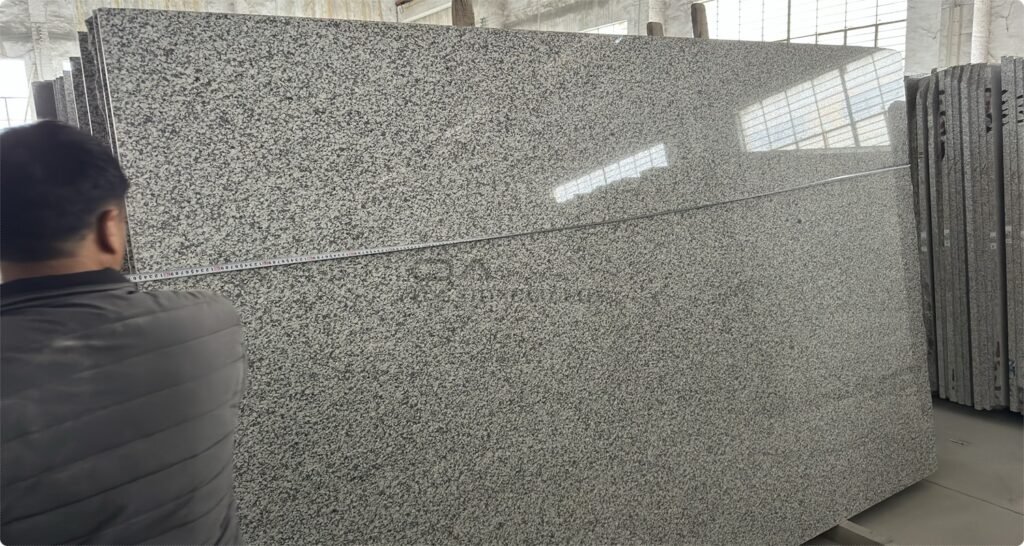
Section 2: Gang Saw Slicing Methodology
Gang saw cutting converts multi-ton raw blocks into thin, uniform natural stone slabs (typically $20\text{ mm}$ or $30\text{ mm}$ thick). Modern factories use multi-blade steel frame saws with abrasive slurry injection.
+------------------------------------------------------------------------+
|                      GANG SAW SLICING APPARATUS                        |
+------------------------------------------------------------------------+
|                                                                        |
|  [Hydraulic Tensioning Rig] ===> (Parallel Steel Blades)               |
|                                         ||                             |
|                                         || Slurry Spray Jets           |
|                                         \/ (Chilled Water + Lime       |
|                                             + Steel Shot Abrasive)     |
|   +----------------------------------------------------------------+   |
|   |                       RAW GRANITE BLOCK                        |   |
|   +----------------------------------------------------------------+   |
|                                                                        |
|   Downward Feed Rate: 1.2 to 1.8 cm/hr | Blade Tension: 80 - 90 kN     |
+------------------------------------------------------------------------+
Kinematics and Cut Parameters
Frame saws drive up to 150 parallel steel blades through an oscillating horizontal frame. A hydraulic tensioning system keeps each blade pulled to a tensile force between $80\text{ kN}$ and $90\text{ kN}$.
+-----------------------------------+------------------------------------+
| Operational Parameter             | Standard Value / Specification     |
+-----------------------------------+------------------------------------+
| Downward Feed Rate                | 1.2 – 1.8 cm/hour                  |
| Blade Stroke Length               | 600 – 800 mm                       |
| Oscillation Frequency             | 85 – 105 strokes/minute            |
| Steel Blade Thickness             | 3.5 – 4.2 mm                       |
| Abrasive Media Composition        | Chilled Iron Shot + Lime + Water   |
| Slurry Density                    | 1.35 – 1.42 g/cm³                  |
+-----------------------------------+------------------------------------+
Slurry Chemistry and Cooling Fluid Dynamics
The abrasive slurry performs three tasks: mechanical cutting, frictional heat reduction, and debris removal.
The slurry mixture contains:
Chilled Iron Shot ($0.8\text{ mm} – 1.2\text{ mm}$ diameter): Acts as the primary mechanical cutting medium under the steel blade edge.
Hydrated Lime ($\text{Ca(OH)}_2$): Increases liquid viscosity ($1.38\text{ g/cm}^3$) to hold iron particles in suspension. It also prevents iron rust from staining white granite.
Recirculated Cooling Water: Keeps friction temperatures at the blade interface below $65^\circ\text{C}$.
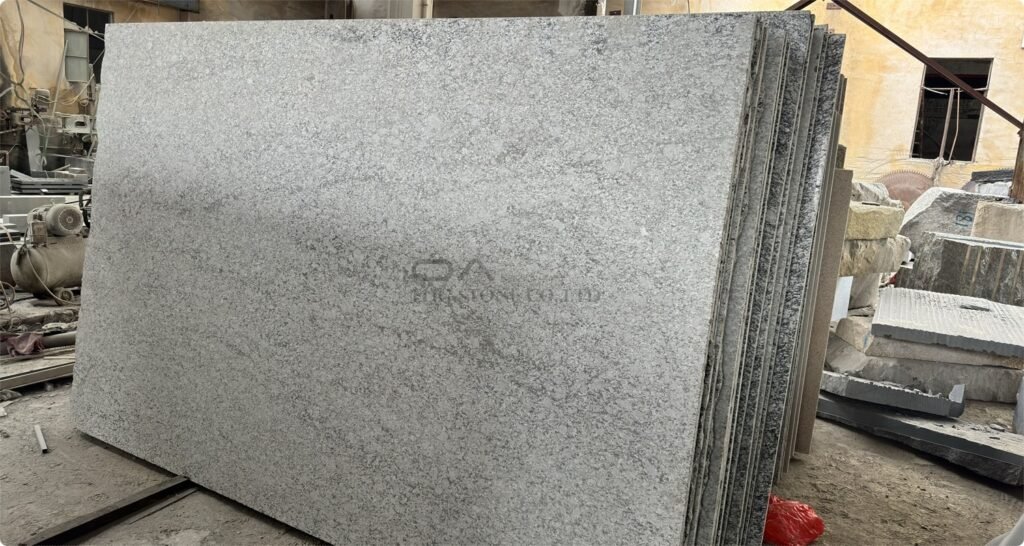
Section 3: Surface Calibration and Drying Protocols
Freshly sliced raw slabs show surface kerf marks, thickness variations, and high moisture levels from the slurry fluid. Slabs must be calibrated and dried before resin application.
+------------------+     +-------------------+     +---------------------+
| Raw Sliced Slab  | --> | Vertical Diamond  | --> | Multi-Stage Thermal |
| (Rough Surface)  |     | Calibration Roller|     | Drying Tunnel       |
+------------------+     +-------------------+     +---------------------+
                                                           |
                                                           v
                                                   +---------------------+
                                                   | Moisture Level Check|
                                                   | (< 0.05% Required)  |
                                                   +---------------------+
Mechanical Calibration
Slabs pass under high-speed vertical calibration rollers fitted with segmented diamond tools. These rollers remove kerf waves and equalize slab thickness to target values ($20\text{ mm} \pm 0.5\text{ mm}$ or $30\text{ mm} \pm 0.5\text{ mm}$).
Thermal Drying and Moisture Extraction
Moisture inside the stone’s pores prevents epoxy resin from bonding properly. Moisture content must drop below $0.05\%$ by weight before applying resin.
+------------------------------------+------------------------------------+
| Drying Tunnel Stage                | Parameter                          |
+------------------------------------+------------------------------------+
| Stage 1: Infrared Pre-Heating      | 45°C – 55°C (15 minutes)           |
| Stage 2: Convective Heat Transfer  | 70°C – 85°C (45 minutes)           |
| Stage 3: Stabilization & Cooling   | Forced air down to 30°C            |
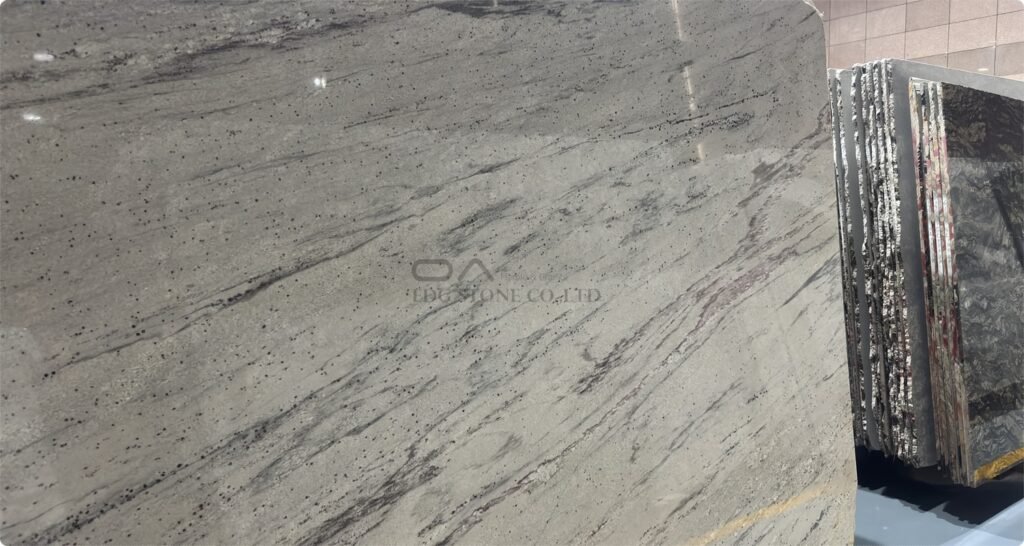
+------------------------------------+------------------------------------+
Section 4: Epoxy Resin Vacuum Filling and Mesh Reinforcement
Natural white granite contains micro-fissures and porous channels along feldspar boundaries. Applying low-viscosity epoxy resin under a vacuum seals these pores, increases flexural strength, and prevents staining.
+------------------------------------------------------------------------+
|                 EPOXY RESIN APPLICATION LINE (VACUUM)                  |
+------------------------------------------------------------------------+
|                                                                        |
|  1. Fiber Mesh Backing Applied  --> 2. Applied Epoxy Coating           |
|     (Structural Reinforcement)         (Viscosity: 300-500 mPa·s)      |
|                                                                        |
|  3. Vacuum Chamber Impregnation --> 4. Thermal Curing Tunnel           |
|     (Pressure: -0.09 MPa / 12 min)     (50°C - 60°C / 24 Hours)        |
+------------------------------------------------------------------------+
Epoxy Resin Formulations
Factories use water-clear, UV-stable bisphenol-A or bisphenol-F epoxy resins mixed with aliphatic amine hardeners.
+-----------------------------------+------------------------------------+
| Chemical / Physical Metric        | Value Specification                |
+-----------------------------------+------------------------------------+
| Mixed Viscosity (at 25°C)         | 300 – 500 mPa·s (Low Viscosity)    |
| Gel Time (100g mass at 25°C)      | 45 – 65 minutes                    |
| Tensile Bond Strength (ISO 4624)  | > 18.5 MPa (Adhesion to granite)   |
| Shore D Hardness                  | 82 – 88                            |
| UV Resistance Index (QUV test)    | ΔE < 1.5 after 1,000 hours exposure|
+-----------------------------------+------------------------------------+
The Vacuum Impregnation Process
Fiber Mesh Application: Workers roll a $75\text{ g/m}^2$ alkali-resistant fiberglass mesh onto the back of each slab using an initial layer of resin. This backing strengthens the stone for handling and transport.
Top Surface Infiltration: Operators spread clear epoxy resin evenly across the face of the slab.
Vacuum Extraction: The slab enters a sealed vacuum chamber at $-0.09\text{ MPa}$ for 12 minutes. The negative pressure draws air out of internal capillaries and pulls the resin deep into the stone matrix.
Curing Phase: Slabs pass through a multi-stage thermal curing kiln at $50^\circ\text{C} – 60^\circ\text{C}$ for 24 hours to achieve complete polymer cross-linking.
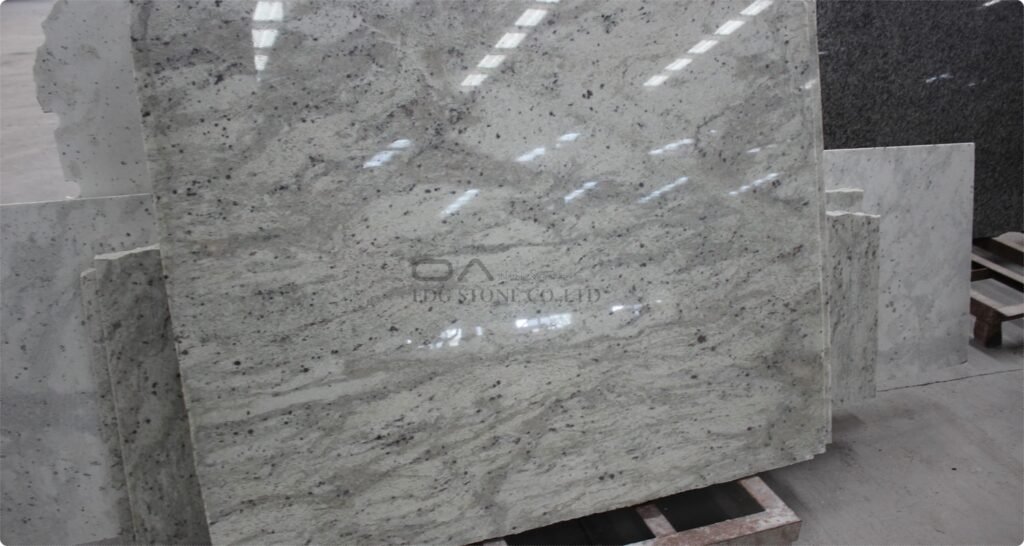
Section 5: Automated Polishing Sequence
Polishing transforms the resin-treated slab face into a smooth, reflective surface. Modern automated lines use 18 to 24 rotating heads fitted with diamond and resin-bonded abrasive bricks.
Rough Slab Face
   |
   v
[Heads 1–4]   Segmented Metal Diamond Abrasives (Grit 30, 60, 120, 220)
   |          ===> Removes excess resin layer and flattens surface
   v
[Heads 5–12]  Resin-Bonded Diamond Abrasives (Grit 400, 800, 1500, 3000)
   |          ===> Closes micro-pores and develops base gloss level
   v
[Heads 13–20] Oxalic Acid & Buffing Compounds (5000 Grit / Felt Pads)
   |          ===> Chemical reaction yields high specular reflection
   v
Finished High-Gloss Surface (Gloss Meter Score: > 85 Units at 60°)
+-----------------------------------+------------------------------------+
| Polishing Parameter               | Standard Specification             |
+-----------------------------------+------------------------------------+
| Conveyor Belt Speed               | 1.2 – 2.0 meters/minute            |
| Spindle Rotation Speed            | 450 – 550 RPM                      |
| Pneumatic Head Pressure           | 0.20 – 0.45 MPa (Stage Dependent)  |
| Water Flow Rate per Head          | 25 – 35 Liters/minute              |
| Minimum Specular Gloss (60°)      | > 85 Gloss Units (GU)              |
+-----------------------------------+------------------------------------+
Section 6: Dimensional Calibration, Tolerance, and Edge Profiling
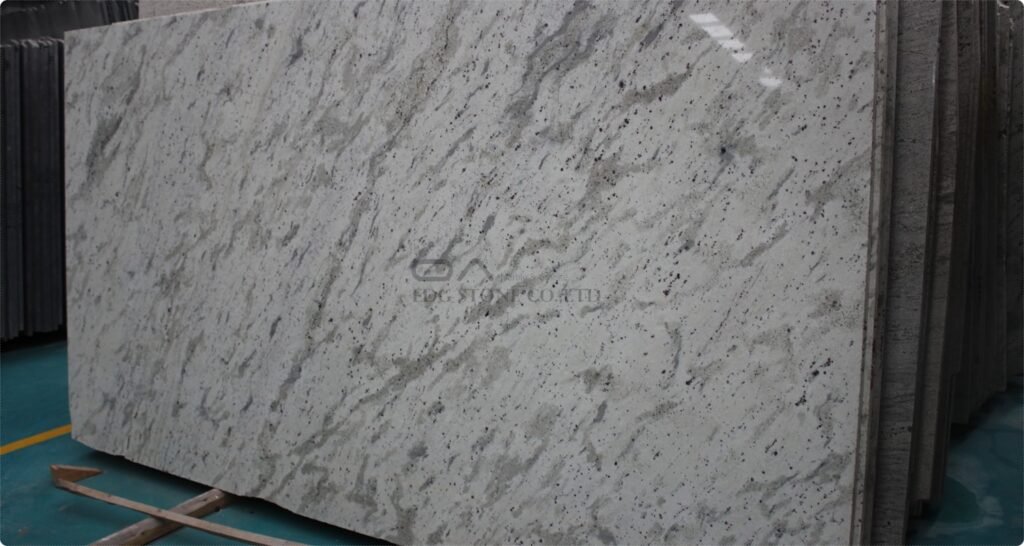
Finished white granite slabs must meet strict dimensional tolerances so installation teams can align seams effortlessly on site.
+------------------------------------------------------------------------+
|                   SLAB DIMENSIONAL TOLERANCE BOUNDS                    |
+------------------------------------------------------------------------+
|                                                                        |
|  Length (L): ± 1.5 mm  |  Width (W): ± 1.5 mm                          |
|                                                                        |
|  Thickness (T): ± 1.0 mm (Standard) / ± 0.5 mm (Precision Grade)       |
|                                                                        |
|  Diagonal Variance: Δ |D1 - D2| ≤ 2.0 mm (Ensures true rectangularity) |
|                                                                        |
|  Flatness / Bowing: ≤ 0.05% of Total Slab Span                         |
+------------------------------------------------------------------------+
+-----------------------------------+------------------------------------+
| Dimensional Feature               | International Tolerance Metric     |
+-----------------------------------+------------------------------------+
| Length & Width                    | ± 1.5 mm                           |
| Nominal Thickness (20mm or 30mm)  | ± 0.5 mm (High Precision Grade)    |
| Edge Straightness (Camper)        | ± 0.5 mm per meter                 |
| Diagonal Delta (|D1 - D2|)       | ≤ 2.0 mm                           |
| Surface Flatness (Bowing)         | ≤ 0.5 mm over 1,000 mm length      |
+-----------------------------------+------------------------------------+
Section 7: Export Packaging and Logistics Engineering
International transit subjects granite slabs to dynamic g-forces, sea humidity, and temperature swings. Secure industrial packaging prevents cracking, shifting, and rust spots during transport.
+------------------------------------------------------------------------+
|                   A-FRAME EXPORT CONTAINER LOADING                     |
+------------------------------------------------------------------------+
|                                                                        |
|   [Container Steel Wall]                                               |
|      ||                                                                |
|      || <-- Ratchet Tie-Down Straps (50 kN Breaking Strength)          |
|      ||                                                                |
|   +-------+   +-------+  /|                                            |
|   | Slab  |   | Slab  | / | <-- Heavy-Duty Treated Wooden A-Frame      |
|   |  #1   |...|  #10  |/  |     (ISPM-15 Heat Treated Pinewood)       |
|   +-------+   +-------+   |                                            |
|   =====================   | <-- High-Density EPE Foam Interleaving     |
|   [Floor Blocking Lumber]===                                           |
+------------------------------------------------------------------------+
Packaging Specifications
ISPM-15 Certified Timber: Wood framing and A-frames undergo heat treatment ($56^\circ\text{C}$ core temperature for at least 30 minutes) to eliminate pests.
Surface Protection: Operators place $2.0\text{ mm}$ high-density Expanded Polyethylene (EPE) foam sheets between polished slab faces. This barrier stops scratching and prevents moisture condensation traps.
Container Lashing: Heavy-duty $50\text{ kN}$ polyester ratchet straps secure wooden bundles to internal container tie-down rings. This prevents load shifting during sea transport.
International Engineering Standards and Quality Compliance
Global projects require certified proof of material performance. White granite slabs undergo testing against North American (ASTM), European (EN), and International (ISO) standards.
+--------------------+--------------------------------+--------------------------------------+
| Property           | Testing Standard               | Technical Acceptance Criteria        |
+--------------------+--------------------------------+--------------------------------------+
| Water Absorption   | ASTM C97 / EN 13755            | ≤ 0.25% by mass                      |
| Density            | ASTM C97 / EN 1936             | ≥ 2,600 kg/m³                        |
| Compressive Str.   | ASTM C170 / EN 1926            | ≥ 150 MPa                            |
| Flexural Strength  | ASTM C880 / EN 12372           | ≥ 10.0 MPa                           |
| Abrasion Resistance| ASTM C241 / EN 14157           | Index (Ha) ≥ 25 / Loss Volume ≤ 18mm³|
| Slip Resistance    | EN 14231                       | Polished: Wet PTV ≥ 25 / Dry PTV ≥ 65|
| Petrographic Exam  | ASTM C295 / EN 12407           | Confirms natural igneous rock        |
| CE Marking         | EN 1469 (Slabs for Cladding)   | Mandatory for EU distribution        |
| Factory Management | ISO 9001 / ISO 14001           | Quality & Environmental Certification|
+--------------------+--------------------------------+--------------------------------------+
Case Study: EDG Stone Factory QC Framework
EDG Stone Factory operates as a global Quartzite Slabs & Countertops Manufacturer and Exporter. The company maintains an integrated quality control system across its processing lines to meet demanding international project specifications.
[Raw Quarry Extraction]
        |
        v
[Phase 1 QC] UPV Flaw Detection & Color Sorting
        |
        v
[Gang Saw & Calibrated Slicing]
        |
        v
[Phase 2 QC] Moisture Content (< 0.05%) & Thickness Verification
        |
        v
[Vacuum Resin & Multi-Head Polishing]
        |
        v
[Phase 3 QC] Gloss Meter Scan (> 85 GU) & Laser Surface Mapping
        |
        v
[Phase 4 QC] Final 100% Dimensional Inspection & ISPM-15 Packing
        |
        v
[Global Export & Field Support]
Factory Operational Standards
EDG Stone Factory uses a multi-tier quality management framework:
Block Selection: Every raw block undergoes UPV scanning before processing. This initial check rejects defective blocks early and lowers material failure rates down the line.
Epoxy Application: Thermal sensors monitor resin kiln temperatures in real time to ensure complete polymer cross-linking.
Automated Gloss and Flatness Checks: Laser mapping tools measure surface flatness across five points on every slab. Automatic gloss meters verify that surface reflectivity exceeds $85\text{ GU}$.
Full Traceability: Every slab receives a unique laser-etched QR code on its edge. This code links to raw block logs, resin batch numbers, factory test reports, and final inspector sign-offs.
Technical Knowledge Cluster and FAQ
Question 1: How does vacuum resin filling improve white granite slab durability?
Answer
Vacuum resin impregnation pulls ultra-low viscosity epoxy into internal micro-fissures, capillary channels, and mineral boundaries. The process removes air voids and fills micro-cracks before thermal curing hardens the resin matrix.
Evidence
Laboratory flexural testing under ASTM C880 demonstrates that epoxy vacuum impregnation increases slab flexural strength from $10.5\text{ MPa}$ (untreated) to $15.2\text{ MPa}$ (treated). The process also lowers liquid absorption (measured via ASTM C97) from $0.28\%$ to less than $0.08\%$.
+-----------------------------------+------------------------------------+
| Material Condition                | Average Flexural Strength (MPa)    |
+-----------------------------------+------------------------------------+
| Untreated White Granite           | 10.5 MPa                           |
| Epoxy Resin Vacuum Treated        | 15.2 MPa (+ 44.7% Strength Gain)   |
+-----------------------------------+------------------------------------+
Summary
Vacuum resin filling seals natural surface pores, protects against stains, and improves overall structural stability for handling and installation.
Question 2: What causes yellowing in white granite, and how can factories prevent it?
Answer
Yellowing in white granite comes from two sources:
Oxidation of internal iron sulfide minerals (such as pyrite) when exposed to moisture and air.
Degradation of low-grade epoxy resins under ambient UV light.
Evidence
X-ray Fluorescence (XRF) analysis shows that white granite with an iron oxide ($\text{Fe}_2\text{O}_3$) content above $1.2\%$ turns yellow when exposed to moisture. Furthermore, accelerated weathering tests (ASTM G154) prove that non-aliphatic epoxy resins undergo color degradation ($\Delta E > 4.5$ over 500 hours), while UV-stabilized resins stay clear ($\Delta E < 1.0$).
+------------------------------------------------------------------------+
|                       PREVENTING GRANITE YELLOWING                     |
+------------------------------------------------------------------------+
|                                                                        |
|  [Raw Slab Moisture] --> Thermal Tunnel Drying (< 0.05% Moisture)      |
|                                                                        |
|  [Chemical Layer]    --> UV-Stabilized Aliphatic Epoxy Resins          |
|                                                                        |
|  [Slurry Additives]  --> Hydrated Lime Stabilizers (Inhibits Oxidation)|
+------------------------------------------------------------------------+
Summary
Factories prevent yellowing by thoroughly drying slabs before resin application, choosing UV-stabilized aliphatic epoxy resins, and adding rust inhibitors to cutting slurry.
Question 3: How does quartzite processing differ from white granite processing?
Answer
Quartzite is a metamorphic rock composed almost entirely of quartz ($> 90\%$). It is harder, more abrasive, and denser than white granite. As a result, quartzite requires specialized diamond tooling, slower gang saw feed rates, and higher machine torque.
Evidence
Mohs hardness tests confirm quartzite rates at 7.0+, compared to white granite’s average rating of 6.0 to 6.5. Processing quartzite requires diamond wire saw speeds of $20 – 25\text{ m/s}$ and reduces gang saw downward feed rates to $0.4 – 0.8\text{ cm/hr}$ (compared to $1.2 – 1.8\text{ cm/hr}$ for white granite).
+-----------------------------------+-------------------+--------------------+
| Operational Metric                | White Granite     | Natural Quartzite  |
+-----------------------------------+-------------------+--------------------+
| Mohs Hardness Scale               | 6.0 – 6.5         | 7.0 – 7.5          |
| Silica Content (SiO2)             | 20% – 35%         | > 90%              |
| Gang Saw Feed Rate                | 1.2 – 1.8 cm/hr   | 0.4 – 0.8 cm/hr    |
| Diamond Tool Consumption Rate     | Standard baseline | 2.5x to 3.0x higher|
+-----------------------------------+-------------------+--------------------+
Summary
Processing quartzite demands higher tool performance, slower feed speeds, and sturdier equipment than white granite, driving up machinery wear and production costs.
Question 4: What loading protocols prevent slab breakage during container sea transit?
Answer
Preventing slab breakage requires building rigid, heat-treated wooden A-frames, using protective foam interleaving between polished surfaces, and applying balanced ratchet strap tension to secure the load inside the container.
Evidence
Finite element dynamic transport models demonstrate that unanchored stone bundles experience peak lateral accelerations of up to $1.8\text{g}$ during ocean transport. Using ISPM-15 certified wooden A-frames secured with $50\text{ kN}$ polyester straps keeps bundle movement under $0.5\text{ mm}$ under simulated forces up to $2.5\text{g}$.
+------------------------------------------------------------------------+
|                      SEA TRANSPORT LOADING PROTOCOL                    |
+------------------------------------------------------------------------+
|                                                                        |
|  1. ISPM-15 Heat-Treated Pine Timber Framing                           |
|  2. High-Density (2.0 mm) EPE Interleaving Foam Sheets                 |
|  3. Dual-Directional 50 kN Ratchet Strapping                           |
|  4. Heavy Floor Anchor Blocking Timber Fastened with Steel Spikes      |
+------------------------------------------------------------------------+
Summary
Proper A-frame construction, face-to-face foam padding, and heavy-duty container tie-downs protect slabs from cracking or shifting during ocean transit.
Technical References and Data Sources
ASTM C97/C97M: Standard Test Methods for Absorption and Bulk Specific Gravity of Dimension Stone. ASTM International.
ASTM C170/C170M: Standard Test Method for Compressive Strength of Dimension Stone. ASTM International.
ASTM C880/C880M: Standard Test Method for Flexural Strength of Dimension Stone. ASTM International.
ASTM C597: Standard Test Method for Pulse Velocity Through Concrete and Stone Materials. ASTM International.
EN 1469: Natural Stone Products — Slabs for Cladding — Requirements. European Committee for Standardization.
EN 12372: Natural Stone Test Methods — Determination of Flexural Strength Under Concentrated Load. CEN.
EN 1936: Natural Stone Test Methods — Determination of Real Density and Apparent Density, and of Total and Open Porosity. CEN.
ISO 9001:2015: Quality Management Systems — Requirements. International Organization for Standardization.
ISPM 15: Regulation of Wood Packaging Material in International Trade. International Plant Protection Convention (IPPC).
Marble Institute of America (Natural Stone Institute): Dimension Stone Design Manual, Version VIII. NSI Technical Publications.