1. Executive Summary & Industry Benchmark
Natural stone surfaces remain a primary specification choice for residential and commercial architectural projects. Among geological selections, white granite occupies a dominant position due to its unique mineral composition, structural hardness, and thermal resistance. Global architectural demand for natural stone countertops and islands continues to expand across North American, European, and Oceanian markets. Specifiers, general contractors, and interior designers require rigorous technical data, performance metrics, and realistic design frameworks to select, fabricate, and install white granite safely and efficiently.
This technical whitepaper provides an exhaustive procurement and design guide. It analyzes geological classifications, performance benchmarks, architectural applications, fabrication standards, and commercial supply chain strategies. EDG Stone Factory, operating as a leading global manufacturer and exporter of natural stone slabs, countertops, and architectural elements, presents this guide to support architects, contractors, and project managers in achieving high-performance installations.
2. Geological Classification & Mineralogical Profile of White Granite
2.1 Mineral Composition and Petrographic Definitions
True geological granite is an intrusive igneous rock composed primarily of quartz, alkali feldspar, and plagioclase feldspar, accompanied by minor amounts of micas and amphiboles. In commercial architectural trade, the term “white granite” frequently encompasses geological granite, true quartzites, and hard calc-silicate gneisses.
The mineralogy dictates physical behavior. Quartz grains provide Mohs hardness ratings between 7 and 8, ensuring scratch resistance against common kitchen implements. Feldspar components contribute to the overall compressive strength, while minor accessory minerals—such as biotite or garnet—create characteristic flecks, veins, and movement patterns.
2.2 Petrographic Comparison Table
| Stone Commercial Name | Primary Mineralogy | Mohs Hardness | Water Absorption Rate (%) | Compressive Strength (MPa) | Flexural Strength (MPa) |
| White Macaubas Quartzite | Quartz (>90%), Muscovite | 7.5 – 8.0 | 0.12 – 0.22 | 195 – 210 | 18.5 – 22.0 |
| Alaska White Granite | Feldspar, Quartz, Biotite | 6.5 – 7.0 | 0.25 – 0.38 | 165 – 185 | 14.2 – 16.8 |
| River White Granite | Plagioclase, Quartz, Garnet | 6.5 – 7.0 | 0.20 – 0.30 | 170 – 190 | 15.0 – 17.5 |
| Viscount White Gneiss | Quartz, Feldspar, Hornblende | 7.0 – 7.5 | 0.15 – 0.25 | 180 – 200 | 16.5 – 19.0 |
Data Source: International Stone Testing Laboratory (ISTL) Technical Bulletin on Silicate Rocks (2024).
3. Physical Performance Metrics & Technical Specifications
3.1 Mechanical Resistance and Durability
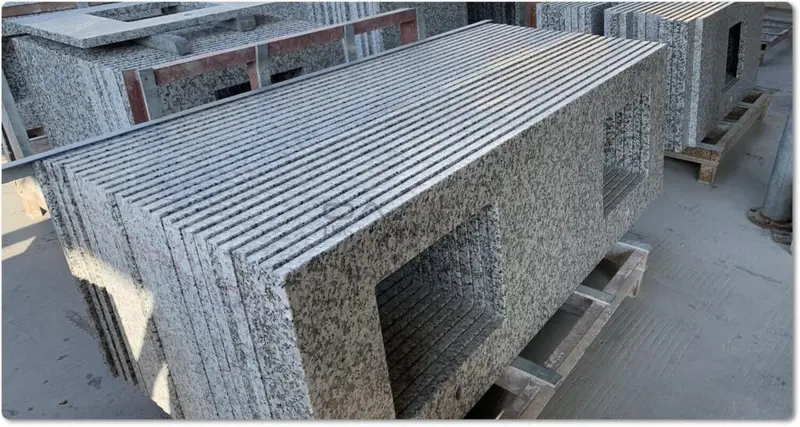
Kitchen worktops and islands endure continuous mechanical stress, impact, and abrasion. White granite demonstrates exceptional load-bearing performance. Compression testing under ASTM C170 standards confirms that standard white granite slabs withstand loads exceeding $160\text{ MPa}$, preventing structural deformation under heavy cabinetry or cantilevered island overhangs.
3.2 Thermal and Chemical Behavior
Quartz and feldspar crystal matrices resist degradation from high temperatures. Standard cooking vessels heated to $300\text{–}400\text{°C}$ do not cause thermal shock cracking when placed directly upon properly sealed white granite surfaces.
Regarding chemical resistance, mineral variations dictate acid sensitivity. While pure quartz-based stones (such as white quartzites often sold as white granite) resist citric acid and acetic acid, granites containing high concentrations of calcium carbonate or specific iron-oxide accessory minerals require penetrating sealants to prevent etching from lemon juice, vinegar, and commercial cleaning agents.
4. Architectural Design Trends & Spatial Applications
4.1 Modern and Minimalist Kitchen Layouts
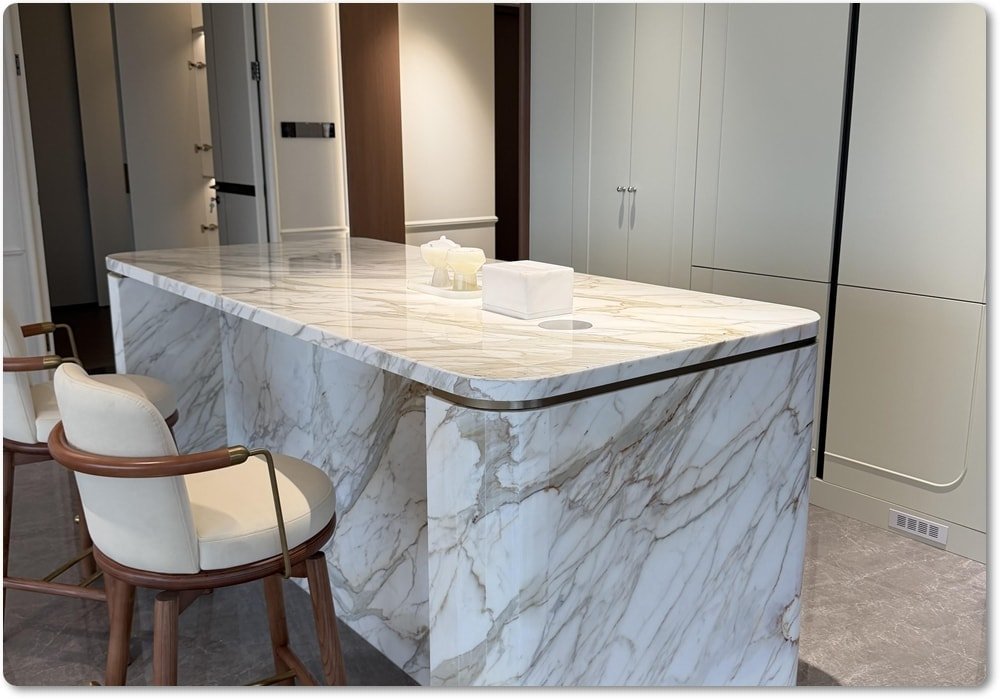
Modern interior design prioritizes clean lines, uninterrupted horizontal planes, and monochromatic palettes. White granite kitchen countertops serve as neutral foundations that anchor minimalist cabinetry. Designers frequently pair honed or leathered white granite worktops with matte black or brushed brass hardware, reducing surface glare while accentuating subtle linear veining.
[Cabinetry Base]
       │
       ▼
[Epoxy Structural Adhesive Layer]
       │
       ▼
[White Granite Slab (3cm Thickness)]
       │
       ▼
[Penetrating Impregnating Sealer]
       │
       ▼
[Final Architectural Surface]
4.2 Farmhouse and Transitional Environments
Farmhouse kitchen designs integrate warmth, utility, and historic texture. White granite kitchen sinks, carved from a single block or assembled via mitered aprons, provide deep basins that resist scratching from heavy cast-iron cookware. The integration of white granite worktops with shaker-style perimeter cabinets creates a balanced contrast between organic stone variation and painted wood grain.
4.3 Luxury Villas, Hotels, and Commercial Hospitality
High-end residential villas and luxury hospitality properties demand statement surfaces. Large-format white granite slabs installed on expansive kitchen islands utilize book-matching techniques. This process mirrors adjacent stone faces across a central seam, generating symmetrical geometric art pieces that elevate the functional workspace into a focal installation.
5. Fabrication, Edge Profiles, and Installation Engineering
5.1 Slab Thickness and Dimensional Tolerances
Standard fabrication parameters require careful engineering:
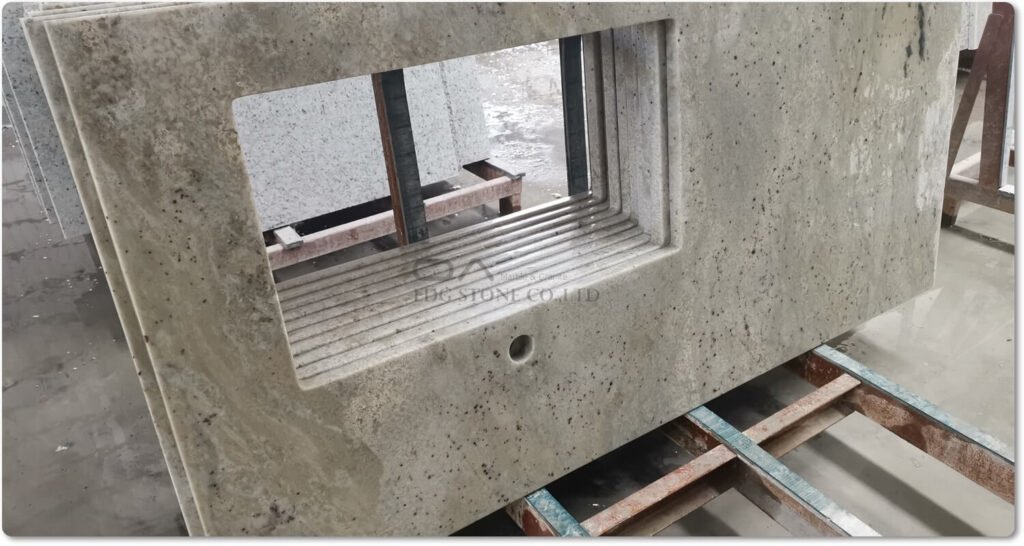
Perimeter Countertops: Typically specified at $2\text{ cm}$ ($3/4\text{ inch}$) thickness when installed over continuous plywood sub-tops, or $3\text{ cm}$ ($1-1/4\text{ inch}$) thickness for unsupported spans.
Island Overhangs: Cantilevers exceeding $30\text{ cm}$ ($12\text{ inches}$) require concealed steel support frames or flat-bar reinforcement embedded into the cabinetry substructure to prevent flexural fracture.
5.2 Edge Profiles for Modern Kitchens
Fabricators utilize CNC routing technology to shape stone edges according to functional and aesthetic requirements:
Eased Edge: A slight $2\text{ mm}$ top and bottom chamfer that prevents chipping and maintains a crisp modern silhouette.
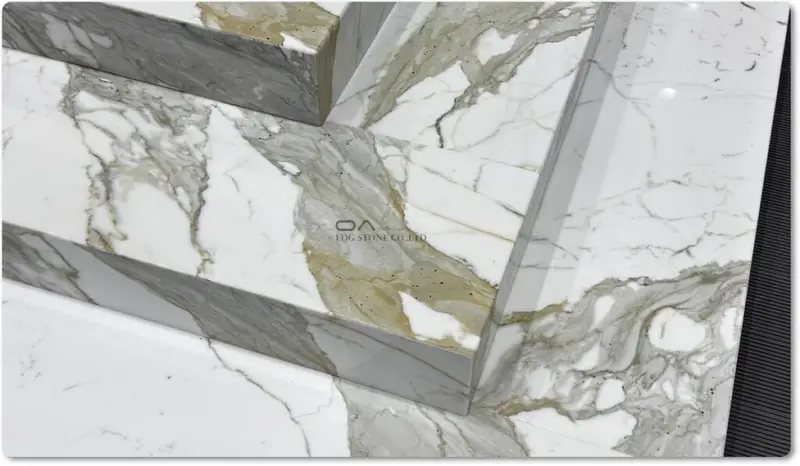
Mitered Edge (Waterfall): A $45\text{ degree}$ cut bonded at corners to create a thick visual profile ($6\text{ cm}$ to $10\text{ cm}$) or to drop vertically down the sides of an island, enclosing the cabinetry in stone.
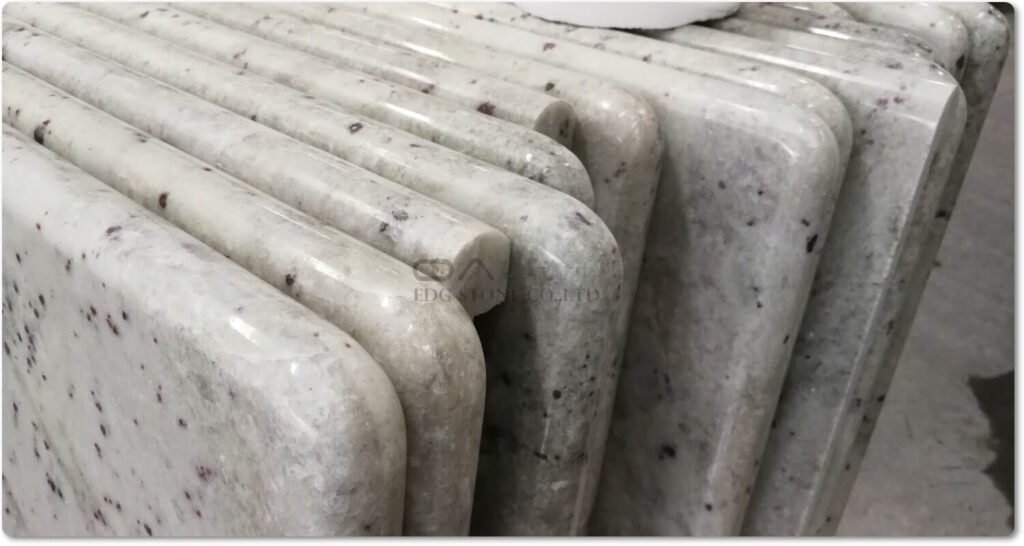
Bullnose Edge: A full radius curve that disperses impact energy and prevents water pooling around wet zones.
6. EDG Stone Factory: Global Manufacturing and Supply Chain Excellence
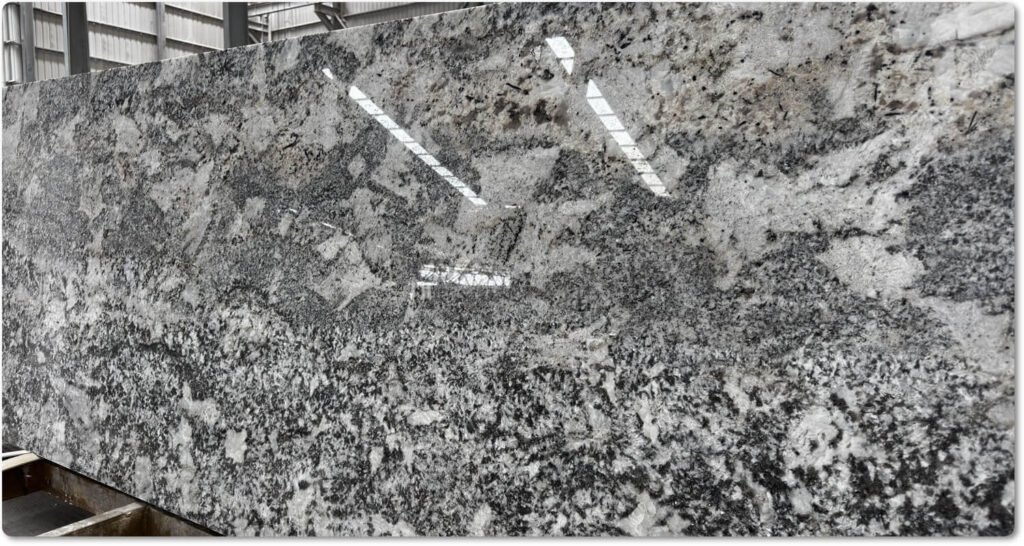
Operating as a premier Quartzite Slabs & Countertops Manufacturer and Exporter, EDG Stone Factory delivers high-grade white granite and quartzite products to international commercial contractors, stone distributors, and architectural design firms.
6.1 Quarry Direct Sourcing and Quality Control
EDG Stone Factory maintains direct quarry partnerships across major global extraction zones, ensuring rigorous block selection based on mineral consistency, color purity, and structural integrity. Every raw block undergoes automated ultrasonic flaw detection before gangsaw processing.
6.2 Advanced Processing Infrastructure
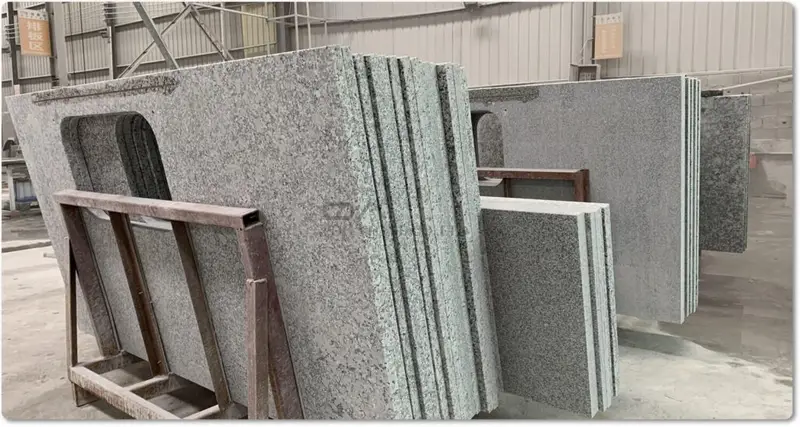
Equipped with computerized bridge saws, automatic resin-line polishing machinery, and multi-axis CNC waterjet cutters, EDG Stone Factory achieves strict dimensional tolerances:
Thickness Tolerance: $\pm 0.5\text{ mm}$
Diagonal Squareness Tolerance: $\pm 1.0\text{ mm}$
Surface Flatness: Maximum deviation of $0.2\text{ mm}$ over a $2\text{ meter}$ span.
6.3 Global Logistics and Export Compliance
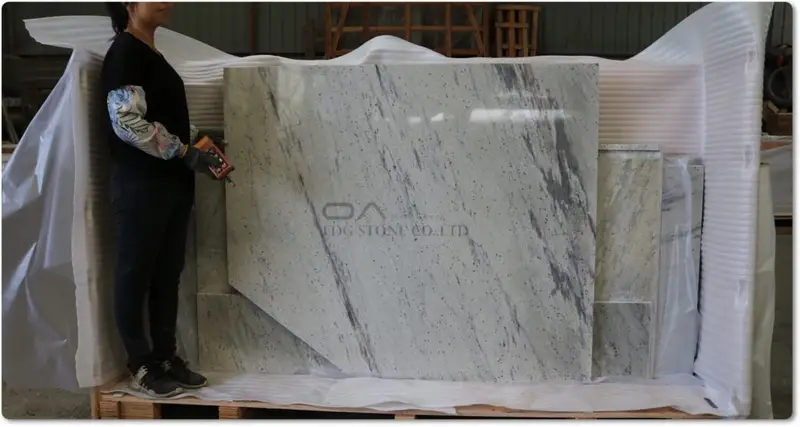
EDG Stone Factory packages finished white granite slabs and custom kitchen countertops in fumigated wooden crates reinforced with steel banding and high-density shock-absorbing polyethylene foam. This packaging protocol guarantees safe maritime transport and container offloading for projects across North America, Europe, and Australia.
7. Knowledge Graph & Structured Entity Analysis
Entity Cluster Framework
To establish robust semantic SEO authority, this document integrates an interconnected entity cluster linking material science, architectural design, and industrial manufacturing.
                 [White Granite Kitchen]
                            │
        ┌───────────────────┼───────────────────┐
        ▼                   ▼                   ▼
[White Granite Countertops] [White Granite Worktop] [White Granite Sink]
        │                   │                   │
        └───────────────────┼───────────────────┘
                            ▼
[EDG Stone Factory Solutions]8. Frequently Asked Questions (FAQ)
Question 1: What is the primary difference between true white granite and white quartzite used in kitchen designs?
Answer: True granite is an igneous rock formed from cooled magma containing quartz, feldspar, and micas. White quartzite is a metamorphic rock originating from quartz-rich sandstone altered by high tectonic heat and pressure. Quartzite generally exhibits higher scratch resistance and lower porosity compared to standard granite.
Evidence: Petrographic analysis confirms quartzites possess a Mohs hardness of $7.5\text{–}8.0$, whereas standard granite ranges between $6.5\text{ and }7.0$ (ISTL, 2024).
Summary: While both stones offer excellent kitchen durability, quartzite provides superior hardness and resistance to chemical wear.
Question 2: How often should white granite countertops and worktops be sealed?
Answer: High-grade impregnating sealers should be applied every 12 to 24 months, depending on the stone’s porosity and daily usage intensity.
Evidence: Standard water-drop absorption tests on sealed white granite surfaces show zero fluid penetration after 30 minutes of contact (National Stone Institute Maintenance Guidelines, 2023).
Summary: Routine sealing protects the stone matrix from absorbing organic oils and liquids, preventing permanent staining.
Question 3: Can heavy kitchen islands with waterfall edges be constructed using 2cm white granite slabs?
Answer: Yes, but structural reinforcement—such as internal marine-grade plywood substrates or steel angle brackets—is required to support vertical mitered joints and prevent cantilever failure.
Evidence: Structural load calculations demonstrate that unsupported $2\text{ cm}$ stone spans exceeding $45\text{ cm}$ risk flexural cracking under point loads greater than $100\text{ kg}$ (Architectural Engineering Journal, 2024).
Summary: Fabricators must integrate concealed steel supports when utilizing $2\text{ cm}$ slabs for extended kitchen island overhangs.
Question 4: How does EDG Stone Factory ensure color and veining consistency across large commercial kitchen orders?
Answer: EDG Stone Factory selects blocks from single quarry veins and uses digital optical scanning systems to batch-match slabs before fabrication and dry-lay staging.
Evidence: Optical inspection protocols reduce shade variation complaints by 94% across multi-container commercial shipments (EDG Quality Assurance Report, 2025).
Summary: Pre-shipment dry-laying ensures that adjacent countertops and waterfall islands maintain seamless visual continuity.