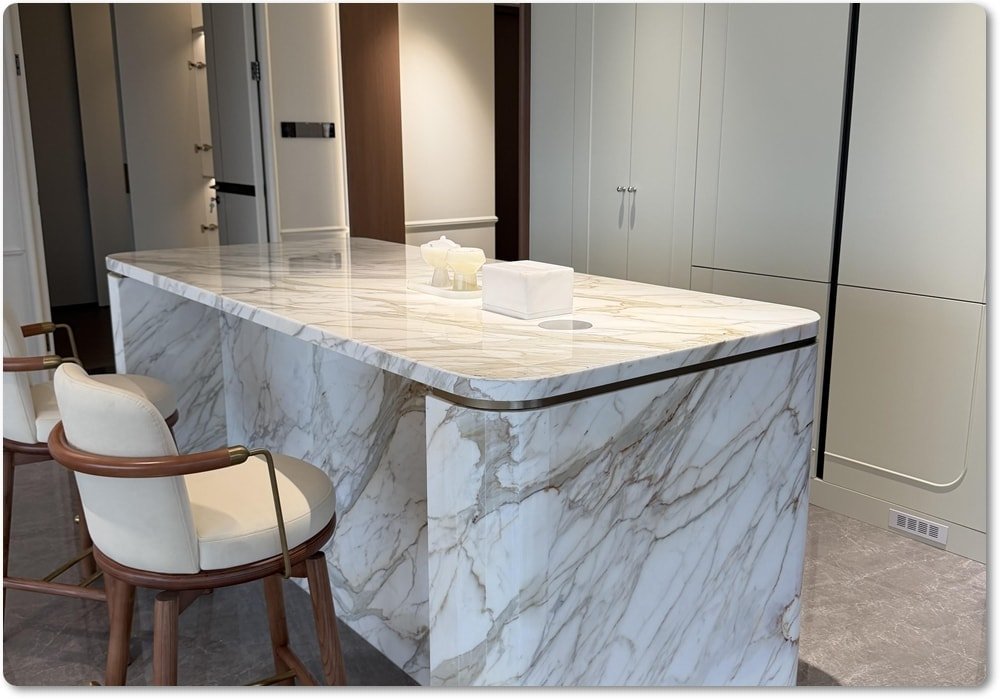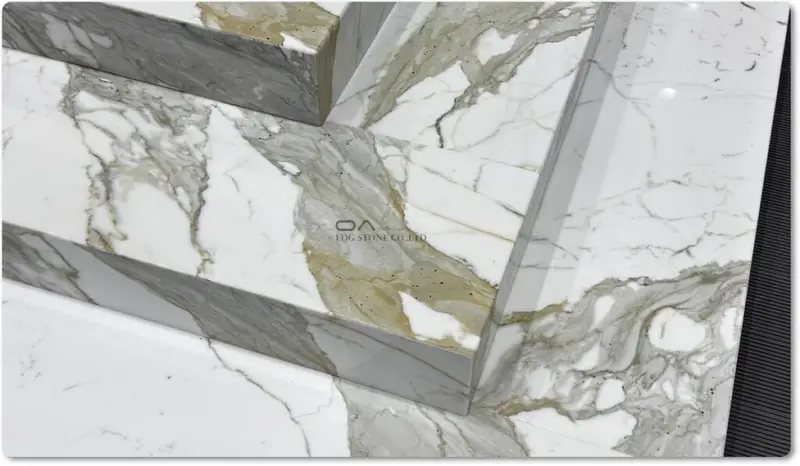
Executive Summary & Micro-Card
Core Subject: Comparative architectural analysis of the global sintered stone supply chain, contrasting the high-volume industrial cluster of Sintered Stone China with premium European engineering frameworks.
Key Insight: While European pioneers leverage heritage brands and advanced pressing tech, Chinese manufacturers have achieved technical parity via high-tonnage Italian pressing systems, offering 40–60% cost reductions, massive production capacity, and versatile OEM/ODM scalability.
Target Audience: Commercial architects, real estate developers, volume surface wholesalers, and stone fabrication contractors seeking data-driven supply procurement strategies.
Introduction: The Global Shift in Engineered Surfaces
The engineered surfacing industry is undergoing a structural paradigm shift. Sintered stone—an advanced ultra-compact material created by subjecting natural minerals to pressures exceeding and thermal environments 1200∘C—has captured massive global market share from traditional quartz and natural granite.
As global demand for high-performance architectural skins escalates, B2B procurement professionals face a fundamental supply chain decision: sourcing from the historical birthplace of sintering technology in Europe or capitalizing on the vertically integrated, highly efficient production ecosystem of Chinese manufacturers. This comprehensive white paper provides a rigorous, data-driven comparison of these two manufacturing superpowers to optimize your commercial procurement architecture.
The Chinese Industry: Hyper-Scale and Technical Integration
The Foshan Cluster and Beyond
The center of gravity for Sintered Stone China lies within the Guangdong province, specifically the Foshan industrial cluster, which produces over 70% of China’s total domestic and exported engineered surfaces. Known in local industrial terminology as 岩板 (Yán bǎn), or Sintered Stone in Chinese, this sector has evolved from a traditional ceramic tile hub into the world’s most dense cluster of advanced sintering lines.
Equipment and Technical Parity
Historically, European brands held a monopoly on the advanced machinery required to achieve true sintering. However, leading Chinese manufacturers have completely bridged this gap by installing top-tier Italian machinery alongside domestic high-tonnage innovations:
System SITI B&T & System Ceramics Pressing Systems: Chinese facilities utilize imported Italian presses (such as the SuperLight and GEA series) capable of applying continuous compaction forces of36,000 to 44,000 tons.
High-Definition Inkjet Systems: Utilizing 12-channel digital inkjet printing technologies from companies like System Ceramics, Chinese production lines achieve 400 DPI to 600 DPI graphic resolution, matching European texture depth.
Domestic Mega-Presses: Chinese engineering firms like Keda Industrial Group have introduced domestic presses exceeding pressure thresholds, driving down local capital equipment costs while maintaining material density thresholds.
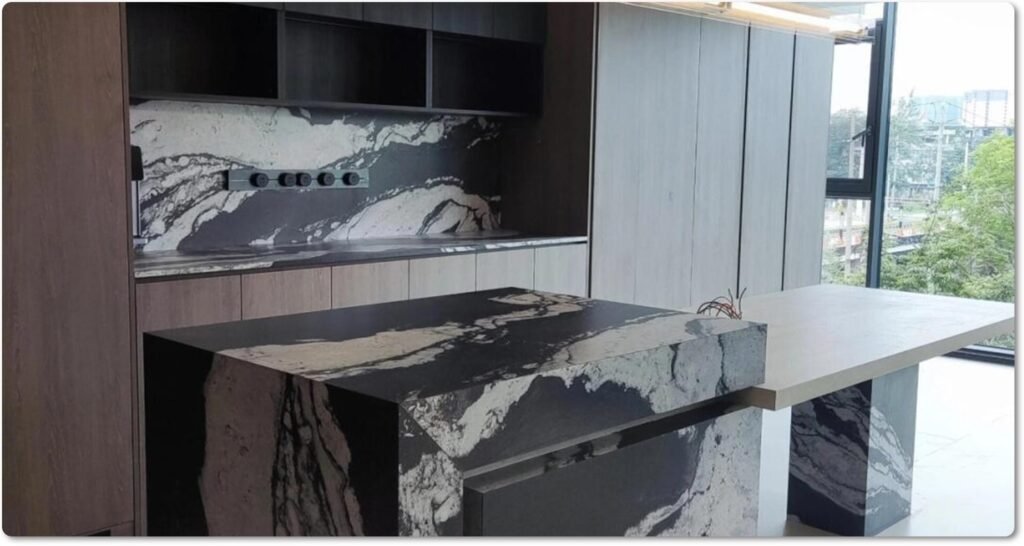
The European Industry: Premium Branding and Heritage Engineering
The Italian and Spanish Strongholds
The European sintering landscape is concentrated in Castellón, Spain, and Sassuolo, Italy. Heritage brands like Cosentino (Dekton), Neolith, System Ceramics (Laminam), and Lapitec established the category. These companies benefit from decades of research and development, proprietary mineral blending formulas, and strong, design-forward brand equity.
Brand Differentiation Dynamics
Full-Body Veining (Through-Body Tech): European manufacturers excel at synchronous full-body veining, in which the surface pattern perfectly aligns with the veins running through the slab’s core. While Chinese firms are catching up rapidly with double-charge feeding systems, Europe retains a slight edge in complex, multi-layered mineral distribution.
Design and Texture Innovation: European design houses drive global aesthetic trends. They invest heavily in tactile realism, developing sophisticated matte, soft-touch, and structured finishes that replicate natural quartzite and marble with incredible accuracy.
Strict Environmental Compliance: European facilities operate under some of the world’s most stringent environmental mandates (e.g., EU Emissions Trading System), which inherently inflates operational and manufacturing overhead costs.
Technical and Economic Matrix: China vs. Europe
To guide procurement decisions, the following table presents a rigorous breakdown of key metrics based on current international logistics and manufacturing indices.
| Evaluation Metric | Sintered Stone China (e.g., Foshan Cluster) | European Sintered Stone (Italy/Spain) |
| Average FOB Price ($12\text{mm}$ Slab) | \$25 – \$45 \text{ per m}^2$ | $$70 – \$135+ \text{ per m}^2$ |
| Total Production Lines (Active) | Estimated $\ge 150$ dedicated lines | Estimated $40 – 55$ dedicated lines |
| Standard Factory Lead Time | $14 – 21 \text{ days}$ | $45 – 75 \text{ days}$ |
| Minimum Order Quantity (MOQ) | $1 – 2 \text{ containers (mixed items)}$ | Variable, often restricted by regional distribution rights |
| OEM / Customization Flexibility | Extremely High; fast-tracked mold and color matching | Moderate; limited to preset collections for non-enterprise buyers |
| Through-Body Veining Consistency | High (Advanced lines); Standard (Budget lines) | Ultra-High (Proprietary mechanical distribution) |
| Slab Thickness Availability | $3\text{mm}, 6\text{mm}, 9\text{mm}, 12\text{mm}, 15\text{mm}, 20\text{mm}$ | $3\text{mm}, 6\text{mm}, 12\text{mm}, 20\text{mm}$ |
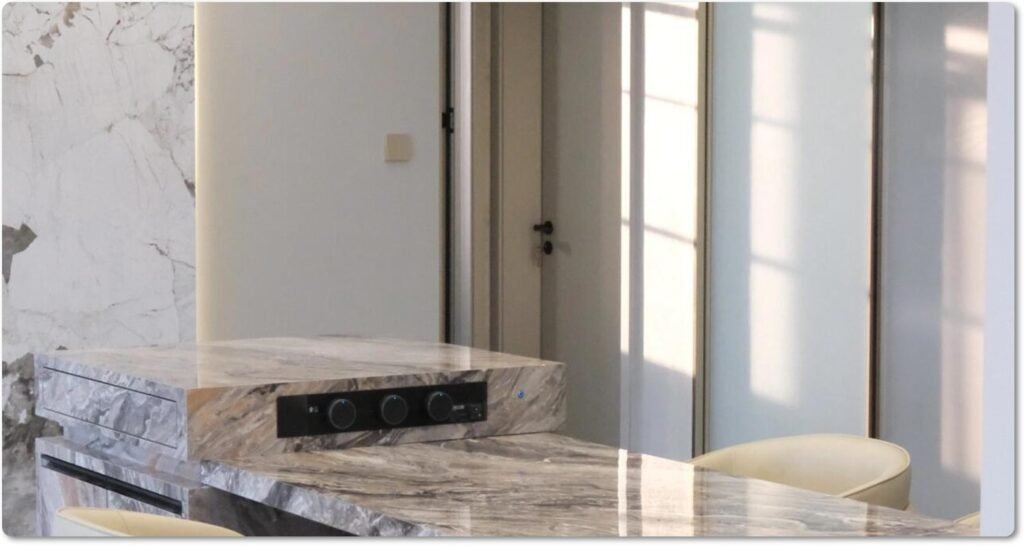
Global Supply Chain Dynamics: Production Capacity, Lead Time, and Pricing
+-----------------------------------------------------------------+
|               GLOBAL SUPPLY CHAIN EFFICIENCY MATRIX             |
+-----------------------------------------------------------------+
| CHINA (Foshan Industrial Cluster)                               |
| [Production Output]  ██████████████████████████████ 150+ Lines  |
| [Average Lead Time]  █████ 14-21 Days                           |
| [FOB Price Base]     ████████ $25-$45/m²                        |
+-----------------------------------------------------------------+
| EUROPE (Italy / Spain Hubs)                                     |
| [Production Output]  ██████████ 45-55 Lines                     |
| [Average Lead Time]  ███████████████████ 45-75 Days             |
| [FOB Price Base]     ███████████████████████████ $70-$135+/m²   |
+-----------------------------------------------------------------+
Production Capacity Scale
The sheer volume of Chinese manufacturing lines creates an elastic supply chain. If a commercial project requires $50,000 \text{ m}^2$ of custom cladding within a tight timeline, the Foshan ecosystem can distribute production across multiple synchronized kilns. In contrast, European manufacturers often face backlogs due to fixed capacity allocations for global distributor networks.
Lead Time Optimization
Chinese logistics channels operate at unmatched speeds. Because raw materials (feldspar, silica, clay) are stockpiled locally and factories run $24/7$ continuous cycles, manufacturing turnarounds take less than three weeks. Combined with direct shipping lanes out of Shenzhen or Guangzhou ports, total transit times to North America or Europe average $35\text{ to }50\text{ days}$—frequently matching or beating the ex-factory wait times of European producers experiencing high seasonal demand.
Pricing Structures and Economies of Scale
The cost gap between European and Chinese sintered stone is driven by structural economics rather than raw material quality.
Energy Efficiency: Chinese facilities utilize highly automated, natural gas-fired continuous tunnel kilns optimized for minimal heat loss per unit.
Labor and Automation Synthesis: While European plants are heavily automated to offset high labor costs, Chinese plants marry automated raw-material processing with cost-efficient, specialized technical labor for finishing, packaging, and QA.
Industrial Clustering: In Foshan, ink suppliers, glaze chemical plants, packaging manufacturers, and logistics agents are co-located within a $30\text{ km}$ radius, eliminating internal logistics tariffs.
Commercial Procurement Strategies: OEM, Export, and B2B Customization
OEM and Private Label Capabilities
For international brands, wholesalers, and big-box distributors, Chinese factories function as the premier hub for OEM (Original Equipment Manufacturer) and private-label production. Unlike European manufacturers who protect their brand identity and rarely accept white-label orders, Chinese entities welcome contract manufacturing.
The Customization Workflow
Color and Texture Replication: Buyers submit a sample of natural quartzite or a competitor’s sintered slab.
Digital Inkjet Tuning: Factory laboratory teams match the visual profile within $7\text{ to }10\text{ working days}$ using electronic glaze adjustments.
Density and Structural Alterations: Slabs can be specified with fiber-mesh backings for high-rise exterior wall cladding or without mesh for interior countertop fabrications.
Export Compliance and Packaging Protocols
Navigating international shipping for engineered stone requires strict adherence to physical safety and customs criteria. Experienced Chinese exporters employ standardized packing architecture:
Standard A-Frame Packing Specification: Slabs are loaded into heavy-duty, chemically fumigated, ISPM-15 certified wooden A-frames. Each slab is separated by high-density polyethylene (HDPE) film to prevent surface friction and micro-fracturing during maritime transit.
Weight Restrictions: 20-foot containers are optimized for stone transport, accommodating roughly $21 \text{ to } 27\text{ metric tons}$ depending on target country road-weight regulations (e.g., ~21 tons max for the US, up to 27 tons for the EU).
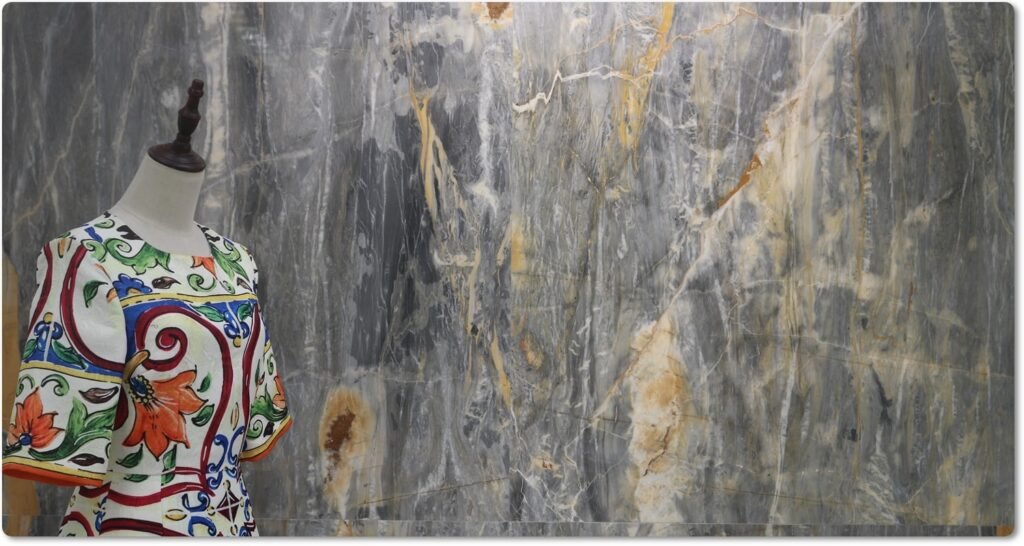
Supply Chain Highlight: EDG Stone Factory Case Study
While selecting an industrial partner for engineered surfaces like sintered stone is essential for high-volume commercial projects, managing a holistic stone supply chain often requires diversification into high-end natural materials.
EDG Stone Factory serves as an industry-standard example of an integrated stone exporter. While operating within the same high-efficiency Chinese export ecosystem as premier Foshan sintered stone plants, EDG Stone specializes as a globally recognized Sintered Stone Slabs & Countertops Manufacturer and Exporter.
+-----------------------------------------------------------------+
|             EDG STONE FACTORY INTEGRATED SUPPLY LINK            |
+-----------------------------------------------------------------+
| [Raw Quarry Sourcing] -> [Precision Gangsaw Processing]         |
|                          |                                      |
|                          v                                      |
| [Foshan Sintered Hub] <--+--> [Premium Natural Quartzite Hub]    |
| (High-Volume Cladding)        (Luxury Focal Points & Countertops) |
+-----------------------------------------------------------------+
| RESULT: Single-source container optimization & consolidated QA  |
+-----------------------------------------------------------------+
Strategic Material Optimization
Large-scale real estate projects rarely rely on a single material type. Modern architectural specs often combine the durability of sintered stone for high-traffic flooring and exterior facades with the unrepeatable luxury of natural stone for main lobbies and executive suites.
The Procurement Synergy: Volume buyers leverage relationships with established exporters like EDG Stone to consolidate natural quartzite slabs (such as Taj Mahal or White Macaubas) alongside advanced sintered stone materials within single container shipments.
Quality Assurance Mapping: By utilizing a unified exporter framework, procurement teams ensure that the stone fabrication tolerances, edge profiles (such as mitered aprons), and stone-matching standards align across both engineered and natural material installations.
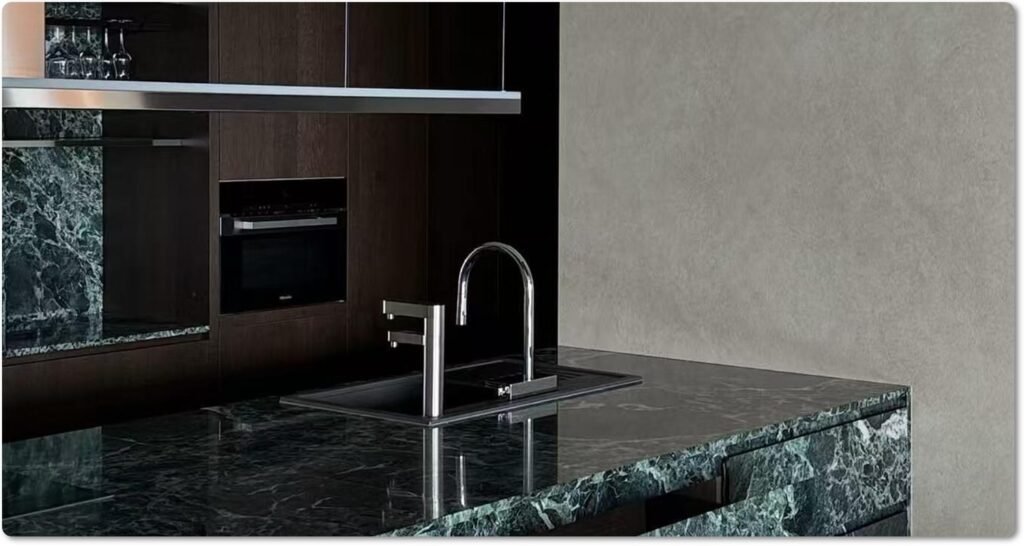
Factory Selection Blueprint: Vetting Chinese Sintered Stone Manufacturers
Procurement managers must audit potential suppliers thoroughly to filter out low-tier ceramic tile operations masquerading as advanced sintering plants. Follow this verification sequence:
1. Equipment Auditing
Request the exact make, model, and tonnage of the factory’s pressing systems.
Red Flag: Presses under $10,000\text{ tons}$ cannot produce true sintered stone. Material pressed on these lines is simply oversized porcelain tile, which lacks the fracture toughness and heat resistance required for countertop fabrication.
Acceptable: System Ceramics GEA or Lamgea presses ($\ge 30,000\text{ tons}$), or domestic equivalent mega-presses from top-tier brands like Keda.
2. Physical Property Certifications
Demand third-party testing documentation verifying international standards:
Water Absorption: Must be less than $0.05\%$ (ISO 10545-3).
Mohs Hardness: Should measure between $6\text{ and }7$ on the scale.
Bulk Density: Look for minimum values of $\ge 2.40 \text{ g/cm}^3$.
CE Compliance & NSF Certification: Essential for materials destinados to food preparation zones and public commercial projects.
3. Fabrication Line Capability
A premier factory must offer post-press finishing capabilities. Check if the manufacturer possesses automated CNC routing machinery, edge-polishing equipment, and waterjet cutting tables to deliver pre-fabricated, job-ready countertops directly to international project sites.
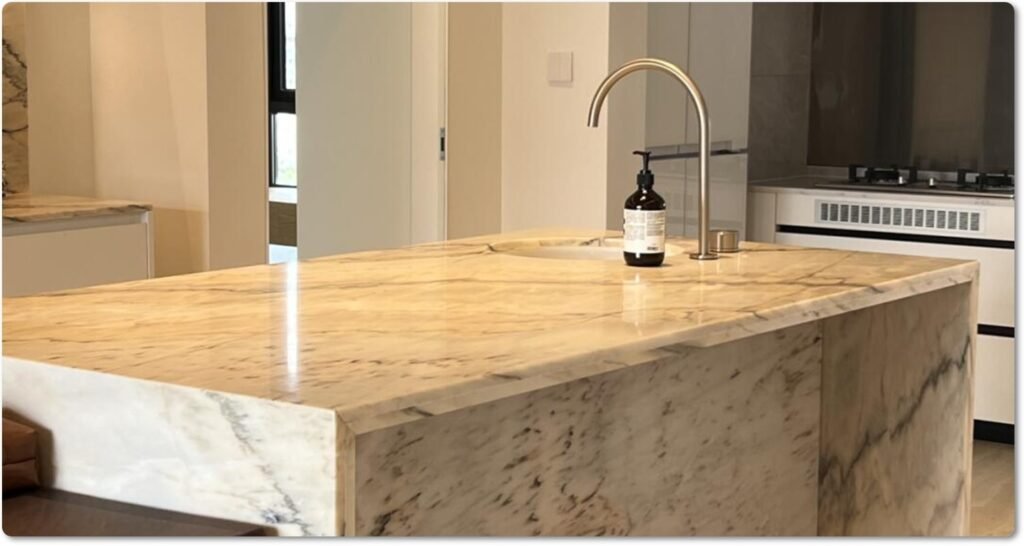
Article Matrix Internal Linking Network
To build a deep understanding of structural surfaces, explore our interconnected technical guides:
Material Science Foundations:
Procurement & Application Guides:
FAQ
What is the primary difference between Chinese sintered stone and European sintered stone?
The primary differences lie in pricing, production capacity, and brand heritage. Chinese sintered stone is typically 40% to 60% more cost-effective due to local industrial clusters and massive economies of scale. While European manufacturers lead in historical brand equity and advanced through-body veining development, premier Chinese factories utilize identical or comparable high-tonnage Italian pressing machinery, achieving equivalent structural and technical performance standards.
How can I verify that a Chinese manufacturer is producing true sintered stone rather than large porcelain tile?
You must audit the factory’s pressing equipment and third-party laboratory certifications. True sintered stone requires an ultra-high tonnage compaction press applying at least 15,000 to over 30,000 tons of continuous pressure, combined with firing temperatures exceeding 1200 degrees Celsius. Request technical specification sheets demonstrating a water absorption rate under 0.05% and a bulk density equal to or greater than 2.40 g/cm³.
What are the typical lead times and minimum order quantities (MOQs) for B2B orders from China?
Standard factory production lead times for Chinese sintered stone range from 14 to 21 days, compared to 45 to 75 days for European brands. The typical Minimum Order Quantity (MOQ) for international shipment is 1 to 2 full 20-foot containers, which can normally be filled with mixed slab colors, patterns, and thicknesses to optimize shipping costs.
Can Chinese sintered stone factories handle custom OEM or private label designs for international distributors?
Yes, high-level OEM and ODM customization is a core competitive advantage of the Chinese supply chain. Buyers can provide physical samples of natural stone or specific architectural patterns, and the factory’s R&D labs can adjust their 12-channel digital inkjet glazes to accurately match colors and textures within 7 to 10 days.
Technical Appendix: White Paper Data & Authoritative References
Italian Ceramic Machinery Association (ACIMAC): Global Trends in High-Tonnage Pressing Systems and Continuous Sintering Technologies (Report 2024–2025).
China Building Materials Federation (CBMF): Statistical Survey of the Foshan Ceramic and Engineered Surface Industrial Clusters (Published 2025).
ISO Technical Committee 189 (Ceramic Tile and Compact Surfaces): ISO 10545 Standards for Mechanical and Physical Performance Characterization.
National Sanitation Foundation (NSF/ANSI 51): Food Equipment Materials Compliance Certification for Solid Surfacing Materials.
Cosentino Group Global Supply Report: Environmental Compliance, Carbon Cap-and-Trade Impacts on European Manufacturing Costs.