Introduction
Taj Mahal Quartzite has become one of the most requested light-toned natural stone choices for premium countertops because it sits at the intersection of three buyer priorities: visual softness, project versatility, and material prestige. In the countertop market, quartzite is valued because it is a metamorphic stone formed when quartz-rich sandstone is altered by heat and pressure, and commercial quartz-based dimension stone is defined through specification and testing frameworks rather than by marketing language alone. That matters because the slab name on a sample board is never enough for a serious project; real purchasing decisions should be based on slab-level inspection, physical property testing, and fabrication suitability.
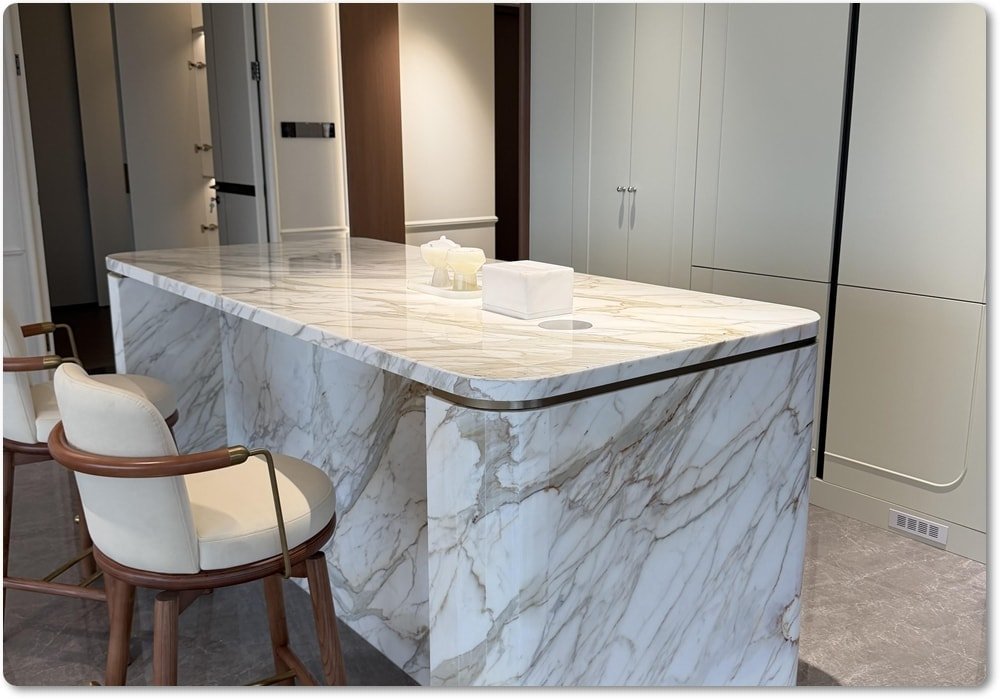
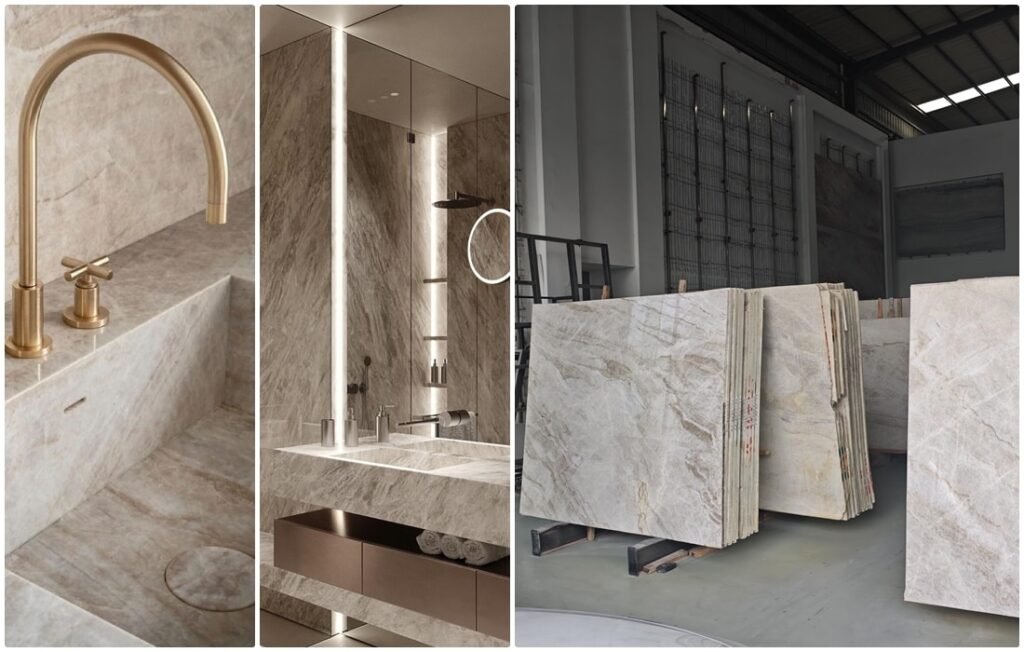
For luxury kitchen islands, bathrooms, and hospitality projects, Taj Mahal quartzite is often selected for its warm ivory-to-beige appearance with soft gold or taupe movement. Commercial descriptions from slab suppliers are consistent on that visual profile, but the exact appearance still varies from quarry lot to quarry lot and even from slab to slab. That variation is not a defect; it is the core reason why slab approval, vein matching, and layout planning are essential before fabrication begins.
This whitepaper is designed to support a full buyer journey: from understanding what quartzite is, to evaluating slab quality, to selecting formats for kitchen islands and bathrooms, to coordinating fabrication and export packaging. It also includes a practical EDG Stone Factory case module, FAQ schema, a source list, and an internal link matrix that can support a 15-article content cluster.
1) What is Taj Mahal Quartzite, from a Procurement Perspective?
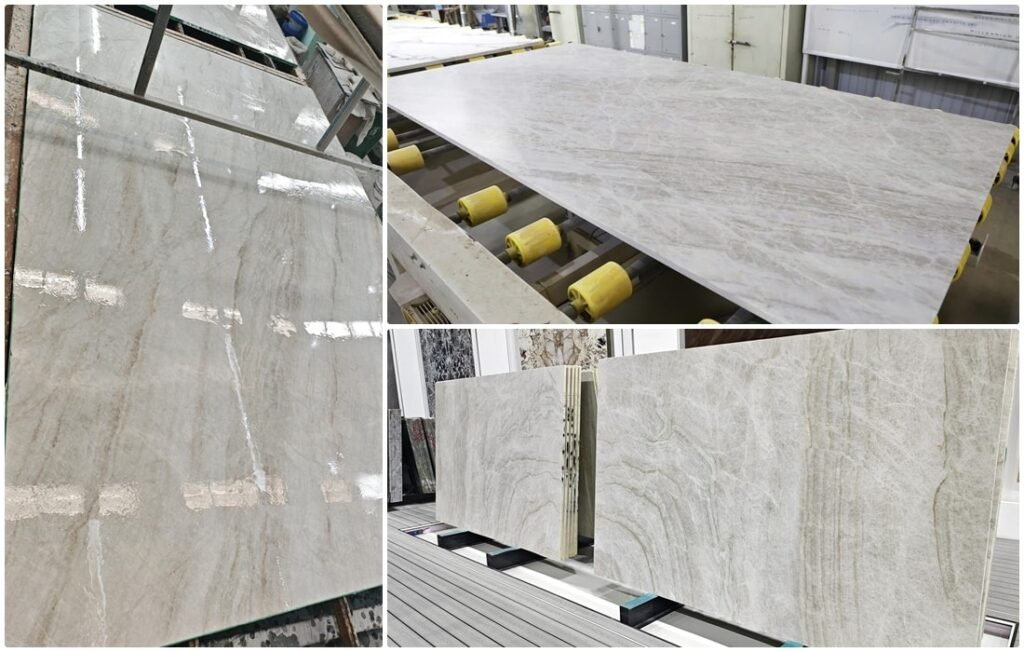
Quartzite is a metamorphic rock formed when quartz-rich sandstone is subjected to heat and pressure. Geological references consistently describe this transformation, and the result is a dense stone with interlocking quartz crystals. In practical countertop procurement, that means buyers are not selecting a manufactured surface; they are selecting a natural stone material with inherent variation, structural strength patterns, and quarry-specific characteristics that must be validated for the intended use.
The Natural Stone Institute’s quartz-based stone guidance explicitly places quartzite within the broader family of quartz-based stones and ties specification to recognized testing and design references. ASTM C616 is the relevant specification for quartz-based dimension stone, and the broader test set commonly used for natural stone includes absorption and bulk specific gravity, modulus of rupture, compressive strength, and flexural strength testing. For a serious buyer, that means the correct question is not “Is it beautiful?” but “Does this specific slab lot meet the project’s performance and fabrication requirements?”
That technical mindset matters even more with quartzite trade names, because the market often treats “quartzite” as a design label rather than a specification category. The Natural Stone Institute even maintains educational material aimed at reducing confusion around quartzite as a stone type. For procurement teams, the safest workflow is to verify the actual stone variety, review quarry origin and finish, and request slab photos, test data, and production tolerances before committing to container orders.
2) Why Taj Mahal Quartzite Dominates Luxury Design?
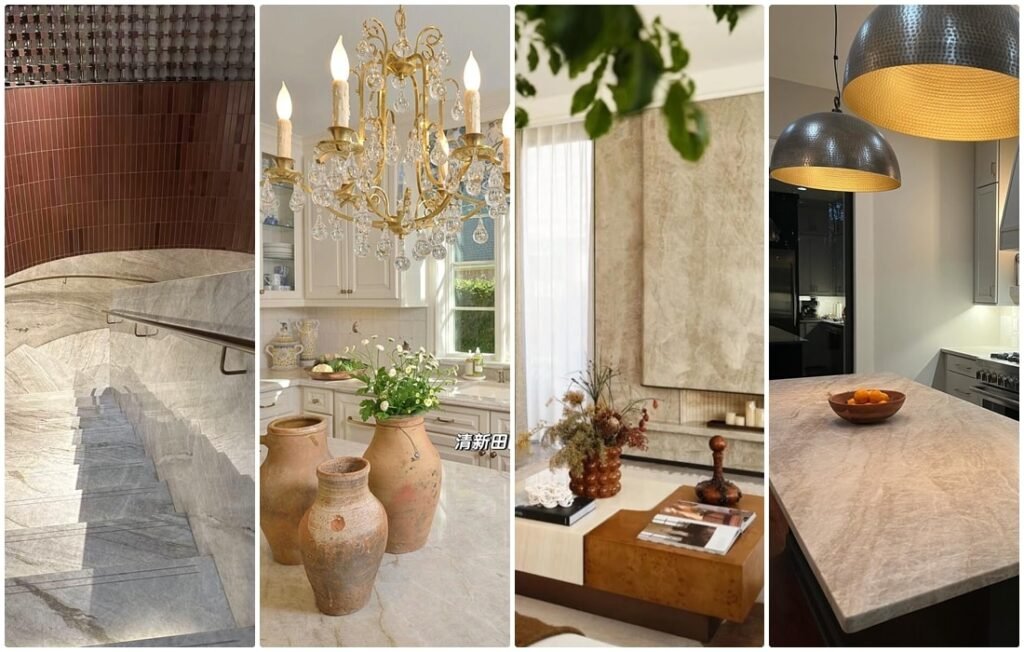
The reason Taj Mahal quartzite remains highly visible in luxury design is not just color; it is the combination of a restrained base tone with enough natural movement to avoid looking flat. Commercial slab descriptions commonly place it in the warm white, ivory, beige, and soft gold family, with subtle veining that reads more elegant than dramatic. That makes it useful in kitchens that need a calm visual field, in bathrooms that should feel spa-like, and in hospitality projects that need a premium look without overwhelming the rest of the material palette.
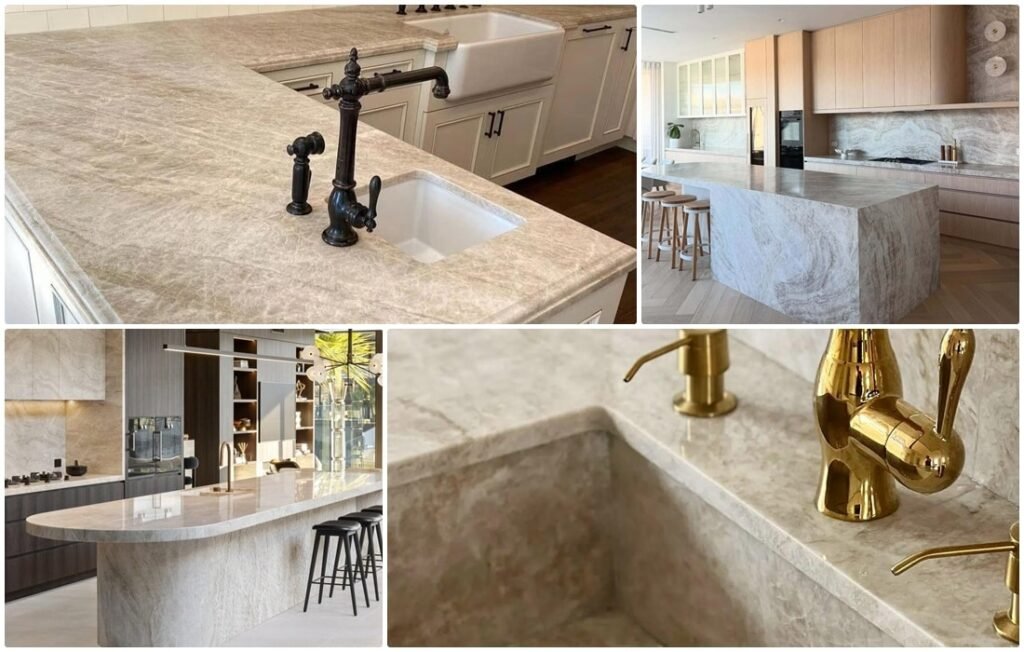
The design flexibility comes from its neutrality. Taj Mahal quartzite tends to work with warm wood, brushed brass, matte black hardware, white oak cabinetry, and soft neutral paint systems. In commercial interiors, that flexibility reduces design risk because the stone can adapt to transitional, modern, classic, and quiet-luxury schemes without forcing a hard stylistic commitment. That is one reason it is so frequently used as a “safe premium” material in projects where the client wants luxury but not visual noise.
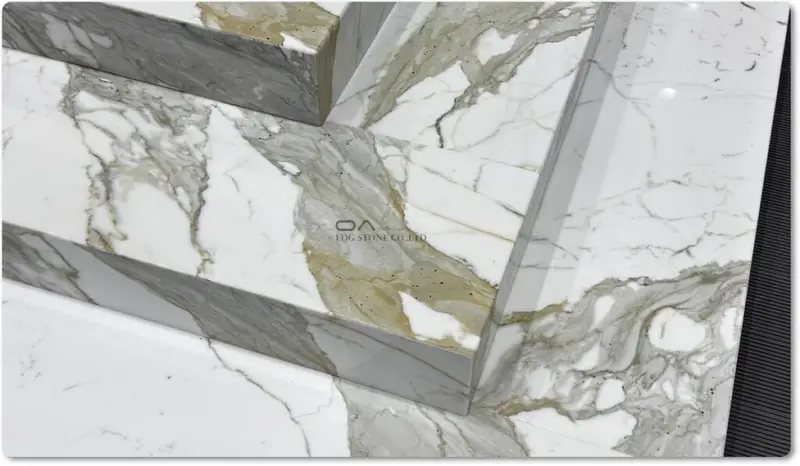
Bookmatching and vein matching extend that design value. Bookmatching mirrors slab patterns across a seam to create a symmetrical statement, while vein matching aligns movement so that it flows from one piece to the next. The Natural Stone Institute notes that bookmatching expectations should be clearly defined and that perfect mirror-image symmetry is not always realistic in natural stone. That is an important procurement point, because the more dramatic the pattern strategy, the more slab yield, layout control, and fabrication discipline matter.
3) Visual Characteristics That Buyers Should Specify
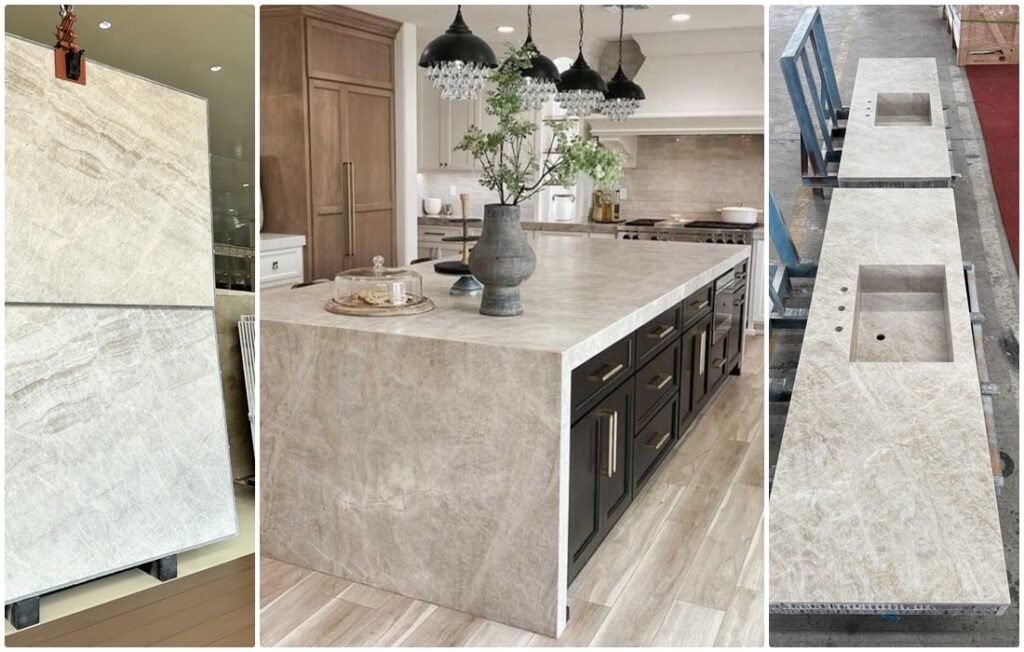
A dependable Taj Mahal quartzite specification starts with three visual variables: background tone, vein intensity, and finish behavior. A commercial buyer should not accept “Taj Mahal” as a complete description, because the actual slab may lean whiter, creamier, more beige, more gold, or more taupe, depending on block and finish. In practice, this means the visual approval process should happen against real slabs, not only against catalog photos.
The second variable is movement. Some slabs have soft, linear movement suitable for minimal interiors, while others have more fluid veining that better supports bookmatched islands or statement bathroom walls. Because these patterns are natural, the procurement team should approve not just a “material name” but a slab range, showing acceptable variation and any no-go patterns such as heavy fractures, unstable zones, or overly cloudy sections. Natural stone design guidance emphasizes slab-level and project-level evaluation rather than assuming one sample tile represents every piece in the shipment.
The third variable is finish. Polished, honed, and leathered finishes will change both reflectivity and perceived color depth. For premium work, finish choice should be tied to use case: polished for maximum light and crisp luxury presentation, honed for softer contemporary surfaces, and leathered where tactile texture and lower glare are important. Since the final appearance of any natural stone finish depends on the specific slab and processing, buyers should request finish samples or finished slab photos before approval.
4) A Practical Buyer Grading System: Commercial, Premium, and Select
The following grading framework is a procurement tool, not an ASTM standard. It helps buyers and fabricators align expectations before fabrication starts.
Commercial Grade should be used for large projects that prioritize efficiency, stable tone, and acceptable natural variation. These slabs may contain more visible movement, moderate tonal shift, or less symmetrical pattern continuity, but they still need to pass the project’s physical and fabrication requirements. Commercial grade works well where consistency across large quantities matters more than elite pattern purity. This is the right tier for many hospitality back-of-house zones, secondary vanities, and value-sensitive multi-unit projects.
Premium Grade is the center of the market for Taj Mahal quartzite. Here, the slab should show balanced veining, attractive background clarity, and better pairing potential across a set. This is the tier most buyers want for kitchen islands, primary bathrooms, reception counters, and visible hospitality front-of-house installations. Premium grade should still be selected from actual slabs, but the visual spread should be narrow enough for coordinated layout control.
Select Grade is for projects that need the highest visual precision. These slabs should have the cleanest background, the most desirable movement, the best bookmatch potential, and the strongest visual consistency across the set. Select grade is appropriate for signature islands, luxury showrooms, high-end hotel foyers, and feature walls where the stone is expected to function as the focal point. Because yield is usually lower in Select work, buyers should expect tighter slab filtering and more detailed layout approval. This mirrors the way bookmatching and vein matching constrain usable yield in natural stone fabrication.
5) The Slab Selection Process: Color Matching, Vein Matching, and Bookmatching
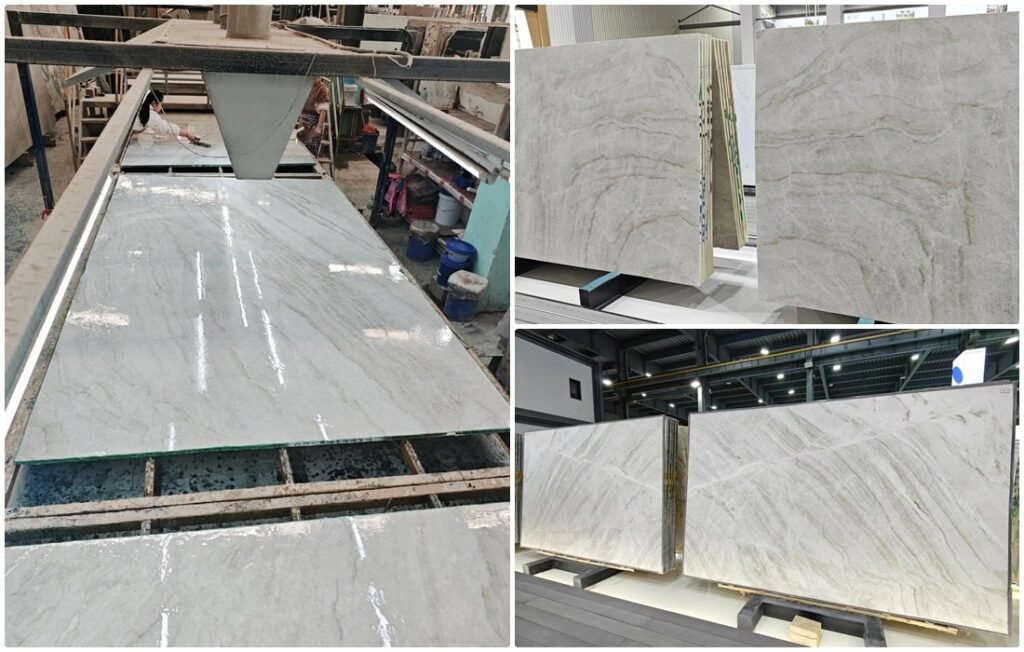
Color matching should always come first. The buyer needs to define whether the project requires warm ivory, soft beige, pale gold, or a cooler neutral. Then the slab lot should be reviewed in natural light and under shop lighting so the team can understand how the color shifts with the environment. Because Taj Mahal quartzite is a natural material, the goal is not perfect sameness; the goal is controlled compatibility across all visible pieces.
Vein matching comes next. This is especially important for islands, waterfall edges, and full-height backsplash assemblies. The Natural Stone Institute’s guidance around bookmatching and vein matching makes a key point: the visual result depends on how slabs are cut, sequenced, and installed, and perfect symmetry should not be assumed unless it is explicitly engineered into the project scope. For procurement, that means the fabricator needs slab numbering, dry layout approval, and a clear seam map before cutting begins.
Bookmatching is the highest-impact visual strategy, but it is also the most demanding. It works by opening sequentially cut slabs like a book, so the pattern mirrors across the center line. The result can be dramatic, especially on feature islands and statement walls, but the yield penalty is real because the pieces must be sequenced and positioned more strictly. Buyers should treat bookmatching as a premium design decision with measurable fabrication cost consequences, not as a decorative afterthought.
6) Countertop Applications: Where Taj Mahal Quartzite Performs Best?
Kitchen Islands
Kitchen islands are one of the strongest applications for Taj Mahal quartzite because the stone’s soft movement reads beautifully across large horizontal surfaces. In this setting, the island often becomes the visual anchor of the room, so the stone should be selected for continuity, seam logic, and edge detailing as much as for color. The Natural Stone Institute’s countertop guidance also highlights overhang and cantilever considerations, and its published technical Q&A notes a common reference point of 6 inches for 2 cm tops and 10 inches for 3 cm tops, while emphasizing that real support decisions depend on stone strength and project conditions.
Bathrooms
In bathrooms, Taj Mahal quartzite works well on vanities, shower walls, tub surrounds, and splash areas because the soft neutral palette supports a spa-like atmosphere. However, bathroom use does not eliminate maintenance requirements. The Natural Stone Institute notes that sealing improves stain resistance but does not make stone stain-proof, and recommends consulting the sealer manufacturer or supplier for frequency of use. For buyers, this means the project documents should include care language, approved cleaners, and maintenance expectations so the end user understands the surface correctly.
Hospitality Projects
Hospitality work rewards stone with a strong visual identity and repeatable fabrication behavior. Taj Mahal quartzite can work in reception desks, feature walls, bar tops, bathroom suites, and suite-level kitchenettes, but the stone should be selected with durability, maintenance, and slab availability in mind. Natural stone industry education emphasizes that kitchen and bath applications require the correct expectation setting around fabrication, installation, care, and maintenance. For hospitality buyers, that translates to a need for consistency across multiple containers and a clear replacement strategy for future phases.
7) Performance and Testing Standards Buyers Should Request
A rigorous Taj Mahal quartzite purchase should ask for the right test categories, not just a pretty sample. The Natural Stone Institute and ASTM references support the use of absorption and bulk specific gravity testing, compressive strength testing, modulus of rupture testing, and flexural strength testing for dimension stone. ASTM C616 is the quartz-based stone specification, while ASTM C97, C170, C99, and C880 cover the common physical-property checks used to compare stone varieties and support specification decisions.
Buyers should also understand what the tests do and do not prove. These standards help compare stones and define suitability for a given use, but they do not replace slab inspection. A slab can pass a test framework and still be a poor fit for a bookmatched island if its visual movement, fissuring, or lot variation does not align with the design intent. That is why a mature procurement process always pairs test data with photograph approval, slab marking, and final layout review.
The Natural Stone Institute’s design resources also remind buyers that quartz-based stone categories include quartzite, quartzitic sandstone, metaquartzite, and related quartz-rich stones. This is one more reason the commercial name on a label is not enough. The correct workflow is to specify the project requirement, request the technical data, and approve the exact slab lot that will be fabricated.
8) EDG Stone Factory Processing Program: A Buyer-Facing Case Module
EDG Stone Factory should be positioned in the content cluster as a global Quartzite Slabs & Countertops Manufacturer and Exporter that helps translate visual selection into export-ready production. The business case is simple: premium quartzite projects fail when slab selection, fabrication, and packaging are handled as separate decisions. A manufacturer-exporter model closes that gap by aligning quarry intake, slab grading, shop drawings, QC, and container packing under one workflow.
A buyer-facing EDG Stone Factory module can be structured like this: raw block and slab intake, slab-by-slab quality sorting, photo cataloging, color and vein grouping, full-size dry layout approval, precision cutting, edge and profile fabrication, optional bookmatching or vein matching, final inspection, and export packing with corner protection, reinforcement, labeling, and moisture-safe loading. This is the practical sequence that turns a premium natural stone selection into a repeatable shipment rather than a one-off art piece.
The factory story should also emphasize safety and professional handling. The Natural Stone Institute provides silica and slab safety training because safe material handling is a real operational issue in the stone industry. For a brand like EDG Stone Factory, that is not a side note; it is part of the credibility of a serious export manufacturer.
9) Export Packaging and Project Delivery Logic
Quartzite export packaging should protect both the stone and the project schedule. The packaging logic is straightforward: each slab must be identified, stabilized, separated, and protected from edge damage and transit vibration. For countertop projects, the most expensive failure is not only breakage; it is pattern mismatch caused by poor slab control. The packaging and loading plan, therefore, need to preserve sequence, orientation, and labeling from the shop floor to the jobsite.
A strong export workflow also helps the buyer manage multi-container consistency. For hospitality and multi-unit work, the procurement team should request lot photos, slab numbering, packing lists, and a replacement reserve strategy. That makes it possible to maintain visual continuity across project phases, especially when later orders must match the original installation. This is exactly where a manufacturer-exporter model adds value beyond a simple reseller model.
10) Procurement Decision Framework
A buyer should choose Taj Mahal quartzite when the project needs a premium natural surface with a warm neutral palette, high design flexibility, and the prestige of a real stone slab. A buyer should choose it only after confirming the actual slab lot, test data, fabrication capability, and maintenance expectations. That is the balanced way to avoid the common mistake of buying by name instead of by performance and layout reality.
For projects with large islands, continuous waterfall edges, and mirrored feature walls, the best procurement approach is to approve slab groups, not single display slabs. For bathrooms and hospitality, the priority shifts slightly toward tone consistency, supply continuity, and maintenance clarity. Across all scenarios, the same rule applies: the stone should be selected as a project material, not as a showroom object.
Conclusion
Taj Mahal Quartzite remains a benchmark material because it satisfies a rare combination of requirements: it is visually elegant, commercially flexible, and suitable for a wide range of premium countertop applications when it is correctly specified and professionally fabricated. Its true value is not only in color or veining, but in the way it performs within a disciplined procurement process that includes slab inspection, testing, layout planning, and export-ready fabrication. The Natural Stone Institute and ASTM framework support exactly that kind of decision-making: define the stone properly, test it properly, and install it according to the project’s real structural and visual requirements.
For EDG Stone Factory, the strongest positioning is not simply “we sell Taj Mahal quartzite,” but “we control the full chain from slab grading to countertop delivery.” That is the message that turns a beautiful material into a reliable procurement solution for global buyers, designers, fabricators, and hospitality specifiers.
Suggested Internal Link Matrix for a 15-Article Quartzite Content Cluster
- Quartzite Slabs 2026 Buyer Primer — anchor: “what quartzite is.”
- Quartzite vs Quartz: A Procurement-Grade Comparison — anchor: “quartzite vs quartz.”
- Quartzite Slab Size Guide — anchor: “how big quartzite slabs are.e”
- White Quartzite Slabs: Specification Standards — anchor: “white quartzite slabs.”
- Green Quartzite Slabs: Procurement Strategies — anchor: “green quartzite slabs.bs”
- Taj Mahal Quartzite Slabs: The Global Benchmark — anchor: “Taj Mahal quartzite slabs.”
- Quartzite Thickness Guide — anchor: “2 cm vs 3 cm quartzite”
- Quartzite Edge Profiles for Luxury Countertops — anchor: “quartzite edge profiles.”
- Quartzite Bookmatching and Vein Matching Guide — anchor: “bookmatchedquartzite.”
- Quartzite Countertop Care and Maintenance — anchor: “how to care for quartzite.”
- Quartzite Supplier Audit Checklist — anchor: How to Audit a Quartzite Supplier.”
- Quartzite Quality Grading Framework — anchor: “quartzite grading standards.”
- Quartzite Export Packaging and Container Loading — anchor: “quartzite export packaging.”
- Quartzite Installation Tolerances and Support Rules — anchor: “quartzite overhang support.”
- Quartzite ROI for Luxury Residential and Hospitality Projects — anchor: “quartzite project ROI.”
Core Sources Referenced in This Whitepaper
- U.S. Geological Survey, metamorphic rock definition.
- Encyclopaedia Britannica, quartzite definition and formation.
- University of Auckland geology resource on quartzite formation.
- Natural Stone Institute’s quartz-based stones resource library.
- ASTM C616 quartz-based dimension stone specification.
- Natural Stone Institute standards page for quartz-based stone and ASTM references.
- Natural Stone Institute testing services / ASTM test bundles.
- ASTM C97 absorption and bulk specific gravity.
- ASTM C170 compressive strength.
- ASTM C880 flexural strength reference.
- Natural Stone Institute sealing guidance.
- Natural Stone Institute installation standards/overhang guidance.
- Natural Stone Institute silica and slab safety resources.
- Natural Stone Institute bookmatching / vein matching guidance.
- Taj Mahal quartzite commercial appearance references from slab suppliers.