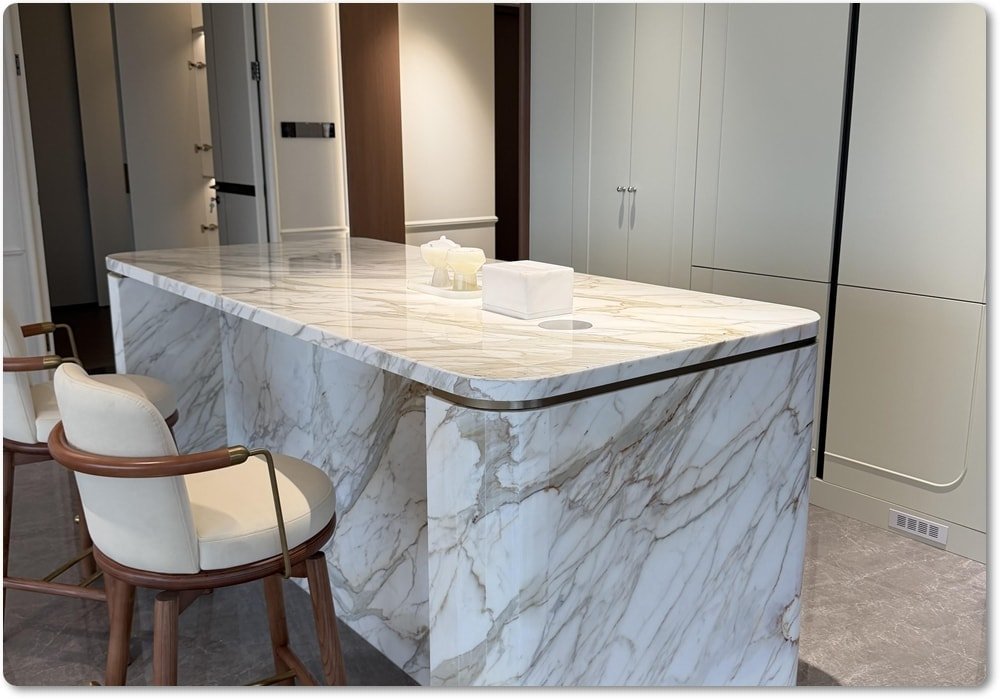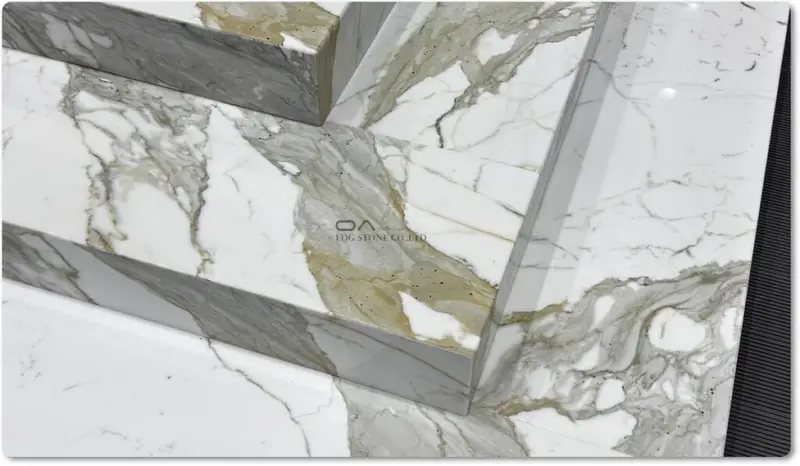
What is Taj Mahal quartzite? (origin, visual character, finishes, technical profile)
Taj Mahal quartzite is a trade name commonly used to describe a warm cream-to-ivory quartzite with soft gold and gray veining. While the name evokes a timeless aesthetic, the material itself is a naturally metamorphosed silica-rich stone with the visual appeal of marble combined with the physical properties of quartzite.
Origin & market positioning
Most commercially available Taj Mahal quartzite slabs are quarried and processed through international supply chains; suppliers position the stone as a luxury aesthetic alternative to marble when a more durable surface is required.
Visual character & finishes
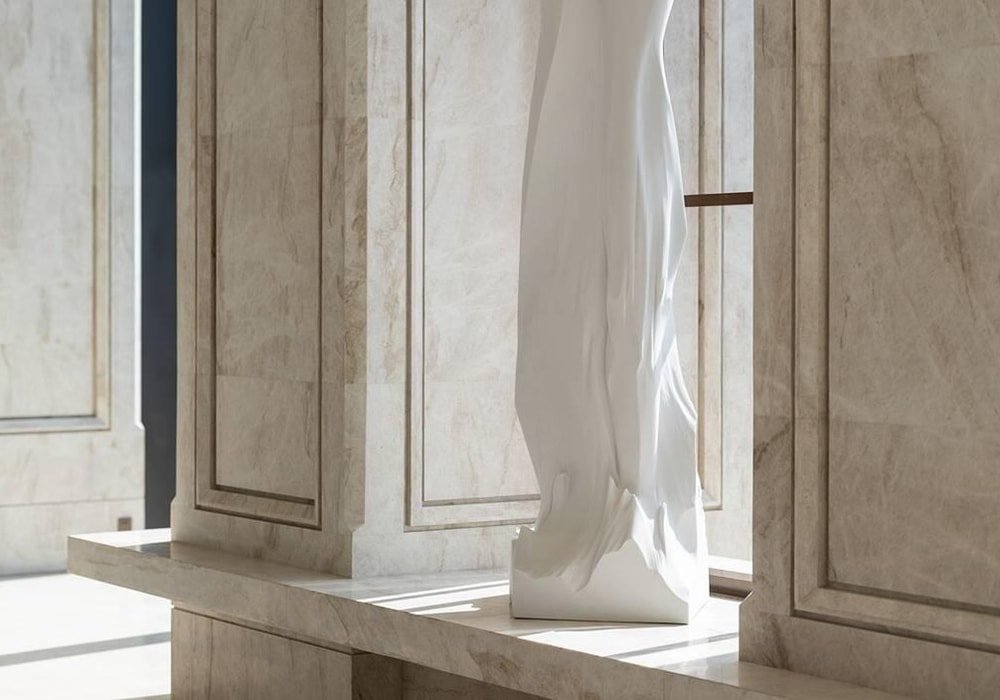
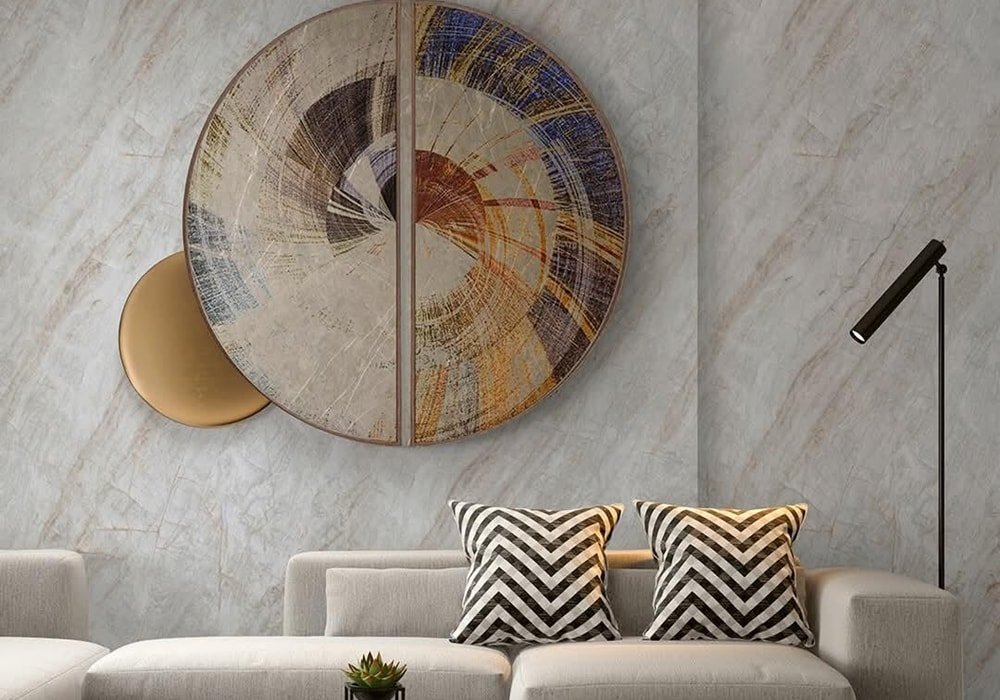
The stone’s palette typically ranges from warm creams to soft ivories, interrupted by subtle linear or cloud-like veins in gold, beige, or soft gray. Finishes commonly offered are polished (high gloss and depth), honed (matte/satin), and leathered/textured (tactile surface with reduced gloss). Finish selection affects reflections, perceived color depth, and cleaning behavior.
Technical profile (practical summary)
Hardness & abrasion resistance: Quartzite is substantially harder than calcitic marble and more resistant to scratches and surface loss — an asset in heavy-traffic areas.
Thermal stability: Natural quartzite tolerates thermal variation better than resin-based engineered surfaces, making it suitable for applications near decorative heat sources.
Porosity & sealing: While not as porous as some limestones, quartzite benefits from penetrating sealers in high-exposure commercial settings to reduce staining risk without materially altering appearance.
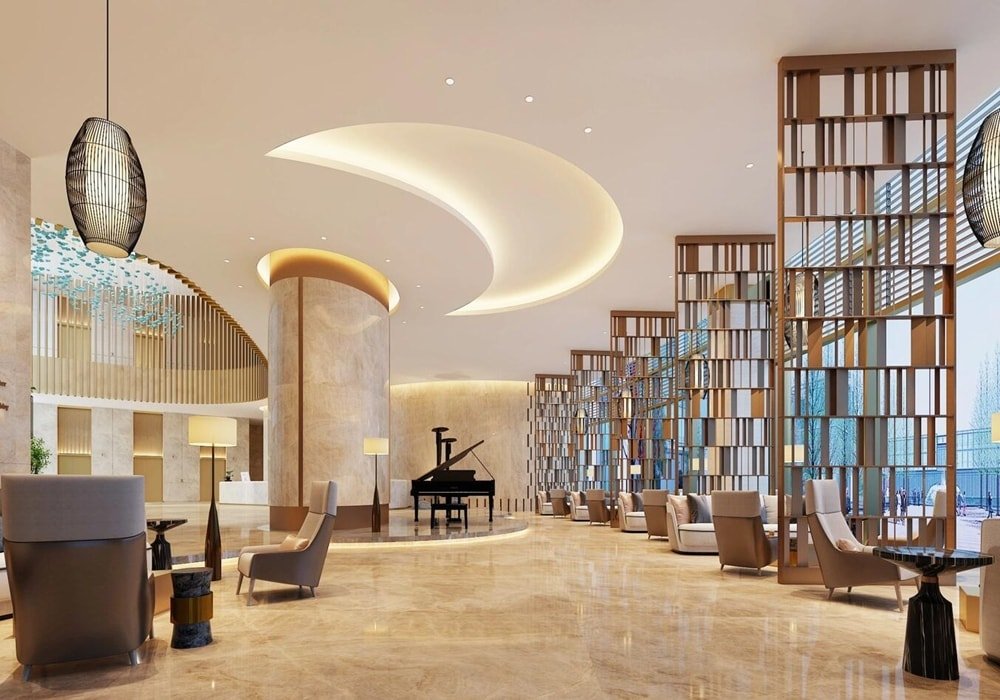
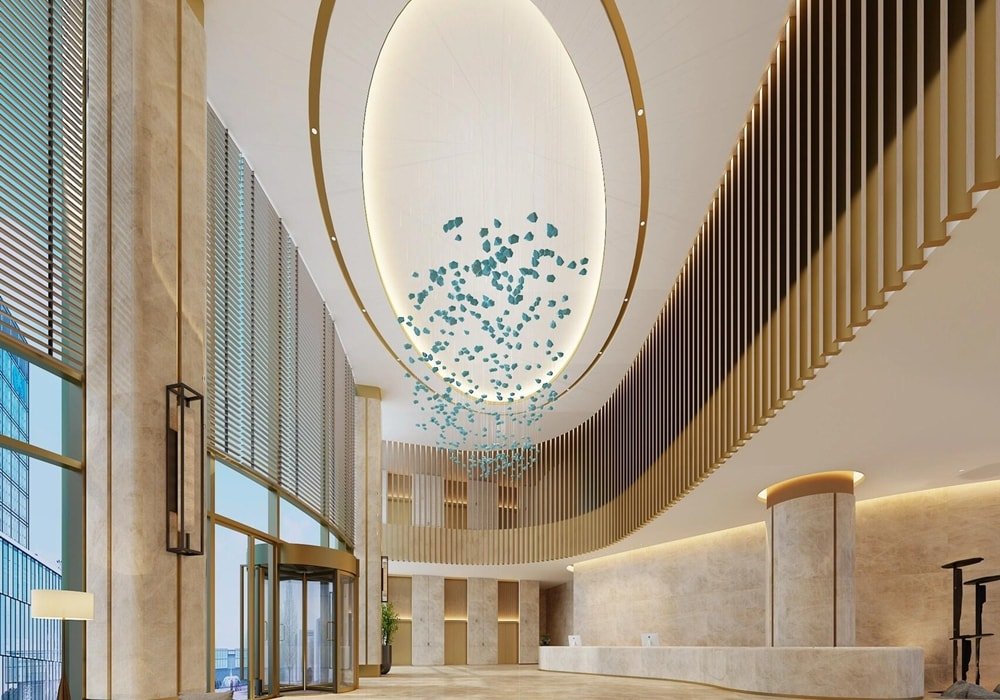
Why Taj Mahal quartzite works in hotel lobbies and high-end commercial spaces?
Immediate brand impact
A lobby sets guest expectations. Taj Mahal quartzite projects classic warmth and understated luxury. Large, book-matched panels and mitered edges create signature moments that photograph well for brand communications and social media.
Resilience to public use
Hotel lobbies contend with luggage, carts, heavy foot traffic, and frequent cleaning cycles. Taj Mahal quartzite’s hardness and abrasion resistance reduce polishing cycles and surface repairs compared to softer marbles, lowering operational disruption and service costs over time.
Lifecycle value & sustainability
Durable finishes last longer and lower embodied carbon per year of service when compared to short-lived alternatives. For owners and operators focused on lifecycle economics and sustainability reporting, durable natural stone supports both brand permanence and lower long-term costs.

Codes, interior-finish rules, and fire / life-safety considerations
Commercial interiors are subject to building code and life-safety scrutiny. Interior finish ratings (flame spread and smoke development) and non-combustibility considerations are evaluated for materials in public circulation and egress areas.
Non-combustibility & interior finish ratings
Natural stone is inherently non-combustible, which generally favors its acceptance under interior-finish rules. However, compliance is not only about the stone itself: the installation system — adhesives, backer, concealed materials — and the application method may affect an authority’s view. Always document the complete assembly (stone + adhesive + backer + anchors) for permit review.
Fireplaces and decorative heat sources
If the lobby design includes decorative fireplaces or radiant elements, coordinate the stone application with appliance manufacturer clearances and tested assembly details to ensure safe operation and insurer acceptance.
Accessibility and slip resistance
Where used on floors or transitions, verify slip resistance, threshold heights, and maintenance practices to comply with accessibility standards and building code expectations.
Design approaches for lobby applications
Feature walls and book-matching
Book-matching produces a mirror effect across slabs and is exceptionally powerful at the lobby scale. For book-matched feature walls, plan slab selection early, order contiguous lots, and design seams and reveals that enhance the pattern rather than interrupt it.
Reception counters and cladding
Reception desks are high-touch moments. Use 3 cm thickness for exposed horizontal surfaces where direct wear is expected, or design mechanically supported 2 cm panels over reinforced backing to achieve a slender visual profile without sacrificing durability.
Accent bands, inlays, and transitions
Pair Taj Mahal quartzite accent strips with more wear-resistant field flooring (porcelain, dense granite) to get the visual continuity with functional flooring performance.
Lighting & finish interplay
Lighting temperature and direction dramatically alter the perceived warmth of the stone. Warm LED lighting (2700K–3000K) brings out golden undertones; backlighting book-matched translucent features (if applicable) provides dramatic depth.
Fabrication, logistics, and lot-control for large projects
Large commercial projects create demands on supply consistency, fabrication capacity, and logistics. Successful outcomes require early procurement and tight coordination.
Lot control & slab procurement
For installations spanning many panels, secure contiguous slab lots or a guaranteed lot run to avoid visible tonal shifts. Include contractual language for supply continuity and acceptable variance. Approve slab photos and physical samples before fabrication begins.
Templating, shop dry-fit, and QC
Use CAD/laser templating and perform shop dry-fits for complex miters and integrated systems (recessed niches, services, lighting). Shop assembly reduces on-site fitting time and helps maintain tight seam tolerances.
Transport, rigging & on-site handling
Plan for reinforced crating, crane access, hoisting equipment, and experienced rigging crews. Late coordination with general contractors avoids costly delivery delays and site access complications.
Stabilization & transparency
Highly veined or fissured slabs are sometimes stabilized with resin fills during fabrication. Document any stabilization in the submittal so future testing, maintenance, or repair is accurate and transparent.
Installation best practices (substrate, anchorage, movement, tolerances)
Non-combustible backing and substrate strategy
When applying stone to framed partitions, specify cementitious sheathing or other non-combustible boards rated for vertical stone cladding. Combustible backings can negate the stone’s inherent non-combustibility in the eyes of code officials.
Mechanical anchorage & redundant support
Combine stainless steel carrier systems, hidden clips, or Z-bars with an appropriate thin-set or structural adhesive. Redundant mechanical anchors mitigate the risk of adhesive failure, simplify panel replacement, and improve longevity.
Movement joints & building dynamics
Plan discreet movement joints so that thermal and building movement do not cause cracking or visible stress at seams. Use flexible, non-staining sealants and integrate joints into the architectural language.
Seams, miters & tolerance control
Define acceptable seam widths and miter tolerances in the contract. Tight seams and accurately cut miters are essential to a high-quality visual result; include interim inspections at dry-fit and post-setting.
Durability, maintenance & lifecycle costs
Daily and periodic maintenance
Establish routines: daily dusting, weekly damp cleaning with pH-neutral stone cleaners, and periodic deep cleaning for textured finishes. Train staff on proper products and techniques to avoid surface damage.
Sealing strategy and inspection intervals
Apply a penetrating sealer at installation for lighter tones in heavy-use areas. Inspect quarterly the first year, then annually; reseal typically every 1–3 years depending on traffic and exposure.
Repair planning & spare slabs
Reserve spare slabs from the original lot for future repairs. Retaining matching material dramatically reduces downtime and preserves visual continuity if damage occurs.
Total cost of ownership (TCO) perspective
Although initial procurement of high-end quartzite may represent a premium, reduced polishing cycles, fewer repairs, and longer service life often produce a favorable TCO for commercial owners compared with softer natural stones.
Procurement & specification tactics (manufacturer/factory / wholesale focus)
Sourcing strategies at scale
For multi-location hotel programs and large commercial rollouts, work with manufacturers or factories that can guarantee lot continuity, provide technical documentation, and commit to delivery timelines. Wholesale relationships can deliver price and supply advantages for large quantities.
Specification checklist to include in contracts
Required slab lot/lot run and photo approvals
Finish, thickness and allowed tolerances (2 cm vs 3 cm)
Stabilization disclosures (resin fills)
Templating method (laser/CAD) and factory dry-fit requirements
Installation system (backing, anchors, adhesives) and inspection points
Spare slab reservation and replacement logistics
Long-tail purchase keywords to capture intent
Use buyer-focused phrases on procurement and product pages: “Taj Mahal quartzite slabs manufacturer bulk supply”, “buy Taj Mahal quartzite wholesale factory price”, “Taj Mahal quartzite for hotel lobby supplier”, “EDG Stone Taj Mahal lot matching”.
FAQ
Q1 — Is Taj Mahal quartzite suitable for hotel lobbies and high-end commercial projects?
Yes. Taj Mahal quartzite combines a refined, marble-like appearance with the hardness and abrasion resistance needed in high-traffic public spaces. With proper lot control, non-combustible backing, and professional installation, it performs reliably as feature walls, reception desks, and accent installations.
Q2 — Which finish is best for a busy lobby: polished, honed, or leathered?
Polished finishes deliver maximum visual drama and veining contrast but show light surface marks more readily; honed finishes reduce glare and hide fine wear; leathered finishes add tactile depth and better mask fingerprints and micro-abrasion. Choose the finish based on lighting, maintenance capacity, and the desired brand expression.
Q3 — How can I ensure consistent color and veining across large installations?
Order contiguous slab lots, require photographic and sample approvals, and include lot-matching and supply-continuity clauses in procurement contracts. Shop dry-fits and pre-assembly minimize surprises and ensure seams and book-matched panels align as designed.
Q4 — What installation system should I specify for vertical Taj Mahal panels over framed partitions?
Specify non-combustible backing (cementitious board or equivalent), stainless mechanical anchors or carrier systems, and an appropriately rated adhesive or thin-set; redundant mechanical support is recommended for safety and longevity. Document the entire assembly in submittals for the building official and include inspection steps.
Q5 — What maintenance schedule keeps Taj Mahal quartzite looking premium in a commercial lobby?
Daily dusting, weekly damp cleaning with pH-neutral stone cleaners, quarterly inspections in the first year, and reseal cycles between 1–3 years are common best practices. Keep spare slabs from the original lot for future repairs and ensure facilities staff follow O&M protocols to protect finish investments.
Semantic closure: How / Why / What / Options / Considerations — Taj Mahal quartzite in high-end lobbies
How: Specify Taj Mahal quartzite slabs from the same lot with CAD/laser templates; mount panels over non-combustible backing, use stainless mechanical anchors plus rated adhesive, and perform shop dry-fits for miters and book-matched assemblies.
Why: It combines marble-like visual warmth with quartzite durability — resisting scratches and abrasion typical in lobbies while preserving a premium brand aesthetic.
What: Include lot numbers, finish, thickness (2 cm vs 3 cm), any stabilization disclosures, and the installation system in procurement and submittal documents for AHJ review and future maintenance.
Options: Polished for high drama; honed for low glare and maintenance ease; leathered for texture. Choose 3 cm where structural simplicity is desired or 2 cm with reinforced backing for a thin profile.
Considerations: Coordinate early with lighting and structural engineering, reserve spare slabs for repairs, document maintenance schedules for facilities, and include supply-continuity clauses in contracts with manufacturers or wholesalers.
References (author/article/source — no links; authoritative and professional, up to 10)
International Code Council — International Building Code (IBC) — Interior finish and life-safety provisions.
NFPA — NFPA 101 Life Safety Code — Interior finish and occupancy guidance.
ASTM International — Standards for dimension stone and test methods — Material performance test references.
Stone industry trade publication — Best Practices for Large Stone Panel Installation — Trade technical article.
Manufacturer technical guide — Taj Mahal Quartzite product and application data — Supplier technical bulletin.
Fabricator technical note — Stabilization, resin fills, and finishing for veined quartzite slabs — Fabrication guidance.
Facilities management resource — Stone Care and Lifecycle Planning for Commercial Properties — FM best practices.
Lighting design reference — Material rendering and color temperature for hospitality interiors — Lighting design resource.
Procurement case study — Lot control and supply continuity in large stone installations — Project summary.