Quick Summary:
Quick Summary: A practical, vendor-ready guide to designing, sourcing, fabricating, and maintaining a seamless monochromatic white marble backsplash paired with white marble countertops. Includes manufacturer/wholesale buying cues (EDG Stone), installation best practices, regulatory and sustainability considerations, and cost drivers.
Introduction: Why Monochromatic White Marble Backsplash?
Monochromatic white marble backsplashes—paired with matching white marble countertops and vanity tops—are a cornerstone of contemporary, luxury interior design. The seamless monochrome approach removes visual breaks between horizontal and vertical surfaces, producing a calm, elevated field that amplifies natural light, simplifies material decisions, and increases perceived finish quality. For architects, designers, and procurement teams, the choice raises technical questions (seam tolerance, bookmatching, sealing) and supply questions (factory-direct sourcing, lead times, and certifications). This article synthesizes design principles, fabrication details, regulatory context, and purchase guidance (with EDG Stone as a manufacturer/wholesale buying model).

Design Principles: Aesthetic rules for seamless white-on-white installations
A seamless monochromatic backsplash is not simply “the same stone above the counter.” It is a considered design approach that aligns tone, texture, scale, and light to produce continuity without monotony.
Tone, veining, and texture matching
Choose stones with a compatible base tone and veining scale. Continuous veining across countertop and backsplash (bookmatching or slab extension) creates the strongest “seamless” effect. For quieter designs, select a marble with subtle, fine veins to keep the eye moving gently rather than stopping at a dramatic vein intersection.
Choosing complementary vs. continuous veining
Continuous veining (same slab carried vertically) gives the truest monolithic look. Complementary veining (same quarry/vein family but different slabs) preserves continuity while introducing slight variation—often preferable in commercial settings where material waste and slab matching constraints exist.
Scale & proportion — backsplash height & reveal
Monochrome pairs best when the backsplash height relates to the countertop-to-ceiling ratio. Common solutions:
4″ backsplash return — subtle, practical
Full-height slab to upper cabinets or ceiling — dramatic, premium
Partial full-height (to mid-wall shelving) — balanced and cost-conscious
Lighting & reflective strategies
Marble reflects and diffuses light; polished finishes will maximize reflection and make the space feel larger, while honed or leathered finishes create a softer, tactile surface under directional lighting.
Material Selection & Technical Considerations
Choosing the right white marble (or white-toned natural stone) and the correct finish is the technical backbone of a long-lasting monochrome backsplash.
White marble types, performance traits, and quick chart
Common white marbles used for backsplashes include Carrara, Calacatta, Statuario, and select white quartzites. Each has trade-offs:
Calacatta / Statuario — dramatic veining, high aesthetic value, moderate porosity
Carrara — modest veining, economical, good for subtle monochrome fields
White quartzite — looks marble-like but offers higher hardness and scratch resistance
Refer to recognized installation and material standards (industry installation and dimension-stone manuals) when specifying slab thickness, tolerances, and reinforcement. The Natural Stone Institute maintains installation standards and a Dimension Stone Design Manual that many fabricators follow for tolerances and handling best practices.
Finishes: polished, honed, leathered — pros & cons
Polished: maximum reflectivity, shows veining vividly, higher maintenance for visible stains.
Honed: matte, hides etch marks better, ideal for contemporary kitchens and high-use vanities.
Leathered: textured, tactile, hides fingerprints and light scratches—excellent for hospitality applications.
Thickness, substrate, and anchoring systems
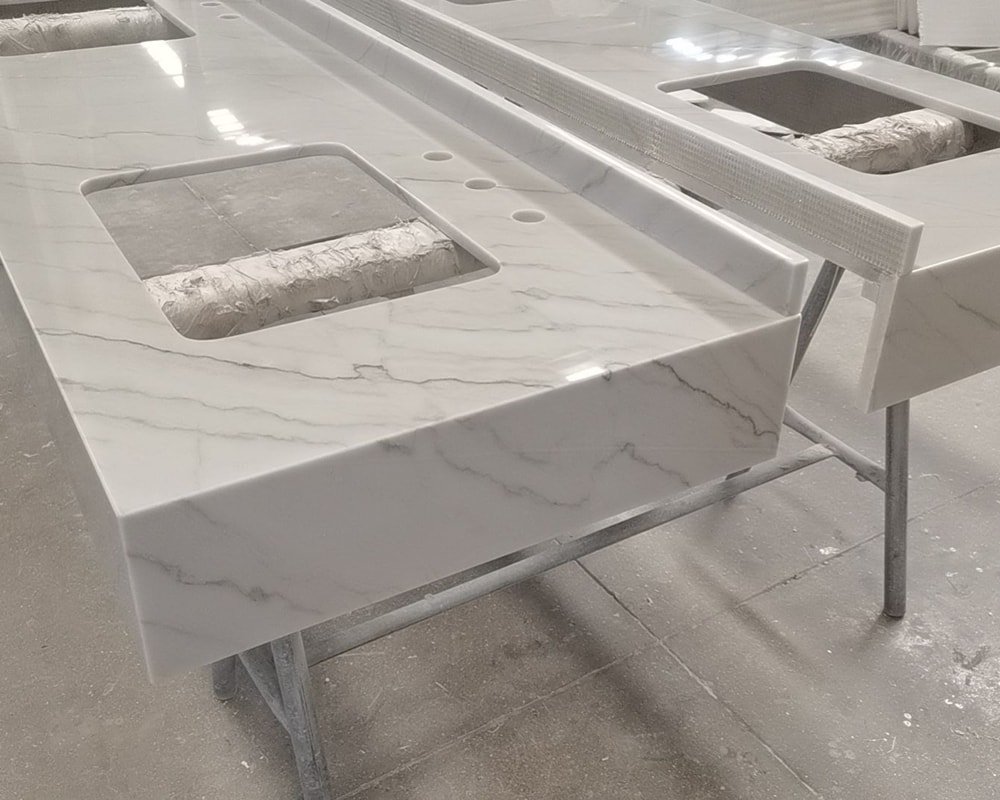
Typical backsplash thicknesses range from 6–20 mm, depending on the method (thin panels vs full slabs). Full-slab seamless backsplashes usually use 12–20 mm slabs with competent backing (waterproof cement board, appropriate adhesive beds, and sometimes mechanical anchors for large panels).
Sealing & stain risk
White marbles are naturally porous: prompt sealing is necessary after fabrication and periodically in service. Specify impregnating sealers formulated for natural stone; ensure installers use low-VOC formulations when local regulation demands it (see CARB and relevant VOC rules).
Seamless Integration: Backsplash and Countertop Relationship
The seam between countertop and backsplash is the design junction. How you join them determines visual success and long-term performance.
Seamless vs. shadow line joints — the trade-offs
Seamless (butt joint, color-matched epoxy): visually continuous but requires precise fabrication and strong adhesive/seam color match.
Shadow line or reveal: adds a design gap that hides tolerances and thermal movement—more forgiving in long-term multi-material assemblies.
Countertop backsplash ideas
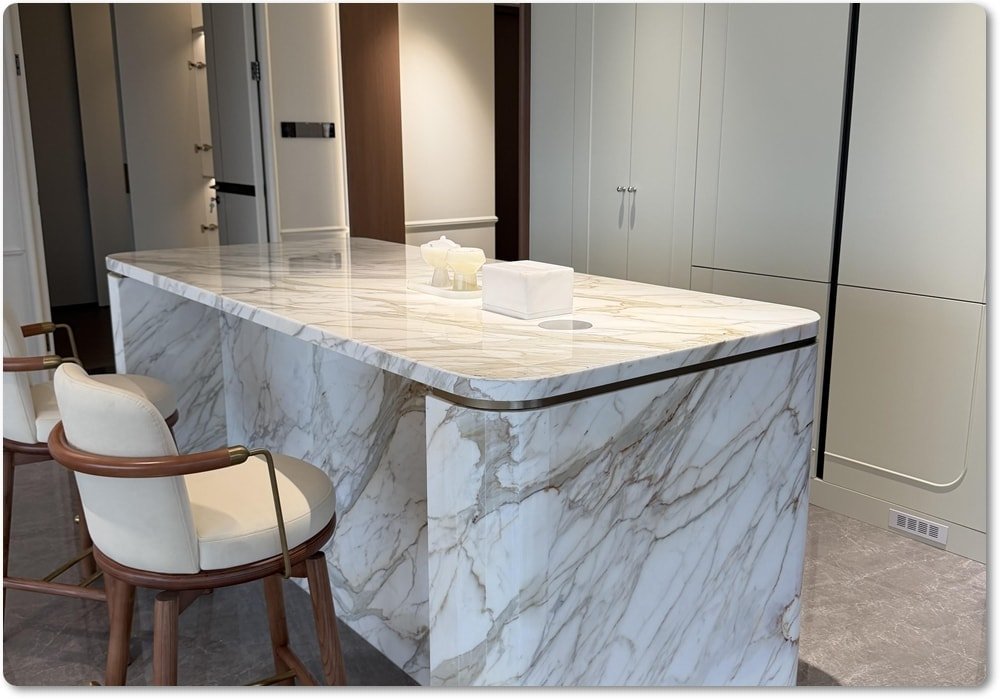
Full-slab backsplash: slab continues from horizontal surface up the wall—best visual continuity.
4″ or 6″ backsplash return: common and economical.
Waterfall return: slab flows down the island —dramatic and cohesive.
Backlit thin-slab panel: when marble is translucent (certain white marbles/onyx), strategic backlighting creates drama.
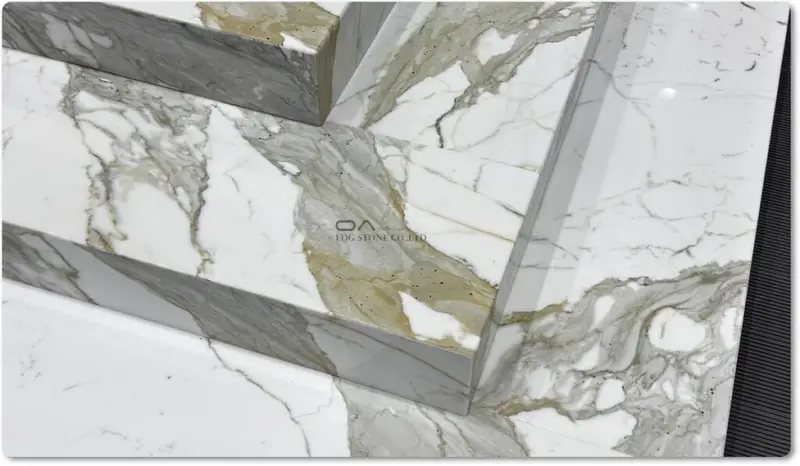
Matching veining & bookmatching
Bookmatching across the horizontal-to-vertical junction is executed by planning slab cuts during fabrication. Request numbered slabs and mark seam locations during templating so veining aligns where desired.
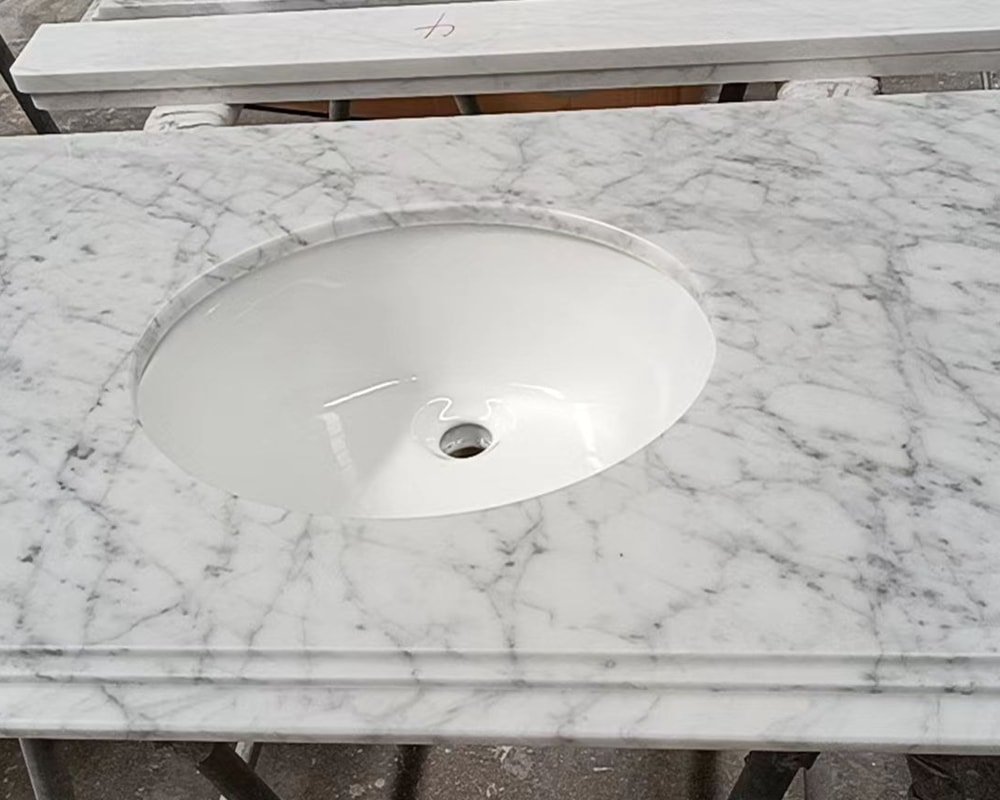
Edge profiles and caulk selection
A soft, eased, or beveled edge reads as refined. At the seam, use color-matched neutral silicone or stone-specific caulks; specify non-acidic, low-VOC products for health and compliance.
Fabrication & Installation Best Practices
A high-quality installation is a systems approach: slab selection, template precision, transport protection, and on-site execution.
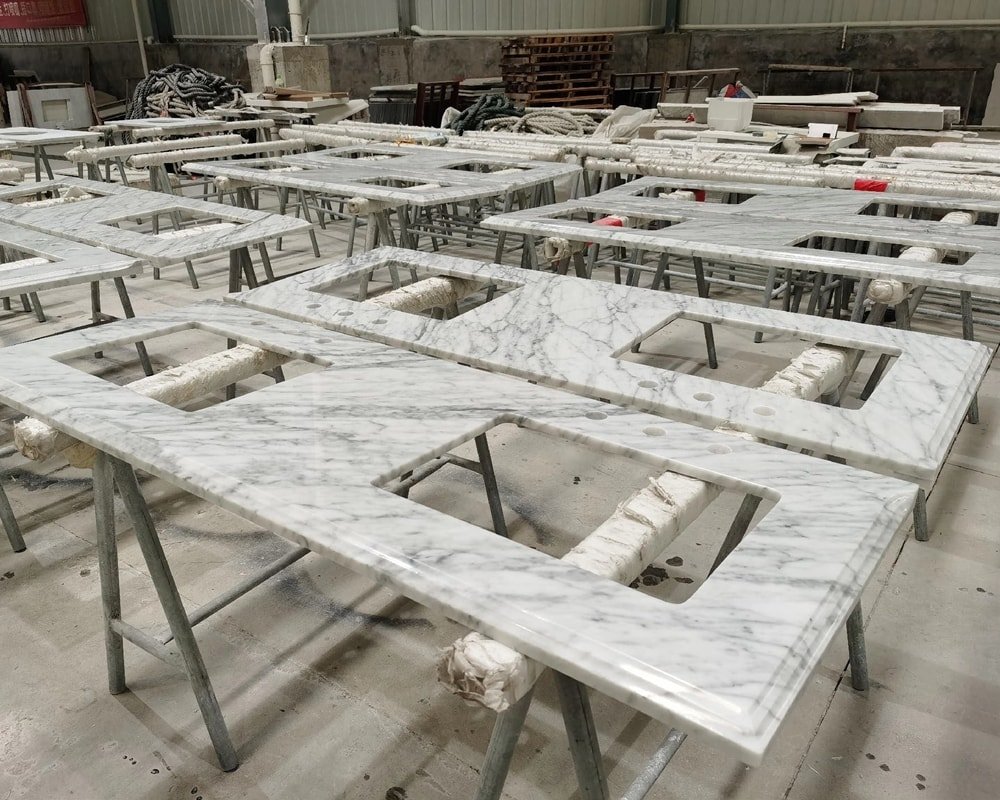
Prefab panels vs site-cut slabs
Prefabricated panels minimize on-site labor but require accurate field dimensions. Site-cut slabs allow last-minute adjustments and are common for custom jobs.
Bookmatching, slab layout planning, CNC templating
Digital templating and CNC nesting allow efficient yield, accurate cuts, and bookmatch control—insist on slab photos and digital layout proof before fabrication.
Adhesives, mechanical fixing, and waterproof backing
Use adhesives specified for stone-to-stone or stone-to-substrate applications, combined with a waterproof backing (cement board or Plywood with membrane) behind wet-area backsplashes. For larger panels, mechanical anchors or stainless-steel clips provide redundancy.
On-site tolerances, groutless joints, finishing details
Skilled installers keep joints as tight as fabrication tolerances allow (1–2 mm). For a true monolithic look, groutless joints and color-matched seams are essential.
Compliance, Regulations & Sustainability
Regulation and sustainability have real procurement effects: material choices, adhesives, and sealants must meet local VOC rules; quarry transparency and third-party sustainability certifications increasingly appear in project specifications.
VOC, hazardous materials & adhesives
Stricter VOC rules are enforced in regions such as California; CARB’s consumer products and adhesive rules are a common compliance benchmark used by manufacturers to standardize low-VOC formulations across markets. Specify CARB-compliant or equivalent low-VOC adhesives and sealers for projects that may ship to or be installed in strict jurisdictions.
Industry standards, installation manuals & worker safety
Follow established dimension stone manuals and installation standards for load-bearing overhangs, anchorage, and tolerances. The Natural Stone Institute publishes the Dimension Stone Design Manual and provides industry-recognized installation guidance used globally.
Sustainability & quarry traceability
Buyers increasingly ask for third-party sustainability verification. The Natural Stone Sustainability Standard (ANSI/NSI 373) and related certification programs validate environmental management, worker safety, and responsible extraction. Including sustainability requirements in specs helps future-proof projects and aligns with corporate ESG expectations.
Health & safety for fabrication crews
Silica exposure and slab handling drive industry training and certification—fabricators and onsite teams should follow recognized safety programs to prevent silicosis and ensure slab handling safety. The Natural Stone Institute and other industry groups provide silica safety resources and certificates.
Cost, Sourcing & Supply-Chain (Manufacturer / Factory / Wholesale Focus)
Procurement decisions determine both budget and outcome. Key cost drivers: slab grade, bookmatching, fabrication complexity, shipping, and installation labor.
Cost drivers
Slab grade & rarity: Calacatta/Statuario grades cost more than common Carrara.
Bookmatching & waste: Bookmatching increases yield loss and cost.
Finish & backlighting: specialty finishes and electrical integrations drive labor costs.
Manufacturer/factory direct vs wholesale channels
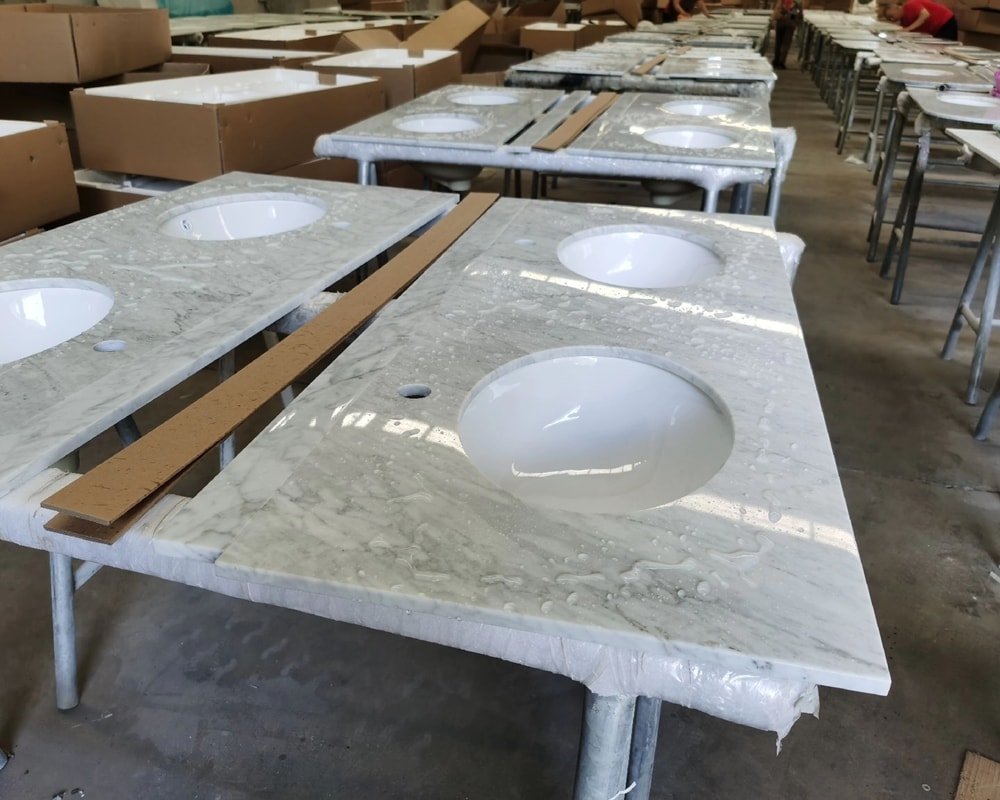
Factory-direct purchasing (e.g., from EDG Stone-style suppliers) reduces margins and offers control over slab selection and lead time. Wholesale distributors provide convenience and smaller-quantity purchases with faster local availability. Negotiate slab photos, slab IDs, and shipping terms to avoid surprises.
Lead-times & international logistics
Slab availability, port congestion, and fabrication queue contribute to delivery windows—plan lead times into project schedules (often several weeks to months for custom bookmatched orders).
Case Studies & Real Project Examples
Below are condensed project sketches that illustrate how the principles above are applied.
Residential kitchen — full-slab seamless backsplash
A high-end renovation used a single Calacatta slab extended to full-height behind the cooktop and sink. Digital templating, CNC edge profiling, and a pre-approved bookmatch layout minimized on-site adjustments. The result was a continuous visual plane that read as sculptural and simplified material maintenance (no grout lines above the counter).
Boutique hotel bathroom — bookmatched vanity + backsplash
Designers used bookmatched Statuario slabs as both vanity top and full-height backsplash. Honed finish reduced visible etch marks from high-use guest bathrooms, and the local fabricator included silica-safe practices and low-VOC sealers per the spec.
Commercial showroom — long-term durability data
A showroom installation selected white quartzite that resembled marble to gain higher scratch and heat resistance with marble-like aesthetics. The material’s performance, combined with periodic re-sealing, produced low lifetime maintenance costs for a public-facing floor and backsplash application.
Maintenance, Care & Troubleshooting
Marble maintenance is straightforward when planned: daily gentle cleaning, periodic resealing, and prompt response to acidic spills.
Daily cleaning & recommended cleaners
Use pH-neutral stone cleaners and soft microfiber cloths. Avoid acidic cleaners (vinegar, lemon) that etch polished marble surfaces.
Stain removal & resealing schedule
Perform spot testing for stain removal using poultices for oil-based stains. Reseal every 12–36 months, depending on use and sealer type; high-use kitchens may require more frequent re-sealing.
Repairing chips & polishing restoration
Minor chips can be epoxy-filled and color-matched by a skilled stone repair technician. Polishing or honing rejuvenates the finish but should be coordinated with the original finish choice.
Gallery & Visual Assets (suggested assets & alt tags)
Suggested photos:
Full-slab backsplash with continuous veining (alt: “Full-slab white marble backsplash flowing into matching white marble countertop”)
Bookmatch close-up (alt: “Bookmatched white marble pattern detail for backsplash and countertop junction”)
Fabrication shop image showing CNC templating (alt: “CNC templating for marble slab bookmatch layout”)
Backlit thin-slab (alt: “Backlit translucent marble thin-slab backsplash installation”)
Buying Guide & Checklist (call-to-action for manufacturers/wholesale buyers)
Quick procurement checklist:
Request slab photos + slab ID and confirm bookmatch direction.
Specify finish (polished/honed/leathered) and exact edge profile.
Confirm substrate and adhesive performance (CARB-compliant / low-VOC).
Ask for sustainability certifications (ANSI/NSI 373, EPD, HPD) if required.
Lock fabrication/installation lead times in the contract.
Questions to ask your supplier (EDG Stone/factory/wholesale):
What is the exact slab ID and cut number?
Can you produce a digital layout for approval?
Which sealer type do you recommend, and is it low-VOC?
Do you have third-party sustainability verification?

FAQ
How do I achieve a seamless look between white marble countertops and backsplash?
Achieve a seamless look by extending the same slab from the countertop up the wall (full-slab approach) or by bookmatching adjacent slab cuts so veining aligns at the corner. Use tight fabrication tolerances, color-matched epoxy seams, and a consistent finish to minimize visual breaks. Plan slab layout digitally before cutting to control vein flow and waste.Which white marble is best for a backsplash in a kitchen with heavy use?
For heavy-use kitchens, consider white quartzite or lower-porosity marbles with a honed finish. Quartzites provide greater scratch and heat resistance while preserving a marble-like look; honed marble reduces the visibility of etch marks. Also specify a high-performance impregnating sealer and low-VOC adhesives.Can I use a backlit white marble backsplash, and what are the requirements?
Yes — backlit designs are possible with thin, translucent marbles or onyx-like stones. Requirements include selecting an appropriately translucent slab, using thin-slab fabrication (commonly 6–12 mm supported on a stable backing), planning for LED arrays behind the slab, and ensuring heat dissipation and electrical access are properly integrated in the wall cavity.What is the cost difference between a full-slab backsplash and a 4” counter return?
A full-slab backsplash typically costs more due to slab usage, bookmatching needs, transport, and additional fabrication labor. A 4” return is the most economical option and often sufficient for splash protection. Exact cost differences depend on slab grade, bookmatching demands, and local labor rates—factory quotes will clarify the delta.How should I maintain and reseal a white marble backsplash to prevent staining?
Clean daily with pH-neutral stone cleaners and blot spills immediately. Reseal with the manufacturer-recommended impregnating sealer every 12–36 months (frequency depends on use and sealer). Avoid acidic cleaners and test any new cleaning product in an inconspicuous area first.
Semantic Closure: How / Why / What / Options / Considerations
How: Achieve seamless monochrome by planning slabs and layouts digitally, specifying bookmatching when needed, using low-VOC adhesives and color-matched seam epoxies, and coordinating transport/fabrication timelines with the factory.
Why: Monochrome white marble elevates perceived material quality, improves daylight performance through reflection, and simplifies design decisions—yielding higher perceived value in homes and hospitality projects.
What: Specify exact slab ID, finish (polished/honed), thickness, edge profile, sealer type, adhesive standard (CARB or equivalent), and any sustainability certification (ANSI/NSI 373, EPD/HPD) in your purchase order.
Options: Full-slab, partial-slab, thin-backlit panels, or quartzite equivalents—each balances cost, durability, and visual impact differently; factory-direct suppliers (manufacturer/factory/wholesale channels) offer the most control for bookmatching and slab selection.
Considerations: Regulatory compliance (VOC limits), health & safety (silica training and safe slab handling), traceability (responsible quarrying certifications), and lifecycle maintenance (reseal schedule) are essential to long-term performance and ESG alignment.
References (author, article title, publication/organization)
California Air Resources Board — “Consumer Products Program” and Rule 1168 (Adhesives/VOC) — CARB Publications.
Grand View Research — “Natural Stone Market Size & Share” — Market Research Report.
Market Research / The Business Research Company — “Natural Stone Market Report” — Industry Market Report.
Coldspring / Industry Publication — “How Is Stone Sustainable” — Corporate Sustainability Guidance.
Nexreg / Government Summaries — “VOC Regulations and Limits Guide” — Regulatory Compliance Overview.
Verified Market Research — “Natural Stone Market Size & Forecast” — Industry Analysis.