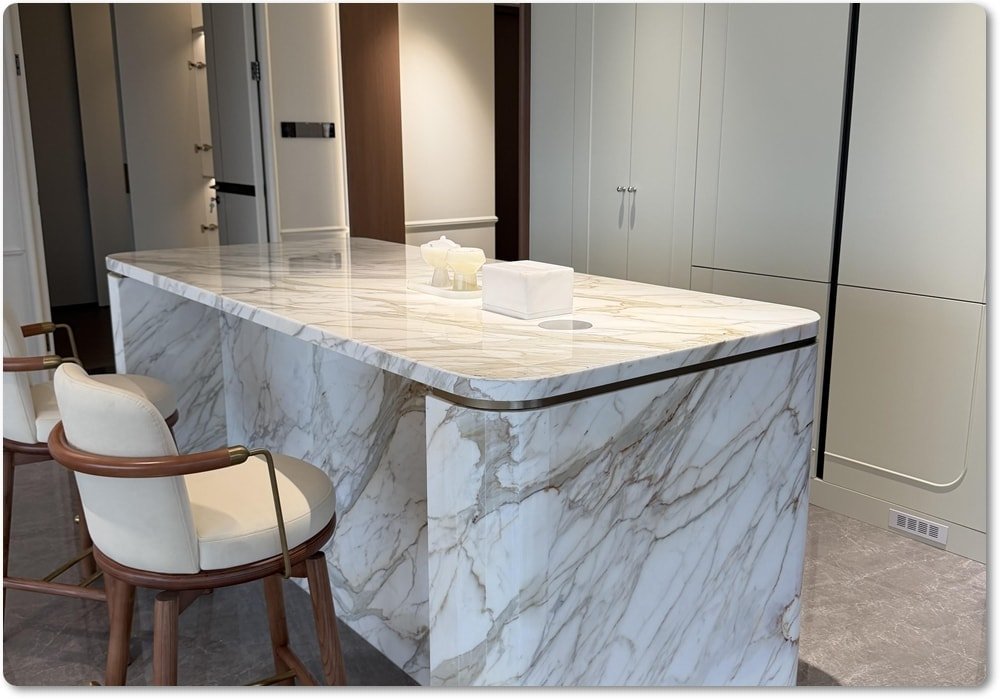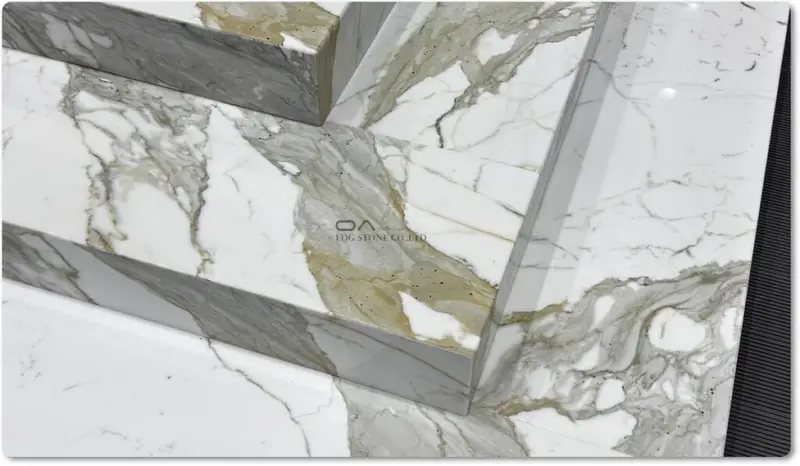
Quick Summary: The Science of Marble Preservation
The Challenge: Natural stones like marble and limestone are calcium-based and porous, making them vulnerable to moisture absorption (staining) and chemical reactions with acids (etching). Traditional sealing prevents stains but does NOT prevent etching.
- Sealing: Penetrating impregnators fill pores to repel oil and water. Essential for how to seal marble tables and countertops.
- Coating (Anti-Etch/UV): Advanced UV-cured marble sealers and Marble Shield films create a physical barrier that stops acid from touching the stone.
- Industry Direction: The shift toward factory-applied UV coatings ensures 100% protection before the stone even reaches the job site.
Natural stone surfaces represent the pinnacle of architectural elegance. However, the high porosity of marble and limestone creates a paradoxical challenge: how to maintain their timeless beauty in high-moisture environments like kitchens and bathrooms. At EDG Stone, we recognize that moisture protection is not a “one-size-fits-all” solution. It requires a layered approach involving chemical impregnators, modern UV coatings, and specialized AntiEtch marble sealers.
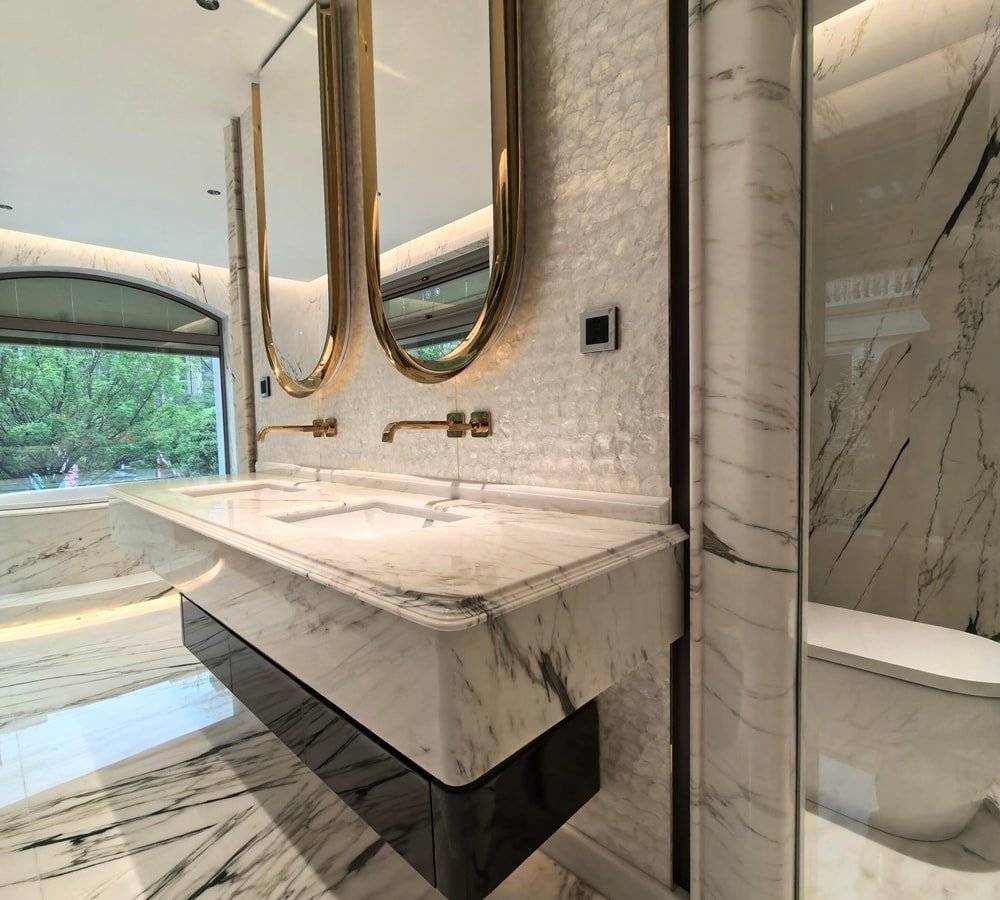
The Vulnerability of Calcium-Based Stones: Porosity and Etching
To protect marble, one must first understand its geological weaknesses. Unlike granite, which is primarily composed of silica and feldspar, marble and limestone are “calcitic.”
Why Marble and Limestone Absorb Moisture?
Natural stone is characterized by a network of microscopic, interconnected pores—capillaries that act like a sponge.
Absorption Rates: While granite often has an absorption rate below 0.1%, marble typically ranges between 0.1% and 0.2%.
Capillary Action: Moisture pulled into these pores can carry minerals, organic matter, and pigments, leading to deep-seated “shadow” stains that are nearly impossible to remove without professional poultice treatments.
Staining vs. Etching: The Critical Distinction
A common misconception in the stone industry is that “sealing” solves all problems.
Staining is a matter of absorption (oil or water entering the stone).
Etching is a chemical burn. When an acidic substance (lemon juice, vinegar, wine) touches the calcium carbonate in marble, it dissolves a layer of the stone, leaving a dull, white mark.
Does sealing marble prevent etching? The answer is no. Standard penetrating sealers live below the surface. To prevent etching, you need a marble protection coating or a UV coating marble countertop solution that provides a surface barrier.
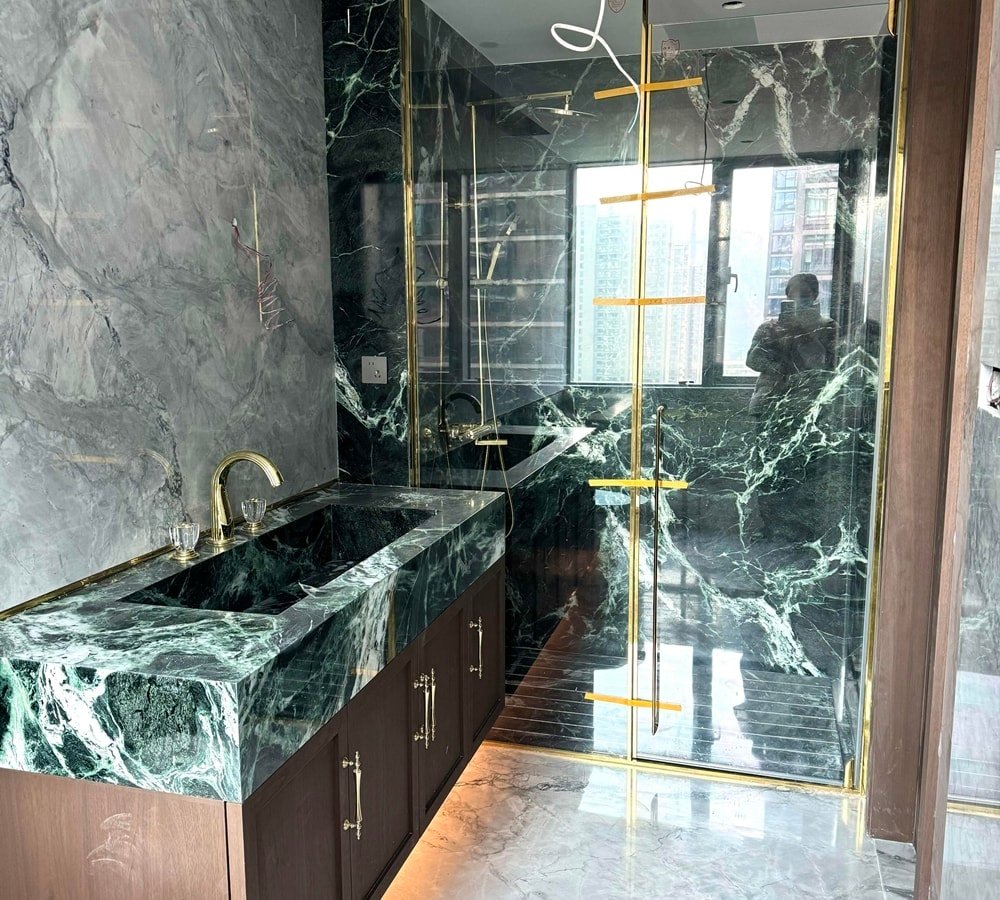
Traditional Protection: Penetrating Sealers (Impregnators)
For many applications, particularly in low-traffic areas or for those who appreciate a “natural” patina, traditional sealing is the first line of defense.
How to Seal Marble Countertops: A Professional Workflow?
When learning how to seal marble countertops, the process is as much about chemistry as it is about application.
Preparation: Use a pH-neutral cleaner. Learning how to clean and seal marble countertops correctly ensures no residue is trapped under the sealer.
Saturation: Apply the best marble sealer for countertops (impregnator) generously until the stone stops “drinking” the liquid.
Dwell Time: Allow the sealer to sit for 10–15 minutes, but never let it dry on the surface.
Buffing: Remove all excess sealer to prevent “haze.”
Best Sealer for Honed Marble Countertops
Honed (matte) marble is more porous than polished marble because the pores are “open.” Therefore, the best sealer for honed marble countertops must have a smaller molecular structure to penetrate deeper. EDG Stone recommends solvent-based fluorocarbon aliphatic resins for these finishes to provide maximum oil and water repellency.
How Often to Seal Marble Countertops?
A frequent question is: How often to seal marble countertops? * High-use (Kitchens): Every 6 to 12 months.
Low-use (Guest Baths): Every 2 years.
The Water Test: Pour a tablespoon of water on the stone. If it beads up, the sealer is intact. If it disappears into the stone within 2 minutes, it is time to reseal.
Advanced Protection: The Era of Anti-Etch and UV Coatings
For homeowners and commercial designers who want “worry-free” marble, the industry has evolved beyond liquid sealers to permanent or semi-permanent barriers.
UV Cured Marble Sealer and UV Coatings
The UV coating marble countertop process is a revolutionary advancement. By applying a specialized resin and curing it instantly with high-intensity Ultraviolet light, we create a diamond-hard, crystal-clear shield.
Total Acid Resistance: Acids cannot penetrate the UV layer.
Zero Porosity: The stone is effectively hermetically sealed from moisture.
EDG Stone Expertise: As a leading manufacturer, we offer factory-applied UV coatings that are vastly superior to aftermarket sprays.
More AntiEtch Reviews and Marble Shield
Products like More AntiEtch and Marble Shield have changed the landscape. Unlike a sealer, these are “high-build” coatings.
Pros: They are the only guaranteed way to stop etching. They can be applied in different finishes, from ultra-high gloss to deep matte.
Cons: They require professional application and can be more expensive than liquid sealants. However, looking at More AntiEtch reviews, the consensus is that the cost is justified by the elimination of professional restoration fees every few years.
Marble Protective Film
For a more temporary or reversible solution, marble protective film (similar to clear bras on luxury cars) is used. This is a thin, heat-resistant laminate that physically wraps the stone. It is particularly popular for how to seal marble tables in high-use hospitality settings.
Factory-Direct Solutions: The EDG Stone Advantage
Purchasing stone is an investment. Ensuring that the stone is protected from day one is the hallmark of a professional project.
Why Pre-Sealed Stone is the Future?
When you source from an EDG Stone factory, you aren’t just getting raw slabs. We offer wholesale solutions where the stone is treated in a controlled environment.
Dust-Free Application: On-site sealing often traps dust or construction debris. Factory sealing occurs in a clean-room environment.
How to Seal Granite Countertops for the First Time: Even for granite, which is less porous, a factory-applied initial seal ensures that the “first time” is the right time, preventing any stains during the installation process.
Industry Trends: Eco-Regulations and Sustainability
The chemical landscape of stone protection is shifting toward “Green” chemistry.
Low VOC and Sustainable Protection
The push for LEED-certified buildings has led to a crackdown on Volatile Organic Compounds (VOCs) in stone sealers.
Water-Based Innovations: The newest generation of water-based AntiEtch marble sealers now matches the performance of old-school solvent-based products without the toxic fumes.
Compliance: All EDG Stone sealing solutions are curated to meet modern environmental safety standards, ensuring indoor air quality is preserved.
Frequently Asked Questions (Google Hot Search FAQs)
1. Does sealing marble prevent etching from acidic foods? No, traditional sealing does not prevent etching. Sealers are designed to prevent “stains” by repelling liquids from soaking into the pores. Because etching is a chemical reaction between acid and the stone’s calcium, only a surface barrier like AntiEtch or a UV coating can prevent it.
2. What is the best marble sealer for countertops in a high-traffic kitchen? The best sealer is a high-grade penetrating impregnator containing fluorocarbon resins. For those seeking absolute protection against both stains and etches, a professional UV-cured marble sealer or Marble Shield is the superior choice for high-traffic environments.
3. How to seal a marble table yourself? To seal a marble table, first clean it with a stone-safe, wax-free cleaner. Apply a high-quality marble countertop sealer using a microfiber cloth, ensuring even coverage. Let it sit for 10 minutes, then buff off every trace of excess liquid until the surface is dry to the touch.
4. Is UV coating marble countertops worth the extra cost? Yes, especially for commercial settings or busy households. While the initial investment is higher than a standard sealer, it eliminates the need for periodic resealing and, more importantly, prevents the expensive professional sanding and polishing required to fix acid etches.
5. How can I tell if my marble protector coating is still working? Perform the “Water Test.” Place droplets of water on various areas of the countertop. If the water stays in a tight bead after 5-10 minutes, the protection is active. If the water spreads or the stone underneath darkens, the moisture protection has been compromised and needs reapplication.
🔍 Technical Insights: The 2026 Strategy for Stone Longevity
What is the optimal protection level? (Options)
The choice depends on the End-Use Case. For residential bathrooms, a high-quality penetrating sealer is sufficient. For “Hard-Working” kitchens (lemon juice, vinegar, alcohol), a UV Coating or Anti-Etch barrier is the only way to maintain a “Day 1” look indefinitely.
Why a professional application beats DIY? (Considerations)
- Factory Precision: EDG Stone uses industrial-grade UV curing lights that create a more uniform molecular bond than hand-applied sprays.
- Anti-Etch Chemistry: Modern coatings require specific humidity and temperature controls to cure without bubbles or “orange peel” textures.
Market Trends & Regulatory Compliance
Sustainability is the new standard. The stone industry is moving away from PFAS-heavy chemicals toward “Eco-shield” nanotechnology. Choosing Low-VOC and NSF-certified coatings is no longer optional for high-end commercial projects.
The “EDG” Recommendation
If you are purchasing Wholesale marble, always opt for factory-applied moisture protection. It reduces installation risk and provides a higher ROI by extending the stone’s life cycle by 300%.
Reference List
Natural Stone Institute: Technical Bulletin on Sealing and Maintenance of Natural Stone Surfaces.
ASTM International (C97/C97M): Standard Test Methods for Absorption and Bulk Specific Gravity of Dimension Stone.
Journal of Architectural Conservation: Studies on the degradation of calcium-carbonate stones by acidic rain and household pollutants.
U.S. Green Building Council (USGBC): LEED v4.1 requirements for Low-Emitting Materials (Stone and Sealants).
International Surface Fabricators Association (ISFA): Best practices for anti-etch coating applications.
SGS Testing Labs: Comparative analysis of UV-cured resins vs. penetrating silanes in stone protection.
Environmental Protection Agency (EPA): Volatile Organic Compound (VOC) limits for Architectural Coatings.