1. Executive Summary: How to Procure Marble Countertops Successfully?
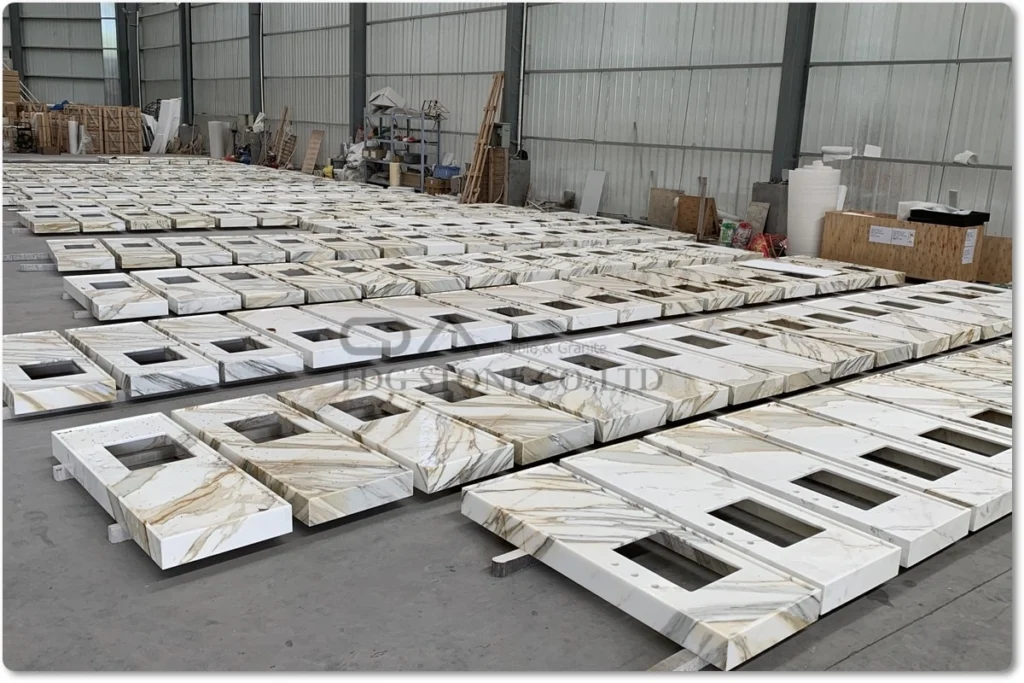
Successfully procuring marble countertops requires more than comparing prices per square foot. Buyers should establish the marble variety, material selection criteria, dimensions, thickness, fabrication details, tolerances, packaging requirements, delivery destination, Incoterms, MOQ, and production schedule before requesting quotations. A complete Marble Countertops RFQ lets manufacturers compare prices, identify technical risks, confirm production feasibility, and provide realistic delivery commitments. Buyers should evaluate suppliers based on material consistency, fabrication capabilities, quality control, export packaging, documentation, and total landed cost rather than selecting the lowest quotation alone.
Marble countertops are natural stone products that require careful material selection, dimensional control, specialized fabrication, and international logistics coordination.
For importers, contractors, hospitality procurement departments, residential developers, and cabinet manufacturers, the procurement process directly influences project budgets, installation schedules, product quality, and long-term customer satisfaction.
A poorly prepared RFQ can produce quotations that appear competitive but are commercially incomparable. One manufacturer may quote polished marble with basic edge processing, while another includes sink cutouts, reinforced packaging, inspection, and customized fabrication.
The difference may not become apparent until production or shipment.
A professional procurement process should therefore establish three priorities:
Technical comparability: Every supplier receives the same material specifications, drawings, quantities, and quality requirements.
Commercial transparency: Prices, MOQ, lead time, packaging, freight, payment terms, and Incoterms are clearly identified.
Supply-chain reliability: Material approval, production inspection, packaging, shipping, and claims procedures are agreed before order confirmation.
EDG Stone operates as a Chinese natural stone manufacturer and exporter, supplying marble countertops, vanity tops, slabs, and customized stone products for international buyers. Buyers can submit drawings, project schedules, quantity lists, and material references to request a project-specific quotation.

2. Scope and Definitions: Understanding Marble Countertops Procurement
2.1 What Does Marble Countertops Procurement Include?
Marble countertops procurement refers to the commercial and technical process of sourcing natural marble countertop products from quarries, slab suppliers, stone manufacturers, fabrication factories, or export suppliers.
The procurement scope may include:
Natural marble slabs and selected blocks.
Kitchen countertops and island countertops.
Bathroom vanity tops.
Hotel bathroom countertops.
Reception counters and commercial surfaces.
Custom countertops with backsplashes.
Waterjet and CNC-fabricated components.
Bookmatched marble panels and integrated decorative elements.
Bulk countertop packages for residential and hospitality developments.
Depending on the purchasing arrangement, a buyer may source raw slabs separately and arrange local fabrication, or purchase finished countertops directly from a manufacturer.
These two sourcing models have different responsibilities.
Slab procurement focuses on material selection, slab dimensions, thickness, surface condition, and transportation.
Finished countertop procurement additionally requires approved fabrication drawings, finished dimensions, cutouts, edge profiles, packaging specifications, and installation coordination.
2.2 Understanding the Main Procurement Terms
| Term | Procurement meaning |
|---|---|
| Marble Countertops Manufacturer | A company responsible for manufacturing or fabricating marble countertop products. |
| Marble Countertops Factory | The production facility where cutting, polishing, edge processing, and other fabrication operations take place. |
| Marble Countertops Supplier | A broader commercial term covering manufacturers, exporters, distributors, and trading companies. |
| Marble Countertops Wholesale | Purchasing products in commercial quantities for resale or project supply. |
| Marble Countertops RFQ | A formal request asking suppliers to quote against defined technical and commercial requirements. |
| Marble Countertops MOQ | Minimum order quantity accepted under specified commercial and production conditions. |
| Marble Countertops Lead Time | The estimated period required for material preparation, production, inspection, and shipment readiness. |
| Marble Countertops Bulk Order | A purchase involving multiple countertop units, project packages, or repeated production batches. |
A critical distinction is that MOQ and lead time are not universal industry values. They depend on material availability, production capacity, order complexity, fabrication requirements, and shipping arrangements.
3. Technical Evaluation: Defining Marble Countertop Specifications
3.1 Stone Type, Commercial Name, and Material Selection
The first step in preparing a Marble Countertops RFQ is identifying the required marble.
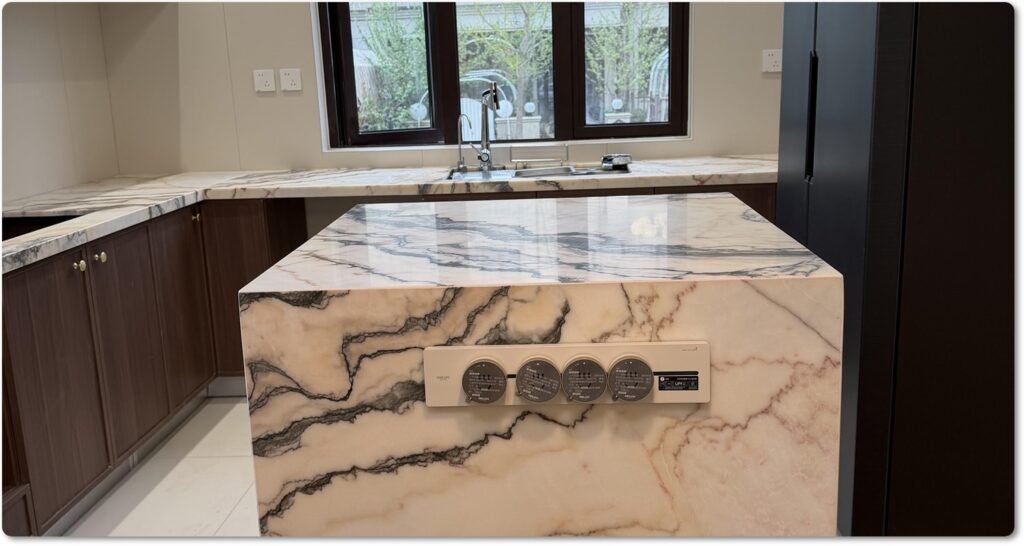
Commercial marble names often refer to particular geological varieties, quarry sources, or established market descriptions. However, a commercial name alone does not guarantee identical color, veining, mineral composition, or physical properties.
Commonly specified marble varieties include:
Carrara White Marble.
Calacatta White Marble.
Calacatta Gold Marble.
Statuario Marble.
Arabescato Marble.
Volakas White Marble.
Nero Marquina Black Marble.
Green Marble varieties.
Beige and Crema Marfil Marble.
Buyers should provide the following information:
Commercial marble name.
Preferred origin or quarry, if applicable.
Main background color.
Veining pattern and intensity.
Acceptable natural variation.
Surface treatment and repair expectations.
Reference slab photographs or an approved physical sample.
Natural Marble Grade and Acceptance Criteria
Natural marble should not be evaluated using the same assumptions as factory-produced uniform materials.
Variation in mineral composition, veins, color bands, fissures, and texture is inherent in natural stone.
A supplier’s internal grade designation, such as A, B, or commercial grade, should not be treated as a universal international classification unless its grading criteria are explicitly documented.
A better procurement approach is to establish measurable acceptance criteria:
Acceptable color range.
Vein direction and visual characteristics.
Permitted natural fissures.
Visible repairs and resin treatment.
Surface defects and polishing consistency.
Structural integrity and intended application suitability.
For technical reference, ASTM C503/C503M-22 covers marble dimension stone characteristics, physical requirements, and sampling for general building and structural purposes. Buyers should verify the currently applicable edition and specify the relevant test requirements in the contract.
Importantly, compliance with a material specification does not automatically establish that every finished countertop meets a project’s appearance or fabrication requirements.
3.2 Dimensions, Thickness, and Dimensional Tolerances
Accurate dimensions are essential for countertop installation.
The RFQ should identify:
Finished length and width.
Nominal and actual thickness.
Number of countertop pieces.
Individual component identification.
Backsplash height and thickness.
Island dimensions.
Cutout dimensions and locations.
Finished edge requirements.
Standard Thickness Considerations
Commonly requested nominal thicknesses include:
| Nominal thickness | Typical procurement application |
|---|---|
| 12 mm | Selected lightweight applications and engineered assemblies, subject to design approval. |
| 20 mm | Common residential and commercial countertop specifications. |
| 30 mm | Heavier countertop designs and projects requiring a substantial visual profile. |
| Custom thickness | Special architectural and hospitality requirements. |
These are commercial specification options, not a guarantee that every marble variety or installation design is suitable at every thickness.
Actual thickness must be confirmed against material availability, structural design, fabrication methods, support conditions, and installation requirements.
How to Specify Dimensional Tolerances?
Do not simply write “standard tolerance” in an RFQ.
Instead, specify acceptable deviations for:
Length.
Width.
Thickness.
Diagonal measurements.
Flatness.
Edge straightness.
Cutout dimensions.
Cutout positioning.
Corner squareness.
For example:
| Inspection item | Project requirement |
|---|---|
| Length | Buyer-defined tolerance |
| Width | Buyer-defined tolerance |
| Thickness | Buyer-defined tolerance |
| Flatness | Buyer-defined limit |
| Sink cutout | Approved drawing |
| Faucet hole | Approved drawing |
| Edge profile | Approved sample or drawing |
A numerical tolerance should be agreed upon by the buyer and manufacturer based on product dimensions, material characteristics, manufacturing capability, and installation requirements.
3.3 Surface Finish and Edge Profile
The surface finish influences appearance, maintenance, and performance.
Common marble countertop finishes include:
Polished Finish
A reflective finish that emphasizes marble color and veining. It is frequently specified for kitchens, hotel vanities, and decorative interior applications.
Honed Finish
A smooth, low-reflective surface with a more understated appearance.
Leathered or Textured Finish
A textured surface that creates a different tactile and visual effect. Availability depends on the stone variety and processing equipment.
The RFQ should also define the edge profile.
Typical options include:
Eased edge.
Straight edge.
Pencil edge.
Beveled edge.
Bullnose edge.
Half bullnose.
Ogee edge.
Custom CNC edge profiles.
Mitered edges.
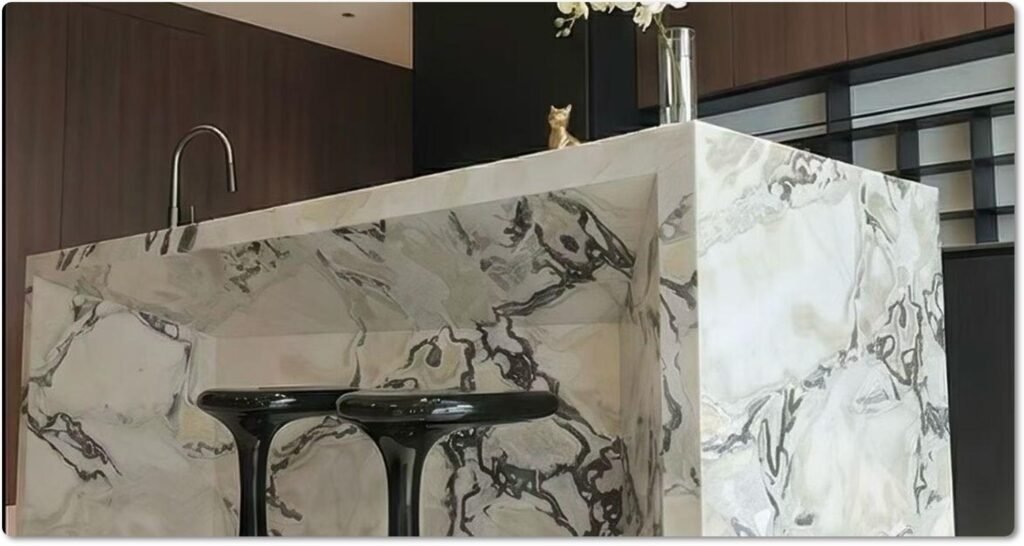
For waterfall islands and thick-profile designs, the RFQ should clarify whether the visible edge is a solid thick section or a mitered assembly.
3.4 Sink Cutouts, Faucet Holes, and Other Fabrication
Fabrication details can significantly affect the final quotation.
A countertop RFQ should identify:
Undermount sink cutouts.
Top-mount sink openings.
Integrated sink requirements.
Faucet holes.
Soap dispenser holes.
Cooktop openings.
Electrical outlet openings.
Drainboard grooves.
Decorative grooves.
Backsplash fabrication.
Mitered corners.
Waterjet patterns.
Special CNC machining.
For every cutout, provide:
Finished opening dimensions.
Corner radius.
Distance from the finished edges.
Sink or appliance model.
Required edge treatment.
Relevant reinforcement or support details.
A sink cutout should not be fabricated from approximate measurements when an approved sink template or manufacturer’s technical drawing is available.
The buyer should also specify whether the sink is supplied by the countertop manufacturer or purchased separately.
3.5 Drawings, Templates, and Installation Requirements
Professional Marble Countertops Manufacturers should receive sufficient technical information before confirming production feasibility.
Preferred documents include:
CAD drawings in DWG or DXF format.
Dimensioned PDF drawings.
Countertop layout drawings.
Sink and appliance specifications.
Installation details.
Site measurement records.
Project photographs.
Component numbering schedules.
Drawing Approval Workflow
A practical approval sequence is:
Buyer submits drawings and specifications.
Manufacturer reviews dimensions and fabrication feasibility.
Manufacturer identifies missing information or potential conflicts.
Revised shop drawings are submitted where required.
Buyer confirms the final production drawings.
Production begins only after documented approval.
For complex projects, each countertop should have a unique identification number that corresponds to its drawing, inspection record, and packaging label.
This reduces confusion when hundreds of components are delivered to a construction site.
3.6 Quantity, Packaging, and Delivery Destination
A complete RFQ must include the estimated quantity.
The quantity should be divided into meaningful product categories.
For example:
| Product category | Quantity | Unit |
|---|---|---|
| Kitchen countertops | 120 | Sets |
| Kitchen islands | 40 | Pieces |
| Bathroom vanity tops | 180 | Pieces |
| Backsplashes | 180 | Pieces |
| Custom components | As scheduled | Pieces |
For large projects, attach a detailed Bill of Quantities (BOQ).
Export Packaging Requirements
Natural marble is heavy and can be vulnerable to impact, edge damage, vibration, and improper handling.
A professional packaging plan may include:
Protective surface covering.
Foam or suitable cushioning materials.
Edge and corner protection.
Individual separation between finished components.
Custom wooden crates or A-frames, as appropriate.
Internal bracing and load restraint.
Moisture protection where required.
Shipping marks and identification labels.
Container loading photographs.
Packing lists and crate numbering.
The buyer should confirm whether the packaging must comply with the destination market’s import and wood-packaging requirements.
For international shipments using solid wood packaging, ISPM 15 requirements should be checked. Where applicable, wood packaging must meet the prescribed treatment and marking requirements.
The shipping quotation should state whether packaging, container loading, and export documentation are included.
4. Cost and Risk Factors: Understanding Marble Countertops Pricing
4.1 What Determines Marble Countertops Prices?
Marble countertop prices are not determined by stone type alone.
The final quotation may include:
Raw marble material cost.
Material selection and slab yield.
Cutting and sizing.
Edge processing.
Sink and appliance cutouts.
CNC or waterjet fabrication.
Surface finishing.
Reinforcement and assembly.
Quality inspection.
Export packaging.
Inland transportation.
Export handling and documentation.
International freight and insurance, where applicable.
A useful purchasing model is:
Total Procurement Cost = Product Cost + Fabrication Cost + Packaging Cost + Export Logistics + International Freight + Insurance + Import Charges + Local Delivery + Installation-Related Costs
Not every quotation includes every cost category.
Buyers should therefore distinguish between factory prices, export prices, shipping-inclusive prices, and fully landed project costs.
4.2 How to Compare EXW, FOB, and CIF Quotations?
International marble countertop buyers frequently receive quotations using different Incoterms.
The most important rule is to identify the exact Incoterms version and named location.
| Incoterm | Seller’s main responsibility | Buyer’s main responsibility |
|---|---|---|
| EXW | Makes goods available at the named premises. | Arranges collection, export/import formalities, and transportation as applicable. |
| FOB | Delivers goods on board the vessel at the named port of shipment and completes export clearance. | Arranges main ocean freight, insurance if desired, and import procedures. |
| CIF | Arranges and pays ocean freight and obtains the required minimum insurance to the named destination port. | Handles import clearance, duties, and subsequent delivery. |
Important: Under CIF, risk transfers when the goods are loaded on board the vessel at the port of shipment, not when the goods arrive at the destination port.
Furthermore, CIF is intended for sea and inland waterway transport. For containerized shipments handed over at a container terminal before vessel loading, FCA may be more appropriate than FOB, depending on the actual delivery arrangement.
For procurement contracts, write the complete term, for example:
EXW EDG Stone Factory, China, Incoterms® 2020.
FOB Xiamen Port, China, Incoterms® 2020.
CIF Vancouver Port, Canada, Incoterms® 2020.
Always confirm the named place or port, cargo insurance coverage, loading responsibilities, and the actual delivery point.
4.3 Hidden Costs and Commercial Risks
A low factory quotation does not necessarily represent the lowest total procurement cost.
Potential additional expenses include:
Additional material selection.
Replacement pieces caused by approved quality failures.
Special crating.
Port handling.
Container detention and demurrage.
Customs inspection.
Import duties and taxes.
Local unloading equipment.
Storage and site delivery.
Project delays caused by drawing revisions.
A buyer should request a written breakdown of included and excluded costs before comparing suppliers.
4.4 Marble Countertops MOQ and Lead Time
MOQ and lead time depend on the product and manufacturing arrangement.
For example, a standard vanity top using readily available material may have different production requirements from a large hotel project involving several marble varieties, custom edge profiles, and hundreds of individually dimensioned components.
Factors affecting MOQ include:
Availability of the selected marble.
Required slab selection.
Production setup.
Custom tooling.
Packaging requirements.
Order quantity.
Factory scheduling.
Factors affecting lead time include:
Drawing approval.
Material procurement.
Slab selection.
Fabrication complexity.
Production capacity.
Inspection and rework.
Packaging.
Export booking and shipping schedules.
A reliable supplier should distinguish between:
Material Preparation Time: Time needed to source and approve the required stone.
Production Lead Time: Time needed for cutting, fabrication, finishing, and inspection.
Shipment Preparation Time: Time needed for packaging, documentation, and container loading.
Transit Time: Time required for transportation to the destination.
These periods should not be combined into one unqualified delivery promise.
4.5 Payment Terms and Contractual Protection
Payment terms should be negotiated according to the supplier relationship, order size, project risk, and commercial agreement.
The purchase contract should clearly establish:
Deposit requirements.
Production milestone payments.
Balance payment conditions.
Inspection rights.
Ownership and risk provisions.
Delivery schedule.
Claims and replacement procedures.
Cancellation and modification conditions.
Avoid making the final payment dependent on vague language such as “satisfactory quality.”
Instead, define objective inspection criteria, approved reference samples, documentation, and agreed inspection procedures.

5. Procurement Checklist: A Step-by-Step RFQ Process
A structured procurement process reduces quotation errors and production disputes.
Step 1: Define the Project Scope
Identify the project type, total quantity, required product categories, and final delivery destination.
Determine whether the purchase involves slabs, finished countertops, vanity tops, or complete fabricated packages.
Step 2: Establish Material Requirements
Select the marble variety, preferred appearance, origin requirements, and acceptable natural variation.
Attach reference photographs or physical sample information.
Step 3: Prepare Technical Drawings
Provide dimensioned drawings, sink specifications, appliance cutouts, edge details, and installation requirements.
Step 4: Establish Quality Requirements
Specify material acceptance, surface quality, repairs, dimensional tolerances, and inspection procedures.
Step 5: Define Packaging and Shipping
Identify the packaging method, shipping marks, destination port, unloading requirements, and preferred Incoterm.
Step 6: Request Comparable Quotations
Send the same RFQ package to all shortlisted manufacturers.
Ask suppliers to identify exclusions and assumptions.
Step 7: Review Supplier Capabilities
Evaluate factory production, fabrication machinery, quality control, project experience, packaging, and export capabilities.
Step 8: Approve Samples and Drawings
Confirm the selected material, finish, edge profile, and final fabrication drawings.
Step 9: Release Production
Issue a written purchase order and production authorization after all technical and commercial requirements are confirmed.
Step 10: Inspect and Arrange Shipment
Review production records, conduct agreed inspections, verify packaging, and approve shipment documentation.
6. Supplier Evaluation: How to Compare Marble Countertops Manufacturers?
6.1 Manufacturer vs. Trading Company vs. Local Fabricator
Not every supplier offers the same operational capabilities.
| Supplier type | Main advantages | Procurement considerations |
|---|---|---|
| Marble quarry | Direct access to selected raw materials. | May not offer finished countertop fabrication. |
| Slab supplier | Material selection and slab inventory. | Finished fabrication may require another supplier. |
| Stone manufacturer | Integrated or coordinated manufacturing and processing. | Verify actual factory capabilities and subcontracting. |
| Trading company | Sourcing flexibility and commercial coordination. | Verify production control and quality accountability. |
| Local fabricator | Site measurement, local installation, and after-sales coordination. | Material sourcing and project pricing may differ. |
A factory-direct sourcing model can improve communication between material selection and fabrication, but the buyer must still verify the manufacturer’s actual production responsibilities.
6.2 What Documents Should a Manufacturer Provide?
Depending on the project, request:
Company and factory profile.
Business registration information.
Factory production photographs or inspection access.
Product specifications.
Material sample records.
Relevant stone test reports.
Quality inspection procedures.
Packaging specifications.
Previous project references, where available.
Export documentation examples.
Written commercial quotation.
Technical documents should identify the material tested, test method, issuing laboratory, test date, and relevant results.
A test report for one marble variety should not automatically be used as proof for another variety.
6.3 Marble Countertops Supplier Comparison Matrix
Use the following matrix to compare competing offers.
| Evaluation item | Supplier A | Supplier B | EDG Stone |
|---|---|---|---|
| Stone type and specifications | To be completed | To be completed | Based on actual quotation |
| Sample and vein approval | To be completed | To be completed | Based on agreed approval process |
| Fabrication scope | To be completed | To be completed | Based on actual quotation |
| Packaging method | To be completed | To be completed | Based on agreed packaging plan |
| MOQ | To be completed | To be completed | Confirmed by RFQ |
| Production lead time | To be completed | To be completed | Confirmed by RFQ |
| Incoterm | To be completed | To be completed | Clearly specified in quotation |
| International freight | To be completed | To be completed | Confirmed by destination |
| Inspection procedure | To be completed | To be completed | Agreed before production |
| After-sales and claims | To be completed | To be completed | Subject to contract |
EDG Stone’s commercial and technical entries should be completed using the actual quotation and agreed project conditions. Buyers should not treat unconfirmed MOQ, production time, freight, or warranty terms as fixed commitments.
6.4 A Weighted Supplier Evaluation Model
For larger procurement projects, buyers can use a weighted scoring model.
| Evaluation category | Suggested weight |
|---|---|
| Material quality and consistency | 20% |
| Fabrication capabilities | 20% |
| Quality control and inspection | 15% |
| Packaging and export experience | 15% |
| Price competitiveness | 15% |
| Lead time and production planning | 10% |
| Communication and documentation | 5% |
| Total | 100% |
Score each supplier from 1 to 5.
Weighted score = (Supplier score ÷ 5) × Category weight.
The weights are a suggested procurement framework, not an industry standard. Buyers should adjust them according to project priorities.
For a luxury hotel project, material appearance and quality inspection may deserve greater weight. For a large residential development, dimensional consistency, delivery scheduling, and packaging may become more important.

7. Regulatory and Standards Considerations for International Buyers
International procurement should account for destination-specific technical and legal requirements.
7.1 ASTM Standards for Marble Dimension Stone
ASTM C503/C503M addresses marble dimension stone and provides a technical reference for material characteristics, physical requirements, and sampling.
Other relevant dimension stone testing methods may include:
ASTM C97/C97M: Absorption and bulk specific gravity.
ASTM C99/C99M: Modulus of rupture.
ASTM C170/C170M: Compressive strength.
ASTM C880/C880M: Flexural strength.
ASTM C1353/C1353M: Abrasion resistance by the Taber Abraser method.
The applicable test methods should be selected according to the intended application and material.
Not every test is required for every countertop purchase. A project specification should identify which tests are necessary, whether existing reports are acceptable, and whether new testing is required.
7.2 OSHA Respirable Crystalline Silica Requirements
Stone cutting and fabrication can generate respirable crystalline silica, depending on the mineral composition of the stone and the processing operation.
In the United States, OSHA regulates occupational exposure under:
29 CFR 1910.1053 for general industry.
29 CFR 1926.1153 for construction.
These standards include exposure assessment, engineering and work-practice controls, housekeeping, training, and other applicable protective measures.
The permissible exposure limit is 50 micrograms per cubic meter of air as an eight-hour time-weighted average.
For buyers sourcing countertops from manufacturers, this creates an important supplier evaluation consideration: ask about wet processing, dust extraction, worker protection, and applicable workplace safety procedures.
OSHA obligations apply to covered employers and workplaces, rather than automatically becoming product certification requirements for imported marble countertops.
7.3 European Union Construction Products Regulation
Regulation (EU) 2024/3110 revises the EU Construction Products Regulation framework.
It entered into force in January 2025, with its main application beginning on 8 January 2026.
However, the existence of the regulation does not mean that every marble countertop automatically requires the same declaration or CE marking.
The European Commission explains that CPR obligations depend on the relevant harmonised technical specification or European Assessment Document cited for the particular product family.
Importers should therefore verify the applicable product classification, intended use, harmonised technical specification, and current transition provisions before placing products on the EU market.
7.4 EU REACH and Material Information
Where applicable, buyers should also consider chemical-substance communication obligations under REACH.
For example, ECHA explains that suppliers of articles containing Candidate List substances above 0.1% weight by weight have information obligations under Article 33.
For natural marble countertops, this is not a blanket requirement for every stone product. The relevant assessment depends on the actual article, treatments, adhesives, coatings, and other substances involved.
Buyers should request appropriate material and treatment information when required by their destination market or project specifications.
8. Practical RFQ Template: Marble Countertops Request for Quotation
The following template can be copied directly into an email or purchasing document.
REQUEST FOR QUOTATION (RFQ)
Natural Marble Countertops
1. Buyer Information
Company Name:
Contact Person:
Country / Destination:
Email:
Company Website:
2. Project Information
Project Name:
Project Type: Residential / Hospitality / Commercial / Distribution
Estimated Order Quantity:
Required Delivery Date:
3. Material Specifications
Marble Type / Commercial Name:
Preferred Color and Veining:
Origin Preference, if applicable:
Reference Images or Approved Sample:
Surface Finish:
Material Selection Requirements:
4. Product Specifications
Product Dimensions:
Thickness:
Edge Profile:
Sink Cutouts:
Faucet Holes:
Backsplash Requirements:
Special Fabrication:
Required Dimensional Tolerances:
5. Technical Documents
CAD / PDF Drawings Attached: Yes / No
Installation Drawings Available: Yes / No
Sample Approval Required: Yes / No
Inspection Requirements:
6. Packaging and Shipping
Packaging Requirements:
Delivery Address or Destination Port:
Preferred Incoterm and Named Place / Port:
Customs or Import Documentation Requirements:
7. Commercial Requirements
Requested Quotation Currency:
Target Delivery Schedule:
Requested MOQ:
Payment Terms for Quotation:
Warranty and Claims Requirements:
8. Additional Information
Project Photos:
Special Requirements:
Questions for the Manufacturer:
Please provide a quotation with clearly stated product specifications, pricing basis, MOQ, estimated production lead time, packaging details, shipping assumptions, and quotation validity.
8.1 What Should a Professional Manufacturer Include in the Quotation?
A complete quotation should include:
Product description and marble identification.
Material selection assumptions.
Finished dimensions and thickness.
Surface finish and edge profile.
Fabrication scope.
Unit price and total price.
Currency and quotation validity.
MOQ, if applicable.
Estimated production lead time.
Packaging specifications.
Incoterm and named location.
Freight and insurance, where applicable.
Payment conditions.
Inspection and claims provisions.
A supplier that identifies missing technical information before quoting is often providing a more useful commercial service than one that submits an unsupported price immediately.
9. Sample Approval and Production Release
Sample approval is an important control point in natural stone procurement.
However, buyers should understand that a small sample cannot fully represent the appearance of an entire production batch.
9.1 Material Sample Approval
The buyer should confirm:
Background color.
Vein characteristics.
Surface finish.
Visible natural variation.
Permitted repairs.
General appearance.
For large orders, request photographs of the actual selected slabs or a documented slab-selection process.
Where visual consistency is essential, establish a reference range rather than requiring every natural stone piece to look identical.
9.2 Production Drawing Approval
Before production, verify:
All dimensions.
Thickness.
Cutout locations.
Edge details.
Backsplash specifications.
Component numbering.
Installation orientation.
Any subsequent revision should be documented and its effect on cost and lead time evaluated.
9.3 Pre-Shipment Inspection
The inspection plan should define the sample size, inspection timing, acceptance criteria, and documentation requirements.
Recommended inspection points include:
Material inspection
Marble identity and visual characteristics.
Surface defects and repairs.
Material thickness.
Fabrication inspection
Finished dimensions.
Cutout position.
Edge profile.
Polishing quality.
Visible damage.
Packaging inspection
Protection of finished surfaces.
Edge and corner protection.
Crate condition.
Product identification.
Loading arrangement.
For large projects, inspection records should be linked to component numbers and packing lists.

10. Frequently Asked Questions: Marble Countertops Procurement
Q1. How do I request a quotation from a marble countertops manufacturer?
Prepare a detailed RFQ containing the marble type, dimensions, thickness, surface finish, edge profile, fabrication requirements, order quantity, destination, and delivery schedule. Attach CAD or PDF drawings and reference photographs wherever possible. Request a written quotation that identifies pricing, MOQ, lead time, packaging, Incoterms, and exclusions.
Q2. What is the MOQ for marble countertops from a factory?
There is no universal MOQ for marble countertops. It depends on material availability, production arrangements, fabrication complexity, and packaging requirements. Some manufacturers may evaluate small customized orders individually, while bulk projects require more detailed production planning. Request a project-specific MOQ from the factory.
Q3. How long does it take to manufacture marble countertops?
Production lead time depends on material preparation, drawing approval, slab selection, fabrication complexity, inspection, and packaging. Buyers should request separate estimates for material preparation, production, shipment readiness, and ocean transit instead of relying on one general delivery estimate.
Q4. How can I compare marble countertop wholesale prices from different suppliers?
Send the same RFQ and technical documents to every supplier. Compare material specifications, fabrication scope, dimensional tolerances, packaging, MOQ, lead time, Incoterms, freight, insurance, and payment terms. Calculate the total landed procurement cost rather than comparing factory unit prices alone.
Q5. Is buying marble countertops directly from a manufacturer cheaper?
Factory-direct sourcing may reduce intermediary costs and improve communication between material selection and fabrication. However, the final commercial advantage depends on order quantity, shipping, import duties, packaging, quality control, and local installation requirements. Buyers should compare the total landed cost and verify the manufacturer’s actual production capabilities.
11. References and Technical Resources
The following sources provide authoritative technical, regulatory, and commercial references for international stone procurement.
U.S. Geological Survey (USGS) — Dimension Stone Statistics and Information. Provides information about dimension stone supply, demand, production, and industry statistics.
https://www.usgs.gov/centers/national-minerals-information-center/dimension-stone-statistics-and-informationASTM International — ASTM C503/C503M-22, Standard Specification for Marble Dimension Stone.
https://store.astm.org/c0503_c0503m-22.htmlASTM International — ASTM C1242, Standard Guide for Selection, Design, and Installation of Dimension Stone Attachment Systems.
https://store.astm.org/c1242-12ae01.htmlOccupational Safety and Health Administration (OSHA) — 29 CFR 1926.1153, Respirable Crystalline Silica in Construction.
https://www.osha.gov/laws-regs/regulations/standardnumber/1926/1926.1153Occupational Safety and Health Administration (OSHA) — 29 CFR 1910.1053, Respirable Crystalline Silica in General Industry.
https://www.osha.gov/laws-regs/regulations/standardnumber/1910/1910.1053European Commission — Construction Products Regulation Overview, including Regulation (EU) 2024/3110.
https://single-market-economy.ec.europa.eu/sectors/construction/construction-products-regulation-cpr/cpr-overview_enEuropean Chemicals Agency (ECHA) — REACH Candidate List Obligations.
https://echa.europa.eu/candidate-list-obligationsInternational Chamber of Commerce (ICC) — Incoterms® 2020 Rules and Guidance.
https://library.iccwbo.org/clp/clp-incoterms-qa-2020.htmICC Digital Library — Incoterms® 2020 Checklist and Flowcharts.
https://library.iccwbo.org/content/clp/Others/incoterms_2020_checklist_2024-update.pdfInternational Plant Protection Convention (IPPC) — ISPM 15: Regulation of Wood Packaging Material in International Trade.
https://www.ippc.int/
Standards and regulatory requirements should be checked against the latest applicable editions and destination-country rules before contract execution. This article provides general procurement guidance and does not replace project-specific engineering, legal, customs, or regulatory advice.
12. EDG Stone CTA: Submit Your Marble Countertops RFQ
Source Marble Countertops Directly from an Experienced Chinese Manufacturer and Exporter
Choosing the right marble countertops manufacturer is not simply about finding the lowest price. It is about establishing a dependable supply relationship that supports material selection, customized fabrication, quality inspection, export packaging, and international project delivery.
EDG Stone specializes in natural stone products, including marble countertops, marble vanity tops, stone slabs, and customized fabrication for international customers.
Our product and fabrication capabilities cover a range of natural stone materials and customized applications, subject to material availability and project requirements.
Whether you are sourcing countertops for a residential development, hotel project, commercial building, cabinet brand, or wholesale distribution business, submitting a complete RFQ helps us understand your requirements and evaluate the appropriate production solution.
What to Send EDG Stone for a More Accurate Quotation
Marble type, commercial name, or reference photographs.
CAD, DWG, DXF, or PDF drawings.
Bill of Quantities (BOQ) or estimated order quantity.
Required dimensions, thickness, and edge profiles.
Sink and appliance cutout specifications.
Surface finish and material selection requirements.
Packaging requirements and destination port.
Preferred Incoterm and target delivery date.
Why Include EDG Stone in Your Supplier Evaluation?
Chinese natural stone manufacturer and exporter.
Marble slabs and customized countertop fabrication.
CNC, waterjet, cutting, and edge processing capabilities.
Customized solutions for residential and commercial projects.
Export packaging and international shipping coordination.
Project-specific quotations based on drawings and quantities.
Submit Your Marble Countertops RFQ to EDG Stone
Request a Project-Specific Quotation
Send your drawings, quantity list, reference images, and destination information to EDG Stone.
Our team can review your requirements and provide a quotation based on the actual material, fabrication scope, order quantity, and shipping arrangements.
CTA BUTTON: Submit Your Marble Countertops RFQ
Secondary CTA: Explore EDG Stone Countertops & Custom Fabrication
Website: https://www.edgstone.com/
13. Semantic Intelligence: Marble Countertops Procurement Insights for Global Buyers
Marble Countertops Procurement: Global Sourcing, Manufacturing, and Purchasing Intelligence
What Defines a Successful Marble Countertops Procurement Strategy?
A successful marble countertops procurement strategy integrates five connected decisions: material suitability, manufacturing feasibility, dimensional accuracy, commercial transparency, and logistics planning. Buyers should evaluate the complete supply chain rather than treating marble countertops as standardized finished goods. Natural stone variation, fabrication complexity, and project-specific installation conditions make documented specifications and approval procedures essential.
How Should Buyers Choose Between Local Fabricators and Overseas Manufacturers?
Local fabricators can offer advantages in site measurement, installation coordination, and local after-sales service. Overseas manufacturers may provide broader material sourcing options, factory-based fabrication, and opportunities for bulk project production. The appropriate model depends on the project quantity, technical complexity, destination costs, and the buyer’s ability to coordinate installation.
A hybrid sourcing model is also possible: purchase customized countertops or stone components from an overseas factory and use local professionals for final site measurement, installation, and adjustments.
Why Is a Complete RFQ More Important Than a Low Initial Price?
An incomplete RFQ creates uncertainty. Suppliers may quote different marble selections, thicknesses, fabrication scopes, packaging levels, and delivery arrangements. Consequently, the lowest initial quotation may exclude costs that appear later.
A standardized RFQ creates a common commercial basis. It enables buyers to compare suppliers according to the same technical specifications and evaluate total procurement costs more accurately.
What Are the Main Purchasing Options?
Option A: Raw Slab Procurement
Suitable for buyers with established local fabrication capabilities, inventory facilities, or distribution networks. Purchasing decisions focus on slab selection, thickness, surface condition, quantity, and transportation.
Option B: Factory-Fabricated Countertops
Suitable for importers, cabinet manufacturers, developers, and project procurement teams seeking customized finished components. The RFQ must include drawings, dimensions, cutouts, edge profiles, packaging, and delivery requirements.
Option C: Project-Based Bulk Procurement
Suitable for hotels, multifamily developments, residential communities, and commercial construction. Purchasing decisions should incorporate BOQ management, batch consistency, component identification, phased production, inspection, and delivery scheduling.
What Should Buyers Consider Before Confirming an Order?
Material appearance should be approved before production. Fabrication drawings should be signed off before cutting. Commercial terms should distinguish product cost from freight and destination expenses. Packaging requirements should reflect the weight and fragility of finished stone components. Quality acceptance criteria should be documented rather than based on subjective descriptions.
For international buyers, compliance assessments should also consider applicable workplace safety requirements, product regulations, chemical-substance obligations, customs documentation, and wood packaging rules.
Where Is the Marble Countertops Supply Chain Heading?
The procurement process is increasingly influenced by traceability, standardized digital drawings, documented quality inspection, and more transparent supply-chain communication.
For buyers, this means that manufacturer evaluation is moving beyond the traditional questions of price and material availability. Production records, material identification, drawing revisions, inspection photographs, packaging records, and shipment documentation are becoming valuable purchasing controls.
For manufacturers and exporters, the ability to connect material selection, customized fabrication, quality control, and export logistics into one documented process can strengthen international B2B relationships.
Why Consider EDG Stone as a Factory-Direct Sourcing Partner?
EDG Stone provides natural stone products and customized fabrication for international buyers. Its product scope includes marble countertops, vanity tops, slabs, and project-specific stone components.
For buyers evaluating a Chinese marble countertops factory, EDG Stone can be included in the supplier comparison process through a formal RFQ. The most useful starting documents are the project drawings, material references, BOQ, fabrication specifications, and delivery destination.
The objective is not simply to obtain a price. It is to establish whether the manufacturer can meet the actual material, fabrication, quality, packaging, and commercial requirements of the project.
Final Procurement Insight
The most reliable marble countertop purchasing decision is based on verified specifications, approved samples, comparable quotations, documented quality requirements, and clearly allocated shipping responsibilities.
A complete RFQ transforms an initial supplier inquiry into a structured procurement process. It gives manufacturers the information needed to assess feasibility and gives buyers a more reliable basis for comparing prices, production capabilities, and supply-chain risks.
For international importers and project procurement teams, this is the foundation of a repeatable marble countertops sourcing strategy.