1. Executive Summary: What Marble Countertop Trends Mean for 2026 Procurement?
Marble countertops remain an important design option for residential kitchens, bathroom vanities, hospitality interiors, luxury residential developments, and selected commercial projects. Their appeal comes from natural mineral patterns, distinctive veining, variation between slabs, and the ability to coordinate a countertop with cabinetry, flooring, wall panels, and other interior materials.
For 2026, buyers should distinguish between documented design-industry findings and professional design interpretation.
The National Kitchen & Bath Association’s 2026 Kitchen Trends Report, released in September 2025, identified neutrals as popular among 96% of surveyed respondents, followed by greens at 86% and blues at 78%. The report also highlighted timeless or transitional interiors, minimalism, organic materials, and increasingly connected kitchen spaces. These findings provide useful context for evaluating marble color palettes, but they do not establish marble-specific sales rankings.
The 2026 U.S. Houzz Kitchen Trends Study, published in December 2025, reported marble in 3% of countertop material selections among homeowners undertaking kitchen renovations, compared with 32% for engineered quartz, 15% for granite, and 10% for quartzite. These figures describe the study’s reported renovation selections; they should not be interpreted as global market shares or forecasts of future marble demand.
Taken together, these sources suggest an important commercial distinction: natural stone can play a compelling role in design-led projects, but buyers should not assume that visual popularity automatically translates into the highest material sales.
For architects, interior designers, cabinet brands, furniture retailers, residential developers, and stone distributors, a more effective approach is to build a marble collection around clearly defined design applications.
Five practical directions for marble countertop selection
| Design direction | Visual characteristics | Potential applications | Main procurement consideration |
|---|---|---|---|
| White and cream marble | Light backgrounds, gray or beige veining | Kitchens, bathrooms, hospitality interiors | Slab consistency and undertone |
| Dramatic veining | Strong mineral movement and contrasting lines | Feature islands, reception counters, statement vanities | Vein placement and slab matching |
| Dark marble | Black, charcoal, deep brown, or dark green backgrounds | Bars, powder rooms, luxury interiors | Lighting, finish, and visible marks |
| Green and earth-tone marble | Botanical green, beige, warm brown, muted gold | Contemporary homes, boutique hospitality, furniture | Color coordination and lot variation |
| Coordinated surface finishes | Polished, honed, and other specified textures | Residential and commercial interiors | Maintenance, finish consistency, and acceptance criteria |
These categories are design-planning tools, not a ranking of sales volume.
Procurement conclusion: Choose marble by combining the desired visual effect with material suitability, slab availability, fabrication feasibility, maintenance requirements, and a documented approval process.
2. Scope and Definitions: Understanding the Marble Countertops Collection
2.1 What is a marble countertop?
A marble countertop is a fabricated stone surface made from marble slabs or other dimension-stone pieces. Depending on the project, the finished product may include cut-to-size panels, polished or honed surfaces, shaped edges, sink cutouts, faucet holes, backsplashes, and other custom features.
Natural marble is a geological material whose appearance and properties depend on its mineral composition, geological history, and subsequent processing. Its visual characteristics can include veins, mineral bands, color variation, and localized features that differ from one slab to another.
This natural variability is part of marble’s design appeal. It is also a reason to establish clear visual acceptance criteria before placing a large order.
2.2 Marble, quartzite, and engineered quartz are not interchangeable
These materials may appear similar in photographs, but they should not be treated as technically equivalent.
Natural marble: A carbonate stone, commonly dominated by calcite or dolomite, with characteristics that vary by geological type.
Natural quartzite: A metamorphic rock composed predominantly of interlocking quartz grains, although its composition and properties vary.
Engineered quartz: A manufactured composite material whose composition and performance depend on its formulation and production process.
A marble-look appearance does not establish a material’s geological identity. Where the specification requires natural marble, material identity should be confirmed through appropriate supplier documentation and, where necessary, testing.
2.3 What does a commercial Marble Countertops Collection include?
For a manufacturer, wholesaler, distributor, or project supplier, a collection should be more than a gallery of attractive photographs.
A commercially useful collection may organize products by:
Stone type and commercial material name.
Background color and undertone.
Veining intensity and direction.
Slab dimensions and thickness.
Available surface finishes.
Edge profiles and fabrication options.
Suitable interior applications.
Current stock or sourcing status, where verified.
Sample availability and lead-time conditions.
Project photographs and actual slab images, where available.
A collection structured this way helps design professionals move from inspiration to a specific, orderable product.
2.4 Intended applications and limitations
Marble countertops are commonly considered for kitchen islands, bathroom vanities, powder rooms, reception counters, hotel interiors, bars, and furniture surfaces.
However, not every marble is appropriate for every application. A material suitable for a lightly used vanity may not be the preferred option for a busy food-preparation area or an exposed exterior installation.
Selection must account for the actual stone, intended use, support conditions, fabrication details, maintenance plan, and applicable project requirements.
3. Technical Evaluation: Marble Countertop Design Directions for 2026
3.1 Direction One: White and Cream Marble
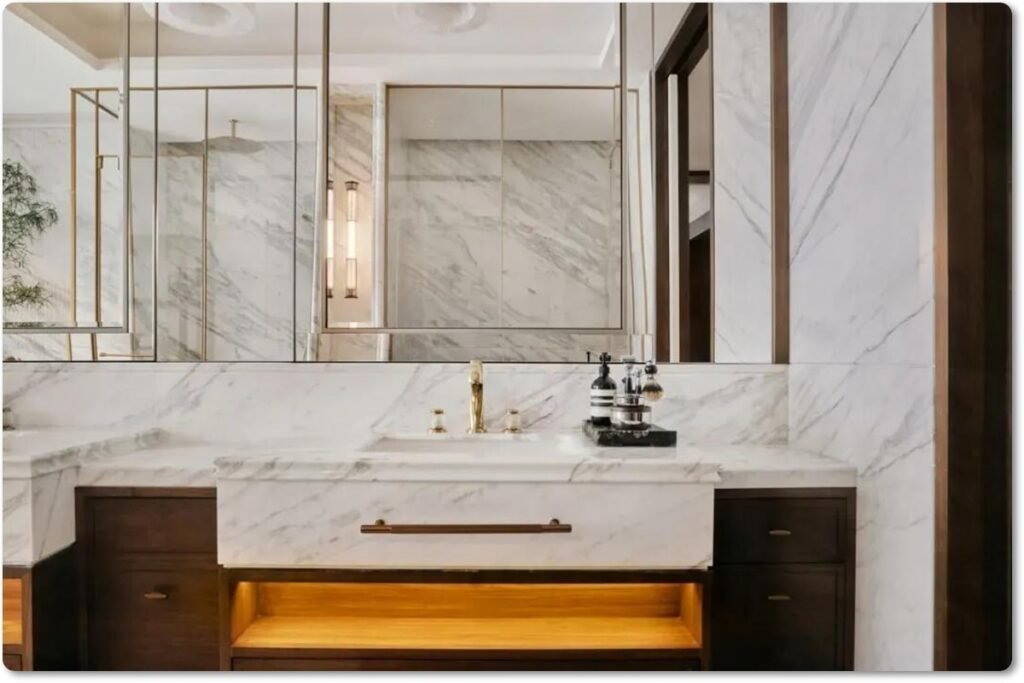
White and cream marble offer a flexible starting point for projects that require light, visually coherent interiors.
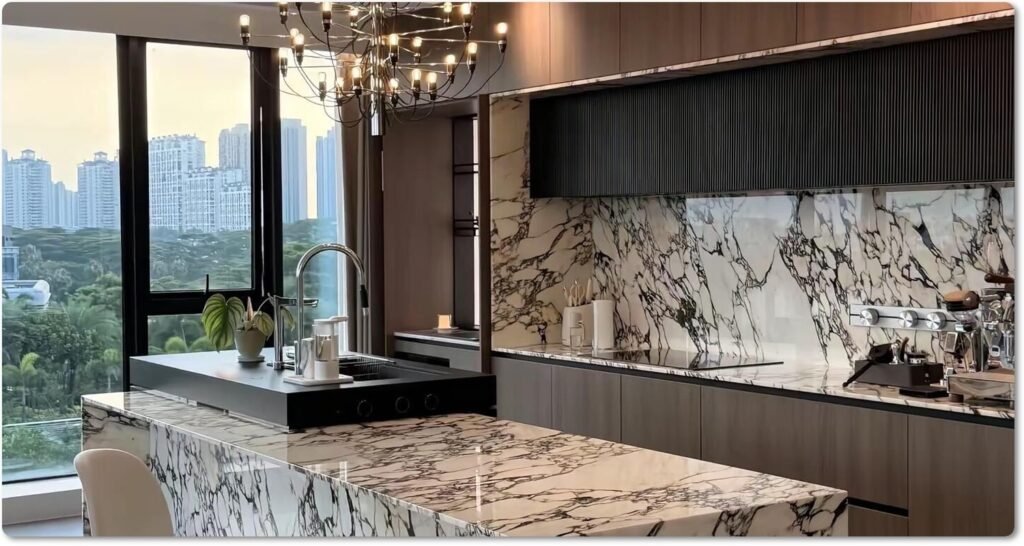
Examples of commercially recognized white marble families include Carrara, Calacatta, Statuario, Thassos, Volakas, and Arabescato. These names cover different materials and visual characteristics; they should not be treated as interchangeable grades or as guarantees of a specific appearance.
White marble for modern homes
White marble can work particularly well with:
Flat-panel cabinetry.
White oak and other warm wood tones.
Brushed-metal hardware.
Neutral wall colors.
Minimalist or transitional interiors.
Large islands where the countertop becomes a major visual surface.
Carrara-style materials often provide a softer gray-and-white appearance, while some Calacatta and Statuario selections feature stronger or more contrasting veins. Actual patterns vary by slab and source.
For commercial projects, the distinction between cool white, warm white, and creamy white is important. Two samples with similar names may look noticeably different under warm LED lighting, daylight, or adjacent wood finishes.
White marble procurement considerations
Request photographs of the actual slabs proposed for the project.
Confirm the background tone under consistent lighting.
Review vein density, direction, and any visible repairs.
Approve the intended slab range rather than relying only on a small sample.
Specify the finish and edge profile separately.
Establish acceptable variation before fabrication.
For a multi-unit development, white marble can create a consistent overall palette, but visual consistency should be defined in the purchasing specification rather than assumed from the material name.
3.2 Direction Two: Dramatic Veining and Bookmatched Designs
Expressive marble can turn a countertop into the central visual feature of a room.
Materials with pronounced veins, contrasting backgrounds, or broad mineral movement can be considered for kitchen islands, hospitality reception desks, luxury bathroom vanities, and feature counters.
Potential design references include selected Calacatta Gold, Calacatta Viola, Arabescato, and other naturally expressive marble varieties. These names describe broad commercial categories; the actual pattern must be evaluated from individual slabs.
What is bookmatching?
Bookmatching is a layout technique in which adjacent stone slabs or pieces are arranged to create a mirrored or visually related pattern.
It is not a property of the stone itself. The result depends on the slab sequence, cutting direction, vein orientation, and the fabricator’s layout plan.
Bookmatching may be suitable for:
Large waterfall islands.
Full-height backsplashes.
Reception counters.
Feature walls adjoining a countertop.
Oversized vanity installations.
Coordinated furniture and architectural surfaces.
How to specify a bookmatched countertop?
Step 1: Approve the slab sequence.
Request photographs showing the relevant slabs together, preferably with identification numbers.
Step 2: Confirm the layout.
Ask for a drawing showing the intended relationship between the veins and the finished countertop pieces.
Step 3: Review fabrication constraints.
Check slab dimensions, required overhangs, cutouts, seams, edge returns, and any structural reinforcement requirements.
Step 4: Confirm visual priorities.
Decide whether vein continuity, symmetry, background consistency, or the position of a particular mineral feature matters most.
Step 5: Approve the final layout before cutting.
Changes after cutting may create additional material waste and fabrication costs.
Bookmatching should be treated as a planned fabrication outcome, not as an automatic feature of purchasing two slabs of the same commercial stone name.
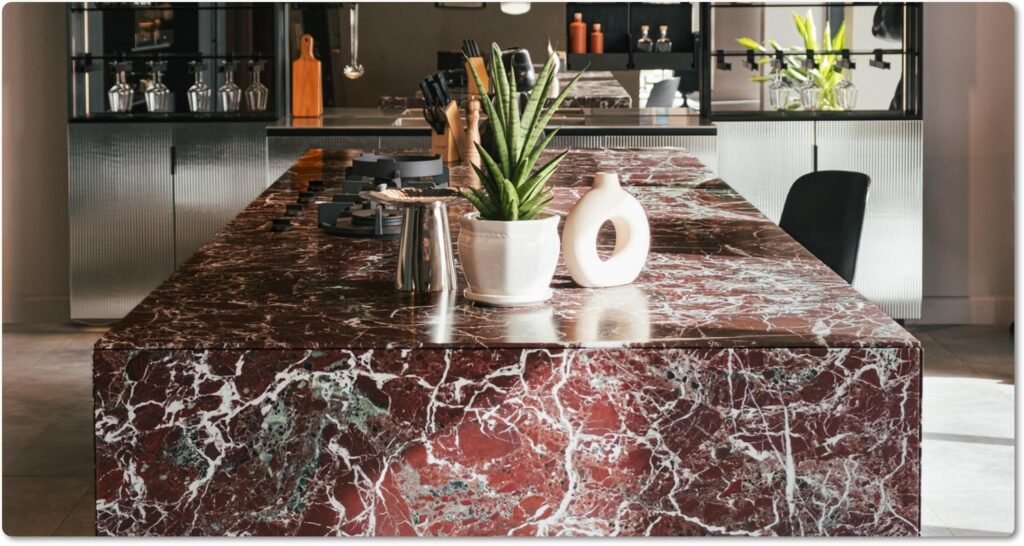
3.3 Direction Three: Dark Marble and High-Contrast Interiors
Dark marble can create depth and visual contrast in interiors built around light cabinetry, warm metals, natural wood, or restrained architectural detailing.
Potential applications include:
Bar counters.
Powder-room vanities.
Boutique hospitality interiors.
Reception desks.
Selected kitchen islands.
Accent furniture and display surfaces.
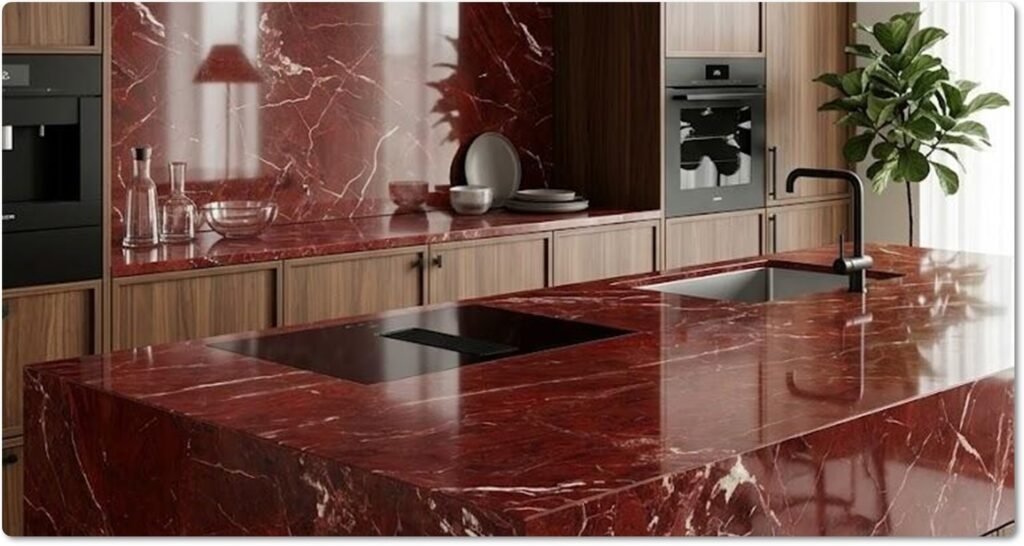
Black, charcoal, deep brown, and dark green marble varieties offer different visual effects. Some have fine, restrained veining; others contain prominent white or gold-colored mineral patterns.
Design advantages
Dark stone can anchor a light interior, define a focal point, or create a more intimate atmosphere. In a large kitchen, a dark island may visually separate the preparation area from surrounding cabinetry.
Technical considerations
Dark surfaces may make dust, fingerprints, dried water marks, and some surface scratches more noticeable, depending on the stone and finish.
Highly reflective dark stone may also reveal reflections, lighting inconsistencies, and surface defects more readily than a less reflective finish.
For these reasons, designers should review dark marble under the actual or representative lighting conditions of the project.
For commercial installations, the approval sample should include the specified finish and, ideally, a representative finished edge. A small polished sample is not sufficient to judge how a large honed or leather-textured surface will appear.
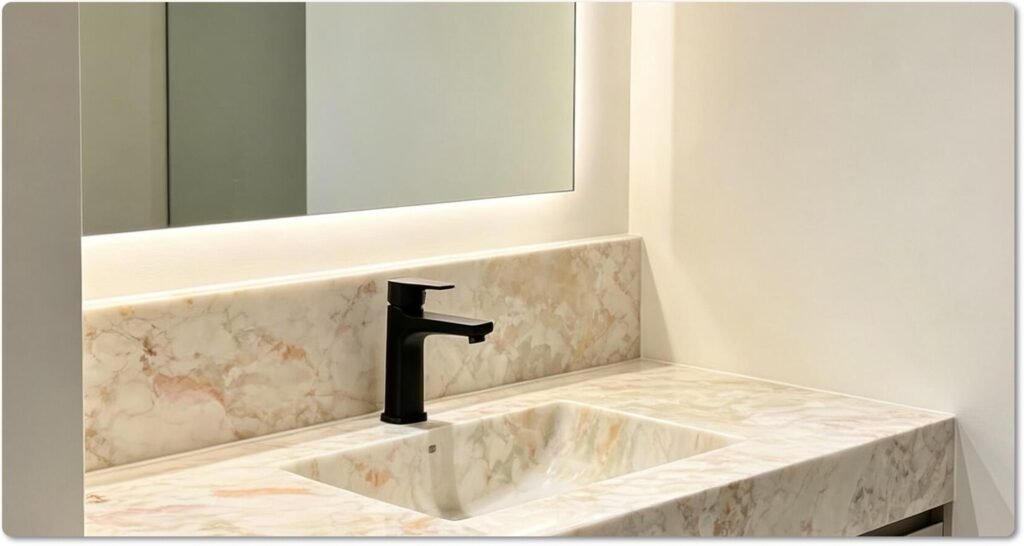
3.4 Direction Four: Green, Beige, and Earth-Tone Marble
Green and earth-tone palettes offer alternatives to the familiar white-and-gray combination.
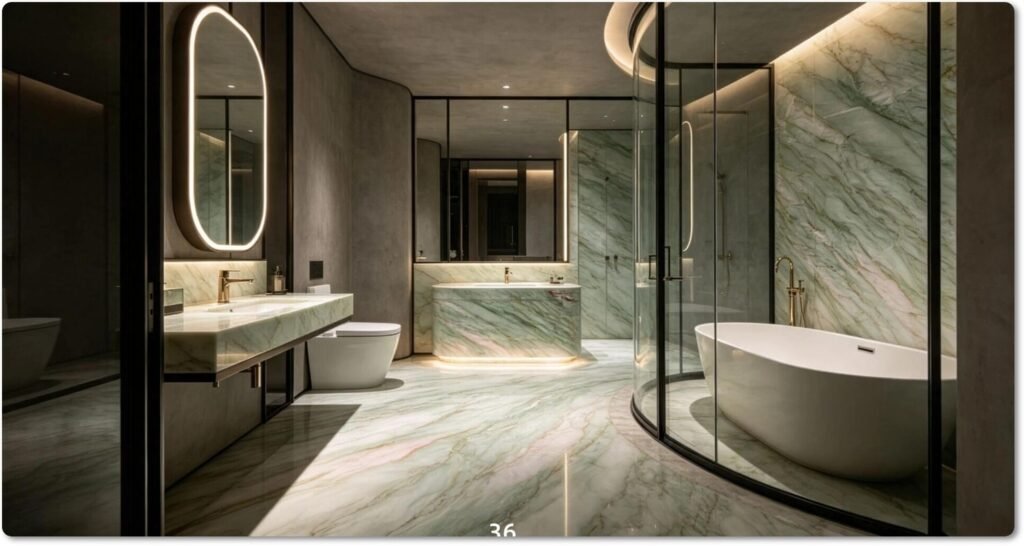
Green marble may include light sage tones, deep forest green, or darker backgrounds with white veining. Beige and brown marble may contain cream, sand, caramel, or muted gold tones.
These categories are useful for projects seeking a more organic material palette.
Green marble for modern interiors
Green stone can be paired with:
Natural oak or walnut cabinetry.
Cream-colored cabinets.
Brushed brass or bronze hardware.
Neutral plaster finishes.
Warm gray flooring.
Restrained decorative lighting.
For example, a deep green vanity top with warm wood cabinetry can create a strong contrast without relying on a highly reflective surface.
A pale green marble with subtle veining may instead support a softer, more understated design.
Beige and warm-toned marble
Beige marble can work with limestone-look flooring, warm white cabinetry, bronze fixtures, and natural wood.
For multi-unit residential projects, warm neutral stone can also provide an alternative to stark white while maintaining a coordinated overall appearance.
Why green does not automatically mean environmentally sustainable
Color and environmental performance are different considerations.
A green marble countertop is not automatically a more sustainable choice than a white or gray countertop. Environmental assessment may require information about quarrying, processing, transport, product yield, service life, maintenance, and end-of-life options.
Where sustainability is a project requirement, buyers should request relevant evidence rather than infer environmental benefits from a material’s color or natural origin.
3.5 Direction Five: Polished, Honed, and Other Surface Finishes
Surface finish changes the appearance of marble and affects how a countertop interacts with light, touch, and daily use.
| Finish | General appearance | Design applications | Key considerations |
|---|---|---|---|
| Polished | Smooth, reflective surface | Formal kitchens, statement islands, decorative vanities | Reflections and visible surface marks |
| Honed | Smooth, lower-reflectivity appearance | Contemporary kitchens, understated bathrooms | Surface may respond differently to spills and staining |
| Brushed or textured | More tactile surface, depending on process | Selected feature surfaces and design-led interiors | Texture consistency and cleaning requirements |
| Other specialty finishes | Varies by processing method | Custom furniture and architectural projects | Confirm terminology, process, and sample approval |
Finish names are not always used consistently by every supplier. Buyers should therefore request a physical sample or representative finished piece rather than relying on terminology alone.
Polished versus honed marble: Which is better?
Neither finish is universally superior.
Polished marble may emphasize color contrast and make some patterns appear more visually pronounced. Honed marble generally produces a softer, less reflective appearance.
The correct choice depends on the intended aesthetic, the particular stone, lighting conditions, maintenance expectations, and the client’s tolerance for visible wear.
A critical technical distinction is that sealing and surface finish do not eliminate marble’s susceptibility to acid etching. Acidic substances can react with carbonate minerals and alter the surface appearance. A penetrating sealer may help reduce certain forms of staining, but it does not make marble acid-proof.
For food-preparation areas, specify cleaning guidance, spill-response procedures, and maintenance expectations before approval.
3.6 Direction Six: Waterfall Islands and Integrated Visual Design
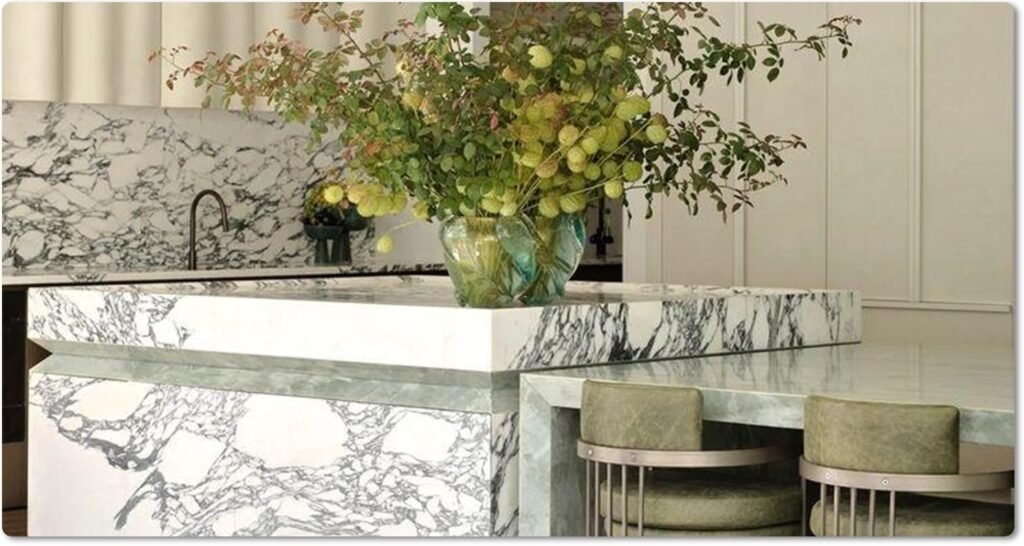
A waterfall island extends the countertop material vertically down one or both sides of the island.
This approach can make a stone surface appear more architectural and can bring the countertop material into closer visual relationship with cabinetry, flooring, and nearby wall finishes.
Fabrication considerations
A successful waterfall design requires more than choosing an attractive slab.
The fabricator must consider:
Slab size and usable yield.
Vein direction across horizontal and vertical pieces.
Corner geometry and seam visibility.
Edge treatment.
Cabinet dimensions and finished floor levels.
Support and attachment details.
Access for delivery and installation.
Protection during transportation and handling.
If the design requires vein continuity, the drawings should identify the intended relationship between the island top and the waterfall panels.
Natural variation may make perfect visual continuity impossible. The required appearance should therefore be discussed and approved before production.
Integrated backsplash design
A matching or coordinated marble backsplash can create visual continuity between the countertop and wall.
Options include using the same material, selecting a complementary slab, or choosing a contrasting surface that highlights the countertop.
For full-height backsplashes, consider electrical outlets, penetrations, joint locations, slab dimensions, installation access, and the position of prominent veins.
3.7 Direction Seven: Matching Marble with Cabinets, Flooring, and Backsplashes
A successful material palette considers how all major surfaces work together.
White marble and warm wood
White marble with soft gray veining can complement white oak, natural walnut, or other warm wood finishes. The combination can support contemporary, transitional, and Scandinavian-inspired interiors.
Cream marble and neutral cabinetry
Cream or beige marble can be paired with warm white cabinets, muted bronze hardware, and neutral flooring.
The principal risk is undertone mismatch. A strongly yellow cream stone may conflict with a cooler white cabinet even when both products are individually attractive.
Dark marble and light cabinets
A dark countertop can create a clear visual anchor against light cabinetry.
To avoid an overly heavy appearance, designers may balance the contrast with warm wood, lighter flooring, natural light, or restrained hardware.
Green marble and natural materials
Green marble can coordinate with wood, brass, bronze, cream, and selected warm gray surfaces. Because green stone varies substantially in hue, actual slab approval is especially important.
A practical coordination method
Use a three-part review:
Color: Compare undertones under consistent lighting.
Pattern: Decide which surface should be the visual focal point.
Texture: Ensure that reflective, matte, and tactile surfaces work together.
Avoid choosing countertop, cabinet, and backsplash samples independently. Review them together, preferably as a physical material board or a coordinated digital presentation supported by actual product photographs.
4. Technical Evaluation: Material Suitability, Fabrication, and Quality
Design appeal is only one component of countertop selection. A visually attractive slab must also be suitable for its intended use and fabrication method.
4.1 Material identification and physical properties
Where required by the project, buyers should request information on:
Geological or commercial material identification.
Water absorption and bulk specific gravity.
Flexural or modulus-of-rupture performance.
Compressive strength, where relevant.
Abrasion resistance, where applicable.
Visible cracks, open seams, repairs, and other material characteristics.
ASTM C503/C503M-23 is a specification for marble dimension stone covering relevant material characteristics, physical requirements, and sampling for its stated scope. ASTM C97/C97M addresses absorption and bulk specific gravity of dimension stone, while ASTM C99/C99M addresses modulus-of-rupture testing.
These standards do not replace project-specific countertop design, installation, or acceptance requirements. Buyers should verify the applicable edition, scope, and relevance of each standard before incorporating it into a contract.
4.2 Thickness, support, and structural design
Countertop thickness affects visual proportions, edge fabrication, weight, and material yield.
However, thickness alone does not establish structural suitability. Span, overhang, cutouts, stone characteristics, support spacing, attachment details, and installation conditions also matter.
Large overhangs and waterfall panels may require engineered support or reinforcement, depending on the design and material.
A qualified fabricator or project professional should review the relevant drawings and support conditions before production.
4.3 Cutouts and edge profiles
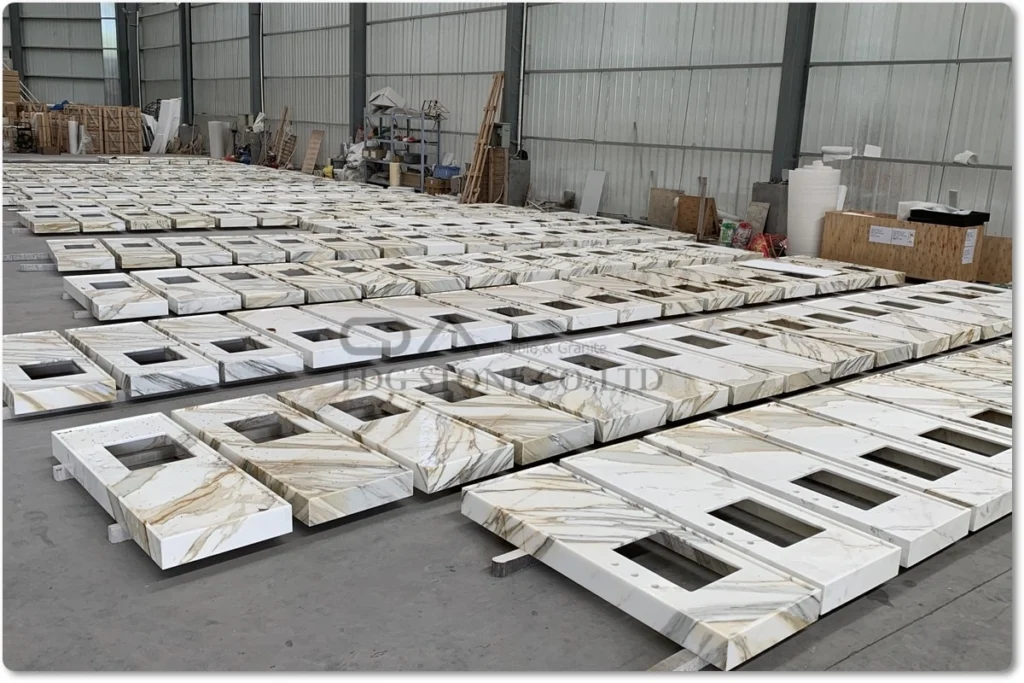
Common fabrication requirements include:
Sink cutouts.
Faucet holes.
Cooktop openings.
Straight, eased, beveled, or other specified edge profiles.
Mitered edges.
Drainage details where applicable.
Backsplash returns.
Finished ends and exposed edges.
The RFQ should specify dimensions, tolerances, edge profiles, and the relationship between drawings and approved samples.
A vague instruction such as “premium edge finish” is not a reliable acceptance criterion.
4.4 Visual quality and natural variation
Natural marble may contain veins, mineral bands, color shifts, and other geological features.
Quality inspection should distinguish between acceptable natural characteristics and conditions that affect the product’s suitability or agreed appearance.
Potential concerns include:
Cracks that affect structural integrity.
Open seams or unstable areas.
Poorly executed repairs.
Chips or damage to exposed edges.
Unacceptable surface defects.
Incorrect dimensions or cutout locations.
Finish inconsistency.
Vein placement that differs materially from the approved layout.
The acceptance criteria should be agreed upon before production and should account for the material’s natural characteristics.
5. Procurement Checklist: Turning Design Inspiration into Specifications
A design reference becomes commercially useful only when it can be translated into measurable requirements.
5.1 Define the project before selecting the slab
Start by documenting the intended application, quantity, dimensions, location, and use conditions.
For example, a single luxury kitchen island and a 100-unit residential development require different approval procedures, even when the same marble variety is specified.
A one-off installation may prioritize a particular slab and vein arrangement. A multi-unit project may prioritize repeatability, approved variation limits, production planning, and replacement availability.
5.2 Create a visual approval package
The approval package should include:
A photograph of the actual proposed slab.
A slab identification number, where available.
A full-slab image and closer views of relevant features.
The proposed cutting layout.
The approved finish.
Edge-profile details.
Any special vein-matching requirements.
Written acceptance criteria for natural variation.
Photographs should be labeled as actual product photographs or design illustrations. Rendered imagery should never be presented as evidence of available stock.
5.3 Confirm the technical specification
Before issuing a purchase order, confirm:
Material name and identification requirements.
Finished dimensions and tolerances.
Nominal thickness and permitted variation.
Surface finish.
Edge profile.
Cutouts and penetrations.
Seam and joint locations.
Support and installation requirements.
Inspection method.
Packaging and shipping requirements.
Where test results or material certifications are required, identify the applicable method, responsible party, and acceptance criteria.
5.4 Establish approval gates
A useful commercial process includes four checkpoints:
Gate 1 — Material approval: Confirm the stone type, color range, and intended application.
Gate 2 — Slab approval: Confirm actual slab appearance and any required vein arrangement.
Gate 3 — Fabrication approval: Review shop drawings, dimensions, cutouts, edges, and finished-piece layout.
Gate 4 — Pre-shipment inspection: Verify the finished products, packaging, identification, and relevant documentation.
This process reduces ambiguity between the design concept, purchased material, and delivered product.
6. Cost and Risk Factors: What Influences Marble Countertop Pricing?
Marble countertop pricing depends on more than the quoted price per square meter or square foot.
6.1 Material and slab selection
The commercial stone name, origin, visual characteristics, slab dimensions, thickness, and availability may affect pricing.
Particularly expressive slabs may require more time for selection and layout. A project that requires a specific vein arrangement may also generate more material waste than a straightforward rectangular countertop.
Prices should be compared using equivalent material specifications rather than names alone.
6.2 Fabrication complexity
Potential cost drivers include:
Cut-to-size requirements.
Complex edge profiles.
Mitered corners.
Waterfall panels.
Bookmatching.
Multiple cutouts.
Custom backsplashes.
Additional polishing or finishing.
Templates and shop drawings.
Special reinforcement or support details.
The impact of these factors depends on the design, fabrication facility, material yield, and order quantity. A supplier should explain which operations are included in the quotation.
6.3 Packaging, transport, and installation
International projects may involve crating, protective materials, handling, inland transport, export documentation, ocean freight, insurance, customs-related charges, destination handling, and final delivery.
Not every quotation includes all these items.
When comparing suppliers, specify the delivery basis and the point at which responsibility and costs transfer. For international sales, use the agreed Incoterms® rule and named place or port, where applicable.
Installation should be separately defined unless explicitly included in the quotation.
6.4 Risk controls
| Risk | Possible consequence | Recommended control |
|---|---|---|
| Material name does not match expectations | Incorrect appearance or material | Verify identification and approve actual slabs |
| Color variation is not defined | Disputes over delivered products | Set a written visual acceptance range |
| Vein layout is not approved | Unwanted pattern continuity or seams | Approve slab sequence and cutting drawings |
| Dimensions are unclear | Rework or installation problems | Use dimensioned drawings and stated tolerances |
| Finish is ambiguous | Inconsistent appearance | Approve a representative finished sample |
| Packaging is inadequate | Breakage or edge damage | Specify protective packaging and inspection |
| Delivery scope is unclear | Unexpected costs | Define Incoterms®, named place, and exclusions |
| Maintenance is not discussed | Customer dissatisfaction | Provide material-specific care guidance |
The goal is not to eliminate every natural variation or project risk. It is to identify foreseeable risks and establish responsibilities before they become costly disputes.
7. Supplier Evaluation: Choosing a Marble Countertops Manufacturer or Supplier
A marble supplier should be evaluated on its ability to deliver the specified material and finished product consistently, not solely on its online gallery.
7.1 Evidence to request from a manufacturer
For a direct factory order, buyers should request relevant evidence of:
Material sourcing and identification.
Actual slab availability or sourcing status.
Slab dimensions and thickness.
Fabrication equipment and process capabilities.
Relevant inspection procedures.
Sample and slab approval processes.
Export packaging methods.
Production and delivery planning.
Experience with comparable product types, where documented.
Claims such as “best quality,” “fastest delivery,” or “top manufacturer” are not meaningful without evidence and defined comparison criteria.
7.2 What should a commercial Marble Countertops Collection show?
A useful online collection should help buyers move from browsing to a specification.
For each material, provide as much verified information as possible:
| Information field | Buyer benefit |
|---|---|
| Commercial stone name | Initial material identification |
| Actual slab photographs | Better assessment of visual variation |
| Background color and vein description | Easier design coordination |
| Available finishes | Clearer product comparison |
| Available thicknesses | Preliminary fabrication planning |
| Slab dimensions, where verified | Yield and layout assessment |
| Custom fabrication options | Project feasibility review |
| Sample availability | Preliminary material approval |
| Stock or sourcing status | Procurement planning |
| RFQ contact and required information | Faster quotation preparation |
Stock status, available sizes, production capacity, and lead times should be confirmed rather than inferred from a product listing.
7.3 How EDG Stone fits into the selection process
EDG Stone can be presented as a starting point for buyers exploring natural marble countertops, slabs, and custom-fabricated stone products.
The appropriate next step is to identify the desired marble family, review available product information, request actual slab photographs, and provide the project dimensions and fabrication requirements.
For a project requiring special vein matching, multiple finished pieces, or coordinated countertops and backsplashes, the RFQ should explicitly identify those requirements so that material selection and fabrication planning can be evaluated together.
A supplier should confirm product availability, finish options, technical details, and delivery conditions for the specific order.
8. Practical RFQ Template: Marble Countertops for Residential and Commercial Projects
The following template can be copied into an email or procurement document.
Marble Countertops Request for Quotation
A. Buyer and project information
Company:
Contact person:
Email:
Project name:
Project location:
Intended application:
Project type: Residential / Hospitality / Multifamily / Retail / Other
B. Material requirements
Required stone name or preferred material family:
Natural marble required? Yes / No
Preferred background color:
Preferred vein pattern:
Acceptable color variation:
Reference images or design drawings:
Actual slab photographs required? Yes / No
Specific slab selection required? Yes / No
C. Product dimensions
Quantity:
Finished length:
Finished width:
Thickness:
Unit of measurement:
Edge profile:
Sink or appliance cutouts:
Backsplash dimensions:
Waterfall panels:
Bookmatching or vein-continuity requirements:
Required tolerances:
D. Surface finish and quality
Finish: Polished / Honed / Other
Sample approval required? Yes / No
Shop drawing approval required? Yes / No
Material test documentation required? Yes / No
Inspection requirements:
Natural characteristics requiring special review:
Packaging and labeling requirements:
E. Commercial requirements
Requested quantity by product or size:
Sample requirements:
Delivery destination:
Preferred delivery basis and named place:
Required delivery date:
Requested production schedule:
Quotation currency:
Quotation validity:
Payment terms:
Warranty or remedy terms:
Required export documentation:
F. Supplier response
Please provide:
Confirmation of material identity and availability.
Actual slab photographs, where available.
Available thicknesses and surface finishes.
Unit prices and quotation assumptions.
Estimated production and dispatch schedule.
Fabrication inclusions and exclusions.
Packaging and transport assumptions.
Applicable inspection records or test results, where required.
Recommended approval procedure.
Any limitations or risks relevant to the proposed application.
Suggested pre-shipment inspection record
| Inspection item | Acceptance basis | Result |
|---|---|---|
| Material identification | Matches purchase order | Pass / Fail / N/A |
| Visual appearance | Matches approved slab or range | Pass / Fail / N/A |
| Dimensions | Within agreed tolerances | Pass / Fail / N/A |
| Thickness | Within agreed tolerances | Pass / Fail / N/A |
| Surface finish | Matches approved sample | Pass / Fail / N/A |
| Edges and cutouts | Match approved drawings | Pass / Fail / N/A |
| Visible damage | Within written acceptance criteria | Pass / Fail / N/A |
| Packaging | Matches agreed requirements | Pass / Fail / N/A |
| Identification and labels | Match order documentation | Pass / Fail / N/A |
Acceptance limits must be defined in the purchase specification. This table is a practical checklist, not a substitute for a project-specific inspection standard.
9. Frequently Asked Questions: Marble Countertops Trends & Design Ideas 2026
FAQ 1: What marble countertop colors are worth considering in 2026?
White, cream, green, dark, and earth-tone marble are useful options to evaluate. Industry reports published for 2026 describe broader interest in neutral palettes, natural materials, and selected greens. These findings provide design context, but they do not prove that any individual marble variety is the market leader.
FAQ 2: Is white marble still suitable for modern homes?
Yes. White marble can work with minimalist cabinetry, warm wood, contemporary hardware, and transitional interiors. The important considerations are the stone’s actual undertone, veining, surface finish, maintenance requirements, and compatibility with the intended use.
FAQ 3: Is honed marble better than polished marble for kitchen countertops?
Neither is universally better. Polished marble has a more reflective appearance, while honed marble generally looks softer and less glossy. Both finishes require appropriate care. Marble can be etched by acidic substances, and a penetrating sealer does not prevent acid etching.
FAQ 4: What should I request from a marble countertops manufacturer before placing a bulk order?
Request actual slab photographs, material identification, dimensions, thickness, finish details, fabrication drawings, written visual acceptance criteria, packaging specifications, and a confirmed quotation scope. For larger projects, establish sample, slab, fabrication, and pre-shipment approval stages.
FAQ 5: How do I source marble countertops for a commercial or multifamily project?
Begin with a defined material specification, quantity schedule, dimensional drawings, finish requirements, delivery destination, and acceptance criteria. Ask the supplier to confirm material availability, fabrication capabilities, production planning, packaging, and relevant documentation before issuing the purchase order.
10. References: Industry Evidence, Technical Standards, and Further Reading
The following sources support the article’s industry context and technical procurement guidance. They should be consulted directly when preparing formal specifications or making project-specific claims.
National Kitchen & Bath Association (NKBA), 2026 Kitchen Trends Report. Released in September 2025. The report summarizes surveyed industry professionals’ views on kitchen design, colors, materials, and anticipated design directions.
Official source: NKBA, 2026 Kitchen Trends Report.Houzz, 2026 U.S. Houzz Kitchen Trends Study. Published in December 2025. The study reports homeowner renovation choices, including countertop material selections. Its results should be interpreted within the study’s stated population and methodology.
Official source: Houzz, 2026 U.S. Houzz Kitchen Trends Study.ASTM C503/C503M-23, Standard Specification for Marble Dimension Stone. Covers material characteristics, physical requirements, and sampling within its stated scope. Verify applicability to the particular project and intended application.
ASTM C97/C97M, Standard Test Methods for Absorption and Bulk Specific Gravity of Dimension Stone. Relevant when assessing specified physical properties of dimension stone.
ASTM C99/C99M, Standard Test Method for Modulus of Rupture of Dimension Stone. Relevant to specified flexural-strength evaluation.
Natural Stone Institute, ASTM International Standards. A reference point for identifying dimension-stone specifications and test methods.
Use Natural Stone, How to Care for Your Marble Countertops. Provides practical guidance on cleaning, sealing, and the distinction between stain protection and acid etching.
Evidence limitation: Industry trend reports describe broader design preferences or reported material selections; they do not necessarily measure marble-specific demand. Design examples in this article are professional application observations, not claims of verified sales performance. ASTM references should be checked against the current edition and the project’s applicable requirements before being used contractually.
11. EDG Stone CTA: Explore Marble Countertops Collections & Request Slab Photos
Choosing marble should begin with the design objective and finish with an approved material and fabrication specification.
EDG Stone invites architects, interior designers, cabinet brands, furniture retailers, residential developers, importers, and stone distributors to explore its Marble Countertops Collection as a starting point for material selection.
Whether your project calls for a light marble countertop, a dramatic veined island, a dark statement surface, or a coordinated vanity and backsplash, the next step is to identify the preferred material and confirm the actual slab options available for your project.
Explore your options
Explore Marble Countertops Collections: Review relevant marble varieties and product information.
Request Actual Slab Photos: Compare available background colors, veining, and natural variation.
Discuss Custom Fabrication: Submit dimensions, edge profiles, cutouts, backsplash details, and any bookmatching requirements.
Request a Project Quotation: Include quantities, drawings, delivery destination, required finish, and target schedule.
What to include in your inquiry
For a faster and more useful quotation, provide your preferred marble type, reference images, approximate dimensions, quantity, finish, project location, and delivery requirements.
For larger commercial projects, also include the unit schedule, approved drawings, visual acceptance criteria, and any required inspection documentation.
Explore Marble Countertops Collections & Request Slab Photos from EDG Stone.
Select marble for its visual character, specify it for its intended application, and procure it through a documented process that connects slab approval, fabrication quality, and delivery requirements.