1. Executive Summary
Natural marble countertops remain an important material choice for luxury residential interiors, hospitality projects, high-end bathrooms, decorative kitchens, and architectural applications where natural veining and geological character are central to the design.
However, marble is not a uniform industrial material. Two slabs sold under the same commercial name may differ in color, veining, mineral composition, absorption characteristics, structural integrity, and response to fabrication or maintenance.
For architects, fabricators, importers, and procurement professionals, successful marble purchasing requires a documented evaluation process that combines aesthetic approval, technical assessment, product specifications, and supplier verification.
This guide provides a practical framework for evaluating natural marble countertops, from material identification to international procurement.
Key procurement conclusions
Specify the actual material, not just its trade name. Commercial names help with identification but don’t guarantee consistent physical performance.
Separate appearance from technical performance. A visually attractive slab is not necessarily the best material for every application.
Recognize marble’s inherent limitations. Calcium-carbonate-based marble is susceptible to acid etching, and some varieties may be vulnerable to staining, scratching, or localized structural weakness.
Approve the production material before fabrication. Representative samples alone may not capture the variation within a commercial block or slab lot.
Define acceptance criteria in writing. Color, veining, dimensions, thickness, finish, repairs, edge details, and allowable defects should be agreed upon before production.
Evaluate the complete countertop system. The finished product depends on the stone, cutouts, supports, joints, adhesives, installation, and intended use—not simply the slab itself.
ASTM C503/C503M-23 provides a recognized framework for evaluating marble dimension stone used for general building and structural purposes. Its material classifications and physical-property requirements are useful references, but the standard should not be treated as a complete acceptance specification for every finished kitchen countertop.
Project-specific requirements must address finished dimensions, fabrication, installation, appearance, and anticipated service conditions separately.
2. Scope and Definitions
2.1 What Are Natural Marble Countertops?
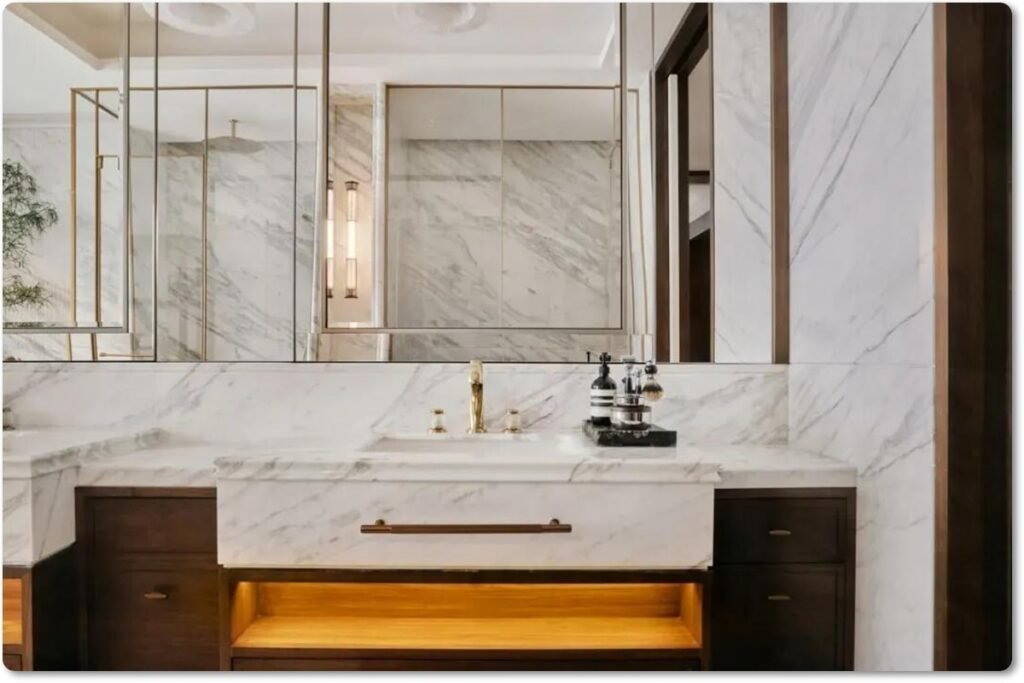
Natural marble countertops are finished horizontal surfaces manufactured from quarried natural stone commercially identified as marble.
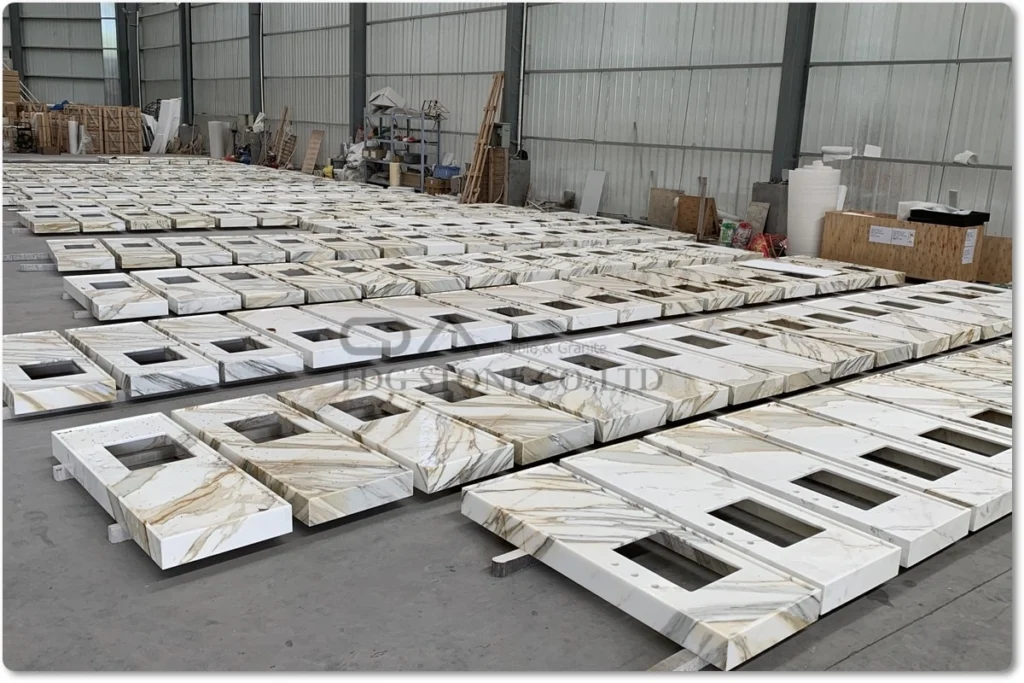
The manufacturing process typically involves selecting marble slabs, cutting them to specified dimensions, machining sink and faucet openings, processing exposed edges, finishing the surface, inspecting the finished pieces, and preparing them for installation and shipment.
Common applications include:
Kitchen countertops and islands.
Bathroom vanity tops.
Hotel bathroom countertops.
Reception desks and hospitality counters.
Restaurant and decorative bar tops.
Luxury residential interiors.
Commercial washroom counters.
Custom architectural furniture and interior surfaces.
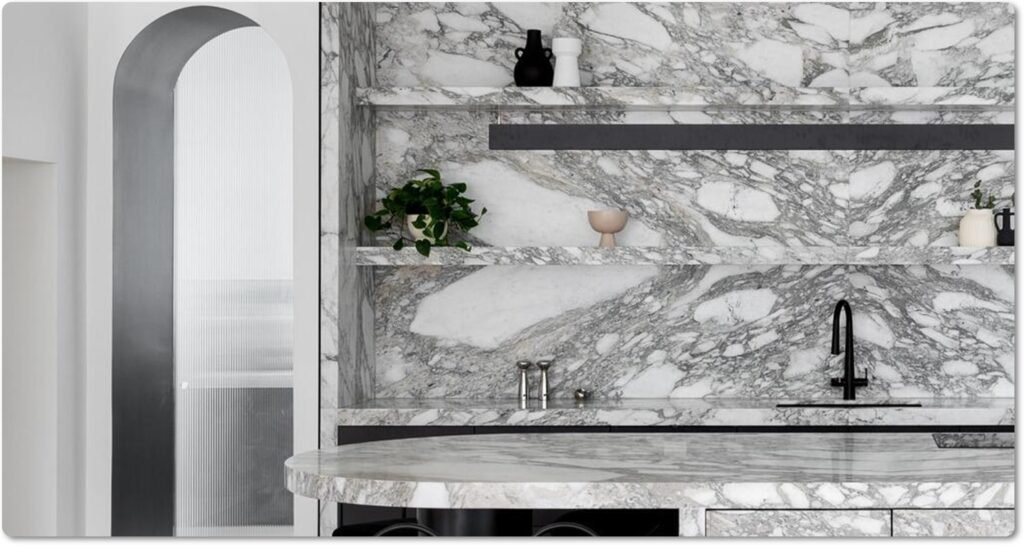
Natural marble is valued for its distinctive mineral patterns, depth of color, ability to receive different surface finishes, and suitability for customized fabrication.
Nevertheless, its suitability depends on the material variety and service conditions. A marble suitable for a decorative vanity may not be the most practical choice for a heavily used kitchen.
2.2 Natural Marble, Commercial Marble, and Engineered Stone
The word marble can describe different things depending on whether the context is geological, commercial, or regulatory.
| Category | Definition | Procurement implication |
|---|---|---|
| Geological marble | A metamorphic rock formed through recrystallization of carbonate-rich rocks | Mineralogy and geological structure influence performance |
| Commercial marble | A market category that may include certain carbonate stones sold as marble | Verify the actual material and applicable specification |
| Engineered quartz | A manufactured composite containing mineral aggregates and binding materials | Performance depends on the product formulation and manufacturer |
| Sintered surface | An industrially manufactured surface produced through a controlled process | Requires product-specific performance and fabrication documentation |
| Granite | An igneous rock commonly used as dimension stone | Generally offers different hardness, mineralogy, and acid resistance characteristics |
| Quartzite | A metamorphic rock dominated by interlocking quartz grains | Must be distinguished from softer carbonate stones marketed under similar decorative names |
These categories are not interchangeable. Their physical properties, fabrication requirements, maintenance needs, and appropriate test methods differ.
2.3 What Does a Marble Countertop Specification Cover?
A complete specification should identify at least five components:
Material: Commercial name, source where available, material identification, and relevant test data.
Appearance: Background color, veining, movement, natural features, and permitted variation.
Dimensions: Finished length, width, thickness, tolerances, edge profiles, and cutouts.
Finish: Polished, honed, brushed, leathered, or another specifically agreed treatment.
Performance and installation: Intended use, support requirements, joints, maintenance expectations, and applicable project standards.
For international projects, the specification should also clarify who is responsible for final measurements, installation, damage inspection, and acceptance.
3. Technical Evaluation: Geological Background and Mineral Composition
3.1 How Is Natural Marble Formed?
Geological marble typically develops when limestone or dolostone undergoes metamorphism under elevated temperature, pressure, and chemically active conditions.
During this process, the original carbonate minerals recrystallize. Depending on the source rock and geological history, the resulting marble may contain predominantly calcite, substantial dolomite, or additional minerals that influence its appearance and physical characteristics.
Veining may develop through mineral redistribution, fractures filled by secondary minerals, deformation, and other geological processes.
The result is a natural material whose visual and physical characteristics reflect its formation history.
The U.S. Geological Survey identifies color, grain texture, pattern, finish, durability, strength, and polishing characteristics among the factors relevant to dimension-stone selection.
For countertop buyers, this means that material evaluation should include both aesthetic and technical criteria rather than treating marble as a standardized decorative product.
3.2 Calcite Marble vs. Dolomitic Marble
ASTM C503/C503M-23 distinguishes calcite and dolomite marble within its dimension-stone specification.
The distinction is relevant because mineral composition influences how marble responds to chemical exposure and may affect other properties.
| Characteristic | Calcite-dominant marble | Dolomite-dominant marble |
|---|---|---|
| Principal carbonate mineral | Calcite | Dolomite |
| Chemical formula | CaCO₃ | CaMg(CO₃)₂ |
| Response to dilute acid | Generally reacts readily | Often reacts less vigorously, depending on conditions |
| Kitchen acid exposure | Susceptible to etching | Also potentially susceptible to etching |
| Mechanical performance | Depends on the complete rock structure | Depends on the complete rock structure |
| Procurement requirement | Verify material-specific properties | Verify material-specific properties |
The table describes general mineralogical tendencies, not guaranteed performance.
A dolomitic marble should not automatically be classified as acid-proof or scratch-proof. Grain boundaries, accessory minerals, porosity, surface treatment, and the specific chemical exposure all matter.
Likewise, calcite content alone cannot establish whether a slab is suitable for a particular structural or commercial application.
Procurement principle: Mineral composition provides useful context, but acceptance should be based on the actual stone, the intended use, and relevant evidence.
3.3 Why Marble Trade Names Cannot Determine Performance?
Trade names such as Carrara, Calacatta, Statuario, and other decorative marble designations primarily help buyers identify commercial material categories and appearance preferences.
They do not necessarily establish:
A uniform mineral composition.
A guaranteed water-absorption value.
A minimum flexural strength.
Consistent hardness across all suppliers.
Identical performance between different quarries.
The absence of natural fissures or mineral concentrations.
A uniform response to staining or acidic substances.
Even material marketed under one recognizable name can vary between quarry locations, geological beds, blocks, and production lots.
A supplier should therefore be able to identify the offered material as specifically as reasonably possible and explain the basis of any performance claims.
Where technical requirements are important, request applicable laboratory results rather than inferring performance from the commercial name.
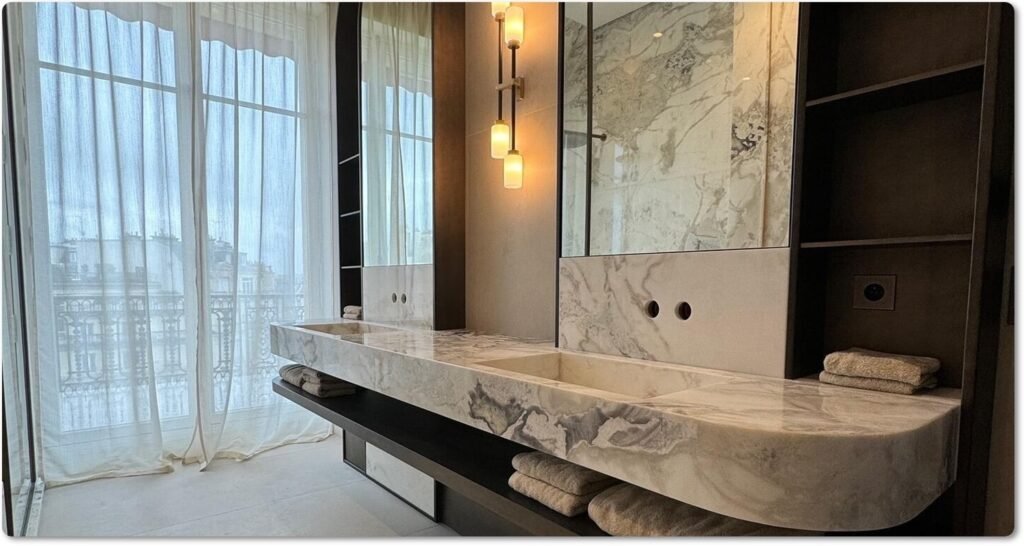
4. Natural Veining, Color Variation and Slab Selection
4.1 Why Can Natural Marble Veining Never Be Fully Standardized?
Natural marble forms through geological processes that do not create identical patterns in every block.
Color and veining depend on factors including:
Original sediment composition.
Mineral impurities.
Metamorphic conditions.
Fractures and secondary mineral deposits.
Geological deformation.
Differences between quarry beds.
The orientation of the block during cutting.
When a block is sawn into slabs, the cutting direction determines how the internal geological structure appears on the finished surface.
Consequently, adjacent slabs may exhibit related patterns without being visually identical.
Bookmatching and sequence matching can create coordinated designs, but neither technique eliminates natural variation. They organize existing patterns into a planned visual composition.
4.2 How to Select Marble Slabs for Commercial Projects?
For a hotel, apartment development, residential tower, or large hospitality project, slab selection should be treated as a controlled approval process.
Step 1: Define the visual target
Document:
Preferred background color.
Vein color and intensity.
Acceptable vein density.
Preferred pattern movement.
Permitted mineral inclusions.
Acceptable natural fissures.
Required visual consistency across the installation.
Avoid relying exclusively on broad descriptions such as “white marble” or “light gray marble.”
Step 2: Review representative slabs
Request photographs or videos showing the entire slab, not just a close-up of its most attractive area.
Images should ideally include a reference identifier and sufficient context to assess the pattern from edge to edge.
For high-value orders, consider an in-person inspection or a mutually agreed remote approval process.
Step 3: Approve the production lot
A small sample may demonstrate color and finish, but it cannot fully represent the visual variation of an entire production lot.
For bulk purchases, review the actual available slabs or an agreed representative range from the production lot.
Step 4: Plan cutting layouts
Before fabrication, determine how individual countertop pieces will be cut from the slabs.
The layout should account for:
Vein direction.
Island and peninsula orientation.
Sink and cooktop openings.
Joint positions.
Edge details.
Bookmatched or sequence-matched requirements.
Material yield and waste.
Step 5: Record the approval
Maintain a record of approved photographs, slab identifiers, drawings, finish samples, and agreed acceptance criteria.
This provides a reference if a dispute arises between natural variation and a genuine quality defect.
4.3 Distinguishing Acceptable Variation from Nonconformity
Natural variation is not automatically a defect. Equally, the fact that marble is natural does not excuse every deviation from an agreed specification.
| Observation | Potential classification | Appropriate evaluation |
|---|---|---|
| Different vein movement within an approved range | Inherent variation | Compare against approved slabs and criteria |
| Color difference between production lots | Potential variation or nonconformity | Review lot approval and agreed color tolerances |
| Open fissure at a critical sink cutout | Potential structural concern | Inspect location, continuity, and approved repair method |
| Resin-filled natural feature | Depends on agreed finish and disclosure | Verify repair policy and acceptance requirements |
| Edge chip caused during fabrication | Processing defect | Inspect the finished edge against agreed tolerances |
| Crack introduced during transportation | Handling or transport damage | Review packaging, inspection records, and damage evidence |
| Acid etching after installation | Use-related surface damage in many cases | Assess exposure, finish, and maintenance history |
Final classification should consider the contract, the approved material, the defect’s location and severity, and any applicable technical requirements.
5. Water Absorption, Density and Mechanical Properties
5.1 Why Physical Testing Matters?
Natural marble is a geological material rather than a uniformly manufactured surface.
Relevant physical properties may vary because of mineral composition, grain structure, porosity, natural discontinuities, and the orientation of the specimen.
For commercial buyers, testing can help determine whether the selected material is appropriate for the intended application.
ASTM C503/C503M-23 addresses material characteristics, physical requirements, and sampling for marble dimension stone used for general building and structural purposes.
Its listed physical-property categories include:
Absorption by weight.
Density.
Compressive strength.
Modulus of rupture.
Abrasion resistance.
Flexural strength.
These properties are useful evaluation criteria, but the required values and their interpretation must be determined using the applicable standard and project specification.
The ASTM standard is not, by itself, a complete acceptance specification for every finished countertop.
5.2 Water Absorption and Porosity
Water absorption is an indicator of how much water a stone specimen takes up under specified test conditions.
A higher absorption value may indicate a greater tendency for liquids to penetrate the material, although absorption alone does not predict every staining outcome.
Staining also depends on the liquid’s composition, exposure time, stone mineralogy, surface treatment, cleaning practices, and other factors.
For countertop procurement, buyers should consider:
Laboratory-reported absorption values.
Whether the result applies to the actual material being purchased.
The intended application and likely liquid exposure.
The need for an appropriate impregnating sealer.
Cleaning and maintenance requirements.
A sealer may reduce the penetration of certain liquids, but it does not make marble completely impermeable and does not prevent acid etching.
5.3 Density
Density describes the mass of a material relative to its volume.
It can help inform weight calculations, transportation planning, handling arrangements, and structural coordination.
However, buyers should not use an assumed universal marble density for final engineering calculations when actual material data or project-specific requirements are available.
For heavy islands, cantilevered elements, large vanity tops, and commercial counters, the designer or responsible engineer should assess the complete assembly, including the stone, supports, cabinetry, fixings, and applied loads.
5.4 Compressive Strength and Flexural Performance
Compressive strength concerns the material’s response to compressive loading under specified test conditions.
Flexural strength and modulus of rupture concern resistance to bending-related failure in a test specimen.
These properties are not interchangeable.
A countertop may be subjected to localized loads and bending stresses around unsupported spans, sink cutouts, cooktop openings, and narrow sections.
Therefore, a compressive-strength result alone cannot establish that a fabricated countertop will resist breakage in service.
The finished product’s performance also depends on:
Slab thickness.
Unsupported span.
Cutout dimensions and corner geometry.
Edge and surface defects.
Support spacing.
Handling and installation.
Concentrated loads.
Material orientation and natural discontinuities.
For demanding installations, the design professional should evaluate the complete countertop geometry and support conditions.
5.5 Abrasion Resistance and Scratch Susceptibility
Abrasion resistance measures behavior under a specified test method. It should not be confused with a universal scratch-resistance rating.
A marble surface can be scratched or dulled by abrasive materials even when the underlying slab has adequate structural strength.
Polished surfaces can also make certain scratches and changes in reflectivity more noticeable.
Procurement documents should distinguish between structural performance and cosmetic wear.
For high-traffic applications, buyers should assess whether the anticipated appearance changes are acceptable and whether periodic professional refinishing is included in the maintenance plan.
5.6 What Does ASTM C503/C503M-23 Actually Establish?
The standard provides a material specification and sampling framework for marble dimension stone within its stated scope.
It should be used alongside the applicable guidance, project requirements, and product-specific acceptance criteria.
For finished countertops, buyers may additionally need requirements for:
Finished dimensions and thickness.
Dimensional tolerances.
Surface finish and appearance.
Edge profiles.
Sink and cooktop cutouts.
Repair disclosure.
Joint alignment.
Installation supports.
Packaging and handling.
Inspection and acceptance procedures.
Important: Do not assume that a supplier’s statement of compliance with ASTM C503/C503M-23 automatically verifies every characteristic of a fabricated countertop. Confirm what material was tested, which tests were performed, which edition was used, and what the results actually establish.
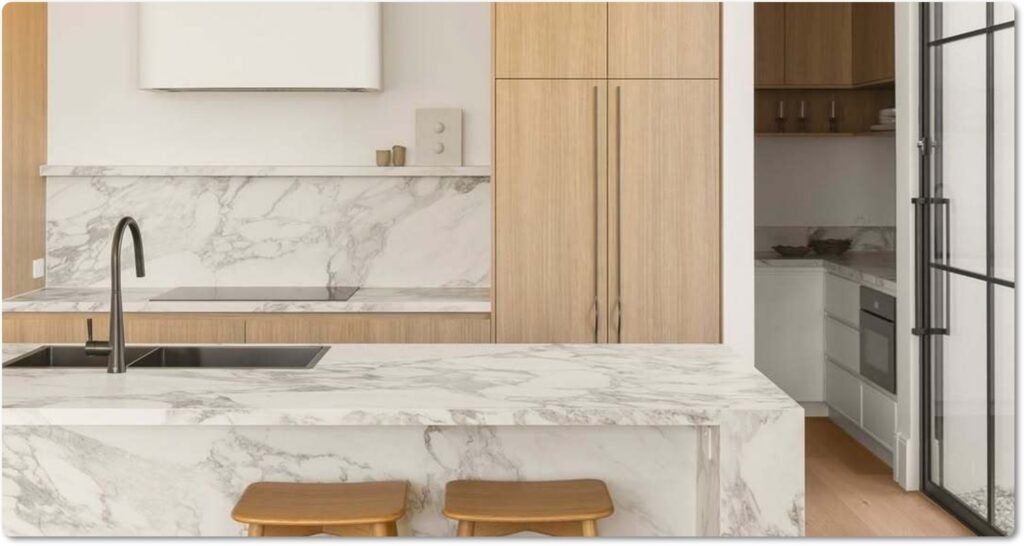
6. Surface Finishes: Polished, Honed, Leathered, and Brushed
Different surface finishes change the appearance, reflectivity, tactile character, and visibility of certain marks on marble.
The finish should be specified independently from the stone’s commercial name.
| Finish | Appearance | Potential advantages | Important considerations |
|---|---|---|---|
| Polished | Glossy, reflective surface | Highlights color and veining; easy to wipe clean when properly maintained | Etching and changes in gloss may be conspicuous |
| Honed | Matte or low-sheen appearance | Creates a softer visual effect and may make some surface marks less noticeable | Can still stain, etch, or scratch; appearance varies by stone |
| Leathered | Textured surface with a tactile finish | Adds surface character and can reduce mirror-like reflections | Texture and cleanability depend on the specific finish |
| Brushed | Textured surface created through mechanical treatment | Provides a more tactile, less reflective appearance | Texture depth, consistency, and maintenance requirements need approval |
6.1 Does a Honed Finish Prevent Etching?
No.
A honed finish may make some etch marks less visually obvious because the surface is already matte. However, the underlying carbonate minerals remain susceptible to chemical attack.
Similarly, a polished surface does not necessarily mean the stone has higher structural strength.
The finish affects the surface appearance and may influence how wear is perceived, but it does not eliminate the fundamental chemical characteristics of the material.
6.2 How Should Finish Quality Be Specified?
A practical finish specification should identify:
The required finish name.
A physical reference sample.
The acceptable degree of gloss or texture.
Permitted variations between pieces.
Whether resin treatment or other repairs are allowed.
Inspection lighting and viewing conditions.
Cleaning and maintenance expectations.
For large projects, the approved sample should be retained as a reference throughout production.
7. Marble vs. Granite, Quartzite and Engineered Surfaces
Material selection should begin with the intended use, appearance requirements, maintenance expectations, and technical constraints—not with a general ranking of stone types.
| Evaluation factor | Natural marble | Granite | Quartzite | Engineered quartz | Sintered surface |
|---|---|---|---|---|---|
| Material origin | Natural carbonate rock, commonly metamorphic | Natural igneous rock | Natural quartz-rich metamorphic rock | Manufactured composite | Manufactured surface |
| Natural variation | Often prominent veining and mineral variation | Grain and mineral patterns vary | Can show prominent veins or granular patterns | Depends on product design and manufacturing | Depends on design and manufacturing |
| Acid sensitivity | Generally vulnerable to etching | Many varieties offer better resistance to common household acids | Often better acid resistance, subject to composition and finish | Product-specific; some formulations are acid-sensitive | Product-specific |
| Scratch performance | Generally more susceptible than many harder countertop materials | Often good, but varies by mineralogy | Often good, but varies by composition and structure | Product-specific | Product-specific |
| Porosity and staining | Varies by material | Varies by material | Varies by material | Depends on formulation and surface | Depends on product |
| Fabrication | Requires stone-specific cutting and finishing | Requires suitable stone fabrication | Requires material identification and appropriate tooling | Requires manufacturer-approved fabrication | Requires product-specific tooling and handling |
| Typical design appeal | Classic veining and natural movement | Mineral grain and varied natural patterns | Distinctive natural patterns and quartz-rich appearance | More controlled manufactured appearance | Broad range of manufactured visual effects |
This table provides general tendencies, not guaranteed ratings for every product.
7.1 When Is Marble a Good Choice?
Marble can be appropriate when the project prioritizes:
Natural veining and distinctive pattern movement.
A premium architectural appearance.
Custom fabrication.
Coordinated slabs and bookmatched designs.
Bathroom vanities and decorative interior surfaces.
A design that accepts natural variation and ongoing maintenance.
7.2 When Should Buyers Consider Alternatives?
Consider comparing marble with other materials when the project requires:
High resistance to acidic food exposure.
Minimal visible surface change over time.
Highly standardized visual repetition.
Intensive commercial kitchen use.
A maintenance regime that cannot accommodate periodic care.
Specific performance requirements that the proposed marble cannot demonstrate.
This does not mean marble is unsuitable for every kitchen. It means that the material’s known characteristics should be weighed against the client’s expectations.
7.3 How to Choose the Right Countertop Material?
Use a weighted evaluation model rather than relying on a single feature.
For example, a project team could assign weights to:
Appearance and design: 25%.
Chemical and staining resistance: 20%.
Structural suitability: 20%.
Maintenance requirements: 15%.
Total installed cost: 10%.
Supply consistency and availability: 10%.
These percentages are an illustrative decision model, not an industry standard. Each project should adjust the weights to reflect its priorities.

8. Application Suitability and Performance Limitations
8.1 Kitchen Countertops
Natural marble can be used in kitchens, but buyers should understand the implications of food acids, abrasive contact, spills, and frequent cleaning.
Lemon juice, vinegar, and other acidic substances can react with calcium-carbonate-based stone and leave dull areas known as etch marks.
Etching is different from staining:
Etching is chemical alteration of the surface.
Staining involves discoloration caused by substances entering or interacting with the material.
Scratching is physical damage to the surface.
Chipping involves localized material loss, often at an edge or corner.
A penetrating sealer may reduce certain staining risks, but it will not prevent acid etching.
Users should follow the stone and sealer manufacturers’ maintenance instructions and avoid assuming that sealing makes marble acid-proof.
8.2 Bathroom Vanity Tops
Bathroom vanities are often attractive applications for marble because they showcase the material’s natural patterns.
However, cosmetics, toiletries, cleaning products, and personal-care substances can affect the surface.
Procurement teams should establish:
Appropriate sink cutout geometry.
Edge and corner requirements.
Faucet-hole positions.
Support and fixing arrangements.
Water-management details.
Suitable cleaning instructions.
The selected marble should be evaluated against the products and cleaning methods expected in the actual bathroom environment.
8.3 Hotels and Commercial Projects
Hotels and other commercial facilities introduce additional procurement considerations.
A project may require multiple vanity tops, repeated dimensions, coordinated vein direction, reliable packaging, and a defined replacement process.
The buyer should establish a documented production approval procedure covering:
Material identification.
Approved visual range.
Fabrication drawings.
First-piece approval where appropriate.
Dimensional inspection.
Finish inspection.
Packaging and labeling.
Shipment inspection records.
For multi-phase developments, the buyer should also clarify whether future replacement slabs can be obtained and whether later production lots may differ visually.
8.4 Structural and Installation Considerations
Natural stone countertops are part of a larger assembly.
The designer, fabricator, and installer should coordinate:
Cabinet or support capacity.
Unsupported spans.
Sink and appliance cutouts.
Cutout corner geometry.
Seam locations.
Overhangs.
Transportation and lifting methods.
Installation adhesives and sealants.
Required clearances and movement accommodation.
A slab’s laboratory properties alone do not determine the safety of every finished installation.
For complex or heavily loaded designs, the responsible professional should assess the actual geometry, supports, and loads.
8.5 Separating Material, Fabrication, Installation and Maintenance Problems
A reliable quality investigation should identify the likely source of the observed problem before assigning responsibility.
| Problem | Potential causes | Evidence to review |
|---|---|---|
| Visible color variation | Natural geology, mixed lots, lighting | Approved slab photographs and lot records |
| Surface etching | Acid exposure, unsuitable cleaners | Surface condition and maintenance history |
| Darkened areas | Liquid penetration, moisture, treatment effects | Moisture conditions, absorption characteristics, sealer records |
| Cracked countertop | Natural discontinuity, handling, cutout geometry, inadequate support, installation stress | Crack location, photographs, support details, transport records |
| Chipped edge | Fabrication, installation, impact, transportation | Inspection photographs and delivery records |
| Uneven finish | Fabrication variation, inconsistent treatment, lighting | Reference sample and inspection conditions |
| Joint mismatch | Measurement, fabrication, layout, or installation | Approved drawings and installation records |
These categories are diagnostic possibilities, not automatic conclusions.
For example, a crack near a sink opening may involve stone characteristics, fabrication geometry, support conditions, handling, or installation. The location alone does not prove the cause.
A sound investigation documents the evidence and evaluates the complete sequence of events.
9. Procurement Checklist
9.1 Material Identification
Before ordering natural marble countertops, confirm:
Commercial material name.
Supplier’s material description.
Quarry or source information, where available.
Actual production lot or slab identifiers.
Relevant laboratory test reports.
Whether repairs or resin treatments are permitted.
Whether the proposed material matches the approved sample.
9.2 Appearance Approval
Document:
Background color.
Vein color and direction.
Pattern density and movement.
Acceptable natural inclusions.
Acceptable fissures and repairs.
Finish and surface texture.
Reference slab photographs.
Rules for evaluating natural variation.
For large projects, the buyer should approve an agreed range of visual variation rather than relying on one small sample.
9.3 Fabrication Specifications
Specify:
Finished dimensions.
Nominal and required actual thickness.
Dimensional tolerances.
Edge profile and dimensions.
Sink and cooktop cutouts.
Faucet holes.
Backsplashes and upstands.
Seam locations.
Finished edges and corners.
Required underside reinforcement, if any.
Drawing approval procedures.
Tolerances should be realistic for the fabrication method and coordinated with the installation requirements.
9.4 Testing and Documentation
Request the relevant test data for the proposed material.
Where appropriate, this may include absorption, density, compressive strength, flexural performance, modulus of rupture, and abrasion resistance.
The testing program should identify the applicable method, standard edition, specimen preparation, laboratory, and reported result.
Do not assume that every property requires testing for every project. Select tests according to the material, application, risk, and contractual requirements.
9.5 Packaging and Shipping
For international shipments, define:
Protective packing method.
Crate construction.
Piece identification and labeling.
Edge and corner protection.
Internal restraints.
Handling and lifting instructions.
Loading and unloading responsibilities.
Shipment inspection requirements.
Documentation of pre-shipment condition.
Procedures for reporting transport damage.
Large, heavy, or irregularly shaped countertop pieces may require individual packaging and specific handling arrangements.
Packaging should be designed around the actual dimensions, weight, geometry, transportation method, and unloading conditions.
9.6 Establishing Bulk-Order Acceptance Criteria
The most effective procurement specifications combine measurable requirements with documented visual approval.
| Item | Recommended acceptance method |
|---|---|
| Material identity | Approved material description and traceable lot information |
| Color and veining | Reference slabs, photographs, and agreed variation range |
| Thickness | Defined nominal thickness and dimensional tolerance |
| Length and width | Approved fabrication drawings and tolerances |
| Surface finish | Reference sample and agreed inspection conditions |
| Edges | Profile drawing and dimensional inspection |
| Cutouts | Approved drawings and dimensional checks |
| Repairs | Written disclosure and acceptance criteria |
| Physical properties | Applicable test methods and agreed project requirements |
| Packaging | Approved packaging specification and shipment inspection |
| Documentation | Inspection records, photographs, and material identification |
The buyer and supplier should agree on these criteria before production begins, not after the finished countertops arrive.
10. Cost and Risk Factors
10.1 What Determines Natural Marble Countertop Cost?
The purchase price of marble countertops depends on several interacting variables.
Material cost
Factors may include:
Commercial material and source.
Slab dimensions and thickness.
Visual quality and rarity.
Available inventory.
Natural defects and usable yield.
Selected surface finish.
Quantity purchased.
Fabrication cost
Potential cost drivers include:
Cutting complexity.
Edge profiles.
Sink and cooktop openings.
Custom shapes.
Bookmatching.
Seam planning.
Surface finishing.
Repair and reinforcement requirements.
Inspection and quality-control procedures.
Packaging and logistics cost
For export orders, the total may also include:
Crate materials and construction.
Protective packing.
Loading labor and equipment.
Inland transportation.
Port and documentation charges.
Freight and insurance, where applicable.
Import duties and destination handling.
The final landed cost depends on the agreed commercial terms and the buyer’s destination-specific costs.
10.2 Why the Lowest Unit Price May Not Be the Lowest Project Cost?
A low quoted price may not include all the work needed to deliver a compliant finished product.
For example, two quotations may differ because one includes detailed cutouts, finished edges, individual protective packaging, and documented inspection, while the other excludes these items.
Buyers should compare quotations on an equivalent scope.
A useful comparison formula is:
Comparable Project Cost = Material + Fabrication + Packaging + Logistics + Applicable Import and Destination Costs + Expected Quality and Replacement Costs
This is a procurement framework rather than an accounting standard. Avoid double-counting costs already included in a supplier’s quotation or freight arrangement.
10.3 Main Commercial Risks
| Risk | Possible consequence | Recommended control |
|---|---|---|
| Unclear material identification | Unexpected physical or visual characteristics | Confirm material description and supporting evidence |
| Insufficient slab approval | Appearance disputes | Approve representative production slabs |
| Incomplete fabrication drawings | Incorrect cutouts or dimensions | Obtain written drawing approval |
| Undefined finish | Inconsistent appearance | Retain an approved physical sample |
| Inadequate packaging | Damage during handling or transport | Specify packaging and inspection requirements |
| Unclear responsibility | Delays and disputes | Define inspection, installation, and damage responsibilities |
| Unverified performance claims | Unsuitable application | Request relevant test reports and evaluate the intended use |
| Unplanned maintenance | Unexpected operating costs | Provide maintenance guidance before handover |
The objective is not to eliminate every natural variation or commercial risk. It is to identify the risks, agree on acceptable limits, and document how deviations will be handled.

11. Supplier Evaluation: How to Choose a Marble Countertops Manufacturer?
Selecting a qualified Marble Countertops Supplier requires more than comparing photographs and quotations.
The supplier should demonstrate that its material selection, fabrication process, quality-control procedures, and export arrangements match the project requirements.
11.1 Material Knowledge and Traceability
Ask whether the supplier can explain:
The proposed marble’s commercial identity.
Available slab sizes and thicknesses.
Known visual characteristics.
Relevant technical limitations.
Available laboratory test data.
Material reservation and lot identification.
The handling of natural fissures and repairs.
A supplier should distinguish documented facts from general expectations and avoid presenting trade names as guarantees of performance.
11.2 Fabrication Capability
Confirm the supplier’s ability to execute the actual drawings and product requirements.
Relevant capabilities may include:
Precision cutting.
Sink and cooktop cutouts.
Edge profiling.
Surface finishing.
Custom shapes.
Bookmatching and sequence matching.
Dimensional inspection.
Protective packaging.
Where specialized machinery or subcontracted processes are involved, clarify who is responsible for quality control.
11.3 Quality Assurance
Ask the supplier to explain its inspection process.
Useful evidence may include:
Material inspection records.
Approved drawings.
Dimensional inspection results.
Surface and edge photographs.
Repair records.
Packaging photographs.
Shipment identification.
Procedures for handling nonconforming pieces.
The exact documents required should reflect the project’s size, complexity, and risk.
11.4 Export and Project Coordination
For international buyers, the supplier should be able to clarify:
Production and delivery lead-time assumptions.
Packaging specifications.
Loading arrangements.
Export documentation responsibilities.
Shipping terms.
Inspection timing.
Procedures for claims and replacements.
Lead times should be confirmed against actual material availability, order quantity, fabrication complexity, and shipping arrangements rather than relying on a generic promise.
11.5 Working with EDG Stone
EDG Stone is a China-based natural stone manufacturer and export supplier serving buyers seeking stone slabs, countertops, and customized stone products.
For projects involving natural marble countertops, EDG Stone can discuss the proposed stone, available slab options, dimensions, surface finishes, fabrication details, and packaging requirements according to the project brief.
A practical first step is to provide the intended application, approximate quantity, preferred material, drawings or reference images, destination, and delivery expectations.
This information helps establish whether the proposed material and manufacturing scope align with the buyer’s requirements.
Supplier evaluation principle: Select a manufacturer based on documented capability, material suitability, communication, inspection procedures, and the ability to meet the agreed specification—not on marketing claims alone.
12. Practical RFQ Template: Natural Marble Countertops
Use the following template when requesting a quotation from a Marble Countertops Manufacturer, factory, wholesaler, or export supplier.
Natural Marble Countertops — Request for Quotation
A. Buyer and project information
Company name:
Contact person:
Project name:
Project location:
Intended application:
Project type: Residential / Hospitality / Commercial / Multifamily / Other
B. Material requirements
Preferred marble name:
Alternative acceptable materials:
Requested source or origin, if applicable:
Background color:
Veining characteristics:
Required thickness:
Surface finish:
Reference photographs or sample:
Repair or resin-treatment requirements:
C. Product dimensions and fabrication
Total quantity:
Number of pieces:
Finished dimensions:
Edge profile:
Sink cutouts:
Cooktop cutouts:
Faucet holes:
Backsplash or upstand:
Seam and bookmatching requirements:
Attached CAD drawings:
Required dimensional tolerances:
D. Technical and quality requirements
Applicable standards:
Required physical-property tests:
Appearance acceptance criteria:
Permitted natural variation:
Repair acceptance criteria:
Inspection requirements:
Required production photographs:
Packaging and labeling requirements:
E. Commercial requirements
Requested quotation basis: EXW / FOB / CIF / Other agreed term
Delivery destination:
Required delivery date:
Packaging requirements:
Sample requirements:
Payment terms requested:
Required documentation:
Inspection and claims procedure:
F. Supplier response
Please provide:
Material availability and identification.
Available slab dimensions and thicknesses.
Relevant technical documentation.
Unit pricing and total quotation.
Fabrication and packaging scope.
Estimated production lead time.
Proposed inspection procedure.
Shipping assumptions and exclusions.
Sample availability and associated costs, if any.
Any technical limitations or deviations from the request.
Recommended Approval Sequence
Stage 1: Confirm the material and commercial scope.
Stage 2: Review samples, slab photographs, and relevant technical information.
Stage 3: Approve the fabrication drawings and visual acceptance criteria.
Stage 4: Confirm pricing, production timing, packaging, and shipping responsibilities.
Stage 5: Inspect the finished pieces against the approved requirements.
Stage 6: Retain inspection records and coordinate delivery and installation.
For large projects, the contract should define how nonconforming products, damage claims, replacements, and changes to the approved specification will be handled.
13. Frequently Asked Questions About Natural Marble Countertops
1. Are natural marble countertops suitable for kitchens?
Yes, natural marble countertops can be used in kitchens, provided that the owner understands their maintenance requirements and susceptibility to acid etching, scratching, and certain types of staining. Material selection, surface finish, cleaning practices, and user expectations should all be considered before purchase.
2. Why does natural marble have different colors and veins?
Marble develops through geological processes involving mineral composition, recrystallization, fractures, and other structural changes. When the stone is cut into slabs, the cutting direction reveals different parts of this geological structure. As a result, slabs from the same commercial material may have related but nonidentical patterns.
3. Does sealing marble prevent staining and etching?
No. An appropriate impregnating sealer can reduce the penetration of certain liquids, depending on the stone and product. It does not make marble completely impermeable and does not prevent chemical etching caused by acidic substances. Follow the stone and sealer manufacturers’ instructions for cleaning and maintenance.
4. What is the difference between calcite marble and dolomitic marble?
Calcite marble is dominated by calcite, while dolomitic marble contains substantial dolomite. Their mineral composition affects their response to certain chemicals, but neither category guarantees a particular level of durability. Buyers should assess the specific material and relevant technical evidence instead of assuming that mineral classification alone determines performance.
5. What should I request from a marble countertops manufacturer before placing a bulk order?
Request a clear material description, representative slab photographs or samples, fabrication drawings, dimensional and finish specifications, relevant technical reports, agreed appearance tolerances, packaging details, and a written inspection procedure. For larger projects, establish the approval process before production and document how deviations or damage will be handled.
14. Semantic Insight Block: How to Specify and Procure Natural Marble Countertops?
Natural Marble Countertops: Material Selection, Performance and Procurement Insights
What determines the performance of a natural marble countertop?
The performance of a natural marble countertop depends on mineral composition, geological structure, physical properties, surface finish, fabricated geometry, support conditions, installation, and maintenance. No single trade name or laboratory value establishes suitability for every application. Buyers should evaluate the actual material against the expected service conditions.
Why should buyers approve actual slabs before bulk production?
Natural marble develops its color and veining through geological processes, so individual slabs are not visually identical. A small sample can demonstrate general appearance but cannot fully represent a complete production lot. Reviewing actual slabs, recording identifiers, and defining acceptable visual variation help align the supplier’s output with the approved design.
Which marble countertop finish should a project specify?
Polished marble offers a reflective surface that emphasizes color and veining. Honed marble creates a matte appearance, while leathered and brushed finishes provide varying degrees of texture. The best option depends on design intent, cleaning requirements, visibility of wear, and the specific material. A physical reference sample should be approved before production.
How should buyers evaluate marble countertop technical data?
Review the test method, standard edition, specimen identification, laboratory results, and applicability to the proposed material. Absorption, density, compressive strength, flexural performance, and abrasion resistance provide different information. ASTM C503/C503M-23 is a relevant reference for marble dimension stone, but finished countertop requirements must also address fabrication, installation, appearance, and intended use.
What are the principal limitations of natural marble?
Many marble varieties are vulnerable to acidic etching, and some may require particular attention to staining, scratching, natural discontinuities, or localized damage. These characteristics do not automatically make marble unsuitable. They should instead inform material selection, finish approval, installation planning, cleaning instructions, and owner expectations.
How can a buyer reduce procurement risk?
Establish a written specification before placing the order. Identify the material, approve representative slabs, define dimensions and finishes, agree on natural-variation limits, request relevant technical documentation, approve fabrication drawings, and specify packaging and inspection procedures. This creates a common reference for production, delivery, and acceptance.
What should a marble countertops supplier demonstrate?
A qualified supplier should provide clear material information, realistic technical explanations, relevant test documentation where available, fabrication coordination, inspection evidence, protective packaging, and transparent commercial terms. The buyer should evaluate these capabilities against the project’s actual requirements rather than relying on generic quality claims.
How should buyers compare natural marble with other countertop materials?
Compare appearance, chemical resistance, scratch and abrasion behavior, structural requirements, maintenance, supply consistency, and total installed cost. Granite, quartzite, engineered quartz, and sintered surfaces have different characteristics. The appropriate choice depends on project priorities and verified product information, not a universal ranking of materials.
What information should be included in a marble countertop RFQ?
An effective RFQ identifies the material, quantity, dimensions, thickness, surface finish, edge profiles, cutouts, appearance criteria, technical requirements, drawings, packaging, destination, delivery expectations, and inspection procedures. Providing this information helps suppliers prepare comparable quotations and reduces the likelihood of misunderstandings during fabrication.
Why consider EDG Stone for natural marble countertop sourcing?
EDG Stone offers a point of contact for buyers evaluating natural stone slabs, customized countertop fabrication, surface finishes, dimensions, and export packaging. Buyers can submit project drawings, reference images, quantities, and destination requirements to discuss material availability and a project-specific quotation.
Procurement Outlook: What Buyers Should Prioritize
The most reliable marble procurement strategy combines design approval, technical evaluation, manufacturing control, and documented acceptance.
For architects, this means specifying the material’s intended use and acceptable appearance. For fabricators, it means coordinating slab selection with cutouts, seams, support requirements, and finishing. For importers and distributors, it means ensuring that the approved material, production lot, packaging, and documentation are traceable.
For hospitality and multifamily projects, repeatability is often more important than obtaining one exceptionally attractive slab. Buyers should establish a process for managing variation across production lots and future replacement orders.
For manufacturers and suppliers, the practical opportunity is to provide more than a material name and a price. Clear technical information, realistic appearance approvals, coordinated fabrication, and documented quality control can make procurement more predictable.
The central conclusion is straightforward: successful natural marble countertop procurement depends on matching the actual stone to the intended application and agreeing on measurable, observable acceptance criteria before production begins.
15. References and Technical Resources
The following resources provide the technical foundation for this guide. Buyers should confirm the applicable edition and contractual requirements when preparing project specifications.
1. U.S. Geological Survey (USGS) — Dimension Stone Statistics and Information
Resource: Dimension Stone Statistics and Information
Relevant topics include dimension-stone classification, supply and demand information, and the material-selection considerations associated with color, texture, durability, strength, and finish.
2. ASTM International — ASTM C503/C503M-23
Standard: Standard Specification for Marble Dimension Stone
The standard covers material characteristics, physical requirements, and sampling appropriate to marble dimension stone for general building and structural purposes. It distinguishes calcite and dolomite marble and addresses absorption by weight, density, compressive strength, modulus of rupture, abrasion resistance, and flexural strength.
3. Natural Stone Institute — Residential Stone Countertop Installation
Technical resource covering natural-stone countertop characteristics, installation considerations, and material-specific performance issues.
4. Natural Stone Institute / Use Natural Stone — Marble Countertop Care
Consumer and maintenance guidance discussing cleaning, sealing, staining, and the distinction between surface etching and other forms of damage.
Standards and Regulatory Considerations
ASTM C503/C503M-23 should be applied within its stated scope. It does not replace project-specific requirements for finished countertop dimensions, surface finish, edge quality, cutouts, installation, or acceptance.
For projects in the United States, Canada, the European Union, or other markets, buyers should identify the applicable building requirements, contractual specifications, product documentation obligations, and installation requirements for the actual project.
Do not assume that one material standard automatically establishes compliance with every local building code or regulatory obligation.
Where the application is safety-critical or technically complex, the project team should consult the relevant design professional, testing laboratory, and applicable standards.
16. EDG Stone CTA: Request Natural Marble Samples & Material Specifications
Choosing the right natural marble countertop begins with the actual material, not just its commercial name.
EDG Stone works with buyers sourcing natural stone slabs and customized stone products for residential, hospitality, and commercial projects. Depending on the project requirements, discussions can cover material options, slab selection, dimensions, surface finishes, edge profiles, cutouts, fabrication, and export packaging.
To help evaluate your project, please provide:
Your preferred marble or reference images.
Intended application and project location.
Approximate quantity and required dimensions.
Preferred thickness and surface finish.
Drawings or CAD files, if available.
Required delivery date and destination.
Any applicable technical or appearance specifications.
These details help establish the proposed material, fabrication scope, documentation requirements, and quotation basis.
Ready to discuss your project?
Request Natural Marble Samples & Material Specifications from EDG Stone.
Submit your project requirements to discuss material availability, customization, and a project-specific quotation.