1. Executive Summary: What Should You Look for When Searching for Marble Countertops Near Me?
Searching for marble countertops near me is often the first step toward finding a nearby showroom, countertop fabricator, stone supplier, or contractor who can help complete a kitchen, bathroom, hospitality, or commercial interior project.
However, proximity alone does not determine whether a supplier is suitable.
A nearby showroom may display attractive marble slabs but outsource all fabrication. A local fabricator may provide precise cutting and installation but purchase materials through a separate distributor. An importer or wholesale supplier may offer a broad selection of slabs without providing residential installation. An overseas marble countertops manufacturer may produce customized components for larger projects but require the buyer to coordinate international shipping and local installation.
Understanding these differences helps buyers choose the right procurement model.
This guide is designed for:
Homeowners planning kitchen islands, bathroom vanities, and residential renovations.
General contractors and remodeling companies coordinating multiple trades.
Cabinet companies seeking compatible countertop supply and fabrication.
Interior designers and architects specifying marble for residential and commercial projects.
Importers, dealers, wholesalers, and distributors sourcing stone products for resale.
Developers, hotels, and commercial project procurement teams managing repeat orders or multiple properties.
The central recommendation is straightforward: compare suppliers by their actual scope of responsibility, not simply by their location or advertised price.
For a single kitchen renovation with a tight installation schedule, a local supplier with verified measuring and installation capabilities may be the most practical choice. For a multifamily development, hotel project, cabinet program, or repeat wholesale order, comparing local quotations with an overseas factory-direct quotation may reveal additional procurement options.
The correct choice depends on the project quantity, material requirements, technical specifications, logistics, schedule, and the buyer’s ability to manage each stage of the supply chain.

2. Scope and Definitions: What Does “Marble Countertops Near Me” Actually Mean?
The phrase marble countertops near me describes a local search intent rather than a specific type of supplier.
Someone using this search may want to view slabs in person, obtain a quotation, arrange a countertop measurement, purchase a vanity top, or hire a company to fabricate and install a complete kitchen countertop.
These requirements are related, but they are not interchangeable.
2.1 Stone showroom
A stone showroom displays marble slabs, countertop samples, finished products, or material collections.
A showroom can help buyers compare colors, veining, finishes, and visual variations. Some showrooms sell slabs directly, while others operate as sales locations for manufacturers, distributors, or fabrication companies.
Before visiting, ask whether the displayed material is physically available, whether the exact slab can be reserved, and whether the showroom sells directly to homeowners or only to trade customers.
A photograph or display sample should not automatically be treated as proof that the same slab is available for your project.
2.2 Countertop fabricator
A countertop fabricator converts slabs into finished components.
Typical services may include:
Digital templating and measurements.
Cutting to approved dimensions.
Edge profiling and polishing.
Sink and faucet cutouts.
Drainboard or backsplash fabrication.
Mitred edges and waterfall panels.
Seam planning and assembly.
Delivery and installation, where included in the contract.
Some fabricators maintain their own slab inventory. Others purchase the material from a local distributor or ask customers to select and purchase slabs separately.
A fabricator is particularly important when the project requires complex geometry, multiple seams, bookmatching, custom edges, or close coordination with cabinetry.
2.3 Marble countertops supplier, dealer, vendor, and wholesaler
These terms overlap in everyday business usage, but they can indicate different commercial roles.
| Supplier type | Typical role | Questions to ask |
|---|---|---|
| Marble Countertops Supplier | General supplier of slabs, countertops, or related services | Does the company sell raw slabs, fabricated tops, or both? |
| Marble Countertops Dealer | Resells stone products to homeowners or trade buyers | Who owns the inventory, and who handles warranty claims? |
| Marble Countertops Vendor | Broad term for a company providing materials or services | What deliverables and responsibilities are included? |
| Marble Countertops Wholesaler | Supplies materials or products in commercial quantities | What are the volume requirements, packing arrangements, and repeat-order terms? |
| Marble Countertops Importer | Brings materials or finished products into a destination market | Who handles customs, duties, inland delivery, and inventory? |
| Marble Countertops Manufacturer | Produces slabs or fabricates stone products, depending on its actual operations | Which manufacturing and fabrication processes are performed in-house? |
A business may perform several of these functions. The label alone does not prove that it owns a factory, maintains inventory, or performs installation.
2.4 Factory-direct sourcing
Factory-direct sourcing means purchasing from a manufacturing business rather than relying exclusively on a local reseller or intermediary.
Depending on the supplier’s actual capabilities, a factory-direct order may involve raw slabs, cut-to-size stone, finished vanity tops, kitchen countertop components, or other custom stone products.
Factory-direct does not automatically mean lower cost. Shipping, customs clearance, local fabrication, storage, inspection, and installation can materially affect the final budget.
The buyer must compare equivalent deliverables before determining which procurement route offers better value.
2.5 What products are covered by this guide?
This guide focuses on natural marble countertops and related products, including:
Kitchen countertops and islands.
Bathroom vanity tops.
Backsplashes and wall panels.
Bar and reception countertops.
Hotel and hospitality vanity tops.
Multifamily residential countertop packages.
Cut-to-size marble components for commercial interiors.
Natural marble should not be confused with engineered quartz, porcelain slabs, granite, or quartzite. These materials have different compositions, properties, maintenance requirements, and applicable technical specifications.

3. Technical Evaluation: How to Assess Marble Countertops Before Ordering?
Choosing a supplier is only part of the decision. Buyers must also determine whether the proposed material and fabrication are appropriate for the intended application.
3.1 Identify the actual marble material
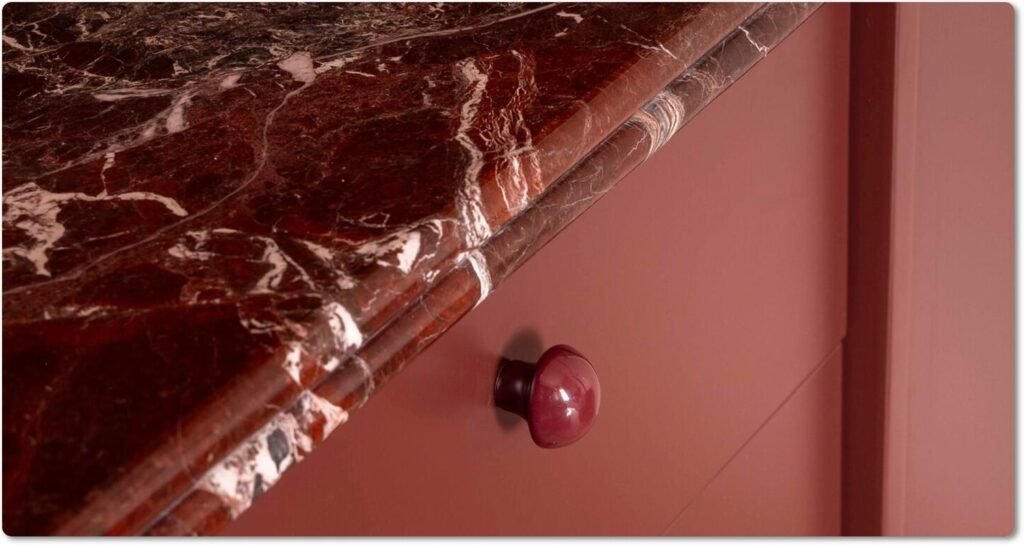
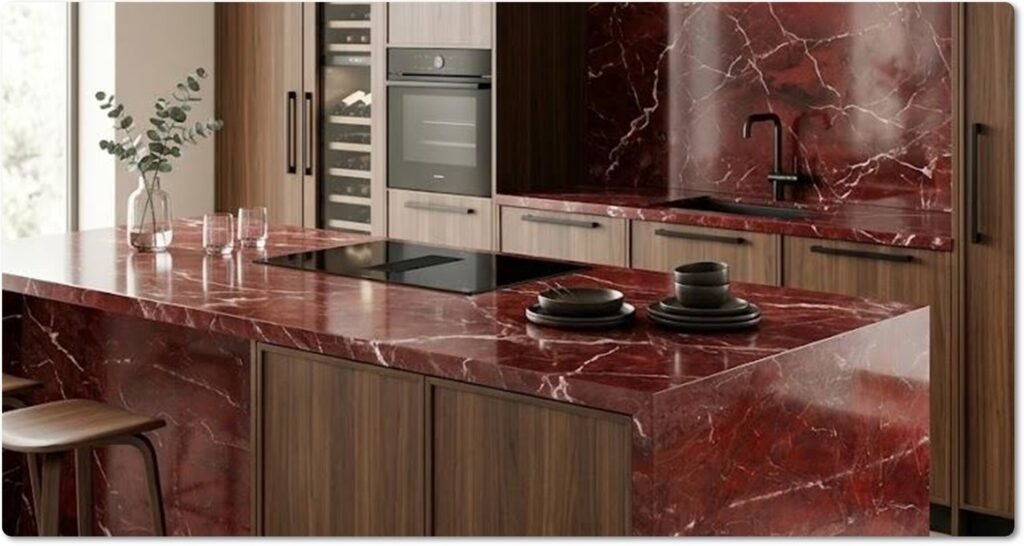
Commercial names such as Carrara, Calacatta, Statuario, and other white or colored marbles can describe distinct material categories, commercial selections, or visually similar products offered by different suppliers.
A name alone is insufficient to establish the exact origin, mineral composition, performance, or appearance of a particular slab.
Request the supplier’s available material identification, quarry or origin information where documented, slab photographs, and product description.
For larger projects, identify an approved material reference and define the acceptable range of color, veining, and natural variation.
3.2 Evaluate natural variation and slab appearance
Marble is a natural stone. Variations in veining, mineral bands, color, and texture are expected characteristics rather than automatically being defects.
Nevertheless, buyers should establish acceptance criteria before production.
Ask for:
Current photographs of the actual slabs proposed for the order.
Slab identification numbers, where available.
Full-slab images rather than close-up photographs alone.
Photographs showing relevant veining and color variation.
Confirmation of which slabs will be allocated to each component.
A layout drawing where vein continuity or bookmatching matters.
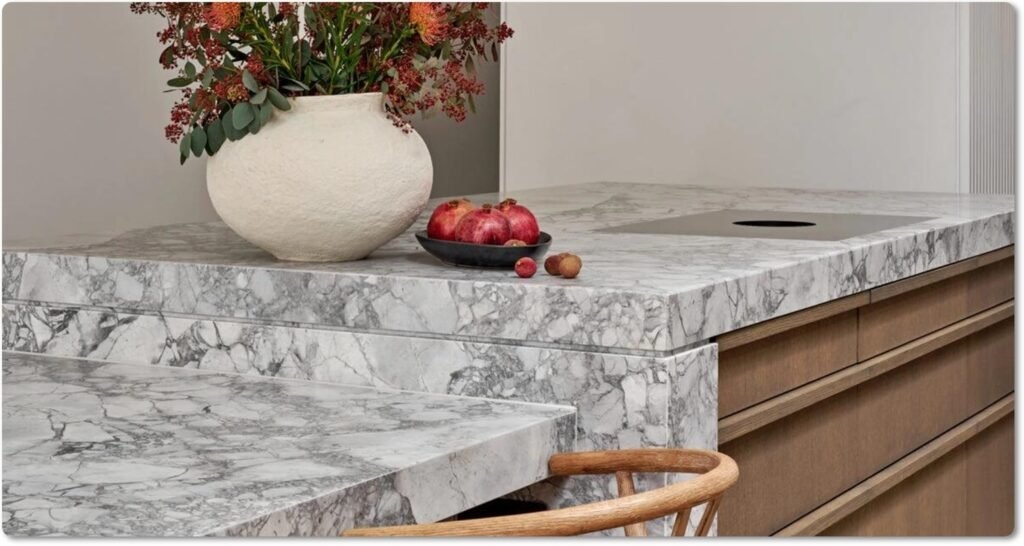
For a kitchen island, reception counter, or hotel vanity package, the visual relationship between adjacent pieces may be as important as the appearance of each slab.
Practical principle: Approve the material and its acceptable natural variation before fabrication, rather than relying exclusively on a small sample.
3.3 Understand the technical properties of marble
Marble performance depends on its specific geological characteristics, finish, fabrication, installation, and intended use.
Relevant considerations include:
Water absorption and density.
Flexural strength and resistance to bending.
Compressive strength where relevant to the design.
Abrasion resistance for the intended surface use.
Mineral composition and sensitivity to acidic substances.
Existing cracks, open seams, fissures, repairs, or other discontinuities.
Suitability for the specified thickness, overhang, and support conditions.
ASTM C503/C503M-23, Standard Specification for Marble Dimension Stone, addresses material characteristics, physical requirements, and sampling for marble used in general building and structural applications. The specification references properties including absorption, density, compressive strength, modulus of rupture, abrasion resistance, and flexural strength. Its applicability should be assessed against the specific product and project rather than assumed to establish every requirement for a finished countertop.
Buyers can consult the official ASTM International standards catalogue and the Natural Stone Institute’s ASTM standards reference when preparing technical specifications.
Marble is not automatically suitable for every application
Marble can be an attractive choice for kitchens, bathrooms, bars, and hospitality interiors, but its performance should be considered in context.
Calcareous stones may react with acidic substances such as lemon juice, vinegar, and certain cleaning products. Depending on the stone and finish, this reaction can cause etching or a change in surface appearance.
Sealers may help reduce certain forms of staining, but they do not make marble immune to acid etching, scratching, or every type of stain.
For heavily used surfaces, establish realistic maintenance expectations with the supplier and specify the finish, protective treatment, and cleaning instructions before ordering.
3.4 Evaluate thickness, edges, cutouts, and structural support
A finished countertop must meet both dimensional and structural requirements.
The quotation and approved shop drawings should identify:
Nominal slab and finished countertop thickness.
Finished dimensions and permitted tolerances.
Edge profiles and edge build-ups.
Sink type and cutout dimensions.
Faucet and accessory openings.
Seam locations.
Overhang dimensions.
Support requirements.
Backsplash height and thickness.
Finished surface and edge treatment.
Large overhangs, narrow stone sections, sink openings, and complex cutouts can introduce stress concentrations.
The appropriate support and reinforcement arrangements depend on the material, geometry, thickness, and installation design. Do not assume that a particular marble slab can support an overhang simply because another stone product of similar dimensions can do so.
Require the fabricator to confirm the design and support details before cutting.
3.5 Inspect fabrication quality
A polished surface does not necessarily mean that a finished countertop meets the approved specification.
Inspect the following areas:
| Inspection area | What to verify |
|---|---|
| Dimensions | Finished length, width, thickness, and project-specific tolerances |
| Edges | Consistent profile, polish, and specified edge details |
| Cutouts | Correct position, dimensions, and finish |
| Surface | Compliance with approved appearance criteria |
| Cracks and repairs | Identification and acceptance of relevant discontinuities or repairs |
| Seams | Approved locations, fit, and agreed appearance |
| Backsplash | Correct height, thickness, and edge treatment |
| Identification | Components correspond to approved drawings and material selections |
| Packing | Adequate protection for edges, corners, and finished surfaces |
Acceptance criteria should be documented before production. Natural color variation, mineral features, repair treatments, fabrication defects, and transport damage should not all be treated as the same category.
4. Local Showrooms vs. Fabrication Workshops vs. Importers
The most effective local supplier search starts by identifying which service you actually need.
4.1 When a local showroom is the better choice?
A local showroom can be valuable when visual selection is the priority.
It allows the buyer or designer to compare materials in person and may simplify the selection of slabs for a distinctive kitchen island or bathroom vanity.
A showroom may also coordinate fabrication through a partner company. If so, confirm which business will be contractually responsible for the finished countertop.
Ask:
Can I inspect the exact slabs before purchase?
Are the displayed slabs in stock or available only by special order?
Is fabrication performed in-house or subcontracted?
Who is responsible for measuring and installation?
Who handles defects, breakage, and warranty claims?
4.2 When is a local fabricator the better choice?
A local fabricator is often a practical option when accurate site measurements and installation coordination are critical.
For residential renovations, the cabinet layout may change during construction. Walls may not be perfectly square, and plumbing or appliance positions may require adjustments.
A fabricator that can coordinate templating, cutting, delivery, and installation may reduce the number of parties the homeowner needs to manage.
However, local fabrication does not guarantee that the material is locally sourced or that every production process is performed in-house.
Ask the fabricator to explain its material sourcing, subcontracting arrangements, and responsibility for the finished product.
4.3 When is an importer or local distributor the better choice?
An importer or distributor may maintain inventory from multiple manufacturers or origins.
This can be useful for buyers who need:
Access to multiple marble selections.
Smaller quantities from available inventory.
Faster material availability than a new international order can provide.
Consolidated purchasing from several material categories.
Established local delivery arrangements.
For commercial buyers, verify whether the quoted price includes only slabs or also cutting, packaging, delivery, and other services.
A wholesale price should not be compared directly with a fully fabricated and installed countertop price without adjusting for the difference in scope.
4.4 How to verify local supplier credibility?
Use the following checks before paying a deposit:
Verify the company’s legal name and business registration where applicable.
Confirm its physical business address and contact details.
Review the written quotation and contract.
Ask for examples of comparable completed projects.
Confirm who owns or controls the proposed material inventory.
Establish whether fabrication and installation are performed in-house or subcontracted.
Review the payment schedule and cancellation provisions.
Obtain written defect, damage, and warranty procedures.
For US buyers, the Federal Trade Commission’s guidance on Made in USA claims is relevant when a seller makes US-origin claims. Imported goods may also be subject to country-of-origin marking requirements under applicable customs law, including 19 U.S.C. § 1304. Buyers should verify the rules relevant to the particular product and transaction.
These checks are not a substitute for legal advice, but they help buyers distinguish verifiable business information from unsupported marketing claims.
5. Factory-Direct Sourcing: Benefits, Limitations, and Best-Fit Applications
Factory-direct procurement is an alternative to purchasing exclusively through local retailers or distributors.
It is particularly worth evaluating when the project involves multiple countertops, repeated specifications, custom dimensions, or wholesale purchasing.
5.1 Potential benefits of working with a marble countertops manufacturer
A suitable manufacturer may offer:
Direct communication about production. Buyers can discuss material availability, fabrication requirements, packaging, and production schedules with the business responsible for the order.
Customization. Depending on the factory’s capabilities, orders may include custom dimensions, edge profiles, sink cutouts, backsplashes, vanity tops, and other cut-to-size components.
Bulk-order coordination. For multifamily housing, hospitality projects, and repeat commercial orders, direct production coordination may simplify the management of multiple components and approved specifications.
Material selection. Buyers may be able to review available slabs, request photographs, and establish material-selection criteria before production.
Commercial comparison. A factory quotation provides another price and scope reference against which to assess local supplier offers.
These benefits depend on the specific manufacturer, production capacity, quality systems, order quantity, and agreed contract terms. They should be verified rather than assumed.
5.2 What factory-direct sourcing does not automatically provide?
Purchasing directly from a factory does not necessarily include:
Local site measurement.
Local countertop templating.
Installation by a local contractor.
Customs clearance.
Import duties and taxes.
Destination warehousing.
Local emergency replacement.
On-site warranty service.
Final plumbing, electrical, or cabinetry coordination.
Unless the contract explicitly includes these services, the buyer must arrange them separately.
This distinction is especially important for homeowners ordering a single kitchen countertop. A factory may produce the stone component, but a local professional will generally need to verify site dimensions and handle installation.
5.3 Introducing EDG Stone as a factory-direct option
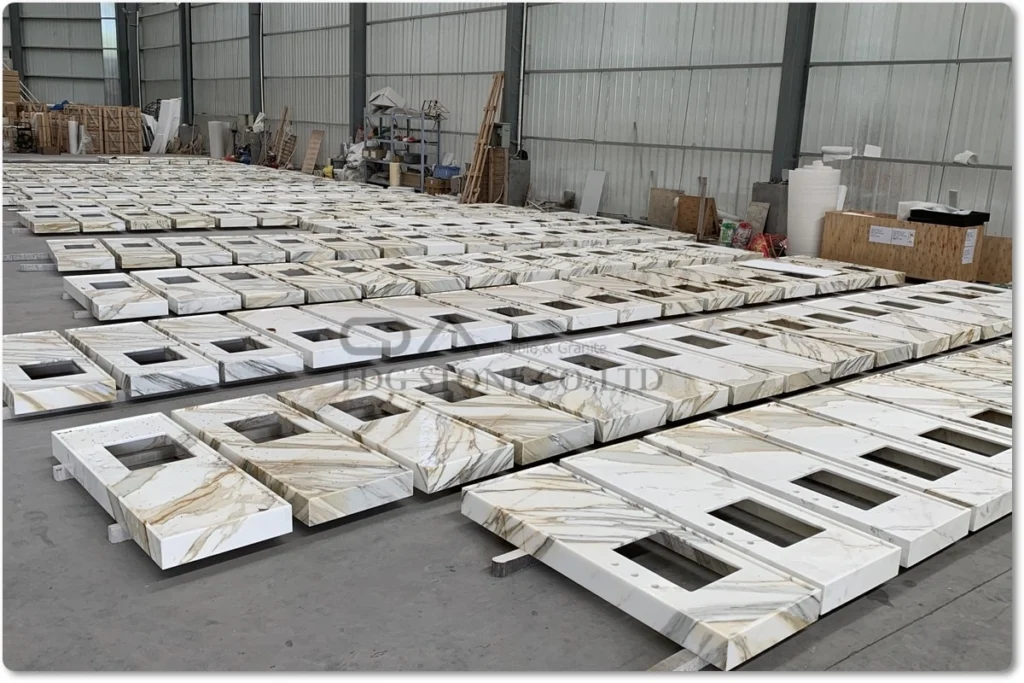
EDG Stone is a China-based stone manufacturer and exporter offering natural stone products and custom fabrication services for project and commercial buyers.
Potentially relevant products include marble slabs, natural stone countertops, vanity tops, and cut-to-size components. Buyers can inquire about applicable fabrication services, such as CNC processing, waterjet cutting, edge processing, and project-specific customization, subject to confirmation of the material and order requirements.
For a factory-direct inquiry, buyers should provide the proposed material, quantity, dimensions, drawings, finish, edge details, delivery destination, and target schedule.
EDG Stone should be evaluated using the same criteria as other overseas manufacturers: verified business information, current material photographs, written technical specifications, sample or reference approval where appropriate, production confirmation, packaging details, and clearly defined commercial terms.
Important limitation: Factory-direct supply should not be interpreted as local showroom access, local stock, local measurement, or local installation in the buyer’s destination market. Buyers should independently confirm shipping arrangements, customs responsibilities, local fabrication, installation, and after-sales support before placing an order.
5.4 When should you choose a local supplier instead?
A local supplier may be the better option when:
You need a single countertop installed quickly.
Site dimensions are still changing.
You need repeated on-site visits.
You cannot manage international shipping or import documentation.
Local replacement and service response are essential.
The factory-direct material price advantage disappears after logistics and local processing.
For many homeowners, a local supplier’s integrated service can justify a higher quotation.
For commercial procurement teams, the decision may be different because the cost of coordinating an international shipment can be distributed across a larger order.

6. How to Inspect Marble Slabs Before Ordering?
Slab inspection is one of the most important steps in reducing disputes over appearance and quality.
6.1 Inspect the actual slab, not only a sample
A small sample can indicate the general color and texture of a marble selection, but it cannot represent every feature of a full slab.
Before approval, request photographs or a video showing the actual slab under reasonable lighting.
For projects requiring visual continuity, review the arrangement of multiple slabs and confirm how the fabricator intends to allocate them to the finished pieces.
If the supplier cannot provide physical inspection, agree on an acceptable remote approval procedure.
6.2 Establish appearance acceptance criteria
Document which natural characteristics are acceptable and which conditions require further review.
For example:
General color range.
Vein direction and intensity.
Natural fissures or open seams.
Filled or repaired areas.
Surface pits or mineral inclusions.
Edge condition.
Polishing consistency.
Visible differences between adjacent pieces.
The acceptance criteria should reflect the specific stone and application. A feature that is acceptable in a decorative wall panel may not be acceptable in a narrow countertop section subject to structural stress.
6.3 Request relevant test information
For larger or technically demanding projects, ask whether suitable test reports are available for the proposed stone.
Depending on the specification, these may address water absorption, density, strength, or other relevant physical properties.
ASTM C97/C97M concerns absorption and bulk specific gravity of dimension stone, while ASTM C503/C503M addresses the specification of marble dimension stone. Confirm the applicable editions and project requirements before incorporating a standard into the purchase contract. The Natural Stone Institute standards reference provides a useful starting point.
Do not assume that a test report for one marble type, quarry source, or material batch automatically proves the performance of a different product.
6.4 Confirm approval before fabrication
Before authorizing production, approve:
The material selection.
The shop drawings.
The component dimensions.
The edge profiles and finish.
The sink and faucet cutouts.
The seam and vein-layout plan, where relevant.
The agreed appearance criteria.
The packing and delivery requirements.
Retain the approved documents as part of the purchase record.
7. Comparing Quotations on an Equivalent Basis
A low quotation is not necessarily the lowest-cost solution.
The first task is to identify exactly what each supplier is offering.
7.1 Compare equivalent deliverables
A local supplier might quote a complete installed kitchen countertop, while an overseas manufacturer quotes only fabricated stone components.
Comparing these totals without adjusting for scope can lead to a misleading conclusion.
Use a comparison table:
| Cost or responsibility | Local supplier | Factory-direct supplier |
|---|---|---|
| Marble material | Confirm included | Confirm included |
| Material selection | Showroom or remote approval | Remote approval or agreed inspection |
| Measurement | Confirm responsibility | Usually needs separate arrangement unless included |
| Fabrication | Confirm included scope | Confirm included scope |
| Sink and faucet cutouts | Specify quantity and details | Specify quantity and details |
| Edge finishing | Specify profile and dimensions | Specify profile and dimensions |
| Export packing | Usually not applicable to domestic supply | Confirm packaging and protection |
| International freight | Usually not applicable | Confirm shipping quotation |
| Insurance | Confirm applicable coverage | Confirm cargo insurance and claims process |
| Customs and duties | Usually reflected in domestic pricing, but verify | Identify the responsible party and applicable charges |
| Local delivery | Confirm distance and unloading | Confirm destination delivery and unloading |
| Installation | Confirm included or excluded | Confirm separate local installer arrangements |
| Damage claims | Confirm procedure | Confirm evidence, deadlines, and responsible parties |
| Warranty | Obtain written terms | Obtain written terms and identify the responsible entity |
7.2 Calculate the total landed and installed cost
For an overseas order, a useful budgeting framework is:
Estimated total project cost =
Material purchase price
fabrication charges not included in the purchase price
export packing
international freight
cargo insurance, if applicable
customs brokerage and clearance
applicable duties and taxes
port, terminal, or handling charges
inland transportation
storage, if required
local fabrication or adjustment
installation
expected allowance for documented project risks.
This is a budgeting framework, not a universal customs valuation formula. The actual calculation depends on the transaction, applicable trade rules, shipping arrangement, and the services already included in the quotation.
Avoid double-counting fabrication or packing charges that are already included in the quoted price.
7.3 Understand the commercial delivery terms
If a supplier quotes EXW, FOB, CIF, or another Incoterms® rule, identify the named place or port and the applicable version.
These terms allocate specific responsibilities, costs, and risks between the seller and buyer. They do not independently settle every issue involving ownership, payment, quality acceptance, warranty, or installation.
The official International Chamber of Commerce website is the appropriate starting point for understanding Incoterms® rules.
For an international order, clarify who arranges freight, who handles export and import formalities, when transport risk transfers, and whether destination charges are included.
7.4 Compare lead times realistically
Ask each supplier to separate the estimated timeline into stages:
Material selection and approval.
Site measurement or confirmation of dimensions.
Shop drawing approval.
Fabrication.
Inspection and packing.
Dispatch and transit.
Customs clearance, where applicable.
Final delivery.
Installation.
For a local order, the main schedule risks may involve measurement, fabrication capacity, and installer availability.
For a factory-direct order, international transit and customs processing may add uncertainty. The supplier should provide the estimated production and dispatch schedule, while the buyer independently evaluates the destination-side arrangements.
Do not treat a production lead time as equivalent to the date the countertop will be installed.
8. Measuring, Fabrication, and Installation Responsibility
Responsibility for dimensions is one of the most common areas requiring clarification.
8.1 Identify who takes the final measurements
Before production, the buyer and supplier should agree on who is responsible for confirming dimensions.
For a locally installed kitchen, the fabricator or its appointed templating professional may measure the cabinetry after it is installed and ready for templating.
For factory-direct cut-to-size orders, the buyer may need to supply approved drawings and dimensions, or engage a local fabricator to prepare and verify the measurements.
A factory should not be assumed to have independently verified site conditions when it has received only customer-provided drawings.
8.2 Use approved shop drawings
The drawings should show all critical dimensions, including:
Overall length and depth.
Component thickness.
Edge profile.
Sink cutout size and location.
Faucet openings.
Backsplash dimensions.
Seams and joints.
Overhangs.
Finished edges.
Support requirements.
Reference points and orientation.
Both parties should approve the final drawings before production.
If dimensions change afterward, document the revision and determine whether additional costs or delays apply.
8.3 Separate manufacturing tolerances from installation conditions
A countertop may be manufactured to its approved dimensions and still encounter installation difficulties because of uneven walls, inaccurate cabinetry, incorrect appliance clearances, or changes at the jobsite.
The contract should distinguish between manufacturing defects, drawing errors, site measurement errors, and installation issues.
For commercial projects, a written responsibility matrix is particularly useful.
| Task | Responsible party to identify |
|---|---|
| Final site measurement | Buyer, local fabricator, or appointed templating contractor |
| Shop drawing preparation | Fabricator or manufacturer |
| Drawing approval | Buyer or authorized project representative |
| Material approval | Buyer, designer, or authorized representative |
| Manufacturing | Contracted manufacturer or fabricator |
| Packing and dispatch | Contractually designated supplier |
| Import clearance | Designated importer or customs representative |
| Site preparation | General contractor or designated trade |
| Installation | Local installer or contracted fabricator |
| Final acceptance | Buyer or authorized inspector |
The purpose is not to assign every task to one party. It is to ensure that each task has a clearly identified owner.
9. Delivery, Damage Claims, and Warranty Terms
Stone is heavy, and finished edges and corners can be vulnerable to impact during handling and transport.
International shipping adds more handoffs between packing, loading, freight, customs, unloading, and final delivery.
9.1 Confirm the packing method
Ask the supplier to describe the proposed packing arrangement.
Depending on the product and transport method, protection may include suitable crates, internal supports, separators, corner protection, surface protection, and clear component identification.
For multiple countertop components, request a packing list that links each piece to its drawing reference or identification number.
Packing should be suitable for the product’s dimensions, weight, finish, and transport route. A generic statement such as “export packing included” does not fully describe the protection provided.
9.2 Document damage immediately
Before delivery, agree on the process for reporting visible damage.
The receiving procedure should identify:
Who is authorized to sign for delivery.
Whether the packaging must be inspected before acceptance.
How damage should be recorded.
What photographs are required.
The notification deadline under the applicable contract or carrier procedure.
Who contacts the carrier or insurer.
How replacement, repair, or reimbursement claims are evaluated.
Where permitted, document visible damage on the delivery receipt and retain photographs of the packaging, labels, and affected components.
Do not assume that the seller, freight carrier, and insurance provider follow the same claims process.
9.3 Define warranty coverage in writing
Ask the supplier to distinguish between:
Material issues: Problems attributable to the supplied stone and covered by the agreed material warranty.
Fabrication issues: Problems such as nonconforming dimensions, incorrect cutouts, or workmanship defects that fall within the agreed fabrication responsibility.
Transportation damage: Damage governed by the applicable transport contract, insurance arrangements, and claims procedures.
Installation issues: Problems caused by site conditions, inadequate support, improper handling, or installation work.
Normal stone characteristics: Natural variations or characteristics that were disclosed and accepted under the agreed criteria.
A warranty should specify the coverage period, exclusions, notification procedure, available remedies, and responsible contracting entity.
For factory-direct orders, buyers should also confirm how replacement components would be produced and shipped if a valid claim is accepted.
10. Procurement Checklist: How to Choose the Right Marble Countertops Supplier?
Use this checklist before comparing final quotations.
10.1 Business verification
Confirm the legal business name.
Verify registration and contact information where applicable.
Identify the entity issuing the quotation and signing the contract.
Confirm whether the company is a showroom, dealer, importer, fabricator, manufacturer, or a combination.
Request relevant project references.
Identify any subcontracted services.
10.2 Material verification
Confirm the marble type and commercial name.
Request current photographs of the actual material where available.
Agree on natural color and veining variation.
Review relevant test reports where required.
Document acceptable and unacceptable defects.
Confirm slab thickness and finished thickness.
Specify the surface finish.
10.3 Fabrication verification
Obtain dimensioned shop drawings.
Confirm edge profiles.
Specify sink and faucet cutouts.
Review seam placement.
Confirm overhang and support requirements.
Define dimensional and workmanship acceptance criteria.
Approve the material and drawings before fabrication.
10.4 Commercial verification
Compare quotations using the same product scope.
Identify excluded charges.
Confirm payment terms and deposit requirements.
Clarify delivery terms and named destinations.
Confirm the estimated production and delivery schedule.
Define cancellation and variation procedures.
Obtain written warranty terms.
Agree on damage notification and claims procedures.
10.5 Factory-direct verification
Confirm the manufacturer’s actual production capabilities.
Request relevant business and product documentation.
Verify whether the quoted products are slabs or finished components.
Confirm packing specifications.
Identify the importer of record where applicable.
Obtain freight and destination-handling estimates.
Arrange local measurement and installation where necessary.
Establish a practical process for replacement parts and after-sales issues.
A supplier that can answer these questions clearly is easier to evaluate than one offering only a low headline price.
11. Supplier Evaluation: What Evidence Should a Professional Buyer Request?
For commercial projects, evaluate suppliers using a consistent evidence-based framework.
The following scorecard is a suggested internal procurement tool, not an official industry rating system.
| Evaluation category | Suggested weighting | Evidence to review |
|---|---|---|
| Material suitability | 20% | Material identification, slab images, applicable test information |
| Fabrication capability | 20% | Equipment and process information, shop drawings, comparable project references |
| Quality control | 15% | Inspection procedures, acceptance criteria, production records where available |
| Commercial transparency | 15% | Detailed quotation, exclusions, payment and variation terms |
| Delivery and logistics | 15% | Packing plan, shipping arrangement, schedule, claims process |
| Communication and documentation | 10% | Response quality, drawing revisions, approval records |
| After-sales arrangements | 5% | Warranty terms, replacement procedure, responsible contracting party |
| Total | 100% |
The weightings can be adjusted to reflect project priorities.
For example, a homeowner with a small renovation may place greater importance on measurement, installation, and local service. An importer placing a recurring wholesale order may prioritize production consistency, packing, repeat-order material availability, and logistics.
11.1 Verify capability instead of relying on labels
A company describing itself as a marble countertops manufacturer should be able to explain which operations it performs and which it outsources.
A local supplier claiming to provide complete installation should explain how templating, fabrication, delivery, and installation are coordinated.
A wholesale supplier should identify its minimum order conditions, stock status, packing specifications, and commercial terms.
These questions establish whether the company’s actual operating model matches the buyer’s requirements.
11.2 Treat documentation as part of quality control
Written specifications reduce ambiguity.
Keep the quotation, material selection, approved drawings, inspection records, packing list, delivery documents, and warranty terms together as one project record.
If the order is revised, retain the updated version and identify which document supersedes the earlier one.
This process is especially useful for projects involving multiple properties, repeated vanity sizes, phased deliveries, or several suppliers.
12. Cost and Risk Factors: When Does Overseas Factory Sourcing Make Commercial Sense?
The economics of overseas sourcing depend on the relationship between order size, customization, logistics, local services, and risk.
12.1 One residential countertop versus a commercial package
Consider two hypothetical projects.
Project A: One residential kitchen. The homeowner needs one marble island and a short run of countertops. A local fabricator offers measurement, fabrication, delivery, and installation under one contract. An overseas factory can supply the stone components, but the homeowner must separately arrange measurements, international transport, and installation.
Even if the factory’s material price is lower, the additional coordination and service costs may eliminate the advantage.
Project B: A multifamily development. A buyer needs multiple vanity tops with repeat dimensions and standardized cutouts. The project team can provide approved drawings, coordinate inspections, consolidate shipments, and arrange local installation.
In this case, comparing direct factory production with local supply may be commercially worthwhile because repeatable specifications and consolidated logistics can improve purchasing efficiency.
These examples illustrate procurement logic; they are not quotations, market averages, or guaranteed savings estimates.
12.2 Calculate the break-even point
A simple comparison can help identify whether factory-direct sourcing deserves further investigation.
Let:
L = total comparable local-supply cost.
F = factory purchase and fabrication cost.
S = international shipping, insurance, and handling costs.
I = import-related charges and applicable taxes.
D = destination delivery, storage, and unloading.
M = local measurement, adjustment, and installation costs.
R = a documented allowance for additional project risks and coordination.
Then:
Estimated factory-direct project cost = F + S + I + D + M + R
Factory-direct sourcing may offer a cost advantage when:
F + S + I + D + M + R < L
The comparison is valid only when both options provide equivalent materials, dimensions, fabrication scope, delivery conditions, and installation outcomes.
The risk allowance should reflect the actual project, not an arbitrary percentage presented as an industry standard.
12.3 Consider the hidden cost of delays
A delayed countertop can affect cabinetry completion, plumbing work, occupancy schedules, and other trades.
For developers and contractors, the commercial effect of a delay may exceed the difference between two material quotations.
Compare the supplier’s schedule, production dependencies, shipping plan, approval process, and replacement arrangements.
A reliable local supplier may offer greater value when installation dates are difficult to change. A factory-direct supplier may be competitive when specifications are stable, and the project schedule allows for international logistics.
12.4 Consider currency, customs, and regulatory uncertainty
International procurement can expose buyers to exchange-rate movements, changing freight costs, customs requirements, and product-specific trade measures.
Before committing to a purchase, identify the likely country of origin, product description, applicable tariff classification, importer responsibilities, and destination-market requirements.
For US imports, verify current requirements with the appropriate customs authorities or a qualified customs broker. Do not assume that rules applying to engineered stone or other product categories automatically apply to natural marble.
Likewise, avoid assuming that a particular customs duty, tax rate, or trade restriction applies without checking the product classification, origin, and current regulations.
12.5 When is factory-direct sourcing the strongest option?
It is worth evaluating when several of the following conditions apply:
The order contains multiple countertops or vanity tops.
The dimensions and specifications are standardized.
Custom fabrication is commercially important.
The buyer can approve materials remotely.
Production and shipping schedules are sufficiently flexible.
Local installation services are available.
The project team can manage import documentation.
The comparable landed cost is competitive.
The supplier can document quality requirements and acceptance procedures.
Conversely, local procurement may be more appropriate when the project is small, urgent, dimensionally uncertain, or heavily dependent on repeated site visits.
13. Practical RFQ Template: Request a Comparable Marble Countertops Quote
The following template can be copied into an email or supplier inquiry form.
Marble Countertops RFQ
A. Buyer information
Company or buyer name:
Contact person:
Destination city and country:
Project type:
Project address or delivery area:
Required delivery date:
Estimated order quantity:
B. Material requirements
Marble type or commercial name:
Preferred color and veining:
Material origin requirements, if any:
Slab or finished countertop:
Nominal slab thickness:
Finished countertop thickness:
Surface finish:
Sample or slab approval requirements:
C. Product dimensions and fabrication
Number of countertop components:
Overall dimensions:
Edge profile:
Sink cutouts:
Faucet openings:
Backsplash requirements:
Seam and vein-layout requirements:
Overhang dimensions:
Support or reinforcement requirements:
Applicable drawings or CAD files attached:
Required inspection criteria:
D. Quality requirements
Required material documentation:
Applicable technical standards:
Dimensional tolerances:
Acceptable natural variation:
Treatment of repairs, fissures, and filled areas:
Inspection and approval procedure:
Required photographs or production records:
E. Packing and logistics
Delivery destination:
Required packing method:
Requested shipping arrangement:
Preferred delivery term and named place or port:
Importer of record:
Customs broker, if appointed:
Unloading arrangements:
Cargo insurance requirements:
Damage notification procedure:
F. Commercial terms
Unit price:
Total material and fabrication price:
Packing charges:
Freight estimate:
Excluded charges:
Payment schedule:
Production lead time:
Estimated dispatch date:
Estimated delivery window:
Quotation validity:
Warranty terms:
Replacement and after-sales arrangements:
G. Supplier declaration
Please identify your role as a manufacturer, fabricator, importer, distributor, dealer, or other supplier. Specify which production processes and services are performed in-house and which are subcontracted. Confirm the contracting entity, applicable product specifications, quotation exclusions, and responsibility for measurement, fabrication, shipping, delivery, and installation.
How to use the RFQ?
Send substantially the same requirements to each supplier.
Do not compare one supplier’s material-only price with another supplier’s installed price. Normalize the quotation scope first, then evaluate price, quality, lead time, service, and contractual risk.
For overseas suppliers, request the destination-side cost assumptions explicitly. If a supplier cannot provide an accurate freight quotation without more information, ask it to identify the missing details rather than treating an incomplete estimate as a final delivered price.
14. Frequently Asked Questions: Marble Countertops Near Me
Q1. How do I find the best marble countertops supplier near me?
Start by identifying whether you need material selection, slab supply, fabrication, installation, or a combination of services. Verify the supplier’s business information, actual material availability, fabrication capabilities, quotation scope, and warranty terms. Compare at least several genuinely comparable offers when practical, and evaluate the full delivered and installed cost rather than the advertised starting price.
Q2. Is it better to buy marble countertops from a local supplier or directly from a factory?
A local supplier may be preferable for a single residential countertop when measurement, installation, and quick service are priorities. Factory-direct sourcing may be worth evaluating for bulk orders, repeat dimensions, customized components, or commercial projects. The best choice depends on total cost, quality controls, schedule, logistics, and the services included in each offer.
Q3. Can I buy marble countertops directly from a manufacturer without using a local dealer?
Yes, where the manufacturer accepts direct orders for the relevant products and destination. However, the buyer should confirm order requirements, payment terms, material approval, fabrication scope, export packing, shipping, customs responsibilities, and local installation arrangements. A manufacturer selling directly does not necessarily provide local measurement or installation.
Q4. What should I check before purchasing a marble countertop?
Confirm the material identity, slab appearance, finished dimensions, thickness, surface finish, edge profile, sink cutouts, seam locations, and support requirements. Establish acceptance criteria for natural variation and relevant defects. Obtain approved drawings and written commercial terms before production, and confirm how delivery damage and warranty claims will be handled.
Q5. Are factory-direct marble countertops always cheaper than local countertop suppliers?
No. A factory quotation may exclude international freight, customs-related charges, destination handling, local measurement, adjustments, installation, and replacement logistics. Factory-direct sourcing is commercially attractive only when the total cost for an equivalent product and service scope compares favorably with the local alternative.
15. References: Standards, Regulatory Resources, and Procurement Guidance
The following sources support the technical and regulatory principles discussed in this guide. Always verify the edition and applicability of a standard or regulation before incorporating it into a contract.
ASTM International — ASTM C503/C503M-23, Standard Specification for Marble Dimension Stone. Covers material characteristics, physical requirements, and sampling relevant to marble dimension stone. Published January 2024 following approval in December 2023.
Official source: ASTM C503/C503M-23Natural Stone Institute — ASTM International Standards. A reference for dimension-stone material specifications and related test standards, including ASTM C503 and ASTM C97.
Official source: Natural Stone Institute ASTM StandardsFederal Trade Commission — Complying with the Made in USA Standard. Explains the FTC framework for US-origin claims in advertising, labeling, and marketing. Relevant where a supplier makes claims about domestic manufacturing or product origin.
Official source: FTC Made in USA GuidanceUnited States Code — 19 U.S.C. § 1304, Marking of Imported Articles and Containers. Provides the statutory framework for country-of-origin marking of imported goods, subject to applicable exceptions and implementing requirements.
Official source: 19 U.S.C. § 1304International Chamber of Commerce — Incoterms® Rules. Provides official information about internationally recognized commercial delivery terms and the allocation of specified responsibilities, costs, and risks between sellers and buyers.
Official source: International Chamber of CommerceASTM International — ASTM C97/C97M, Test Methods for Absorption and Bulk Specific Gravity of Dimension Stone. Consult the official catalogue for the current applicable edition and project requirements.
Reference: ASTM International Standards Catalogue
These references do not replace project-specific engineering, customs, legal, or installation advice. A technical standard should be applied only where its scope and requirements are relevant to the actual stone product and intended use.
16. Semantic Closure: How to Choose the Right Marble Countertops Procurement Model
Marble Countertops Near Me: Decision Framework for Buyers
What is the best way to source marble countertops?
The best sourcing method is the one that matches the buyer’s required product, service scope, project quantity, schedule, and risk tolerance. A local showroom helps with visual selection; a fabricator provides dimensional processing and may coordinate installation; an importer or distributor offers access to stocked materials; and a manufacturer may provide direct production and customization.
Why does the supplier’s operating model matter?
The business name alone does not establish which services are included. Buyers should identify who supplies the stone, who fabricates it, who verifies dimensions, who arranges transport, who installs the product, and who resolves valid warranty claims. Clear responsibility reduces procurement ambiguity and makes quotations easier to compare.
What are the main purchasing options?
Option A — Local supply and installation: Suitable when on-site measurement, installation coordination, and local service are important.
Option B — Local slab purchase with independent fabrication: Suitable when the buyer wants direct control over slab selection but prefers to use a separate fabricator.
Option C — Importer or wholesale distribution: Worth considering when material availability, selection breadth, or consolidated purchasing is important.
Option D — Overseas factory-direct sourcing: Worth evaluating for repeat orders, bulk projects, customized components, and commercial procurement where the buyer can coordinate international logistics and destination-side services.
What should buyers consider before making the decision?
Compare equivalent product specifications, material approval procedures, fabrication details, total delivered and installed cost, lead times, packing, import responsibilities, warranty coverage, and replacement arrangements. Natural marble variation should be documented and accepted before production. Technical standards should be selected according to the actual material and application, not simply listed as generic quality claims.
What is the practical conclusion?
A local supplier is not automatically better because it is nearby, and a factory-direct supplier is not automatically better because its initial quotation is lower. The strongest procurement decision is supported by verifiable supplier information, approved drawings, documented quality criteria, transparent cost assumptions, and a written allocation of responsibilities.
For homeowners, this approach helps avoid unexpected installation and service costs. For contractors, cabinet companies, importers, and developers, it provides a repeatable method for evaluating suppliers across projects.
17. EDG Stone CTA: Compare Your Project Requirements with a Factory-Direct Quote
If you are evaluating marble countertops for a residential development, hotel, multifamily property, cabinet program, wholesale order, or customized stone project, comparing a factory-direct quotation with your local supplier’s offer can help clarify the available procurement options.
EDG Stone invites qualified buyers to inquire about natural marble products, countertop components, vanity tops, and applicable custom stone fabrication services.
To support a meaningful quotation, prepare the following information:
Product: Marble kitchen countertops, islands, vanity tops, or other cut-to-size components.
Material: Preferred marble type, color, and visual reference.
Quantity: Number of pieces, sets, rooms, units, or project phases.
Dimensions: Approved measurements, drawings, or CAD files.
Fabrication: Thickness, edge profiles, cutouts, finish, and other technical details.
Destination: Delivery city and country.
Schedule: Target production and delivery dates.
Procurement requirements: Inspection, packaging, shipping, and documentation expectations.
For overseas factory-direct orders, buyers should separately confirm freight, import responsibilities, local measurement, installation, and after-sales arrangements.
Compare your project requirements with a factory-direct quote before making your final sourcing decision.
Explore EDG Stone’s available stone products and customization options through the official EDG Stone website, or submit a project inquiry through the website to discuss the applicable product scope and quotation requirements.