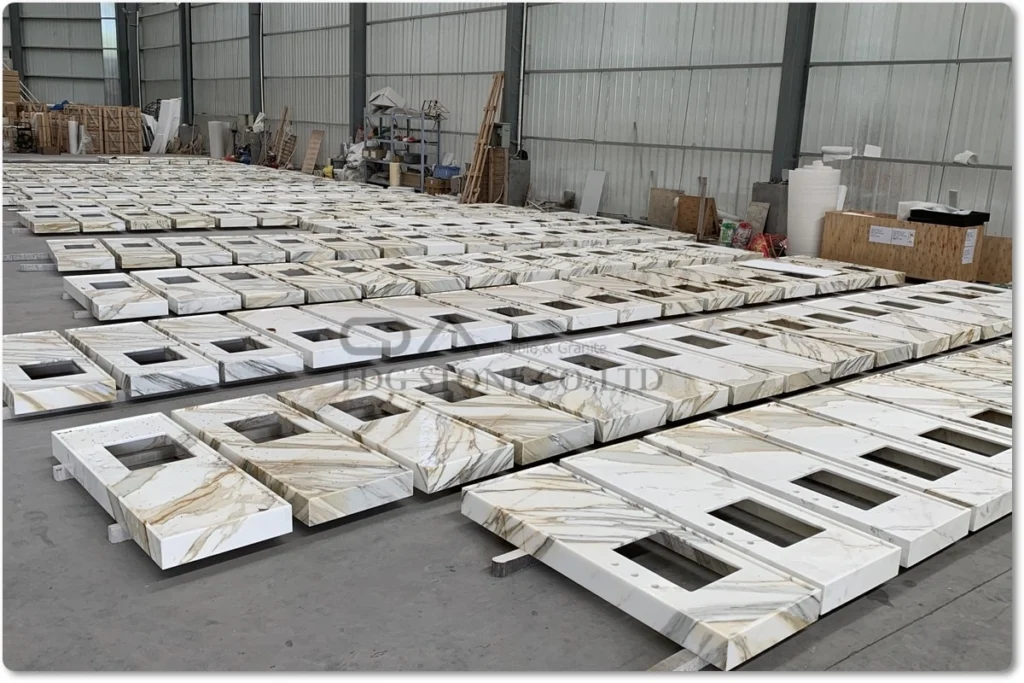
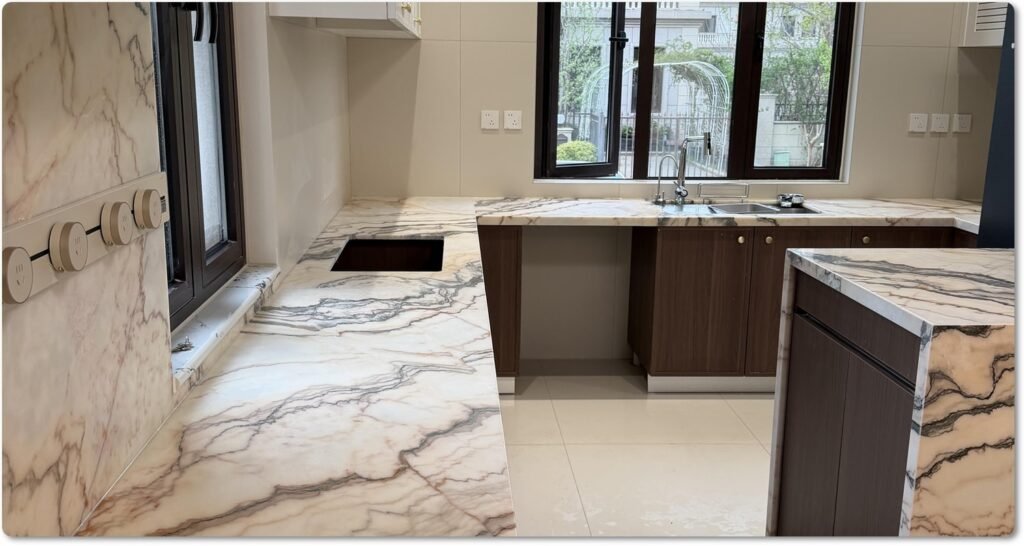
1. Executive Summary: What Makes a Commercial Marble Countertops Collection Procurement-Ready?
A successful Marble Countertops Collection is more than a gallery of attractive stone photographs. It is a structured product portfolio that enables buyers to identify materials, compare specifications, approve samples, request quotations, and place repeat orders with fewer misunderstandings.
For a marble countertops manufacturer, factory, wholesaler, or supplier, a commercially useful collection must connect visual presentation with technical documentation and purchasing information. This is particularly important for importers and distributors supplying multiple customers, cabinet manufacturers managing recurring production, and contractors purchasing countertops for hotels, apartments, villas, and other commercial developments.
A procurement-ready collection should answer six questions:
What is the material? Identify the commercial name and document the best available information about its geological classification and origin.
What does it look like? Show representative slab photographs, color variation, vein patterns, and surface finishes.
What can be manufactured? State confirmed dimensions, thickness options, edge profiles, cutouts, and fabrication capabilities.
How consistent is the supply? Explain how production lots, slab selection, and repeat-order requirements will be managed.
What evidence supports the specification? Provide applicable technical reports, product records, sample references, and agreed inspection criteria.
What is required to purchase it? Clarify quantities, destination, packaging, lead-time assumptions, quotation basis, and approval procedures.
The central procurement principle is straightforward: select marble by documented material characteristics and agreed acceptance criteria, not by a trade name alone.
A collection can help a business attract new customers, but its long-term commercial value depends on whether the products presented online can be identified, quoted, inspected, fabricated, and supplied according to the buyer’s requirements.
For EDG Stone, the collection page should therefore function as both a product discovery page and a commercial sourcing entry point for importers, distributors, cabinet brands, and project buyers.

2. Scope and Definitions: Understanding Commercial Marble Countertops
2.1 What Is a Marble Countertops Collection?
A Marble Countertops Collection is an organized selection of marble materials and fabricated countertop products presented under a consistent identification and specification system.
Depending on the supplier’s actual offering, a collection may include:
Marble slabs intended for countertop fabrication.
Standardized marble vanity tops.
Custom kitchen countertops and islands.
Bathroom vanity countertops.
Countertops for hospitality and residential developments.
Custom-cut tops for cabinetry and furniture.
Project-specific products fabricated from selected slabs.
These categories are related, but they are not interchangeable.
A slab supplier may sell uncut stone, while a countertop manufacturer may provide finished components with edge profiles, sink openings, finished dimensions, and packaging. Buyers should establish exactly which product stage is included in a quotation.
2.2 Natural Marble Versus Other Countertop Materials
Natural marble is a dimension stone whose principal carbonate minerals commonly include calcite or dolomite. Geological classification, commercial naming, and finished-product performance are separate matters.
A product marketed as a marble countertop should not automatically be assumed to have the same composition, durability, or maintenance requirements as another product carrying a similar commercial name.
Buyers may also encounter limestone, dolomitic stone, quartzite, granite, engineered quartz, and porcelain within broader countertop collections.
These materials should have separate product identities and technical documentation. A supplier should not combine them into one undifferentiated category merely because their colors or patterns appear similar.
ASTM C503/C503M-23, Standard Specification for Marble Dimension Stone, addresses material characteristics, physical requirements, and sampling for marble dimension stone used in general building and structural applications. It identifies properties including absorption, density, compressive strength, modulus of rupture, abrasion resistance, and flexural strength. Its applicability to a particular countertop must be assessed against the product, intended use, and project specification.
2.3 Commercial Names, Geological Identity, and Origin
Names such as Carrara, Calacatta, Statuario, and other familiar market labels are useful for product discovery. However, commercial names do not always establish a unique geological identity, a specific quarry, or a particular physical performance profile.
Two suppliers may use similar names for materials that differ in background color, veining, geological characteristics, treatment history, or sourcing location.
Consequently, the product record should distinguish between:
| Information field | What it should establish |
|---|---|
| Commercial name | The name under which the product is marketed |
| Material classification | The documented geological or petrographic classification, where available |
| Origin | The verified country or region of origin, where documented |
| Quarry or source | The specific source, if known and supported by records |
| Production lot | The identifiable group of slabs offered for selection or fabrication |
| Finish | The specified treatment of the visible surface |
| Treatment history | Disclosed resin filling, reinforcement, or other relevant processing |
| Technical data | Applicable test results or declarations supported by documentation |
Procurement rule: If the project requires a specific geological type or country of origin, make that requirement explicit in the purchase specification and request supporting evidence.
Do not treat a marketing label as a substitute for material verification.
3. Technical Evaluation: Building a Commercial Marble Collection
3.1 How to Build a Commercial Marble Countertops Collection?
A commercially effective collection should balance design appeal, customer demand, manufacturing practicality, and sourcing reliability.
Rather than displaying dozens of poorly documented materials, a supplier can begin with a focused portfolio organized by color family, visual character, application, and purchasing purpose.
Recommended Collection Architecture
| Collection group | Typical visual characteristics | Potential commercial applications |
|---|---|---|
| White marble | White to off-white backgrounds, with varying gray or colored veins | Kitchens, bathroom vanities, hospitality interiors |
| Beige and cream marble | Warm neutral backgrounds and softer tonal variation | Residential developments, hotels, traditional interiors |
| Gray marble | Light to dark gray backgrounds, linear or cloud-like patterns | Contemporary kitchens, commercial interiors |
| Green marble | Green backgrounds with contrasting veins or mineral patterns | Feature counters, boutique hospitality, statement interiors |
| Dark marble | Black, charcoal, brown, or other deep backgrounds | Bars, reception desks, vanity tops, decorative counters |
| Distinctive or highly veined marble | Strong contrast, prominent movement, or unusual patterns | Premium residences, bespoke projects, feature islands |
These categories are a product organization framework, not a guarantee of availability or suitability.
Each collection should include a clear material identification, representative photographs, finish options, confirmed specifications, and a route for requesting a quote.
Build Around Buyer Requirements
Different customers need different levels of product information.
Importers and wholesalers need repeat-order information, slab dimensions, lot identification, packing arrangements, and commercial quotation details.
Distributors and showrooms need sample availability, product photography, customer-facing descriptions, SKU records, and reliable information about variation.
Kitchen cabinet brands need fabrication drawings, finished dimensions, cutout coordination, edge details, and production scheduling.
Project procurement teams need approved material references, inspection procedures, quantity planning, delivery coordination, and a documented process for handling deviations.
A well-designed Marble Countertops Collection supports all four groups without forcing every buyer to interpret the same generic product description.
3.2 White Marble: Carrara, Calacatta, and Other Marketed Varieties
White marble is an important collection category because it can suit a broad range of interior design schemes. However, white marble is not one uniform material specification.
Products marketed as Carrara, Calacatta, Statuario, or other white marble varieties may differ significantly in background whiteness, gray veining, vein density, contrast, and visual movement.
Carrara-Style White Marble
Carrara is commonly associated with a white to gray background and softer gray veining, although individual materials vary.
For commercial selection, buyers should establish the acceptable range of background tone, vein density, and pattern scale. A sample showing a pale background does not guarantee that every slab in the same commercial category will have the same appearance.
Calacatta-Style White Marble
Calacatta is often marketed for its more pronounced veining and higher-contrast visual character. Particular products may feature gray, gold, or other colored veins.
Because the name alone cannot guarantee a specific pattern, buyers should request actual slab photographs and identify the selected slabs when the design depends on prominent veins.
Statuario and Other White Marble Products
Other white marble names may be used to describe materials with different combinations of whiteness, vein structure, and visual contrast.
A procurement specification should therefore define the appearance required rather than relying exclusively on the product name.
For a white marble countertop order, record at least:
Acceptable background color range.
Preferred vein color and intensity.
Maximum or minimum acceptable pattern contrast, if relevant.
Permitted natural mineral features.
Required finish.
Slab selection or matching requirements.
Approval sample and photographic reference.
These criteria make visual expectations more understandable and easier to assess.
3.3 Beige, Grey, Green, and Dark Marble
Color-based product categories help buyers navigate a large collection, but each category requires its own acceptance criteria.
Beige and Cream Marble
Beige and cream marble can provide a warm, relatively neutral appearance. Buyers should assess background undertones, tonal variation, visible mineral features, and compatibility with the cabinetry, flooring, and lighting specified for the project.
A beige stone that appears neutral under one lighting condition may look warmer or cooler in another environment.
Grey Marble
Gray marble may contain linear veins, cloudy patterns, white mineral features, or darker inclusions.
For a contemporary project, the important question is not simply whether the stone is gray. Buyers should establish whether the desired appearance is relatively uniform, strongly linear, high contrast, or more naturally varied.
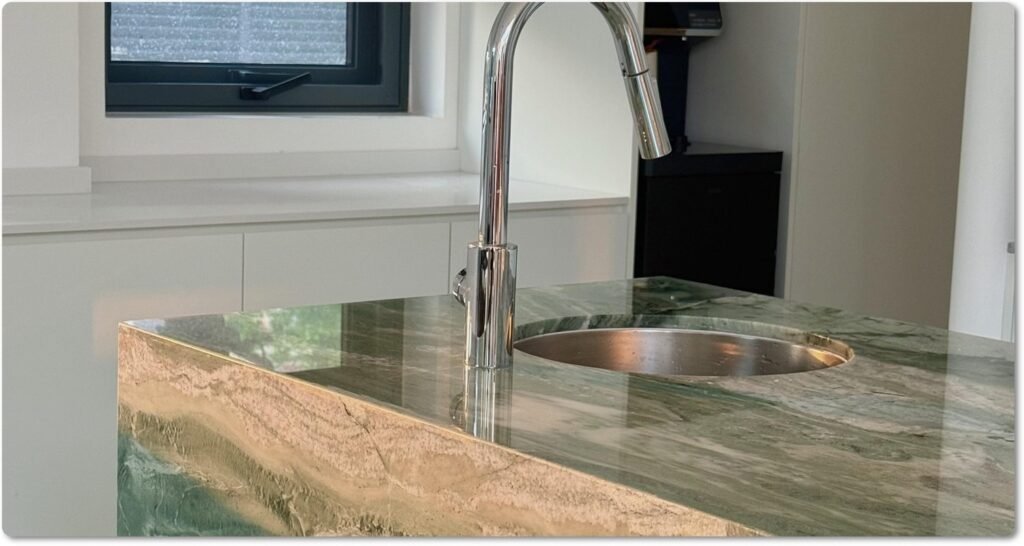
Green Marble
Green marble products can range from relatively consistent backgrounds to highly contrasting patterns.
For bathrooms, reception counters, and decorative applications, verify the material’s intended use, surface treatment, maintenance requirements, and response to the specified installation environment.
Do not assume that every green stone sold under a marble label has identical mineral composition or durability.
Dark Marble
Black, charcoal, and other dark marble products can create a strong visual effect, but surface scratches, dust, water marks, and polishing differences may be more noticeable on some finishes.
Request a representative sample with the intended finish and evaluate it under realistic lighting before approving a large order.

3.4 Understanding Slab Photography and Physical Sample Approval
Photographs are valuable for product discovery, but they are not sufficient evidence of exact color, texture, or slab consistency.
Camera exposure, white balance, artificial lighting, screen calibration, image processing, and the viewing environment can all affect perceived color.
A commercially useful image library should distinguish between general product photography and images of the actual slabs offered for a particular order.
A Three-Level Sample Approval Process
Level 1: Collection reference
Use representative photographs to shortlist potential products. Label these images as representative when they do not show the actual production lot.
Level 2: Physical sample
Provide a labeled physical sample, where available, showing the approximate color, finish, and visible material characteristics. A small sample helps evaluate surface treatment and texture, but it cannot represent the entire slab.
Level 3: Actual slab selection
For projects with strict appearance requirements, provide identification numbers and photographs of the actual slabs proposed for production.
Where possible, photograph each slab in full, with consistent lighting and a visible identification label. Additional close-ups can document significant veins, mineral features, repairs, or other characteristics relevant to acceptance.
The approval record should identify the selected material, sample reference, production lot, finish, and date of approval.
Important limitation: Even an approved slab photograph does not replace the physical material, establish its complete technical performance, or guarantee that every fabricated component will look identical under all lighting conditions.
3.5 Color and Vein Variation Between Slabs
Natural marble forms through geological processes, so variation is an inherent characteristic of many marble products.
Differences may occur in background color, veining, mineral distribution, tonal movement, and the presence of natural features. Some materials may also have disclosed resin filling or other treatments.
The objective of commercial quality control is not necessarily to eliminate natural variation. It is to establish which variation is acceptable for the intended application.
Establish an Appearance Acceptance Range
For repeat orders and multi-unit developments, define:
The approved reference sample or slab.
The acceptable background color range.
The permitted variation in vein density and direction.
The treatment of natural fissures, open seams, pits, and filled features.
The required finish and acceptable surface defects.
Whether individual slabs require separate approval.
How disagreements will be evaluated.
A written visual acceptance standard is more useful than an instruction such as “same color as the sample.”
For example, a project may accept moderate variation in background tone while requiring strong consistency in the dominant vein direction across a group of adjacent countertops.
The criteria must be agreed by the buyer and supplier before production. They should reflect the actual material, not an unrealistic expectation that natural stone will behave like a uniform printed or manufactured surface.
3.6 Slab Dimensions, Thickness, and Finish Options
The slab dimensions and fabrication requirements determine how efficiently a material can be converted into finished countertops.
A visually attractive slab may not be economical for a particular project if its usable dimensions, thickness, defects, or pattern distribution create excessive cutting waste.
Slab Dimensions
Request the actual available slab dimensions rather than assuming every slab in a collection has identical measurements.
For each material or production lot, document:
Length and width.
Nominal and measured thickness, where required.
Usable area after accounting for defects and cutting restrictions.
Slab identification number.
Relevant edge or corner damage.
Any limitations affecting cutting layouts.
Large kitchen islands, long reception counters, and projects requiring multiple coordinated components need particular attention to usable slab dimensions.
Thickness
Specify the required finished thickness and clarify whether the quoted product is a raw slab, a finished countertop, or a fabricated component using a built-up or laminated edge.
Do not assume that a visually thicker edge indicates a single solid piece of stone.
The structural suitability of a countertop depends on the material, geometry, support conditions, cutouts, installation method, and applicable design requirements.
Surface Finishes
Common finish categories may include polished, honed, and other finishes offered for the specific stone.
A polished surface generally has a reflective appearance. A honed surface has a more subdued, less reflective appearance. Other finishes may be available depending on the material and intended application.
The finish can affect perceived color, texture, maintenance, and visible surface marks.
Specify the required finish in the quotation and approval record. Do not assume that a sample approved in one finish automatically approves the same material in another finish.
3.7 Matching Slabs Across Multiple Countertops
Matching is especially important for hotels, apartment developments, hospitality projects, and premium residential installations.
However, the word “matching” can describe several different requirements.
| Matching requirement | Meaning | Recommended control |
|---|---|---|
| Color matching | Keeping background tones within an agreed range | Compare identified slabs under consistent lighting |
| Vein matching | Coordinating vein direction or visual movement | Review slab photographs and cutting layouts |
| Bookmatching | Creating a mirrored visual pattern from appropriately paired slabs | Approve the actual slab sequence and layout |
| Batch matching | Selecting slabs from the same identified production lot where possible | Record lot and slab IDs |
| Finish matching | Maintaining a consistent surface appearance | Confirm finish specifications and inspect completed parts |
For ordinary multi-unit projects, the buyer may require a consistent overall appearance without exact vein continuity.
For feature islands, reception desks, or bookmatched surfaces, the slab layout may be a central design requirement and should be agreed before cutting.
Practical Slab Coordination Procedure
Finalize the countertop dimensions and approved material.
Determine the estimated slab quantity, including cutting yield and a suitable contingency.
Identify candidate slabs.
Review full-slab photographs and arrange the intended cutting layout.
Confirm which components must be visually coordinated.
Approve the slab selection and layout in writing.
Record slab IDs on the fabrication documents.
Inspect the fabricated components against the agreed criteria.
A supplier should not promise perfect color or vein continuity unless the specific material, slab arrangement, and fabrication plan make that commitment achievable.
3.8 SKU Management and Product Documentation
A product catalog becomes difficult to manage when several materials share similar names or when the same material is sold in multiple finishes and thicknesses.
A structured SKU system helps importers, wholesalers, and distributors connect online listings with samples, quotations, orders, and inspection records.
A practical SKU might combine a material identifier, finish code, thickness code, and product format. The exact structure should suit the supplier’s inventory and production systems.
For example, a hypothetical internal SKU could use:
MAR-WHT-001-POL-20
In this example, the code is illustrative only. It does not identify an actual EDG Stone product or confirm availability.
Each product record should include:
SKU and commercial name.
Material classification and documented origin, where available.
Product category and intended application.
Representative photographs.
Available slab dimensions and thickness options.
Finish and edge options.
Relevant test reports or technical documents.
Sample reference.
Production lot and slab IDs, when applicable.
Packaging details.
Quotation status and order history.
For distributors, consistent naming and documentation can reduce the risk of quoting the wrong product or using outdated photographs.
A product page should also distinguish confirmed information from details that must be verified for a specific order.
3.9 Collection Planning for Importers and Distributors
A commercial collection should be planned around the buyer’s sales model.
A showroom distributor may prioritize a manageable set of recognizable colors, attractive physical samples, and reliable customer-facing photography.
A wholesale importer may prioritize slab utilization, shipment planning, product documentation, and the ability to reorder comparable material.
A cabinet manufacturer may need coordinated countertop dimensions, sink cutouts, edge profiles, and repeatable fabrication procedures.
A project contractor may need material traceability, documented acceptance criteria, and the ability to coordinate deliveries with site progress.
A Practical Collection Planning Matrix
| Planning factor | Question to resolve | Why it matters |
|---|---|---|
| Target market | Which customer segment will buy the product? | Determines the appropriate assortment |
| Color balance | Does the collection cover the requested design palette? | Helps customers shortlist products |
| Material verification | What evidence supports the product description? | Reduces naming and sourcing risks |
| Supply continuity | Can comparable material be sourced for future orders? | Supports repeat business |
| Fabrication | Can the required components be manufactured? | Reduces technical and yield risks |
| Documentation | Are product records complete and consistent? | Improves quoting and traceability |
| Logistics | Can the product be packed and delivered to the destination? | Reduces transport and handling risks |
| Commercial viability | Does the expected yield support the target price? | Helps evaluate total procurement cost |
For EDG Stone, the product collection should use actual product photographs and verified product information. Each listing should direct buyers toward a relevant inquiry process rather than implying that every pictured slab is continuously available.

4. Procurement Checklist: From Product Discovery to Purchase Order
Before issuing a purchase order, buyers should complete a structured review of the material, specifications, appearance, commercial terms, and delivery requirements.
Stage 1: Define the Requirement
Identify the intended application and installation environment.
Confirm the number of countertops and their finished dimensions.
Prepare drawings showing sink cutouts, faucet holes, edges, joints, and support requirements.
Specify the preferred material and acceptable alternatives.
Establish the target finish and thickness.
Identify any special appearance or matching requirements.
Stage 2: Verify the Product
Confirm the commercial name.
Request available material identification and origin documentation.
Check whether the description accurately distinguishes natural marble from other stone or manufactured materials.
Request relevant technical data for the intended application.
Confirm the disclosed treatment history where it affects appearance, fabrication, or maintenance.
Stage 3: Approve the Appearance
Review representative product images.
Request physical samples when appropriate.
Identify the actual slabs for appearance-sensitive projects.
Agree on the permitted color and vein variation.
Record approved slab IDs and layout references.
Establish how natural features and repairs will be evaluated.
Stage 4: Confirm Manufacturing
Confirm the fabrication scope.
Review shop drawings and dimensions.
Agree on tolerances and measurement methods.
Specify cutouts, edge profiles, finished thickness, and surface finish.
Confirm inspection stages and approval responsibilities.
Stage 5: Confirm Commercial and Logistics Details
Confirm quantities and the quotation basis.
Identify tooling, packaging, and other additional charges.
Agree on production timing and the events that start the lead-time clock.
Confirm packing method and shipment protection.
Clarify delivery terms, destination, and responsibilities.
Agree on documentation and the process for reporting damage or nonconformity.
The completed checklist should be retained with the quotation, purchase order, drawings, and inspection records.
5. Cost and Risk Factors: What Determines the Real Cost of Marble Countertops?
The purchase price of marble countertops is only one part of the total procurement cost.
A lower-priced slab may create higher overall costs if it produces poor cutting yield, requires additional selection, generates excessive waste, or fails to meet the project’s appearance requirements.
5.1 Material and Yield
The cost of a fabricated countertop depends on the usable portion of the slab, not simply its gross area.
Relevant factors include:
Slab dimensions and thickness.
Natural features and defects affecting cutting.
Countertop layout and component nesting.
Vein-matching requirements.
Cutout positions and edge details.
The number of usable pieces obtained from each slab.
A simplified planning formula is:
Estimated material cost per finished countertop = Allocated slab cost + Fabrication cost + Finishing cost + Packaging cost + Allocated logistics cost + Other applicable charges.
This formula is a budgeting framework, not a universal pricing rule. Actual quotations may allocate costs differently.
5.2 Fabrication Complexity
Straightforward rectangular vanity tops may require less processing than large islands with complex cutouts, multiple joints, shaped edges, or coordinated veining.
Before comparing quotations, ensure that suppliers are pricing the same scope.
A quotation for raw slabs should not be compared directly with one that includes finished dimensions, sink cutouts, edge processing, inspection, and export packaging.
5.3 Visual Selection and Waste
Strict visual matching can reduce the number of usable cutting layouts.
For example, a buyer requiring continuous vein movement across adjacent surfaces may need a specific slab sequence. This can limit cutting flexibility and increase material consumption.
The procurement documents should identify these requirements early so that the supplier can assess feasibility before the price is finalized.
5.4 Transport and Packaging
Natural stone is heavy and can be damaged by poor handling, inadequate restraint, or insufficient protection.
Packaging costs depend on the product format, shipment method, destination requirements, and agreed protection measures.
Confirm the packing design, identification labels, loading plan, and responsibilities for transit-related claims. Do not assume that all suppliers use the same export packaging standard.
5.5 Risk Allocation
The purchase agreement should distinguish between:
Acceptable natural variation.
Fabrication defects.
Damage occurring before dispatch.
Transport damage and responsibility under the agreed delivery terms.
Deviations from approved dimensions or specifications.
Missing or incorrect documentation.
Clear responsibility allocation is generally more effective than attempting to resolve every possible issue after shipment.

6. Supplier Evaluation: How to Choose a Marble Countertops Supplier?
A qualified supplier should be evaluated on documented capabilities and the suitability of its proposed process, not solely on catalog appearance or quoted price.
6.1 Product Identification and Documentation
Ask whether the supplier can provide:
Product identification records.
Available origin and material documentation.
Representative and actual slab photographs.
Sample references.
Applicable test reports.
Confirmed dimensions, thicknesses, and finish options.
Written inspection and acceptance procedures.
Where a project requires a particular standard, certificate, or declaration, identify the exact requirement and verify its applicability to the product and market.
6.2 Manufacturing and Fabrication Capabilities
For finished countertops, establish whether the supplier can provide the required cutting, edge processing, sink cutouts, drawing coordination, surface finishing, and final inspection.
Request evidence appropriate to the order, such as production drawings, sample work, inspection records, or a documented workflow.
Do not assume that a supplier offering raw slabs can automatically manufacture every custom countertop configuration.
6.3 Repeat-Order Management
For distributors and developers, repeat-order capability can be as important as the initial product quality.
Ask how the supplier records material names, production lots, slab IDs, approved samples, fabrication drawings, and changes between orders.
If the original material is no longer available, the supplier should explain how replacement material will be evaluated and approved.
6.4 Export and Logistics Readiness
International buyers should confirm the supplier’s ability to prepare the agreed shipping documents, protect finished products during transport, and coordinate packaging and dispatch.
The precise requirements depend on the destination, transaction structure, product category, and agreed delivery terms.
6.5 Supplier Evaluation Scorecard
The following is a proposed internal evaluation tool, not an industry certification or a claim about any particular supplier.
| Evaluation category | Suggested weighting |
|---|---|
| Material identification and documentation | 20% |
| Appearance approval and traceability | 20% |
| Fabrication and dimensional quality | 20% |
| Repeat-order and production coordination | 15% |
| Packaging and logistics | 15% |
| Communication and quotation clarity | 10% |
| Total | 100% |
Score each category using evidence from the supplier’s actual records, samples, and proposed procedures. Buyers may adjust the weights to suit the project’s priorities.
6.6 EDG Stone as a Commercial Sourcing Contact
EDG Stone can be positioned as a marble countertops manufacturing and export supplier for importers, wholesalers, distributors, cabinet brands, and project procurement teams seeking product information or custom fabrication.
The collection page should help potential buyers move from browsing to a clearly defined inquiry.
To support this positioning, publish actual product photographs, confirmed specifications, available fabrication options, and relevant documentation. Where a specification depends on the selected material or production lot, state that it must be confirmed during quotation.
This approach gives buyers a more practical basis for evaluating EDG Stone than broad claims about quality or availability that are not supported by product-specific evidence.
7. Regulations, Technical Standards, and Documentation Trends in 2026
Commercial stone procurement increasingly requires buyers to connect product selection with technical evidence, traceability, and destination-market requirements.
However, no single regulation or test standard automatically establishes that every marble countertop is suitable for every application. The applicable requirements depend on the material, product format, intended use, installation conditions, and jurisdiction.
7.1 ASTM Standards Relevant to Marble Procurement
The following standards provide useful starting points for developing a project specification.
| Standard | Subject | Procurement relevance |
|---|---|---|
| ASTM C503/C503M-23 | Specification for marble dimension stone | Material characteristics and applicable physical requirements |
| ASTM C97/C97M | Absorption and bulk specific gravity of dimension stone | Evaluating water absorption and density-related properties |
| ASTM C99/C99M | Modulus of rupture of dimension stone | Evaluating a specified aspect of stone flexural behavior |
| ASTM C170/C170M | Compressive strength of dimension stone | Evaluating compressive strength under the specified test method |
The current edition, applicability, specimen preparation, test conditions, and acceptance limits should be confirmed before a standard is incorporated into a purchase contract. ASTM C503/C503M-23 is identified by ASTM as an active edition in its published standards listing.
A test result should be interpreted in context. A laboratory result for one material sample does not automatically prove that every slab in a later production lot has identical properties.
Where technical performance is critical, establish the sampling method, required reports, acceptance limits, and responsibility for testing before placing the order.
7.2 European Construction Products Regulation: What Buyers Should Check
For projects involving the European Union, buyers should review the applicable construction-product framework rather than relying on a generic statement that a product is compliant.
Regulation (EU) 2024/3110 entered into force on 7 January 2025, with its main application beginning on 8 January 2026. Its implementation includes transitional arrangements and requirements linked to the relevant product families and harmonised technical specifications. The precise obligations for a particular product must therefore be checked against the current legal framework and its applicable technical provisions.
For marble countertop procurement, buyers should determine:
Whether the specific product and intended use fall within applicable harmonised technical specifications.
Which declarations, technical documentation, or other conformity evidence are required.
Whether additional national building requirements apply to the installation.
Which party is responsible for supplying the required documents.
Whether any transitional provisions affect the product category.
Important: Do not assume that every natural marble countertop requires the same CE marking or declaration. Applicability depends on the product and regulatory framework.
For the United States, Canada, and other markets, purchasers should similarly identify the relevant building codes, project specifications, and contractual requirements rather than assuming that EU documentation automatically satisfies local obligations.
7.3 Product Documentation as a Competitive Advantage
Well-organized documentation makes a collection easier to sell, specify, and reorder.
A supplier’s documentation system should connect product descriptions, actual slab photographs, samples, technical records, fabrication drawings, and shipment references.
This also improves the usefulness of a website for search engines and AI systems because the page provides explicit, verifiable information instead of relying on broad marketing language.
Google’s published guidance for AI search experiences emphasizes foundational SEO, technically accessible pages, and original, useful content. It does not require special AI-specific schema markup for inclusion in generative search features. Structured data remains useful where applicable, but it cannot guarantee rankings or AI citations.
For EDG Stone, the practical priority should be to maintain accurate product records and make the most important facts easy for both buyers and search engines to understand.
8. Practical RFQ Template: Request a Marble Countertops Product Catalog and Quote
Use the following template when contacting a marble countertops manufacturer, factory, wholesaler, or export supplier.
Marble Countertops Product Inquiry
A. Buyer Information
Company name:
Country and destination city:
Buyer type: Importer / Wholesaler / Distributor / Cabinet Manufacturer / Contractor / Designer / Developer / Other
Contact person:
Email:
B. Product Requirements
Preferred commercial marble name:
Required material classification, if applicable:
Required country or region of origin, if applicable:
Preferred color family:
Reference images or product links:
Intended application: Kitchen / Bathroom / Hotel / Apartment / Reception / Other
Required surface finish:
Required thickness:
Required finished dimensions:
Edge profile:
Sink cutouts and other openings:
Quantity and number of units:
C. Appearance and Quality Requirements
Physical sample required: Yes / No
Actual slab photographs required: Yes / No
Individual slab selection required: Yes / No
Vein matching or bookmatching required: Yes / No
Acceptable color variation:
Permitted natural features:
Required test reports or technical documents:
Applicable project standards:
Inspection method and acceptance criteria:
D. Fabrication and Delivery
Raw slab supply or finished countertops:
Drawings available: Yes / No
CAD or shop drawings required: Yes / No
Required packaging:
Delivery destination:
Preferred shipping method:
Required delivery date:
Requested quotation basis:
Required shipping or export documents:
E. Supplier Response
Please provide:
Available products matching the stated requirements.
Representative photographs and actual slab photographs where available.
Confirmed dimensions, thickness, and finish options.
Available technical documentation and test reports.
Fabrication scope and quotation exclusions.
Material, fabrication, packaging, and shipping cost breakdowns where available.
Estimated production and delivery schedule, including assumptions.
Sample arrangements and approval procedures.
Proposed inspection and acceptance process.
Information required to finalize the quotation.
This template is intended to improve quotation comparability. Buyers should adapt it to the specific product, project, destination, and contractual requirements.
9. Frequently Asked Questions About Marble Countertops Collections
FAQ 1: How Do I Choose a Marble Countertops Supplier for Commercial Projects?
Evaluate material identification, product documentation, actual slab selection, fabrication capabilities, inspection procedures, packaging, and repeat-order management. Compare suppliers using the same drawings, specifications, quantities, and quotation scope. Do not make the decision based on price or catalog photographs alone.
FAQ 2: What Is the Difference Between Carrara Marble and Calacatta Marble?
Carrara and Calacatta are commercial names associated with different visual characteristics and sourcing traditions. They are often distinguished by background tone and vein appearance, but those descriptions are not universal technical specifications. Request actual slab photographs and verify the material identity and origin when these details are important to the project.
FAQ 3: How Can I Ensure Consistent Color Across Multiple Marble Countertops?
Define an acceptable visual range before production, request photographs of the actual slabs, and record approved slab identification numbers. For high-visibility installations, coordinate the cutting layout and specify which components require matching. Natural variation cannot always be eliminated, so acceptance criteria should describe the range that is commercially acceptable.
FAQ 4: What Information Should a Marble Countertops Product Catalog Include?
A useful catalog should include commercial names, material descriptions, representative photographs, available finishes, confirmed dimensions, thickness options, applicable technical documentation, sample references, and quotation instructions. For order-specific purchases, actual slab photographs, production-lot references, and confirmed specifications provide additional value.
FAQ 5: How Do I Find a Marble Countertops Manufacturer or Factory for Wholesale Orders?
Shortlist suppliers that can document their material offerings, confirm the required product format, explain fabrication capabilities, and provide a clear quotation and inspection process. Ask for actual product records, samples, and relevant production evidence. Confirm minimum order requirements, lead-time assumptions, packaging, and shipping arrangements directly with the supplier rather than relying on general website statements.
10. References and Technical Resources
The following primary and industry sources can help buyers develop product specifications and verify the requirements applicable to a particular project.
ASTM International — ASTM C503/C503M-23, Standard Specification for Marble Dimension Stone. Review the scope, material characteristics, physical requirements, and sampling provisions.
ASTM C503/C503M-23Natural Stone Institute — ASTM International Standards. Reference information on dimension-stone specifications and testing standards.
Natural Stone Institute ASTM StandardsEuropean Commission — Construction Products Regulation Overview. Review the transition between Regulation (EU) No 305/2011 and Regulation (EU) 2024/3110.
European Commission Construction Products Regulation OverviewEUR-Lex — Regulation (EU) 2024/3110. Consult the official legal text and applicable provisions.
Official Regulation (EU) 2024/3110Google Search Central — Guide to Optimizing for Generative AI Features on Google Search. Guidance on creating useful content and maintaining foundational SEO practices for AI search experiences.
Google Search Central AI Optimization GuideASTM International — ASTM C97/C97M, C99/C99M, and C170/C170M. Consult the current applicable editions for test methods and project-specific requirements.
ASTM International Standards Portal
Standards note: Verify the current edition and applicability of each standard when preparing a contract, inspection plan, or technical submittal. This guide is a commercial procurement resource, not a substitute for project-specific engineering advice or regulatory review.
11. EDG Stone CTA: Request a Marble Countertops Product Catalog
Source the Right Marble Countertops for Your Next Project
Selecting marble for commercial projects requires more than choosing a color from a photograph. Buyers need a clear understanding of the material, slab variation, fabrication requirements, approved specifications, and delivery arrangements.
EDG Stone welcomes inquiries from importers, wholesalers, distributors, cabinet brands, interior designers, and project procurement teams seeking marble countertops and custom stone fabrication.
To help us evaluate your requirements, please include:
Your preferred marble colors or commercial material names.
Reference images or product photographs.
Required countertop dimensions and thickness.
Surface finish and edge profile.
Project quantity and intended application.
Destination country and delivery requirements.
Any sample, slab-selection, or matching requirements.
Our team can review the information provided and clarify which product details, fabrication options, and supporting documentation need to be confirmed for your order.
Request a Marble Countertops Product Catalog
CTA button: REQUEST PRODUCT CATALOG
Secondary CTA: REQUEST A PROJECT QUOTE
Suggested internal links:
Stone Countertops Manufacturer in China
Marble Countertops Manufacturer
Custom Stone Fabrication
Stone Vanity Tops Manufacturer
Natural Marble Countertops Guide
Marble Countertops Quality Inspection
Suggested inquiry form fields: Name, company, business email, country, buyer type, product interest, estimated quantity, required dimensions, project timeline, and message.
Only publish product photographs, origin details, dimensions, test reports, and availability statements that EDG Stone can verify. Where specifications vary by production lot, explain that they are confirmed during quotation and sample approval.
12. Semantic Closure: A Commercial Framework for Selecting Marble Countertops
The following HTML section is designed to appear near the end of the page, immediately before the final EDG Stone CTA or after the FAQ section. Unlike a conventional FAQ, it synthesizes the article’s key procurement principles, product-selection logic, commercial implications, and purchasing considerations.
It can help readers understand the relationship between material identity, visual consistency, technical suitability, and supplier selection without repeating the entire article.
Marble Countertops Collection: Selection Insights for Commercial Buyers
What Defines a Reliable Commercial Marble Countertops Collection?
A reliable commercial marble countertops collection connects verified product information with practical purchasing requirements. It should help buyers distinguish marble varieties, compare background colors and vein patterns, review available slab dimensions, specify finishes, and understand the documentation required before placing an order. The collection should also explain which details are representative and which must be confirmed for a specific production lot.
Why Does Material Verification Matter More Than a Commercial Name?
Commercial stone names help buyers discover products, but they do not necessarily establish geological composition, quarry origin, treatment history, or physical performance. A dependable procurement process combines the commercial name with available material identification, representative or actual slab photographs, applicable technical records, and written acceptance criteria. For projects with strict sourcing requirements, origin and material classification should be verified through appropriate supporting documentation.
How Should Buyers Choose Between Different Marble Options?
Buyers should evaluate marble according to the intended application, design requirements, fabrication scope, maintenance expectations, and project budget. White marble may be selected for its bright appearance and contrasting veins, while beige, gray, green, and dark marble can support different interior design objectives. However, visual preference alone does not establish technical suitability. The selected material must also meet the project’s applicable performance and installation requirements.
Which Procurement Options Are Available?
Depending on the supplier’s actual capabilities, commercial buyers may procure raw slabs, fabricated countertop components, vanity tops, or custom-cut products. Standardized products may simplify repeat ordering, while project-specific fabrication can accommodate custom dimensions, sink cutouts, edge profiles, and coordinated slab layouts. Buyers should compare quotations on an equivalent scope of supply, including material, fabrication, finishing, packaging, and applicable logistics costs.
What Should Buyers Consider Before Approving a Collection?
Before approval, buyers should review actual slab variation, thickness, finish, usable dimensions, fabrication drawings, and relevant technical documentation. Projects involving multiple countertops should define acceptable color variation and any required vein matching before cutting begins. Suppliers should document approved samples, slab identification numbers, inspection criteria, and order-specific specifications. These controls help reduce avoidable disputes while recognizing that natural marble is inherently variable.
How Is the Commercial Marble Market Changing?
For importers, wholesalers, distributors, and project procurement teams, a useful collection increasingly needs to function as a documented sourcing system rather than a simple image gallery. Clear product identification, traceable approval records, accurate digital catalogs, and transparent technical information can improve product evaluation and purchasing coordination. Regulatory documentation must also be assessed according to the destination market and the requirements applicable to the specific product.
For EDG Stone, the practical opportunity is to connect product discovery with verifiable material information, custom fabrication inquiries, and clearly defined export requirements. Buyers should be able to move from browsing a marble countertop collection to requesting the relevant photographs, specifications, samples, and quotation information needed to evaluate a commercial order.