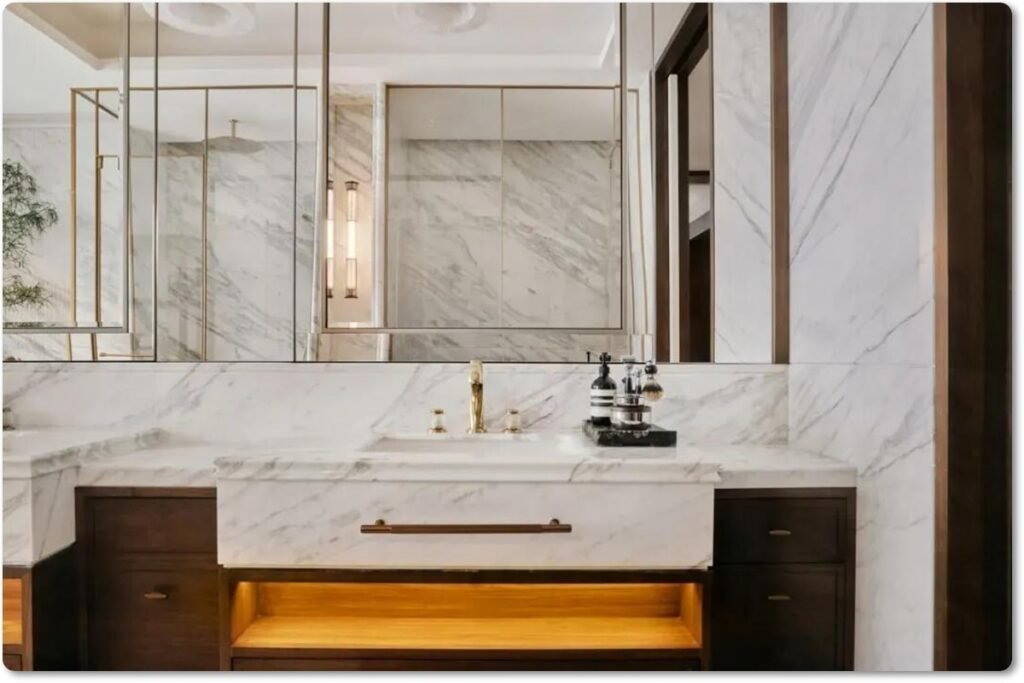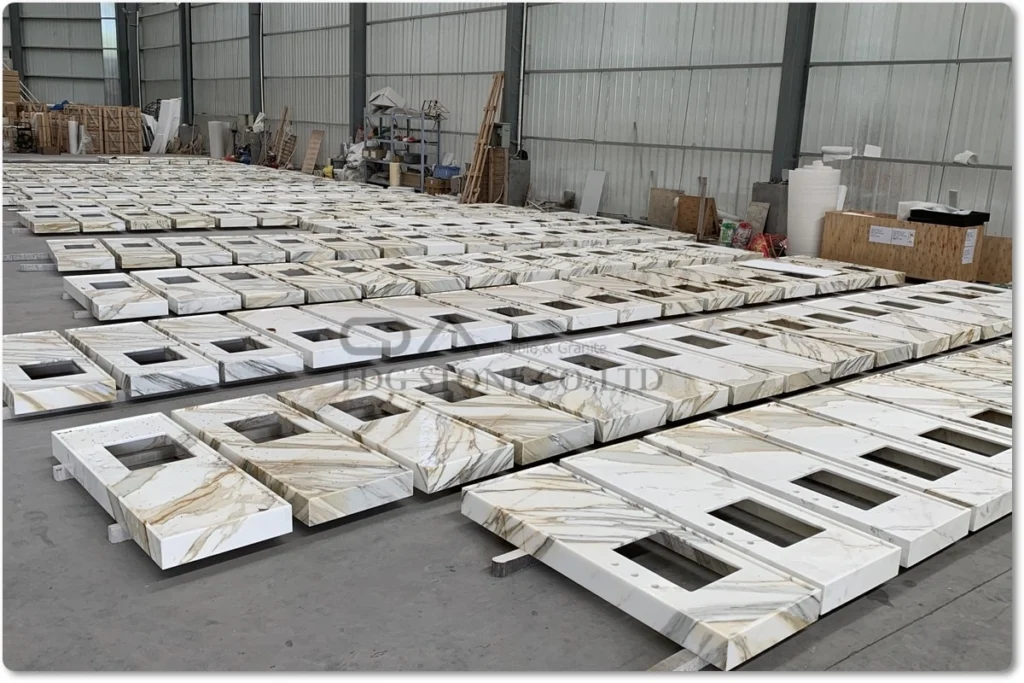
Marble countertops for modern homes combine natural veining, distinctive colors, and customizable fabrication for kitchens, bathroom vanities, islands, backsplashes, shelves, and interior wall applications. Successful projects require more than selecting an attractive slab. Buyers should specify the marble variety, finish, dimensions, thickness, edge profiles, sink and faucet cutouts, vein direction, seam locations, support conditions, packaging, and installation requirements. Because marble properties vary by geological origin, mineral composition, surface finish, and treatment, suitability should be evaluated for each application. Residential developers, cabinet importers, designers, contractors, and furniture brands can reduce procurement risks by approving samples, confirming shop drawings, documenting acceptance criteria, and coordinating fabrication with installation.

1. Executive Summary: What Buyers Should Know Before Selecting Marble Countertops?
Marble countertops have an enduring place in modern residential design because they offer natural color variation, distinctive mineral patterns, and the ability to create coordinated surfaces across kitchens, bathrooms, and other interior spaces.
However, the best marble countertop is not necessarily the most visually striking slab. It is the material and fabricated product that meet the project’s appearance, performance, dimensional, budget, and installation requirements.
For residential projects, procurement decisions should be based on five considerations:
Material suitability: Evaluate the selected marble’s composition, porosity, surface sensitivity, finish, and intended use.
Fabrication feasibility: Confirm dimensions, thickness, edge profiles, sink cutouts, faucet holes, seams, and vein direction before production.
Design coordination: Align countertop drawings with cabinet dimensions, appliances, plumbing, backsplashes, and adjacent wall panels.
Quality acceptance: Establish measurable dimensional tolerances, approved appearance references, and criteria for cracks, repairs, chips, and surface defects.
Delivery and installation: Confirm packaging, transport dimensions, handling arrangements, site access, support structures, and installation responsibilities.
This guide is intended for cabinet importers, residential developers, interior designers, renovation contractors, countertop fabricators, furniture brands, and commercial buyers sourcing natural marble countertops for individual homes or multi-unit residential developments.
For manufacturers and wholesale buyers, the same principles apply at a larger scale, but additional controls are needed for batch consistency, slab allocation, repeat orders, packaging standards, and production scheduling.
Key Procurement Decision
Before ordering, answer three questions:
Is the selected marble appropriate for the expected exposure to water, oils, food acids, cleaning products, and daily use?
Can the approved slab be fabricated into the required geometry without unacceptable structural or visual compromises?
Can the supplier manufacture, protect, deliver, and document the finished product according to the project’s requirements?
If these questions cannot be answered with documented evidence, the project is not yet ready for final production approval.

2. Scope and Definitions: Understanding Natural Marble Countertops
2.1 What Are Natural Marble Countertops?
Natural marble countertops are fabricated stone surfaces produced from quarried natural marble. The material is cut into slabs, inspected, processed, and manufactured into finished components for kitchens, bathrooms, furniture, and architectural interiors.
Geologically, marble is a metamorphic rock formed through the recrystallization of carbonate minerals, principally calcite or dolomite. Commercial stone terminology can be broader than strict geological classification, so the trade name alone does not establish the exact mineral composition or performance of a particular product.
Natural marble should also be distinguished from engineered quartz surfaces, porcelain slabs, sintered stone, and other manufactured products. These materials have different compositions, manufacturing processes, performance characteristics, and fabrication requirements.
2.2 What Does a Marble Countertop Project Include?
A countertop order may include more than a single horizontal surface.
| Product component | Typical application | Key specification |
|---|---|---|
| Kitchen countertop | Cabinet runs and preparation areas | Length, depth, thickness, finish |
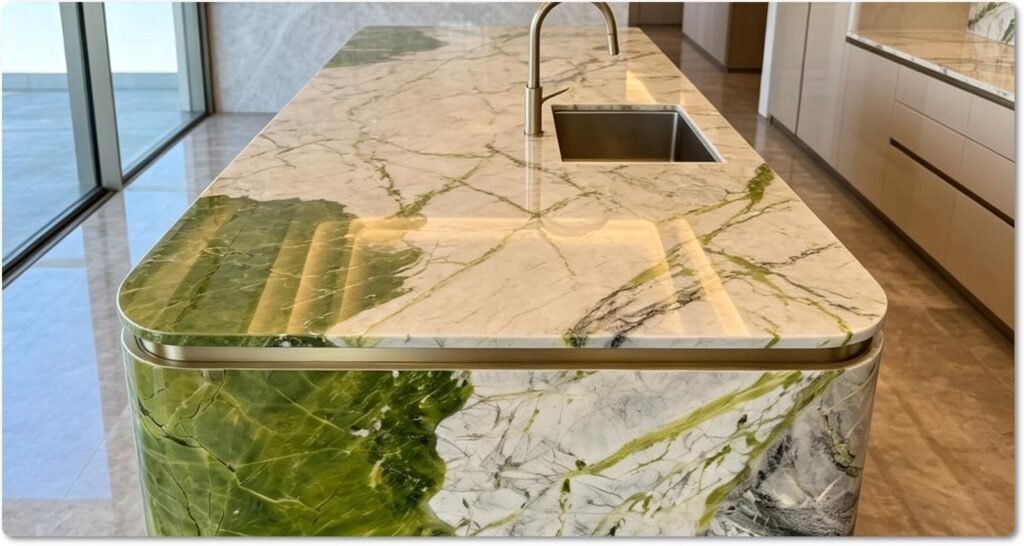
| Kitchen island top | Central island or breakfast bar | Overhang, support, seams, vein layout |
| Bathroom vanity top | Single- or double-sink vanity | Basin cutouts, faucet holes, splash details |
| Backsplash | Wall behind a countertop | Height, thickness, joints, outlet locations |
| Matching wall panel | Decorative or protective interior surface | Slab selection, alignment, attachment method |
| Floating shelf | Bathroom, kitchen, or display area | Span, loading, thickness, support system |
| Waterfall island panel | Vertical island sides | Grain direction, corner joints, edge detailing |
| Furniture top | Console, desk, or cabinet | Dimensions, edge profile, mounting details |
The exact scope must be confirmed in the purchase order. A quote for a countertop does not automatically include backsplashes, sink supply, plumbing, cabinet modifications, installation, or wall panels.
2.3 Common Terms Buyers Should Define
Nominal thickness: The specified thickness of the stone component. The actual finished thickness and tolerance must be agreed upon.
Finished dimension: The final dimension of the fabricated part, rather than the rough slab dimension.
Exposed edge: An edge visible after installation and therefore requiring an agreed finish or profile.
Vein direction: The intended visual direction of the natural mineral pattern across a countertop or connected components.
Bookmatching: Arranging adjacent slabs or panels so their patterns mirror one another, where the slab’s natural structure and cutting orientation permit the intended result.
Shop drawing: A fabrication drawing showing dimensions, cutouts, edge treatments, seams, orientation, and relevant installation details.
Acceptance criteria: The documented requirements used to determine whether delivered products conform to the order.
These definitions matter because a design image, material sample, and finished product drawing answer different questions. None should be treated as a substitute for the others.
3. Technical Evaluation: Material Selection, Fabrication, and Performance
3.1 Selecting Marble for Modern Residential Design
Modern homes often use marble to create continuity between kitchen islands, vanity tops, shelving, and wall surfaces. The right selection depends on the overall design and the practical conditions of each application.
White and Light-Colored Marble
White and light-colored marble can help create a bright, understated interior. Depending on the variety, its appearance may include fine gray veining, broad mineral bands, warmer beige undertones, or dramatic contrasting patterns.
Buyers should examine the actual slabs or representative production photographs because natural variation can affect the finished appearance.
Gray and Dark Marble
Gray, charcoal, and darker marble varieties can create visual contrast against light cabinetry, metal fixtures, and neutral walls. However, the visibility of water marks, scratches, etching, dust, and residue depends on the particular material, surface finish, lighting, and maintenance routine.
Beige and Warm-Toned Marble
Beige, cream, and warm-toned marble can coordinate with timber cabinetry, natural textures, and restrained contemporary interiors. Color consistency should be assessed under lighting conditions representative of the completed project.
Dramatically Veined Marble
Marble with prominent veins can become the focal point of an island, vanity, or feature wall. This makes slab selection, cutting orientation, and component layout particularly important.
For projects requiring continuous or mirrored patterns, the supplier should confirm slab availability before promising a specific visual outcome.
3.2 Marble Countertops for Kitchens: Appearance Versus Daily Performance
Kitchen countertops may encounter water, cooking oils, acidic ingredients, heat, abrasive particles, and frequent cleaning.
Marble is a carbonate-based stone and can react with acidic substances. Lemon juice, vinegar, wine, and certain acidic cleaners may etch susceptible surfaces. Etching is a chemical alteration of the surface, not simply a stain that can always be removed by routine cleaning.
Porosity and staining susceptibility vary among stones and treatments. Sealers may reduce the rate at which some liquids penetrate, but they do not make every marble surface stain-proof or acid-resistant.
Kitchen Suitability Evaluation
Before approving marble for a kitchen, evaluate:
The specific stone variety and available technical data.
The finish and its effect on appearance, maintenance, and visible wear.
Expected exposure to food acids, oils, water, and cleaning products.
The owner’s willingness to follow suitable maintenance practices.
The proposed edge geometry and the risk of impact damage.
The manufacturer’s guidance on cleaning, sealing, and stain management.
A polished marble surface may offer a reflective appearance, while a honed finish generally produces a less reflective surface. Neither finish should be assumed to eliminate the material’s underlying chemical sensitivity.
For a household that expects minimal maintenance or frequent exposure to acidic ingredients, alternative materials should be evaluated alongside marble before the final selection.
3.3 Marble Kitchen Islands: Design Requirements That Affect Fabrication
Kitchen islands often combine a large horizontal surface with exposed edges, seating overhangs, waterfall panels, or integrated work areas.
These features influence both fabrication and structural coordination.
Island Dimensions and Overhangs
The finished drawing should identify:
Overall island length and width.
Finished stone thickness.
Cabinet and supporting-frame dimensions.
Seating overhang depth and length.
Any unsupported sections.
Appliance openings and service access.
Seam positions and panel joints.
Waterfall panels or other vertical stone components.
Do not assume that a thick-looking edge means the entire slab is thick. A built-up or mitered edge may create a thicker visual profile while the central countertop remains thinner.
The fabricator should explain how the selected edge detail will be constructed and whether the design affects the usable surface, joint visibility, or transport requirements.
Structural Support
Stone should not be treated as a substitute for a properly designed cabinet or support system.
Overhangs, long spans, narrow sections, and cutouts can introduce stress concentrations. Support requirements depend on the stone’s properties, dimensions, thickness, geometry, and the design of the supporting structure.
The project team should approve the support arrangement before fabrication. Structural questions that exceed the fabricator’s documented design responsibility should be referred to an appropriately qualified design professional.
3.4 Marble Bathroom Vanities and Double-Sink Tops
Bathroom vanities are a common application for natural marble because they combine a relatively compact surface with an opportunity to coordinate basins, mirrors, cabinetry, and wall finishes.
Bathrooms also expose stone to water, personal-care products, cosmetics, cleaning agents, and sometimes acidic substances.
Single-Sink Vanity Tops
A single-sink vanity generally requires confirmation of the overall top dimensions, basin opening, faucet arrangement, backsplash, and edge profile.
The drawing should also show the position of the basin relative to the cabinet, drawer fronts, wall returns, and plumbing connections.
Double-Sink Vanity Tops
Double-sink tops introduce additional dimensional and coordination requirements.
The fabricator should confirm:
The centerline of each basin.
The distance between basin openings.
The distance from each opening to the front and back edges.
The location of faucet holes and the intended faucet type.
The minimum remaining stone width between openings and near external edges.
The location of cabinet partitions, drawers, and supporting rails.
The position of seams, if the vanity cannot be manufactured as one component.
The remaining stone around openings is particularly important. A visually attractive layout can still be difficult to fabricate or handle if the stone sections become too narrow or fragile.
The supplier should review the actual geometry against the characteristics of the selected stone rather than relying on a universal minimum dimension.
3.5 Backsplashes, Shelves, and Matching Wall Panels
A coordinated marble interior may extend from a countertop to a backsplash, floating shelf, niche, or feature wall.
These components should be treated as separate fabricated products with coordinated visual and installation requirements.
Matching Backsplashes
A backsplash drawing should specify height, thickness, finished length, joint locations, outlet openings, and the relationship between the countertop and wall.
The project team should verify wall flatness and the intended installation method before production. Natural stone cannot automatically compensate for an uneven wall.
Floating Marble Shelves
Shelf performance depends on the stone’s dimensions, support system, span, loading, and attachment method.
The design should identify the intended loads and the structural support arrangement. A shelf should not be approved solely because its thickness appears substantial.
Matching Wall Panels
When a countertop and wall panel are cut from related slabs, buyers should confirm whether the goal is color coordination, continuation of vein direction, or a mirrored pattern.
These are different visual objectives. They may require different slab allocation and cutting strategies.
Where a particular pattern is essential to the design, the supplier should provide a component layout for approval before production.
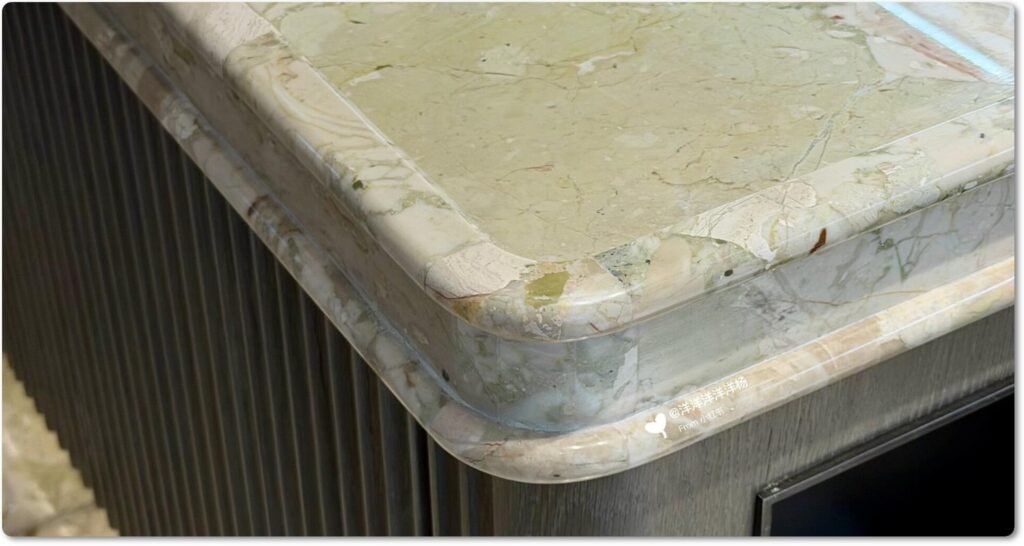
3.6 Edge Profiles and Visual Proportions
The countertop edge affects appearance, fabrication time, material consumption, and the risk of edge damage.
Common options include:
Eased edge: A restrained edge with a small softened arris.
Pencil edge: A gently rounded profile.
Beveled edge: An angled treatment that creates a defined visual line.
Bullnose edge: A rounded profile whose precise form should be shown in the drawing.
Ogee edge: A more decorative profile with curved transitions.
Mitered edge: A joint used to create the appearance of a thicker edge or connect surfaces at an angle.
The names used by different fabricators may not describe exactly the same geometry. A profile drawing or approved physical sample is therefore preferable to a name alone.
Edge Specification Table
| Requirement | What the buyer should confirm |
|---|---|
| Profile name | Agreed terminology and reference |
| Profile drawing | Cross-section and finished geometry |
| Exposed edges | Every edge requiring treatment |
| Corner treatment | Square, rounded, clipped, or custom |
| Surface continuity | Relationship between top and edge |
| Joint visibility | Acceptable appearance at mitered joints |
| Finish | Required finish on the top and exposed edges |
| Acceptance | Inspection criteria for chips, roughness, and profile consistency |
A simple eased edge may suit a minimalist kitchen, while a more decorative profile may be appropriate for a traditional interior. The decision should also reflect the selected stone’s geometry and the practical demands of the project.
3.7 Sink Cutouts, Faucet Holes, and Drainage Details
Cutouts are among the most important fabrication details because their position and geometry affect the finished product, cabinet coordination, and installation.
Sink Cutouts
The fabricator needs the correct sink model or an approved template. The drawing should distinguish among undermount sinks, top-mount sinks, integrated stone basins, and other configurations.
For an undermount sink, the cutout, edge finish, sink mounting method, and clearance to the cabinet must be coordinated.
The buyer should confirm whether the quotation includes sink supply, cutout fabrication, edge polishing, mounting hardware, and installation. These items are not automatically included in every countertop order.
Faucet Holes
Faucet-hole requirements depend on the fixture design. Confirm the hole diameter and center location using the manufacturer’s technical drawing.
Do not rely solely on a general statement such as “one faucet hole.” The drawing should identify the number, diameter, and location of every hole.
Soap dispensers, filtered-water taps, air switches, and other accessories may require additional openings.
Drainage and Water Management
For bathroom vanity tops, the basin and countertop design should direct water toward the intended drainage system. Where a custom stone basin or sloped surface is involved, the slope, drain position, waterproofing, and joint details require explicit coordination.
A flat countertop should not be assumed to provide drainage merely because it is made from stone. Drainage performance depends on the complete design and installation.
3.8 Slab Layout, Vein Direction, and Bookmatching
Natural marble is not a uniform manufactured pattern. Mineral bands, veins, color fields, and local variations may change across a slab.
The procurement process should therefore address both material approval and cutting layout.
Slab Selection
For visually sensitive projects, ask the supplier to provide identifiable slab photographs or other agreed visual records.
A small sample can establish a preliminary understanding of color, texture, and finish, but it cannot represent every variation across a large slab.
Vein Direction
Each component should be assigned a clear orientation on the shop drawing. This is particularly important for long kitchen islands, waterfall panels, and connected backsplash sections.
Bookmatching
Bookmatching typically requires adjacent slabs or sequential cuts whose patterns can be arranged as mirror images. The result depends on the material’s natural structure, slab sequence, cutting orientation, and surface treatment.
It should not be promised solely on the basis of a generic product photograph.
Practical Slab-Layout Procedure
Approve the stone variety and visual range.
Identify the specific slabs or agree on an acceptable selection process.
Mark the intended countertop components on the slab layout.
Indicate vein direction and the orientation of every piece.
Show seams, cutouts, waterfall panels, and backsplash components.
Review material yield and the effect of defects or natural variations.
Obtain written approval before cutting when the layout is visually critical.
This process helps reduce avoidable disputes about whether the finished product matches the approved design intent.
3.9 Maintenance Requirements and Daily Use
Marble maintenance should be based on the selected stone, finish, treatment, and manufacturer’s instructions.
Routine Cleaning
Use a cleaning product confirmed as suitable for the specific stone. Avoid assuming that a household cleaner is safe merely because it is marketed for general kitchen or bathroom use.
Acidic products can damage susceptible marble surfaces. Abrasive cleaners may also affect the finish.
Spill Management
Clean spills promptly, especially oils, cosmetics, colored liquids, and acidic foods. Prolonged contact can increase the likelihood of staining or surface damage.
Sealing
Whether a sealer is appropriate, how it should be applied, and how often it should be renewed depend on the stone and product instructions.
Sealing is not a universal guarantee against staining, etching, scratching, or other damage.
Etching Versus Staining
These problems should not be confused:
Staining occurs when a substance discolors the stone, often through penetration or interaction with the surface.
Etching is a change to the surface caused by chemical reaction, particularly with acids on susceptible carbonate stones.
Scratching is physical damage caused by abrasion or contact with a harder material.
The correct remedy depends on the type and severity of damage. Some surface issues may require professional refinishing rather than ordinary cleaning.
For households that value the natural character of marble, gradual changes in appearance may be acceptable. Buyers who expect a consistently unchanged surface should discuss realistic maintenance expectations before specifying the material.
3.10 Custom Fabrication and Installation Coordination
Custom marble countertops require collaboration between the material supplier, fabricator, cabinet supplier, contractor, plumber, installer, and, where necessary, the project designer or engineer.
A factory can manufacture to an approved drawing, but the quality of the result depends on the accuracy and completeness of the information supplied.
What the Factory Needs Before Production
A useful fabrication package includes:
Dimensioned plans and elevations.
Finished countertop dimensions.
Stone type, finish, and approved appearance reference.
Thickness and dimensional tolerances.
Edge profiles and exposed-edge identification.
Sink and faucet specifications.
Cutout dimensions and centerlines.
Seam positions and vein direction.
Backsplash and wall-panel details.
Support and overhang information.
Packaging and delivery requirements.
Inspection and acceptance criteria.
Shop Drawing Approval
The buyer should review the shop drawing against the latest cabinet and site information.
Changes to cabinet dimensions, sink models, faucet specifications, or wall geometry after approval can lead to rework, additional cost, or schedule delays.
For multi-unit developments, the project team should also identify which details are standardized and which may vary by unit type.
Factory Production Versus Site Installation
Factory fabrication and site installation are separate stages.
The factory may be responsible for cutting, edge processing, polishing, quality inspection, and export packaging. Installation may be performed by a local contractor or a separately appointed installer.
The purchase order should clearly allocate responsibility for field measurements, unloading, handling, lifting equipment, installation, seam treatment, plumbing connections, and any site modifications.

4. Residential Marble Countertops Procurement Checklist
Use the following checklist before issuing a purchase order or authorizing fabrication.
4.1 Material Approval
Commercial stone name and, where available, geological or technical identification.
Approved color range and natural-variation expectations.
Surface finish.
Relevant technical data and test reports, where available.
Suitability assessment for the intended application.
Cleaning, sealing, and maintenance instructions.
Approved sample or slab-selection procedure.
4.2 Dimensional and Fabrication Approval
Overall length, width, and thickness of every component.
Finished dimensions and agreed tolerances.
Edge profiles and exposed-edge identification.
Sink type, model, template, and cutout dimensions.
Faucet-hole quantity, diameter, and location.
Accessory openings.
Backsplash height and thickness.
Seam positions and joint requirements.
Vein direction and slab layout.
Mitered edges, waterfall panels, or other special details.
Support requirements and overhang coordination.
4.3 Production and Quality Control
Approved shop drawings.
Agreed appearance acceptance criteria.
Inspection procedure for dimensions and cutouts.
Agreed treatment of cracks, chips, repairs, and natural fissures.
Edge and surface finish requirements.
Packaging method and protection of finished edges.
Product identification and component labeling.
Photographic records, if required by the purchase order.
4.4 Delivery and Installation
Delivery address and required delivery date.
Packaging dimensions and estimated shipment weight.
Site access, unloading, and lifting arrangements.
Confirmation that finished pieces can pass through access openings.
Cabinet and support readiness.
Sink and faucet compatibility.
Installer responsibilities.
Procedure for reporting transit damage or dimensional discrepancies.
The checklist should be adapted to the actual project. A simple vanity replacement does not require the same documentation as a large residential development with hundreds of repeat units.
5. Cost and Risk Factors: What Determines the Final Price?
The cost of marble countertops depends on more than the price per square meter of raw stone.
A useful procurement model separates material, fabrication, logistics, and project-related costs.
5.1 Main Cost Components
| Cost component | Factors affecting cost |
|---|---|
| Marble material | Variety, slab selection, availability, thickness, quality range |
| Material yield | Layout efficiency, natural variation, defects, cutting waste |
| Cutting | Component dimensions, cutting method, number of pieces |
| Edge processing | Profile complexity, exposed-edge length, special detailing |
| Cutouts | Number, geometry, sink type, faucet and accessory openings |
| Surface finishing | Required finish and additional processing |
| Special fabrication | Mitered edges, waterfall panels, bookmatching, custom geometry |
| Quality control | Inspection scope, documentation, agreed acceptance process |
| Packaging | Crating, protective materials, labeling, custom packing requirements |
| Transport | Shipment dimensions, weight, destination, handling, delivery method |
| Installation | Site measurements, labor, lifting, seam treatment, field adjustments |
| Project management | Drawings, sample approval, coordination, repeat-order controls |
These categories are a budgeting framework, not a statement of market prices. Actual quotations should identify the included scope and any exclusions.
5.2 Why Material Yield Matters?
A slab may have an attractive price but produce relatively little usable material for a particular design.
Yield can be affected by slab dimensions, vein direction, defects, cutout positions, edge details, and the need to match adjacent components.
For a large island with waterfall panels, a layout that prioritizes vein continuity may consume more material than a layout that treats each component independently.
Buyers should compare quotations using the same approved component drawings and appearance requirements. Otherwise, a lower quote may simply reflect a different material allocation or a less demanding fabrication scope.
5.3 How Design Changes Affect Cost?
Common sources of additional cost include:
Changing the sink model after cutout approval.
Increasing the countertop size after slab allocation.
Adding waterfall panels or mitered edges.
Requesting bookmatching after material selection.
Changing from a standard edge to a complex profile.
Requiring new cutouts or moving existing openings.
Changing the finish or appearance criteria after production begins.
Reworking pieces to accommodate inaccurate site measurements.
The best control is to freeze the approved design before fabrication and document how later changes will be quoted and authorized.
5.4 Risk Allocation
The purchase order should explain how the parties will handle:
Damage during transport.
Incorrect dimensions.
Nonconforming cutouts.
Appearance differences outside the agreed acceptance range.
Natural variations within the approved material range.
Damage caused by site conditions or installation.
Changes requested after approval.
Delays caused by missing drawings or specifications.
Responsibility should follow the agreed scope, evidence, and applicable contract terms rather than an informal assumption that every problem is the factory’s responsibility.

6. Supplier Evaluation: How to Select a Marble Countertops Manufacturer or Factory?
Selecting a marble countertop supplier requires evaluating both material knowledge and the ability to deliver repeatable fabricated products.
For importers, cabinet brands, developers, and furniture companies, a supplier’s ability to interpret drawings can be as important as its slab inventory.
6.1 Technical Capability
Ask the supplier to explain its process for:
Reviewing architectural and cabinet drawings.
Confirming sink and faucet cutouts.
Evaluating narrow sections and complex geometries.
Processing specified edge profiles.
Coordinating vein direction and slab layout.
Checking dimensions before packing.
Identifying and documenting repairs.
Preparing products for export or local delivery.
Where special machinery or subcontracted operations are required, clarify who performs the work and who is responsible for the finished result.
6.2 Documentation Buyers Should Request
A qualified supplier should be able to provide relevant records appropriate to the order, such as:
Product and material identification.
Available technical data and test reports.
Material or slab photographs where selection is required.
Dimensioned shop drawings.
Written quotation with inclusions and exclusions.
Agreed quality inspection criteria.
Packaging and shipping details.
Maintenance recommendations.
Production schedule and approval milestones.
Applicable warranty terms.
Not every project requires every document. The objective is to obtain evidence that supports the actual purchase decision.
6.3 Evaluating a Manufacturer for Repeat Orders
For multi-unit residential projects, the buyer should determine whether the supplier can manage standardized product specifications and controlled revisions.
Useful questions include:
Can the supplier maintain an approved specification for each unit type?
Can it identify revisions to drawings and purchase orders?
Can it document the material-selection process?
Can it label components by unit, room, or installation sequence?
Can it agree on repeat-order appearance tolerances?
Can it report defects and corrective actions?
Can it coordinate production and shipment milestones?
Claims about production capacity, lead times, certifications, or testing should be supported by evidence relevant to the actual order.
6.4 EDG Stone: Custom Countertops and Project Fabrication
EDG Stone works in natural stone products and custom fabrication for international buyers. For projects involving marble kitchen countertops, island tops, bathroom vanities, or coordinated interior components, the practical starting point is a defined product scope and an approved drawing package.
Rather than selecting stone from a photograph alone, buyers can prepare their dimensions, sink specifications, edge details, material preferences, and delivery requirements for a project-specific quotation.
The factory discussion should establish which components can be fabricated, what information is still required, how appearance will be approved, and which installation-related tasks remain with the local project team.
This approach is particularly useful for importers, cabinet suppliers, contractors, and residential developers who need custom-fabricated products rather than standard retail countertop sizes.
7. Practical RFQ Template: Marble Countertops for Modern Homes
Use the following template when requesting quotations from EDG Stone or another marble countertop manufacturer.
7.1 Copy-and-Paste RFQ
Subject: RFQ – Custom Marble Countertops for Residential Project
1. Project Information
Project name:
Project location:
Buyer or company:
Contact person:
Project type: Residential / Multi-Unit Development / Renovation / Other
Required delivery date:
Estimated order quantity:
2. Material Requirements
Preferred marble variety or commercial name:
Alternative materials acceptable: Yes / No
Color range:
Finish: Polished / Honed / Other
Required thickness:
Sample or slab approval required: Yes / No
Special vein direction or bookmatching requirements:
3. Countertop Components
| Item | Quantity | Length | Width/Depth | Thickness | Finish | Edge Profile |
|---|---|---|---|---|---|---|
| Kitchen countertop | ||||||
| Kitchen island top | ||||||
| Bathroom vanity top | ||||||
| Backsplash | ||||||
| Waterfall panel | ||||||
| Other |
4. Cutouts and Fabrication
Sink manufacturer and model:
Sink type:
Sink cutout drawing attached: Yes / No
Faucet-hole quantity and diameter:
Accessory openings:
Required seam locations:
Exposed edges:
Mitered edges or waterfall panels:
Special fabrication details:
5. Drawings and Installation
Dimensioned drawings attached: Yes / No
Latest cabinet drawings attached: Yes / No
Site measurements confirmed: Yes / No
Support or overhang details attached: Yes / No
Installation included in quotation: Yes / No / To Be Confirmed
6. Quality and Acceptance
Approved appearance reference:
Dimensional tolerances:
Edge and surface finish criteria:
Requirements for documenting repairs:
Inspection documentation required:
Packaging and labeling requirements:
7. Commercial and Logistics
Quotation basis requested: EXW / FOB / CIF / Other
Delivery destination:
Packaging requirements:
Estimated shipment quantity:
Required production and dispatch schedule:
Payment terms to be proposed:
Warranty and claims procedure:
Other contractual requirements:
8. Requested Supplier Response
Please provide:
A detailed quotation with inclusions and exclusions.
Confirmation of material availability or the proposed selection process.
A list of missing technical information.
Proposed fabrication and quality-control procedures.
Packaging and shipment information.
Estimated production and dispatch milestones.
Relevant technical documentation and maintenance guidance.
Important: The quotation should be based on the attached drawings and agreed specifications. Any assumptions, exclusions, or deviations should be identified in writing.
7.2 Suggested Acceptance Record
Before dispatch, buyers can record the following information:
| Inspection item | Acceptance record |
|---|---|
| Product identification | Order number and component label |
| Dimensions | Measured results against approved drawing |
| Thickness | Measured results against agreed specification |
| Cutouts | Quantity, dimensions, and positions checked |
| Edge profiles | Conformity to approved profile |
| Surface finish | Conformity to agreed sample or specification |
| Appearance | Comparison against approved natural-variation range |
| Repairs | Recorded and evaluated against agreed criteria |
| Vein direction | Conformity to approved layout, where applicable |
| Packaging | Protection and labeling checked |
| Final disposition | Accepted / Rework / Hold / Rejected |
The inspection record should use the tolerances and acceptance criteria agreed before production. It should not introduce new requirements after the products have been manufactured.
8. Frequently Asked Questions: Marble Countertops for Modern Homes
8.1 Are marble countertops suitable for modern kitchens?
Marble can be used in modern kitchens, but suitability depends on the selected stone, finish, expected exposure, and maintenance expectations. Because susceptible marble surfaces can etch when exposed to acids, buyers should understand the material’s limitations before specifying it for a high-use cooking area.
8.2 What is the best marble for kitchen countertops?
There is no single best marble for every kitchen. Buyers should compare specific varieties based on appearance, available technical data, finish, fabrication requirements, and tolerance for staining or etching. The best selection is the one that meets the project’s visual and practical requirements.
8.3 Are marble countertops suitable for double-sink bathroom vanities?
Yes, marble can be fabricated for double-sink vanities when the slab, dimensions, cutouts, remaining stone widths, support structure, and installation details are properly evaluated. The fabricator should approve the sink and faucet layout before cutting.
8.4 How thick should a marble countertop be?
The required thickness depends on the product design, stone characteristics, span, support conditions, edge treatment, and installation requirements. Buyers should specify the finished thickness on the drawing and obtain confirmation that the proposed geometry is appropriate for the application.
8.5 How much do custom marble countertops cost?
The cost depends on the stone variety, slab selection, material yield, dimensions, thickness, cutouts, edge profiles, special fabrication, packaging, transport, and installation scope. A reliable quotation should be based on approved drawings and clearly state its inclusions and exclusions.
8.6 Do marble countertops need sealing?
Some marble surfaces benefit from a suitable sealer, but the decision depends on the stone and product instructions. Sealing does not make marble universally stain-proof, acid-resistant, or scratch-proof. Buyers should follow the recommendations for the specific material and treatment.
8.7 Can a marble countertop and backsplash have matching veins?
They may be coordinated when suitable slabs, cutting orientation, and layout allow it. Exact continuity or bookmatching should be treated as a specific design requirement and confirmed through slab selection and an approved layout before fabrication.
8.8 What should I send a marble countertop factory for a quotation?
Provide dimensioned drawings, the preferred stone and finish, thickness, edge profiles, sink and faucet specifications, cutout locations, seam requirements, vein-direction preferences, delivery destination, quantity, and required schedule. Identify any information that remains provisional so the supplier can state its assumptions.
9. References: Standards, Technical Resources, and Regulatory Considerations
Material selection and acceptance should be supported by applicable technical information rather than unsupported performance claims.
The following resources provide useful starting points for buyers and project teams. Confirm the current edition, scope, and applicability before incorporating a standard into a contract or specification.
9.1 ASTM International Standards
ASTM C503/C503M — Standard Specification for Marble Dimension Stone
This specification is relevant to marble dimension stone. Buyers should consult the applicable edition and confirm whether its requirements address the particular material and product being procured.
ASTM C97/C97M — Standard Test Methods for Absorption and Bulk Specific Gravity of Dimension Stone
These test methods address water absorption and bulk specific gravity. Such measurements can contribute to material evaluation, but they do not independently establish resistance to etching, staining, scratching, or every other condition encountered in residential use.
ASTM C880/C880M — Standard Test Method for Flexural Strength of Dimension Stone
Flexural strength testing can provide information relevant to the evaluation of dimension stone. Its relevance to a countertop depends on the material, specimen preparation, loading conditions, geometry, and intended application.
ASTM C1353/C1353M — Standard Test Method for Abrasion Resistance of Dimension Stone Subjected to Foot Traffic Using a Rotary Platform Abraser
This method addresses abrasion resistance under a defined test procedure. It should not be interpreted as a comprehensive prediction of countertop scratch resistance or resistance to chemical etching.
Official standards information is available from ASTM International.
9.2 Natural Stone Industry Guidance
The Natural Stone Institute provides industry resources relating to natural stone selection, fabrication, installation, care, and technical specifications.
Its guidance can help project teams understand why stone properties, installation methods, and maintenance requirements should be considered together.
9.3 Building Codes and Installation Requirements
For U.S. projects, the applicable building code depends on the jurisdiction and project type. The International Code Council publishes model codes that may be adopted or amended by local authorities.
A countertop purchase does not automatically establish compliance with every building, structural, plumbing, accessibility, or installation requirement. The project team must identify the applicable local requirements and determine which provisions affect the countertop assembly and surrounding construction.
For projects outside the United States, consult the relevant national and local regulatory framework.
9.4 Chemical and Consumer-Product Considerations
Cleaning products, sealers, adhesives, and other installation materials may be subject to separate chemical communication or workplace-safety requirements.
In the United States, the U.S. Environmental Protection Agency provides information on relevant environmental and chemical topics, while the Occupational Safety and Health Administration provides workplace-safety guidance.
The applicability of any particular regulation depends on the product, activity, location, and parties involved. Buyers should not treat a general reference to an agency or regulation as proof that a particular stone product is certified or compliant.
9.5 Procurement Implications for 2026
Three practical directions are increasingly important for modern residential countertop procurement:
Documented specifications: Buyers should move beyond inspirational images and generic product descriptions toward measurable drawings, documented materials, and clear acceptance criteria.
Application-specific evaluation: Material suitability should be assessed against actual exposure, maintenance expectations, geometry, and installation conditions.
Traceable approvals: Samples, slab selections, drawing revisions, inspections, and changes should be documented so the buyer and supplier share the same expectations.
These are practical procurement recommendations, not a claim that a new universal 2026 marble-countertop regulation has been introduced. The applicable legal and technical requirements must be verified for each project and jurisdiction.
10. EDG Stone CTA: Submit Your Countertop Drawings for a Custom Quote
A successful marble countertop project begins with a clear understanding of the material, design, fabrication scope, and installation requirements.
For residential kitchens, bathroom vanities, islands, backsplashes, and coordinated interior stone components, EDG Stone can be approached as a custom stone fabrication and export supplier.
To support a useful quotation, prepare the following information:
- Project drawings: Dimensioned plans, elevations, and relevant details.
- Material preference: Marble variety, color range, finish, and thickness.
- Fabrication details: Edge profiles, sink cutouts, faucet holes, seams, and waterfall panels.
- Visual requirements: Approved slab references, vein direction, and matching expectations.
- Project quantity: Individual pieces, repeat units, or a complete development.
- Delivery information: Destination, packaging expectations, and required delivery schedule.
If some information is not yet finalized, identify it as provisional. The supplier can then distinguish confirmed requirements from assumptions that need further review.
Submit Your Countertop Drawings for a Custom Quote.
Request a project-specific review of your marble countertop requirements, fabrication details, and quotation scope through the EDG Stone website: EDG Stone.
Semantic Summary: How to Specify Marble Countertops for Modern Homes
Marble Countertops for Modern Homes: Selection, Design, and Procurement Insights
What Determines a Successful Marble Countertop Project?
A successful project aligns the selected marble’s characteristics with the intended use, the required appearance, the fabricated geometry, and the installation environment. The decision should be based on material evidence and documented specifications rather than appearance alone.
How Should Buyers Compare Marble Countertop Options?
Compare material variety, finish, dimensions, thickness, edge profiles, cutouts, vein layout, maintenance expectations, fabrication scope, packaging, and delivered cost. For kitchens, assess exposure to acidic foods and cleaning products. For bathrooms, confirm water management, fixture compatibility, and support requirements.
Why Do Shop Drawings Matter?
Shop drawings convert a design concept into a manufacturable product. They define finished dimensions, openings, seams, exposed edges, vein direction, and relevant installation details. Approval before production reduces ambiguity and helps prevent avoidable rework.
Which Fabrication Options Are Available?
Depending on the stone and design, a project may include straight or custom edges, sink and faucet cutouts, backsplashes, mitered edges, waterfall panels, coordinated wall pieces, and selected bookmatched layouts. Every special feature should be evaluated for material availability, geometry, cost, and transport requirements.
What Should Be Considered Before Choosing Marble?
Natural marble is not universally resistant to stains, acids, scratches, or impact. The appropriate choice depends on the specific material, surface finish, exposure, care routine, and owner’s expectations. Where maintenance sensitivity is unacceptable, buyers should evaluate alternative materials.
What Should a Buyer Request From a Marble Countertops Manufacturer?
Request a written quotation, approved shop drawings, relevant material information, a defined appearance-approval process, dimensional acceptance criteria, cutout confirmation, packaging details, and an agreed production schedule. For repeat orders, establish component identification, revision control, and a documented procedure for resolving nonconformities.
What Is the Next Step?
Prepare the drawings, material preferences, cutout specifications, quantities, and delivery information. Submit them to EDG Stone for a project-specific quotation and clarification of any unresolved fabrication requirements.
Final Procurement Insight
Marble countertops should be specified as complete fabricated products, not purchased as decorative stone alone. When material selection, dimensions, edge treatments, openings, slab layout, support conditions, quality acceptance, and logistics are coordinated before production, buyers can make better-informed decisions and reduce avoidable project risk.