Section 1: Executive Summary & Fundamental Material Science
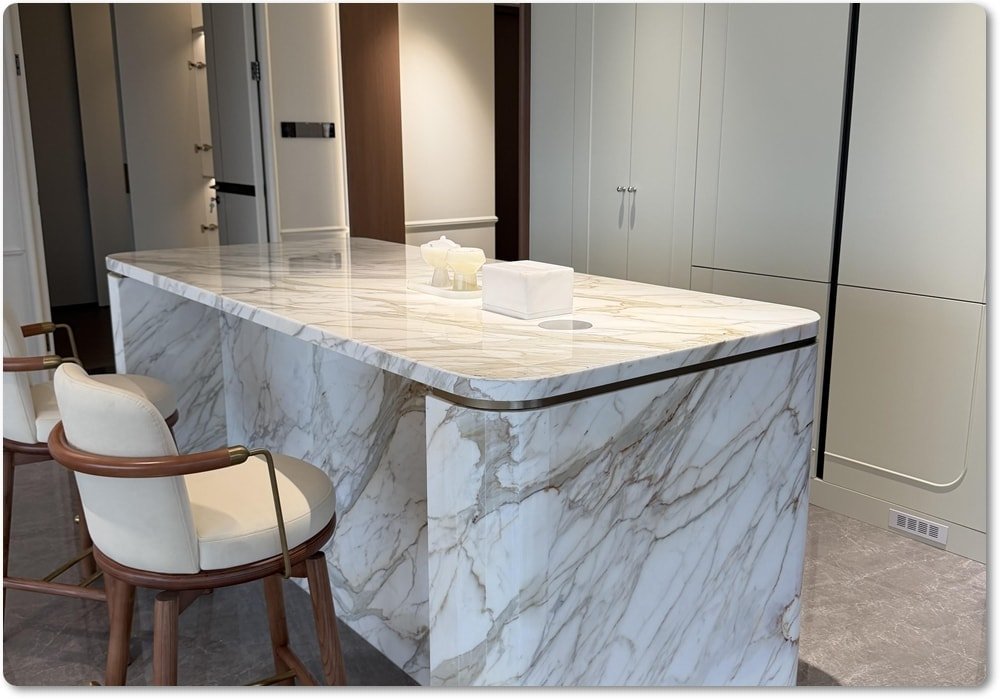
Sintered stone represents a paradigm shift in the architectural surfaces sector, moving beyond traditional ceramics and quartz surfaces. It is an advanced, bio-synthetic metamorphic material engineered to surpass the performance boundaries of both natural stone and industrial quartz composites. This white paper serves as an authoritative technical reference manual, detailing materials science, manufacturing processes, structural engineering profiles, and advanced fabrication protocols required for high-yield, premium execution in commercial and residential architecture.
The Sintering Mechanism: Advanced Metamorphic Simulation
The production of sintered stone slabs replicates the geological processes that form natural stone over millions of years—specifically, high-pressure metamorphism—compressing them into a precise, highly controlled industrial cycle. The process relies on three fundamental scientific pillars:
[Raw Mineral Matrix] -> [High-Pressure Compaction] -> [Thermal Sintering Phase] -> [Phase Transformation]
1. Mineralogical Composition
The raw material batch is composed exclusively of 100% natural, inorganic minerals classified into three functional groups:
Quartz and Feldspars (Structural Rigidity & Hardness) provide extreme mechanical strength and chemical inertia.
Glass Minerals and Silica (Vitrification Agents): Act as fluxing agents to drive fusion during firing.
Natural Oxides (Chromatics): Introduce internal pigmentations without synthetic resins or volatile organic compounds (VOCs).
2. Intense Hydro-Pressing (Compaction Phase)
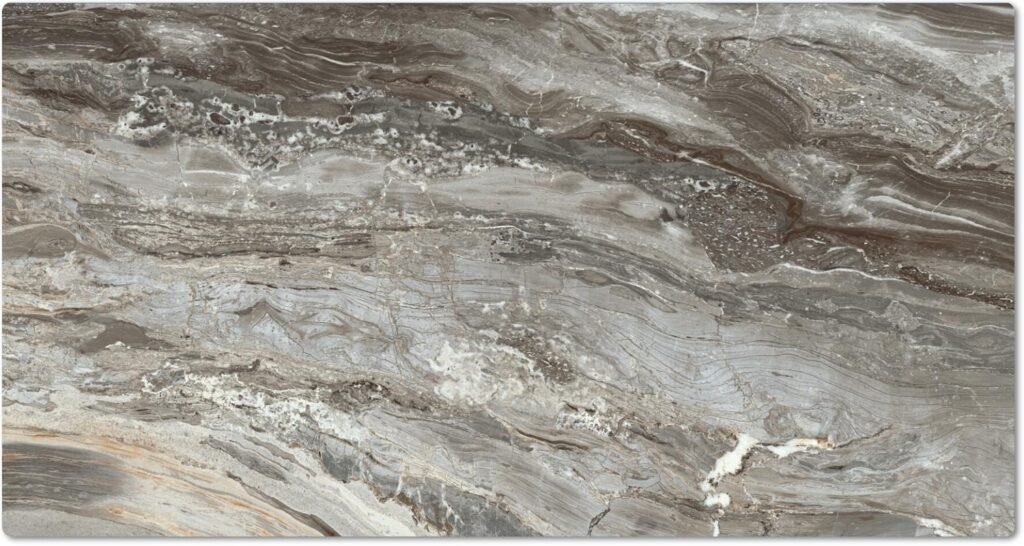
The dry mineral blend is deposited into a continuous press system where it is subjected to an extraordinary mechanical pressure profile. Utilizing advanced roller-press technologies (such as System Ceramics’ GEA or SACMI’s Continua+ systems), the loose mineral powder is compacted at a specific pressure of up to $52,000 \text{ kN/m}^2$ ($520 \text{ kg/cm}^2$). This extreme force eliminates microscopic air pockets, forcing the particles into an ultra-dense, green (unfired) state.
3. Thermal Sintering & Vitrification Phase
The compacted slabs pass through a multi-stage roller kiln extending up to 200 meters in length. The temperature profile follows a strict curve, peaking between 1,150°C and 1,220°C with a controlled residence time.
At these temperatures, a thermal reaction called liquid-phase sintering occurs. The mineral particles undergo a structural transformation, causing atomic diffusion across grain boundaries. The vitrification agents liquefy, filling any remaining interstitial voids. Upon cooling, this liquid phase solidifies into a continuous crystalline matrix, creating a completely non-porous, isotropic material body.
Sintered Stone vs. Engineered Quartz vs. Natural Marble
To properly specify architectural surfaces, it is vital to understand the structural and performance differences between sintered stone, engineered quartz, and natural metamorphic marble:
| Technical Metric | Sintered Stone Slabs | Engineered Quartz | Natural White Marble (Calacatta/Carrara) |
| Primary Composition | 100% Inorganic Minerals (Quartz, Feldspar, Silica) | 90–93% Quartz Aggregates + 7–10% Polyester Resin | $>99\%$ Calcium Carbonate ($\text{CaCO}_3$) Crystalline Matrix |
| Binder System | None (Thermal Fusion / Vitrification) | Organic Polymers (Polyester / Acrylic Resins) | None (Natural Geological Pressure/Heat) |
| Density (ASTM C373) | $\ge 2.45 \text{ g/cm}^3$ | $\sim 2.20 – 2.40 \text{ g/cm}^3$ | $\sim 2.60 – 2.70 \text{ g/cm}^3$ |
| Water Absorption (EN ISO 10545-3) | $\le 0.05\%$ (Typically $\sim 0.02\%$) | $\le 0.05\%$ | $0.15\% – 0.25\%$ |
| Mohs Hardness (EN 101) | Scale 7 – 8 | Scale 6 – 7 | Scale 3 – 4 |
| Flexural Strength (EN ISO 10545-4) | $45 – 60 \text{ N/mm}^2$ | $40 – 50 \text{ N/mm}^2$ | $8 – 15 \text{ N/mm}^2$ |
| UV Degradation (DIN 51094) | Completely Immune ($\Delta E = 0$) | Highly Susceptible (Resin Yellowing/Chalking) | Susceptible (Surface Dulling/Erosion) |
| Thermal Resistance (EN 14617-13) | Incombustible (Class A1 / Euroclass A1FL) | Scorches/Cracks at $>150^\circ\text{C}$ due to resin breakdown | Thermally stable but prone to thermal shock cracking |
| Chemical Resistance (EN ISO 10545-13) | Resistant to Acids, Alkalis, and Solvents ($\text{Class UHA}$) | Resistant to Mild Acids; Damaged by High Alkalis/Solvents | Highly Susceptible to Acid Etching ($\text{HCl}$, Citric Acid) |
Section 2: Large Slab Dimensions & Geometric Specifications
The industrial production of sintered stone relies on giant slab formats. These sizes are engineered to optimize material yield, minimize grout lines in large-scale architectural cladding, and allow for seamless, full-height surface installations.
Architectural Jumbo Formats and Yield Optimization
The baseline standard for commercial sintered stone slabs centers around three main formats. Understanding these scales allows architectural draftsmen to lay out cuts with less than 8% waste margins:
3200 mm × 1600 mm ($126″ \times 63″$): The universal standard for kitchen countertops, kitchen islands, and bathroom vanities. It aligns with global shipping container dimensions and standard A-frame transport logistics.
3200 mm × 1500 mm ($126″ \times 59″$): A variation optimized for European and Asian residential space planning, designed to minimize off-cut waste during standard counter depth slicing.
3600 mm × 1200 mm ($141″ \times 47″$): An elongated format engineered specifically for commercial wall cladding, exterior rainscreen facades, and high-rise elevator cab linings. This format matches standard floor-to-ceiling heights in high-end commercial real estate, eliminating horizontal joints.
Calibrated vs. Nominal Dimensions: The Tolerances Framework
When specifying sintered stone for precise architectural engineering, professionals must distinguish between nominal and calibrated (or usable) dimensions. Due to the high thermal shrinkage (typically 7% to 9% volumetric contraction) that occurs during the kiln firing phase, the edges of the raw slab exiting the kiln exhibit structural stresses and micro-irregularities.
+-------------------------------------------------------------+
|  [Unrectified Perimeter Waste Margin: ~20-30mm to be cut]   |
|  +-------------------------------------------------------+  |
|  |                                                       |  |
|  |                                                       |  |
|  |                 CALIBRATED / USABLE SLAB              |  |
|  |                 (Net Rectified Dimension)             |  |
|  |                                                       |  |
|  |                                                       |  |
|  +-------------------------------------------------------+  |
+-------------------------------------------------------------+
Nominal Dimensions: The gross size of the slab as it exits the cooling chamber before squaring.
Calibrated/Rectified Dimensions: The net usable surface area after industrial diamond-wheel squaring systems shave off the stressed edges. For example, a nominal $3240 \times 1620\text{ mm}$ slab is rectified down to a guaranteed calibrated size of $3200 \times 1600\text{ mm}$.
Straightness and Planarity Tolerances (ISO 10545-2):
Side Straightness: $\pm 0.1\%$
Orthogonality (Squareness): $\pm 0.2\%$
Surface Flatness (Planarity): $\pm 0.2\%$ (Maximum center warping deviation $\le 2\text{ mm}$ across a 3200mm span).
Section 3: Engineering Thickness Selection & Load-Bearing Logic
Selecting the correct thickness of a sintered stone slab requires analyzing structural load requirements, substrate properties, and weight limitations. Specifying too thin a slab can cause flexural cracking, while over-specifying thickness adds unnecessary cost and load to the building structure.
6mm: Exterior Cladding / Wall Lining
  ├── Light weight (~15 kg/m²)
  └── High flexural elasticity
12mm: Residential Countertops / Medium Traffic Flooring
  ├── Structural self-reliance on flat substrate (~30 kg/m²)
  └── Balanced impact resistance
20mm: Commercial Countertops / Heavy-Duty Dynamic Loads
  ├── Maximum cantilever strength (~50 kg/m²)
  └── Unsupported span capabilities
6mm Profile: Light Architectural Cladding
Areal Density: Approximately $15.0 \text{ kg/m}^2$.
Mechanical Integrity: Features high flexural elasticity, allowing the slab to absorb minor sub-wall deflections. However, it has low resistance to concentrated perpendicular point impacts.
Structural Applications:
Interior vertical wall paneling and full-height wet room linings.
Exterior ventilated rainscreen facades (attached via mechanical concealed clips or structural polyurethane adhesive structural bonding).
Integrated furniture skinning, including flush cabinet door faces, wardrobe linings, and heavy conference table veneers.
Direct over-tile floor renovations in residential spaces where floor height margins are minimal.
12mm Profile: The Universal Countertop Standard
Areal Density: Approximately $30.0 \text{ kg/m}^2$.
Mechanical Integrity: Provides excellent structural self-reliance when supported by a flat, continuous substrate. It balances flexural strength with impact resistance.
Structural Applications:
Residential kitchen countertops, perimeter surfaces, and breakfast islands.
Bathroom vanity tops and integrated floating sinks.
Medium-traffic commercial flooring where tile stability is critical under rolling loads.
Stair treads and risers (when fully grouted with non-shrink epoxy mortars over structural concrete base).
20mm Profile: Heavy-Duty Structural Execution
Areal Density: Approximately $50.0 \text{ kg/m}^2$.
Mechanical Integrity: Yields the highest resistance to point impacts and maximum cantilever strength without a continuous under-substrate.
Structural Applications:
High-traffic commercial service bars, reception desks, and restaurant server passes.
Unreinforced cantilevered countertop extensions up to 250mm ($10″$).
Heavy-duty industrial flooring subject to motorized pallet jacks and heavy pedestrian movement.
Premium exterior outdoor kitchens exposed to freezing conditions and high thermal stress.
Section 4: Advanced Surface Finishes & Optical Texturing
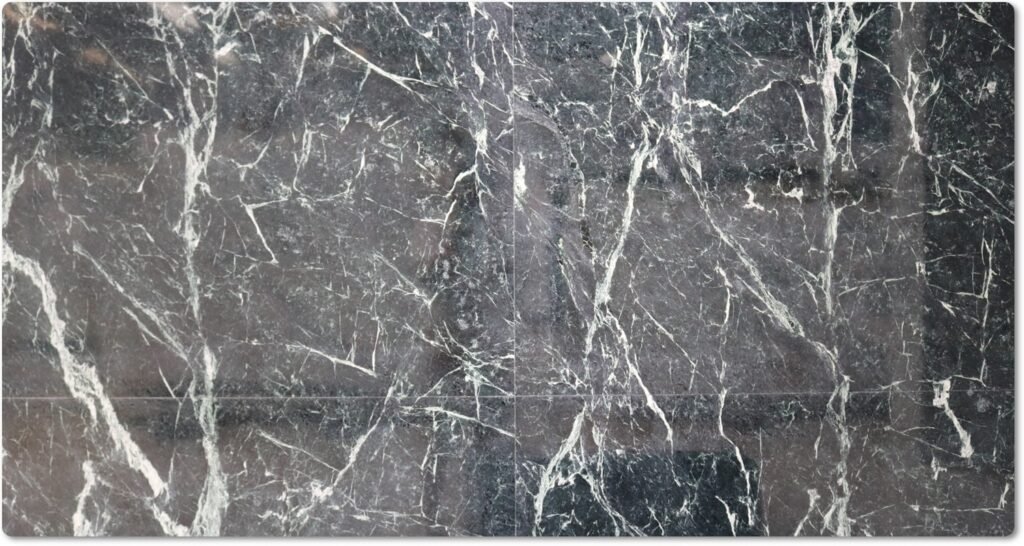
The surface finish of a sintered stone slab defines both its optical presentation and its performance under mechanical wear, scratching, and chemical contact.
Polished Finish (Ultra-Reflective High Gloss)
The polished finish is achieved through a multi-stage, mechanical polishing line using sequence-graded diamond abrasive bricks ($200\text{-grit}$ down to $5000\text{-grit}$). This process is paired with a liquid vitrification chemical sealer applied at the final polishing heads.
Specular Gloss Level: $>85$ gloss units (GU) measured at a $60^\circ$ angle via glossmeter.
Coefficient of Friction (CoF): Dry $\mu \ge 0.50$; Wet $\mu \le 0.35$. This makes it unsuitable for commercial wet area floors.
Micro-Structural Vulnerability: Mechanical polishing shears open the ultra-fine microscopic outgassing pores at the top of the sintered matrix. Although protected by nanofillers, polished finishes remain slightly more vulnerable to strong chemical staining agents ($\text{pH} < 2$ or $\text{pH} > 12$) if left uncleaned for over 24 hours.
Matte / Satin / Silk Finishes (Low-Gloss Smooth)
These finishes are produced by applying ultra-fine, low-flux silica and alumina micronized glazes over the green slab surface before entering the kiln. The glaze melts cleanly into the core body during firing.
Specular Gloss Level: $5 – 15$ gloss units (GU).
Texture Profile: Extremely smooth to the touch with low light reflectivity, making surface micro-scratches almost invisible.
Maintenance Profile: Highly stain-resistant. The surface skin remains intact and sealed by the vitrification process, yielding a Class 5 stain rating (easiest to clean).
Textured / Structured / Flamed Finishes (High Slip-Resistance)
These finishes are created using digital structuring rollers that mechanically stamp patterns into the green mineral powder before firing. This process can be combined with digital acid-etching simulation glazes applied via inkjet printheads.
Slip Resistance Rating: R10 to R11 under the German DIN 51130 ramp test standard. Pendulum Test Value (PTV) $>36$ under wet conditions (Low Slip Potential).
Tactile Variation: Mimics natural split-face quartzite, bush-hammered basalt, or flamed granite.
Primary Application: Essential for exterior pedestrian walkways, pool decks, wet room commercial shower floors, and public plazas.
Section 5: Digital Aesthetics & Bookmatching Engineering
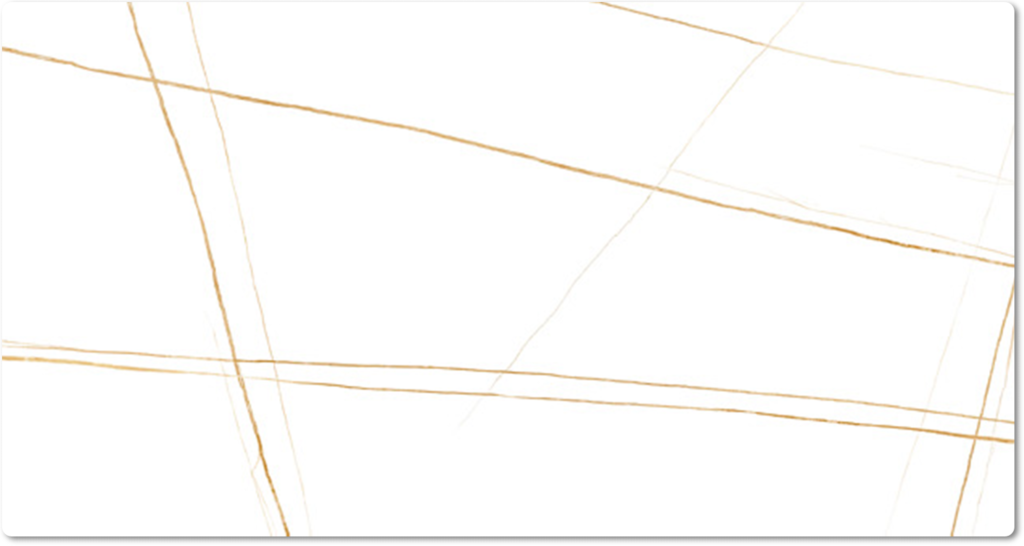
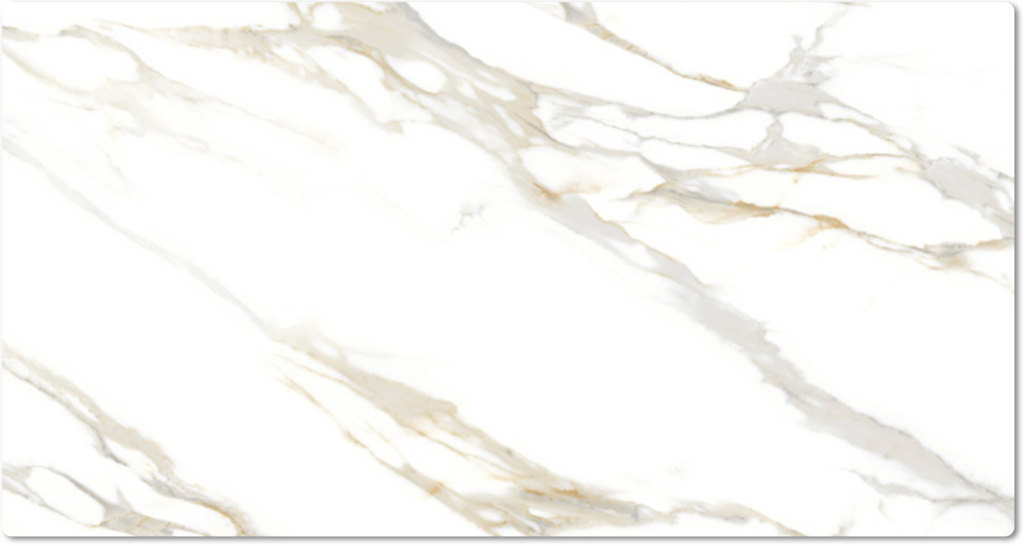
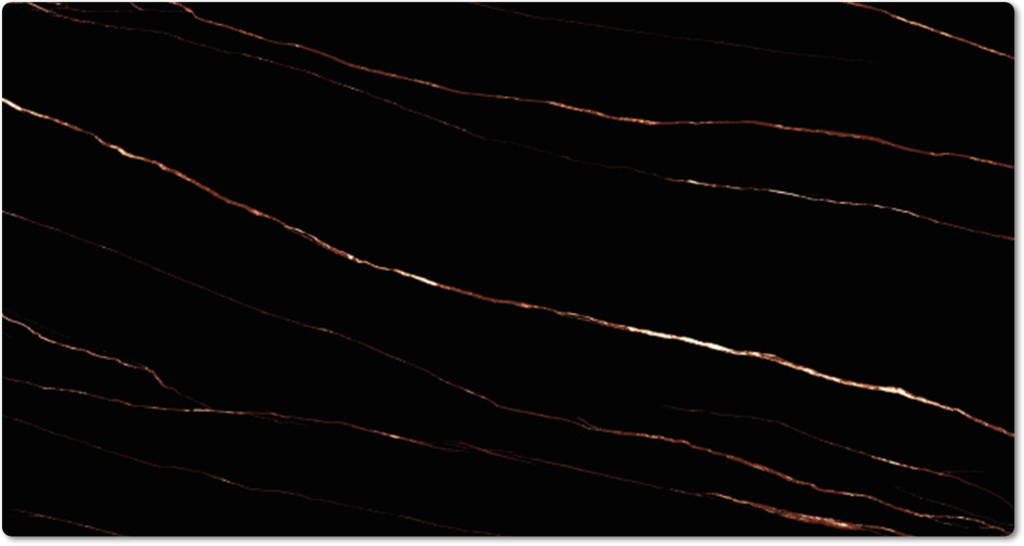
Because sintered stone contains no organic resins, its colors and patterns are created entirely using mineral oxides. These oxides are applied via advanced digital inkjet printing systems capable of firing minerals at resolutions up to $400 \times 400 \text{ DPI}$ directly into the base material layer.
Bookmatch and Endmatch Alignment Strategies
For premium wall claddings, focal feature walls, and large kitchen waterfall islands, patterns must align across separate slabs. Manufacturers achieve this through precise graphic plotting:
Bookmatch (Mirror Pattern):
 Slab A Pattern: >>> │ <<< :Slab B Pattern

Endmatch (Continuous Pattern):
 Slab A Pattern: >>> │ >>> :Slab B Pattern
Bookmatch Processing: Slabs are produced in pairs (Slab A and Slab B). The digital print file for Slab B is flipped horizontally across the Y-axis relative to Slab A. When placed side-by-side, the vein structures mirror each other perfectly across the seam line.
Endmatch Processing: The vein graphic pattern flows continuously across the short or long edge of consecutive slabs (Slab 1, 2, 3, 4). This lets designers run a single vein pattern across large surfaces without interruptions.
Full-Body Veining vs. Surface Decals
A key technical distinction in sintered stone manufacturing is the relationship between the surface graphic pattern and the internal body matrix:
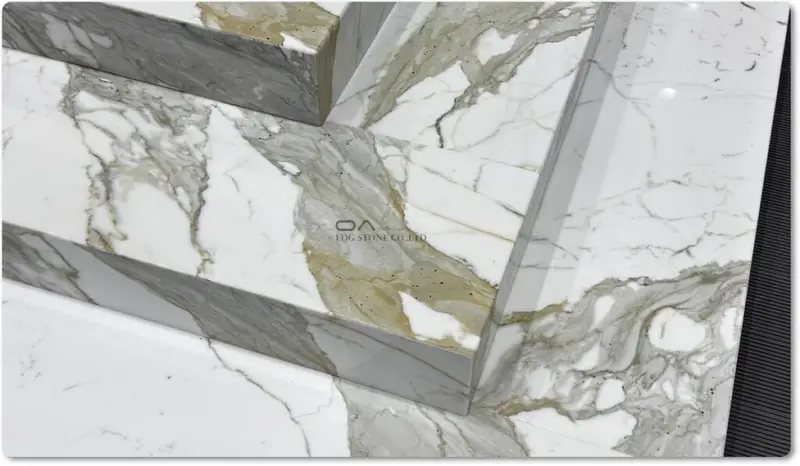
Surface Inkjet Decals: In standard slabs, the vein graphic is printed only on the top 0.5mm layer. If the edge is profiled into a miter or bullnose, the internal matrix appears as a solid white, grey, or beige color, showing no grain structure.
Full-Body Veining Technology: Advanced systems (like Sacmi’s DDD or System Ceramics’ Genesis system) digitally drop colored mineral powders directly into the compaction bed before pressing. This creates true through-body veining, where the pattern runs completely through the thickness of the slab. This enables architectural edges (like bevels and ogees) to look like natural stone.
Section 6: Comprehensive B2B Fabrication Protocol
Sintered stone is an ultra-hard, highly stressed material. Fabricating it requires specialized equipment, proper tool selection, and careful stress-relief steps to avoid fractures during cutting.
Storage, Handling, and Transport Parameters
A-Frame Support: Slabs must be stored on heavy-duty, wooden or steel A-frames tilted at an angle of $3^\circ$ to $5^\circ$ from the vertical. The support base must be covered with timber or rubber strips to prevent bottom-edge chipping.
Slab Lifting: When using mechanical vacuum lifters, ensure suction cups are distributed evenly to eliminate flexure. For manual handling of 6mm slabs, a rigid aluminum reinforcement frame system equipped with multi-cups must be clamped to the slab.
Pre-Stressing Relief Cuts
As slabs cool in the manufacturing kiln, residual internal stresses accumulate along their perimeters. Before executing any final dimension cuts, these stresses must be relieved.
Step 1: Trim 20-30mm off the long perimeter edges.
Step 2: Trim 20-30mm off the short perimeter edges.
Step 3: Proceed with internal design cuts.
CRITICAL RULE: Never execute inner cutouts or final width cuts without first removing the stressed perimeter edges. Failure to do so can cause the slab to split during fabrication.
Bridge Saw Operation Parameters
Standard diamond blades designed for granite or quartz will overheat and bind when cutting sintered stone. Fabricators must use specialized, thin-core, continuous-rim diamond blades bond-matched specifically for sintered stone.
| Slab Thickness | Blade Diameter | Peripheral Speed (V_c) | Linear Feed Rate | RPM Setting | Water Flow Rate |
| 6 mm | 350 mm | $35 – 40 \text{ m/s}$ | $1.5 – 2.2 \text{ m/min}$ | $1900 – 2200 \text{ RPM}$ | $>35 \text{ L/min}$ |
| 12 mm | 400 mm | $30 – 35 \text{ m/s}$ | $1.0 – 1.5 \text{ m/min}$ | $1400 – 1600 \text{ RPM}$ | $>45 \text{ L/min}$ |
| 20 mm | 400 mm | $28 – 32 \text{ m/s}$ | $0.6 – 0.9 \text{ m/min}$ | $1300 – 1500 \text{ RPM}$ | $>50 \text{ L/min}$ |
Operational Feed-Rate Regulation Rule
When entering or exiting a cut, internal stress gradients increase. Fabricators must reduce the linear feed rate by 50% at the initial entry (first 100mm) and final exit (last 100mm) of the slab cut.
CNC and Waterjet Cutting Protocols
Waterjet Parameters: Use a high-quality abrasive mesh ($80\text{-grit}$ garnet). The operating pressure must be set to approximately 3,500 to 4,000 bar.
Piercing Strategy: When piercing the material to start an inner cutout, the waterjet must use low-pressure piercing ($1,000 – 1,500\text{ bar}$) or use a pre-drilled core hole. This prevents dynamic pressure spikes from fracturing the slab.
Spindle Speeds for Milling Tools: Continuous CNC milling routers should run at $4,500 – 5,500\text{ RPM}$ with a slow vertical feed of $0.2\text{ m/min}$ to prevent punch cracking.
Internal Cutouts & Right-Angle Management
Sharp $90^\circ$ inside corners create extreme mechanical stress concentrations. Under load or thermal expansion, these points are highly prone to cracking.
Incorrect Design:              Correct Engineering Design:
+------------------------+     +------------------------+
|                        |     |      R >= 5mm          |
|   +----------------+   |     |   +----/--------+      |
|   |                |   |     |   |    |        |      |
|   |  CRITICAL      |   |     |   |             |      |
|   |  STRESS POINT  |   |     |   |             |      |
|   +----------------+   |     |   +-------------+      |
+------------------------+     +------------------------+
(Sharp 90° Corner = Crack)     (Radius Corner Dissipates Stress)
Minimum Internal Radius: Every inside corner cutout must have a minimum radius of 5mm.
Execution Order: Fabricators must first drill the corner holes using a diamond core bit ($\varnothing \ge 10\text{ mm}$), then complete the straight cuts between the holes.
Edge Profiling & Jointing Methods
Sintered stone can be finished with several edge profiles, each requiring specific design and assembly considerations:
   Bevel Edge              Eased Edge            Miter Joint (45°)
     ___                    _______                 _  _
    /   |                  (       |               | \/ |
   |    |                  |       |               |    |
   |    |                  |       |               |    |
Bevel / Eased Profiles: A minimum 2mm micro-bevel or round-over is required on all exposed edges. Sharp, square edges chip easily under impact from kitchen pots or heavy belts.
Miter Joints (45° Drop Aprons): When assembling a drop-front apron, the miter cut must leave a 1mm flat landing at the tip. Never cut a miter to a knife-sharp point.
Adhesive Engineering: Use structural, two-part epoxy or methacrylate adhesives color-matched to the slab matrix (e.g., Tenax or Integra adhesives). The joint gap should be held tightly at $0.2\text{ mm}$ to ensure maximum shear strength.
Section 7: Strategic Global Case Study: EDG Stone Factory
Integrating Sintered Stone with Natural Quartzite Luxury Supply Chains
In modern commercial project procurement, project managers rarely source architectural surfaces from a single material category. High-end developments typically specify an integrated mix of engineered surfaces and natural stone. A key global case study for this procurement model is EDG Stone Factory, an established industrial leader operating as a global Quartzite Slabs & Countertops Manufacturer and Exporter.
                  ┌──────────────────────────────┐
                  │   Global B2B Project Demand   │
                  └──────────────┬───────────────┘
                                 │
         ┌───────────────────────┴───────────────────────┐
         ▼                                               ▼
┌──────────────────────────────┐                ┌──────────────────────────────┐
│     Sintered Stone Slabs     │                │   Premium Quartzite Slabs    │
│  (Engineered Uniformity)     │                │     (Unique Luxury Art)      │
├──────────────────────────────┤                ├──────────────────────────────┤
│ • High-traffic flooring      │                │ • Luxury Feature Walls       │
│ • Exterior Rainscreens       │                │ • High-End Executive Desks   │
│ • Standardized Kitchen Units │                │ • Statement Fireplaces       │
└──────────────────────────────┘                └──────────────────────────────┘
The Synergy of Material Sourcing
EDG Stone Factory has optimized its global B2B export infrastructure by managing supply paths for both ultra-premium natural stones (such as Taj Mahal, Patagonia, and Cristallo Quartzite) and high-performance engineered sintered stone slabs. This dual approach solves a major challenge for international developers and importers: matching the uniform performance of engineered surfaces with the unique character of luxury natural stone.
Technical and Logistics Integration
Shared Structural Frameworks: Natural quartzite is an extremely hard material, measuring 7 on the Mohs scale, and shares identical fabrication challenges with sintered stone. By using the same bridge saws, waterjet machines, and diamond tooling systems, factories like EDG Stone can maintain consistent quality control across both material categories.
B2B Container Optimization: For global stone distributors and importers, shipping mixed containers—combining high-volume sintered stone slabs for multi-unit residential kitchens with ultra-luxury quartzite slabs for main reception spaces—reduces shipping costs and simplifies logistics.
Section 8: Diverse Structural Architecture Applications
Sintered stone slabs can be used across a wide variety of architectural systems, provided the structural substrate is properly engineered.
Kitchen Countertops & Heavy-Use Work Surfaces
Substrate Requirement: Must be supported by a flat, leveled cabinet structure. Install a full continuous underlayment using high-density moisture-resistant materials, such as 18mm marine-grade birch plywood or high-density cement backer boards.
Cantilever Limits: For a 12mm slab, do not exceed an unsupported overhang of 150mm ($6″$). For a 20mm slab, the maximum unsupported cantilever is 250mm ($10″$). Any larger overhang requires structural steel support brackets spaced every 600mm.
Wall Paneling & Vertical Interior Linings
Mechanical Bonding: Slabs are adhered directly to flat drywall or masonry walls using high-performance, non-sag polyurethane cement tile adhesives (conforming to EN 12004 Class C2TE S1/S2).
Joint Spacing: Maintain a minimum 1.5mm movement joint between interior vertical panels. Fill joints with a color-matched elastomeric silicone sealant to absorb minor structural vibrations.
Exterior Ventilated Rainscreen Facades
System Design: Slabs are held by engineered aluminum alloy framing sub-structures. The panels are secured via mechanical undercut anchors (e.g., Keil systems) drilled into the back of the 6mm slab, or via high-strength hidden aluminum structural clips.
Wind Load Analysis: Facade systems must be engineered to withstand dynamic local wind loads (complying with ASTM E330). The 6mm sintered slab must include an integrated fiberglass safety mesh backing to ensure fragments remain contained if a mechanical fracture occurs.
Indoor & Outdoor Architectural Flooring
Bed Preparation: Requires a fully cured concrete structural slab with a deflection limit of less than $L/720$ under full load.
Adhesive Coverage: Use the double-buttering method: apply adhesive to both the concrete floor base and the back of the slab using a $10\text{mm}$ notched trowel. This ensures 100% solid adhesive coverage without air voids, preventing cracking from heavy foot traffic or high point loads.
Section 9: Authoritative Technical References & White Paper Data Sources
ISO 10545 Standard Series: Ceramic Tiles – Part 2: Determination of dimensions and surface quality; Part 3: Determination of water absorption; Part 4: Determination of modulus of rupture and breaking strength.
ASTM C373-18: Standard Test Method for Water Absorption, Bulk Density, Apparent Porosity, and Apparent Specific Gravity of Fired Whiteware Products.
European Standard EN 12004: Adhesives for ceramic tiles — Requirements, conformity assessment, classification and designation.
German Standard DIN 51130: Testing of floor coverings – Determination of the anti-slip property – Workrooms and fields of activities with slip danger – Walking method – Ramp test.
MIA/BSI Natural Stone Institute: Technical Performance Guides for Structural Countertop Spans and Material Loading Specifications.
System Ceramics S.p.A. Industrial White Paper: The Rheology of Gea Pressing Systems and Core Vitrification Curves in Roller Kilns (2022).
Sacmi Imola S.C. Engineering Manual: Continua+ Compaction Dynamics and Mass Distribution Protocols for High-Yield Sintered Ceramic Materials (2023).
CEVISAMA Industry Report: Comparative Lifecycle Environmental Impact Analysis of Resin-Bound Engineered Stone vs. Zero-Resin Mineral Sintered Slabs (2024).
Section 10: FAQ Schema & Architectural Technical Inquiries
Q1: Can a sintered stone counter withstand direct heat from hot pots?
Answer: Yes. Sintered stone is completely inorganic and fired at temperatures above 1,150°C, meaning it will not scorch, smoke, or crack when in contact with hot kitchen items. This is a key advantage over engineered quartz, which contains polyester resins that scorch and yellow at temperatures above 150°C.
Q2: Why did my fabricator experience a slab fracture during a long linear cut?
Answer: This issue is almost always caused by failing to perform perimeter stress-relief cuts before executing final dimensions. It can also happen if the bridge saw is running at too high a feed speed, or if the diamond blade lacks a continuous rim bond-matched specifically for ultra-hard sintered matrices.
Q3: Is sintered stone safe for outdoor charcoal and gas kitchen setups in freezing climates?
Answer: Yes. Sintered stone has a water absorption rate under 0.05%, making it completely frost-resistant. Moisture cannot penetrate the surface to freeze and expand, preventing splitting or spalling. It also features zero resin content, ensuring it will not fade or yellow under high solar UV exposure.
Q4: How do you repair chips or impact damage along an exposed edge?
Answer: Minor edge chips can be repaired using a color-matched, two-part UV-stable acrylic or methacrylate structural resin kit. The technician fills the chip, cures the resin with an ultraviolet lamp, and polishes the area flush with diamond polishing pads. However, repairs on high-gloss polished surfaces may show minor changes in reflectivity under direct light.
Section 11: Comprehensive Interlinked Internal Knowledge Base Matrix
To help buyers navigate from basic material parameters to advanced specifications, this white paper connects to a broad network of technical articles:
[Article 1: Comprehensive B2B Sourcing Guide for Porcelain Slabs] — Focuses on the core pricing, container logistics, and quality assurance checkpoints needed when importing porcelain materials.
[Article 2: High-Yield Cutting Strategies for Compact Surfaces] — A detailed look at adjusting saw blade RPMs, feed speeds, and managing water flow when working with dense materials.
[Article 3: Designing Ventilated Facades with 6mm Engineered Slabs] — Structural calculations, wind load testing, and mechanical anchoring configurations for building envelopes.
[Article 4: The Chemistry of Two-Part Adhesives for Sintered Surfaces] — Deep dive into the shear strength, curing speeds, and UV stability of polymer resins.
[Article 5: Comparing Global Stone Suppliers: Quartzite and Sintered Options] — Analysis of supply chains, mixing containers, and bulk material procurement.
[Article 6: Specifying Countertops for Commercial Kitchens] — Focuses on NSF sanitation approvals, impact resistance, and edge design protocols.
[Article 7: The Future of Eco-Friendly Architecture: Eliminating Resin Aggregates] — Examines the environmental benefits, LEED certification credits, and low-VOC output of clean mineral surfaces.
[Article 8: Preventing Corner Cracking: CNC Programming for Fabricators] — CAD/CAM guidelines for designing smooth transitions and internal radiuses.
[Article 9: Natural Stone vs. Engineered Alternatives: Performance Analysis] — Compares density, hardness, and wear resistance across quartz, marble, granite, and sintered stone.
[Article 10: Logistics Guide: Safely Transporting Jumbo Slabs Globally] — Packaging standards, container tie-down systems, and port handling rules for large stone slabs.
[Article 11: Slip-Resistance Ratings: R-Value Specifications for Floors] — Analyzes the safety metrics needed for public transit hubs, shopping centers, and exterior public spaces.
[Article 12: Maintaining Large Public Installations: Polished vs. Matte] — Cleaning guides, chemical resistance profiles, and long-term surface wear testing.
[Article 13: Digital Graphic Design: Perfecting Vein Matching on Large Surfaces] — Guide to setting up seamless patterns on large walls using advanced software.
[Article 14: Modern Floating Bathroom Vanities: Structural Support Engineering] — Heavy-duty hidden bracket layouts and load-bearing math for floating stone furniture.
[Article 15: Deep Dive: Advanced Quartzite Countertops and Luxury Stone Design] — A detailed look at ultra-luxury natural stones, including procurement, sourcing, and design integration.