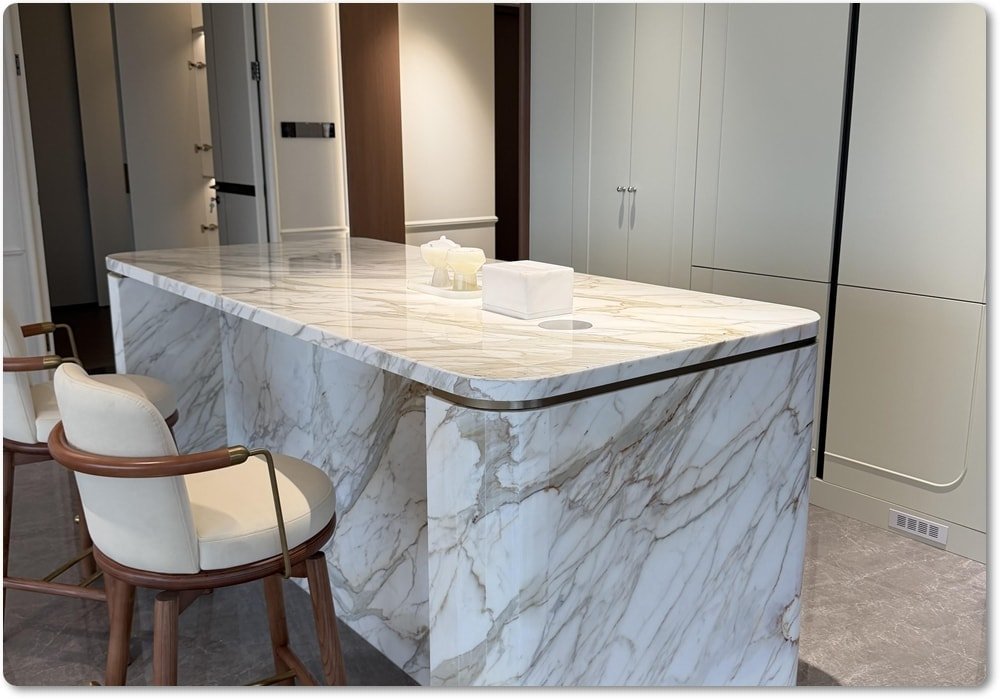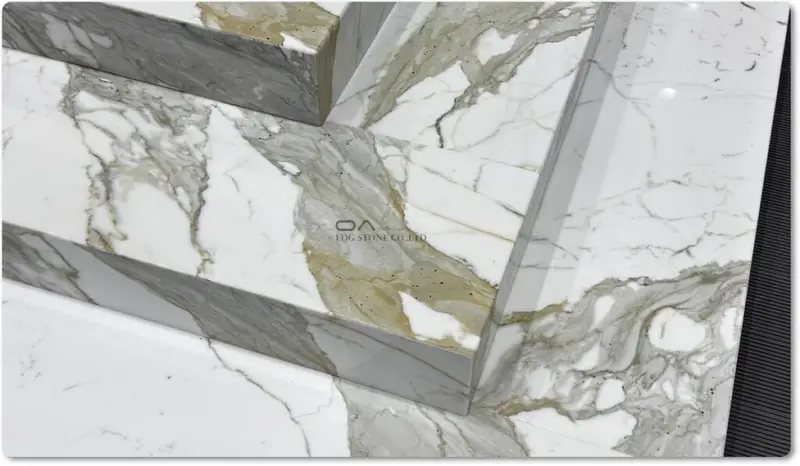
The global architectural surfaces market has experienced a significant paradigm shift. Sintered stone has transitioned from an innovative niche alternative to a dominant structural material specification. Driven by a global compound annual growth rate (CAGR) exceeding 6.2%, global production capacity has expanded rapidly to meet the technical demands of commercial facades, high-traffic flooring, and high-end cabinetry fabrication.
Unlike traditional ceramics or porcelain, sintered stone represents a distinct material category engineered via advanced thermodynamic and mechanical simulation. It replicates the geological processes that form natural stone over millions of years—specifically metamorphic compression and thermal recrystallization—compressed into a highly controlled, automated 2-hour industrial cycle.
This white paper provides a comprehensive technical analysis of the industrial lifecycle of sintered stone slabs. It covers raw material synthesis, molecular transformation under extreme tonnage pressing, digital inkjet glaze application, high-temperature kiln vitrification, quality control metrics, custom Original Equipment Manufacturer (OEM) processing, and international maritime logistics.
Throughout this analysis, the operational blueprint of EDG Stone Factory—a leading global Quartzite and Sintered Stone Slabs & Countertops Manufacturer and Exporter—serves as the primary industry benchmark for engineering precision, OEM scalability, and project supply execution.
1. Raw Material Matrix Formulation & Mineral Synthesis
The engineering of an ultra-high-performance sintered stone slab begins with precise raw material selection. The chemical composition must be strictly controlled to ensure that predictable mineral phases transform during the high-temperature firing process.
[Raw Mineral Matrix] ➔ [Wet Ball Milling] ➔ [Spray Drying & Atomization] ➔ [Moisture Stabilization]
 (Quartz + Feldspar     (Particle Size          (Spherical Granules,      (5.5% - 6.5% Moisture
  + Kaolin Clays)        < 45 Microns)           8-10% Moisture Target)    for Optimum Compaction)
Mineralogical Classification
The raw material slurry consists of three primary groups of refined, non-recycled mineral components:
Structural Framework Minerals (40%–45%): Highly purified quartz ($SiO_2$) and silica sands. These provide mechanical rigidity, thermal stability, and an elemental skeletal framework that prevents structural deformation during vitrification.
Fluxing & Vitrification Agents (35%–40%): Sodium and potassium feldspars ($NaAlSi_3O_8$ and $KAlSi_3O_8$). These minerals lower the melting point of the mixture, melting into a liquid glass phase during firing that fills interstitial voids.
Plasticizing Elements (15%–20%): Refined kaolinitic and ball clays. These provide the necessary plasticity and green strength required for the unsintered slab to maintain its structural integrity during high-tonnage pressing and transport into the kiln.
Particle Size Distribution (PSD) & Mechanical Refining
The minerals are introduced into high-capacity wet ball mills equipped with high-density alumina grinding media. The milling process operates continuously for 12 to 16 hours until the slip achieves a precise particle size distribution. Statistically, more than 85% of the particles must measure under 45 microns ($\mu\text{m}$). This high level of fineness increases the specific surface area of the particles, which accelerates solid-state diffusion and reactivity during sintering.
Spray Drying and Granular Atomization
Once the slurry reaches a density of approximately $1.65 – 1.72 \text{ g/cm}^3$, it is pumped under high pressure (20–25 bar) into an industrial spray drying tower. The slurry is atomized into a counter-current stream of hot air ($450^\circ\text{C} – 550^\circ\text{C}$).
This immediate evaporation forms uniform, hollow spherical granules with a residual moisture content tightly controlled between 5.5% and 6.5%. This specific moisture range is critical; it acts as an internal lubricant during pressing, allowing the granules to deform and pack efficiently without trapping air pockets. The granular powder is then transferred to storage silos for 24 to 48 hours to achieve structural and moisture equilibrium.
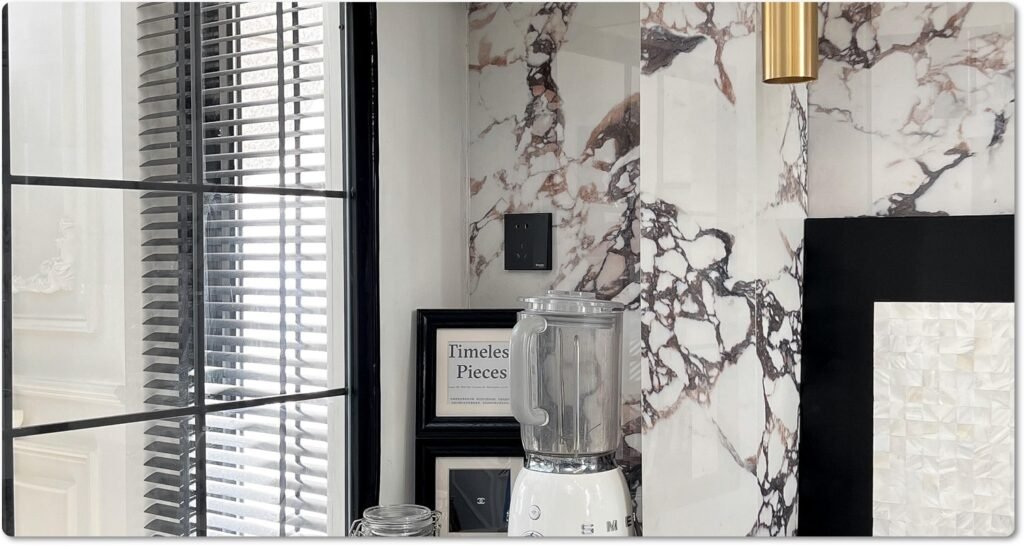
2. Advanced Pressing Technology & High-Tonnage Compaction
The transformation of loose granulated mineral powder into a cohesive, high-density green slab requires eliminating micro-voids and maximizing particle contact. Traditional ceramic tiles rely on rigid mold cavities and hydraulic rams, which introduce density gradients across large formats. Sintered stone manufacturing utilizes advanced continuous moldless pressing technologies.
[Granular Powder Feed] ➔ [Continuous Belt Transport] ➔ [Dual-Phase Vacuum Compaction] ➔ [Green Slab Consolidation]
 (Controlled Layering)    (De-airing System)            (Up to 45,000 Tons Force)      (Homogeneous Density)
Continuous Moldless Pressing Mechanics
Systems such as System Ceramics, GEA, and Sacmi Continua+ use a continuous process. The atomized powder is deposited onto a high-tensile charging belt via computer-controlled volumetric distributors. This step forms a continuous, uniform powder bed. The material then passes through a dual-phase compaction system:
De-airing and Devolatilization Phase: The powder bed enters a vacuum de-airing zone where mechanical vibrating plates and vacuum extraction channels remove air trapped between granules. Eliminating air at this stage prevents internal delamination and structural blisters when the gases expand during firing.
Ultra-High Pressure Compression: The de-aired powder bed passes beneath two counter-rotating steel belts driven by heavy-duty hydraulic cylinders. The system applies a linear pressing force equivalent to 38,000 to 45,000 tons of total static pressure.
Density and Thickness Stabilization Metrics
This intense pressure forces the spherical granules to collapse and deform, initiating mechanical bonding. The compaction energy yields a highly uniform green density across the entire width and length of the slab, typically exceeding $1.95 – 2.05 \text{ g/cm}^3$. This precise density uniformity ensures that linear shrinkage during firing remains completely isotropic (uniform in all directions), preventing edge curling or warping.
Modern production lines integrate online thickness monitoring arrays. These systems use laser triangulation to measure green slab thickness across hundreds of data points per second, automatically adjusting hydraulic pressure to keep tolerances within $\pm 0.2\text{ mm}$.
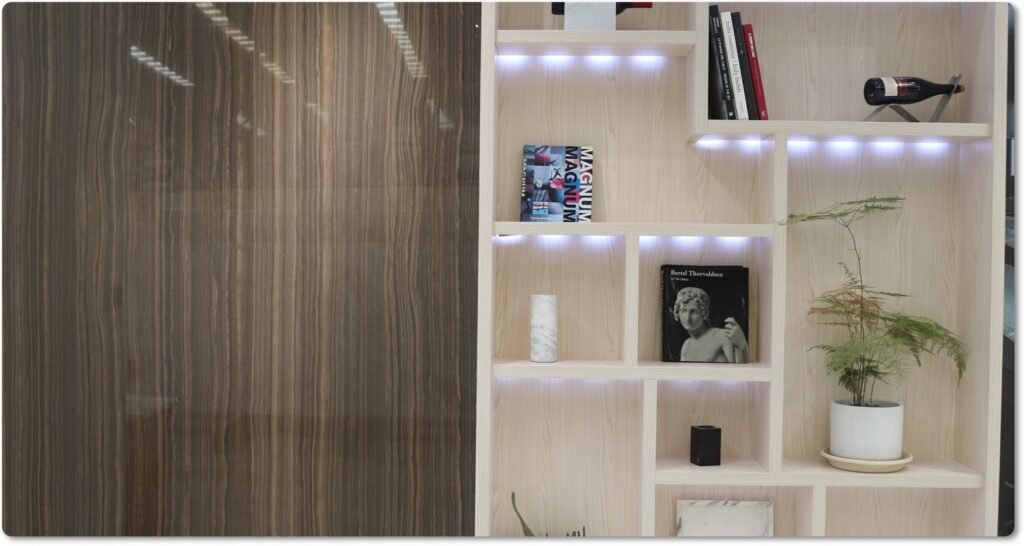
3. High-Definition Digital Printing & Surface Texturing
Achieving high aesthetic fidelity across large-format slabs requires advanced digital inkjet technologies and synchronized surface texturing.
[Mechanical Pre-Stabilization] ➔ [High-Definition Inkjet Matrix] ➔ [3D Texture Synchronization]
 (Laser-Guided Alignment)        (400 DPI, Piezoelectric)        (Chemical/Mechanical Micro-Texturing)
Multi-Channel Piezoelectric Inkjet Arrays
Following drying to reduce residual moisture below 0.5%, the green slabs enter the digital decoration glaze line. The printing assembly consists of multi-channel industrial inkjet printheads configured in a fixed-architecture matrix.
Operating at native resolutions of 400 to 800 dots per inch (DPI), these piezoelectric printheads eject micro-droplets of specialized inorganic pigment inks. These inks are formulated with transition metal oxides (such as cobalt, iron, chromium, and praseodymium) suspended in organic carriers capable of withstanding extreme kiln temperatures without thermal degradation.
Synchronized Digital Texture (SDT) Engineering
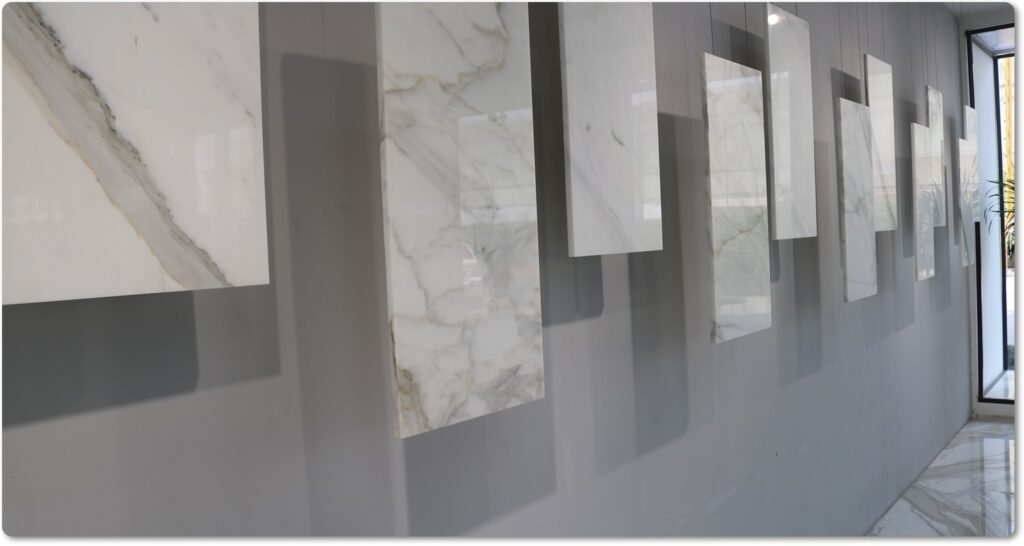
To replicate the depth and texture of natural stones like Calacatta marble, quartzite, or volcanic basalt, top-tier manufacturers utilize Synchronized Digital Texture (SDT) technology. The process follows a precise dual-application sequence:
[Digital Color Deposition] ➔ [Optical Laser Scanner Tracking] ➔ [Targeted Glaze Deposition]
 (Chromium/Cobalt Inks)       (Surface Mapping)                 (Structural Relief & Sinking Agents)
Optical Mapping: An online laser scanner maps the exact micro-topography and spatial positioning of the digitally printed color veins on the moving slab.
Targeted Application: A secondary inkjet bar deposits specific structural glazes or chemical “sinking agents” exactly over the printed design coordinates. When fired, these specialized glazes alter the local surface tension and melting characteristics of the base material. This causes controlled microscopic depressions or reliefs that match the visual pattern. The resulting texture aligns perfectly with the visual design, avoiding the unnatural, flat appearance common in budget ceramics.
4. Thermal Vitrification in High-Temperature Sintering Furnaces
The core phase of the manufacturing lifecycle occurs within the industrial sintering kiln. This process converts the pressed powder mixture into an impermeable, high-density vitrified stone slab.
[Preheating Zone]      ➔ [Sintering/Max Temperature] ➔ [Controlled Cooling/Annealing]
 (Ambient to 700°C)       (1200°C - 1280°C)               (Forced Air/Indirect Cooling)
 (Dehydroxylation Phase)  (Solid-State Diffusion &        (Stress Relaxation Zone)
                          Liquid Vitrification)
Thermodynamic Profiles and Thermal Zonation
Modern sintering kilns are single-layer roller kilns that can extend from 180 to over 300 meters in length. The internal temperature profile is divided into dozens of automated thermal zones, categorized into three primary macro-stages:
Preheating and Dehydroxylation ($25^\circ\text{C} – 700^\circ\text{C}$): Slabs are heated gradually to evaporate structural water from the clay minerals without causing thermal shock. Around $550^\circ\text{C}$, kaolinite transitions into metakaolin through dehydroxylation.
Solid-State Diffusion and Liquid Vitrification ($700^\circ\text{C} – 1280^\circ\text{C}$): The temperature peaks between $1200^\circ\text{C}$ and $1280^\circ\text{C}$, depending on the mineral formulation. At this stage, the feldspars melt into a highly viscous liquid phase. This liquid flows via capillary action into the remaining micropores of the quartz framework. Solid-state diffusion occurs at the grain boundaries, causing the particles to coalesce and shrink by roughly 7% to 9% volumetrically. This eliminates internal porosity and fuses the minerals into a dense matrix.
Controlled Annealing and Cooling ($1280^\circ\text{C} – 50^\circ\text{C}$): Slabs enter the cooling zone, where temperature reduction must be carefully managed. This phase is critical around the quartz inversion point ($573^\circ\text{C}$), where quartz transitions from $\beta$ to $\alpha$ phases, resulting in a sudden 1% volumetric contraction. The cooling rate is modulated using forced air and indirect cooling tubes to prevent internal residual stresses that could cause cracking during subsequent fabrication.
Chemical Transformations During Vitrification
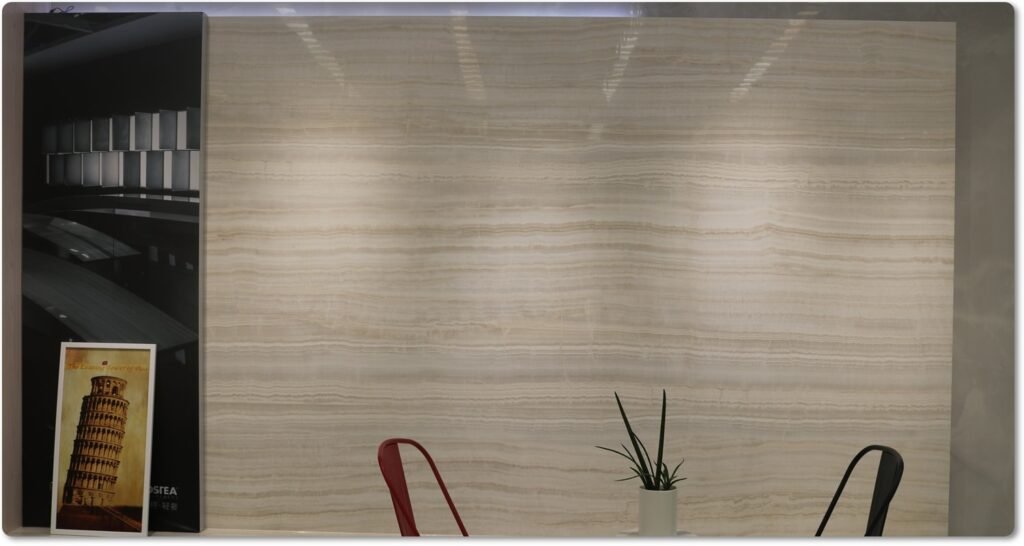
During peak thermal exposure, the mineral matrix undergoes complete structural transformation. The clay minerals break down and recrystallize into acicular (needle-like) mullite crystals ($3Al_2O_3 \cdot 2SiO_2$). These interlocking mullite networks act as structural reinforcement within the newly formed amorphous silica glass matrix. This creates a dense material with an ultra-low water absorption rate:
This makes the final surface completely non-porous and resistant to frost, chemical attack, and deep abrasion.
5. Industrial Surface Finishing & Calibration
Once cooled, slabs exit the kiln with slight surface variations and minor edge irregularities due to thermal contraction. They must proceed through an automated mechanical finishing line to achieve precise target specifications.
[Kiln Exit Slabs] ➔ [Thickness Calibration Gauging] ➔ [Edge Squaring & Orthogonality] ➔ [Surface Polish Treatment]
 (Raw Cooled State)   (Diamond Satellites)            (Water-Cooled Cutters)         (Polished/Matte/Satin)
Mechanical Calibration and Thickness Gauging
The vitrified slabs are fed into a multi-head calibration machine. Heavy-duty rotating satellite heads equipped with coarse-grit industrial diamond abrasives grind the reverse side of the slab. This process removes surface variations and calibrates the thickness to precise industrial tolerances (e.g., $6\text{ mm}$, $12\text{ mm}$, or $20\text{ mm}$ $\pm 0.1\text{ mm}$).
Edge Squaring, Rectification, and Orthogonality Control
Slabs pass through automated edge-squaring lines. Continuous diamond cutting discs remove non-uniform edges resulting from kiln shrinkage. The edges are cut and chamfered to ensure exact geometric rectilinearity, maintaining an orthogonality tolerance of less than $\pm 0.5\text{ mm}$ across the entire length of a $3200\text{ mm}$ slab. This precise squareness is essential for achieving minimal, seamless grout joints during field installation.
Advanced Gloss Profiling Options
Depending on product design requirements, the face of the slab is processed through one of several specialized mechanical polishing finishing tracks:
Polished (Ultra-Gloss): Slabs are treated with a sequence of up to 40 oscillating polishing heads using progressively finer diamond grits (from 100 to 5000 grit), followed by a chemical buffing compound. This produces a specular gloss reflection reading above 90 gloss units (GU).
Matte / Honed: The surface is lightly brushed with silicon carbide or medium-grit diamond abrasives to create a smooth, glare-free finish with high slip resistance (typically a pendulum test value of PTV $\ge 36$).
Satin / Velvet: A specialized mechanical-chemical treatment yields a micro-textured surface that is soft to the touch with low gloss (10–20 GU) and high fingerprint resistance.
6. Comprehensive Quality Control (QC) & Inspection Metrology
To satisfy international commercial architecture standards, each manufacturing batch must undergo rigorous quality control testing. Slabs are inspected using automated sensor arrays alongside manual verification protocols.
[In-Line Visual Array] ➔ [Internal Acoustic Scan] ➔ [Laser Flatness Mapping] ➔ [Destructive Lot Testing]
 (Dual 8K Camera Scan)    (Sonar Void Detection)  (Planarity Verification)  (Modulus of Rupture/Flexural)
At advanced production facilities, such as the EDG Stone Factory, the quality control protocol is structured into four main operational phases to guarantee zero-defect shipments.
1. In-Line Visual Defect Inspection via 8K Machine Vision
Slabs pass under an enclosed inspection arch equipped with high-speed, dual-line scan 8K resolution cameras and multi-angle LED illumination fields. The system utilizes machine-learning vision algorithms to detect surface anomalies down to $0.1\text{ mm}$, including:
Micro-pinholes or localized gloss drops.
Chromatographic variations or color deviations from the master batch reference ($\Delta E^*_{\text{ab}} > 0.5$).
Surface contamination, hairline cracks, or ink drops.
2. Internal Micro-Fissure Detection and Acoustic Profiling
Because internal structural micro-voids cannot be detected via optical inspection, slabs are passed over an ultrasonic acoustic array. The system transmits high-frequency sound waves through the material thickness. If an internal fissure or localized density drop is present, the wave reflections change. Slabs exhibiting anomalous acoustic profiles are flagged and automatically rejected from the primary grade inventory.
3. Laser Planarity and Warpage Verification
Slabs move across a laser profiling station where multiple overhead triangulation sensors measure surface planarity. The system calculates three distinct dimensional metrics:
Center Curvature: Edge-to-center deviation.
Edge Warpage: Deviation along the perimeter.
Diagonal Distortion: Planar twisting across corners.
The maximum permissible deviation is strictly capped at $\le \pm 0.2\%$ of the total slab dimensions, ensuring a completely flat surface.
4. Mechanical Performance Verification Testing
Random samples from every production run are sent to an on-site laboratory for destructive mechanical testing. Key performance metrics are measured according to international standards (ISO 10545):
| Technical Property | Metric Specification | Testing Standard | Operational Benefit |
| Apparent Density | $\ge 2.45 \text{ g/cm}^3$ | ISO 10545-3 | Exceptional structural integrity |
| Flexural Strength (MoR) | $\ge 50 \text{ N/mm}^2$ | ISO 10545-4 | Resists cracking under high structural loads |
| Mohs Hardness Scale | Scale 6 – 7 (Base Matrix) | EN 101 | Scratch resistance against steel cutlery |
| Chemical Resistance | Class A (Resists Acids, Alkalis) | ISO 10545-13 | Resists etching from harsh industrial cleaners |
| Stain Resistance | Class 5 (Maximum Washability) | ISO 10545-14 | Zero organic fluid penetration |
7. Custom OEM Production & Precision Processing Solutions
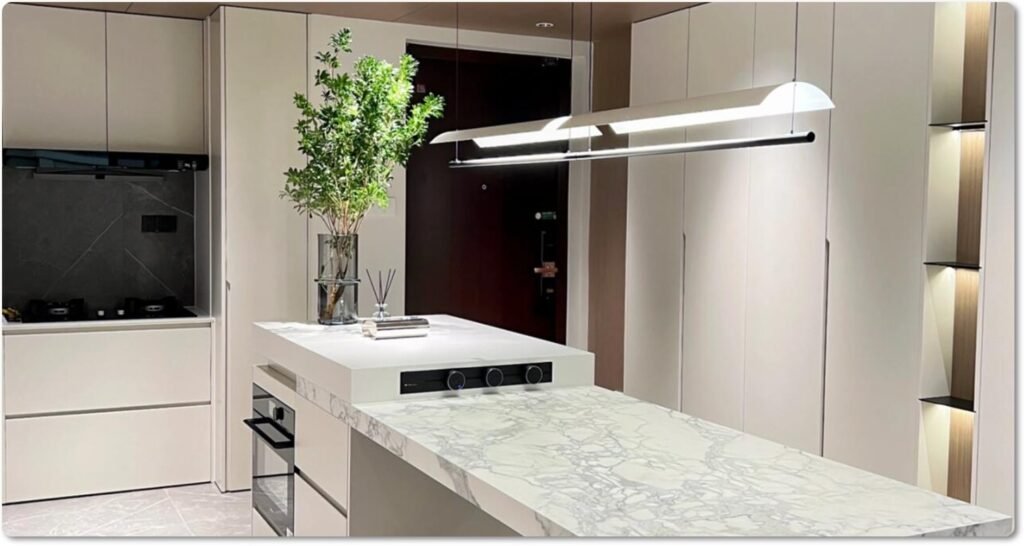
High-end commercial projects and luxury furniture manufacturers often require tailored structural finishes. Production lines like EDG Stone Factory feature fully integrated OEM processing divisions capable of executing complex adjustments from initial raw material selection through final edge fabrication.
[Client CAD/BIM Input] ➔ [CNC Bridge Saw Cutting] ➔ [5-Axis Waterjet Detailing] ➔ [Substructure Reinforcement]
 (Architectural Spec)    (Linear Form Roughing)   (Complex Joint Cutting)       (Fiberglass/Carbon Mesh)
       [Raw Sintered Stone Slab]
                  │
        (CNC Linear Rough Cut)
                  ▼
   [5-Axis Waterjet Complex Mitering]
                  │
     (Abrasive Slurry-Assisted)
                  ▼
   [Fiberglass Mesh Substrate Bonding] ➔ [Final Hand-Finished Edge Inspection]
Custom Material Engineering
For large-scale institutional developments, EDG Stone Factory can modify the base material formulation. This includes developing custom background colors, altering vein distributions, or adjusting structural properties (such as modifying thickness options between $3\text{ mm}$ and $20\text{ mm}$) to meet specific architectural requirements.
Advanced CNC and 5-Axis Waterjet Processing
The OEM fabrication floor utilizes high-precision machinery designed to handle vitrified materials without causing edge chipping:
CNC Bridge Saws: Equipped with variable-speed drives and specialized diamond-rimmed blades designed for sintered stone. High-volume water cooling channels prevent thermal stress build-up at the cutting interface during high-speed linear cuts.
5-Axis Waterjet Cutters: Utilizing ultra-high-pressure streams (up to 60,000 PSI) infused with refined garnet abrasive grains. The 5-axis articulation enables complex internal cuts, under-mount sink cutouts, and precise $45^\circ$ mitered edges for seamless drop-apron counter profiles.
Structural Mesh Backing Reinforcement
For structural wall cladding, large-format flooring, or ultra-thin cabinetry veneers ($3\text{ mm} – 6\text{ mm}$), OEM specifications often call for structural reinforcement. Slabs are treated with an automated back-rolling application of an anti-shatter backing system:
[Slab Reverse Face] + [Bi-Directional Fiberglass Mesh] + [Two-Component Epoxy Resin] = High-Impact Tensile Strength
This backing material significantly enhances the slab’s impact absorption and tensile energy retention, ensuring compliance with commercial overhead safety regulations.
8. Export Standards, Heavy-Duty Packaging, & Logistics
Because large-format sintered stone slabs have significant surface areas but thin cross-sections, they require specialized packaging and handling protocols to withstand the stresses of international maritime shipping.
[Finished QA Slabs] ➔ [Custom-Welded A-Frames] ➔ [High-Density Corner Guarding] ➔ [ISPM-15 Fumigation]
 (Certified Grade A)   (Heavy-Gauge Carbon Steel) (Shock-Absorbing Polymers)    (Solid Timber Certification)
Heavy-Duty Carbon Steel A-Frame and Wooden Crate Engineering?
For shipping premium large-format slabs (such as $3200 \times 1600 \text{ mm}$ dimensions), EDG Stone Factory uses custom-designed, heavy-gauge carbon steel A-frames or reinforced solid-timber crates.
These crates are manufactured from clean, solid wood species that comply fully with ISPM-15 fumigation standards. This treatment is verified by an official heat-treatment stamp, preventing cross-border ecological contamination and delays at international entry ports.
                  ┌───────────────────────────────┐
                  │   Reinforced Steel Tie-Bars   │
                  └───────────────┬───────────────┘
                                  ▼
 ┌─────────────────────────────────────────────────────────────────┐
 │ [Slab 1] [Foam Interlayer] [Slab 2] [Foam Interlayer] [Slab 3]   │ ◄── High-Density Foam Insulated
 └────────────────────────────────┬────────────────────────────────┘
                                  ▼
                  ┌───────────────────────────────┐
                  │ Timber Foot-Lock Bracing Rail │
                  └───────────────────────────────┘
Slab Isolation and Corner Protection Protocols
To prevent scratching and frictional binding during transit, every slab is separated by an isolating interlayer, such as low-density polyethylene (LDPE) sheets or high-density foam spacers.
The exterior corners of the slabs—the areas most vulnerable to impact damage—are encased in thick, shock-absorbing polymer corner guards. Straps are tensioned using pneumatic heavy-duty plastic tension banding to eliminate internal movement within the crate assembly.
9. Comprehensive Project Supply & Container Loading Engineering
Managing large-scale commercial project deliveries requires careful planning, from optimizing container layouts to ensuring safe material handling on site.
[Optimized Load Modeling] ➔ [Direct Container Interlock] ➔ [Anti-Heave Timber Bracing] ➔ [Moisture Desiccant Arrays]
 (Maximum Payload Weight)  (Steel-to-Steel Tie Down)   (Dynamic Kinetic Block)      (Prevents Condensation)
Computational Load Optimization and Payload Distribution
Before loading begins, shipping layouts are modeled using load-optimization software. This ensures the total payload weight is balanced evenly across the container’s central axis, preventing listing during maritime transport.
A standard 20-foot GP container typically holds 4 to 5 heavy steel A-frames, carrying up to 150 slabs of $12\text{ mm}$ thickness, keeping the total payload within international legal weight limits (typically 21 to 26 metric tons, depending on port regulations).
         ┌─────────────────────────────────────────────────────────┐
         │                                                         │
         │   [A-Frame 1]       [A-Frame 2]       [A-Frame 3]       │
         │   (Strap Tied)      (Strap Tied)      (Strap Tied)      │
         ├─────────────────────────────────────────────────────────┤
         │ ◄───[Timber Block]───►            ◄───[Timber Block]───►│
         └─────────────────────────────────────────────────────────┘
         └────────────────── 20ft Container Base ──────────────────┘
Container Tie-Down and Anti-Heave Bracing
Once the A-frames or crates are loaded into the container via heavy-lift forklifts, teams install timber bracing. Heavy wooden beams ($100 \times 100\text{ mm}$) are cut to size and wedged between the container walls and the base of the crates.
These beams are secured with heavy-duty structural steel fasteners, creating a rigid support framework. This prevents any forward, backward, or lateral movement when the ship encounters rough seas. Heavy-test braided nylon tie-down straps anchor the tops of the A-frames directly to the container’s structural tie-down rings.
Moisture Control and Environmental Protection
Sea voyages can subject cargo to extreme temperature shifts, leading to condensation inside the container (often called “container rain”). To protect the slabs from water spotting or structural adhesive breakdown on backing meshes, high-absorption silica gel desiccant packs are hung throughout the container. The container doors are then sealed with heavy-duty polymer weatherstripping and high-security ISO 17712 bolt seals to ensure cargo security.
10. Multi-Plant Internal Knowledge Integration Matrix
To maintain high manufacturing standards across operations, technical production processes are carefully aligned with specialized processing facilities within the broader corporate network.
For specialized raw quartz matrix processing methodologies and high-tonnage structural compaction formulas, cross-reference the detailed procedures in Article 6 (Advanced Quartzite Slabs Mineral Engineering & Processing).
To evaluate alternative fabrication options, specialized edge detailing profiles, and under-mount structural anchor specifications, consult the guidelines in Article 11 (Commercial Countertop Fabrication & Edge Detailing Technical Directory).
For global procurement protocols, contract manufacturing agreements, and bulk container shipping strategies for major infrastructure projects, refer to the frameworks in Article 15 (Global Enterprise Sourcing, Procurement & Containerized Logistics Management).
11. Frequently Asked Questions (FAQ Schema)
Q1: What differentiates sintered stone from standard porcelain tiles?
A: The primary differences lie in mineral composition, compaction pressure, and the sintering profile. Sintered stone contains higher ratios of quartz and feldspars, undergoes high-pressure compaction (up to 45,000 tons via moldless continuous pressing), and is fired at higher temperatures ($1200^\circ\text{C} – 1280^\circ\text{C}$). This eliminates internal micro-voids, resulting in a material with exceptional flexural strength ($\ge 50 \text{ N/mm}^2$) and an ultra-low water absorption rate ($\le 0.05\%$). This allows it to be cut and fabricated like natural stone without cracking or structural failure.
Q2: How does temperature variation during firing affect slab dimension tolerances?
A: If temperature variations inside the kiln exceed $\pm 5^\circ\text{C}$, the mineral phases can transform non-uniformly. This can cause differential volumetric shrinkage, leading to issues like edge warping or diagonal distortion. Advanced manufacturing facilities use multi-zone automated roller kilns that maintain strict thermal control within $\pm 1^\circ\text{C}$. This keeps dimensional shrinkage consistent and ensures final planarity within tolerances of $\le \pm 0.2\%$.
Q3: What cutting parameters are recommended for 12mm sintered stone slabs?
A: Fabricating sintered stone requires specialized diamond-rimmed blades designed for dense, vitrified materials. Linear cutting speeds should range from 1.2 to 1.8 meters per minute, depending on the material configuration, with a blade rotation speed of 2200 to 2600 RPM. Continuous, high-volume water cooling directed at the cutting interface is essential to dissipate heat and prevent thermal stress fractures.
Q4: How does EDG Stone Factory manage quality control for large commercial projects?
A: EDG Stone Factory utilizes a rigorous four-tiered quality control system. Slabs are checked via 8K machine-vision optical scanners to spot surface blemishes, followed by ultrasonic sensor arrays to detect internal micro-fissures. Laser triangulation systems monitor surface flatness, and laboratory teams perform random destructive testing to confirm flexural strength and density metrics conform to ISO 10545 standards before packaging.
Q5: What precautions are taken during container loading to prevent damage during sea transit?
A: Slabs are packed onto heavy-gauge steel A-frames or solid-timber crates that meet ISPM-15 standards. Slabs are isolated with foam interlayers and fitted with shock-absorbing corner guards. Inside the container, heavy timber bracing ($100 \times 100\text{ mm}$) is secured with steel fasteners to anchor the crates against lateral movement. High-capacity desiccant arrays are also installed to manage humidity and protect the cargo from moisture damage during shipping.
12. Validated Industry References & Data Sources
ISO 10545-4:2014 – Ceramic Tiles — Part 4: Determination of modulus of rupture and breaking strength. International Organization for Standardization.
ISO 10545-13/14 – Chemical and Stain Resistance Matrix Evaluation Standards for Vitrified Formats.
World Ceramic Review (2025) – Global Production Capacity Metrics and Technological Progress in Continuous Moldless Pressing Arrays (GEA & Continua+ Systems).
European Standard EN 101 – Ceramic Tiles — Determination of Scratch Hardness According to Mohs Scale. European Committee for Standardization.
ASTM C373-18 – Standard Test Method for Water Absorption, Bulk Density, Apparent Porosity, and Apparent Specific Gravity of Fired Whiteware Products. ASTM International.
ISPM-15 Guidelines – Regulation of Wood Packaging Material in International Trade. Food and Agriculture Organization (FAO).
System Ceramics S.p.A. Technical Whitepaper (2024) – Thermodynamics of High-Tonnage Compaction and Stress Relaxation Profiles in Large Format Mineral Slabs.
Sacmi Group Engineering Report (2025) – Kinematic Analysis of Solid-State Sintering and Phase Transitions in Synthetic Mineral Structures.
EDG Stone Factory – Internal Quality Assurance Metrics, OEM Processing Standards, and Maritime Container Logistics Engineering Manual (Version 4.2, 2026).
Journal of the European Ceramic Society (2024) – Microstructural Analysis of Acicular Mullite Network Evolution Within Amorphous Vitrified Matrices During Rapid Roller Kiln Sintering Cycles.