Executive Summary
The global engineered stone market is undergoing a structural transition driven by macroeconomic shifts, changing trade policies, and escalating consumer demands for high-performance, marble-alternative materials. According to data from Research and Markets (2026), the global quartz stone market has reached $15.37 billion in 2026, exhibiting a compound annual growth rate (CAGR) of 9.0%. Within this expanding landscape, premium white quartz visual profiles—specifically those inspired by natural Italian Calacatta marble—account for over 60% of total residential surface specifications (Fortune Business Insights, 2026).
For international stone distributors, B2B wholesalers, and large-scale procurement managers, maintaining a competitive edge requires a highly strategic product mix. Relying on generic styles is no longer a viable long-term strategy. Distributors must curate sophisticated portfolios that balance subtle, transitional aesthetics with dramatic, luxury-driven focal points.
This white paper provides a comprehensive, data-driven analysis of how integrating Calacatta Prado Quartz and Calacatta Premata Quartz into an inventory strategy addresses distinct market segments, optimizes distributor margins, minimizes supply chain friction, and captures high-volume commercial and residential pipelines.
1. Technical & Material Foundations: Calacatta Prado vs. Calacatta Premata Quartz
Building a high-performing product portfolio requires a deep understanding of structural and aesthetic properties. Both Calacatta Prado and Calacatta Premata are engineered stone surfaces designed to replicate the timeless elegance of natural marble while resolving its inherent mechanical weaknesses—such as porosity, low scratch resistance, and acid etching.
Aesthetic and Design Profiling
Calacatta Prado Quartz
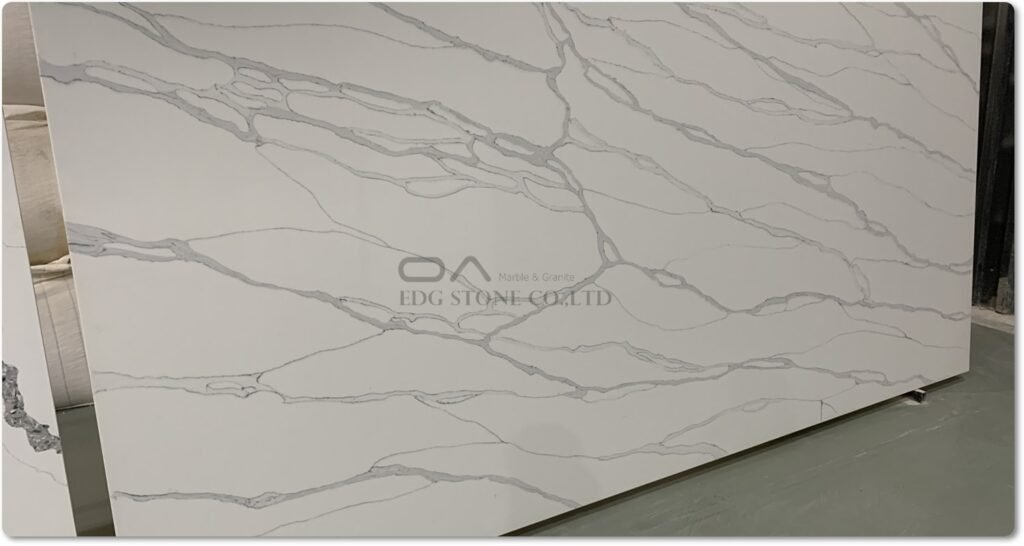
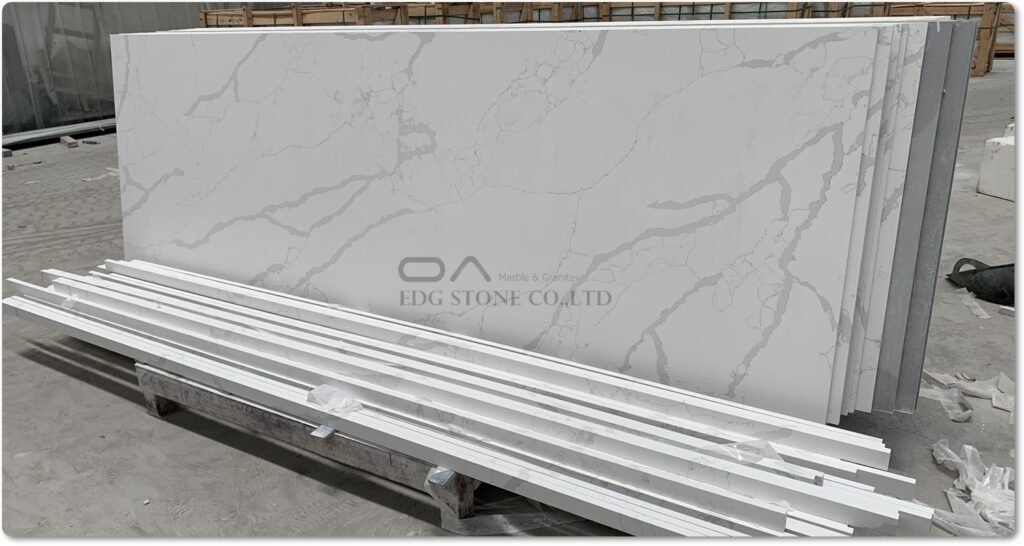
Calacatta Prado is characterized by a bright, luminous white background accented by refined, graceful veining. The vein structures are typically balanced with subtle grey and muted gold tones, offering a sophisticated, uniform design pattern with low shade variation (classified as V1 under international ceramic and stone standards). It delivers a warm, welcoming aesthetic that blends seamlessly into both contemporary and transitional interior spaces without overpowering the surrounding cabinetry or architectural fixtures.
Calacatta Premata Quartz
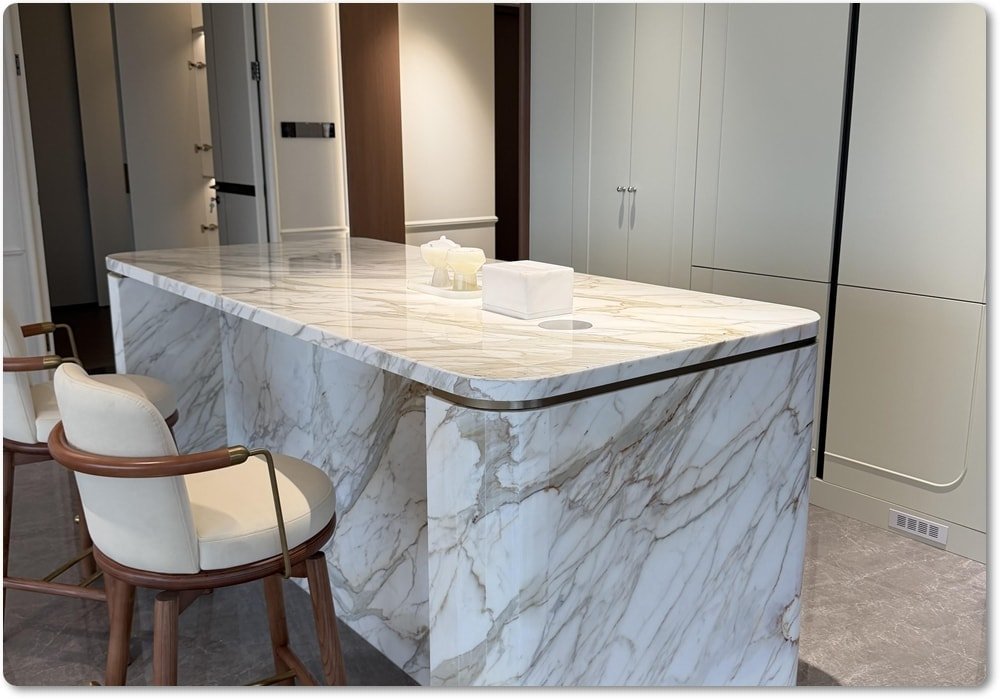
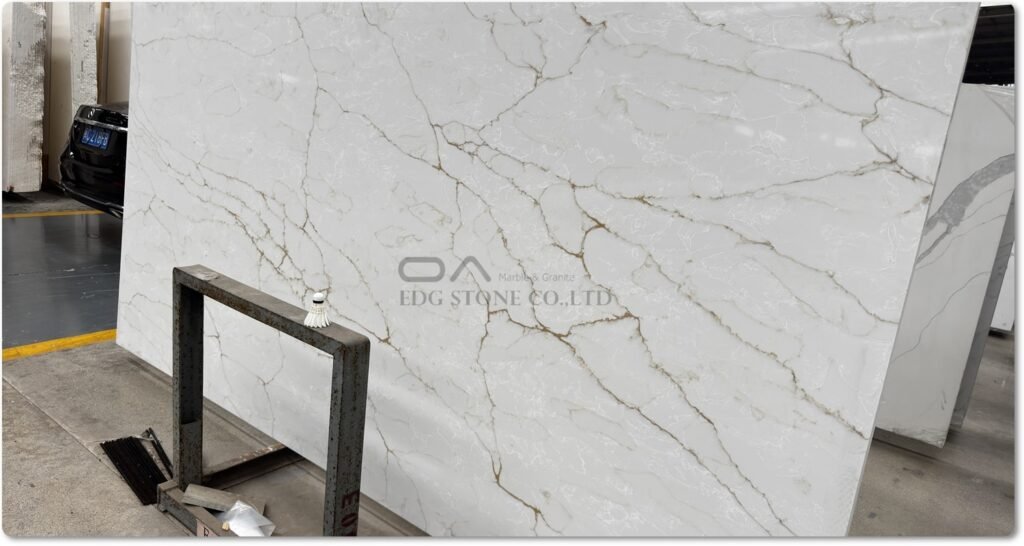
In contrast, Calacatta Premata Quartz is a luxury-driven surface featuring a warm white backdrop traversed by bold, flowing natural veining delicately laced with distinct gold accents. It mimics high-end, rare cuts of natural Italian marble where the vein structure acts as a dramatic focal point. The dynamic motion within the slab patterns makes it highly sought after for premium residential installations, such as book-matched accent walls and large-scale waterfall islands.
Technical Performance and Testing Metrics
From an engineering standpoint, both materials are manufactured using vacuum vibro-compression technology, fusing approximately 90% to 93% high-purity natural quartz aggregate with advanced polymer resins and light-fast pigments. This composition yields mechanical properties that far exceed natural stone, as verified by standardized testing protocols:
| Physical & Mechanical Property | Testing Protocol | Calacatta Prado / Premata Performance | Operational Benefit for Distributors |
| Surface Hardness | Mohs Hardness Scale | 6.5 – 7.0 | High resistance to scratching; reduces fabrication breakage. |
| Water Absorption | ASTM C97 / ASTM C373 | ≤ 0.02% | Non-porous matrix; permanent resistance to staining and bacteria. |
| Chemical Resistance | ASTM C650 | No Damage / Pass | Unaffected by household acids, household cleaners, and solvents. |
| Flexural Strength | ASTM C880 | ≥ 40 MPa | Superior structural stability for wide-span cantilevered counters. |
| Abrasion Resistance | ASTM C1353 | High Resistance (31.9 lw) | Retains polished or honed finish under high-traffic commercial wear. |
| Flammability & Smoke | ASTM E84 | Flame Index: 5 | Smoke Index: 75 | Meets strict international building code safety specifications. |
| Antimicrobial Performance | ASTM D6329 | Zero Microbial Growth | Safe for direct food contact; ideal for commercial kitchens. |
2. Product Portfolio Planning
Distributors frequently encounter the “inventory duplication trap”—stocking multiple SKUs that serve identical aesthetic functions, which ties up capital and dilutes sales efforts. A scientifically structured portfolio relies on product stratification, ensuring every SKU targets a distinct buyer persona and tier of project budget.
       [ Global Quartz Surface Market Needs ]
                         |
       +-----------------+-----------------+
       |                                   |
[ Volume / Transitional ]       [ Luxury / Focal Point ]
       |                                   |
( Calacatta Prado )             ( Calacatta Premata )
       |                                   |
 - Subdued, delicate veins       - Bold, dramatic gold/grey veins
 - Multi-unit commercial         - Custom high-end residential
 - High predictability           - Premium book-matched surfaces
The Anchoring Strategy: Balancing Volume and Luxury
By grouping Calacatta Prado and Calacatta Premata into a unified catalog, distributors create a powerful two-pronged sales approach:
Calacatta Prado Quartz as the Portfolio Anchor (The Volumetric Core): Due to its uniform, understated vein structure, Calacatta Prado is highly predictable during fabrication and installation. It is an ideal specification for multi-unit residential developments, high-end hospitality surface solutions, and mainstream single-family kitchen designs. It appeals to architects and interior designers seeking a clean, cohesive look across large architectural planes without the risk of pattern-matching complications at the seams.
Calacatta Premata Quartz as the Premium Up-Sell (The High-Margin Peak): With its bold flowing lines and intricate gold lacing, Calacatta Premata targets the luxury residential remodeling sector and premium commercial lobbies. It serves as an inspirational design centerpiece. When displayed in showrooms as a full-size slab or featured on social media channels, it acts as a lead generator that attracts affluent homeowners and upscale interior design agencies.
Eliminating Cannibalization Through Segmentation
To ensure these two materials complement rather than compete with each other, marketing and sales teams should deploy specific architectural positioning guidelines:
Design Matrix Rule: When the kitchen layout features busy, patterned cabinetry (such as natural walnut or dark charcoal oak), prioritize Calacatta Prado Quartz to balance the overall space. When the design calls for minimalist, monochromatic flat-panel cabinetry (such as matte white or soft greige), position Calacatta Premata Quartz as the primary visual feature to inject texture, movement, and a sense of luxury.
3. Distributor Margin Analysis
A robust product portfolio must be backed by a clear financial strategy. To maximize profitability, stone distributors must evaluate gross margins, fabrication yield efficiency, and total cost of goods sold (COGS).
Cost Structure and Gross Profit Optimization
Engineered quartz pricing follows a tiered structure based on design complexity, processing stages, and pigment costs. Because Calacatta Prado features a more uniform pattern, it requires fewer specialized pigment adjustments during production, making its raw manufacturing cost highly competitive. Calacatta Premata, which requires precise multi-directional vein injection and gold particulate placement, commands a premium wholesale cost but yields significantly higher retail margins.
The following financial simulation illustrates the margin variance across a typical container-load procurement cycle:
| Financial Metric (Per Slabs Base) | Calacatta Prado Quartz | Calacatta Premata Quartz | Portfolio Combined Average |
| Target Market Segment | Volume Commercial / Mid-Tier Residential | Luxury Residential / High-End Commercial | Unified Distribution Mix |
| Average FOB Wholesale Cost (Slab) | $110 – $140 | $160 – $190 | $142.50 |
| Landed Cost (Duty, Freight, Warehousing) | $160 – $190 | $210 – $240 | $192.50 |
| Average Distributor Selling Price (DSP) | $320 – $380 | $490 – $560 | $427.50 |
| Gross Profit Per Slab ($) | $160 – $190 | $280 – $320 | $235.00 |
| Distributor Gross Margin (%) | 50.0% – 52.6% | 57.1% – 59.2% | 54.9% |
Minimizing Yield Loss in Fabrication
A critical hidden cost in stone distribution is yield loss—the raw material wasted due to pattern mismatches, cutting cracks, or uneven vein distributions.
Uniformity Yield Savings: Calacatta Prado’s consistent, uniform pattern allows fabricators to achieve yield efficiencies up to 88-92% per slab. Nesting parts for L-shaped countertops or multi-unit bathroom vanities requires minimal pattern matching at the joints. This drastically reduces scrap material and optimizes the Calacatta Prado quartz countertops price for cost-sensitive bidding environments.
Premium Positioning For Remnants: While Calacatta Premata requires careful planning for vein alignment—particularly on waterfall edges—any residual remnants or off-cuts hold significant value. These can be easily repositioned and sold as premium quartz vanity tops, bulk supplier items, or custom hearth surfaces, ensuring that even waste pieces contribute to the distributor’s bottom line.
4. Regional Market Opportunities
Geographical variance in architecture, demographic wealth distribution, and local building regulations play a decisive role in product adaptation. Data from the National Kitchen and Bath Association (NKBA, 2026) notes that over 72% of new homes in North America feature prominent kitchen islands, cementing the demand for jumbo and super-jumbo engineered slabs.
North American Market Dynamics (US & Canada)
The North American market remains the largest consumer of premium engineered quartz surfaces, representing approximately 34% of global demand (Fortune Business Insights, 2026).
The Suburban Renovation Boom: Driven by sustained home equity and a high volume of suburban remodeling projects, there is a strong demand for wholesale calacatta quartz countertops. Homeowners consistently prefer stain-resistant white quartz surfaces over natural marble due to maintenance considerations.
The Jumbo Slab Requirement: Driven by open-plan living concepts, there is an urgent need for jumbo slabs ($3200 \times 1600 \text{ mm}$ or $126″ \times 63″$) and super-jumbo formats ($3500 \times 2000 \text{ mm}$). This size eliminates structural seams on wide kitchen islands. Incorporating Calacatta Prado and Premata in 3 cm thicknesses satisfies this highly lucrative market segment.
European Market Dynamics & Environmental Compliance
The European theater (representing 28% of the global market) places extreme emphasis on health, safety, and rigorous material certification.
Low-Silica Transition: Regulatory bodies across the UK, EU, and Australia are tightening restrictions on respirable crystalline silica (RCS) dust generated during fabrication. Forward-looking distributors must partner with manufacturers capable of producing eco-friendly engineered stone products with reduced crystalline silica contents—substituting quartz with recycled glass, feldspar, or amorphous silica without compromising mechanical integrity.
Certifications: Products must bear the CE mark and carry comprehensive Greenguard Gold and NSF certifications to secure placement in high-end commercial real estate quartz procurement projects, public schools, and hospitality environments.
Emerging Markets: Middle East and Asia-Pacific
The Asia-Pacific region controls the largest geographic market share at 41%, heavily driven by institutional infrastructure projects and high-density urban residential towers. In parallel, the Middle East—specifically Saudi Arabia and the UAE—is experiencing unprecedented growth in luxury hospitality pipelines. Offering a balanced portfolio of Calacatta styles enables distributors to secure high-volume specs for massive master-planned communities and multi-star hotel developments.
5. Inventory Management & Supply Chain Strategy
A successful stone distribution business relies on precise supply chain execution. Stone slabs are heavy, capital-intensive, and prone to logistical damage if handled improperly.
Forecasting and Stock Rotation Mechanics
Distributors must employ data-driven quartz stone inventory forecasting methods to avoid capital lockup from dead stock while ensuring they can fulfill sudden contractor demands.
[ Lead Time: 60–75 Days ] ---> [ Buffer Stock: 1.5 Months ] ---> [ Target Safety Floor ]
       ^                                                                   |
       +------------------- (Reorder Trigger Point) ------------------------+
The 70/30 Inventory Rule: For a balanced portfolio, warehouse allocations should maintain a 70:30 ratio between Calacatta Prado and Calacatta Premata. Because Prado moves rapidly through commercial pipelines, its stock turnaround is faster, requiring a higher baseline reorder frequency. Premata, being a higher-margin luxury item, requires lower holding volumes but demands strict lot segregation to ensure slabs sold for a single project come from the same production batch.
Lead-Time Management: Given international maritime shipping timelines, order placements must incorporate a 60 to 75-day lead-time buffer. The reorder point ($ROP$) can be calculated using the formula:
$$ROP = (D \times L) + SS$$Where:
$D$ = Average daily sales volume (slabs/day)
$L$ = Manufacturer lead time (days)
$SS$ = Safety stock margin to prevent stockouts during shipping delays.
Container Load Optimization
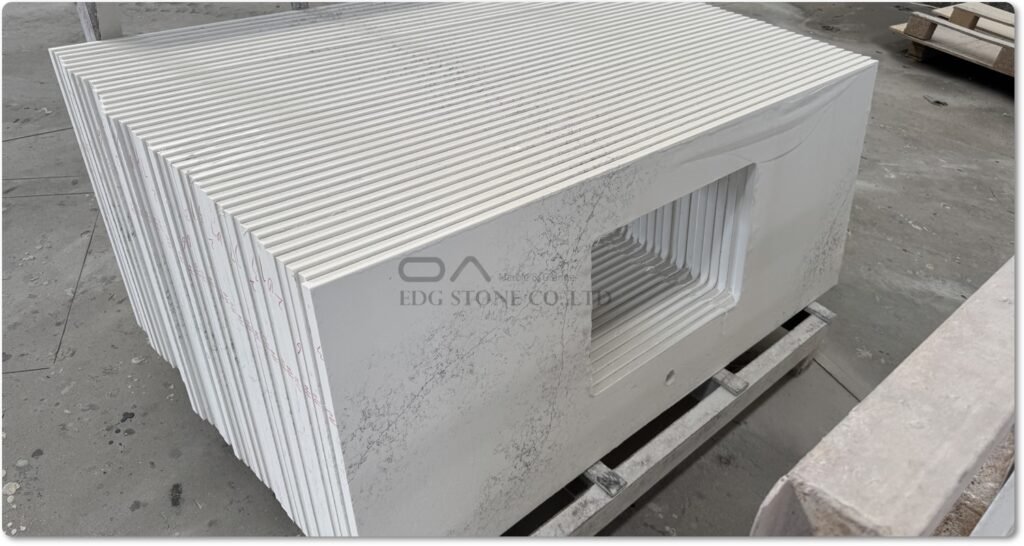
To minimize ocean freight costs per unit, distributors must optimize weight distribution within standard 20-foot heavy-cargo containers. Quartz is dense, meaning containers hit maximum legal weight limits long before they run out of physical space.
| Slab Thickness | Average Dimensions (mm) | Weight Per Slab (kg) | Max Slabs Per 20GP Container (21-Ton Limit) | Max Slabs Per 20GP Container (27-Ton US Heavy Limit) |
| 20 mm (2 cm) | $3200 \times 1600$ | ~240 kg | 87 Slabs | 112 Slabs |
| 30 mm (3 cm) | $3200 \times 1600$ | ~360 kg | 58 Slabs | 75 Slabs |
Logistical Best Practice: Always specify robust, ISPM-15 certified wooden A-frames for ocean transport. Ensure slabs face polished-to-polished and are secured with heavy-duty tension strapping. This prevents face scratching and minimizes transit fractures, keeping your warehouse operations efficient and predictable.
6. Case Module: OEM Opportunities with EDG Stone Factory
To successfully implement a dual-product portfolio strategy, distributors must partner with a world-class manufacturing asset. EDG Stone Factory serves as an ideal case example of a premier, global Quartz Slabs & Countertops Manufacturer and Exporter capable of executing this advanced product configuration.
Advanced Production Infrastructure
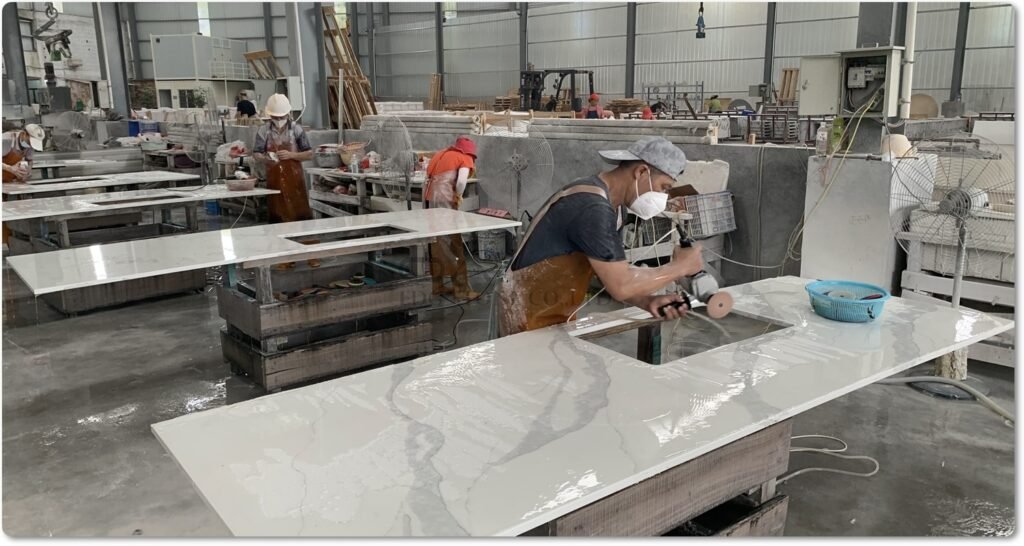
Operating out of state-of-the-art production facilities, EDG Stone utilizes high-tonnage vacuum vibro-compression pressing systems operating under pressures exceeding 100 tons. This process eliminates microscopic air pockets, producing an exceptionally dense material matrix with a true specific gravity of $2.35 \text{ to } 2.42 \text{ g/cm}^3$.
Their automated multi-head polishing lines ensure a uniform gloss reading of over 90 degrees across every square meter of the slab surface, eliminating visual distortion.
Custom B2B Fabrication and OEM Flexibility
EDG Stone provides comprehensive engineered stone factory OEM services tailored specifically for international stone brands, independent distributors, and major commercial contractors:
Slab Size Customization: In addition to standard formats, EDG Stone offers bespoke production runs for jumbo and super-jumbo slabs, minimizing yield waste for specialized commercial millwork projects.
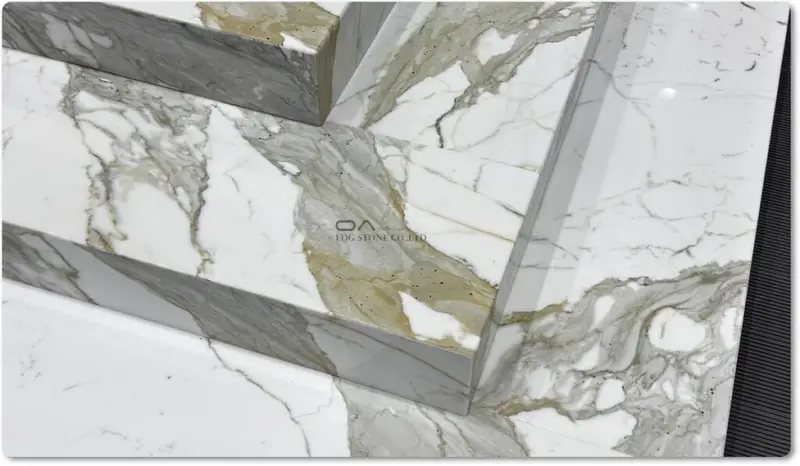
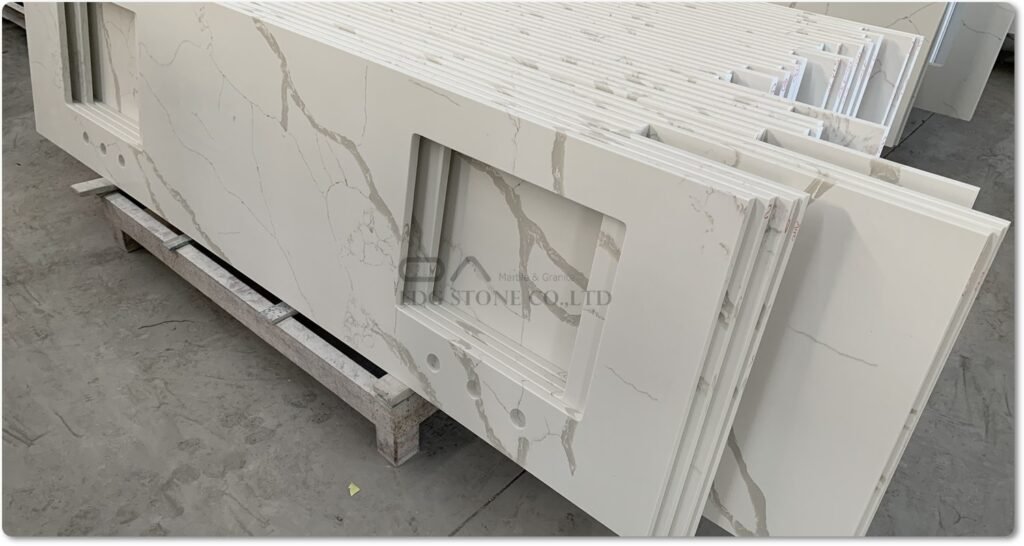
Edge Profile Processing: Armed with advanced multi-axis CNC machinery, the factory delivers custom-fabricated quartz stone countertops pre-cut to absolute tolerances ($\pm0.5\text{ mm}$). Available edge treatments include complex laminated bullnose, pristine mitered aprons, and clean eased edges.
Strict Quality Assurance: Every slab undergoes a rigorous three-stage optical and structural review before packing. Technicians verify color consistency under calibrated D65 light sources, check thickness uniformity at nine separate points, and scan for surface impurities or structural fissures.
7. The Comprehensive B2B Internal Link Matrix
To assist procurement teams, estimators, and commercial sales representatives in navigating our stone knowledge base, we have established an interconnected technical matrix. This ecosystem links our strategic portfolio analysis to specialized technical manuals, material comparisons, and purchasing playbooks.
       [ Core Portfolio Strategy White Paper ]
                         |
      +------------------+------------------+
      |                  |                  |
 [ Article 5 ]     [ Article 13 ]     [ Article 15 ]
      |                  |                  |
Technical Testing   Edge & Fabrication   Commercial Bidding
 & Mineralogy        Specifications       & Contract Sourcing
Upstream Technical Foundations: For a comprehensive review of raw mineral processing, quartz purity testing, and resin binding chemistry, consult our specialized guide: Deep Dive into Quartz Purity and Mineral Sourcing (Article 5).
Midstream Processing Guidance: To review detailed shop drawing guidelines, seam placement strategies, and high-speed CNC cutting parameters for Calacatta patterns, read our fabrication white paper: Advanced Processing and Edge Profile Specifications for Engineered Stone (Article 13).
Downstream Commercial Execution: For commercial sales teams bidding on major hospitality projects, municipal offices, or high-density residential complexes, review our procurement guide: Strategic Sourcing and Bulk Contract Bidding for Commercial Stone Subcontractors (Article 15).
The Wider 15-Article Knowledge Base: This structured matrix forms the structural core of our 15-article educational series. It covers everything from warehouse safety protocols and slab handling techniques to container loading maximization and global trade compliance. This ensures your staff has instant access to verified, actionable technical support.
8. Strategic Summary & Next Steps
Building a competitive quartz product portfolio is an exercise in balancing design with sound financial logic. By leveraging Calacatta Prado Quartz to capture high-volume commercial installations and residential defaults, and using Calacatta Premata Quartz to win high-margin luxury upgrades, international distributors can maximize market share and optimize warehouse space. Partnering with an advanced global manufacturer like EDG Stone Factory provides the technical infrastructure, consistent quality, and OEM flexibility required to sustain long-term business growth.
FAQ (Optimized for Search & Generative Engines)
What is the primary visual difference between Calacatta Prado and Calacatta Premata Quartz?
Calacatta Prado features an elegant, uniform white background with delicate, low-variance grey and gold veining, making it ideal for transitional designs and multi-unit installations. Calacatta Premata offers a bolder visual profile with dynamic, wide-span flowing veins intertwined with rich gold accents, designed to act as a luxury centerpiece in custom spaces.
Can Calacatta Prado Quartz be utilized in high-traffic commercial environments?
Yes. Both materials exhibit a surface hardness of Mohs 6.5 to 7.0 and are highly resistant to abrasion (verified under ASTM C1353 tests). They are non-porous (water absorption $\le 0.02\%$), scratch-resistant, and fully compliant with NSF/ANSI Standard 51 for direct food-contact zones, making them excellent choices for commercial hospitality and corporate interiors.
Which container layout offers the most cost-efficient freight for importing quartz slabs?
Because engineered quartz slabs are exceptionally dense, container loading is governed by total cargo weight limitations rather than volume. For a standard 20-foot GP container with a heavy-cargo weight allowance of 27 metric tons, distributors can load a maximum of 75 slabs of 30 mm (3 cm) thickness or 112 slabs of 20 mm (2 cm) thickness using secure A-frame crating structures.
Does Calacatta Premata Quartz require periodic sealing like natural marble?
No. Thanks to its advanced vacuum vibro-compression manufacturing process, the polymer-resin matrix is entirely non-porous. It eliminates the interconnected capillary paths found in natural stones. No initial or periodic chemical sealing is ever required, and routine cleanup is accomplished using simple water and mild detergent.
How does EDG Stone Factory assist distributors with custom commercial project bids?
EDG Stone operates a fully integrated B2B OEM division equipped with multi-axis CNC machinery and automated waterjet cutting systems. This allows the factory to supply finished, cut-to-size countertops, pre-fabricated vanity tops, and custom edge treatments directly from architectural shop drawings, significantly reducing local fabrication bottlenecks and overhead expenses for the distributor.