1. Quick Snapshot: What does this article cover?
What Taj Mahal quartzite looks like and why it pairs so well with bookmatching.
How bookmatching amplifies natural patterns and how fabricators achieve mirror-image seams for islands and vertical backsplashes.
Cost, sourcing (manufacturer/factory/wholesale options), and realistic price bands.
Regulatory & sustainability drivers (silica safety, EPDs, chain-of-custody) that affect lead times and supplier selection.
2. What is Taj Mahal Quartzite? (Origins, look, and finishes)
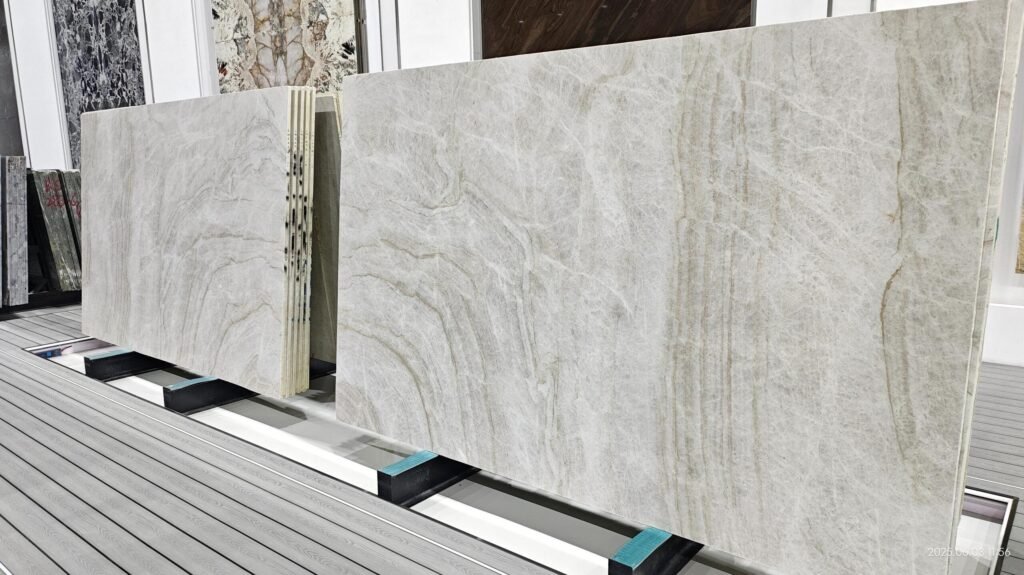
Taj Mahal quartzite is a high-variation, cream-to-sand-colored quartzite prized for its warm background, dynamic rust and gold veining, and ability to lend both classic and contemporary interiors a strong visual identity. It behaves like a natural stone in every respect—hard, heat-resistant, and unique from slab to slab—making it a favorite for one-of-a-kind bookmatched installations where veining continuity becomes the star.
Geology & quarry origins
Quartzite forms when sandstone undergoes intense heat and pressure, converting quartz grains into interlocking crystals that create exceptional hardness and durability. Taj Mahal quartzite is quarried in specific zones where mineral impurities create its signature warm palette.
Typical finishes: Honed vs Polished
Honed Taj Mahal gives a satin, low-sheen surface that emphasizes depth of patterning and reduces glare—popular for kitchens that favor understated luxury.
Polished Taj Mahal produces a high gloss that intensifies color contrast and vein definition. For bookmatching, both finishes succeed; the choice depends on light behavior, maintenance preferences, and desired reflectivity.
Why did Taj Mahal seek book-matching?
Large, bold veining and high-contrast movement make Taj Mahal especially rewarding when bookmatched: mirrored slabs produce sweeping, continuous patterns that read like a designed artwork rather than a countertop. For islands and vertically run backsplashes, the human eye reads the reflected veins as a single, heroic composition.
3. Bookmatching 101: What is bookmatching and why does it matter?
Bookmatching is the process of slicing a slab into sequential panels and opening them like pages so that the veining mirrors across the joint. Think of it as mirror symmetry applied to a natural pattern — it converts a pair (or set) of slabs into a coherent visual sequence.
Definition and types
Mirror (classic) bookmatch: two slabs are matched edge-to-edge to mirror veining.
Cross-bookmatch: multiple slabs are arranged to create a larger symmetrical motif (often used for large walls).
Vein continuation matching: less about perfect mirroring and more about maintaining directional flow across seams.
Why does it amplify natural stone aesthetics?
Bookmatching turns random mineral motion into intentional composition; what was previously “random” becomes an engineered focal point. The technique allows designers to treat slabs like macro-graphics — ideal for islands that face living spaces, or backsplashes meant to be read from a standing viewpoint.
Natural stone vs engineered materials
Natural quartzite delivers organic irregularities that look alive when bookmatched; engineered slabs (quartz, porcelain) can provide predictably repeatable bookmatch patterns at scale, but lack the micro-crystalline depth of natural quartzite. Both are valid—the choice depends on budget, availability, and risk tolerance for seam visibility.
4. Design Applications: Taj Mahal bookmatched islands & backsplashes
Taj Mahal bookmatching is especially dramatic on two architectural canvases: islands (horizontal, central) and backsplashes/feature walls (vertical, large-format).
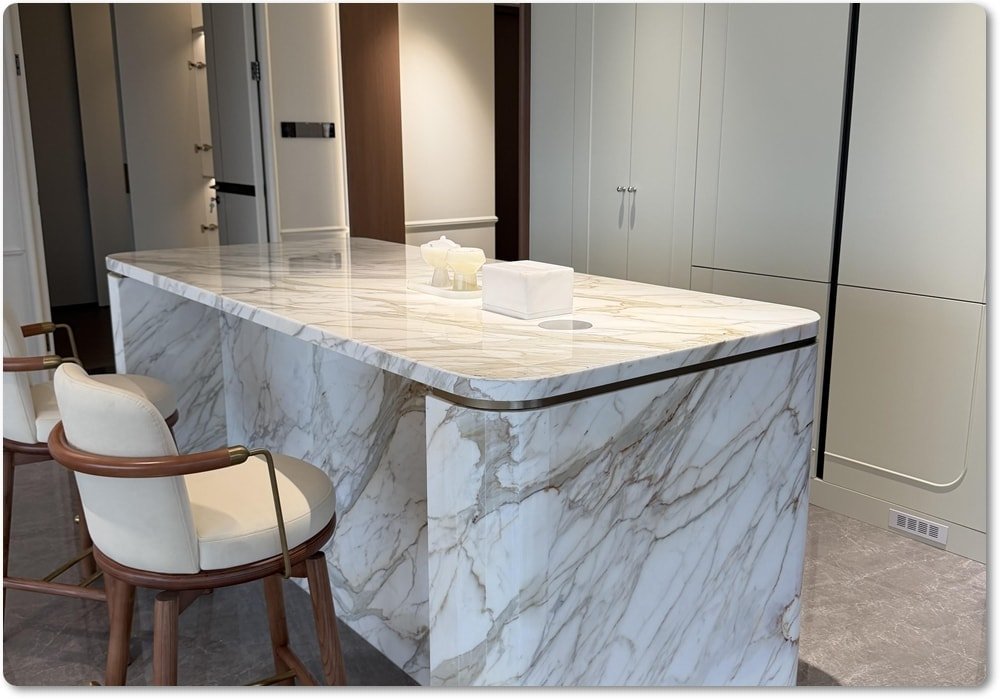
Kitchen islands: centerpieces and waterfall edges
A bookmatched island can be designed so the vein flow centers on the cook zone or sink apron, with waterfall sides that continue the composition down to the floor. Consider these rules:
Place the bookmatch seam where it’s most visible—centered or deliberately offset as a design statement.
Use wide, 3cm (full thickness) slabs where possible to reduce seams.
Plan appliance cutouts and sink placements to avoid bisecting major veins.
Backsplashes & feature walls
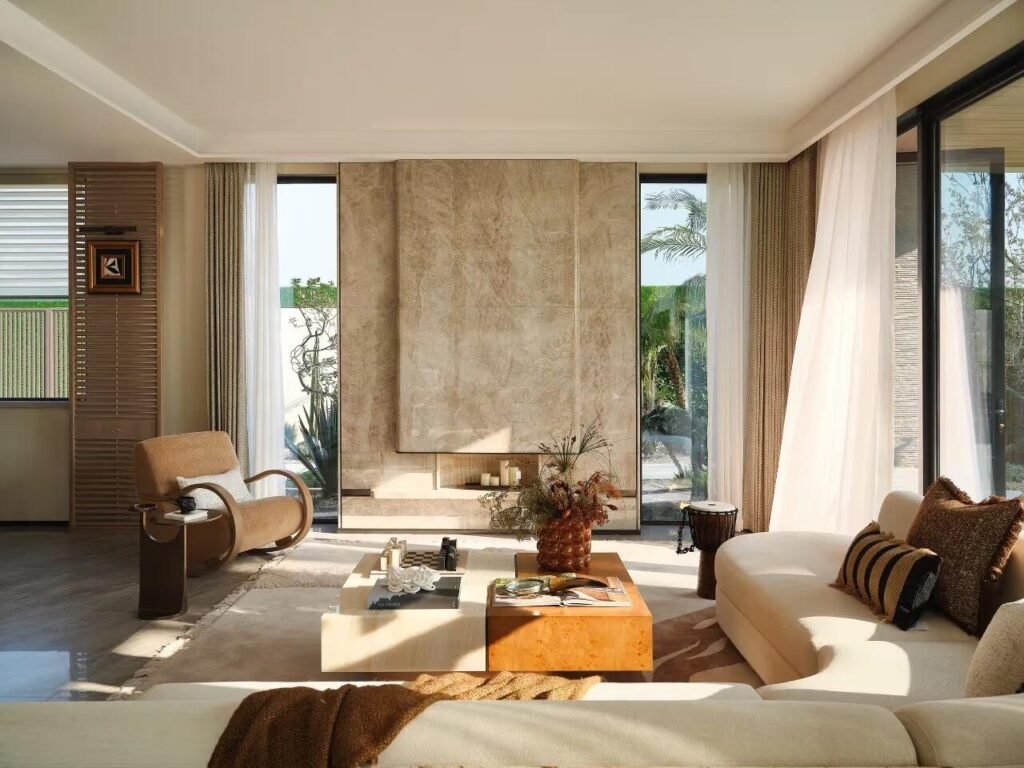
Tall vertical bookmatching creates cinematic drama: two slabs stacked vertically can be matched to form a continuous wallpaper-like surface. For backsplashes, take care with transition details around open shelving and range hoods.
Coordinating cabinetry, fixtures, and lighting
Warmer metals (aged brass, warm nickel) and full-grain wood tones complement Taj Mahal’s sandy base. Directional lighting should be tested on a honed vs polished finish to avoid highlighting micro-scratches in honed surfaces or glare in polished ones.
5. Fabrication & Finishing: From slab to bookmatched masterpiece
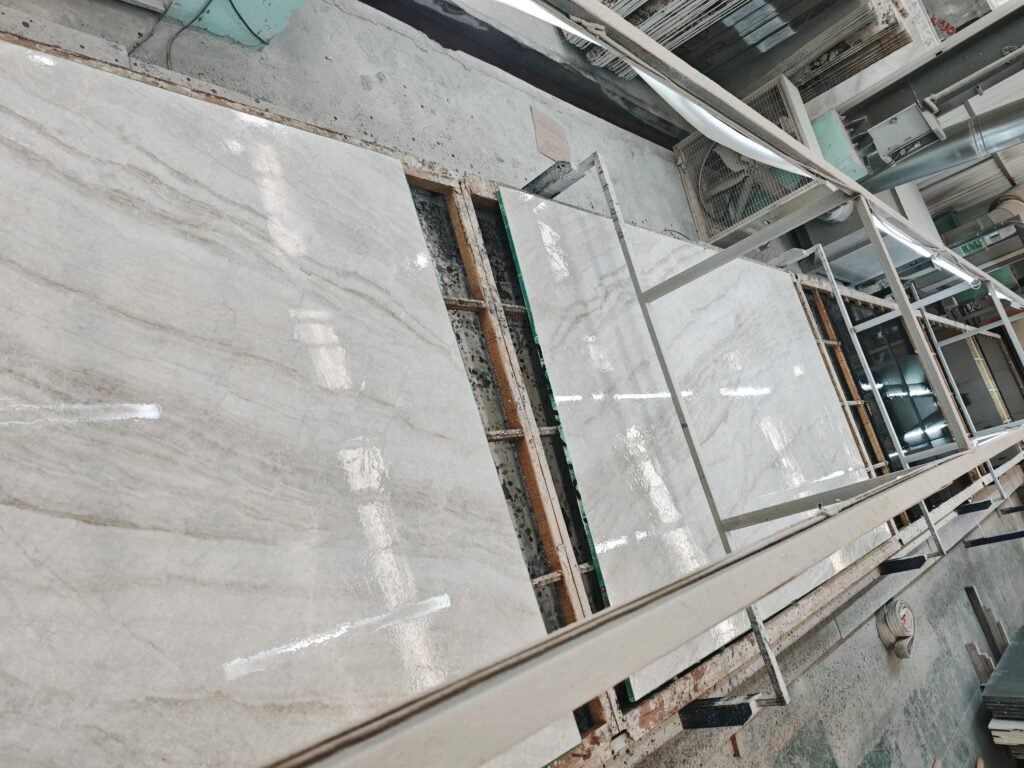
Bookmatching begins in the slab yard. The fabrication strategy determines whether the final installation reads as a seamless composition or an expensive missed opportunity.
Slab selection and cutting strategy
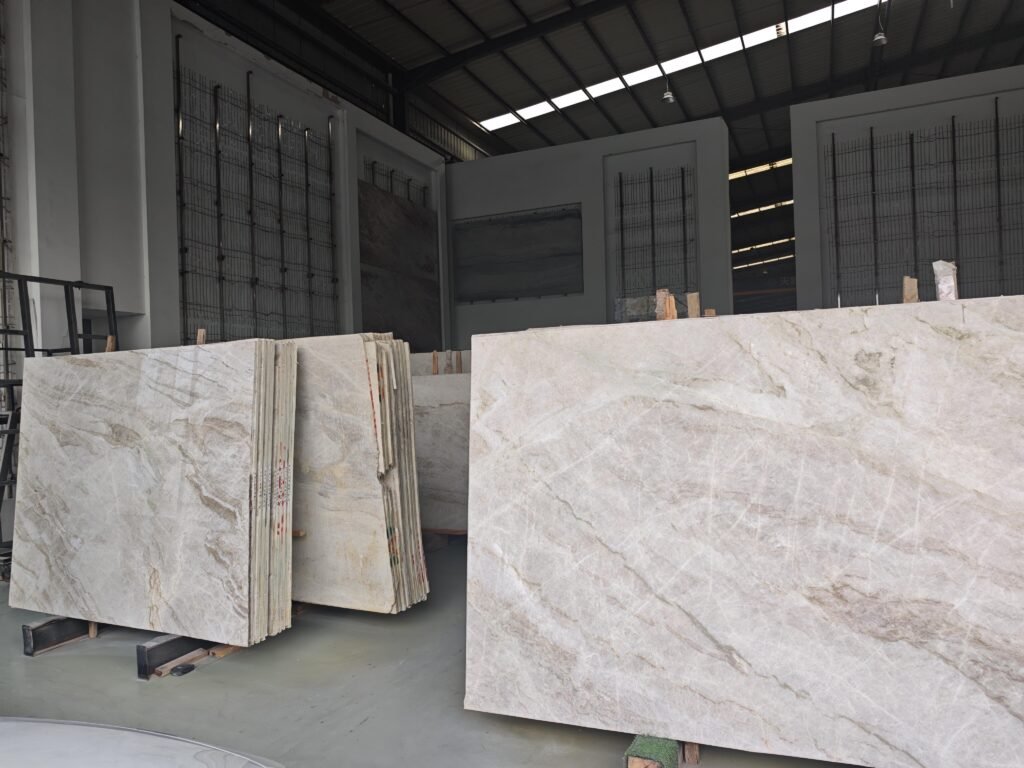
Select paired slabs from the same block and record slab orientation. A fabricator will cut both slabs in tandem and polish/hone opposing faces so the opened edges mirror each other. Slab size and vein orientation determine whether you can achieve a single-seam bookmatch or require more complex sequencing.
Honed finish specifics
A honed Taj Mahal shows muted contrast and is less reflective—excellent for hiding fingerprints and softening visual contrast. Honing slightly reduces surface hardness perception but does not materially change quartzite’s structural strength.
Tolerances, seams, and edge profiling
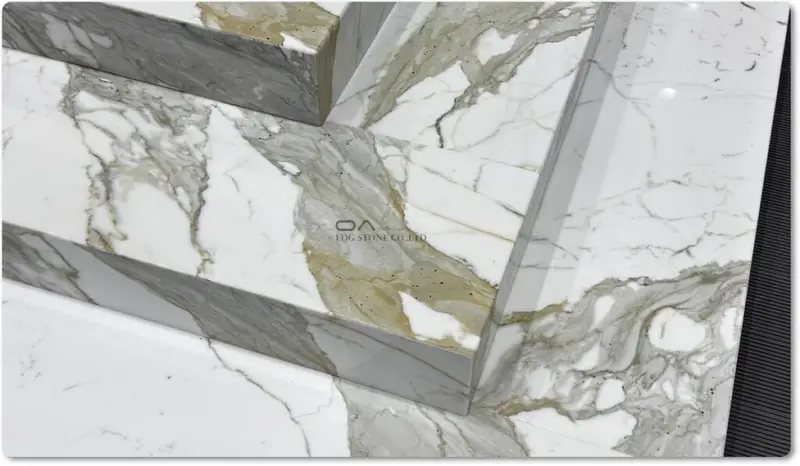
Precision in seam flatness and edge profiling is critical for waterfall islands. Expect micro-tolerances (fractions of a millimeter) and the use of epoxy and color-matched fillers to render seams visually unobtrusive. For bookmatched islands, mitered waterfall edges can produce near-invisible joints when done by experienced fabricators.
6. Sourcing, Pricing & Purchase Intent Keywords (manufacturer/factory/wholesale)
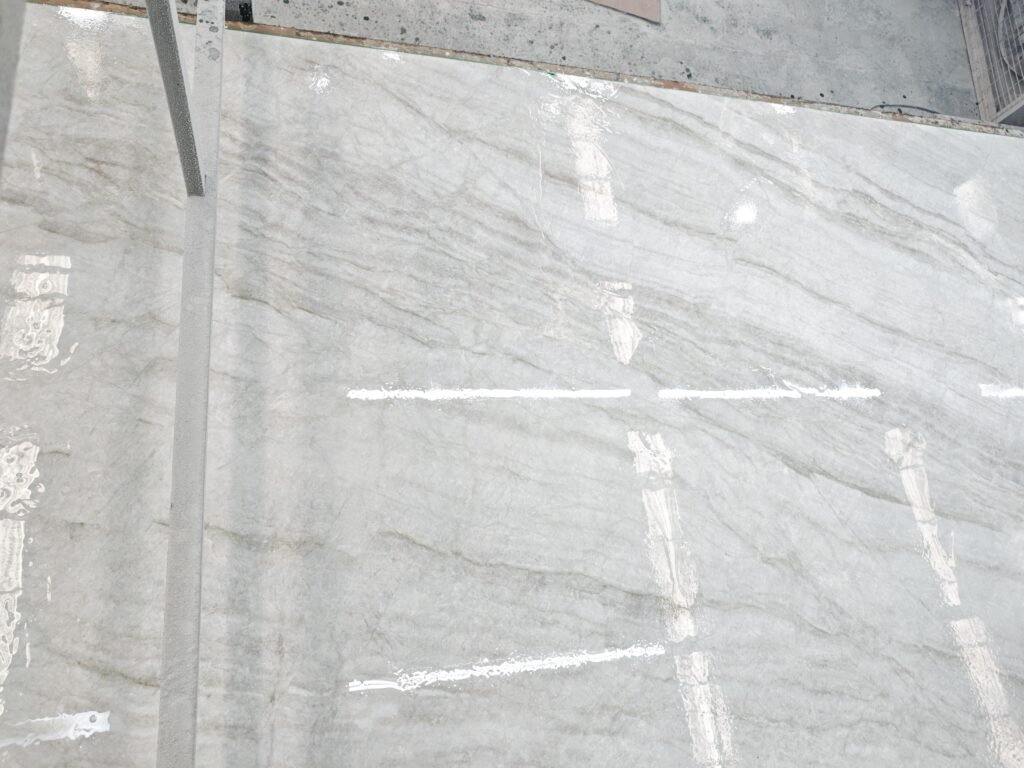
Sourcing through a trusted manufacturer or factory can reduce cost but increases logistical complexity. Wholesale slab purchases require careful slab inspection, photos from both sides, and exact slab measurements.
Typical price ranges and how bookmatching affects cost
Prices for Taj Mahal quartzite vary by slab size, thickness, finish, and market region. Sample market indicators show per-slab retail listings in the mid-thousands (e.g., several thousand USD per slab) and installed per-square-foot figures commonly falling into a $60–$100 per sq ft installed range for premium Taj Mahal quartzite in many U.S. markets; raw slab prices can also appear as per-slab listings in supplier catalogs. Bookmatching raises material waste and fabrication complexity; expect a premium above standard layout costs (commonly a measurable increase that can land in a mid-double-digit percent range depending on yield and labor — frequently estimated in practice at roughly 10–30% extra, though project specifics vary).
Buying routes: local fabricator vs direct manufacturer/factory/wholesale
Local fabricator: less logistical risk, immediate inspection, and easier warranty/installation coordination.
Manufacturer/Factory/Wholesale: potential cost savings on slab unit price, but requires careful QC, shipping, and possible customs/import handling. For high-value bookmatch projects, many buyers combine both: purchase slabs through wholesale channels and contract local fabricators for templating and installation.
Long-tail purchase-intent phrases to target
“Buy Taj Mahal quartzite slab wholesale factory”
“bookmatched Taj Mahal quartzite kitchen island supplier”
“Taj Mahal quartzite honed finish manufacturer price per slab”
7. Compliance, Health & Sustainability: Regulations shaping the countertop industry
Regulatory and sustainability trends are changing how fabricators, manufacturers, and buyers source, handle, and market stone.
Worker safety & crystalline silica rules
Cutting, grinding, and polishing stone generate respirable crystalline silica. U.S. OSHA standards set the permissible exposure limit (PEL) for respirable crystalline silica at 50 micrograms per cubic meter (µg/m³) as an 8-hour TWA, and construction industry standards provide alternative control methods and Table 1 engineering controls for common tasks. NIOSH recommends a similar threshold (REL ≈ 0.05 mg/m³). Compliance requires engineering controls (wet cutting, local exhaust ventilation), exposure monitoring, and respiratory protection programs—factors that increase fabrication overhead and influence supplier choice.
Sustainability trends: EPDs & transparency
Natural Stone Institute and other industry bodies now publish Environmental Product Declarations (EPDs) and product transparency frameworks that allow specifiers to compare embodied carbon and life-cycle impacts. Buyers increasingly demand EPDs, chain-of-custody documentation, and third-party verification—especially for commercial projects chasing green building credits. These requirements can lengthen approval cycles and increase supplier vetting, but they also create differentiation for manufacturers who can demonstrate low lifecycle impacts.
How does compliance affect cost & lead time?
Fabricators who implement full silica control programs, provide EPDs, and certify sustainability credentials often carry higher overhead. For complex bookmatched projects, allow additional lead time (inspection of slabs, production sequencing, documentation) and budget for compliance-driven costs.
8. Installation, Care & Long-term Performance
Best installation practices
Confirm slab orientation and bookmatch sequence on site before templating.
Use experienced installers for mitered waterfall edges and vertical runs to ensure seamless continuity.
Pre-dry fit pieces and photograph the layout for client sign-off.
Daily care for the honed Taj Mahal quartzite
Honed quartzite is durable but can show oil and darker patina more readily than polished finishes. Use pH-neutral cleaners, wipe spills quickly, and apply a suitable penetrating sealer per manufacturer recommendations (many fabricators recommend annual or biennial re-sealing depending on use).
Repair options
Small chips and seam separations can often be repaired with color-matched epoxy or resin; honed surfaces can be re-honed and sealed on site if necessary. Reserve large restorative work for specialist stone restoration professionals.
9. Creative Case Studies & Visual Inspiration
Residential kitchen island (case study)
A modern farmhouse kitchen used two bookmatched Taj Mahal slabs to create a centered, mirrored island with a mitered waterfall. The designer placed the seam behind the island’s informal seating, aligning a central vein with a pendant fixture—turning a countertop into a focal sculpture.
Hospitality bar & backsplash
A boutique hotel lobby used vertical bookmatching across a 14-foot feature wall behind a marble bar. Lighting was calibrated to highlight veining depth while minimizing glare on the honed finish.
Photography & documentation tips
Suppliers should photograph both slab faces, edge profiles, and matched sequences in high resolution; include color references and overhead shots to help designers visualize vein flow and to satisfy remote purchase decisions.
10. Cost Breakdown & Buyer Checklist
Typical budget lines (quick)
Material (slabs) — slab count, thickness, shipping.
Bookmatching premium — extra slab yield + fabrication.
Fabrication — cutouts, edge profiles, mitering.
Installation — removal of old counters, templating, labor.
Sealing & aftercare — initial sealant and routine maintenance.
Quick checklist for ordering bookmatched Taj Mahal slabs
Request both-face slab photos and measure slab lengths/veins.
Confirm honed vs polished finish and test a physical sample if possible.
Ask for EPD / sustainability documentation if the project requires it.
Confirm silica exposure controls and safety certifications for the fabricator.
Sign off on the exact bookmatch sequence before fabrication begins.
11. Long-tail keyword bank & content clusters to target
Buy Taj Mahal quartzite slab wholesale factory,
bookmatched Taj Mahal quartzite kitchen island supplier,
Taj Mahal quartzite slab manufacturer price per slab,
Taj Mahal Quartzite Honed finish supplier,
Taj Mahal quartzite bookmatch installation guide,
12. Semantic Closure: How / Why / What / Options / Considerations
Why: Bookmatched Taj Mahal transforms functional surfaces into curated art—high ROI in prestige projects and hospitality, where visual impact drives perceived value.
What: Expect higher material and fabrication costs, additional lead time for slab inspection and sequencing, and a need for compliant, professional fabricators due to silica control requirements.
Options: Choose honed for understated luxury and fingerprint resistance or polished for maximum contrast. Consider engineered alternatives (porcelain/quartz) if availability, price, or consistency is a priority.
Considerations: Verify EPDs & sustainability claims, confirm fabricator silica controls (wet cutting/HEPA extraction), and request detailed slab imagery and a signed bookmatch layout before fabrication. This makes your investment both beautiful and defensible.