Quick Summary:
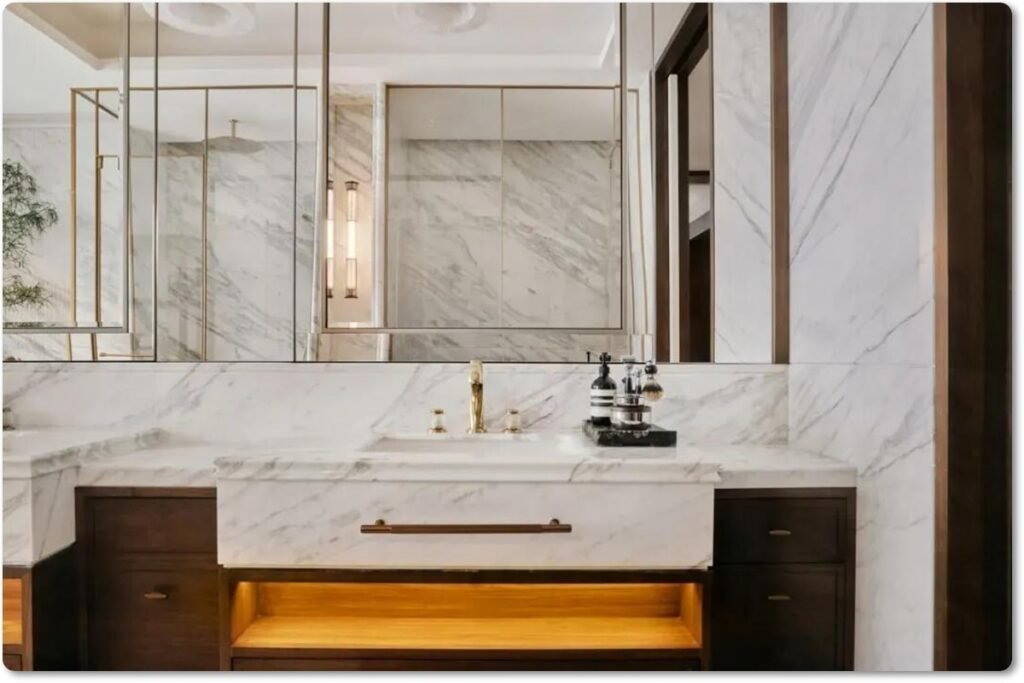
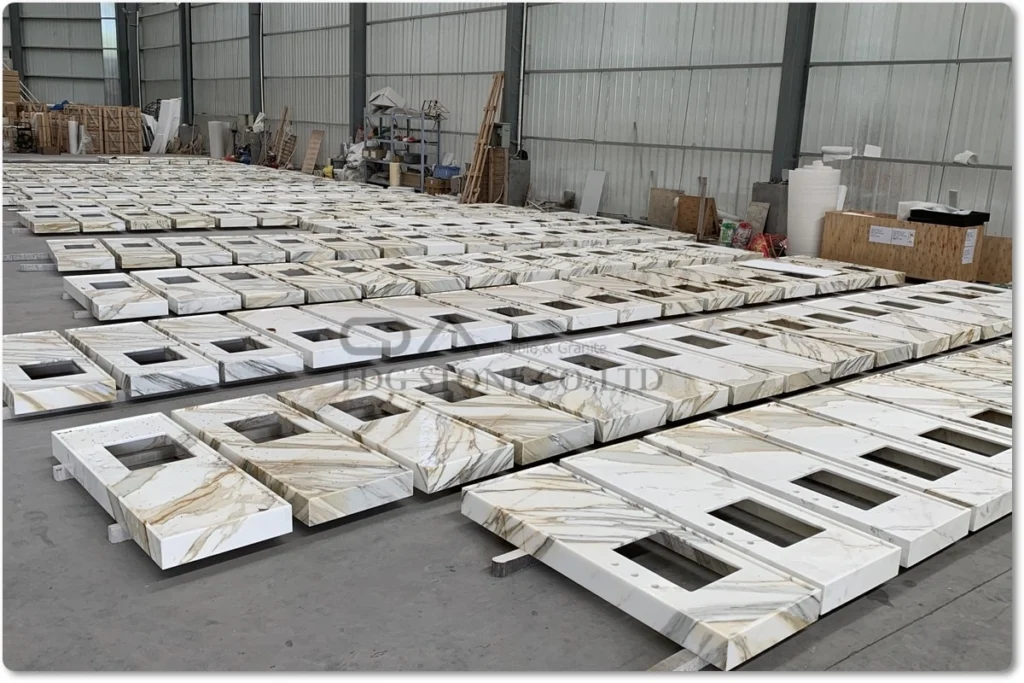
Natural stone furniture combines the visual character of marble, granite, travertine, quartzite, and other stones with furniture structures designed for specific residential applications. Coffee tables, dining tables, side tables, consoles, bedroom furniture, and bathroom vanities require different approaches to stone selection, dimensions, structural support, edge finishing, installation, and maintenance. Buyers should evaluate the complete furniture assembly rather than stone appearance alone. For custom projects, EDG Stone can discuss stone components, dimensions, surface finishes, edge profiles, and fabrication requirements against project drawings, subject to technical review and production feasibility.
1. Executive Summary: Where Natural Stone Furniture Works Best?
Natural stone furniture has become an important design option for contemporary residential interiors because it introduces natural pattern variation, tactile surfaces, substantial visual presence, and opportunities for customization. Unlike mass-produced furniture made entirely from wood, metal, glass, or composite materials, stone furniture can be designed around individual slabs, distinctive veining, sculptural forms, and combinations of stone with other materials.
However, selecting natural stone furniture is not simply a matter of choosing a beautiful slab. Successful projects must account for weight, stability, structural support, transportation, floor loading, maintenance, and the practical requirements of each room.
The most suitable applications depend on the interaction between the material, the furniture design, and the intended use.
| Interior application | Typical stone furniture | Main purchasing consideration |
|---|---|---|
| Living room | Coffee tables, side tables, nesting tables | Stability, impact exposure, weight, and proportion |
| Dining room | Dining tables, dining table tops | Support design, span, edge safety, and seating clearance |
| Entrance and hallway | Console tables, entryway tables | Depth, circulation space, anchoring where needed |
| Bedroom | Bedside tables, dressing tables, vanities | Drawer hardware, stability, and coordinated finishes |
| Bathroom | Vanity tops, integrated-look basins, cabinet tops | Moisture exposure, cutouts, drainage, and installation |
| Open-plan interiors | Coordinated tables, consoles, and vanity components | Batch consistency, slab selection, and finish coordination |
This guide is designed for both individual purchases and commercial sourcing projects. It explains how to assess stone furniture, how to prepare a practical procurement specification, and how to evaluate manufacturers before placing an order.
For B2B buyers, the most efficient approach is to define the intended application first, confirm technical requirements second, and select the stone and finish only after these requirements are understood.
Procurement conclusion: The best stone furniture is not necessarily the heaviest, thickest, or most expensive option. It is the furniture whose stone, support system, dimensions, finish, and installation method are appropriate for its intended environment.
2. Scope and Definitions: Understanding Natural Stone Furniture
2.1 What is natural stone furniture?
Natural stone furniture refers to furniture that incorporates quarried and processed natural stone as a tabletop, panel, structural component, decorative element, or major visible surface.
Common product categories include:
Marble coffee tables and dining tables.
Granite side tables and occasional tables.
Travertine consoles and sculptural furniture.
Quartzite dining tables and custom tabletops.
Natural stone vanity tops and dressing tables.
Stone-and-wood furniture.
Stone-and-metal furniture.
Custom stone furniture for residential and hospitality interiors.
A product may be described as stone furniture even when its entire structure is not made from stone. For example, a marble tabletop mounted on a steel base remains a stone furniture product, but its engineering requirements differ from those of a pedestal table made predominantly from stone.
2.2 Natural stone versus engineered and manufactured surfaces
Buyers should distinguish natural stone from engineered quartz, porcelain or sintered surfaces, and other manufactured materials.
Natural stone is quarried from geological formations. Its color, mineral composition, veining, pore structure, and other characteristics can vary between blocks and slabs.
Engineered quartz is a manufactured composite material. Its composition and performance characteristics depend on the specific product formulation and manufacturer.
Porcelain and sintered surfaces are manufactured materials produced through industrial processes. Their fabrication methods, edge details, thickness options, and support requirements can differ from those of natural stone.
Stone-look laminates and decorative panels may reproduce the appearance of stone without containing a substantial natural stone component.
These categories should not be treated as interchangeable. Their care requirements, structural limitations, repair methods, and technical documentation differ.
2.3 What does “stone furniture store” mean in a B2B purchasing context?
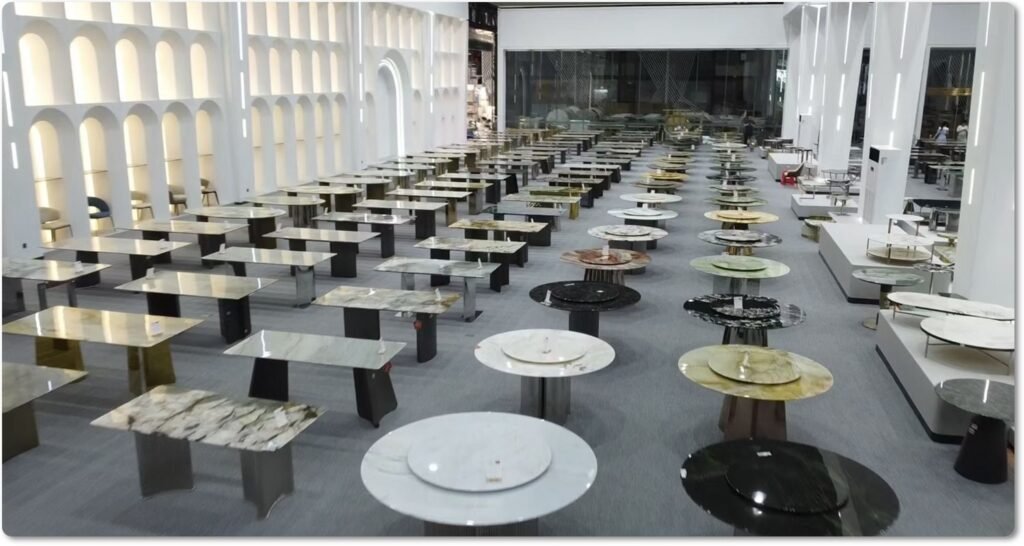
The keyword stone furniture store can describe a retail showroom, online furniture retailer, specialist supplier, or manufacturer-direct purchasing channel.
For a commercial buyer, the more important distinction is the supplier’s role:
A retailer primarily sells finished products to end customers.
A wholesaler supplies products to resellers or business buyers.
A distributor manages product availability and distribution within a market.
A manufacturer produces furniture or its components.
A stone fabrication factory cuts, shapes, finishes, and processes stone components.
An OEM supplier manufactures products to another company’s approved specifications.
An ODM supplier offers product designs or development capabilities that can be adapted for a buyer.
Some companies perform several of these functions. Buyers should confirm which operations are performed in-house and which are outsourced.
For custom stone furniture, the ability to interpret drawings, coordinate stone selection, fabricate components, document tolerances, and support packaging is often more important than whether the supplier operates a traditional retail store.
2.4 Scope limitations
This guide covers interior residential furniture and related B2B procurement. It does not establish a universal structural design, a guaranteed load capacity, or a fixed set of dimensions for every product.
Assess structural calculations, building requirements, furniture safety requirements, and installation details for the specific design, destination market, and intended use.
3. Technical Evaluation: Choosing Stone Furniture for Each Room
3.1 Living rooms: Coffee tables, side tables, and nesting tables
The living room is one of the most versatile applications for natural stone furniture.
Coffee tables
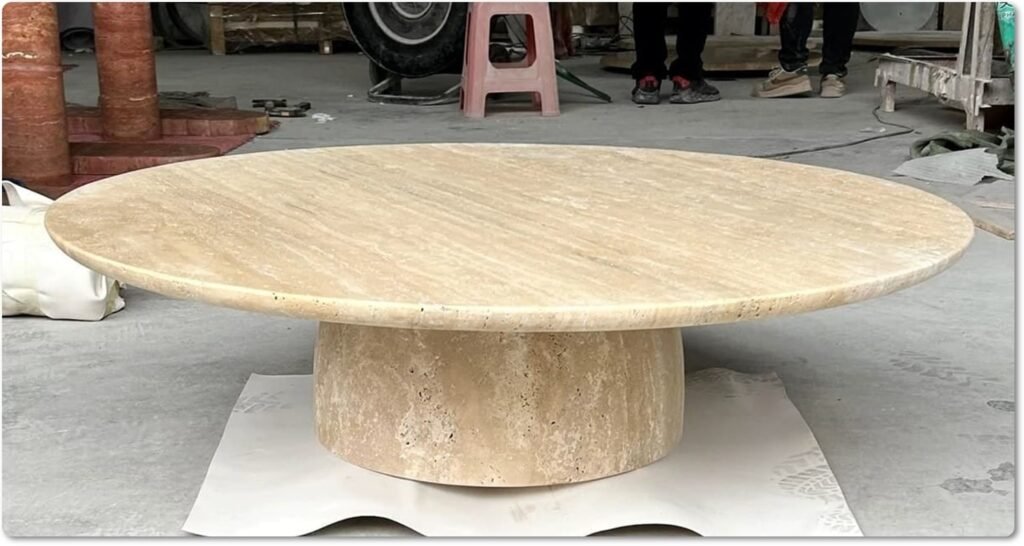
A stone coffee table can function as a central design element, combining a natural surface with a sculptural base or minimalist support structure.
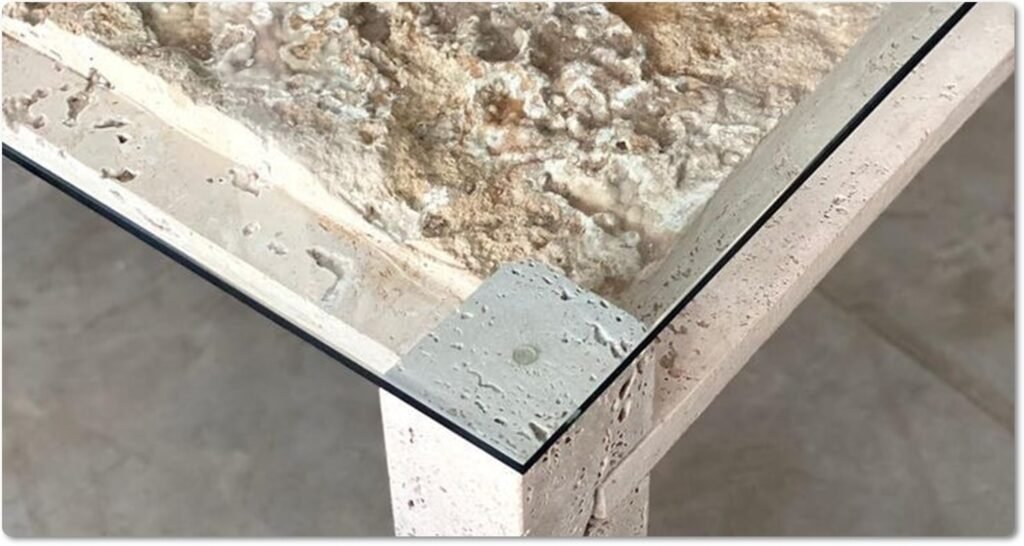
Marble is frequently selected for its distinctive veining and broad range of visual styles. Travertine can provide a softer, more textured appearance, while granite and certain quartzites may be appropriate where the project requires a different combination of appearance and physical properties.
The material should be selected according to the intended use rather than color alone.
Consider the following:
Will the table be used primarily for decorative objects or daily family activities?
Will drinks, food, or cosmetics regularly contact the surface?
Is the design supported by a central pedestal, multiple legs, or a full stone base?
Are the top and base compatible in weight, dimensions, and stability?
Can the finished table pass through the entrance, elevator, and internal doorways?
Side tables and nesting tables
Smaller tables offer more flexibility for compact apartments, reading corners, and hospitality-style interiors.
Nesting tables may use different tabletop heights and diameters to provide adaptable arrangements. Their design should allow adequate clearance between pieces without creating unstable or easily displaced components.
For small furniture, the base footprint can be as important as the tabletop size. A narrow pedestal supporting a broad stone top may require more careful stability evaluation than a design with a wider support footprint.
Recommended purchasing approach
Request a drawing showing the tabletop dimensions, base dimensions, finished height, estimated weight, material thickness, and connection details. If the table is intended for daily use, also request the proposed cleaning instructions and the supplier’s method of protecting vulnerable edges.
3.2 Dining rooms: Natural stone dining tables
A natural stone dining table combines a large visible surface with structural and ergonomic requirements.
Unlike a small decorative table, a dining table must accommodate people sitting, moving, and interacting around its perimeter. It must also support the stone top without excessive deflection, instability, or stress concentration.
Material and surface considerations
Polished marble can emphasize veining and create a reflective appearance. Honed marble provides a less reflective surface. Travertine may feature natural pores or filled areas depending on the material and finish specification.
The correct choice depends on the desired appearance, maintenance expectations, and approved sample.
Natural stone is not uniformly resistant to acids, staining, scratching, or impact. Calcareous stones, including many marbles and limestones, are particularly vulnerable to etching from acidic substances. A protective treatment may reduce certain risks but does not make every stone surface stain-proof or etch-proof.
Dining table dimensions
There is no single universal dimension that suits every dining table. As an initial planning reference, many residential projects consider the following approximate ranges:
| Design parameter | Preliminary planning range |
|---|---|
| Dining table height | Approximately 740–760 mm |
| Compact two-person tabletop length | Approximately 700–1,000 mm, depending on shape |
| Four-person rectangular table length | Approximately 1,200–1,500 mm |
| Six-person rectangular table length | Approximately 1,600–2,000 mm |
| Eight-person rectangular table length | Approximately 2,000–2,400 mm |
These are planning examples, not mandatory standards. Chair dimensions, table shape, leg position, place settings, and local design conventions can change the final specification.
For circulation, designers commonly aim to allow roughly 900 mm behind occupied chairs where the layout permits. A larger clearance may be necessary where people need to walk behind seated occupants. Tight residential layouts may require a different arrangement, but clearance should be checked on the actual floor plan rather than assumed.
Structural support
A heavy stone tabletop must be supported according to its dimensions, thickness, geometry, material characteristics, and connection method.
The designer and fabricator should assess:
The span between support points.
The position and size of the base.
The risk of tipping under foreseeable use.
The potential for stress around cutouts or narrow sections.
The load path from the tabletop to the floor.
The suitability of adhesives, mechanical fixings, and support materials.
The method for handling, moving, and installing the finished product.
Do not assume that increasing stone thickness automatically produces a safe design. Excess weight may increase transport risks and floor-loading demands without correcting a poorly designed support system.
3.3 Entrance halls: Console tables and entryway furniture
Console tables are useful in entrance halls, corridors, living rooms, and transitional spaces.
A natural stone console can combine a thin visual profile with a distinctive stone surface. However, consoles placed in circulation areas need particular attention to depth, projection, stability, and edge geometry.
Selecting a console for a hallway
A shallow console may be preferable in a narrow entrance. A deeper model may offer more usable surface area but can reduce the available passage.
Before ordering, measure:
The finished wall-to-wall width of the circulation area.
The console’s maximum projection from the wall.
The required passage width after installation.
The position of doors, switches, sockets, and skirting boards.
The space required for installation and future maintenance.
A console with a stone top and metal frame may be easier to move than a predominantly stone design, but the final weight and support system must be confirmed.
Wall-supported and freestanding designs
Wall-supported consoles can reduce floor obstruction, but they require suitable wall construction, anchoring, and load assessment. A stone top should not be installed using unspecified fixings simply because the top appears relatively thin.
Freestanding consoles require adequate resistance to tipping and lateral movement. Where a design is tall, narrow, or placed in a household with children, a suitable stability assessment is especially important.
3.4 Bedrooms: Bedside tables, dressing tables, and vanity furniture
Stone furniture can be introduced into bedrooms through bedside tables, dressing tables, drawer units, and decorative surfaces.
For these products, the stone component is only one part of the purchasing decision. Buyers should also assess the quality of the underlying furniture construction.
Important factors include:
Drawer slide specifications and expected use.
Door and drawer alignment.
Moisture protection for wood-based components.
Fixing details between the stone and cabinet.
The accessibility of maintenance points.
The overall center of gravity and stability.
Whether the design requires wall anchoring.
Dressing tables and stone vanity tops
A dressing table may use a stone top above a timber or metal cabinet. A vanity top may also require a mirror, basin, faucet openings, or cable-management details.
These features should be coordinated before fabrication. Cutouts reduce the continuous cross-section of the stone and can introduce stress concentrations, especially near narrow edges or unsupported corners.
The supplier should review the approved drawing and confirm whether the proposed cutouts, thickness, edge profiles, and support arrangement are technically feasible.
For coordinated bedroom projects, consider selecting bedside tables, dressing tables, and other stone surfaces from a controlled material batch where practical. Exact visual matching cannot be guaranteed for natural stone, but careful slab selection and documented approval can reduce unwanted variation.
3.5 Bathrooms: Stone vanity tops and bathroom furniture
Bathroom furniture requires a more detailed evaluation of moisture exposure, plumbing, cleaning chemicals, and installation tolerances.
A stone vanity top may be used with an undermount basin, vessel basin, integrated-look design, or custom cabinet. Each configuration introduces different fabrication and installation requirements.
Material selection
Marble, granite, quartzite, and travertine can all appear in bathroom design, but they are not equally suitable for every maintenance routine or exposure condition.
Buyers should consider:
Water absorption and the supplier’s relevant test data.
Susceptibility to acids and common bathroom products.
Surface texture and ease of cleaning.
The proposed protective treatment, if any.
Compatibility with the basin, faucet, adhesive, and sealant.
The risk of moisture reaching wood-based cabinet components.
ASTM C97/C97M provides test methods for water absorption and bulk specific gravity of dimension stone. The test can help compare materials, but it does not independently establish the suitability of a complete vanity assembly.
Fabrication and installation details
The approved drawing should show basin cutouts, faucet holes, backsplash dimensions, wall conditions, support points, and any required drainage or plumbing clearances.
Cutouts should be reviewed for edge distance, corner geometry, fabrication method, and the need for additional support. The installation team should verify that the cabinet or support frame is level and can carry the intended loads.
Where a vanity includes a cabinet, drawers, or composite wood panels, the buyer should also identify applicable product and emissions requirements in the destination market.
In the United States, the EPA’s TSCA Title VI formaldehyde requirements may apply to regulated composite wood products used in finished goods. Applicability depends on the materials and product configuration; a natural stone top alone does not determine compliance.
3.6 Choosing the right stone: A material evaluation matrix
No single material is best for every furniture application. Use the following matrix as a preliminary selection tool.
| Material | Common design appeal | Important considerations | Typical applications |
|---|---|---|---|
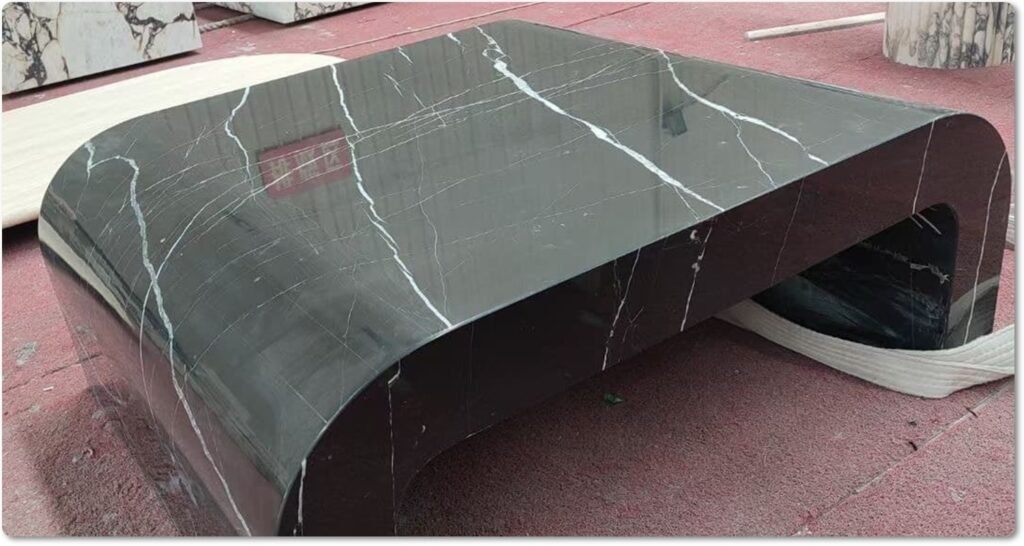
| Marble | Distinctive veining, classic and contemporary aesthetics | Many varieties are acid-sensitive and can etch | Coffee tables, dining tops, consoles, vanities |
| Granite | Broad range of colors and mineral patterns | Performance varies by variety; confirm finish and test data | Dining tables, side tables, vanity tops |
| Quartzite | Often selected for natural patterning and visual depth | Verify actual material identity and technical data; properties vary | Dining tables, consoles, selected vanity applications |
| Travertine | Textural, earthy, architectural appearance | Pores, fillers, finish, and maintenance require specification | Coffee tables, consoles, decorative furniture |
| Limestone | Subtle, natural, often muted appearance | Many varieties are relatively soft or acid-sensitive | Decorative tables and selected low-exposure applications |
| Onyx | Dramatic patterns and potential translucency | Often requires careful support, handling, and exposure control | Feature tables and decorative pieces |
Material names alone are insufficient evidence of performance. Request relevant technical data for the actual stone variety, rather than relying exclusively on a generic product description.
3.7 Technical standards, quality control, and regulatory considerations
Professional procurement should distinguish material test standards, finished-product safety requirements, and legally applicable regulations.
ASTM C97/C97M — Absorption and Bulk Specific Gravity of Dimension Stone
This standard establishes test methods for evaluating water absorption and bulk specific gravity. These results are useful for material comparison but do not replace structural design or finished-furniture testing.
Natural Stone Institute — Dimension Stone Design Manual
The Institute’s Dimension Stone Design Manual 2024 includes guidance on stone properties, design, installation, furniture applications, maintenance, and related industry practices. It is a useful technical reference for designers and fabricators.
U.S. furniture stability requirements
For products sold in the United States, the applicable safety requirements depend on the furniture category. The CPSC’s clothing storage unit rule under 16 CFR Part 1261 applies to qualifying clothing storage units manufactured after September 1, 2023. It should not be incorrectly described as a universal rule covering every coffee table, console, or vanity.
Composite wood and formaldehyde
Where a finished product contains regulated composite wood components, TSCA Title VI requirements may be relevant to U.S. imports and sales. Buyers should obtain appropriate documentation from the responsible suppliers.
European product sustainability developments
The EU Ecodesign for Sustainable Products Regulation (ESPR), Regulation (EU) 2024/1781, establishes a framework for future product-specific ecodesign requirements and digital product passports where applicable. It should not be interpreted as automatically imposing an identical digital product passport requirement on every stone furniture item today. Buyers importing into the EU should verify current implementing measures and the specific product scope before finalizing compliance specifications.
The practical lesson is straightforward: specify the intended market, product category, materials, and evidence required before production begins.
3.8 Dimensions, weight, flooring, and installation
Stone furniture requires coordinated planning because the finished item may be considerably heavier than furniture made from conventional lightweight materials.
Estimate the stone component weight
For preliminary planning, the approximate weight of a rectangular stone slab can be estimated using:
[
\text{Weight (kg)} =
L \times W \times T \times \rho
]
Where:
(L) = length in metres.
(W) = width in metres.
(T) = thickness in metres.
(\rho) = density in kg/m³ for the specified stone.
Example: A stone tabletop measuring 1.8 m × 0.9 m × 0.03 m, using an assumed density of 2,700 kg/m³, has an estimated stone-only weight of:
[
1.8 \times 0.9 \times 0.03 \times 2700
= 131.22\text{ kg}
]
This is an illustrative calculation, not a measurement of a particular product. Actual density depends on the material, and the finished table’s total weight also includes its base, fixings, and other components.
Protecting floors
Before installation, assess the floor type, concentrated loads at feet or pedestals, protective pads, and the route used to move the furniture.
Potential concerns include:
Scratching or indentation of timber flooring.
Damage to delicate stone or tile finishes.
Concentrated loads on small feet.
Uneven floors that create rocking or localized stress.
Damage caused by dragging a heavy item across the floor.
Use suitable non-marking protective pads where appropriate. For large or unusually heavy installations, have the relevant project professional assess floor capacity and load distribution.
Transportation and access
A product that fits the room may still be impossible to install through the building’s access route.
Check the clear opening of doors, corridor widths, elevator dimensions and load limits, stair turns, ceiling clearances, and available lifting equipment. Where necessary, consider shipping the stone top and base separately and assembling them at the destination.
3.9 Cleaning and long-term maintenance
Maintenance instructions must be specific to the stone, finish, and protective treatment.
The Natural Stone Institute recommends neutral cleaners or mild cleaning solutions for routine stone care and warns that acidic products can damage acid-sensitive stones. Lemon juice, vinegar, and some bathroom or kitchen cleaners can etch calcareous surfaces.
A practical maintenance plan includes:
Wipe spills promptly.
Use a soft cloth and a stone-compatible, pH-neutral cleaner.
Avoid abrasive pads and unapproved chemicals.
Use coasters and heat-protective mats where appropriate.
Confirm whether the particular stone benefits from an impregnating sealer.
Follow the approved product’s reapplication instructions, if applicable.
Consult a stone-care professional for significant etching, chips, or deep scratches.
Sealing can improve stain resistance for some stones, but it does not make a surface completely stain-proof or prevent acid etching.
3.10 Coordinating stone furniture across an entire home
A coordinated furniture package may include a living room coffee table, dining tabletop, hallway console, bedroom bedside tables, and bathroom vanity surfaces.
A consistent material strategy can create visual continuity, but specifying the same stone name does not guarantee an identical appearance across all pieces.
For a multi-room project, establish a reference sample, identify the approved slabs, document finish and edge details, and agree on acceptable natural variation.
Where bookmatching, vein direction, or a continuous visual pattern is important, the fabricator should review slab availability and nesting plans before production.
Recommended approach: Treat the project as a coordinated collection rather than a series of unrelated furniture purchases.
4. Procurement Checklist: From Design Brief to Delivery
Use the following checklist before placing a purchase order.
Step 1: Define the project
Identify the room and intended use of each item.
Record the number of units and required delivery date.
Confirm whether the purchase is a single item, a coordinated home collection, or a commercial project.
Identify the destination country and applicable compliance requirements.
Confirm who is responsible for design approval, fabrication, delivery, and installation.
Step 2: Approve the stone
Confirm the material name and, where available, geological classification.
Review representative slab photographs or inspect the actual slabs.
Approve the color range, veining, and acceptable variation.
Specify the finish: polished, honed, brushed, or another agreed treatment.
Request relevant technical data and test reports.
Confirm any filling, reinforcement, resin treatment, or other material processing that affects the agreed specification.
Step 3: Review drawings and dimensions
Approve length, width, height, thickness, and overall tolerances.
Confirm edge profiles and corner details.
Review cutouts, holes, joints, and support locations.
Check the furniture against the room layout and circulation requirements.
Confirm the finished product’s estimated weight.
Review assembly and installation instructions.
Step 4: Verify structural and functional details
Confirm the support frame or base design.
Review the load path and connection method.
Check stability and tipping risks.
Verify drawer, door, and hardware specifications where relevant.
Confirm floor protection and handling arrangements.
Identify any additional testing required for the intended market.
Step 5: Confirm the commercial terms
Obtain an itemized quotation.
Confirm sample, drawing, tooling, packaging, and freight charges.
Record production lead time and approval milestones.
Agree on payment terms and the inspection process.
Confirm the packaging method and responsibility for transit damage.
Define how defects, shortages, and discrepancies will be documented and resolved.
Step 6: Approve production and delivery
Sign off on the final production drawings.
Approve material samples or selected slabs as agreed.
Confirm the pre-shipment inspection requirements.
Request photographs of finished products and packaging.
Verify shipping marks and item identification.
Confirm delivery access, unloading equipment, and installation responsibility.
5. Cost and Risk Factors: What Determines the Price of Stone Furniture?
The purchase price of natural stone furniture is influenced by more than the cost of the raw material.
5.1 Main cost components
Stone material: Variety, block availability, slab size, visual quality, color consistency, and selection requirements can affect material cost.
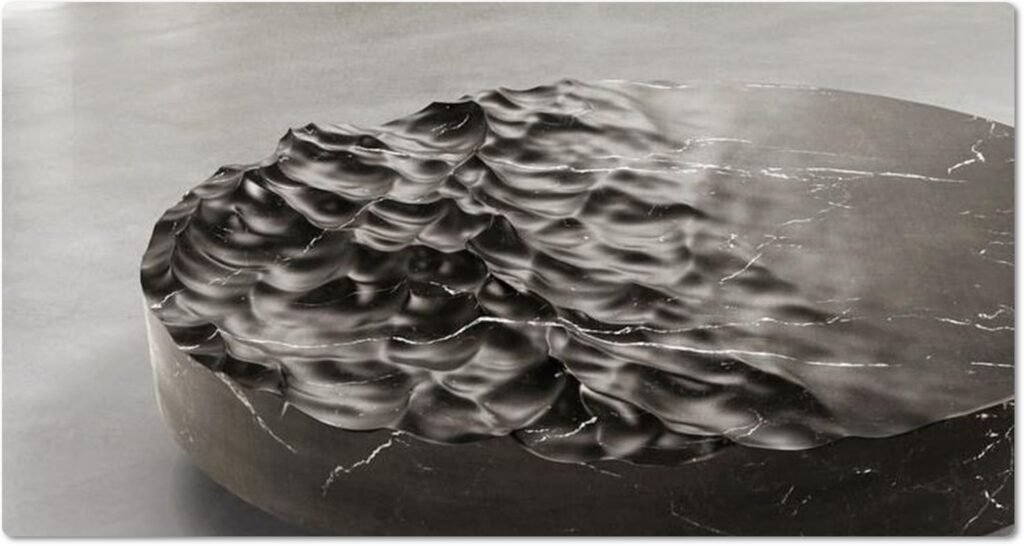
Fabrication: Cutting, edge profiling, polishing, drilling, sink or basin cutouts, complex geometry, and sculptural shaping require different levels of labor and equipment.
Structural components: Metal bases, timber cabinets, hardware, reinforcement, and custom connections contribute to the final price.
Design and engineering: Bespoke projects may require CAD drawings, design development, support calculations, mock-ups, or prototypes.
Quality control: Material selection, dimensional inspection, finish approval, and packaging checks add work but can reduce costly downstream errors.
Packaging and logistics: Crating, protective materials, shipment dimensions, handling, freight, insurance, customs charges, and final delivery all influence landed cost.
Installation: Large furniture may require specialist handling, lifting equipment, assembly, or coordination with other trades.
5.2 Hidden risks that can increase total project cost
| Risk | Potential consequence | Preventive measure |
|---|---|---|
| Incomplete drawings | Incorrect dimensions or missing cutouts | Approve detailed production drawings |
| Uncontrolled natural variation | Visual inconsistency between items | Approve actual slabs where practical |
| Insufficient structural support | Cracking, instability, or failure | Review support design and load paths |
| Inadequate packaging | Chips, cracks, or finish damage | Specify product-specific protection |
| Poor access planning | Failed delivery or extra handling costs | Measure the full access route |
| Unclear tolerances | Disputes over fit and appearance | Document measurable acceptance criteria |
| Incorrect cleaning products | Etching or surface deterioration | Supply stone-specific care instructions |
| Unverified compliance | Delays or market-access problems | Confirm destination-market requirements |
5.3 Single-item purchases versus coordinated projects
A single coffee table may require a relatively simple approval process. A coordinated furniture package for an entire home or hospitality development introduces additional considerations.
| Factor | Single furniture item | Multi-item or project order |
|---|---|---|
| Material selection | One item or slab may be sufficient | Batch planning and visual coordination may be necessary |
| Drawings | One approved product drawing | Multiple drawings and revision control |
| Quality control | Inspect the individual product | Define sampling and inspection across the order |
| Packaging | One protective package | Consistent packing specifications and shipment identification |
| Installation | One location | Site-by-site coordination may be required |
| Commercial planning | One delivery schedule | Production batches, phased delivery, and project deadlines |
For project orders, buyers should compare the total delivered cost rather than unit price alone. A lower quoted price may not represent better value if it excludes essential packaging, inspection, installation coordination, or compliance documentation.
6. Supplier Evaluation: How to Select a Stone Furniture Manufacturer
The right supplier depends on the complexity of the product and the buyer’s business model.
A retail customer may prioritize finished appearance, convenience, and after-sales support. A furniture brand may prioritize repeatability, design confidentiality, production consistency, and packaging suitable for its sales channels. An interior contractor may focus on drawing coordination, deadlines, tolerances, and site installation.
6.1 Evidence to request from a supplier
Ask prospective suppliers to provide relevant evidence in the following areas.
Material capability
Stone varieties and available finishes.
Material identification and traceability, where available.
Slab photographs and sample approval procedures.
Relevant material test reports.
Fabrication capability
Examples of comparable furniture components.
Available cutting, edge-processing, drilling, and shaping operations.
Ability to review CAD drawings and identify fabrication constraints.
Documented dimensional inspection procedures.
Structural coordination
Drawings showing the stone, base, and connections.
Clarification of who is responsible for engineering.
Relevant load, stability, or finished-product test evidence where required.
Installation and handling instructions.
Quality management
Written acceptance criteria.
Inspection records or sample inspection reports.
Procedures for identifying and resolving defects.
Revision control for drawings and material approvals.
Packaging and export
Packaging specifications suited to the product’s geometry and weight.
Photographs of comparable export packaging.
Shipping marks and item identification.
Confirmation of shipping terms and responsibility for damage claims.
Commercial reliability
Itemized quotations.
Production milestones and lead-time assumptions.
Clear communication about outsourced operations.
Written warranty, claims, and replacement terms.
6.2 Questions to ask before choosing a factory
Can the supplier fabricate the stone components to the approved drawings?
Can the supplier explain which work is completed in-house?
Can it provide material samples and a clear approval process?
Can it coordinate stone dimensions with the proposed furniture base or cabinet?
How are tolerances measured and recorded?
How are natural variations and visible defects classified?
What packaging method is proposed for the finished product?
Can the supplier support repeat orders using documented specifications?
6.3 Why manufacturer-direct sourcing may help
Working directly with a stone manufacturer or fabrication factory can simplify communication between material selection and processing, particularly when the product involves unusual dimensions, custom edge profiles, cutouts, or coordinated stone components.
However, manufacturer-direct purchasing does not automatically guarantee lower costs, better quality, or shorter lead times. These benefits depend on the supplier’s capabilities, production planning, material access, quality controls, and commercial terms.
Buyers should evaluate actual evidence and compare quotations on a like-for-like basis.
7. Practical RFQ Template: Custom Natural Stone Furniture
The following template can be copied into an email or procurement document.
7.1 Request for quotation
Subject: RFQ — Custom Natural Stone Furniture for Residential Interior Project
Dear Sales Team,
We are sourcing natural stone furniture for a residential interior project and would like to request a quotation based on the following requirements.
1. Project information
Project name:
Destination country and city:
Intended application:
Required delivery date:
Estimated order quantity:
One-time order or repeat production:
2. Product details
Product type: Coffee table / Dining table / Side table / Console / Dressing table / Vanity top / Other
Quantity per item:
Overall dimensions:
Stone component dimensions and thickness:
Edge profile:
Surface finish:
Cutouts, holes, joints, or special details:
Required assembly method:
3. Material requirements
Preferred stone variety:
Preferred color and veining:
Acceptable natural variation:
Sample or slab approval required:
Requested material test documentation:
Protective treatment, if required:
4. Structure and installation
Proposed base or support material:
Available structural drawings:
Required load or stability documentation:
Installation method:
Site access limitations:
Floor protection requirements:
5. Quality and packaging
Required dimensional tolerances:
Surface and edge acceptance criteria:
Inspection requirements:
Packaging and labeling requirements:
Required product photographs:
Destination-market compliance documentation:
6. Commercial information
Unit price:
Tooling, drawing, or sample charges:
Packaging cost:
Estimated production lead time:
Minimum order quantity, if applicable:
Payment terms:
Shipping terms and freight options:
Warranty and claims procedure:
Please identify any technical limitations or missing information before production. Kindly provide a quotation, preliminary production drawing requirements, relevant material information, and examples of comparable work where available.
Best regards,
[Name]
[Company]
[Email]
[Telephone]
7.2 Suggested pre-shipment acceptance checklist
| Inspection item | Acceptance evidence |
|---|---|
| Material | Approved stone identification and appearance reference |
| Dimensions | Recorded measurements against approved drawings |
| Thickness and edges | Agreed tolerances and profile inspection |
| Surface | Inspection under agreed lighting conditions |
| Cutouts and holes | Position and dimensions checked against drawings |
| Assembly | Connections and support components verified |
| Stability | Required checks or test records completed |
| Cleaning and care | Stone-specific maintenance instructions supplied |
| Packaging | Protective materials, crate condition, and shipping marks checked |
| Documentation | Final drawing revision, inspection record, and shipping documents available |
Acceptance criteria should be agreed before manufacturing. Natural stone variation should be evaluated against the approved sample or agreed reference, not an assumption that every item will be visually identical.
8. Frequently Asked Questions: Natural Stone Furniture
8.1 Is natural stone furniture suitable for modern homes?
Yes. Natural stone furniture can work in minimalist, contemporary, transitional, and other interior styles. Suitability depends on the stone’s appearance, the furniture’s proportions, the structural design, and the room’s practical requirements. Smaller tables and consoles can introduce stone into a space without requiring a large installation.
8.2 Which natural stone is best for coffee tables and dining tables?
There is no universal best stone. Marble is often selected for its veining, granite for its varied mineral patterns, quartzite for distinctive natural patterns, and travertine for its textured appearance. Buyers should compare the specific material’s technical data, finish, maintenance requirements, and structural suitability before making a selection.
8.3 How do I choose a reliable stone furniture manufacturer or factory?
Request comparable project examples, material information, fabrication drawings, inspection procedures, packaging specifications, and a clear quotation. Confirm whether the company manufactures the stone components itself or outsources some operations. For custom furniture, drawing review and documented acceptance criteria are particularly important.
8.4 Is natural stone furniture difficult to maintain?
Maintenance varies by stone type and finish. Routine care generally involves prompt spill removal, a soft cloth, and a suitable neutral cleaner. Many calcareous stones can be etched by acidic substances. Protective treatments may improve stain resistance for some materials but do not eliminate all maintenance risks.
8.5 Can I order custom natural stone furniture directly from a factory?
Yes, some manufacturers and stone fabrication factories accept custom orders based on drawings, dimensions, selected materials, and approved finishes. Availability of one-piece orders, prototypes, OEM production, and wholesale pricing varies by supplier. Before ordering, confirm minimum quantities, fabrication feasibility, packaging, lead time, and delivery responsibilities.
9. References: Standards, Technical Guidance, and Regulations
The following sources provide technical and regulatory context for specifying natural stone furniture. Verify the current edition and applicability before using any standard or regulation in a contract or compliance declaration.
Natural Stone Institute. Dimension Stone Design Manual 2024. Published January 8, 2025, in the Institute’s resource library. Includes technical information on dimension stone, furniture applications, design, installation, and maintenance.
https://pubs.naturalstoneinstitute.org/resources/library/Natural Stone Institute. Care & Cleaning of Natural Stone. Guidance on routine cleaning, acid sensitivity, stains, and protective treatments.
https://www.naturalstoneinstitute.org/consumers/care/ASTM International. ASTM C97/C97M-26, Standard Test Methods for Absorption and Bulk Specific Gravity of Dimension Stone. The active edition listed by ASTM as of September 22, 2026. Confirm the current edition at the time of specification.
https://store.astm.org/c0097_c0097m-26.htmlNatural Stone Institute. Technical Bulletins. Industry guidance includes dimension stone tolerances, anchorage, and related technical topics.
https://www.naturalstoneinstitute.org/designprofessionals/technical-bulletins/U.S. Consumer Product Safety Commission. Clothing Storage Units. Guidance on the U.S. requirements for qualifying clothing storage units under 16 CFR Part 1261.
https://www.cpsc.gov/Business–Manufacturing/Business-Education/Business-Guidance/Clothing-Storage-UnitsU.S. Environmental Protection Agency. Formaldehyde Emission Standards for Composite Wood Products. Information on TSCA Title VI requirements for regulated composite wood products and applicable finished goods.
https://www.epa.gov/formaldehyde/formaldehyde-emission-standards-composite-wood-productsEuropean Union. Regulation (EU) 2024/1781 establishing a framework for the setting of ecodesign requirements for sustainable products. Official Journal of the European Union, June 28, 2024. Product-specific obligations depend on applicable implementing measures and scope.
https://eur-lex.europa.eu/eli/reg/2024/1781/ojASTM International. ASTM F2057-23, Standard Safety Specification for Clothing Storage Units. Relevant where incorporated into applicable U.S. regulatory requirements for qualifying clothing storage units.
https://www.astm.org/
These references support material evaluation, maintenance planning, and selected product-compliance checks. They do not constitute a universal certification of any specific stone furniture design.
10. EDG Stone CTA: Custom Stone Furniture Components and Fabrication
From Natural Stone Selection to Project-Ready Components
A successful natural stone furniture project begins with a clear design brief and a realistic understanding of material, fabrication, structural, and installation requirements.
For interior designers, furniture brands, wholesalers, and project contractors, the challenge is often not simply finding a stone with the right appearance. It is translating a design concept into components that can be fabricated, inspected, packed, transported, and installed according to the project’s requirements.
EDG Stone is a Chinese stone products manufacturer and exporter offering natural stone products and custom fabrication services. For suitable projects, EDG Stone can discuss stone components, material selection, dimensions, surface finishes, edge profiles, and fabrication requirements based on customer drawings and project specifications.
Potential project discussions include:
Custom stone tabletops for coffee tables and dining tables.
Stone components for consoles and side tables.
Marble and other natural stone vanity tops.
Coordinated stone components for multi-room interiors.
Custom cut-to-size stone parts and edge processing.
CAD drawing review, subject to available information and project scope.
Export packaging requirements for stone components.
Project feasibility, structural responsibility, minimum quantities, production lead time, and packaging arrangements should be confirmed for each inquiry. Where a design includes a metal frame, timber cabinet, complex assembly, or load-bearing structure, the responsibilities of the stone fabricator, furniture manufacturer, designer, and installer should be clearly allocated.
Ready to Discuss Your Stone Furniture Project?
Prepare your product dimensions, preferred stone, finish requirements, reference images, and drawings if available.
Explore EDG Stone’s services:
Custom Stone Fabrication: https://edgstone.com/
Stone Countertops Manufacturer: https://edgstone.com/stone-countertops-manufacturer/
Project quotation: Contact EDG Stone through the inquiry form on the official website.
Whether you are sourcing one custom stone component or coordinating a larger interior project, a detailed specification helps the supplier assess feasibility, provide a more accurate quotation, and identify potential production issues before manufacturing begins.
Send EDG Stone your drawings, material preferences, quantities, and delivery destination to start a project discussion.
How to Specify Natural Stone Furniture for Modern Homes?
Natural stone furniture is best understood as a complete product system in which material selection, fabrication, structural support, room planning, maintenance, and logistics work together. The stone determines much of the visual character, but the finished product’s usability depends on the design and execution of the entire assembly.
What makes natural stone furniture suitable for a modern interior?
The strongest design approach matches the stone’s natural pattern, color, finish, and visual weight to the scale and purpose of the room. A sculptural travertine coffee table may suit a relaxed living space, while a carefully supported marble dining table may become the focal point of a formal dining room. A stone console can add a natural material accent to an entrance, and a custom stone vanity top can coordinate with bathroom cabinetry.
How should buyers compare natural stone furniture options?
Compare the intended use, material characteristics, dimensions, finish, structural design, cleaning requirements, and total delivered cost. Request actual material references and relevant test data rather than relying on generic statements such as “stain-proof,” “maintenance-free,” or “suitable for every application.” Confirm the complete furniture assembly’s stability and support requirements independently of the stone’s material properties.
Why does custom fabrication matter?
Standard furniture dimensions may not suit every room, slab pattern, plumbing layout, or project drawing. Custom fabrication can help align tabletop dimensions, edge profiles, cutouts, and visible stone patterns with a specific design. It also creates a need for disciplined drawing approval, tolerance control, material selection, and communication between the designer and fabricator.
Which sourcing option is appropriate: retail, wholesale, or manufacturer-direct?
Retail purchasing can be convenient for buyers who want a finished product with minimal design coordination. Wholesale and distributor channels may suit resellers that need established product ranges and repeat supply. Manufacturer-direct sourcing can be useful for custom dimensions, bespoke stone components, and project-specific fabrication. The correct channel depends on order volume, technical complexity, customization, service expectations, and total landed cost.
What should be considered before placing a project order?
Confirm the approved material, dimensions, finish, drawings, support design, tolerances, packaging, delivery route, and acceptance criteria. Identify destination-market regulations and allocate responsibility for structural engineering, installation, and finished-product compliance. For coordinated interiors, establish a consistent approval process across every item and record any acceptable natural variation.
What is the practical next step?
The most effective starting point is a concise RFQ containing the room application, product type, dimensions, material preference, finish, quantity, drawings, destination, and required delivery date. A qualified supplier can then assess the fabrication scope, request missing technical information, and prepare a quotation based on defined assumptions.
For projects involving natural stone furniture components, EDG Stone can discuss material selection, custom dimensions, surface finishes, and fabrication feasibility against the buyer’s drawings. Clear specifications and early technical coordination help designers, furniture brands, and contractors move from a visual concept toward a more predictable procurement process.