Quick Summary: What Is Green Marble Furniture?
Semantic Content Block: Green Marble Furniture at a Glance
Green Marble Furniture: What Buyers Need to Know
What: Green marble furniture includes coffee tables, side tables, dining tables, and other finished furniture made with natural green marble.
Why: Unlike commodity stone slabs, finished marble furniture converts natural stone into a higher-value architectural and interior product through design, fabrication, assembly, finishing, reinforcement, and packaging.
How: A typical project moves from marble selection → slab inspection → CAD design → cutting → edge processing → surface finishing → structural assembly → quality control → protective packaging → international shipping.
Options: Buyers can choose single-slab tops, bookmatched tops, pedestal bases, metal bases, stone bases, rounded edges, mitered edges, honed surfaces, polished surfaces, and custom dimensions.
Considerations: The most important procurement variables are stone quality, dimensions, thickness, structural support, weight, fabrication tolerances, edge protection, packaging design, shipping method, and destination-market compliance.
Green marble furniture sits at an interesting intersection between natural stone manufacturing and high-value finished furniture.
A green marble slab can be sold as a raw or semi-finished architectural material. The same stone can also become a finished green marble coffee table, green marble side table, or large green marble dining table. The difference is not simply the amount of fabrication. It is the design, engineering, finishing, quality control, packaging, and commercial value built into the final product.
This makes green marble furniture particularly relevant to interior designers, furniture brands, hospitality procurement teams, architects, developers, retailers, distributors, and private-label furniture companies.
According to the U.S. Geological Survey, dimension stone is selected not only for color and pattern but also for characteristics such as durability, strength, mineral composition, hardness, and ability to take a polish. USGS reported that approximately 2.2 million tons of dimension stone were sold or used by U.S. producers in 2024, valued at approximately $370 million.
The implication for furniture buyers is straightforward:
A beautiful marble slab is only the starting point. A successful marble furniture product requires the right stone, the right structure, and the right manufacturing process.
1. Why Is Green Marble Furniture Becoming a Higher-Value Stone Product?
Green marble has traditionally been associated with floors, wall cladding, countertops, vanity tops, and decorative architectural surfaces.
Furniture changes the commercial equation.
A finished table incorporates:
- Natural stone selection
- Slab inspection
- Pattern planning
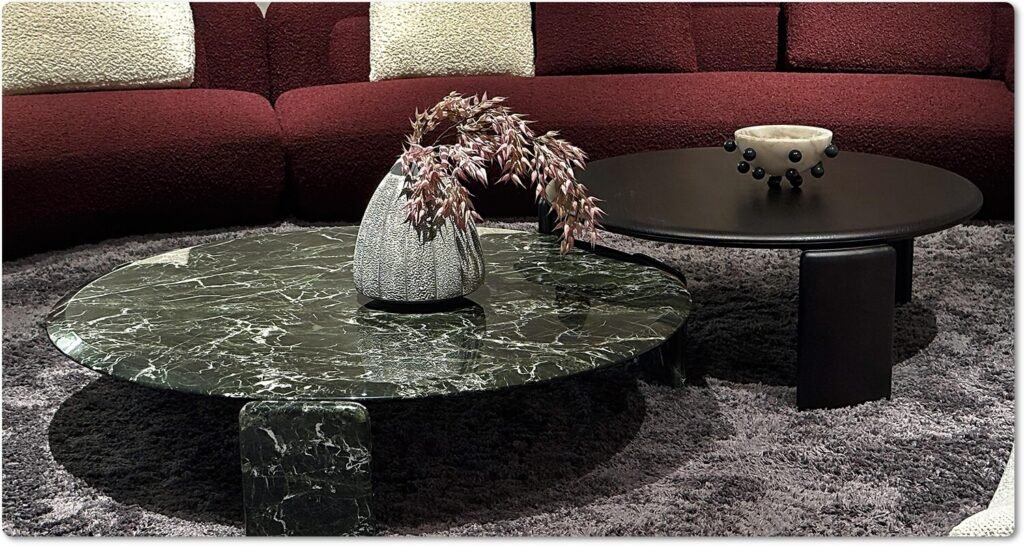
- CAD engineering
- Precision cutting
- Edge fabrication
- Surface finishing
- Base design
- Structural support
- Assembly
- Quality inspection
- Protective packaging
- Export logistics
The result is a product that can be sold according to design, craftsmanship, and finished-product specifications, rather than simply by square meter or square foot of stone.
This is particularly important for manufacturers serving international B2B buyers.
A furniture company may not need an entire container of green marble slabs. It may instead need:
- 20 coffee tables
- 50 side tables
- 10 dining tables
- 100 custom hospitality tables
- A complete furniture collection
- Private-label production
- Custom-designed stone furniture for a hotel or residential development
This creates a natural bridge between stone fabrication and contract furniture manufacturing.
2. Green Marble Coffee Table: Key Specifications Buyers Should Check
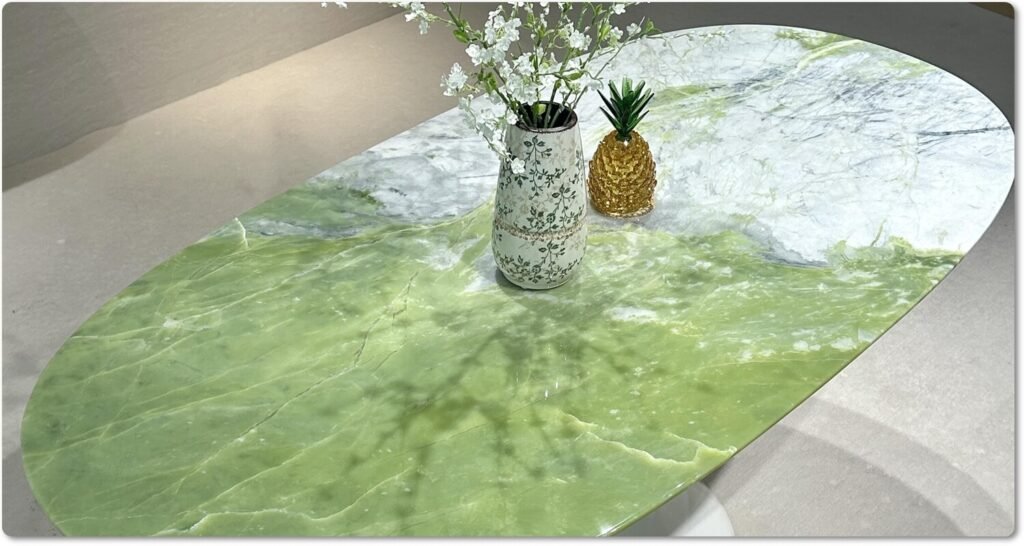
A green marble coffee table is often the most accessible starting point for a furniture collection.
It combines a relatively manageable stone top with a wide range of possible base designs.
2.1 Slab Thickness
Thickness directly affects:
- Visual proportion
- Structural stiffness
- Weight
- Edge profile
- Cost
- Shipping requirements
Common furniture designs may use relatively thin marble tops with reinforcement or thicker slabs for a more substantial appearance.
However, buyers should not select thickness based purely on appearance.
The correct thickness depends on:
- Table dimensions
- Marble characteristics
- Support spacing
- Base design
- Edge profile
- Installation method
- Expected use
- Transportation conditions
For example, a compact coffee table supported close to the center may require a different structural solution from a large rectangular table supported only at the corners.
2.2 Coffee Table Top Size
Common design directions include:
- Round
- Oval
- Square
- Rectangle
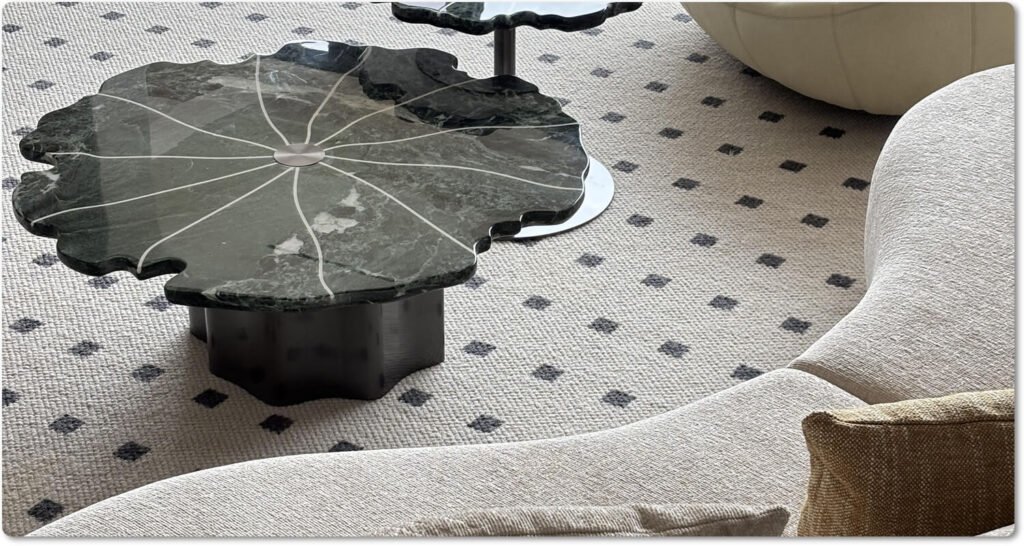
- Organic/freeform
- Irregular natural-edge-inspired shapes
Large unsupported spans deserve particular attention.
The larger the stone top becomes, the more important it is to evaluate:
span + thickness + support + stone characteristics + reinforcement.
A supplier should ideally confirm these parameters before production rather than simply cutting a large slab according to a drawing.
2.3 Edge Profiles
Popular edge treatments include:
- Pencil edge
- Eased edge
- Bullnose
- Half bullnose
- Beveled edge
- Chamfered edge
- Waterfall edge
- Mitered edge
For premium green marble furniture, the edge is not a minor detail.
The edge profile changes how the stone appears from different viewing angles and can dramatically influence the perceived quality of the finished table.
2.4 Base Design
A green marble coffee table can use:
- Stainless-steel base
- Brass base
- Powder-coated metal
- Solid stone pedestal
- Wood base
- Cross base
- U-shaped base
- Sculptural base
- Multiple pedestal supports
The base should be evaluated together with the stone top.
A heavy stone top paired with an undersized or poorly distributed base can create stability and transportation problems.
2.5 Weight
Natural stone is dense.
Therefore, buyers should calculate the approximate stone weight during the design stage.
A useful preliminary approach is:
Stone Weight ≈ Volume × Material Density
For rectangular slabs:
Volume = Length × Width × Thickness
This is only a planning calculation. Actual shipping weight should include the base, hardware, reinforcement, and packaging.
Weight affects:
- Freight cost
- Handling equipment
- Warehouse operations
- Installation
- Packaging
- Container loading
- Last-mile delivery
2.6 Packaging
Packaging should be designed for the finished product, not merely copied from slab packaging.
A premium green marble coffee table may require:
- Foam protection
- Corner protection
- Surface protection film
- Reinforced wooden crate
- Internal blocking
- Anti-movement supports
- Moisture protection where appropriate
- Separate packaging for removable bases
- Assembly instructions
- Hardware identification
The packaging design should consider the entire logistics chain:
Factory → truck → port → container → destination warehouse → final delivery → installation.
For high-value natural stone furniture, packaging is part of product quality.
3. Green Marble Side Table: Small Format Does Not Mean Simple
A green marble side table may look easier to manufacture than a dining table because it uses less stone.
In reality, small-format furniture can require highly precise fabrication.
The smaller the component, the more visible certain manufacturing imperfections can become.
3.1 Small-Format Fabrication
Side tables often include:
- Small round tops
- Small square tops
- Narrow oval tops
- Compact pedestal tops
- Custom geometric shapes
Small pieces can be fabricated from carefully selected sections of larger slabs.
This can create an efficient production model for manufacturers because a premium slab can potentially yield multiple furniture components while allowing pattern planning across a collection.
3.2 Rounded Edges
Rounded edges are particularly popular for side tables.
Possible profiles include:
- Full radius
- Partial radius
- Pencil round
- Bullnose
- Softened corner
- Radius corner
Rounded edges improve the visual softness of a small table and may also reduce sharp exposed corners.
However, the radius needs to be coordinated with:
- Stone thickness
- Table geometry
- Polishing equipment
- Corner radius
- Base position
3.3 Pedestal Design
Pedestal side tables are especially suitable for green marble because the visual mass of the stone can be concentrated around a single structural element.
A pedestal may be:
- Solid stone
- Laminated stone
- Metal
- Stone and metal
- Sculptural composite construction
The critical issue is not simply whether the pedestal looks attractive.
It must create a stable center of gravity.
A narrow pedestal combined with a large,e heavy top can produce an unstable product even when the stone itself is structurally sound.
4. Green Marble Table Design: Stone Selection Comes Before Fabrication
One of the most important differences between a conventional furniture manufacturer and a natural-stone furniture manufacturer is material variability.
Engineered materials can often provide relatively consistent patterns.
Natural green marble cannot.
Every slab can vary in:
- Background tone
- Veining
- Mineral distribution
- Fossil or crystalline features
- Natural fissures
- Color concentration
- Pattern direction
- Surface characteristics
USGS describes dimension stone selection in terms that include color, grain texture, pattern, finish, durability, and strength.
Therefore, professional procurement should begin with slab selection, not production.
4.1 Slab Selection Checklist
Before fabrication, buyers should confirm:
| Parameter | What to Check |
|---|---|
| Color | Background consistency |
| Veining | Direction and intensity |
| Surface | Cracks, pits, repairs and inclusions |
| Thickness | Actual measured thickness |
| Flatness | Slab deformation |
| Finish | Polished, honed, or other specified finish |
| Pattern | Suitable for furniture geometry |
| Quantity | Sufficient matching slabs |
| Bookmatch | Availability of complementary slabs |
| Fabrication | Suitability for required edge details |
For premium projects, buyers should approve actual slab photographs or digital slab layouts before cutting.
5. Green Marble Dining Table: Engineering Becomes More Important
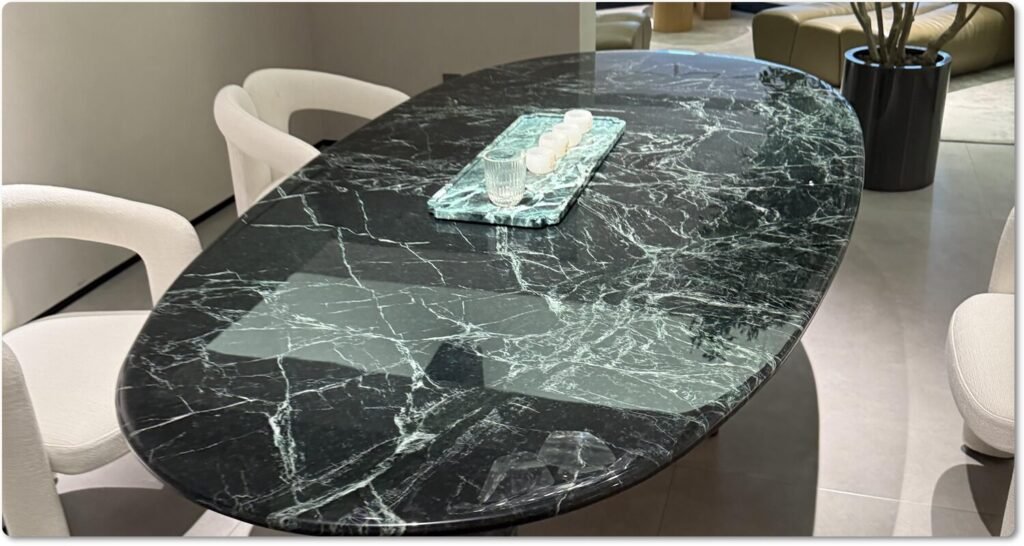
A green marble dining table represents a substantially different engineering challenge from a small side table.
Dining tables are larger.
The stone spans are longer.
The finished product is heavier.
The table is also subject to repeated everyday loading and movement.
5.1 Large Slabs
Large dining-table tops create several procurement questions:
- Is one slab large enough?
- Does the slab have suitable structural characteristics?
- Will the desired pattern fit the table geometry?
- Is the slab sufficiently flat?
- Is the thickness appropriate?
- Does the table require reinforcement?
- Can the finished table be safely transported?
The largest available slab is not automatically the best slab.
A smaller, more stable and visually superior slab can sometimes produce a better finished product than a larger slab with unsuitable characteristics.
5.2 Structural Support
Stone should not be treated as an isolated decorative skin.
The table is a system:
Stone top + reinforcement + base + connection method + load distribution + floor contact.
Possible support strategies include:
- Central pedestal
- Two pedestal bases
- Four-leg base
- Metal frame
- Recessed support frame
- Laminated structural components
- Concealed reinforcement
The appropriate design depends on the dimensions and intended use.
5.3 Stone Weight
Weight becomes a major issue as dining-table dimensions increase.
For example, a stone top measuring:
2400 × 1000 × 30 mm
has a volume of:
0.072 m³
If a preliminary density assumption of 2,700 kg/m³ is used for planning, the stone component would weigh approximately:
194 kg
The actual density of a particular marble should be confirmed from the material specification or testing data.
This example demonstrates why dining-table engineering cannot be separated from logistics.
A 200 kg-plus finished component requires different handling procedures from a small coffee table.
6. Bookmatching Green Marble Dining Tables
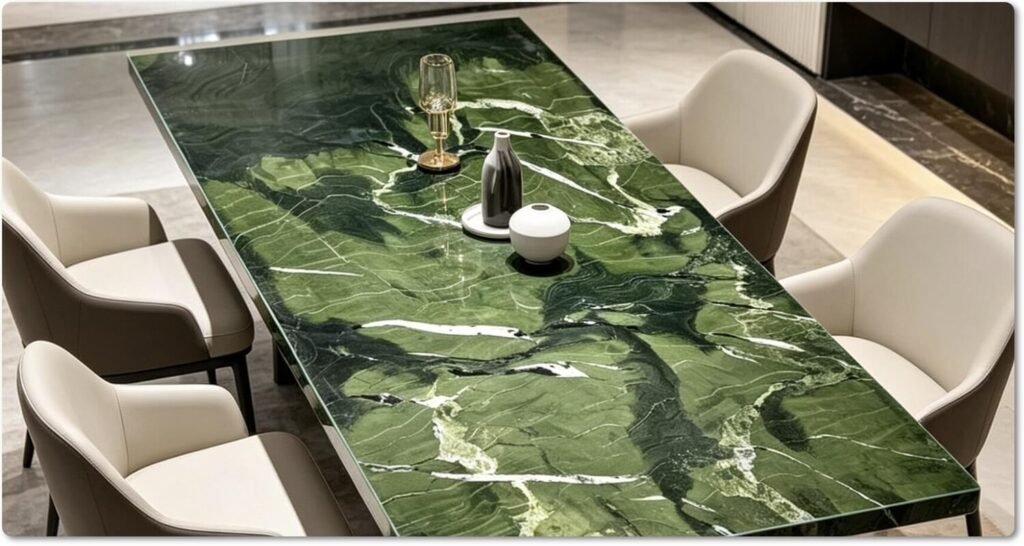
Bookmatching is one of the most visually powerful techniques for premium green marble furniture.
Two slabs are selected and arranged so that the patterns create a mirrored or visually coordinated composition.
This can be particularly effective for:
- Large dining tables
- Conference tables
- Executive tables
- Reception tables
- Feature furniture
- Hospitality projects
6.1 Bookmatch Procurement Requirements
Buyers should confirm:
- Same or compatible material
- Similar slab thickness
- Matching background color
- Compatible vein direction
- Suitable pattern continuity
- Similar surface finish
- Appropriate slab dimensions
Bookmatching should be planned before cutting.
If the slabs are cut independently and pattern planning is performed afterward, the final visual result may not meet the intended design.
6.2 Bookmatch vs Single Slab
| Feature | Single Slab | Bookmatched |
|---|---|---|
| Visual effect | Natural continuous pattern | Dramatic mirrored pattern |
| Fabrication | Simpler | More complex |
| Material requirement | Lower | Higher |
| Pattern control | Moderate | High |
| Premium positioning | High | Very high |
| Procurement planning | Moderate | Critical |
For luxury hospitality and residential furniture, bookmatched green marble can turn the table from a functional object into a major interior focal point.
7. Tabletop Reinforcement: When and Why It Matters
Natural marble is strong, but strength does not mean that every slab can be used in every furniture configuration without engineering consideration.
Reinforcement may be considered when:
- The tabletop is large
- The slab is relatively thin
- There are large unsupported spans
- The design has narrow sections
- Cutouts are incorporated
- The table requires special mounting
- The stone characteristics require additional support
Potential approaches include:
- Metal support frames
- Reinforcing bars
- Backing systems
- Honeycomb-style lightweight panels
- Structural subframes
- Mechanical support systems
The reinforcement solution should be engineered for the specific furniture design.
It should not simply be added as an afterthought.
8. Green Marble Furniture Manufacturing Process
A professional green marble furniture manufacturer should be able to manage the entire workflow rather than treating fabrication as a single cutting operation.
Step 1: Design Brief
Confirm:
- Product type
- Dimensions
- Quantity
- Stone type
- Finish
- Edge
- Base
- Hardware
- Packaging
- Delivery destination
Step 2: Material Selection
Select appropriate green marble slabs according to:
- Color
- Pattern
- Thickness
- Quality
- Availability
- Project quantity
Step 3: Slab Inspection
Inspect:
- Cracks
- Fissures
- Repairs
- Pits
- Surface defects
- Thickness
- Flatness
- Pattern consistency
Step 4: CAD / Shop Drawing
The manufacturer converts the design into production drawings.
These should define:
- Dimensions
- Tolerances
- Edge profiles
- Holes
- Reinforcement
- Base connection
- Assembly method
Step 5: CNC / Waterjet / Cutting
Depending on the design, fabrication can include:
- CNC cutting
- Waterjet cutting
- Bridge-saw cutting
- Edge processing
- Drilling
- Polishing
- Miter fabrication
Step 6: Surface Finishing
Common finishes include:
- Polished
- Honed
- Leathered
- Brushed
- Other project-specific finishes
The finish affects both appearance and maintenance requirements.
Step 7: Assembly
Stone components are combined with:
- Metal bases
- Stone bases
- Hardware
- Reinforcement
- Structural frames
Step 8: Quality Control
Inspect:
- Dimensions
- Color
- Pattern
- Edge quality
- Surface quality
- Assembly
- Stability
- Hardware
- Packaging
Step 9: Protective Packaging
The finished product is prepared for international transportation.
Step 10: Container / Truck Loading
Loading should consider:
- Weight distribution
- Product orientation
- Crate stability
- Internal movement
- Shock protection
- Unloading requirements
9. Green Marble Furniture Packaging for International Shipping
Packaging is one of the most underestimated parts of stone furniture manufacturing.
A table can leave the factory in perfect condition and still arrive damaged if the packaging is inadequate.
9.1 Why Stone Furniture Is Difficult to Ship
Stone furniture combines three characteristics:
High weight + brittle edges + large dimensions.
This creates transportation risks around:
- Corner impact
- Vibration
- Sliding
- Tipping
- Point loading
- Moisture
- Forklift handling
- Unpacking
9.2 Export Packaging Checklist
A professional packaging specification should address:
Stone protection
- Foam
- Corner guards
- Surface protection
- Anti-scratch layers
Internal structure
- Blocking
- Bracing
- Fixed positioning
- Separation between components
External protection
- Reinforced wooden crate
- Appropriate panels
- Clearly identified lifting points
Documentation
- Product identification
- Quantity
- Assembly instructions
- Handling instructions
- Packing list
9.3 EU Packaging Direction in 2026
European buyers should also pay increasing attention to packaging compliance.
The EU Packaging and Packaging Waste Regulation, Regulation (EU) 2025/40, entered into force on February 11, 2025, and applies from August 12, 2026. The European Commission issued implementation guidance in June 2026.
For exporters, the practical implication is that packaging should increasingly be considered as part of the product’s international compliance and sustainability strategy rather than merely as disposable protection.
The exact obligations depend on the market, economic operator,r and packaging configuration, so buyers and exporters should verify the applicable requirements for the destination country.
10. Green Marble Furniture and International Product-Safety Requirements
Natural stone itself is only one part of a finished furniture product.
Once a marble slab becomes a table, the product may be subject to requirements applicable to finished consumer goods or furniture in its destination market.
10.1 European Union: GPSR
The EU General Product Safety Regulation, Regulation (EU) 2023/988, has applied since December 13, 2024.
The framework covers consumer non-food products sold both offline and online and establishes responsibilities for economic operators, rs including manufacturers, importers and distributors.
For green marble furniture sold into the EU consumer market, buyers and suppliers should therefore consider:
- Product identification
- Manufacturer information
- Traceability
- Safety information
- Risk assessment
- Technical documentation
- Instructions and warnings where applicable
- Online product information where relevant
- Importer / responsible economic operator requirements
The regulation applies to products on the EU market regardless of where they were manufactured.
10.2 United States: Furniture Safety Is Product-Specific
The U.S. regulatory environment should not be simplified into a statement such as “all furniture must comply with the STURDY rule.”
The CPSC’s mandatory 16 CFR Part 1261 rule applies to defined clothing storage units, including certain dressers, chests,ests and similar bedroom storage furniture. Dining room furniture and occasional/accent furniture are expressly outside that specific scope.
For furniture manufacturers, the broader lesson is important:
Determine the exact product category before determining the applicable safety requirements.
A green marble dining table is not automatically subject to the same rules as a children’s bedroom dresser.
11. What Should a Buyer Request From a Green Marble Furniture Manufacturer?
For a professional B2B project, buyers should request a complete technical package.
Product Information
- Product name
- Product code
- Dimensions
- Stone type
- Stone thickness
- Finish
- Edge profile
- Base material
- Total weight
Engineering Information
- CAD drawing
- Structural details
- Reinforcement method
- Assembly method
- Hardware specification
- Stability considerations
Stone Information
- Slab photographs
- Material photographs
- Pattern layout
- Actual sample
- Quality inspection record
- Thickness verification
Packaging Information
- Crate dimensions
- Gross weight
- Net weight
- Package quantity
- Handling requirements
- Loading plan
Commercial Information
- MOQ
- Sample policy
- Production lead time
- Payment terms
- Incoterms
- Shipping options
- Replacement/damage policy
A supplier that can provide this information is operating closer to a finished-product manufacturing model than a simple stone trading model.
12. Green Marble Furniture: Wholesale vs Custom Manufacturing
The commercial model matters.
Green Marble Furniture Wholesale
Wholesale buyers typically prioritize:
- Repeatable designs
- Standard dimensions
- Consistent materials
- Production efficiency
- Container optimization
- Stable pricing
- Reorder capability
This model works well for:
- Furniture retailers
- Distributors
- Interior product brands
- E-commerce brands
- Hospitality suppliers
Custom Green Marble Furniture
Custom manufacturing prioritizes:
- Unique dimensions
- Special marble
- Custom edges
- Custom bases
- Bookmatching
- Project-specific engineering
- Private-label production
- Custom packaging
This model is particularly suitable for:
- Luxury villas
- Hotels
- Restaurants
- High-end residential projects
- Interior designers
- Architects
- Contract furniture companies
13. How to Calculate the Real Cost of a Green Marble Table
The purchase price of the table is not the same as the total procurement cost.
A useful commercial model is:
Total Landed Cost = Product Cost + Packaging + Inland Transport + Export Charges + Ocean/Air Freight + Insurance + Destination Charges + Duties/Taxes + Local Delivery + Installation
The stone itself may represent a significant portion of the cost, but finished furniture introduces additional variables.
For example:
| Cost Element | Importance |
|---|---|
| Green marble | High |
| Stone yield | High |
| Fabrication | High |
| Base | Medium–High |
| Reinforcement | Medium |
| Packaging | High |
| Freight | High |
| Installation | Project dependent |
| Customs/taxes | Destination dependent |
| Damage risk | Critical |
For international buyers, stone yield is particularly important.
A visually demanding bookmatched table can consume considerably more slab material than a simple small table.
Therefore, a lower stone price does not automatically produce a lower finished-product cost.
14. Green Marble Furniture Quality-Control Checklist
Before shipment, buyers should consider a structured inspection.
Appearance
- Correct green marble
- Correct background color
- Approved veining
- No unacceptable cracks
- No unexpected repairs
- Consistent finish
Dimensions
- Length
- Width
- Thickness
- Diameter
- Edge radius
- Hole positions
Fabrication
- Edge polishing
- Corner quality
- CNC accuracy
- Waterjet accuracy
- Surface flatness
- Miter joints where applicable
Assembly
- Base alignment
- Hardware
- Reinforcement
- Stability
- Connection strength
Packaging
- Crate integrity
- Internal blocking
- Surface protection
- Component separation
- Product identification
For large B2B orders, inspection photographs and videos can become part of the shipment documentation.
15. Green Marble Furniture Design Trends: From Stone Surface to Sculptural Object
The future of green marble furniture is not limited to placing a slab on top of a conventional metal frame.
The material itself is increasingly being used as part of the design language.
Potential design directions include:
Monolithic Forms
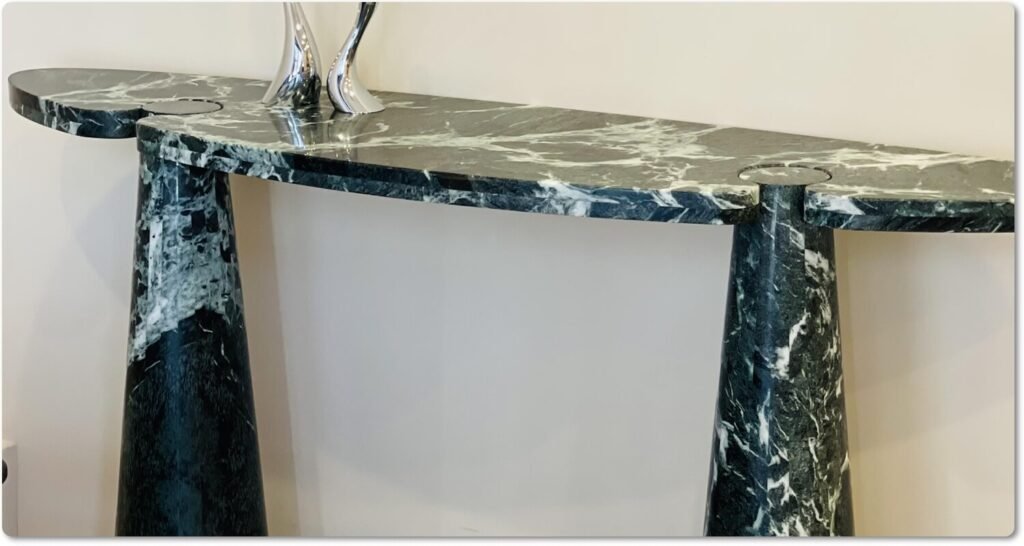
A single visual mass of green stone can create a strong architectural appearance.
Sculptural Pedestals
Curved and geometric bases transform the table into a three-dimensional object.
Mixed Materials
Green marble can be combined with:
- Brass
- Stainless steel
- Bronze
- Wood
- Glass
- Leather
- Other natural stones
Bookmatched Feature Furniture
Large green marble patterns can become the focal point of a room.
Modular Collections
A manufacturer can create a coordinated collection containing:
- Coffee table
- Side table
- Console
- Dining table
- Dining pedestal
- Nightstand
- Vanity
- Occasional table
This is commercially attractive because buyers can build a complete interior collection around one stone family.
16. Why a Green Marble Furniture Manufacturer Is Different From a Marble Slab Supplier
This distinction matters when sourcing internationally.
A slab supplier primarily sells:
Stone material.
A furniture manufacturer delivers:
Finished product + fabrication + structure + assembly + packaging.
A professional green marble furniture factory should ideally be able to control multiple stages:
Quarry/slab sourcing
↓
Material selection
↓
CAD
↓
CNC / Waterjet / Cutting
↓
Edge processing
↓
Surface finishing
↓
Structural fabrication
↓
Assembly
↓
QC
↓
Export packaging
↓
Container/truck loading
This integrated model can reduce communication gaps between different subcontractors.
It can also make it easier to reproduce designs at scale.
17. Custom Green Marble Furniture Manufacturer: What EDG Stone Can Offer
For buyers looking beyond standard slab procurement, EDG Stone Factory can position green marble furniture as an extension of its natural-stone manufacturing and custom fabrication capabilities.
As a professional natural stone manufacturer and exporter, EDG Stone can develop projects around:
- Green marble coffee tables
- Green marble side tables
- Green marble dining tables
- Green marble consoles
- Custom stone furniture
- Stone pedestals
- Custom tabletops
- Bookmatched furniture
- CNC-fabricated components
- Waterjet-cut components
- Custom stone bases
The key advantage is the ability to treat the stone and finished furniture as part of one manufacturing workflow.
For project buyers, the process can begin with:
Stone Selection → Design → CAD → Fabrication → Assembly → QC → Export Packaging
rather than purchasing stone from one supplier and outsourcing fabrication to another.
Customization Options
EDG Stone can support project-specific requirements such as:
- Custom dimensions
- Custom green marble selection
- Polished or honed surfaces
- Custom edge profiles
- CNC fabrication
- Waterjet fabrication
- Bookmatched slabs
- Custom stone bases
- Metal-base integration
- Project packaging
- Export-ready crating
This makes the product category relevant not only to furniture retailers but also to architects, interior designers, hospitality procurement teams, developers and private-label furniture brands.
18. How to Order Custom Green Marble Furniture
A professional purchasing workflow can be simplified into eight stages.
Stage 1 — Send the Design
Provide:
- Sketch
- Reference image
- CAD drawing
- Dimensions
- Quantity
Stage 2 — Confirm the Marble
Select:
- Green marble type
- Background
- Veining
- Finish
- Thickness
Stage 3 — Review CAD
Confirm:
- Dimensions
- Edges
- Base
- Reinforcement
- Assembly
Stage 4 — Approve Material
For premium projects, approve actual slab photographs or slab layout.
Stage 5 — Confirm Prototype
For complex furniture, a prototype or sample may be appropriate.
Stage 6 — Production
The factory performs:
- Cutting
- CNC
- Waterjet
- Edge processing
- Polishing
- Assembly
Stage 7 — QC
Review:
- Stone
- Dimensions
- Fabrication
- Assembly
- Packaging
Stage 8 — Export
Confirm:
- Crate
- Loading
- Shipping documents
- Container plan
- Destination requirements
This workflow is especially useful for international B2B procurement because it turns an aesthetic product into a measurable manufacturing process.
19. Green Marble Furniture Buyer’s Checklist
Before placing an order, ask these questions:
Stone
- What exact green marble is being supplied?
- Can I approve actual slabs?
- Is the marble natural or engineered?
- What is the expected pattern variation?
- Are repairs permitted?
Design
- What is the exact tabletop thickness?
- What edge profile is required?
- Is the design based on one slab or multiple slabs?
- Is bookmatching required?
Engineering
- How is the tabletop supported?
- Is reinforcement required?
- What is the finished weight?
- How is the base connected?
Manufacturing
- Is fabrication performed in-house?
- Is CNC available?
- Is waterjet cutting available?
- Can the factory produce custom dimensions?
Packaging
- How is the table protected?
- Is it shipped assembled or knocked down?
- What is the crate specification?
- What is the gross shipping weight?
Compliance
- What destination-market requirements apply?
- What product identification is required?
- Are safety instructions necessary?
- Does the product fall under any specific furniture safety regulation?
Commercial
- MOQ?
- Sample cost?
- Production lead time?
- Incoterm?
- Replacement policy?
- Container loading plan?
20. The Strategic Value of Green Marble Furniture for B2B Buyers
Green marble furniture represents a broader shift in the natural-stone industry:
from material supply toward finished-product manufacturing.
A slab is a material.
A table is a product.
A custom furniture collection is a design system.
That difference matters commercially.
A manufacturer that can combine natural-stone sourcing, fabrication, engineering, furniture assembly, and export packaging can potentially serve a much broader customer base than a traditional slab supplier.
For buyers, the advantage is also practical.
Instead of coordinating:
Marble Supplier + Fabricator + Furniture Manufacturer + Packaging Company
the project can potentially be managed through one integrated manufacturing partner.
This reduces the number of interfaces where errors can occur.
21. What Makes a Green Marble Furniture Supplier Procurement-Friendly?
That means a supplier’s technical information should answer questions directly.
A strong green marble furniture product page should clearly identify:
Product → Material → Dimensions → Fabrication → Structure → Finish → Packaging → Compliance → Applications → Customization → Manufacturer
The most useful information is usually specific.
Instead of:
Premium quality green marble furniture.
Use:
Custom green marble dining tables manufactured from natural marble slabs with project-specific dimensions, edge profiles, base structures, reinforcement and export packaging.
The second statement explains what the product is, what it is made from, and what manufacturing services are included.
22. Semantic Content Closure: Green Marble Furniture Explained for Buyers
Green Marble Furniture: How to Evaluate, Specify and Purchase It
What is green marble furniture?
Green marble furniture is finished furniture manufactured using natural green marble components, typically combined with engineered structural supports, metal, stone, or other base materials. Common products include coffee tables, side tables, dining tables, consoles,s and custom furniture.
Why does fabrication matter?
Natural marble is a variable material, so furniture quality depends on both slab selection and fabrication. Dimensions, thickness, edge processing, pattern orientation, support structure, reinforcement,nt and surface finish must be considered together.
How should buyers select a green marble coffee table?
Start with the intended dimensions, tabletop thickness, edge profile,ile and base design. Then evaluate the marble pattern, weight, stability, fabrication quality,lity and export packaging. Small tables still require accurate cutting and edge finishing because imperfections can be highly visible.
How should buyers specify a green marble dining table?
Large dining tables require greater attention to slab dimensions, structural support, total weight, reinforcement,ement and transportation. If a bookmatched appearance is required, compatible slabs should be selected and laid out before fabrication.
What should buyers consider about shipping?
Stone furniture is heavy and vulnerable at edges and corners. Export packaging should control movement, protect surfaces, support the product internally,rnally and accommodate handling through trucks, warehouses, ports and final delivery.
What are the major procurement options?
Buyers can source standard designs, wholesale collections, semi-custom products,o r fully custom green marble furniture. Custom projects may specify stone, dimensions, edge profiles, bookmatching, bases, reinforcement, finish, and packaging.
What is the role of a custom manufacturer?
A custom green marble furniture manufacturer can integrate material selection, CAD, cutting, CNC, waterjet, edge processing, assembly, quality control,l and export packaging into one workflow. This can simplify procurement for furniture brands, hospitality projects, architects, designers and distributors.
What should international buyers verify?
International buyers should verify destination-market product safety, traceability, labeling, packaging and transport requirements. In the EU, the General Product Safety Regulation has applied since December 13, 2024, while the Packaging and Packaging Waste Regulation applies from August 12, 2026. Requirements depend on the specific product, sales model, and economic operator.
What is the central buying principle?
The most important principle is to purchase the complete system rather than only the stone. A successful green marble furniture product combines suitable natural stone, accurate fabrication, appropriate structural support, professional finishing, quality control, and export-ready packaging.
23. Conclusion: Green Marble Is Moving From Slab to Finished Product
The strongest opportunity in green marble is not necessarily selling more square meters of stone.
It is creating more value from every selected slab.
A carefully selected green marble slab can become:
Coffee Table → Side Table → Dining Table → Console → Hospitality Furniture → Custom Furniture Collection
Each transformation adds design and manufacturing value.
For buyers, the critical question is therefore not simply:
“Where can I buy green marble?”
A better procurement question is:
“Which manufacturer can transform the right green marble into the finished furniture product I need, while controlling fabrication, engineering, quality and international packaging?”
That is where the concept of a Custom Green Marble Furniture Manufacturer becomes commercially important.
For architects, interior designers, furniture brands, hospitality buyers and distributors, working directly with an experienced natural-stone manufacturer can provide a more integrated path from slab selection to finished furniture.
EDG Stone Factory can support this model through natural stone sourcing, custom fabrication, CNC and waterjet processing, stone furniture manufacturing, quality control, and export packaging for international B2B projects.
Frequently Asked Questions About Green Marble Furniture
1. Is green marble suitable for coffee tables?
Yes. Green marble can be fabricated into coffee-table tops in round, oval, square, rectangular, and custom shapes. Buyers should evaluate thickness, support, edge treatment, stone characteristics, weight, and packaging together rather than selecting the stone based only on appearance.
2. How thick should a green marble table top be?
There is no single thickness suitable for every table. The required thickness depends on table dimensions, marble characteristics, support spacing, reinforcement, edge design, and intended use. A professional manufacturer should evaluate the complete structure before confirming the final thickness.
3. How heavy is a green marble dining table?
The weight depends on the stone volume, actual material density, base, and reinforcement. A preliminary estimate can be calculated using length × width × thickness × density, followed by adding the weight of the base, hardware, and packaging for shipping calculations.
4. Can green marble dining tables be bookmatched?
Yes. Bookmatching is particularly suitable for large feature tables when the selected slabs have compatible color, pattern, and dimensions. The slabs should be selected and planned as a pair before cutting to achieve the intended visual composition.
5. Where can I buy custom green marble furniture from a manufacturer?
International buyers can source custom green marble furniture directly from specialized natural-stone furniture manufacturers. When evaluating a supplier, look for capabilities covering stone selection, CAD, CNC or waterjet fabrication, edge processing, structural assembly, QC, and export packaging rather than evaluating the supplier only by slab price.
Industry Data & Regulatory References
- U.S. Geological Survey — Dimension Stone Statistics and Information: provides background on dimension stone supply, demand, material characteristics, and selection criteria.
- USGS Mineral Commodity Summaries 2025 — Dimension Stone: reported approximately 2.2 million tons of U.S. dimension stone sold or used in 2024, valued at approximately $370 million.
- USGS Mineral Commodity Summaries 2026 — Dimension Stone: notes that the U.S. remained one of the world’s leading dimension-stone markets in 2025 and that estimated dimension-stone imports increased for the first time in five years.
- EU General Product Safety Regulation (EU) 2023/988: applies from December 13, 2024 and establishes the EU general framework for consumer non-food product safety.
- European Commission GPSR guidance: explains responsibilities of manufacturers, importers, distributors, and other economic operators under the new framework.
- EU Packaging and Packaging Waste Regulation (EU) 2025/40: entered into force February 11, 2025, and applies from August 12, 2026.
- CPSC — Clothing Storage Units / STURDY: establishes the scope and requirements for covered clothing-storage furniture; dining room and occasional furniture are outside the specific CSU scope.