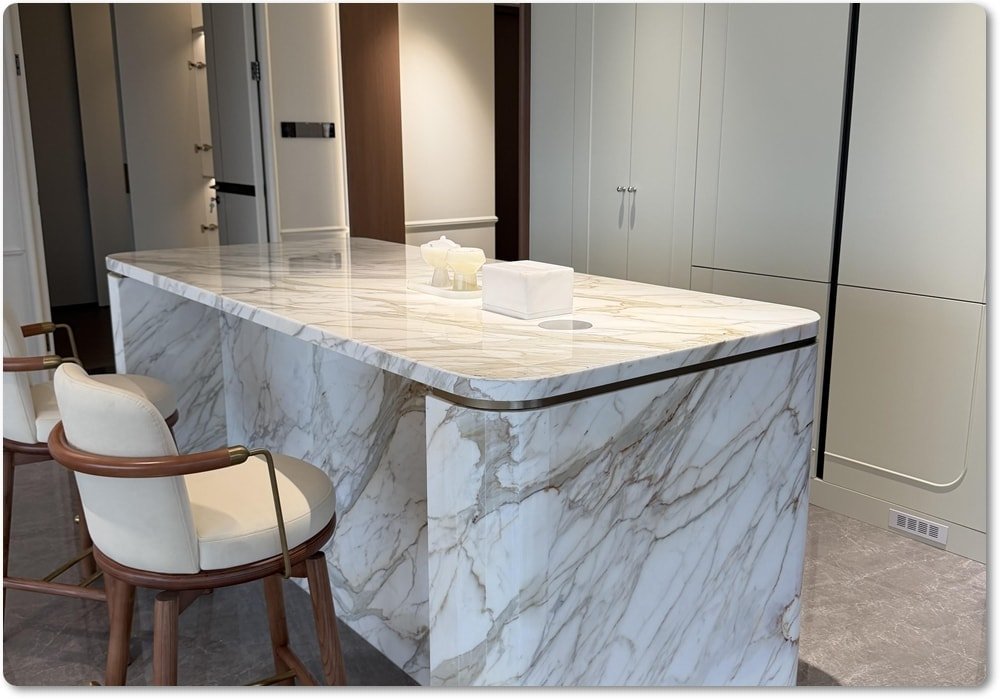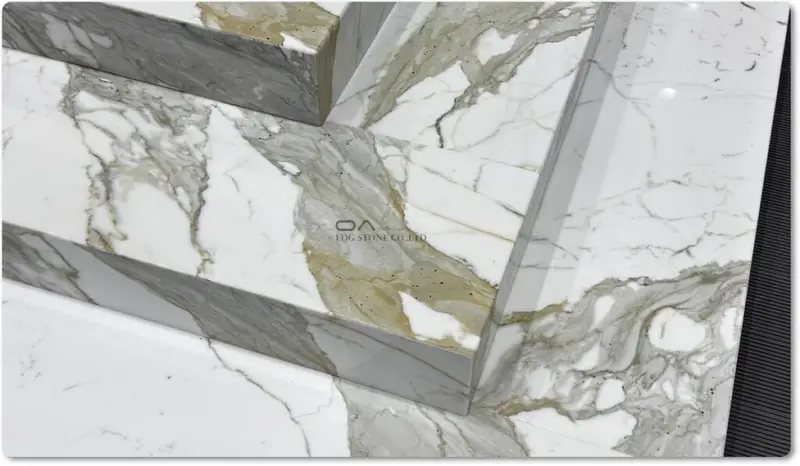
Quick Summary: The Art of Hybrid Flooring
Combining stone flooring and wood flooring creates a sophisticated balance between durability and warmth, essential for modern minimalist design. The key to a successful installation lies in achieving a flush transition (eliminating trip hazards) by accurately calculating subfloor heights.
- Design Philosophy: Contrasting the cool permanence of stone with the organic warmth of timber.
- Technical Key: Using expansion joints (silicone or cork) or minimalist metal profiles to handle different expansion coefficients.
- Sourcing: Partnering with a specialized manufacturer like EDG Stone ensures material consistency and precise calibration.
- Trend: Increasing demand for eco-friendly, low-VOC materials and “stone looking like wood” alternatives.
Ideal for: Open-plan kitchens, luxury entryways, and high-traffic commercial spaces.
The interplay of materials is the language of modern architecture. In the realm of minimalist design, where clutter is eliminated, texture becomes the protagonist. The stone and wood combination is not merely a flooring choice; it is a strategic design decision that defines zones, manages acoustics, and dictates the flow of a home.
For architects, designers, and homeowners, the challenge is not just selecting materials but mastering the seamless transition between them. How do you marry the organic, expanding nature of wood with the rigid, static nature of stone? This guide explores the aesthetic philosophy, technical execution, and industry sourcing secrets—featuring insights on how a professional custom stone flooring factory like EDG Stone can elevate your project.

1. The Aesthetic Duality: Why Combine Stone and Wood?
The resurgence of natural materials in 2024 and 2025 is driven by Biophilic Design—the innate human desire to connect with nature. While single-material floors are safe, they often lack depth.
Warmth Meets Coolness
The psychological impact of flooring is profound. Wooden flooring evokes warmth, softness, and acoustic dampening, making it ideal for living rooms and bedrooms where comfort is paramount. In contrast, stone flooring interior elements suggest permanence, cleanliness, and resilience, perfect for kitchens, bathrooms, and foyers. By combining them, you create a “Thermal and Textural Map” of the home. The cool touch of marble or limestone underfoot in the morning kitchen wakes you up, while the timber in the lounge invites relaxation. This duality creates a sensory journey through the property.
Defining Modern Minimalism
Minimalism is often mistaken for “emptiness.” True minimalism is the intentional promotion of the things we value most. When you remove rugs and excess furniture, the floor becomes the canvas. A stone and wood floor combination acts as a permanent rug. For example, an inset of EDG Stone marble in a dining area surrounded by oak floorboards frames the space without the need for physical barriers. This technique creates “implied rooms” within open-plan layouts, maintaining the sightlines critical to minimalist aesthetics.
Spatial Zoning
In the era of the “Great Room” (open-concept living), walls are disappearing. Flooring changes are the new walls.
The Wet Zone: Stone is impervious to water. Using it in the kitchen protects the subfloor from spills.
The Dry Zone: Wood softens the acoustics of the living area. The transition line where these two meet is the new threshold. It must be deliberate, geometric, and flawlessly executed to avoid looking like an afterthought.
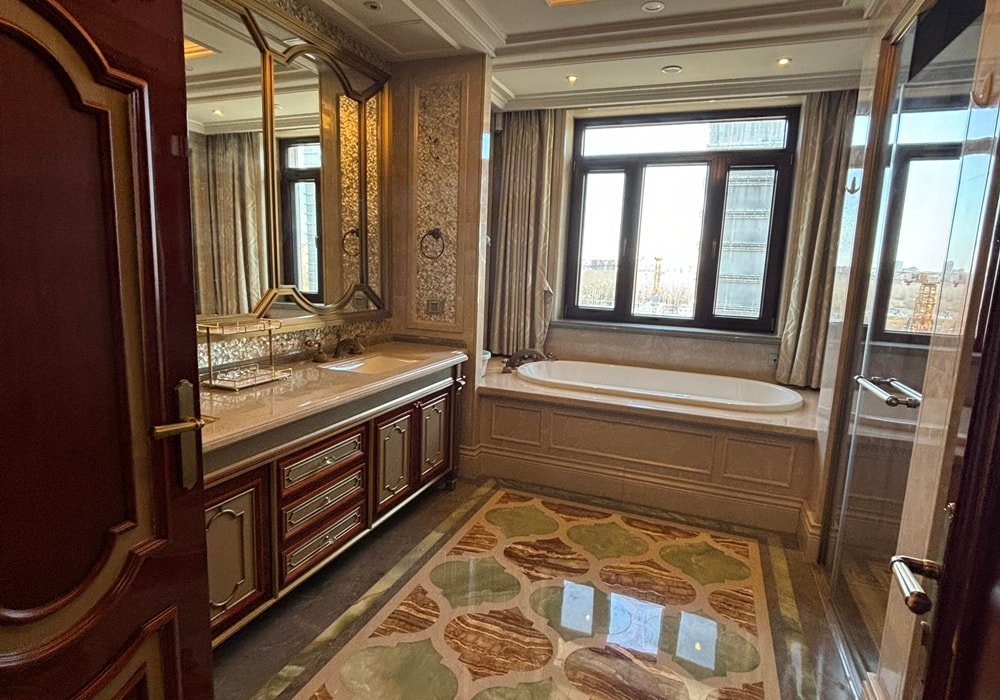
2. Technical Mastery: Achieving the Seamless Transition
This is where the dream often meets the harsh reality of construction. Stone flooring and wood flooring have different thicknesses, installation methods, and physical behaviors.
The “Flush” Look (No Thresholds)
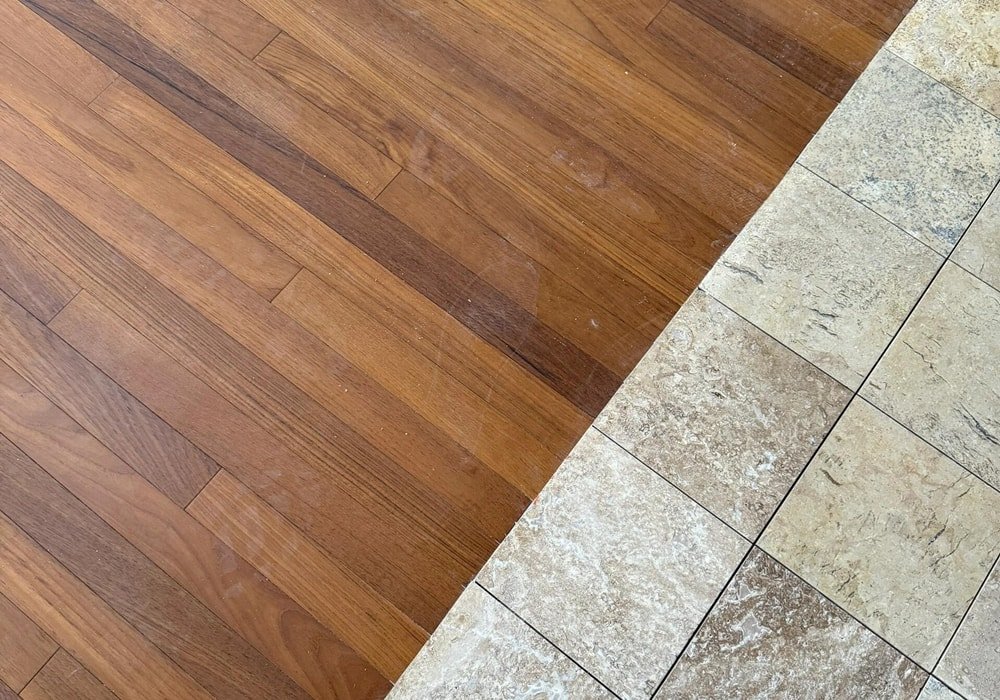
The hallmark of cheap renovation is the “T-molding” or “transition hump”—a raised strip covering the gap between uneven floors. In high-end design, the goal is a zero-transition (flush) floor. To achieve this, the subfloor preparation is critical.
Stone Thickness: Typically 12mm – 20mm + 5mm adhesive bed.
Wood Thickness: Typically 14mm – 18mm + 2mm glue/underlay. If the stone assembly is thicker than the wood, the subfloor under the wood must be built up using high-quality plywood or self-leveling compound. Conversely, if the stone is thinner (rare), the screed must be adjusted. This requires precise calculation before a single tile is laid.
Expansion Joints and Silicone
Physics dictates that wood is hygroscopic—it expands and contracts with humidity. Stone is static. If you butt wood tight against stone, the wood will eventually buckle or crack the stone.
The Solution: You must leave a gap (typically 3mm – 6mm).
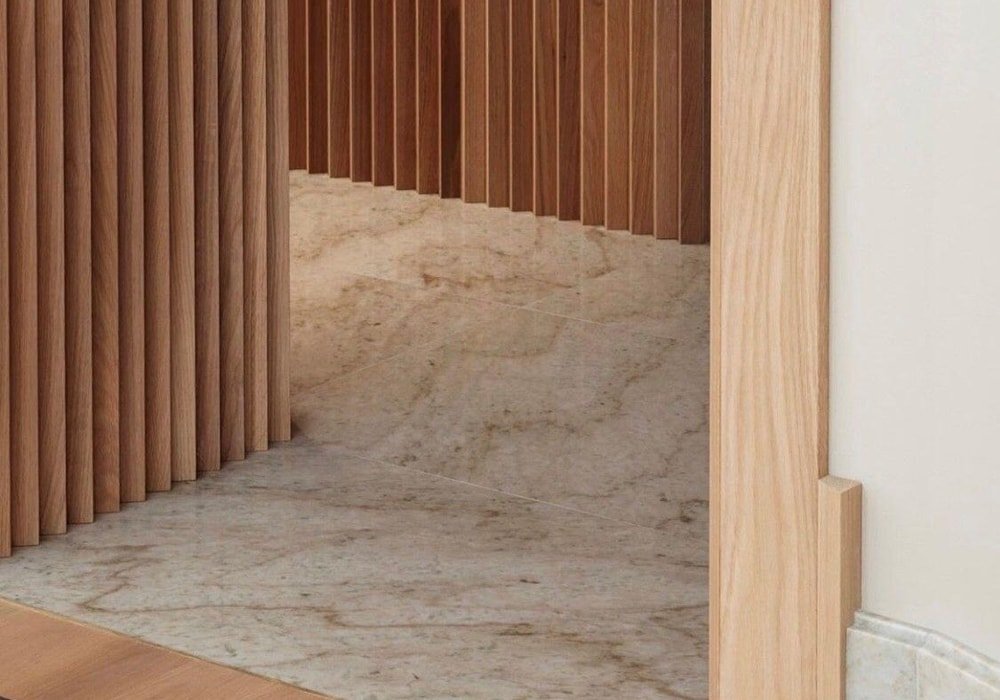
The Filler: Do not use grout (it will crack). Use a color-matched flexible silicone or a strip of natural cork. Cork is popular in Scandinavia as it moves with the wood and visually blends with the timber grain.
Metal Profiles & Transition Strips
For a sharper, more industrial minimalist look, metal profiles are the standard. Brands like Schluter offer L-shaped or T-shaped profiles.
Brass/Gold: Adds a touch of luxury and bridges warm wood tones with warm stone veining (like Crema Marfil).
Matte Black: Creates a graphic boundary, ideal for monochromatic schemes.
Stainless Steel: Disappears against grey limestone or concrete-look stone. The profile must be installed under the stone first, providing a rigid edge that the wood can expand towards.
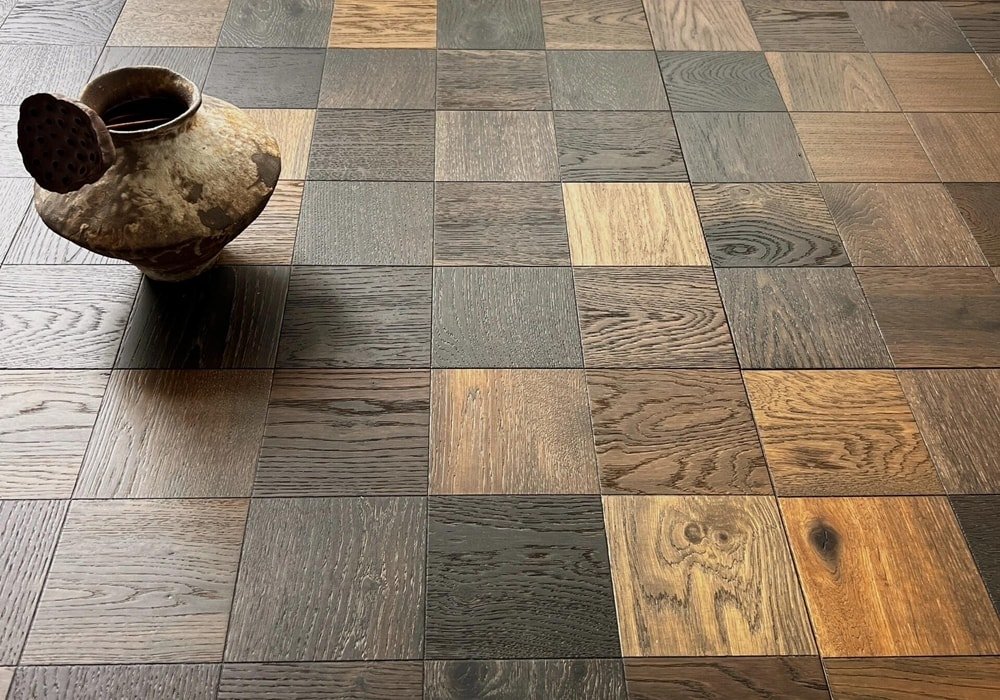
3. Material Selection Strategy: Stone, Wood, and Hybrids
Selecting the right materials is not just about color; it is about performance coefficients and sourcing.
Stone Flooring vs Hardwood: A Comparative View
Understanding the stone flooring advantages and disadvantages versus wood is vital for client education.
| Feature | Natural Stone Flooring | Engineered Hardwood |
| Durability | Extremely High (Centuries) | High (Decades) |
| Water Resistance | Excellent (if sealed) | Low to Medium |
| Thermal Mass | High (Retains heat/cool) | Low (Insulator) |
| Maintenance | Sealing required periodically | Refinishing required periodically |
| Scratch Resistance | High (Granite/Slate) to Medium (Marble) | Low (prone to pet claws) |
The Illusionist: Stone Flooring Looks Like Wood
For areas with high moisture (bathrooms, basements) where the wood look is desired but wood performance is fatal, the market has seen a surge in “wood-look stone.”
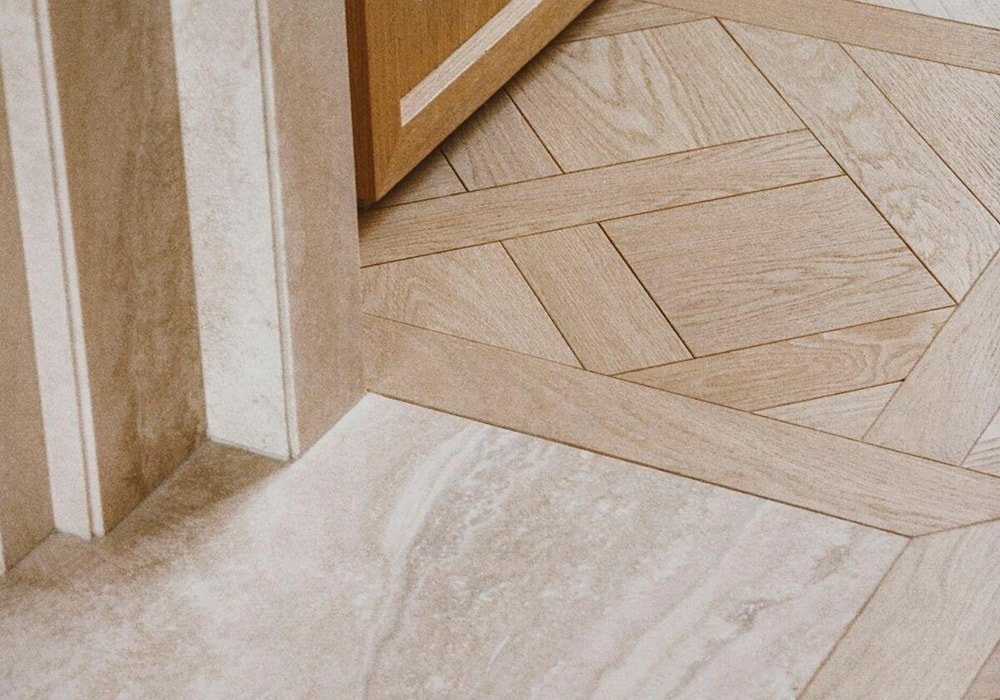
Advanced digital printing on porcelain and textured finishes on limestone can mimic oak grain. However, purists prefer the authenticity of real materials. A better approach is Stonewood flooring and tile hybridization—using real stone planks cut in the same dimensions as wood floorboards (e.g., 6×36 inches) to create a herringbone pattern that transitions from wood to stone without changing the laying pattern.
From Digital to Physical: “Minecraft” Logic
Interestingly, younger architects and designers often draw inspiration from digital spatial planning. The search term “Wood and Stone Floor Design Minecraft” reveals a fascination with grid-based, modular patterns.
In the real world, this translates to checkerboard patterns or pixelated transitions. Instead of a straight line, the wood and stone can “dither” into each other—staggered planks where the stone invades the wood territory and vice versa. This requires extreme precision in cutting, which is where a custom stone flooring factory becomes indispensable.
4. Industry Trends, Data & Regulations (2025 Outlook)
The construction industry is shifting towards transparency and sustainability.
Sustainability and Sourcing (FSC & ISO)
Modern consumers demand ethical sourcing.
Wood: Must be FSC (Forest Stewardship Council) certified.
Stone: There is a growing push for “Ethical Stone Register” compliance, ensuring no child labor and safe quarrying practices. EDG Stone, as a responsible manufacturer, adheres to strict environmental protocols, ensuring that the wholesale stone and wood flooring solutions provided meet global sustainability standards.
VOC Regulations and Adhesives
The transition between stone and wood relies heavily on adhesives. New regulations (like California’s Prop 65 and EU Reach) demand low-VOC (Volatile Organic Compounds) glues. Using the wrong adhesive can not only violate building codes but also cause chemical reactions that stain porous stone from underneath.
Market Data
According to recent market analysis (2024), homes with “natural material” flooring (specifically stone and hardwood mixes) command a 5% to 8% higher resale value than those with laminate or vinyl. The market interprets these materials as “permanent assets” rather than temporary coverings.
5. Installation & Functional Spaces
Where you place the transition line matters as much as how you install it.
The High-Traffic Zones
Entryways: This is the primary battlefield. Grit, salt, and rain enter here. A “landing pad” of stone (granite or slate) that extends 4-5 feet into the home prevents the wood from getting ruined by wet shoes.
Kitchens: The “Galley Zone.” Run the stone along the countertop, extending 3 feet out. This catches grease splatters and dropped knives.
Open Bathrooms: In master suites where the tub is in the bedroom, stone under the tub is non-negotiable.
Radiant Heating Compatibility
Radiant floor heating is a standard in luxury builds.
Stone: An excellent thermal conductor. It heats up fast and radiates heat long after the system is off.
Wood: An insulator. It resists heat transfer and can dry out/crack if the heat is too high. When combining them over a single heating system, the heating loops often need to be zoned differently, or the water temperature adjusted. A high-end residential stone floor supplier can advise on the specific thermal conductivity of different stones (e.g., Travertine vs. Basalt).
6. Sourcing from the Source: Why Choose a Specialized Factory?
For bespoke projects, relying on local tile shops is often insufficient.
The Role of EDG Stone
Working directly with a manufacturer like EDG Stone offers advantages that retail cannot match.
Batch Consistency: Natural stone varies wildly. Buying from a factory ensures your 2,000 sq ft of flooring comes from the same quarry block, ensuring color harmony.
Calibrated Thickness: A factory can calibrate the stone tiles to an exact thickness (e.g., 14mm) to match your chosen wood flooring perfectly, reducing installation labor costs.
Custom Fabrication: Need a curved transition? A factory with CNC and waterjet capabilities can cut the stone to a CAD radius that perfectly matches the bent-wood joinery.
Factory Direct vs. Retail
Searching for a Natural stone flooring manufacturer in China or global wholesale options allows developers to access wholesale stone flooring prices. This budget flexibility allows for upgrading the material quality—swapping standard Carrara for premium Calacatta, for instance.
Customization Capabilities
Modern luxury is personal. Whether it is inlaying brass lines directly into the stone or creating a custom mosaic border to separate the wood, a custom stone flooring factory for minimalist design is the partner that makes the “impossible” detail possible.
7. FAQ: Common Questions on Stone and Wood Transitions
Q1: Can I transition from stone to wood without a T-molding? Yes, absolutely. This is called a “flush transition.” It requires the subfloors to be leveled precisely so the top surface of the stone and wood are at the same height. A flexible sealant or thin metal profile is used in the gap to allow for wood expansion.
Q2: How much expansion gap do I need between stone and wood? The standard gap is between 3mm and 6mm (1/8 to 1/4 inch). This depends on the species of wood and the humidity range of the room. Never butt them tight, or the wood will peak or buckle.
Q3: Which is better for kitchens: Stone or Wood? Stone is functionally superior for kitchens due to its water and stain resistance. However, wood is more comfortable to stand on. A popular compromise is a stone floor in the main work triangle (sink/stove) and wood in the dining/pantry area.
Q4: Is it cheaper to buy stone flooring from a factory or a retailer? Buying from a manufacturer or factory direct (like EDG Stone) is generally more cost-effective for medium to large projects. It cuts out the middleman markup and offers better control over customization and batch quality.
Q5: Can I use radiant heating under a mixed stone and wood floor? Yes, but you must be careful. Stone conducts heat well, while wood insulates. You may need separate heating zones or sensors to ensure the wood doesn’t overheat and dry out while trying to warm the stone sections.
Comprehensive Insight: The Future of Hybrid Flooring Systems
Why This Combination Matters
The stone and wood floor combination is shifting from a purely functional choice to a primary design identifier in luxury real estate. It solves the “open plan” problem by defining zones without walls. Data suggests that 70% of high-end renovations in 2024 involve mixed material flooring to increase visual value.
Technical Consideration (The “How”)
Success relies on Expansion Coefficient Management. Wood moves; stone does not. The use of flexible cork joints, silicone sealants, or Schluter systems is mandatory. Furthermore, subfloor height calibration (often requiring self-leveling cement) is the unseen hero of a flush finish.
Sourcing & Procurement Option
For architects and developers, the trend is moving towards Factory-Direct Customization. Working with a dedicated entity like EDG Stone allows for:
1. Precision calibration (stone thickness matched to wood specs).
2. Large-format consistencies that retail cannot provide.
3. Waterjet customization for intricate, interlocking designs beyond simple straight lines.
References
Natural Stone Institute (MIA+BSI): Technical modules on stone installation standards and tolerances.
National Wood Flooring Association (NWFA): Guidelines for installing wood flooring over radiant heat and transition protocols.
Tile Council of North America (TCNA): Handbook for Ceramic, Glass, and Stone Tile Installation (Method F111).
Forest Stewardship Council (FSC): Standards for responsible forestry and wood sourcing.
Houzz & Pinterest Data Reports (2024): Trends in flooring materials for kitchen and living room transitions.
Architectural Digest: Articles on biophilic design and the resurgence of natural materials in modern interiors.
Journal of Interior Design: Research on the psychological effects of material textures in residential spaces.
Schluter Systems: Technical data sheets on floor profiles and movement joints.