Quick Summary
At a Glance:
What is a green marble tray? A fabricated natural-stone accessory made from green marble or a commercially designated green stone, commonly used for bathrooms, hospitality spaces, bedrooms, kitchens, restaurants, retail displays, and decorative applications.
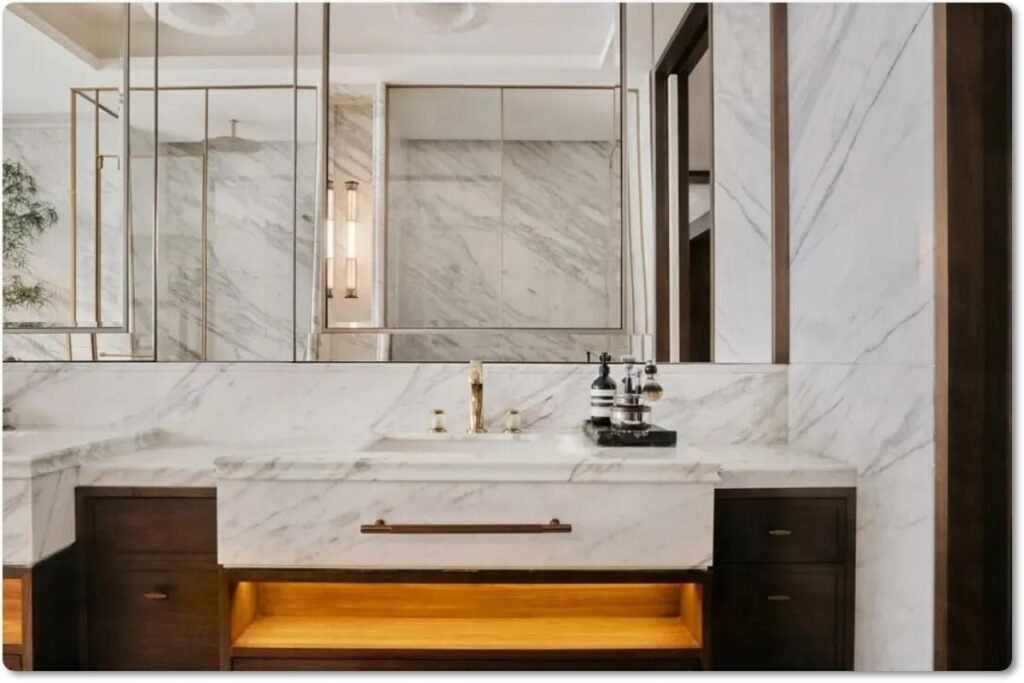
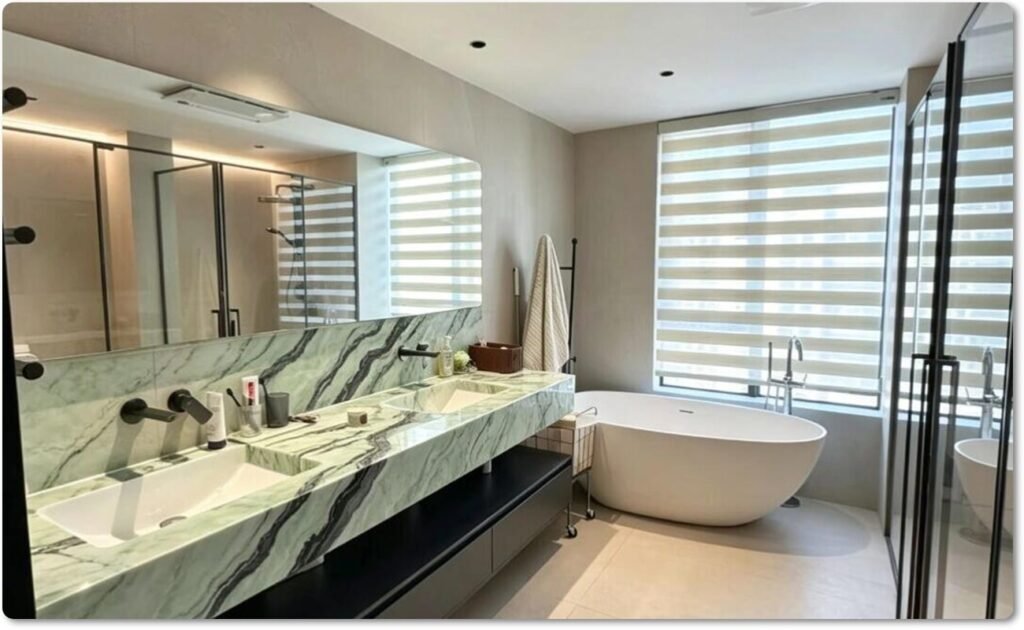
Why use green marble for vanity tops? Green marble vanity tops combine natural veining and color variation with custom fabrication possibilities, allowing the countertop, backsplash, sink, shelf, and accessory package to be coordinated.
What can be custom fabricated? Trays, bowls, vanity tops, shelves, sinks, soap trays, decorative objects, side tables, coffee tables, furniture components, and other architectural or hospitality accessories.
What should buyers inspect? Stone identity, color range, veining, cracks, fissures, repairs, absorption, finish, thickness, dimensions, edge profiles, cutouts, tolerances, reinforcement, packaging, and project-specific performance requirements.
What is the commercial advantage? A qualified natural stone manufacturer can combine material sourcing and fabrication into a coordinated supply chain, particularly for hotel, residential, multifamily, retail, and wholesale programs.
1. Why Green Marble Is Moving Beyond Slabs
Green marble has traditionally been associated with wall cladding, flooring, fireplaces, monumental interiors, and decorative slabs. The material is now also being specified at a much smaller scale.
A single green marble slab can potentially become a coordinated family of products:
Green Marble
→ Trays
→ Bowls
→ Vanity Tops
→ Shelves
→ Sinks
→ Soap Trays
→ Decorative Objects
→ Small Furniture
→ Custom Accessories
This shift is commercially important because smaller stone products allow designers and buyers to introduce natural stone into projects without covering an entire architectural surface.
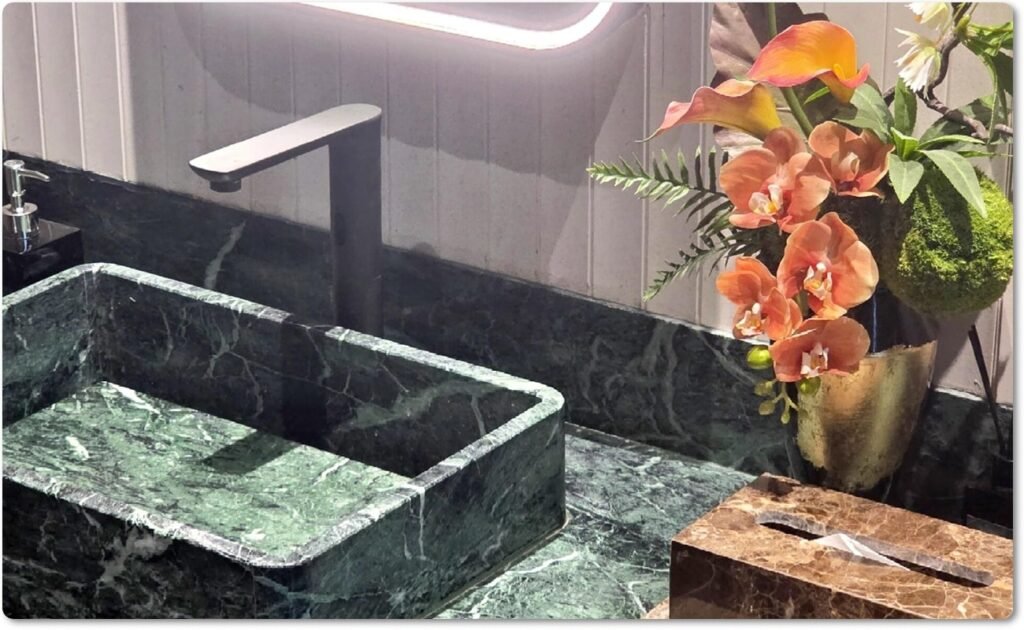
A green marble tray, for example, can introduce the same material language as a green marble vanity top without requiring a large bathroom renovation. A hotel can use matching stone for vanity tops, amenity trays, soap dishes, shelves, and decorative objects. A furniture manufacturer can integrate green marble into coffee tables, side tables, consoles, or accent pieces.
The result is not simply a collection of accessories. It is a coordinated natural-stone product system.
For B2B procurement, this distinction matters.
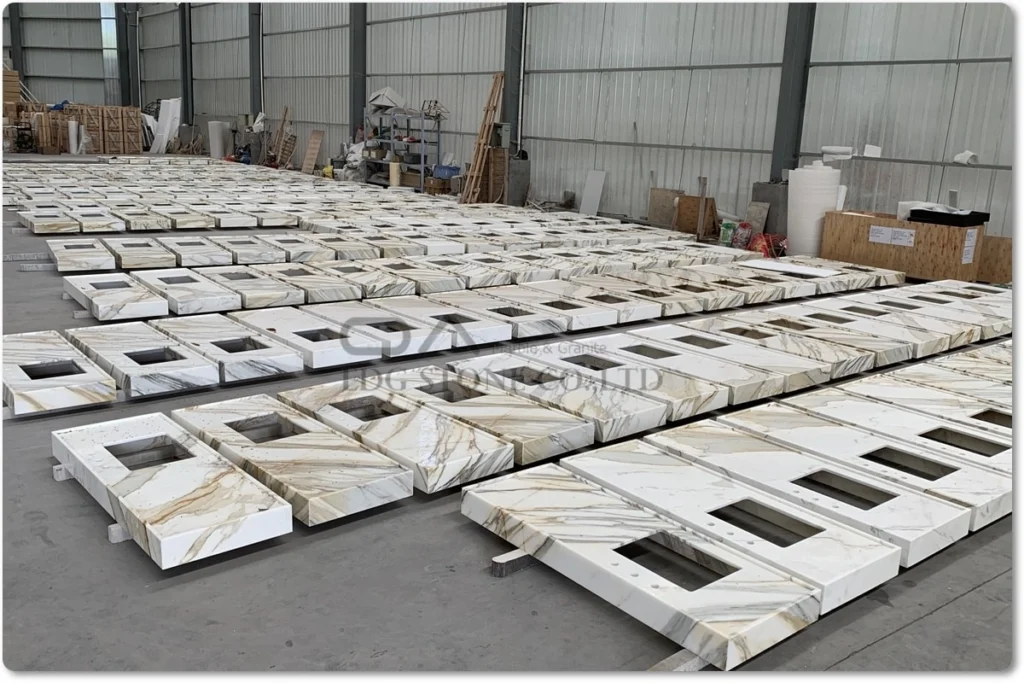
Instead of buying a slab from one supplier, sending it to another fabricator, buying accessories from a third company, and arranging separate export packaging, buyers can work with a green marble manufacturer or factory that can select materials and handle custom fabrication.
2. Green Marble Product Matrix: From Slab to Custom Accessories
A useful way to evaluate green marble is to start with the product, not the stone alone.
2.1 Green Marble Trays
A green marble tray is one of the most accessible applications for natural stone.
Common applications include:
- Bathroom amenity trays
- Hotel vanity trays
- Jewelry trays
- Perfume trays
- Restaurant serving/display trays
- Bedroom accessories
- Retail merchandising
- Decorative table trays
- Spa accessories
Tray fabrication can range from a simple rectangular or round piece with polished edges to a recessed design with CNC-machined pockets.
Important specifications include:
| Specification | Typical Procurement Consideration |
|---|---|
| Shape | Rectangle, square, oval, round, custom |
| Thickness | Project-specific |
| Edge | Square, eased, bullnose, bevel, custom |
| Surface | Polished, honed, leathered, or other suitable finish |
| Corners | Sharp, eased, radius |
| Recess | Optional CNC-machined area |
| Branding | Possible engraving or custom detailing |
| Packaging | Individual protective packaging recommended |
The stone’s natural variation should be considered part of the product specification rather than treated as a manufacturing defect.
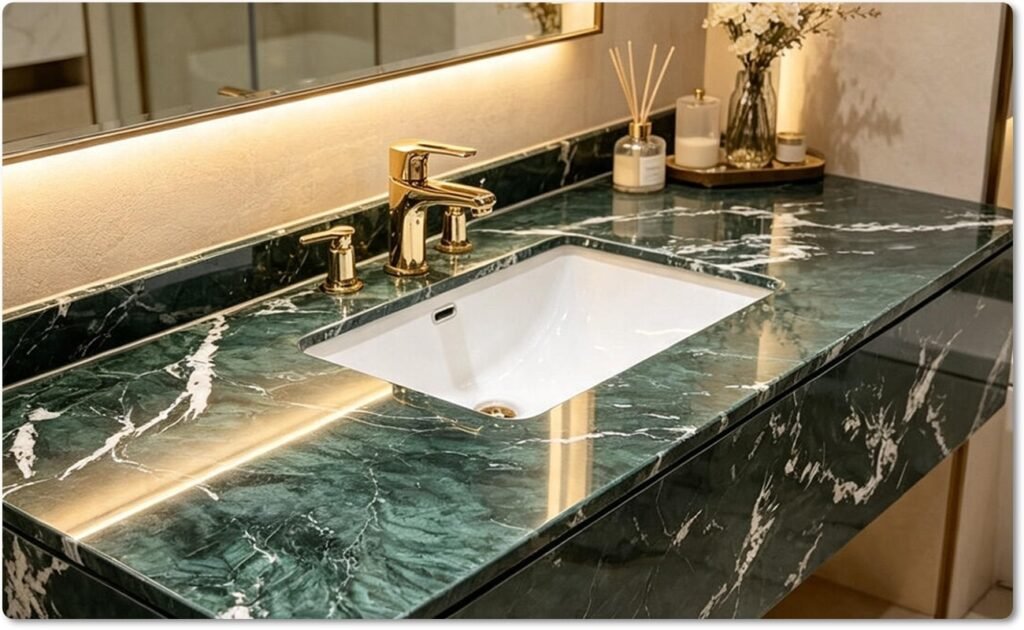
2.2 Green Marble Vanity Tops
A green marble vanity top is a higher-value application because it combines material selection with dimensional fabrication.
A vanity top may include:
- Countertop slab
- Sink cutout
- Faucet holes
- Backsplash
- Side splash
- Apron
- Edge profile
- Integrated or undermount sink
- Wall returns
- Custom support details
For commercial projects, the fabrication process should ideally begin with approved drawings or CAD files.
2.3 Green Marble Vanity vs. Green Marble Vanity Top
The search term green marble vanity can refer to several products.
It may mean:
- A vanity countertop made from green marble.
- A complete bathroom vanity incorporating green marble.
- A furniture-style vanity with a green marble surface.
- A custom bathroom cabinet with a fabricated green marble top.
Therefore, B2B buyers should define the scope precisely before quotation.
A request such as:
“Green marble vanity — 100 sets”
is less useful than:
“100 green marble vanity tops, 1,200 × 550 × 20 mm, polished, eased edge, single sink cutout, faucet holes, CAD drawing supplied.”
The second description gives the factory enough information to calculate material yield, fabrication, packaging, and logistics.
3. Green Marble Bowls, Sinks & Soap Trays
Smaller stone products create opportunities for highly coordinated bathroom collections.
3.1 Green Marble Bowls
Green marble bowls can function as:
- Decorative bowls
- Bathroom accessory containers
- Hotel amenity bowls
- Jewelry bowls
- Fruit bowls
- Display objects
Because natural marble is not identical to engineered materials, the bowl’s wall thickness and geometry should be engineered around the specific stone.
The manufacturer should consider:
- Natural fissures
- Grain direction
- Vein structure
- Minimum wall thickness
- Internal radius
- External radius
- Weight
- Surface finish
- Handling requirements
3.2 Green Marble Sinks
Green marble sinks can be fabricated as:
- Vessel sinks
- Carved stone basins
- Undermount-style components
- Integrated basin designs
- Custom hotel basins
Water exposure makes stone selection and fabrication particularly important.
The buyer should request technical information appropriate to the intended application, rather than assuming that every material marketed as “green marble” has identical physical properties.
3.3 Green Marble Soap Trays
Soap trays are a small but useful application for natural-stone accessories.
A simple product can include:
- Drainage grooves
- Recessed soap area
- Rounded corners
- Polished or honed surface
- Custom logo engraving
For hospitality projects, soap trays can become part of a coordinated bathroom accessory package.
4. Green Marble Shelves & Architectural Accessories
Green marble shelves offer a practical bridge between architectural stone and furniture.
Applications include:
- Bathroom shelves
- Shower shelves
- Wall niches
- Display shelves
- Hotel minibar shelves
- Retail shelving
- Decorative ledges
- Fireplace shelves
4.1 Shelf Design Considerations
A shelf should not be specified only by length and width.
The buyer should define:
Material + thickness + support method + edge profile + finish + load requirement + installation environment.
For example:
Green marble shelf / 900 × 180 × 20 mm / honed / eased edge / bathroom application.
This is significantly more useful for manufacturing than simply saying “green marble shelf.”
4.2 Shower and Wet-Area Applications
For wet-area applications, buyers should pay particular attention to:
- Water absorption
- Surface treatment
- Slip considerations
- Cleaning chemicals
- Installation details
- Joint design
- Drainage
- Maintenance requirements
Natural stone should always be evaluated according to the actual application and project specifications.
5. Custom Green Marble Accessories: Where Fabrication Creates Value
The strongest commercial opportunity may not be a standardized product.
It may be custom green marble.
A manufacturer with CNC, waterjet, edge-processing, drilling, polishing, and other fabrication capabilities can convert slabs into a broad range of products.
5.1 Custom Product Possibilities
A custom green marble program can include:
- Trays
- Bowls
- Soap dishes
- Candle holders
- Coasters
- Tissue boxes
- Bookends
- Shelves
- Sinks
- Vanity tops
- Tabletops
- Side tables
- Coffee tables
- Console tops
- Decorative panels
- Sculptural objects
- Hotel room accessories
- Retail display components
This transforms green marble from a surface material into a product platform.
5.2 CNC Fabrication
CNC machining is particularly useful when products require repeatable geometry.
Potential operations include:
- Pocketing
- Recessing
- Profiling
- Rounded edges
- Sink fabrication
- Bowl carving
- Drilling
- Dimensional shaping
- Custom decorative machining
For repeated commercial production, digital drawings can also help reduce dimensional ambiguity.
5.3 Waterjet Fabrication
Waterjet technology is useful for complex shapes and decorative components.
Applications may include:
- Custom trays
- Medallions
- Geometric accessories
- Inlays
- Logos
- Decorative panels
- Irregular furniture components
The advantage is not simply the cutting method. The important point is the ability to reproduce an approved digital design consistently.
6. How to Select Green Marble for Accessories
Not every green stone should be evaluated in the same way.
Commercial names can describe different geological materials, quarry sources, or market categories. Therefore, buyers should request the actual material identification and technical documentation applicable to the supplied stone.
6.1 Color
Green marble can range from:
- Pale green
- Sage green
- Medium green
- Deep green
- Forest green
- Emerald-like green
- Green with white veining
- Green with darker patterns
- Brecciated green patterns
Color should be approved using actual samples or production slabs.
6.2 Veining
Veining is one of the major reasons designers select natural green marble.
However, vein continuity cannot always be guaranteed across multiple slabs.
For high-end projects, specify:
- Vein direction
- Bookmatching requirements
- Slab sequencing
- Acceptable variation
- Approval process
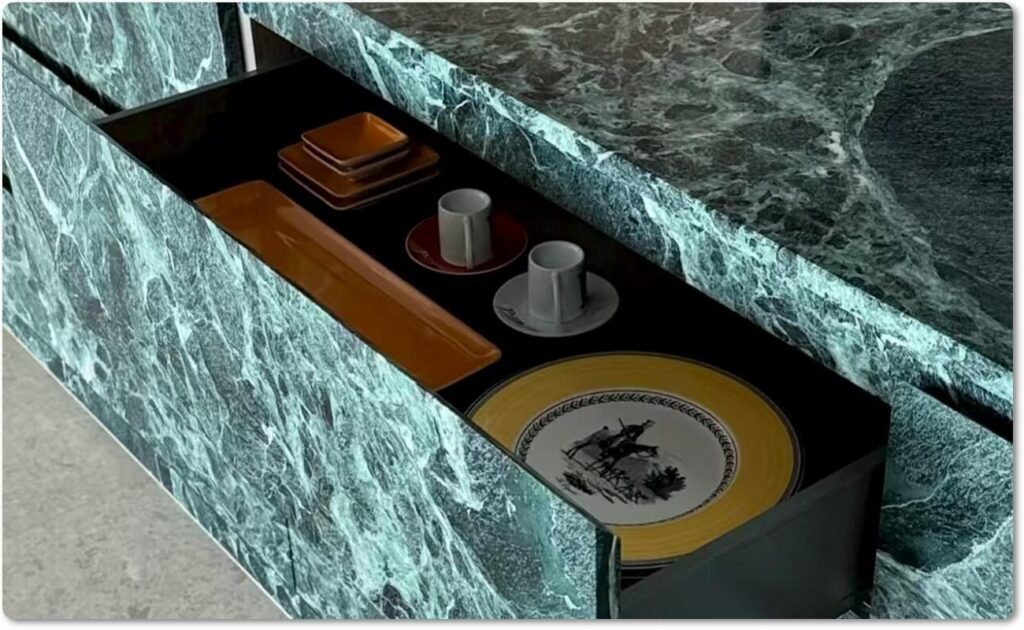
6.3 Fissures and Natural Characteristics
Natural stone can contain geological characteristics such as:
- Veins
- Fissures
- Mineral concentrations
- Color variation
- Crystal variation
The purchasing specification should distinguish between acceptable natural characteristics and unacceptable structural defects.
7. Green Marble Quality Control for B2B Buyers
A professional purchasing program should establish quality-control checkpoints before production begins.
7.1 Material Inspection
Inspect:
- Slab color
- Veining
- Thickness
- Flatness
- Cracks
- Repairs
- Surface consistency
- Dimensional stability
7.2 Fabrication Inspection
After processing, check:
- Length
- Width
- Thickness
- Sink dimensions
- Hole positions
- Edge profiles
- Surface finish
- Corner geometry
- Radius
- Polishing consistency
7.3 Pre-Shipment Inspection
Before shipment, verify:
- Quantity
- Product dimensions
- Surface quality
- Edge protection
- Product identification
- Packing list
- Packaging condition
- Container loading
For large hotel or residential programs, photographic QC records can also provide useful project documentation.
8. Green Marble Vanity Top Manufacturing Process
A typical custom green marble vanity top production workflow is:
Step 1: Project Requirements
Collect:
- Dimensions
- Quantity
- Material
- Finish
- Edge profile
- Cutouts
- Faucet holes
- Backsplash requirements
- Packaging requirements
Step 2: Material Selection
Select suitable slabs according to:
- Color
- Veining
- Thickness
- Quality
- Yield
Step 3: CAD Drawing
Prepare or review the production drawing.
Step 4: CNC / Cutting
Perform slab cutting and machining.
Step 5: Edge Processing
Fabricate the specified edge profile.
Step 6: Surface Finishing
Apply the specified finish.
Step 7: Assembly
Where required, assemble:
- Vanity top
- Backsplash
- Sink
- Apron
- Other components
Step 8: QC
Inspect dimensions, appearance, finish, and functionality.
Step 9: Packaging
Protect corners, surfaces, edges, and individual components.
Step 10: Export
Load the products into appropriate export packaging and containers.
This workflow is particularly useful for buyers sourcing from a green marble factory rather than purchasing finished products through multiple intermediaries.
9. Green Marble Wholesale: What B2B Buyers Should Specify
For green marble wholesale, price alone is rarely a sufficient specification.
A professional RFQ should include:
| Category | Information |
|---|---|
| Material | Commercial name + source where available |
| Product | Slab, vanity, tray, sink, accessory |
| Quantity | Pieces/sets / square meters |
| Dimensions | Exact finished dimensions |
| Thickness | Required thickness |
| Finish | Polished/honed/other |
| Edge | Profile and dimensions |
| Drawings | CAD / PDF / templates |
| Quality | Sample or approved reference |
| Packaging | Individual / crate/pallet |
| Delivery | Port or destination |
| Inspection | Factory QC / third-party inspection if required |
This approach makes quotations easier to compare across suppliers.
10. Regulations, Sustainability & Compliance Considerations in 2026
Natural-stone procurement is increasingly connected with broader construction-product, environmental, packaging, and chemical-management requirements.
The exact obligations depend on the destination country, product type, intended use, importer status, and project specifications.
10.1 Europe
For products entering European construction supply chains, buyers should evaluate applicable requirements under the EU construction-product framework and relevant harmonized standards where applicable.
The EU has also continued developing policies around circularity, sustainability, environmental information, and product data.
For stone products, buyers should therefore avoid treating a generic “green marble certificate” as sufficient evidence of compliance.
Instead, request documentation relevant to the actual product and application.
10.2 United States
U.S. projects can involve project-specific requirements concerning:
- Building codes
- ASTM test methods
- Material performance
- Indoor environmental requirements
- Packaging
- Chemical restrictions
- Project specifications
Natural stone used in commercial construction should be evaluated according to the project’s applicable specification rather than relying only on marketing terminology.
10.3 Packaging
International buyers should also consider wood packaging requirements. Where wood packaging material is used for export, applicable international phytosanitary requirements such as ISPM 15 may apply.
For stone accessories, packaging is particularly important because small fabricated products can be vulnerable to:
- Corner damage
- Edge chipping
- Surface scratching
- Breakage
- Moisture exposure
- Impact during container handling
A supplier’s packaging capability can therefore materially affect delivered product quality.
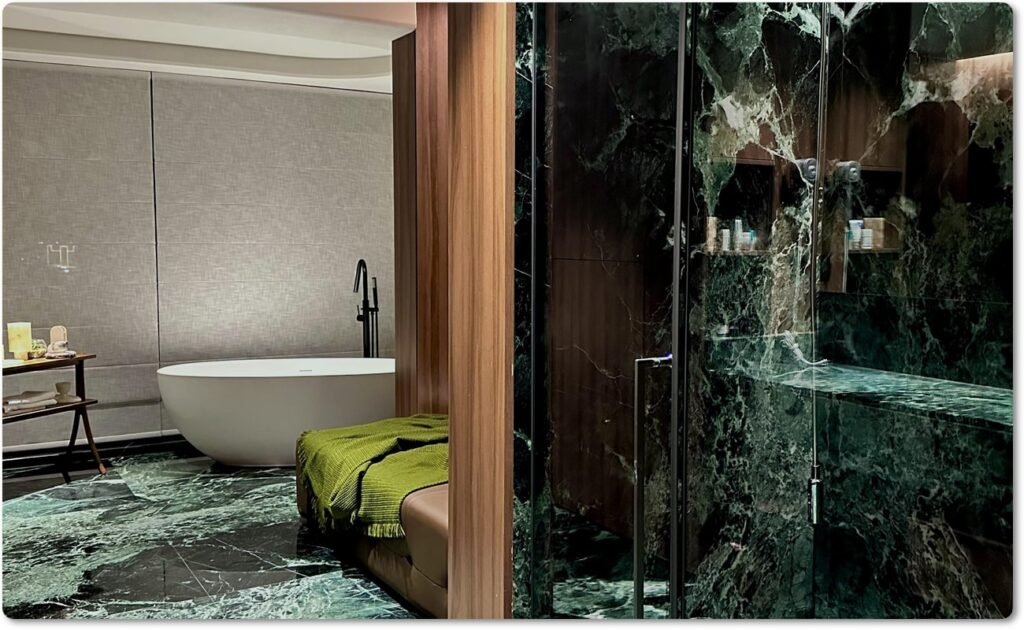
11. Green Marble Accessories for Hotels & Hospitality
Hospitality is an especially interesting application for custom stone accessories because the same material can be repeated across many touchpoints.
A boutique hotel bathroom could combine:
Green Marble Vanity Top
↓
Green Marble Sink
↓
Green Marble Shelf
↓
Green Marble Soap Tray
↓
Green Marble Amenity Tray
↓
Green Marble Decorative Object
This creates visual consistency without requiring every architectural surface to be green marble.
For procurement teams, this can also simplify purchasing.
Instead of sourcing five unrelated products, a qualified fabricator may be able to manufacture a coordinated package.
12. Green Marble Furniture & Small-Scale Products
The transition from accessories to furniture is relatively natural.
Green marble can be incorporated into:
- Coffee tables
- Side tables
- Dining tables
- Console tables
- Bedside tables
- Pedestal tables
- Furniture tops
- Decorative bases
12.1 Green Marble Coffee Tables
A green marble coffee table combines a natural-stone surface with a structural base.
The purchasing specification should identify:
- Marble type
- Slab thickness
- Table dimensions
- Edge profile
- Surface finish
- Base material
- Base dimensions
- Assembly method
- Packaging
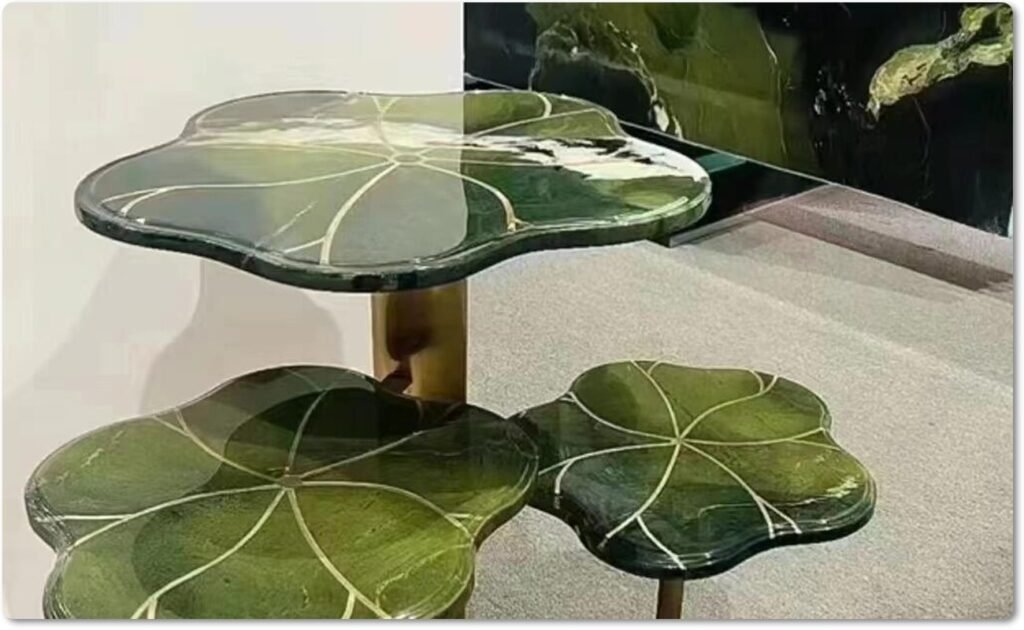
12.2 Green Marble Side Tables
Side tables generally use smaller stone components, making them suitable for selective slab utilization.
This can create an opportunity to turn smaller usable slab sections into higher-value finished products.
13. How to Buy Custom Green Marble from a Factory
For buyers searching for a green marble manufacturer, green marble factory, or green marble wholesale supplier, the most useful evaluation framework is not simply the supplier’s product catalog.
Assess five capabilities.
13.1 Material Access
Can the supplier provide:
- Multiple green marble varieties?
- Consistent slab selection?
- Project-specific slab matching?
- Samples?
- Slab photographs?
13.2 Fabrication
Can the factory perform:
- Cutting?
- CNC?
- Waterjet?
- Drilling?
- Edge processing?
- Sink fabrication?
- Furniture fabrication?
13.3 Engineering
Can the supplier interpret:
- CAD drawings?
- Templates?
- Sink specifications?
- Edge details?
- Assembly requirements?
13.4 Quality Control
Can the factory document:
- Raw material inspection?
- Production inspection?
- Finished-product inspection?
- Packing inspection?
13.5 Export Logistics
Can the supplier handle:
- Export packing
- Wooden crates
- Pallets
- Container loading
- Shipping documentation
- Large project quantities?
These capabilities become especially important when ordering multiple categories of custom green marble accessories.
14. Green Marble vs. Other Materials for Accessories
Green marble is not automatically the correct material for every application.
Natural Green Marble
Advantages
- Natural geological appearance
- Unique veining
- High design value
- Can be custom fabricated
- Suitable for coordinated collections
Considerations
- Natural variation
- Potential fissures
- Maintenance requirements
- Material-specific performance
- Weight
Engineered Stone
Advantages
- More controlled appearance
- Repetitive production
- Broad color selection
Considerations
- Different material composition
- Different fabrication requirements
- Product-specific performance characteristics
Porcelain / Sintered Materials
Advantages
- Large-format options
- Different performance characteristics
- Design consistency
Considerations
- Fabrication equipment
- Edge details
- Visual character differs from natural marble
Material selection should therefore start with the application and performance requirement, followed by aesthetics and procurement considerations.
15. 2026 Buyer Checklist for Green Marble Trays, Vanities & Accessories
Before placing a purchase order, confirm the following.
Material
Commercial stone name
Actual stone/sample approved
Color range approved
Veining expectations documented
Natural characteristics defined
Product
Exact dimensions
Thickness
Finish
Edge profile
Radius
Cutouts
Drilling
Engraving if required
Technical
Intended application
Relevant physical properties
Water exposure
Cleaning requirements
Installation method
Applicable project standards
Quality
Sample approval
Production drawing approval
Pre-shipment inspection
Quantity verification
Logistics
Individual protection
Crate/pallet requirements
Export packaging
Container loading plan
Shipping documents
16. The Commercial Opportunity: One Stone, Multiple Product Categories
One of the most important developments in natural-stone product strategy is the movement from single-product purchasing toward coordinated stone collections.
A buyer may start with green marble slabs.
The same material can then become:
Slabs → Vanity Tops → Sinks → Trays → Shelves → Soap Trays → Tables → Decorative Objects
This creates several commercial advantages.
For designers, it creates material continuity.
For hotels, it creates brand consistency.
For retailers, it creates a broader product assortment.
For distributors, it creates opportunities to sell both slabs and finished products.
For manufacturers, it creates additional value from fabrication.
For buyers, it can reduce the number of separate suppliers required for a project.
This is why custom green marble fabrication deserves to be considered as a manufacturing capability rather than simply a finishing service.
17. Why EDG Stone Is Relevant to Custom Green Marble Programs
EDG Stone operates as a Chinese natural-stone manufacturer and exporter specializing in natural stone products and custom fabrication.
For a green marble program, the relevant manufacturing model is the combination of:
Natural Stone Selection
↓
Slab Inspection
↓
CAD / Technical Drawing
↓
Cut-to-Size
↓
CNC / Waterjet
↓
Edge Processing
↓
Custom Fabrication
↓
QC
↓
Export Packaging
↓
Container Loading
This model can support projects requiring green marble slabs as well as finished components such as vanity tops, sinks, trays, shelves, tables, and other custom accessories.
The key point for B2B buyers is not simply whether a factory can produce one green marble tray. It is whether the supplier can maintain a consistent procurement and quality-control process across multiple products, quantities, drawings, and shipment requirements.
18. Frequently Asked Questions About Green Marble Accessories
What is a green marble tray used for?
A green marble tray can be used in bathrooms, bedrooms, hotels, restaurants, retail displays, spas, and decorative interiors. Common uses include amenity trays, jewelry trays, perfume trays, soap arrangements, and decorative displays.
Can green marble be used for vanity tops?
Yes, green marble can be fabricated into vanity tops when the selected stone is appropriate for the intended application and is fabricated according to the required dimensions, finish, cutouts, and installation details. Buyers should evaluate the specific stone’s technical characteristics rather than assuming all green marble varieties perform identically.
Where can I buy custom green marble vanity tops?
B2B buyers can source custom green marble vanity tops from natural-stone manufacturers, fabricators, and wholesalers. For project purchasing, evaluate material selection, CAD capability, CNC fabrication, quality control, packaging, and export experience in addition to unit price.
Can a green marble factory make custom accessories?
Yes. Depending on the factory’s equipment and capabilities, custom green marble fabrication can include trays, bowls, shelves, soap trays, sinks, vanity tops, furniture tops, tables, decorative objects, and other stone accessories.
Is green marble suitable for hotel projects?
Green marble can be used for many hospitality applications, including vanity tops, wall surfaces, furniture, trays, shelves, and decorative accessories. The appropriate stone and finish should be selected according to the specific application, maintenance requirements, project specifications, and applicable standards.
Semantic Closure: What Buyers Should Understand Before Ordering
What Is the Core Buying Principle?
Green marble should be purchased as a combination of material + application + fabrication + quality control + logistics, not simply as a color. A green marble tray, vanity top, sink, shelf, or furniture component has different technical and manufacturing requirements even when the products are made from the same slab.
How Should Buyers Compare Green Marble Suppliers?
Compare suppliers according to five dimensions: material access, fabrication capability, engineering support, quality control, and export logistics. A supplier capable of producing several coordinated products can be particularly useful for hospitality, residential development, retail, and wholesale programs where multiple stone components must share the same material language.
Why Does Custom Fabrication Matter?
Custom fabrication converts a natural-stone slab into a finished product with measurable dimensions, edges, cutouts, surfaces, and functional details. CNC, waterjet, drilling, edge processing, and other techniques allow manufacturers to produce accessories and architectural components that are difficult to source as standardized catalog products.
What Options Can Be Developed From One Green Marble Program?
A coordinated program may include slabs, vanity tops, sinks, trays, bowls, shelves, soap trays, decorative objects, coffee tables, side tables, and other custom accessories. This creates a broader product ecosystem while allowing designers and buyers to coordinate color, veining, finish, and material identity.
What Should Buyers Consider Before Ordering?
The most important considerations are actual stone identity, sample approval, color and veining variation, physical properties relevant to the intended use, finished dimensions, thickness, fabrication tolerances, finish, edge details, packaging, inspection, and destination-market requirements. For international B2B purchasing, the supplier’s ability to control both fabrication and export packaging can be as important as the initial stone selection.
What Is the 2026 Market Direction?
The broader direction is toward higher-value, application-specific natural-stone products rather than treating stone only as a commodity slab. Designers and buyers can increasingly specify coordinated collections in which the same natural material appears across architectural surfaces, vanity products, furniture, and accessories.
What Is the Procurement Takeaway?
For buyers searching for a green marble manufacturer, green marble factory, green marble wholesale supplier, or custom green marble fabricator, the strongest procurement model is one that connects quarry/material sourcing, slab selection, digital fabrication, quality control, packaging, and international logistics. This approach makes it easier to manage complex product families while preserving the visual characteristics of natural stone.
Conclusion
Green marble is no longer limited to large architectural surfaces.
A carefully selected stone can become a complete family of products—from green marble trays and soap trays to vanity tops, sinks, shelves, bowls, coffee tables, side tables, and custom decorative accessories.
For designers, this creates opportunities for coordinated interiors.
For hotels and developers, it creates a consistent material language across multiple touchpoints.
For wholesalers and distributors, it expands the product range beyond slabs.
For procurement teams, it creates an opportunity to consolidate sourcing with a manufacturer capable of both stone processing and finished-product fabrication.
The most important purchasing principle is therefore simple:
Do not buy green marble only by appearance. Buy the complete manufacturing system behind the product.
That means evaluating the stone, fabrication process, technical requirements, quality-control system, packaging, and logistics together.
For 2026 projects, this integrated approach can turn green marble from a slab specification into a scalable custom natural-stone product platform.