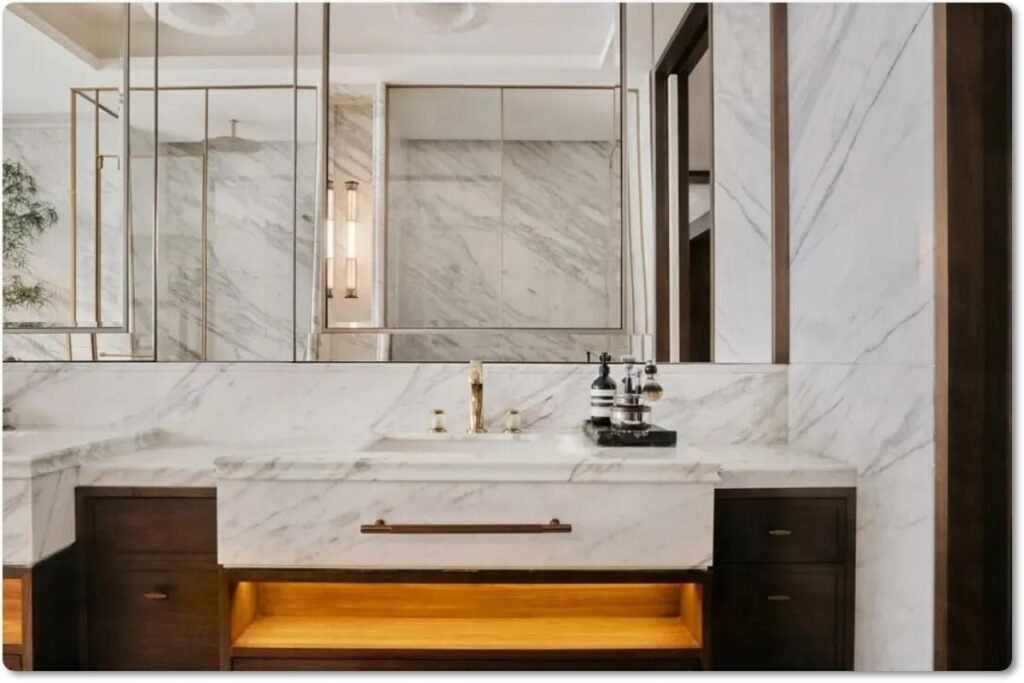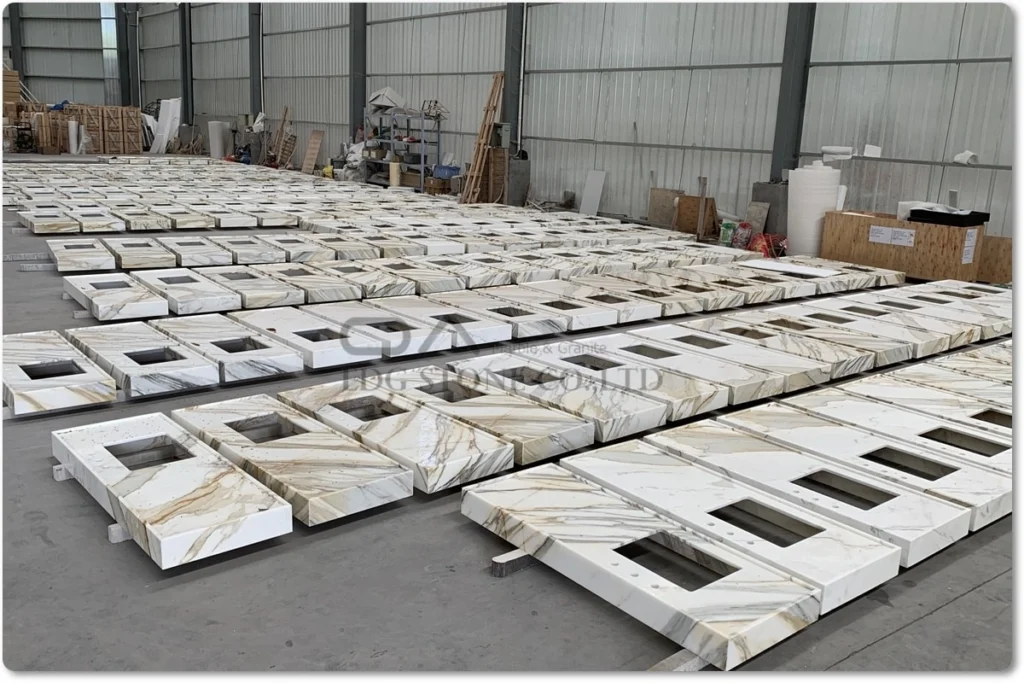
Quick Summary: Green Marble Types at a Glance
Green marble has become an increasingly recognizable material category in residential interiors, hospitality projects, luxury furniture, bathrooms, feature walls, countertops, tables, and architectural surfaces. Its appeal comes from the combination of green color, natural mineral movement, depth, and geological variation.
However, green marble is not one single stone.
The phrase “green marble” may describe materials with very different geological characteristics, origins, colors, patterns, densities, and commercial names. A light green stone from one quarry may look completely different from a dark green material sold under a similar market name. Likewise, terms such as Indian Green Marble, Emerald Green Marble, Forest Green Marble, and Dark Green Marble are commonly used in the marketplace but should not automatically be interpreted as internationally standardized classifications.
This guide explains the major green marble types, how to classify them by color and pattern, how Indian green marble fits into the broader category, and how professional buyers can evaluate green marble for architectural and interior projects.
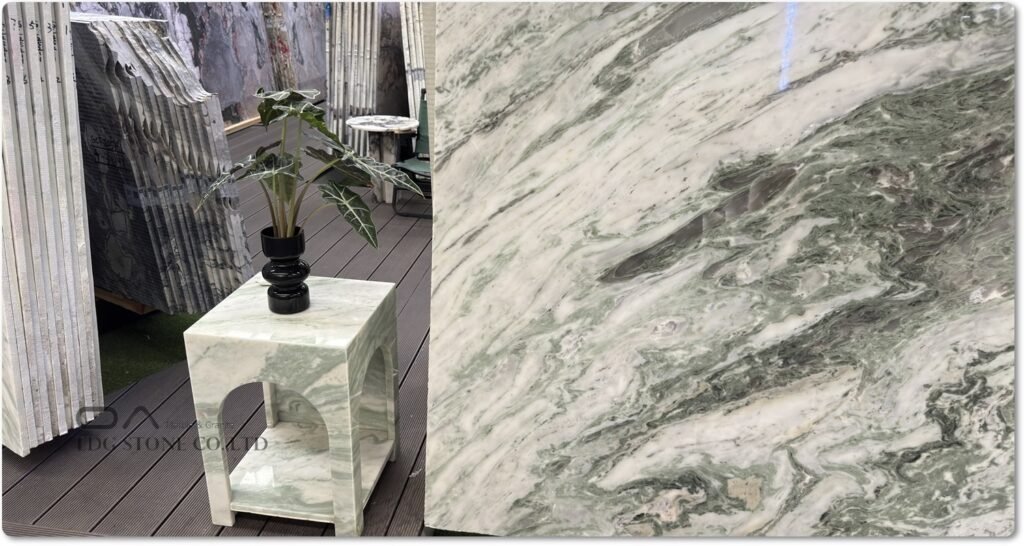
What Are the Main Green Marble Types?
Green marble types can be organized according to several practical classification systems.
The simplest is color:
- Light green marble
- Medium green marble
- Dark green marble
- Emerald green marble
- Forest green marble
A second method is based on pattern and veining:
- Plain green marble
- Veined green marble
- Clouded green marble
- Brecciated green marble
- Forest-patterned green marble
A third method is based on commercial selection:
- Commercial selection
- Select selection
- Premium selection
- Bookmatched / feature grade
These categories are useful for communication between buyers, designers, fabricators, and suppliers, but they should not be treated as a universal international grading system.
Why Green Marble Classification Is Not Universal
Natural stone is a geological material. Its appearance and physical characteristics can vary within the same quarry, block, or production lot.
Terms such as premium, select, first choice, or commercial can therefore have different meanings depending on the supplier and market.
For international procurement, the safest approach is to define the selection using measurable or visually verifiable characteristics rather than relying only on a commercial name.
For example, a purchase specification can identify:
- Dominant background color
- Veining direction
- Acceptable variation
- Maximum fissure size
- Filled or unfilled fissures
- Thickness tolerance
- Surface finish
- Slab dimensions
- Bookmatch requirements
- Allowed repairs
- Edge requirements
- Inspection procedure
This approach is more reliable than assuming that the word “premium” means the same thing worldwide.
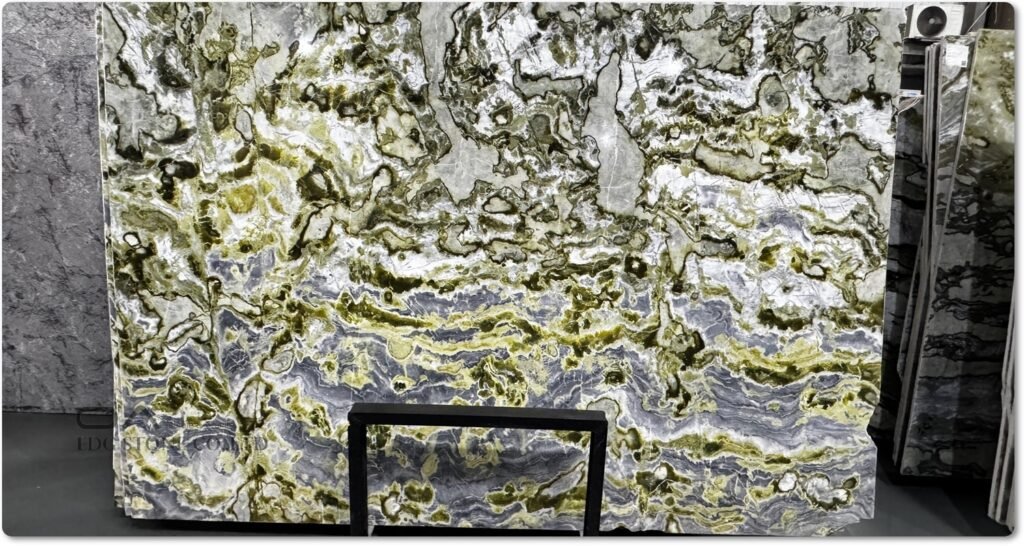
Green Marble Classification by Color
Color is usually the first characteristic buyers notice when comparing green marble.
The following five categories provide a practical visual framework.
Light Green Marble
Light green marble generally has a pale green, mint, sage, grey-green, or soft green background.
Depending on the quarry, the material may contain:
- White veins
- Grey veins
- Dark green movement
- Cloud-like mineral patterns
- Fine crystalline structures
Light green marble is often selected when a project requires a softer and less visually dominant stone.
Common Applications
Light green marble can be used for:
- Bathroom vanity tops
- Wall panels
- Flooring
- Decorative tiles
- Coffee tables
- Side tables
- Console tables
- Fireplace surrounds
- Hotel interiors
- Residential feature walls
For furniture, a light background can also make the natural pattern easier to integrate with wood, metal, glass, or neutral upholstery.
Medium Green Marble
Medium green marble sits between pale green and deep green materials.
It can include muted olive green, classic green, grey-green, and moderately saturated green backgrounds.
Medium green materials are often useful for projects seeking a recognizable green-stone appearance without the visual weight of very dark marble.
Dark Green Marble
Dark green marble is characterized by a deeper green background that may range from bottle green and hunter green to deep forest-like tones.
Dark green marble can contain:
- Black mineral movement
- White veins
- Gold or brown accents
- Dense green background
- Irregular natural movement
Dark green materials can create a stronger visual effect than light green marble.
They are frequently considered for:
- Luxury bathrooms
- Feature walls
- Hotel interiors
- Bars
- Reception areas
- Fireplace surrounds
- Dining tables
- Coffee tables
- Decorative furniture
- High-end residential interiors
Because darker surfaces can show scratches, dust, residue, polishing defects, and fingerprints more visibly, buyers should evaluate the intended finish and maintenance requirements carefully.
Emerald Green Marble
Emerald green marble generally refers to marble or marble-like natural stone with a vivid, saturated green appearance.
The term “emerald” is primarily a commercial and visual descriptor, not a universal geological classification.
Some emerald green materials feature:
- Bright green backgrounds
- Dark green movement
- White mineral veins
- Black inclusions
- Cloud-like structures
- Strong directional patterns
How Is Emerald Green Marble Different From Dark Green Marble?
The difference is primarily visual.
A dark green marble can have a relatively subdued or deep background, while an emerald green marble generally emphasizes higher color saturation and a brighter green appearance.
However, there is no universal color boundary separating the two.
For this reason, a professional buyer should request actual slab photographs, videos, samples, or inspection images instead of purchasing solely from the commercial name.
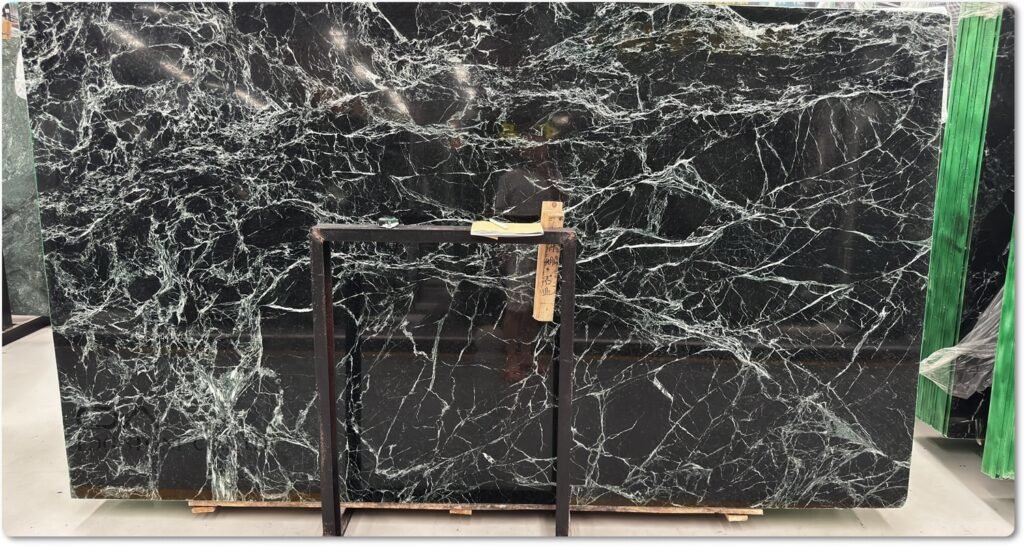
Forest Green Marble
Forest green marble usually describes deep or medium-deep green stone with complex natural movement resembling branches, foliage, clouds, or forest patterns.
Forest-patterned materials can contain several colors simultaneously, including:
- Dark green
- Medium green
- Black
- White
- Grey
- Brown
- Gold
The visual effect can become particularly dramatic when slabs are bookmatched.
Forest Green Marble for Feature Applications
Forest green marble can be particularly effective in applications where the stone itself is intended to become a design focal point.
Potential applications include:
- Feature walls
- Reception desks
- Hotel lobby installations
- Luxury bathroom walls
- Dining tables
- Coffee tables
- Decorative panels
- Fireplace surrounds
- Custom furniture
For these projects, buyers should evaluate the entire block or slab set rather than relying on a small sample.
Green Marble Classification by Pattern
Color alone does not fully describe green marble.
Two stones can have almost identical background colors but create completely different visual effects because of their patterns.
Plain Green Marble
Plain green marble has relatively limited visible veining or movement.
The surface may appear relatively uniform while still showing subtle natural variation.
Plain green materials can be useful when designers want green as a background color rather than a dramatic geological feature.
Veined Green Marble
Veined green marble contains visible linear or irregular veins.
Veins can be:
- White
- Grey
- Black
- Gold
- Brown
- Dark green
Veining direction is particularly important for large architectural applications.
For example, a horizontal installation may require slabs with consistent horizontal movement, while a feature wall may intentionally use bookmatched slabs.
Clouded Green Marble
Clouded green marble contains diffuse areas of color rather than sharply defined veins.
The surface can resemble:
- Clouds
- Smoke
- Waves
- Fluid movement
- Soft mineral transitions
This type of pattern can be particularly attractive on large slabs because the visual movement develops across the entire surface.
Brecciated Green Marble
Brecciated marble contains fragmented-looking geological patterns in which pieces or irregular zones appear surrounded by contrasting mineral material.
A green brecciated marble may combine:
- Green fragments
- White matrix
- Dark green areas
- Grey mineral structures
- Brown or gold accents
Because the pattern can be highly variable, buyers should pay particular attention to slab-to-slab consistency.
Forest-Patterned Green Marble
Forest-patterned green marble is a useful visual category for materials with complex branching, foliage-like, layered, or highly directional movement.
This is especially relevant for:
- Bookmatched walls
- Luxury tables
- Reception counters
- Decorative panels
- Fireplace features
The commercial value of such material can depend heavily on block selection and slab layout, not simply the stone’s base color.
Indian Green Marble: What Does the Term Mean?
Indian green marble is a broad commercial category covering green natural stones marketed from India.
The phrase can refer to different stones, quarry areas, commercial names, and visual varieties rather than one globally standardized material.
This distinction is important for international buyers.
A buyer searching for green Indian marble should not assume that every supplier using the phrase “Indian Green Marble” is offering exactly the same material.
Indian Green Marble Selection Factors
When purchasing Indian green marble, evaluate:
- Quarry or source
- Commercial stone name
- Slab photographs
- Block photographs where available
- Background color
- Veining
- Pattern consistency
- Fissures
- Filled areas
- Thickness
- Surface finish
- Available slab sizes
- Intended application
- Packing and export requirements
The actual material should be approved before mass production.
Green Dark Marble vs. Dark Green Marble
The terms green dark marble and dark green marble are often used interchangeably in online searches.
From a professional procurement perspective, however, the exact phrase is less important than defining what the buyer expects visually.
A useful specification could state:
“Deep green background with limited visible white movement and predominantly dark green/black veining.”
This is much more precise than simply writing “dark green marble.”
For international B2B procurement, descriptive specifications help reduce misunderstandings caused by different naming conventions.
Green Marble Types by Commercial Selection
Natural-stone suppliers frequently use terms such as Commercial, Select, Premium, and Feature Grade.
These terms can be useful internally or commercially, but they are not universal global grades.
Commercial Selection
Commercial material may offer acceptable visual characteristics while allowing a broader range of natural variation.
It may be suitable for:
- Large-volume projects
- Flooring
- Wall cladding
- Commercial interiors
- Tiles
- Projects where natural variation is acceptable
The exact acceptance criteria should be agreed with the supplier.
Select Selection
Select material generally implies tighter visual requirements than a broader commercial selection.
Depending on the supplier, buyers may request:
- More consistent background
- Better overall pattern
- Reduced repairs
- Fewer visible defects
- Better slab presentation
Again, the definition should be documented in the purchase specification.
Premium Selection
Premium is commonly used for materials selected for stronger visual appeal or tighter quality requirements.
For green marble, premium selection may involve:
- More attractive color
- Better pattern
- Better block quality
- More consistent slabs
- Fewer visually distracting defects
- Better suitability for luxury applications
But premium does not have one internationally fixed definition.
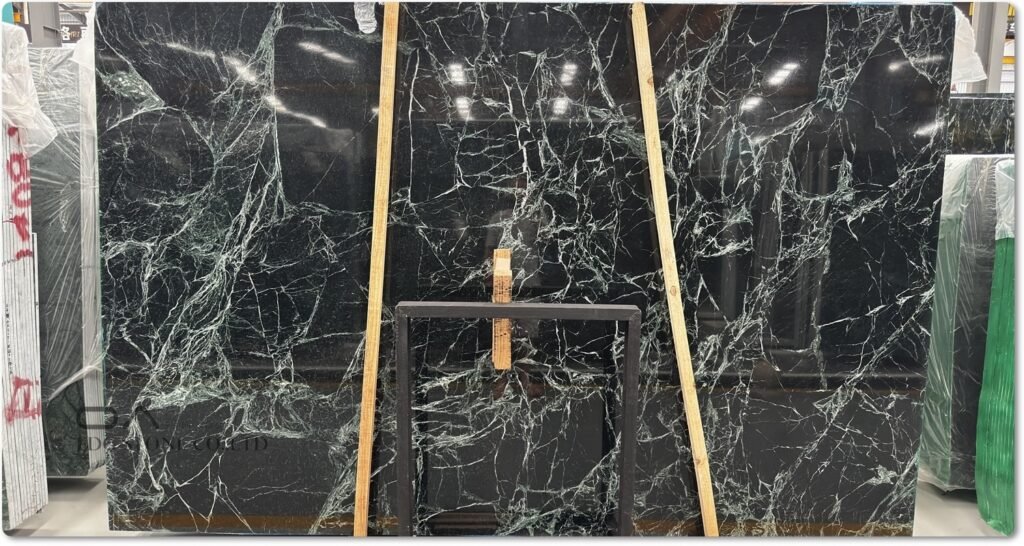
Bookmatched / Feature Grade
For highly decorative green marble, the most important factor may be the quality of the block and the resulting slab pattern.
Bookmatching involves cutting and arranging slabs so that their patterns mirror or visually correspond with one another.
Feature-grade procurement should therefore consider:
- Block size
- Slab sequence
- Vein direction
- Pattern continuity
- Slab pairing
- Thickness
- Surface finish
- Installation layout
A beautiful single slab is not necessarily enough for a successful bookmatched wall.
How to Choose the Right Green Marble Type
The right green marble depends on the project rather than on color alone.
For Minimalist Interiors
Consider:
- Light green marble
- Plain green marble
- Fine-veined green marble
These materials can provide color without overwhelming the interior.
For Luxury Interiors
Consider:
- Dark green marble
- Emerald green marble
- Forest green marble
- Strongly veined materials
These stones can become visual focal points.
For Feature Walls
Prioritize:
- Slab size
- Pattern continuity
- Vein direction
- Bookmatching potential
- Block quality
A dramatic forest-patterned material may perform better visually than a uniform stone when the wall is designed as a centerpiece.
For Tables and Furniture
For green marble tables, coffee tables, and side tables, evaluate:
- Slab thickness
- Edge profile
- Structural support
- Surface finish
- Fabrication quality
- Corner treatment
- Fissure filling
- Stain resistance requirements
Furniture also creates different structural demands from wall cladding or flooring.
Green Marble Countertops: What Should Buyers Check?
Green marble countertops can create a distinctive kitchen or bathroom appearance, but marble is a natural stone and should be evaluated according to the intended environment.
Buyers should consider:
- Water exposure
- Acidic food and beverage exposure
- Staining risk
- Surface finish
- Sealing requirements
- Fabrication method
- Edge profile
- Sink cutouts
- Slab thickness
- Maintenance expectations
For kitchen applications, the project specification should clearly distinguish between aesthetic requirements and performance requirements.
A supplier should not describe a material as suitable for every countertop environment simply because it is marketed as marble.
Green Marble Price: What Determines Cost?
There is no single global green marble price.
Pricing can vary according to:
- Quarry origin
- Material availability
- Block quality
- Slab size
- Thickness
- Color
- Pattern
- Selection
- Surface finish
- Processing
- Bookmatching
- Custom fabrication
- Packaging
- Order quantity
- Destination
- Freight and logistics
A dramatic feature-grade block may have a very different value from a commercially selected green marble even if both are sold under a similar color name.
A Better Way to Request a Green Marble Quote
Instead of asking only:
“What is the price of green marble?”
A B2B buyer can specify:
Green marble slab, 20 mm or 30 mm thickness, polished finish, target slab size, preferred color range, acceptable natural variation, required quantity, application, destination port, and whether bookmatching is required.
This produces a much more useful quotation.
Green Marble Quality Inspection Checklist
Before approving a shipment, professional buyers should establish a documented inspection checklist.
Visual Inspection
Check:
- Background color
- Pattern
- Veining
- Color variation
- Surface consistency
- Natural fissures
- Filled areas
- Repairs
- Scratches
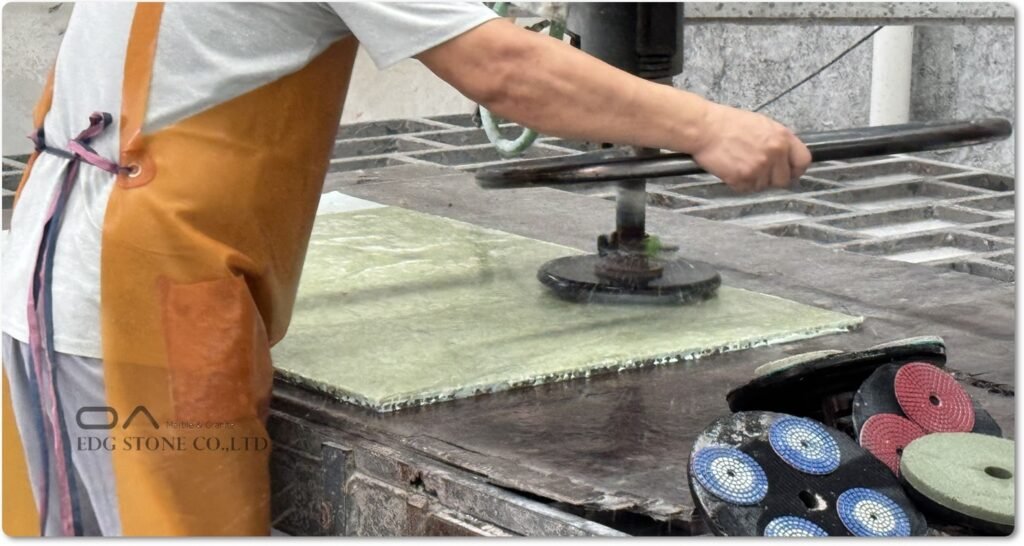
- Polishing quality
Dimensional Inspection
Verify:
- Length
- Width
- Thickness
- Squareness
- Edge condition
- Flatness where relevant
Physical Performance
Depending on the application, request appropriate technical information concerning:
- Water absorption
- Density
- Flexural strength
- Compressive strength
- Abrasion resistance
- Slip characteristics where relevant
The appropriate tests depend on the intended application and applicable project standards.
Green Marble and International Standards
International natural-stone procurement increasingly requires buyers to distinguish between commercial naming and technical documentation.
ASTM, EN, ISO, and other regional or project-specific standards may be relevant depending on the market and application.
For example, technical requirements can cover:
- Dimension and tolerance
- Physical properties
- Test methods
- Surface characteristics
- Installation
- Sustainability documentation
- Product declarations
The correct standard depends on the destination market and application.
Therefore, an exporter should confirm the buyer’s applicable specification before production rather than assuming that one testing framework satisfies every project.
Sustainability and Regulatory Direction for Natural Stone
The direction of the stone industry is increasingly toward greater transparency in material sourcing, environmental information, documentation, and supply-chain accountability.
For projects in the European market, buyers may encounter increasing attention to sustainability documentation, environmental product information, and broader construction-product requirements. In the United States and Canada, project specifications may similarly request environmental declarations, responsible sourcing information, or product documentation depending on the project.
The important procurement principle is:
Do not treat sustainability terminology as a universal certification category. Verify exactly what documentation the project requires.
For example, a buyer may request:
- Quarry origin
- Country of origin
- Material technical data
- Environmental documentation
- EPD where applicable
- Chain-of-custody information where applicable
- Packaging information
- Manufacturing information
- Compliance documentation
Requirements vary by jurisdiction, project type, owner, architect, and certification system.
How EDG Stone Approaches Green Marble Procurement
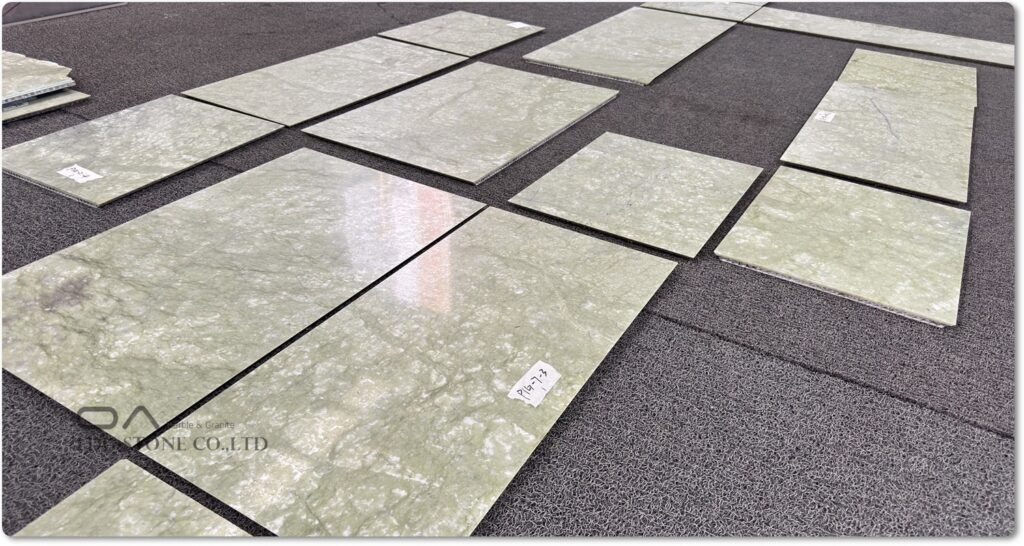
As a professional natural stone manufacturer and exporter, EDG Stone can support buyers looking for green marble slabs and custom stone applications by focusing on the actual material rather than relying only on commercial color names.
For international buyers, the procurement process can include:
- Green marble slab selection
- Color and pattern matching
- Custom sizing
- Cut-to-size fabrication
- Countertops
- Vanity tops
- Tables
- Coffee tables
- Side tables
- Wall panels
- Tiles
- CNC processing
- Waterjet processing
- Edge fabrication
- Sink cutouts
- Export packing
- Container loading
For feature-grade materials, slab sequencing and visual matching are particularly important.
A buyer purchasing green marble for a luxury project should ideally approve the actual slab images or production batch before fabrication.
Green Marble Buyer Guide: Questions to Ask a Supplier
Before placing an order, ask the supplier:
What is the exact stone name?
Do not rely only on “green marble.”
Ask for the commercial name and available origin information.
Where is the material sourced?
Request quarry or source information where commercially available.
Can you provide actual slab photos?
Stock photographs are not sufficient for high-value projects.
Are the slabs from the same block?
This matters for color and pattern consistency.
Is the material bookmatchable?
If bookmatching is required, confirm slab sequence and block availability.
What thicknesses are available?
Common project requirements may include different thicknesses depending on application and market.
Are fissures filled?
Clarify whether filling or resin treatment is present.
What finish is available?
Typical options may include:
- Polished
- Honed
- Leathered
- Brushed
- Other project-specific finishes
What technical data is available?
Request appropriate test information for the intended application.
Green Marble Types: Quick Comparison Table
| Type | Typical Visual Character | Common Applications | Main Procurement Consideration |
|---|---|---|---|
| Light Green Marble | Pale, soft green | Bathrooms, walls, furniture | Color consistency |
| Medium Green Marble | Balanced green | Interiors, flooring, furniture | Overall pattern |
| Dark Green Marble | Deep green | Luxury interiors, tables, walls | Surface quality and movement |
| Emerald Green Marble | Saturated vivid green | Feature applications | Actual slab color |
| Forest Green Marble | Deep green with complex movement | Feature walls, furniture | Block and pattern selection |
| Plain Green Marble | Limited movement | Minimalist interiors | Background uniformity |
| Veined Green Marble | Linear or irregular veins | Walls, countertops, furniture | Vein direction |
| Clouded Green Marble | Soft diffuse movement | Large surfaces | Slab-to-slab variation |
| Brecciated Green Marble | Fragmented pattern | Feature surfaces | Pattern consistency |
| Forest-Patterned Green Marble | Complex branching movement | Feature-grade projects | Bookmatching potential |
Green Marble Types for B2B Wholesale Buyers
Wholesale buyers should think differently from residential consumers.
A homeowner may select one attractive slab.
A distributor, fabricator, contractor, or hotel procurement team may need:
- Multiple slabs
- Repeatable color
- Stable supply
- Consistent thickness
- Reliable fabrication
- Export packaging
- Production scheduling
- Quality control
- Replacement capability
- Documentation
- Container logistics
For this reason, a green marble manufacturer, factory, or wholesale supplier should be evaluated not only on the appearance of one sample but also on its ability to manage the complete supply chain.
For large-volume orders, buyers should ask whether the supplier can reserve blocks, maintain slab sequence, photograph production, conduct pre-shipment inspection, and provide appropriate export packing.
Green Marble Factory vs. Trading Supplier
When sourcing green marble internationally, buyers may encounter:
- Quarry owners
- Block traders
- Slab processors
- Stone factories
- Fabricators
- Exporters
- Trading companies
- Integrated manufacturers
There is no single business model that automatically guarantees quality.
Instead, buyers should evaluate the supplier according to the requirements of the project.
For custom countertops, vanity tops, furniture, or architectural components, fabrication capability can be particularly important.
For raw slabs, block access and slab production may be more important.
For turnkey projects, fabrication, quality control, packing, documentation, and logistics become equally relevant.
Long-Tail Green Marble Keywords for Buyers
The following search terms can support commercial SEO and B2B discovery:
- green marble slabs supplier
- green marble manufacturer and exporter
- Indian green marble wholesale supplier
- dark green marble slabs manufacturer
- emerald green marble slab supplier
- forest green marble for countertops
- green marble slabs for walls
- green marble wholesale factory
- custom green marble countertops
- green marble table manufacturer
These keywords combine material intent + application intent + procurement intent, making them useful for product pages, category pages, case studies, and buyer guides.
Green Marble Classification: What Buyers Should Remember
The most important point is that green marble should not be classified by color name alone.
A useful procurement classification combines:
Color → Pattern → Origin → Selection → Application
For example:
Dark green + strongly veined + specified origin + premium visual selection + bookmatched feature wall
is a much more useful specification than:
Premium Green Marble
The first description communicates actual project requirements.
The second depends heavily on how an individual supplier defines “premium.”
Natural stone will always contain geological variation. The objective of professional procurement is therefore not to eliminate all variation, but to define acceptable variation before production and inspection.
Frequently Asked Questions About Green Marble Types
1. What are the main types of green marble?
The main practical color categories include light green, medium green, dark green, emerald green, and forest green marble. Green marble can also be classified by pattern, including plain, veined, clouded, brecciated, and forest-patterned materials. These are practical market classifications rather than one universal international grading system.
2. What is Indian green marble?
Indian green marble is a broad commercial category referring to green natural stones marketed from India. Different quarries and producers can offer materials with substantially different colors, patterns, and technical characteristics, so buyers should verify the actual stone rather than relying only on the term “Indian Green Marble.”
3. Is emerald green marble the same as dark green marble?
Not necessarily. Emerald green generally describes a more saturated and vivid green appearance, while dark green marble usually emphasizes depth of color. Because these are primarily visual and commercial descriptions, there is no universal boundary separating the two categories.
4. Is dark green marble good for countertops?
Dark green marble can be used for countertops when the specific material and application are appropriate. Buyers should evaluate water absorption, staining, acid sensitivity, finish, sealing, fabrication, maintenance, and the technical requirements of the project before approval.
5. How do I choose the best green marble slab?
Start with the intended application, then specify color, pattern, acceptable variation, slab size, thickness, finish, technical requirements, and budget. For high-end feature projects, inspect actual slabs and consider slab sequencing and bookmatching rather than choosing solely from a small sample.
Friendly Semantic Closure: How to Understand and Buy Green Marble?
What is the most useful way to classify green marble?
The most useful procurement model combines color, pattern, origin, commercial selection, and application. Light green, medium green, dark green, emerald green, and forest green describe visual color families, while plain, veined, clouded, brecciated, and forest-patterned describe geological appearance. These terms should be treated as practical descriptive categories rather than universal international grades.
Why can two green marble slabs with the same name look different?
Natural marble varies according to geological formation, quarry location, block, cutting direction, mineral composition, and production batch. Commercial names may also be used differently by different producers and markets. For this reason, professional buyers should approve actual slabs or representative production material whenever visual consistency is important.
Which green marble option should be considered for a feature project?
Feature applications often place greater emphasis on pattern, movement, slab size, block quality, and bookmatching potential than on color alone. Dark green, emerald green, and forest-patterned materials can provide strong visual effects, but the appropriate choice depends on the project’s design concept, available slab sequence, technical requirements, and budget.
What should buyers consider before purchasing Indian green marble?
Buyers should confirm the exact commercial stone name, source information, actual slab appearance, dimensions, thickness, finish, fissures, filling, technical data, available quantity, and production consistency. “Indian Green Marble” should not be assumed to describe one standardized stone.
How should green marble suppliers communicate quality?
Instead of relying only on terms such as “premium” or “first choice,” suppliers and buyers should define measurable or observable criteria. These can include color range, pattern, acceptable natural variation, fissures, repairs, thickness tolerance, surface finish, slab dimensions, and inspection procedures.
What is the broader procurement trend?
Natural-stone procurement is moving toward greater specification clarity, documentation, traceability, technical verification, and project-specific sustainability requirements. Buyers increasingly need to connect aesthetic selection with technical performance, environmental documentation where required, manufacturing information, packaging, and logistics.
Final Takeaway
Green marble offers one of the broadest visual ranges within decorative natural stone, from soft light green backgrounds to deep dark green, vivid emerald, and complex forest-patterned materials.
For buyers, the key is to move beyond the simple question “Which green marble is best?”
A more useful procurement question is:
Which combination of color, pattern, origin, selection, technical performance, slab format, and fabrication capability matches this project?
That approach allows architects, designers, contractors, distributors, stone fabricators, hospitality buyers, and international importers to communicate more accurately with a green marble manufacturer, factory, supplier, or exporter.
For projects requiring consistent color, large slabs, custom fabrication, bookmatching, countertops, vanity tops, tables, wall panels, or other finished stone products, the actual material and production capability should be evaluated together.
Natural stone is inherently variable. Professional green marble procurement is therefore not about pretending that every slab is identical—it is about understanding the variation, defining acceptable variation, selecting the right material, and controlling the production process accordingly.