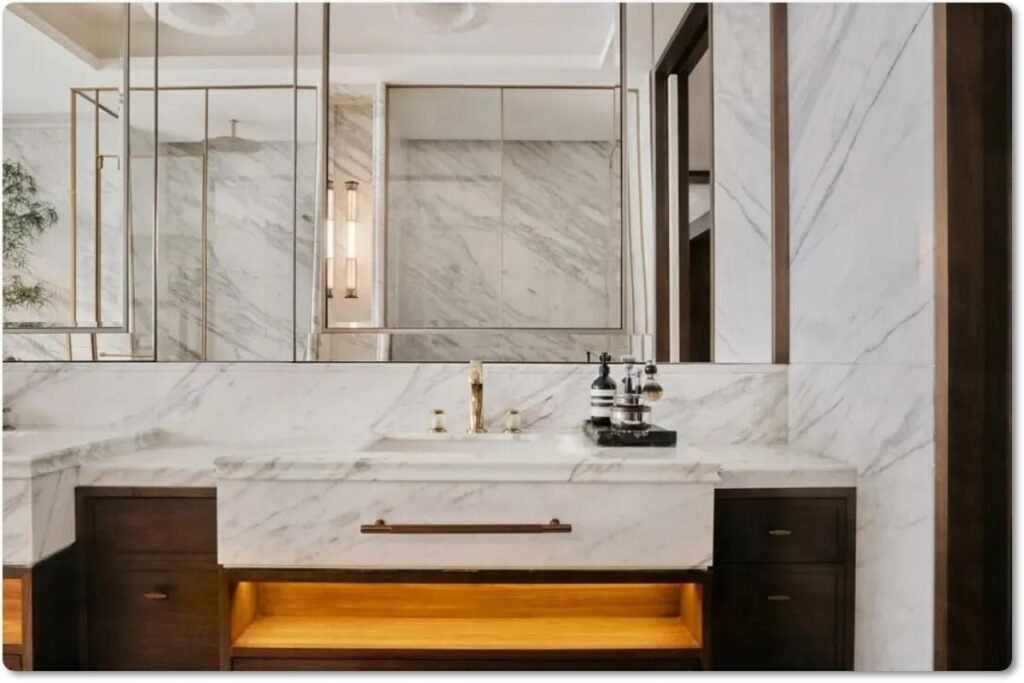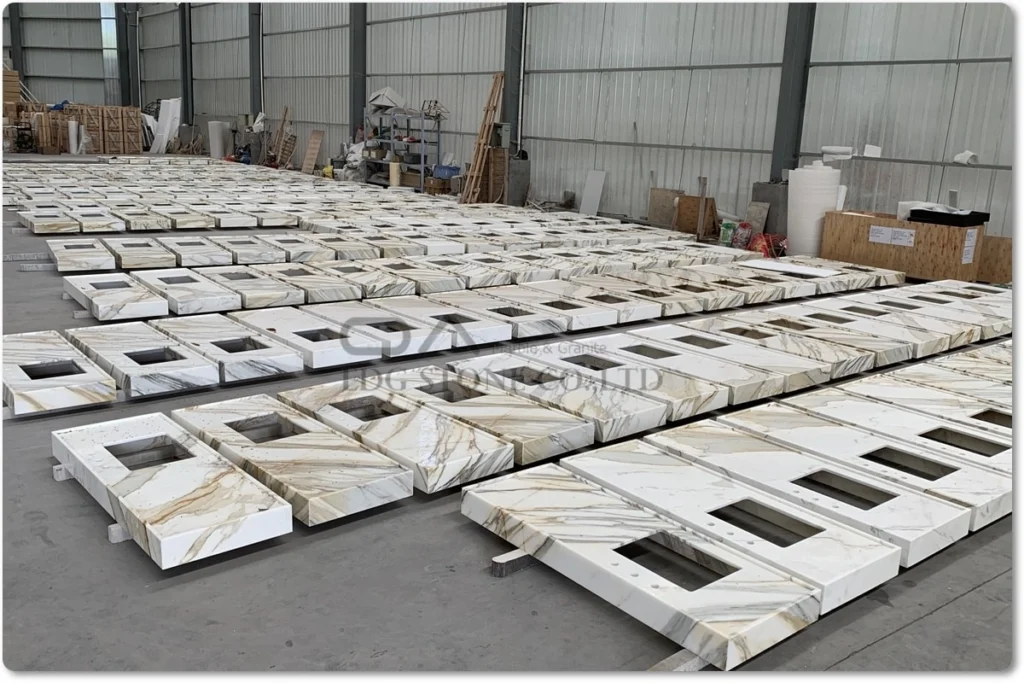
What is Indian green marble? Indian green marble is a commercial category of natural decorative stone quarried and processed in India. Some commercially marketed green marbles are true metamorphosed carbonate rocks, while others—particularly serpentine-rich materials—are commercially classified and sold as marble because they can be cut, polished, and used as architectural stone.
Where does Indian green marble come from? Rajasthan is the principal geographic reference for many Indian green marble varieties, particularly the Udaipur region and other Rajasthan marble-producing districts. Gujarat is another important source of green decorative stone, including materials marketed as Gujarat Green or Ambaji Green.
Why does origin matter? Geographic origin provides useful information about geology and typical appearance, but it does not guarantee a uniform product. Quarry face, bench, block, cutting direction, and processing method can all influence the final slab appearance.
Indian green marble is one of the most recognizable categories in the international natural-stone market. Its appeal comes from the combination of green backgrounds, mineral movement, contrasting veins, and the ability to transform a relatively ordinary architectural surface into a highly visual design element.
However, the phrase “Indian green marble” does not describe one single stone.
For architects, contractors, importers, stone distributors, and international buyers, this distinction is critical. A buyer searching for Indian green marble slabs may encounter Udaipur Green, Bidasar Green, Rainforest Green, Baroda Green, Gujarat Green, Ambaji Green, and other regional or commercial names. These names can describe different geological materials, different quarry areas, or commercial classifications used by the stone trade.
The most useful way to understand the category is therefore:
India → State → Quarry Region → Commercial Name → Geological/Visual Characteristics → Block → Slab → Application
This guide explains that structure and provides a practical framework for selecting Indian green marble for residential, hospitality, commercial, and custom-fabrication projects.
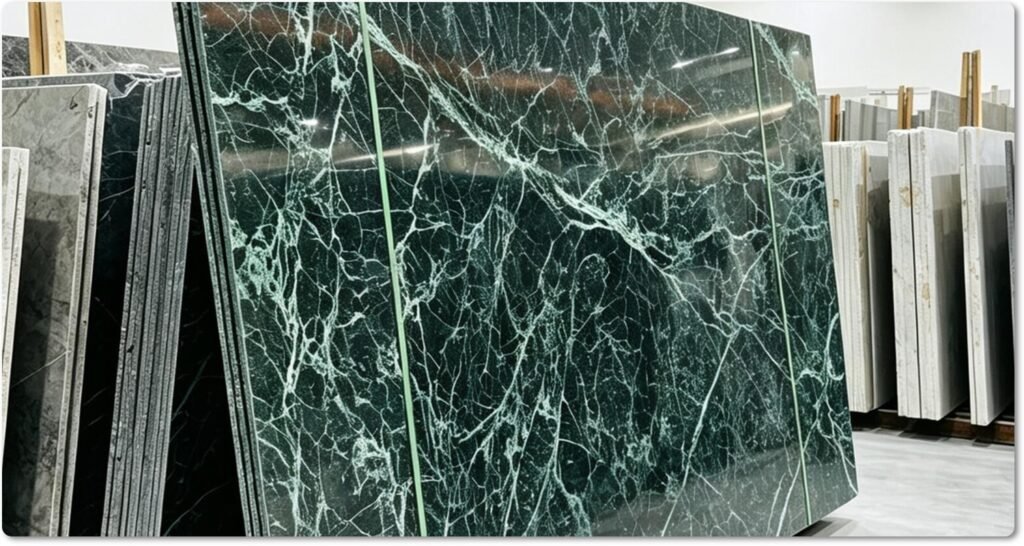
1. What Is Indian Green Marble?
Indian green marble is a broad commercial term for green natural stones quarried in different parts of India and processed into blocks, slabs, tiles, and custom architectural products.
From a geological perspective, not every stone sold as “green marble” is identical.
The Indian Bureau of Mines explains that marble is commercially classified more broadly than its strict geological definition. In commercial practice, attractive serpentine rocks capable of taking a good polish may also be marketed as marble. This is particularly relevant to Indian green marble because serpentine-rich materials can display strong green coloration and are widely used as decorative stone.
1.1 Geological marble vs. commercial marble
A geological definition of marble generally refers to recrystallized carbonate rock formed through metamorphism.
Commercial stone terminology is less restrictive.
A natural stone may be marketed as marble when it:
- has a decorative appearance;
- can be quarried into usable blocks;
- can be sawn into slabs or tiles;
- accepts polishing or other finishes;
- performs adequately for its intended architectural application;
- has an established commercial identity.
This distinction explains why green Indian marble can include materials with substantially different mineral compositions.
1.2 Why green color occurs
Green coloration can be associated with minerals such as:
- serpentine;
- chlorite;
- amphibole;
- other metamorphic minerals;
- mineral inclusions and secondary alteration products.
The exact mineral assemblage varies according to geological origin.
For buyers, the practical implication is simple:
Do not use color alone to identify Indian green marble.
Two slabs may both appear dark green but behave differently during fabrication, polishing, sealing, or installation.
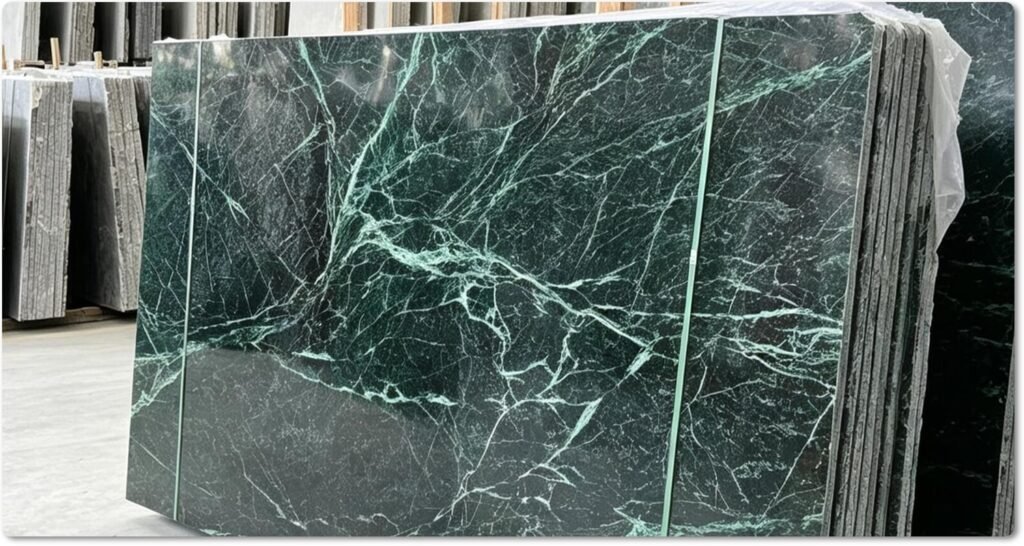
2. India → Rajasthan: The Core Indian Green Marble Supply Region
Rajasthan is central to India’s dimensional-stone industry and is particularly important when discussing Indian marble.
The Indian Bureau of Mines reports marble occurrences across numerous Rajasthan districts, including Udaipur, Rajsamand, Dungarpur, Chittorgarh, Sirohi, Nagaur, Ajmer, and others. The same government mineral review also notes that marble is commercially marketed under numerous names based on color, shade, and pattern.
Rajasthan’s importance is therefore not simply a matter of production volume. It is also a matter of variety and established commercial stone infrastructure.
The state’s stone ecosystem includes:
- quarrying;
- block extraction;
- block trading;
- gangsaw processing;
- slab polishing;
- resin treatment;
- edge fabrication;
- tile production;
- stone warehousing;
- domestic distribution;
- international export.
For an overseas buyer, this creates a mature supply chain from quarry block to finished slab.
3. Udaipur Green Marble: Origin, Appearance and Commercial Importance
3.1 Where is Udaipur Green Marble from?
Udaipur is one of the most important geographic references for Indian green marble.
The Rajasthan Department of Mines & Geology’s District Survey Report for Udaipur describes the Rikhabdeo Green Marble deposit and explains that green marble is commercially associated with serpentine marble. The report identifies green-marble occurrences extending through areas including Parsad, Jhadol and Rikhabdeo and into Dungarpur, with continuation toward Idar in Gujarat.
This geological continuity is important because commercial stone boundaries do not always correspond neatly to administrative boundaries.
3.2 Udaipur Green Marble appearance
Typical Udaipur-region green marble can range from:
- light green;
- medium green;
- dark green;
- bottle green;
- green with white mineral structures;
- green with darker mineral movement.
The Rajasthan government report describes Rikhabdeo Green Marble as light to dark bottle green, fine-grained, with intersecting calcite and magnetite features. It also reports that large blocks can be extracted from identified deposits.
This explains why Udaipur green marble can produce both relatively uniform slabs and highly patterned decorative material.
3.3 Udaipur Green Marble in official construction specifications
The commercial identity of Udaipur Green is not merely a stone-market nickname.
India’s Central Public Works Department has specifically listed “Udaipur green marble slab” in its construction rate documentation. CPWD’s 2021 DSR lists Udaipur green marble slab, plain, 18 mm thick, as a separate material item.
Even more significantly for procurement research, CPWD’s 2023 analysis includes a dedicated section for Udaipur green marble, specifying marble slab quantities, wastage assumptions, and construction cost calculations.
This provides strong evidence that Udaipur Green Marble has an established identity within India’s professional construction and procurement ecosystem.
4. Udaipur, Rikhabdeo and the Green Marble Quarry Belt
The term “Udaipur Green Marble” should not automatically be interpreted as coming from one individual quarry.
The Udaipur District Survey Report identifies multiple green-marble mining locations, including:
- Dhelana;
- Khanmin;
- Bilkhai;
- Bhadawa;
- Pipaldara;
- Saru;
- Ugmana Kotra;
- areas around Jhadol;
- areas around Sultanji Ka Kherwada;
- Bhutala;
- Modi;
- Chhippala;
- Undithal;
- Kalighati;
- Kankan Ka Guda.
The report also describes the broader geological occurrence from the northern Gogunda area toward Kherwara, Dungarpur and into Gujarat.
Why this matters to buyers
A purchasing specification such as:
“Indian Green Marble – Udaipur origin”
may still leave important questions unanswered.
A professional RFQ should additionally specify:
- quarry or quarry belt;
- commercial name;
- preferred color range;
- vein density;
- acceptable natural features;
- slab size;
- thickness;
- finish;
- resin treatment;
- acceptable shade variation;
- application.
This turns a vague stone name into a procurement specification.
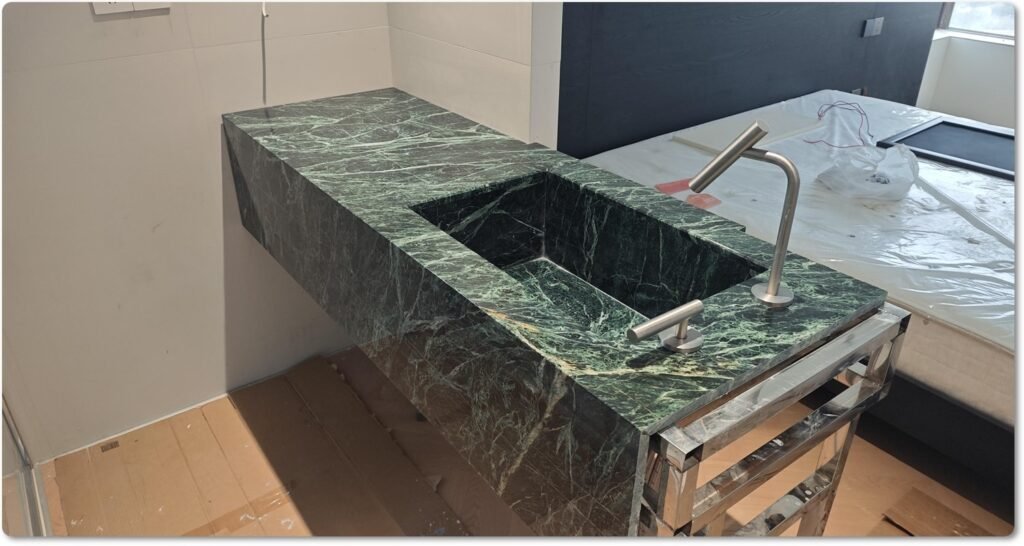
5. Bidasar Green Marble: A Different Commercial Identity
Bidasar Green Marble is another well-known Indian green stone.
It is frequently marketed internationally as Bidasar Green, Green Bidasar, or Rainforest Green Marble.
Unlike more uniform green stones, Bidasar Green is often chosen for its dramatic natural movement.
5.1 Appearance
Typical Bidasar Green may feature:
- green background;
- brown or reddish-brown movement;
- root-like patterns;
- branching mineral structures;
- irregular veins;
- strong visual contrast.
The pattern is one of the material’s primary commercial characteristics.
5.2 Why Bidasar Green is difficult to standardize
Bidasar Green can vary considerably from block to block.
The same commercial name does not guarantee identical:
- background color;
- vein direction;
- vein density;
- pattern scale;
- brown-to-green ratio;
- natural voids;
- mineral inclusions.
Commercial stone references also identify Bidasar Green with Rajasthan and describe its variability between blocks.
Therefore, buyers purchasing Bidasar Green should evaluate actual slabs rather than relying solely on catalog photographs.
5.3 Bookmatching Bidasar Green
Because Bidasar Green can have strong directional patterns, bookmatching is often used to create symmetrical wall panels, feature walls and luxury interiors.
A block can be sawn sequentially so that adjacent slabs preserve the natural pattern relationship.
For architectural projects, buyers should request:
- block photographs;
- slab sequence photographs;
- slab numbers;
- dry layout;
- bookmatch layout;
- final installation orientation.
This is particularly important for hotels, luxury residences and large feature walls.
6. Baroda Green Marble: Understanding the Commercial Name
The name Baroda Green Marble has historical importance in Indian stone terminology.
The Rajasthan Department of Mines & Geology notes that green marble was historically known from Baroda, Gujarat, where it was mined and marketed under the trade name “Green Marble.” Later discoveries of green marble in Udaipur and Dungarpur helped expand the category and its commercial popularity.
This is an excellent example of why commercial names should not automatically be treated as precise geological identifiers.
“Green Marble” may refer to a commercial family rather than one standardized geological product.
For international buyers, the correct question is therefore not:
“Is this called Baroda Green?”
but:
“What is the quarry origin, geological material, block source and current commercial classification of this stone?”
7. Ambaji and Gujarat Green Marble
7.1 Gujarat as a green marble source
Gujarat is another important geographic reference for Indian green marble.
Commercial stone databases identify Gujarat Green Marble and Ambaji Green Marble with the Ambaji/Banaskantha area of Gujarat.
The broader geological continuity described by Rajasthan’s Udaipur District Survey Report is also relevant because green-marble-bearing rocks extend from Rajasthan toward Gujarat.
7.2 Ambaji Green
Ambaji Green is commercially associated with green decorative stone from the Ambaji region.
Commercial suppliers describe Ambaji Green as a medium green material, with lighter and darker variants also appearing in the market.
For buyers, this reinforces a recurring principle:
Regional names identify a market category; the quarry block determines the actual appearance.
8. Indian Green Marble Regional Comparison
| Region | Common Commercial Names | Typical Visual Direction | Procurement Focus |
|---|---|---|---|
| Udaipur, Rajasthan | Udaipur Green, Rikhabdeo Green | Green to bottle green, mineral movement | Color consistency, block quality, slab uniformity |
| Bidasar, Rajasthan | Bidasar Green, Rainforest Green | Green with strong brown/root-like movement | Vein layout, bookmatching, natural voids |
| Baroda, Gujarat | Baroda Green | Commercial green marble category | Verify exact quarry and material identity |
| Ambaji, Gujarat | Ambaji Green, Gujarat Green | Medium to light/dark green variations | Shade, availability, quarry source |
| Dungarpur/Udaipur belt | Various regional green marble names | Green serpentine-rich materials | Exact quarry and geological characteristics |
Important: commercial names and geographic associations can overlap in the marketplace. A purchase specification should always request the exact quarry/block source rather than assuming that a trade name represents a single standardized material.
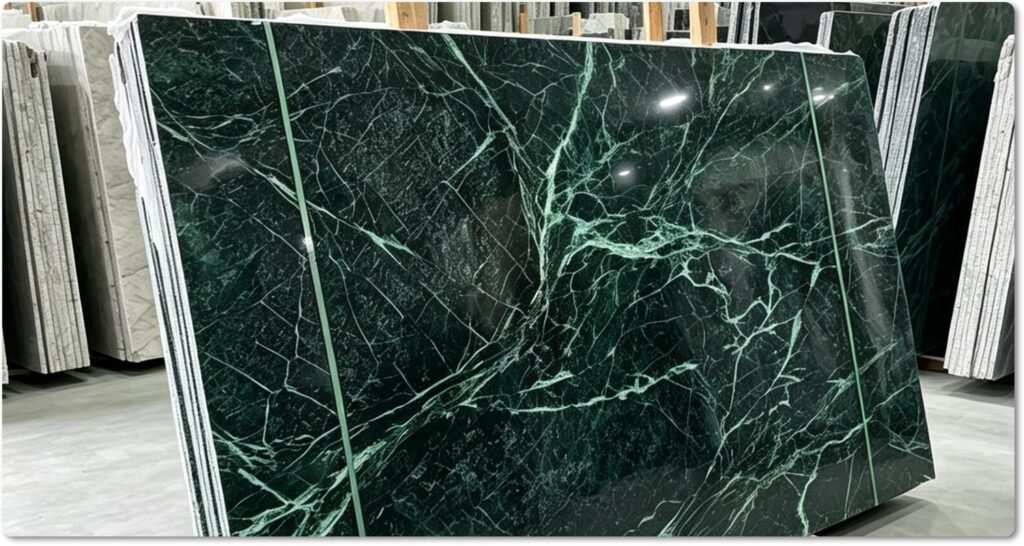
9. Quarry Variability: Why One Green Marble Is Not Always the Same
One of the biggest mistakes in natural-stone purchasing is treating a quarry name like a manufactured SKU.
Natural stone is different.
A quarry is a geological formation with three-dimensional variation.
Even within one quarry, differences may occur between:
- benches;
- quarry faces;
- extraction levels;
- blocks;
- cutting directions;
- production batches.
9.1 What can change from block to block?
A buyer may see differences in:
Background color
Dark green and light green blocks can occur within the same commercial family.
Vein structure
Veins can become thicker, thinner, more concentrated, or more dispersed.
Pattern direction
Some blocks produce horizontal movement; others produce diagonal or branching movement.
Natural fractures
Jointing and micro-fractures influence block recovery and final slab yield.
Calcite and mineral inclusions
These can create white, grey, black, or contrasting structures.
Void structure
Some decorative stones can contain natural cavities requiring resin treatment.
9.2 The practical lesson
Never approve an Indian green marble project solely from a single small sample.
For commercial projects, the approval process should ideally progress through:
Sample → Block photos → Slab photos → Slab sequence → Dry layout → Production approval → Final QC
10. How Indian Green Marble Blocks Become Finished Slabs
Understanding slab production helps buyers evaluate quality.
10.1 Quarry extraction
The first stage is extracting a commercially viable block from the quarry.
The target is not simply “a large block.”
The ideal block should offer a favorable combination of:
- dimensions;
- structural integrity;
- visual quality;
- recovery;
- limited fracturing;
- desirable pattern;
- acceptable natural features.
10.2 Block inspection
Before sawing, the block should be assessed for:
- cracks;
- open joints;
- voids;
- color;
- vein orientation;
- dimensions;
- usable recovery.
For highly patterned green marble, photographs of all block faces are extremely useful.
10.3 Block sawing
Blocks are sawn into slabs using a gangsaw or other suitable stone-processing equipment.
Cutting direction matters.
A block can produce substantially different visual patterns depending on how it is opened.
10.4 Resin treatment
Some green marbles may contain natural cavities or micro-defects.
Resin treatment can be used to stabilize or fill selected natural features before polishing.
The buyer should distinguish between:
- natural mineral movement;
- resin-filled voids;
- repaired cracks;
- surface treatment.
A professional supplier should disclose relevant treatment when requested.
10.5 Polishing and finishing
Typical finishes include:
- polished;
- honed;
- leathered;
- brushed;
- sanded;
- sawn;
- other project-specific finishes.
Polished finishes generally maximize color depth and pattern contrast, while honed finishes produce a softer visual effect.
11. How to Select Indian Green Marble Blocks
11.1 Start with the application
The application determines the appropriate selection criteria.
For example:
Interior feature wall
Prioritize:
- pattern;
- color;
- bookmatching;
- slab size;
- visual continuity.
Hotel lobby
Prioritize:
- consistency;
- large-format slab availability;
- repeatability;
- slip considerations where applicable;
- stain and maintenance requirements;
- replacement availability.
Vanity top
Prioritize:
- slab integrity;
- fabrication compatibility;
- sink-cutout position;
- edge condition;
- sealing;
- maintenance expectations.
Flooring
Prioritize:
- abrasion;
- slip considerations;
- finish;
- thickness;
- expected traffic;
- installation system.
Kitchen countertop
Marble requires additional consideration because carbonate-rich stones can be susceptible to acid etching. Buyers should confirm the actual stone composition and project requirements rather than assuming that all green marble has identical performance.
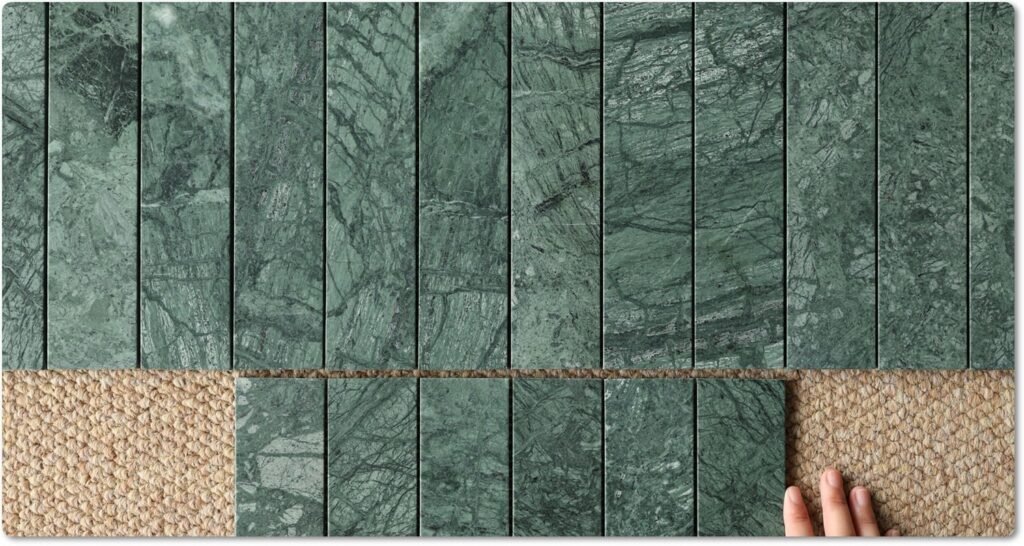
12. Indian Green Marble Slabs: What Buyers Should Specify
A professional purchase order should include more than:
“Indian Green Marble, polished.”
A better specification includes:
| Specification | Example Requirement |
|---|---|
| Origin | India |
| Region | Rajasthan / Gujarat |
| Quarry | Specific quarry or approved source |
| Commercial name | Udaipur Green / Bidasar Green etc. |
| Color | Dark/medium/light green |
| Pattern | Plain/moderate/dramatic |
| Veining | Direction and density |
| Thickness | 18 / 20 / 30 mm |
| Finish | Polished / honed |
| Slab size | Project-specific minimum |
| Resin | Allowed / not allowed/disclose treatment |
| Natural features | Define acceptable range |
| Bookmatch | Required / optional |
| Inspection | Photos + physical inspection |
| Packing | Export seaworthy packing |
| Documentation | Origin and shipping documentation |
This specification substantially reduces the risk of misunderstanding between buyer and supplier.
13. Indian Green Marble Quality-Control Checklist
Before shipment, international buyers should verify:
A. Visual QC
- background color;
- pattern consistency;
- vein direction;
- color variation;
- polishing quality;
- resin visibility;
- edge condition.
B. Dimensional QC
- slab thickness;
- length and width;
- squareness;
- flatness;
- calibration where applicable.
C. Structural QC
- cracks;
- open fissures;
- repaired areas;
- resin-filled voids;
- weak corners.
D. Production QC
- slab sequence;
- block number;
- lot number;
- finish consistency;
- packing sequence.
E. Export QC
- protective packing;
- A-frame or suitable slab packing;
- moisture protection;
- container loading;
- weight distribution;
- shipping documentation.
For high-value architectural projects, photographing every slab before packing can create a useful digital approval record.
14. Indian Green Marble Applications
Indian green marble is suitable for a wide range of decorative and architectural applications when the selected material is technically appropriate.
Common applications include:
- wall cladding;
- feature walls;
- flooring;
- hotel lobbies;
- reception counters;
- vanity tops;
- tabletops;
- coffee tables;
- side tables;
- dining tables;
- fireplace surrounds;
- decorative panels;
- mosaics;
- stair components;
- window sills;
- fountains;
- custom stone furniture.
Udaipur-region green marble is specifically documented by CPWD for wall lining, kitchen platforms, vanity counters, window sills, fascias, and related applications.
The most dramatic green stones, such as highly patterned Bidasar/Rainforest-type materials, are particularly suited to applications where the natural pattern is part of the design concept.
15. Indian Green Marble vs. Green Quartzite and Green Quartz
The word “green” alone is not enough to specify a stone.
Buyers should distinguish:
Indian Green Marble
Natural stone with marble/serpentine commercial classifications and highly variable mineral composition.
Green Quartzite
A quartz-rich metamorphic stone with different physical characteristics and typically higher hardness.
Green Quartz
Usually an engineered or naturally occurring quartz-based material depending on the product category.
Green Porcelain / Sintered Stone
Manufactured surfaces with controlled color and pattern.
The choice depends on the project’s:
- aesthetic objective;
- fabrication method;
- maintenance expectations;
- chemical exposure;
- traffic;
- budget;
- availability;
- design continuity.
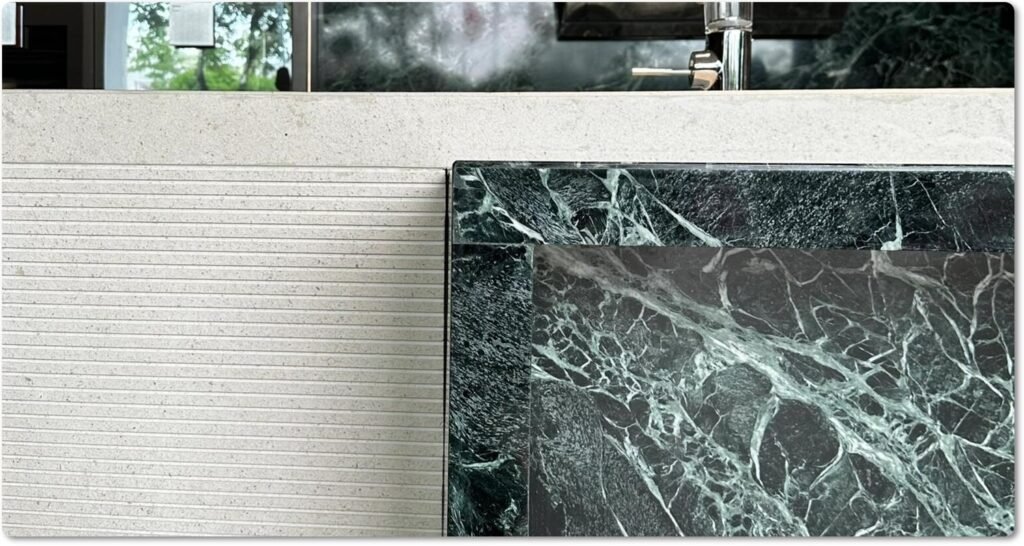
16. 2026 Regulatory and Sustainability Direction for Indian Marble Buyers
The Indian natural-stone industry is increasingly operating within a more formal framework for mineral regulation, environmental approvals, mining administration and traceability.
The Indian Bureau of Mines’ 2024 Mineral Yearbook emphasizes the continuing relevance of the National Mineral Policy 2019, legislative developments in the mining sector and stronger attention to sustainable mining practices.
Rajasthan’s Department of Mines & Geology also provides dedicated systems covering mining leases, environmental clearance, pollution-control permissions, mineral administration and online mineral movement documentation.
For exporters and international buyers, this direction has several practical implications.
16.1 Quarry traceability
Buyers should increasingly expect suppliers to identify:
- quarry/source;
- block;
- processing location;
- commercial material;
- production lot.
16.2 Environmental compliance
Mining projects can be subject to environmental-clearance requirements under India’s environmental regulatory framework. The official PARIVESH system provides access to environmental-clearance processes and EIA-related notifications and amendments.
Therefore, a professional Indian marble supplier should be able to explain the sourcing chain and relevant compliance documentation when required.
16.3 Digital mineral movement
Rajasthan’s mining administration uses digital mineral-transit documentation, including e-Rawanna records for mineral movement. Current government records demonstrate the use of online documentation for marble transportation and royalty-related administration.
This supports a broader industry trend:
Natural-stone procurement is moving from informal material descriptions toward documented source, processing and logistics information.
17. How to Buy Indian Green Marble from an Indian Marble Supplier
If you are sourcing Indian green marble internationally, use the following procurement sequence.
Step 1: Define the commercial name
Start with:
Udaipur Green / Bidasar Green / Ambaji Green / Gujarat Green
but do not stop there.
Step 2: Request the actual quarry origin
Ask:
Which quarry or quarry belt is this material from?
Step 3: Request current block photographs
Do not rely exclusively on old showroom photos.
Step 4: Request slab sequence
For patterned stones, request:
- slab 1;
- slab 2;
- slab 3;
- slab 4.
Step 5: Approve the visual range
Define:
- green tone;
- pattern density;
- acceptable brown/white mineral content;
- acceptable natural features.
Step 6: Approve fabrication
For countertops, vanities, and furniture, review CAD drawings before production.
Step 7: Perform final QC
Photographs and videos should be taken before packing.
Step 8: Confirm export packing
Stone is heavy and brittle. Packing and container loading are part of product quality, not merely logistics.
18. Why Quarry Knowledge Is More Important Than a Stone Name
One of the most important lessons for professional stone procurement is:
A commercial stone name is a starting point—not a complete technical specification.
“Indian Green Marble” identifies a market category.
“Rajasthan Green Marble” narrows the geographic range.
“Udaipur Green Marble” narrows the commercial and regional identity further.
But only information about the actual quarry, block, and slab lot can tell the buyer what material will arrive for a specific project.
This is especially important for:
- large hotel projects;
- luxury residential developments;
- commercial wall cladding;
- bookmatched feature walls;
- stone furniture;
- large vanity programs;
- custom countertops.
For these projects, the buyer should purchase a controlled visual lot, rather than simply purchasing a generic stone name.
19. EDG Stone: Indian Green Marble Sourcing and Custom Fabrication
For international buyers who need Indian green marble combined with custom processing, a capable stone manufacturer/exporter can add value after the raw slab stage.
EDG Stone works with natural stone products and custom stone fabrication for international projects, including:
- stone countertops;
- vanity tops;
- stone furniture;
- custom cut-to-size components;
- CNC processing;
- waterjet fabrication;
- edge processing;
- sink cutouts;
- architectural stone components;
- project-based stone fabrication.
For a green marble project, the procurement workflow can therefore extend from material selection → slab approval → CAD drawing → fabrication → QC → export packing → container loading.
This approach is particularly useful when the buyer does not simply need slabs but requires finished components for hospitality, residential, multifamily or commercial projects.
20. Indian Green Marble Buyer Decision Framework
When comparing different Indian green marble options, use five levels of evaluation.
Level 1 — Origin
Where was the stone quarried?
Level 2 — Commercial Identity
What is the material called in the market?
Level 3 — Visual Characteristics
What are the:
- background;
- veins;
- mineral patterns;
- color variations?
Level 4 — Technical Characteristics
What are the:
- absorption;
- density;
- strength;
- abrasion behavior;
- finish performance;
- fabrication characteristics?
Level 5 — Project Suitability
Does the specific block/lot meet the requirements of the intended application?
This five-level framework is more reliable than selecting stone by an attractive photograph alone.
21. Frequently Asked Questions About Indian Green Marble
FAQ 1: What is Indian green marble?
Indian green marble is a broad commercial category of green natural decorative stones quarried in India. Rajasthan is especially important, with Udaipur and surrounding areas associated with green serpentine marble, while Gujarat also supplies green marble varieties.
FAQ 2: Where is Indian green marble quarried?
Major geographic references include Rajasthan and Gujarat. Rajasthan’s Udaipur and surrounding green-marble belts are particularly important, while Bidasar is associated with another well-known patterned green marble category. Gujarat’s Ambaji/Banaskantha area is also associated with Gujarat or Ambaji Green Marble.
FAQ 3: What is Udaipur Green Marble?
Udaipur Green Marble is a commercially established green marble category associated with the Udaipur region of Rajasthan. Rajasthan’s Department of Mines & Geology describes Rikhabdeo Green Marble as serpentine marble ranging from light to dark bottle green, and CPWD separately identifies Udaipur green marble slab in its construction documentation.
FAQ 4: What is Bidasar Green Marble?
Bidasar Green Marble is a strongly patterned green natural stone commercially associated with Bidasar/Rajasthan and commonly marketed internationally as Rainforest Green Marble. Its green background and contrasting brown or root-like movement can vary significantly between blocks, making slab and block selection important.
FAQ 5: How do I choose the best Indian green marble?
Start with the intended application, then specify geographic origin, quarry, commercial name, color range, pattern, slab thickness, finish, acceptable natural features, and technical requirements. For large projects, approve actual blocks and slab sequences rather than relying only on catalog samples.
22. Semantic Closure: How to Think About Indian Green Marble in 2026
Indian Green Marble: Procurement Insight & Market Interpretation
What defines Indian green marble?
Indian green marble is not one standardized stone. It is a commercial family of green decorative stones whose appearance and mineral characteristics depend on geological origin, quarry location, extraction conditions, and processing direction.
How should buyers interpret regional names?
Rajasthan, Udaipur, Bidasar, Baroda, Ambaji and Gujarat are useful geographic or commercial identifiers, but they should not be treated as substitutes for quarry and block information. The same commercial family can contain significant natural variation.
Why does quarry selection matter?
Natural stone is three-dimensional. Color, pattern, veining, fractures,s and recovery can change between quarry faces, benches, es and individual blocks. For this reason, professional procurement should move from a generic product name toward block-level and slab-level approval.
What is the most important selection consideration?
The best Indian green marble for a project is not necessarily the darkest, most expensive or most visually dramatic stone. It is the material whose actual block and slab characteristics match the project’s application, design intent, technical requirements, budget, and expected maintenance.
How should large projects buy Indian green marble?
Large projects should establish a documented approval chain: commercial name → quarry/source → block photographs → slab production → slab sequence → dry layout → fabrication → final QC → export packing. This process is particularly valuable for hotels, luxury residences, feature walls, vanities, countertops, and stone furniture.
Why is Indian green marble still commercially important?
India combines diverse natural-stone geology with an established quarrying and processing ecosystem. Rajasthan in particular provides multiple commercial marble categories and mature stone-processing infrastructure. Official Indian construction documentation also demonstrates that Udaipur green marble has an established specification identity in professional construction procurement.
What is changing in the market?
The direction of the natural-stone industry is increasingly toward documented sourcing, environmental compliance, digital mineral administration, consistent quality control, and more transparent project procurement. Buyers who can connect geological origin with block selection, processing,g and documented logistics are better positioned to manage quality across international projects.
What should an international buyer ask an Indian marble supplier?
The most useful questions are: Where exactly was the material quarried? Which commercial name is being used? Can you provide current block photographs? What slab yield and size can be expected? What natural features are present? Has resin treatment been applied? Can the slabs be supplied in sequence? What technical data is available? How will the material be packed and documented for export?
Bottom line: Indian green marble should be purchased as a traceable natural-stone material rather than as a generic color category. The most reliable sourcing model connects India → Rajasthan/Gujarat → Quarry Region → Commercial Name → Block → Slab → Fabrication → Application. That structure gives architects, distributors, contractors, RSsS,s and international stone buyers a clearer way to compare materials and reduce variation risk.
Conclusion
Indian green marble represents a diverse family of natural stones rather than a single standardized product.
The most useful way to understand the market is to connect geography with geology and commercial identity:
India → Rajasthan/Gujarat → Quarry Region → Commercial Name → Appearance → Block → Slab → Application
Rajasthan is especially important, with the Udaipur region providing established green marble categories such as Rikhabdeo/Udaipur Green. Bidasar represents another commercially important patterned green marble category, while Gujarat contributes materials associated with Baroda, Ambaji and Gujarat Green.
The central procurement lesson is straightforward:
Do not buy Indian green marble by name alone. Buy the verified quarry source, approved block, controlled slab lot and application-specific specification.
For international buyers, this approach creates a more predictable supply chain and makes it easier to manage visual consistency, fabrication, quality control and export logistics.
For projects requiring finished stone products rather than raw slabs, the same principle applies: the material should be selected first, then engineered through CAD, CNC, waterjet, edge processing and project-specific fabrication before final QC and export packing.
Indian green marble’s greatest commercial strength is also its biggest procurement challenge: natural variation creates unique beauty, but professional sourcing is required to control that variation.