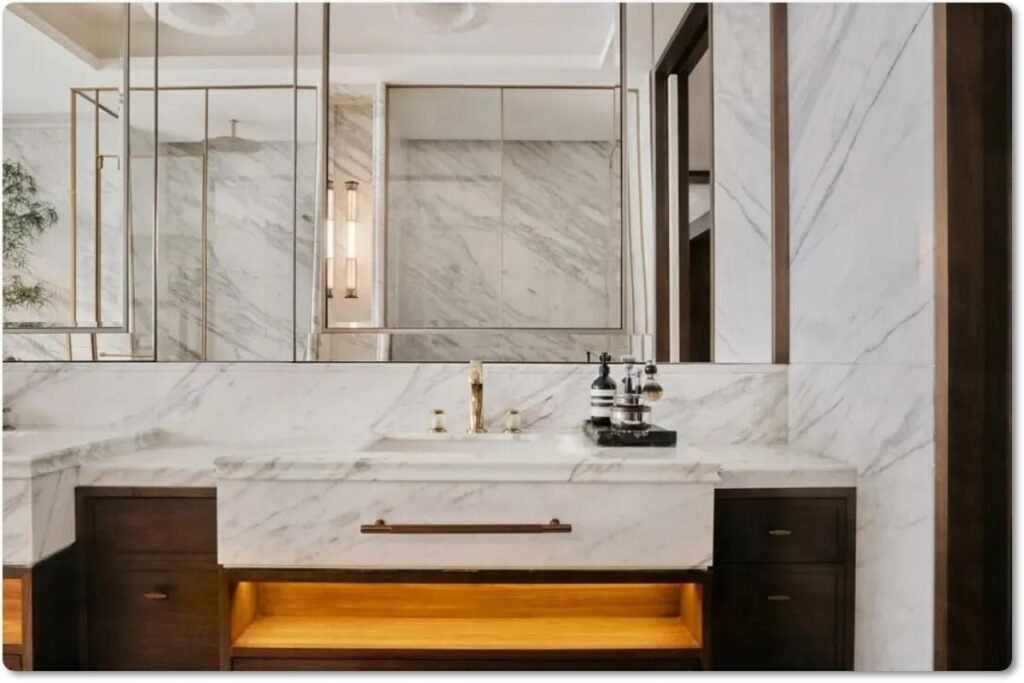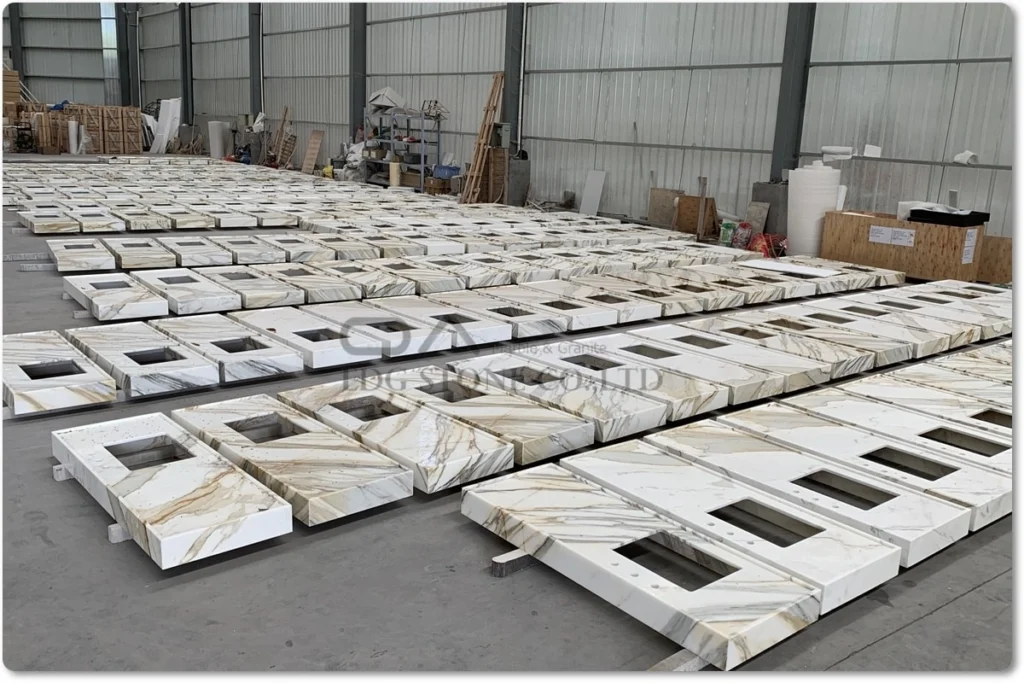
Udaipur Green Marble, Baroda Green Marble, and Rainforest Green Marble are three commercially important names in the Indian green-stone market. Although they may appear similar in photographs, they can differ substantially in origin, geological character, color distribution, veining, block structure, slab consistency, fabrication behavior, and project suitability.
For architects, importers, stone distributors, contractors, hospitality buyers, and natural-stone manufacturers, the key question is therefore not simply “Which green marble is better?” The more useful procurement question is:
Which material has the right verified origin, appearance, technical performance, slab consistency, and supply reliability for the intended application?
This distinction is especially important because natural-stone trade names are not always equivalent to formal geological classifications. Rajasthan government geological documentation states that “green marble” is a trade name for serpentine marble, and identifies green-marble occurrences around Rikhabdeo and other areas of southern Rajasthan.
Rainforest Green requires particular care. Current commercial references commonly associate it with Bidasar/Bidasar Green in Rajasthan, while other commercial documentation may use broader Rajasthan or regional descriptions. Therefore, a professional buyer should verify the actual quarry, block source, technical classification, and production batch instead of relying only on the commercial name.
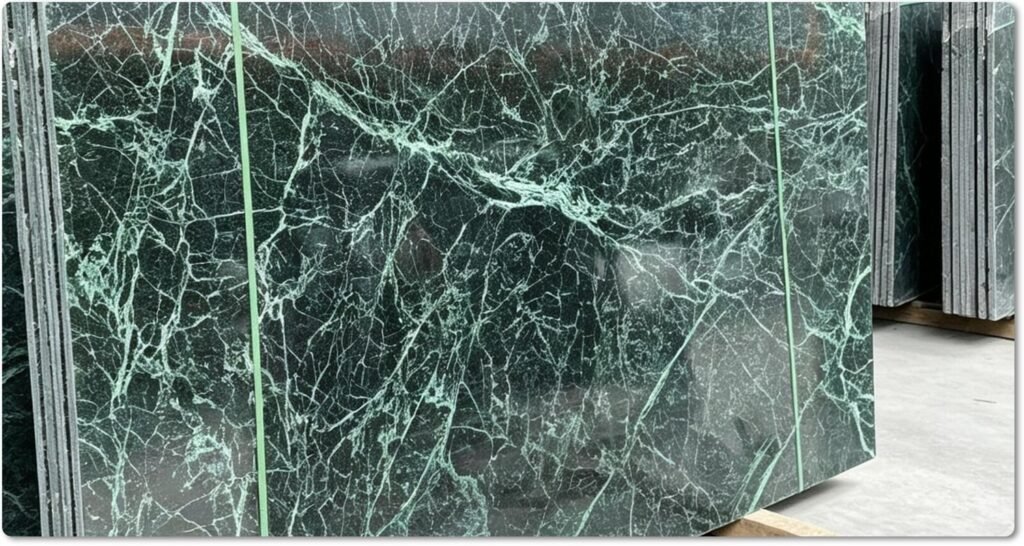
1. Udaipur Green vs Baroda Green vs Rainforest Green: Quick Comparison
| Factor | Udaipur Green Marble | Baroda Green Marble | Rainforest Green Marble |
|---|---|---|---|
| Commercial Origin | India; commonly associated with Udaipur/Rajasthan green-marble belt | India; historically associated with Baroda/Vadodara, Gujarat | Rajasthan, India; commonly marketed as Bidasar Green |
| Typical Base Color | Medium to dark green | Dark green to green | Green with brown, earthy and darker green movement |
| Visual Character | Variable green field with organic mineral movement | More patterned or structured green appearance | Dramatic branch-like / root-like movement |
| Commercial Names | Udaipur Green, Rajasthan Green, Indian Green | Baroda Green, Gujarat Green, Vadodara Green | Rainforest Green, Bidasar Green, Forest Green |
| Pattern Intensity | Low to medium/high depending on block | Medium to high | High |
| Slab Matching | Important | Important | Extremely important |
| Bookmatching Potential | Block-dependent | Block-dependent | Particularly valuable where directional movement is strong |
| Typical Applications | Interior floors, walls, countertops, vanities, decorative surfaces | Decorative walls, flooring, monuments, countertops, architectural features | Feature walls, vanities, tables, fireplaces, statement interiors |
| Procurement Priority | Color and block consistency | Origin and pattern verification | Exact slab selection and vein layout |
| Material Verification | Required | Required | Particularly important |
| Best Buying Method | Approved block/slab photos + physical sample | Verified source + slab inspection | Specific slab approval + layout drawing |
The table should be understood as a procurement framework, not a geological classification. Natural stone can vary considerably even within the same commercial name.
2. What Is Udaipur Green Marble?
2.1 Udaipur Green Marble and the Rajasthan Green-Marble Belt
Udaipur Green Marble is a widely used commercial name for green natural stone associated with the Udaipur region and broader southern Rajasthan green-marble belt.
The Rajasthan Department of Mines & Geology identifies the Rikhabdeo Green Marble deposit as an important green-marble occurrence. Its geological description states that the material marketed as green marble is associated with serpentine/serpentinite and that important occurrences extend through areas including Rikhabdeo, Jhadol, Parsad and other locations toward Dungarpur and Gujarat.
This is an important distinction for international buyers:
Udaipur Green Marble does not necessarily mean that every slab sold under that name was physically quarried inside Udaipur city.
Udaipur is a major stone-producing, processing, trading, and distribution center. Consequently, “Udaipur Green” can function partly as a commercial market identifier.
2.2 Appearance of Udaipur Green Marble
Udaipur Green commonly ranges from lighter green to deep bottle-green shades.
Depending on the quarry section and block, a slab can contain:
- Dark green background
- Medium green areas
- Black or dark mineral features
- White or pale calcite-related lines
- Fine cross-cutting patterns
- Organic mineral movement
- Variable color intensity
The official Udaipur district report describes the Rikhabdeo green marble as ranging from light to dark bottle green, with fine-grained characteristics and cross-cutting appearances associated with calcite and magnetite.
2.3 Where Udaipur Green Marble Works Best
Udaipur Green can be considered for:
- Interior flooring
- Wall cladding
- Feature walls
- Bathroom vanity tops
- Decorative countertops
- Tabletops
- Columns
- Stairs
- Fireplace surrounds
- Mosaics
- Custom stone furniture
For a large commercial project, however, the buyer should not specify simply “Udaipur Green Marble.”
A stronger specification would identify:
commercial name + approved quarry/block + finish + thickness + acceptable color range + vein tolerance + technical requirements.
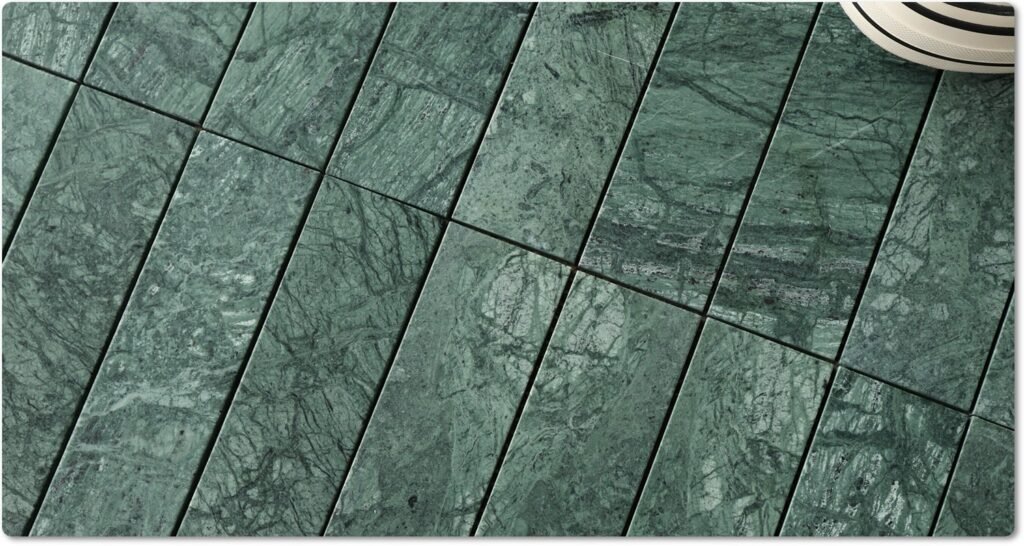
3. What Is Baroda Green Marble?
3.1 Baroda Green Marble: A Historically Distinct Commercial Name
Baroda Green Marble, also marketed as Baroda Green, Gujarat Green Marble, Vadodara Green Marble, or Verde Baroda, is associated historically with the Baroda/Vadodara area of Gujarat.
Stone databases recognize Baroda Green as a separate commercial material name from Rajasthan Green, with alternative names including Gujarat Green Marble, Vadodara Green Marble, and Verde Baroda Marble.
This historical distinction is particularly useful when evaluating older specifications or international stone catalogs.
The Rajasthan government geological report provides an interesting historical connection: it states that green marble was historically mined around Baroda in Gujarat, where it was marketed under the trade name “Green Marble,” before green-marble deposits in Udaipur and Dungarpur became widely popular.
3.2 Appearance of Baroda Green
Baroda Green is generally associated with a green-to-dark-green appearance and can exhibit patterned mineral movement.
However, the exact appearance depends on:
- Quarry location
- Quarry section
- Block
- Cutting direction
- Surface finish
- Resin treatment
- Slab selection
This means that a catalog photograph should never be treated as the contractual appearance standard for a container purchase.
3.3 Baroda Green for Decorative Applications
Baroda Green may be considered for:
- Feature walls
- Interior flooring
- Countertops
- Vanity tops
- Decorative panels
- Monuments
- Mosaics
- Stairs
- Architectural details
- Fountains and ornamental stonework
For high-end interiors, its darker green character can provide a strong contrast against:
- White marble
- Beige limestone
- Brass
- Bronze
- Walnut
- Dark wood
- Cream-colored quartz
- Gold-toned architectural hardware
4. What Is Rainforest Green Marble?
4.1 Rainforest Green Marble Is a Commercial Name
Rainforest Green Marble is perhaps the most important material in this comparison from a terminology-verification perspective.
It is commonly marketed as Rainforest Green, Bidasar Green Marble, Bidasar Green, or Forest Green, and commercial references associate the material with Rajasthan. Several current industry sources identify Bidasar/Churu as an important origin association.
But buyers should avoid assuming that “Rainforest Green” is automatically a formal geological classification.
4.2 Commercial Name vs Technical Classification
This is one of the most important points for professional stone procurement.
A stone can be:
Commercially sold as “marble” → while its technical/geological classification may be serpentinite or serpentine-rich metamorphic rock.
Rajasthan’s official geological documentation explicitly notes that green marble is a trade name for serpentine marble.
Current technical discussions of Rainforest Green similarly identify it as a commercially named stone that may technically be classified as serpentinite rather than conventional calcitic marble.
Therefore, an architect, importer, or contractor should request:
- Quarry origin
- Geological/mineral classification
- Water absorption
- Density
- Flexural strength
- Compressive strength where relevant
- Finish specification
- Recommended applications
- Acid/chemical sensitivity information
- Sealing recommendations
- Batch-specific inspection
4.3 Why Rainforest Green Looks Different
The defining characteristic of Rainforest Green is its highly expressive visual movement.
Depending on the block, the green background can contain:
- Brown veins
- Dark green veins
- Earth-tone movement
- Cream-colored mineral lines
- Root-like structures
- Branch-like patterns
- Irregular networks
- Large contrasting patches
Commercial descriptions consistently emphasize this branch-like visual pattern.
This is why slab matching is particularly important for Rainforest Green.
5. Udaipur Green vs Baroda Green vs Rainforest Green: Color and Pattern
5.1 Udaipur Green: More Flexible Visual Range
Udaipur Green can offer a broad range of green tones.
The buyer should classify the desired material before quotation:
Light Green → Medium Green → Dark Green → Bottle Green
If the project requires visual consistency, the buyer should approve representative slabs before mass production.
5.2 Baroda Green: Structured Green Character
Baroda Green can provide a strong dark-green decorative appearance, but the exact pattern varies according to quarry and block.
For commercial buyers, “Baroda Green” should therefore be treated as a starting material identification rather than a complete product specification.
5.3 Rainforest Green: Maximum Pattern Sensitivity
Rainforest Green is usually the most visually dramatic of the three.
Its value is often related directly to its irregular movement.
That creates a procurement paradox:
The same characteristic that makes Rainforest Green attractive also makes it harder to standardize.
For a hotel project requiring 200 identical vanity tops, this matters.
For a luxury feature wall where every slab is intended to become an individual artwork, the same variation may be an advantage.
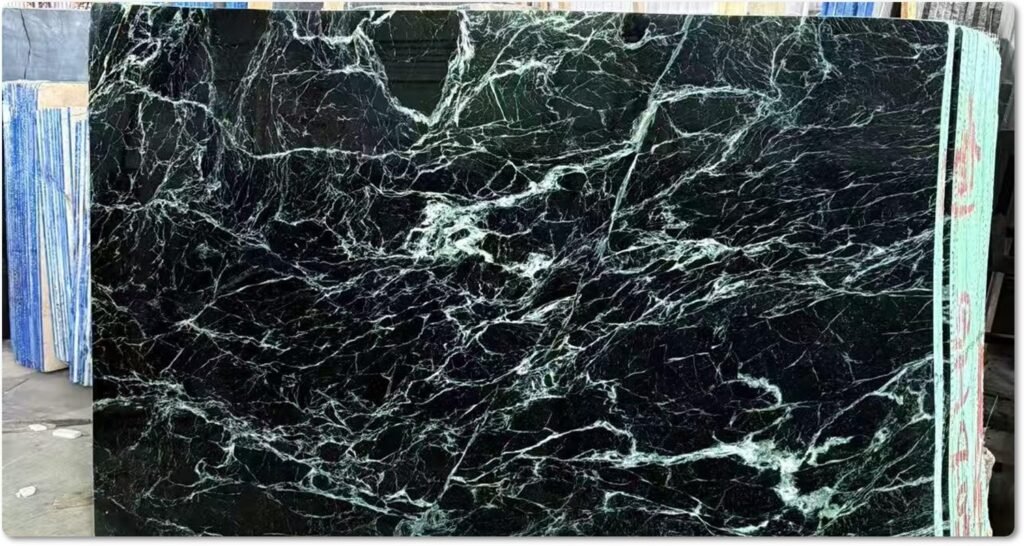
6. Slab Matching: The Most Important Difference for Large Projects
6.1 Why Slab Matching Matters
Natural stone is not manufactured like ceramic tile.
Even blocks from the same quarry can differ.
The production chain is approximately:
Quarry → Block → Gang Saw/Cutting → Slab → Polishing → Sorting → Packing → Fabrication → Installation
Variation can enter at every stage.
6.2 Udaipur Green Matching
For Udaipur Green:
- Approve the block where possible.
- Request slab sequence photographs.
- Specify acceptable green tone.
- Confirm finish.
- Review vein direction.
- Reserve sufficient quantity from the same block.
6.3 Baroda Green Matching
For Baroda Green:
- Confirm the actual source.
- Request full-slab images.
- Check whether the slabs are from the same block.
- Review dark/light distribution.
- Confirm whether the supplied material matches the approved sample.
6.4 Rainforest Green Matching
Rainforest Green requires an even more detailed process.
For a bookmatched feature wall:
Slab 1 → Slab 2 → Slab 3 → Slab 4
should be photographed and arranged according to the installation sequence before fabrication.
A good supplier should be able to provide a slab layout drawing showing:
- Slab number
- Cutting direction
- Finished dimensions
- Seam locations
- Sink cutouts
- Edge profiles
- Bookmatch sequence
7. Technical Verification: Do Not Buy by Name Alone
7.1 Request a Technical Data Sheet
A professional RFQ should request technical information relevant to the intended application.
At minimum:
| Technical Item | Why It Matters |
|---|---|
| Water absorption | Helps evaluate staining/moisture behavior |
| Density | Useful for engineering and handling |
| Flexural strength | Relevant to slabs and fabrication |
| Compressive strength | Useful for architectural applications |
| Surface finish | Affects appearance and maintenance |
| Thickness tolerance | Important for fabrication |
| Flatness | Important for large panels |
| Recommended applications | Helps prevent unsuitable specification |
| Chemical resistance | Relevant to kitchens/bathrooms |
| Sealing recommendation | Important for maintenance |
The exact test standard should also be stated because test methods can affect how results should be interpreted.
7.2 Why a Sample Is Not Enough
A small sample can show:
- Color
- Basic pattern
- Finish
- Texture
But it cannot always show:
- Full-slab movement
- Block consistency
- Internal fractures
- Vein direction
- Large mineral concentrations
- Bookmatching potential
For large projects, slab inspection is more important than sample inspection.
8. Which Green Marble Is Better for Countertops?
There is no universal answer because the correct choice depends on the specification.
Udaipur Green Countertops
Potential advantages:
- Strong green architectural appearance
- Broad commercial availability
- Suitable for custom fabrication
- Works with traditional and contemporary interiors
Key consideration:
Approve the actual slabs before fabrication.
Baroda Green Countertops
Potential advantages:
- Dark green decorative character
- Strong visual contrast
- Suitable for statement interiors
Key consideration:
Verify the actual material origin and technical data because commercial naming can overlap.
Rainforest Green Countertops
Potential advantages:
- Extremely distinctive appearance
- Excellent for statement islands
- Suitable for luxury hospitality interiors
- Strong visual identity
Key consideration:
Pattern and slab selection are critical.
For a dramatic kitchen island, Rainforest Green may be selected specifically because its movement is highly visible. For a large standardized multifamily project, a more visually consistent green material may simplify procurement and fabrication.
9. Which Is Better for Vanity Tops?
For bathroom vanity tops, consider:
- Water exposure
- Edge profile
- Sink cutout
- Slab thickness
- Sealing
- Surface finish
- Vein positioning
Udaipur Green Vanity Tops
Can be suitable when the design requires a rich green natural-stone surface with controlled visual variation.
Baroda Green Vanity Tops
Can create a darker, more traditional or architectural appearance.
Rainforest Green Vanity Tops
Can create a luxury statement piece, especially when the vein pattern is intentionally positioned around the basin.
For hospitality projects, a manufacturer can optimize material yield by nesting vanity-top cutouts around the strongest visual portions of the slab.
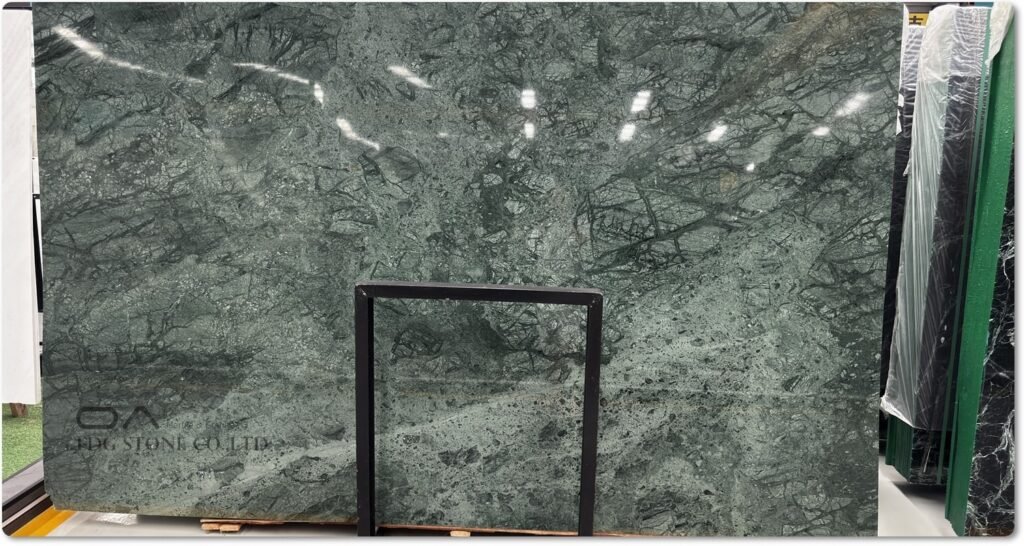
10. Which Is Better for Stone Furniture?
Green marble and serpentine-rich green stone can be particularly effective for:
- Coffee tables
- Side tables
- Console tables
- Dining tables
- Pedestals
- Reception tables
- Decorative trays
- Fireplace furniture
- Custom furniture components
Rainforest Green is particularly suited to projects where the stone itself is intended to function as the visual centerpiece.
Udaipur Green may provide more flexibility where the designer wants green color without necessarily making extreme veining the dominant feature.
Baroda Green can occupy a middle position depending on the selected block and pattern.
11. Rainforest Green vs Green Forest Marble: Are They the Same?
This is an important SEO and procurement question.
The answer is:
Not necessarily.
“Green Forest Marble,” “Forest Green Marble,” “Rainforest Green Marble,” “Bidasar Green,” and similar expressions can overlap in commercial usage.
Stone databases and suppliers use multiple names for related green materials, but naming is not standardized across every market or supplier.
Therefore:
Never use a commercial synonym as proof of geological identity or quarry origin.
Instead, verify:
Commercial Name + Quarry + District/State + Technical Classification + Slab Photos + Test Data
This five-part identification is considerably more reliable.
12. Commercial Origin vs Technical Classification
12.1 Why This Matters
A buyer may receive the following description:
“Rainforest Green Marble — India”
That is not sufficient for a high-value specification.
A professional specification should ask:
Where exactly was the stone quarried?
Then:
How is the stone technically classified?
Then:
Which test data applies to this exact material?
12.2 Processing Location Is Not Quarry Origin
This distinction is especially important in Rajasthan.
A stone may be:
- Quarried in one district
- Transported to another city
- Cut in a large processing center
- Polished elsewhere
- Exported through another logistics hub
Therefore:
Processing location ≠ quarry origin.
This is one reason why “Udaipur Green” should not automatically be interpreted as “quarried within Udaipur city.”
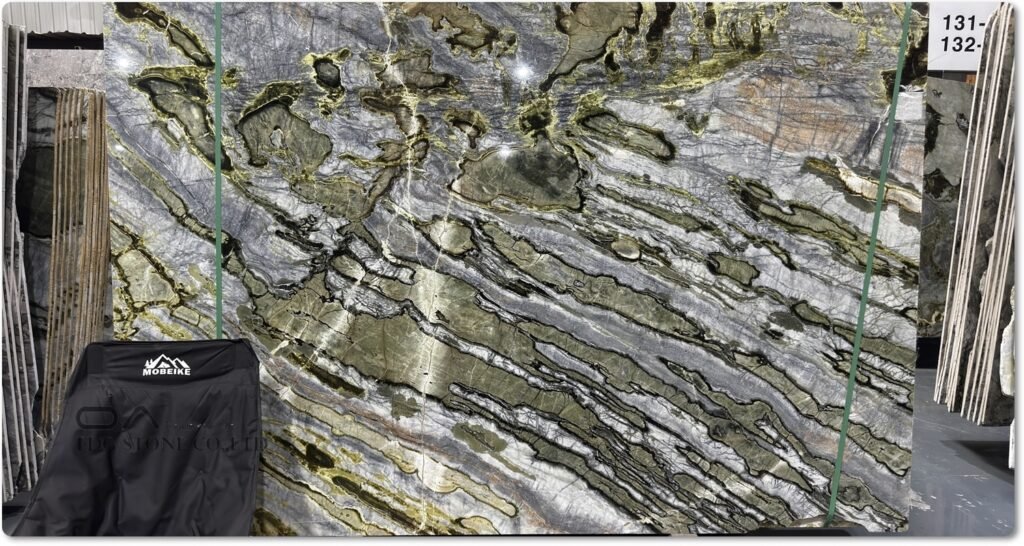
13. 2026 Regulatory and Sustainability Considerations for Buyers
The direction of the Indian natural-stone industry increasingly emphasizes documented mining practices, environmental controls, mine planning, and responsible extraction.
The Indian Ministry of Mines describes the Mineral Conservation and Development Rules, 2017 as a framework covering systematic mineral development, conservation, environmental protection, and sustainable mining requirements.
Rajasthan’s Department of Mines & Geology also states that mining operations are subject to environmental safeguards, mine planning, closure planning, and requirements intended to prevent obstruction of natural watercourses and protect environmental conditions.
Rajasthan’s environmental authorities continue to publish environmental-clearance and public-hearing information for mining projects, demonstrating that environmental compliance remains an active part of the state’s mining framework.
For international buyers, this creates an important procurement trend:
The 2026 Buyer Is Increasingly Purchasing Documentation, Not Just Stone.
A professional supplier should increasingly be able to support:
- Quarry/source information
- Technical data
- Environmental documentation where applicable
- Production traceability
- Quality-control records
- Packing records
- Slab identification
- Commercial invoice and packing list
- Country-of-origin documentation
- Export documentation
The Indian Minerals Yearbook 2024 also demonstrates the continuing importance of mineral production, mining, trade, specifications, and policy information within India’s formal mineral-sector reporting framework.
14. How International Buyers Should Compare the Three Materials
A practical procurement matrix can use six stages.
Stage 1 — Define the Application
Ask:
Is the stone for a floor, wall, countertop, vanity, table, fireplace, facade, or decorative object?
Stage 2 — Define the Visual Target
Specify:
- Green tone
- Pattern intensity
- Vein size
- Background consistency
- Finish
- Gloss level
Stage 3 — Verify Material Identity
Request:
- Commercial name
- Quarry
- District
- State
- Technical classification
- Test report
Stage 4 — Approve the Actual Slabs
For premium projects:
Sample approval → Slab approval → Layout approval → Fabrication approval
Stage 5 — Confirm Fabrication
Specify:
- Thickness
- Edge profile
- CNC
- Waterjet
- Sink cutout
- Miter
- Bookmatching
- Surface finish
- Reinforcement requirements where appropriate
Stage 6 — Confirm Export Packing
For international projects, stone protection should include:
- Strong wooden crates
- Slab separators
- Edge protection
- Moisture protection where appropriate
- Identification labels
- Crate numbering
- Packing list
- Container loading photographs
15. Udaipur Green vs Baroda Green vs Rainforest Green: Buyer Decision Framework
Instead of asking which material is “best,” use the following specification logic.
Choose Udaipur Green When:
- You want a recognizable Indian green-stone appearance.
- The design requires green rather than highly dramatic brown-green movement.
- You can approve slabs or blocks.
- The application is primarily interior.
- The project requires custom fabrication.
Consider Baroda Green When:
- The specification calls specifically for Baroda/Gujarat Green.
- A dark green decorative appearance is required.
- Historical or regional material identity matters.
- The supplier can document the actual material source.
Consider Rainforest Green When:
- Dramatic natural movement is desired.
- The stone is intended as a focal point.
- Bookmatching is part of the design.
- Individual slab selection is possible.
- The project can accommodate natural variation.
16. Common Purchasing Mistakes
Mistake 1: Buying Only by Commercial Name
“Udaipur Green” or “Rainforest Green” is not enough.
Mistake 2: Approving Only a Small Sample
The sample cannot represent every square meter of a natural block.
Mistake 3: Ignoring Cutting Direction
Cross-cut and vein-cut slabs can look completely different.
Mistake 4: Mixing Blocks
Mixing blocks can create visible differences in green tone and pattern.
Mistake 5: Ignoring Finish
Polished, honed, brushed, leathered, and other finishes can change the visual intensity significantly.
Mistake 6: Assuming “Marble” Means Identical Chemistry
Commercial terminology and geological classification are not always the same.
Mistake 7: Forgetting the Installation Layout
A beautiful slab can produce a poor finished wall if the seam and vein layout were not planned.
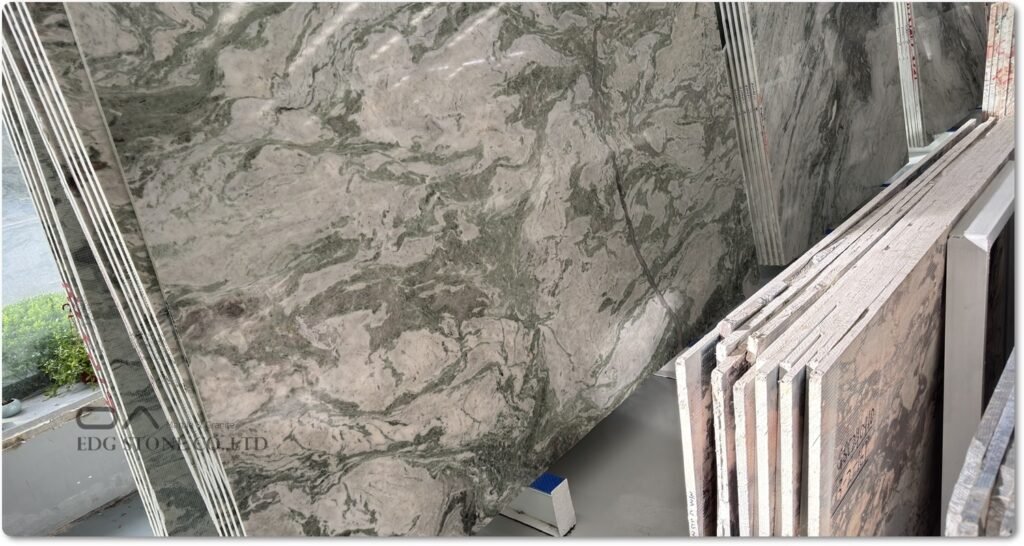
17. How EDG Stone Can Support Green Marble Procurement
For international buyers purchasing green marble from China for residential, hospitality, commercial, or custom fabrication projects, EDG Stone can function as a manufacturing and export partner rather than simply a slab trading intermediary.
EDG Stone’s production workflow can incorporate:
- Natural green marble sourcing
- Slab inspection
- Cut-to-size production
- CNC fabrication
- Waterjet processing
- Edge processing
- Vanity-top fabrication
- Countertop fabrication
- Stone furniture production
- Custom architectural components
- CAD-based fabrication
- Quality control
- Export packing
- Container loading
For projects involving Udaipur Green, Baroda Green, Rainforest Green, or related Indian green-stone materials, buyers should provide the required visual target and project specification first. The manufacturing stage can then focus on translating approved stone into the required finished component.
This is especially useful for projects where the buyer does not simply need slabs, but requires:
slab → fabrication → inspection → packing → container export
as one coordinated procurement process.
18. Green Marble Procurement Checklist
Before issuing a purchase order, confirm:
Material Identity
Commercial name
Quarry origin
Country
State/district
Technical classification
Material test report
Visual Quality
Background color
Pattern intensity
Vein direction
Acceptable variation
Surface finish
Slab photographs
Slab sequence
Fabrication
Thickness
Finished dimensions
CNC requirements
Waterjet requirements
Sink cutouts
Edge profile
Bookmatch
Seam locations
Quality Control
Pre-production approval
In-process inspection
Final inspection
Dimensional check
Finish check
Visual check
Packing inspection
Export
Crate specification
Container loading plan
Slab identification
Packing list
Commercial invoice
Origin documentation
Loading photographs
19. Frequently Asked Questions About Udaipur Green, Baroda Green and Rainforest Green Marble
FAQ 1: What is the difference between Udaipur Green Marble and Rainforest Green Marble?
Udaipur Green Marble is a broad commercial name associated with green marble from the Udaipur/southern Rajasthan region, while Rainforest Green is generally marketed for its highly dramatic brown-green, branch-like movement and is commonly associated with Bidasar and Rajasthan. The names can overlap in commercial catalogs, so buyers should verify the exact quarry and technical classification.
FAQ 2: Is Baroda Green Marble from India?
Yes. Baroda Green Marble is an Indian commercial stone historically associated with Baroda/Vadodara in Gujarat. Rajasthan geological documentation also records the historical importance of Baroda as a source of green marble before green-marble deposits in Rajasthan became widely marketed.
FAQ 3: Is Rainforest Green Marble actually marble?
The answer depends on the classification system being used. It is commercially sold as marble, while technical references may classify Rainforest Green as serpentinite or serpentine-rich metamorphic rock. Rajasthan’s government geological documentation similarly explains that “green marble” is a trade name associated with serpentine marble.
FAQ 4: Is Rainforest Green Marble good for countertops?
It can be considered for countertops when the specific material has been technically verified and the fabrication, sealing, installation, and maintenance requirements are appropriate. Because Rainforest Green has significant natural variation, buyers should approve actual slabs rather than relying only on a catalog photograph.
FAQ 5: Which green marble is best for a luxury feature wall?
The appropriate choice depends on the project’s desired appearance. Rainforest Green is particularly suitable when dramatic, organic movement and bookmatching are central to the design, while Udaipur Green or Baroda Green may be preferable when the specification calls for a more controlled green visual character. The final selection should be based on approved slabs and the intended layout rather than the commercial name alone.
20. Semantic Insight: How to Specify Indian Green Marble in 2026
The modern stone buyer should move away from a simple keyword such as:
“Buy Rainforest Green Marble.”
A stronger procurement model is:
Material → Origin → Classification → Visual Standard → Technical Standard → Fabrication → Quality Control → Logistics
For example:
Rainforest Green → Bidasar/Rajasthan origin → verified technical classification → approved slab sequence → project-specific technical data → CNC fabrication → QC → export packing
This model is more useful for architects, contractors, importers, distributors, and hospitality procurement teams because it converts a visually attractive commercial name into a measurable purchasing specification.
21. Final Comparison: What Really Separates These Three Materials?
The most important difference between Udaipur Green, Baroda Green, and Rainforest Green is not simply their shade of green.
It is their commercial identity, geographic association, visual behavior, and degree of natural variation.
Udaipur Green Marble is closely associated with the southern Rajasthan green-marble belt and can offer a versatile range of green natural-stone appearances.
Baroda Green Marble has a distinct historical association with Gujarat and remains an identifiable commercial category in international stone catalogs.
Rainforest Green Marble stands out for its highly expressive, organic movement and requires particularly careful slab selection and layout planning.
For all three materials, the same professional procurement principle applies:
Commercial stone names are useful for identifying a market category, but they should not replace quarry verification, technical documentation, physical inspection, and project-specific specification.
For architects and buyers working on premium interiors, the strongest purchasing process is therefore:
Verify the origin → verify the classification → approve the slabs → approve the layout → fabricate → inspect → pack → export.
That approach reduces the risk of receiving a material that technically matches the purchase order but visually fails the project.
Indian Green Marble Procurement: What Buyers Should Know
How should buyers compare Udaipur Green, Baroda Green and Rainforest Green Marble?
The comparison should begin with material identity rather than color alone. Udaipur Green Marble is commercially associated with the green-marble belt around Udaipur and southern Rajasthan; Baroda Green Marble has a historical association with Baroda/Vadodara in Gujarat; and Rainforest Green Marble is commonly marketed as a Rajasthan material, particularly Bidasar Green. These commercial names can overlap, so the quarry and technical classification should always be confirmed.
Why is technical classification important?
Natural-stone commercial terminology does not always correspond exactly to geological terminology. Government geological documentation from Rajasthan describes green marble as a trade name associated with serpentine marble, while current industry technical references may classify Rainforest Green as serpentinite or serpentine-rich material. The distinction can affect fabrication, chemical behavior, maintenance, and application decisions.
What should buyers consider when selecting the material?
Buyers should evaluate origin, geological/technical classification, base color, mineral movement, slab consistency, water absorption, strength data where relevant, finish, thickness, fabrication requirements, sealing recommendations, and actual slab appearance. For large projects, a small sample should not be treated as a substitute for slab approval.
Which material requires the greatest attention to slab matching?
Rainforest Green generally requires particularly careful slab selection because its commercial appeal comes from dramatic, irregular brown-green movement. Bookmatched walls, luxury vanities, fireplace surrounds, and feature islands should be planned using actual slab photographs and a layout drawing before fabrication.
How is the green-marble market changing?
The procurement direction is moving toward greater traceability, technical documentation, environmental compliance, quality control, and documented supply chains. India’s mining framework and Rajasthan’s environmental procedures increasingly emphasize systematic mining, environmental safeguards, mine planning, and compliance documentation. For international buyers, this means that supplier capability increasingly includes documentation and traceability in addition to the physical stone.
What is the practical buying conclusion?
There is no universally superior green marble. The appropriate material depends on the required appearance, application, technical performance, slab availability, project scale, fabrication complexity, and budget. Professional buyers should purchase against a documented specification and approved material rather than relying on the commercial name alone.
2026 Buyer Takeaway
Udaipur Green = Rajasthan green-marble identity and versatile green appearance.
Baroda Green = historically Gujarat-associated green marble with its own commercial identity.
Rainforest Green = highly dramatic Rajasthan commercial stone where slab selection and matching are especially important.
For international B2B procurement, the winning specification is not simply:
“Green Marble.”
It is:
Verified Origin + Technical Classification + Approved Slabs + Fabrication Specification + Quality Control + Traceable Export Packing.