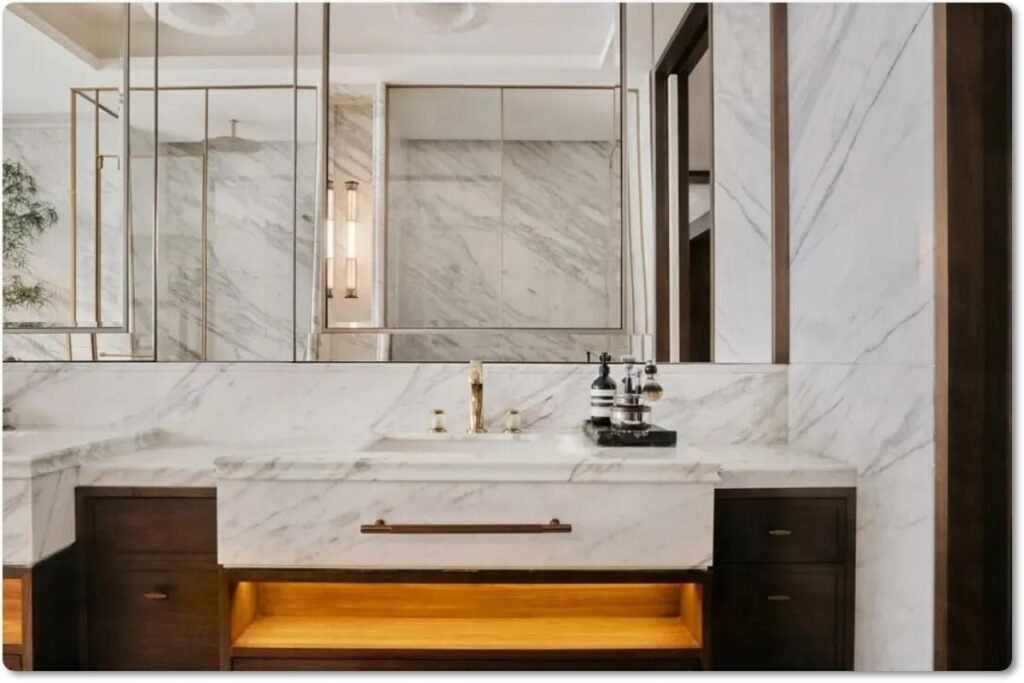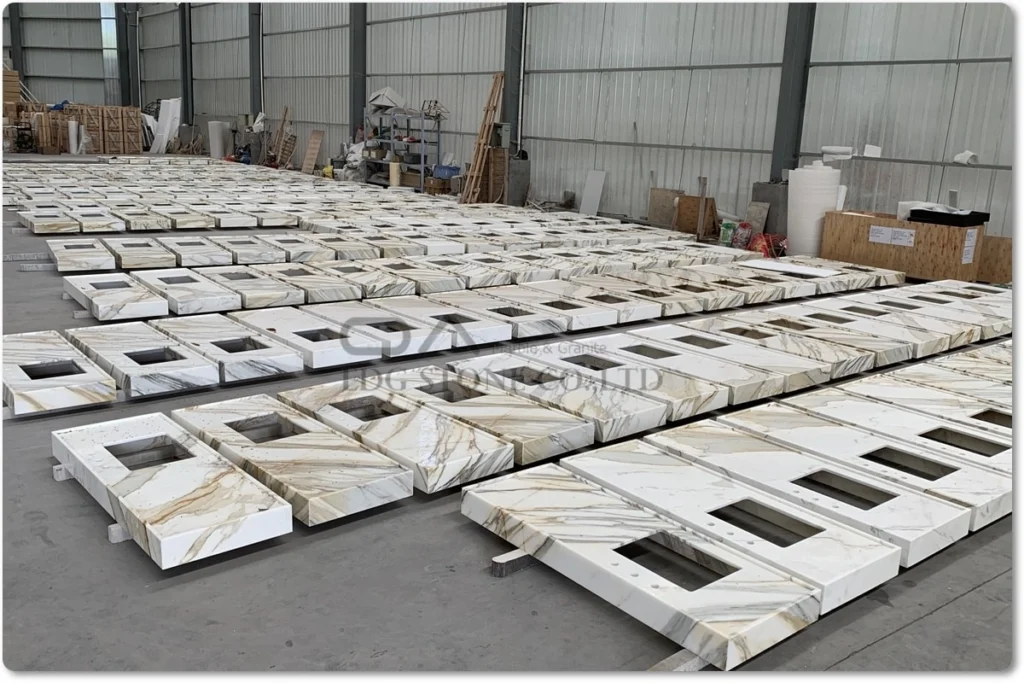
Quick Summary: What Is Green Marble?
Green Marble at a Glance
What: Green marble is a category of natural decorative stone characterized by green coloration, often combined with white, black, gold, grey, brown,rown or mineral veining.
Where: Green marble is used in residential, hospitality, retail, and commercial interiors, particularly countertops, vanity tops, flooring, wall cladding, tables, and decorative stone products.
Why: Its natural color variation, geological patterning,g and ability to be polished or honed make it suitable for projects seeking a distinctive luxury appearance.
How to buy: Evaluate the actual slab, geological type, dimensions, thickness, finish, physical properties, processing tolerance, packing method, quantity, ty and landed cost rather than purchasing solely by the trade name.
Green marble has moved beyond being a niche decorative material. In contemporary residential interiors, hotels, restaurants, luxury retail environments and custom furniture, green stone is increasingly used as a visual focal point rather than simply as a background finish.
For architects, interior designers, contractors, stone distributors and importers, however, buying green marble requires more than choosing a color. Two stones marketed under similar names can have significantly different mineral compositions, veining, absorption, strength, translucency,ncy and fabrication characteristics.
This 2026 Green Marble Buyer’s Guide explains how to identify, compare, specify, price, and source green marble for professional projects.
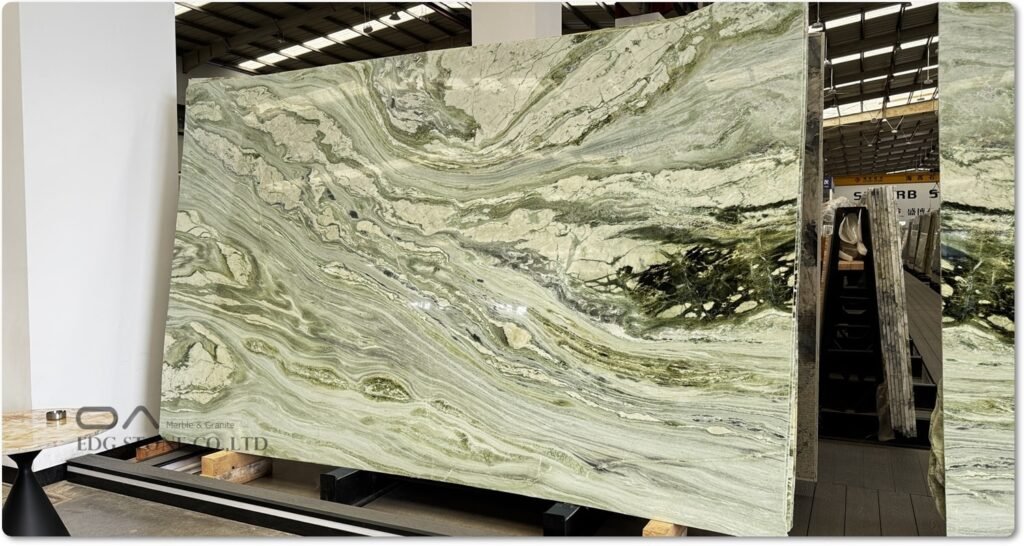
What Is Green Marble?
Green marble is a broad commercial category rather than one single geological material.
Natural stone suppliers may use the term to describe true marble as well as certain green decorative stones that resemble marble. Some green materials may contain calcite or dolomite, while others may be serpentine-rich or have different mineral compositions.
The distinction matters because mineralogy influences performance.
The Natural Stone Institute notes that true marble is generally a metamorphic rock and that calcite-based marble can be vulnerable to mild acids. It also distinguishes serpentine from true marble because serpentine has a different mineral composition and can demonstrate greater resistance to acids and abrasion.
Therefore, a professional buyer should never evaluate green marble only by its commercial name.
Green Marble vs. Green Serpentine vs. Green Onyx
These materials can look similar but are not necessarily the same stone.
| Material | Typical visual character | Key consideration |
|---|---|---|
| Green Marble | Veined, brecciated or cloud-like | Acid sensitivity and absorption should be evaluated |
| Green Serpentine | Deep green, often mottled or veined | Different mineralogy and performance |
| Green Onyx | Translucent green with layered patterns | Best known for decorative and backlit applications |
| Green Quartzite | Green with crystalline structure | Generally harder than marble |
| Green Granite | Speckled or crystalline appearance | Usually selected for higher durability |
ASTM C503/C503M covers dimension marble and identifies properties such as absorption, density, compressive strength, modulus of rupture, abrasion resistance, and flexural strength as relevant physical characteristics.
For commercial procurement, the safest practice is to request the quarry or supplier’s actual material identification and technical data.
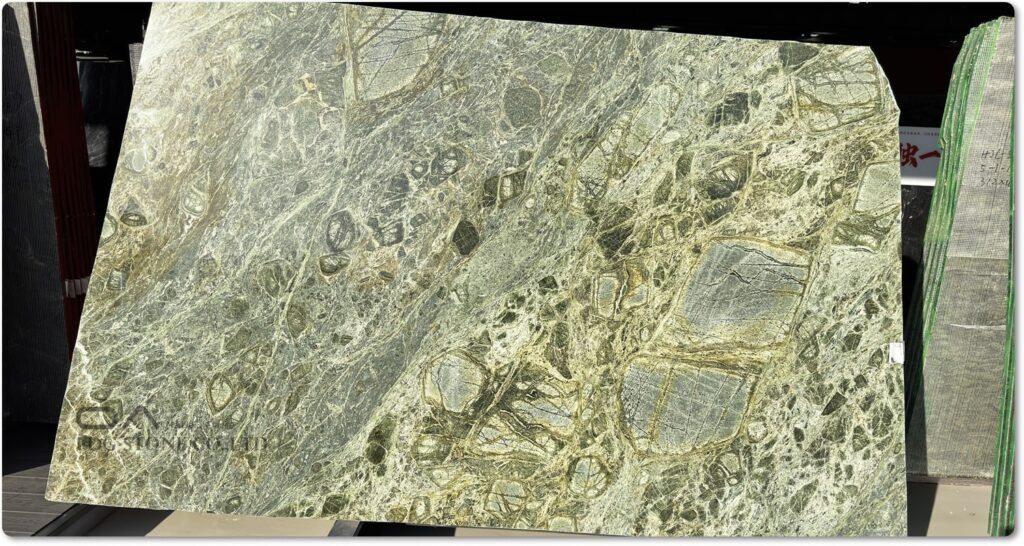
Why Is Green Marble Popular in 2026?
Green has become an important architectural and interior-design color because it can connect natural materials with contemporary luxury interiors.
Unlike a uniform manufactured surface, green marble provides geological variation.
Depending on the variety, a slab may include:
- Emerald-green backgrounds
- Deep forest-green fields
- Black-green movement
- White veins
- Gold or brown mineral lines
- Cloud-like patterns
- Rainforest-style branching structures
- Dramatic contrasting fragments
- Translucent areas in some decorative materials
This makes every slab potentially different.
For hospitality and high-end residential projects, that variation can become part of the design identity.
Green Marble as a Design Statement
A large green marble slab can function as:
- A kitchen island focal point
- A hotel reception feature
- A bathroom vanity wall
- A fireplace surround
- A dining tabletop
- A coffee table surface
- A luxury retail counter
- A feature wall
- A decorative partition
- A custom stone furniture component
The key trend is not simply “more green marble.” It is the use of large-format natural stone as a visual architectural element.
Green Marble Types and Popular Names
The green marble market includes many trade names and regional names.
Buyers should understand that trade names are not always standardized internationally.
Indian Green Marble
Indian green marble is widely associated with several visually distinctive materials and regional commercial names.
Common search terms include:
- Indian green marble
- Green Indian marble
- Indian green marble slabs
- Indian green marble countertops
- Indian green marble supplier
- Indian green marble wholesale
The phrase “Indian green marble” should therefore be treated as a sourcing category rather than a guarantee of one specific geological composition.
Baroda Green Marble
Baroda Green Marble, also searched as Baroda Green Marble or Green Baroda Marble, is associated with rich green decorative stone and is frequently specified for walls, floors, countertops, furniture, and decorative applications.
When purchasing Baroda green marble, ask for:
- Quarry or origin information
- Slab photographs
- Available block or slab sizes
- Thickness
- Surface finish
- Water absorption
- Flexural strength where relevant
- Quantity available from the same lot
- Resin treatment, if any
- Export packing specifications
Udaipur Green Marble
Udaipur is an important marble-producing region in India, and the term Udaipur green marble is commonly used in international searches.
The visual appearance can vary considerably between materials sold under regional names.
For large commercial projects, the buyer should approve an actual slab or representative slab bundle rather than approving a name alone.
Dark Green Marble
Dark green marble is especially useful where designers want a dramatic, luxurious appearance.
Applications include:
- Bathroom walls
- Vanity tops
- Fireplace surrounds
- Dining tables
- Hotel lobbies
- Bar counters
- Feature walls
- Luxury retail interiors
Dark green surfaces can work particularly well with brass, bronze, black metal, warm wood, and neutral architectural backgrounds.
Light Green Marble
Light green marble creates a softer visual effect.
It can be used for:
- Spa interiors
- Bathrooms
- Vanity tops
- Residential kitchens
- Decorative walls
- Tabletops
- Hospitality interiors
The lighter background also makes veining and mineral patterns more visible.
Emerald Green Marble
Emerald green marble is generally searched by buyers looking for a saturated, jewel-like green appearance.
Because the name “emerald” is strongly associated with color rather than a standardized geological classification, buyers should verify the actual material before specifying it.
Rainforest Green Marble
Rainforest green marble is typically associated with highly dramatic patterns, often featuring branching or organic visual movement.
It is particularly suitable for:
- Feature walls
- Bookmatched panels
- Reception desks
- Fireplace surrounds
- Statement furniture
- Luxury bathroom interiors
Forest Green Marble
Forest green marble usually refers to darker natural green materials with deep tonal variation.
It can create a more architectural, sophisticated look than pale green materials.
Green Onyx Marble and Onyx Green Marble
The phrases green onyx marble, onyx green marble, and green onyx are frequently used in searches, but buyers should understand that onyx is not simply another type of marble.
The Natural Stone Institute identifies onyx as a distinct rock type and notes its characteristic translucency.
This distinction matters most when the material is intended for backlighting.
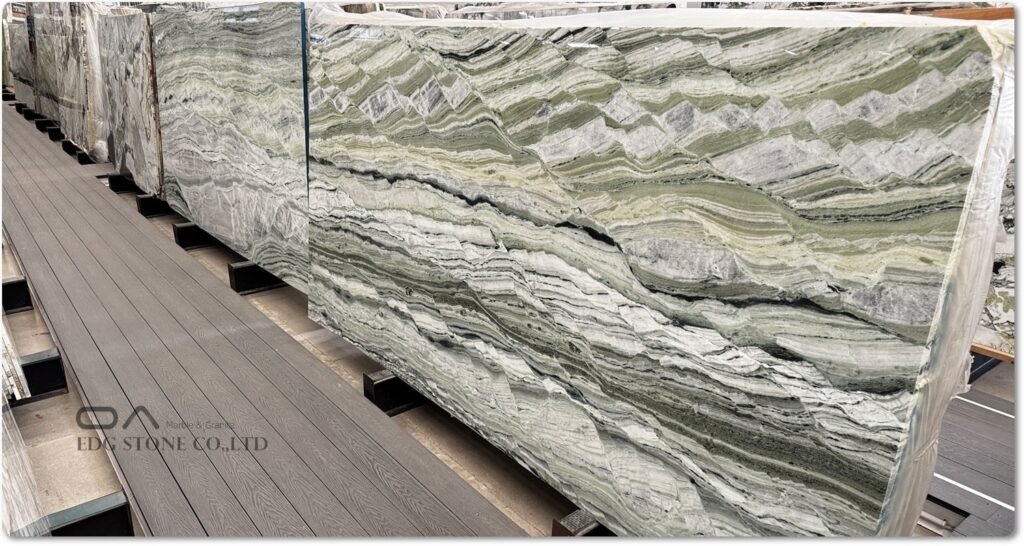
Green Marble Slabs: What Should Buyers Check?
For commercial buyers, slabs are normally more important than sample chips.
A 10 × 10 cm sample can communicate color but cannot fully communicate:
- Vein direction
- Large-scale pattern
- Natural fissures
- Color variation
- Slab thickness
- Bookmatch potential
- Surface consistency
- Resin treatment
- Edge quality
Slab Size
Ask the supplier to provide actual slab dimensions.
Common commercial slab formats vary according to quarry block size and processing equipment.
Instead of assuming a standard size, specify:
Length × Width × Thickness
For example:
- 2400 × 1400 × 18 mm
- 2800 × 1600 × 20 mm
- 3000 × 1800 × 20 mm
Actual availability depends on the stone and block.
Slab Thickness
Typical project specifications may include:
- 18 mm
- 20 mm
- 30 mm
- Custom thickness
For furniture, thicker visual edges can also be produced through laminated edges or built-up fabrication.
Surface Finish
Common finishes include:
- Polished
- Honed
- Leathered
- Brushed
- Sandblasted
- Flamed, where technically appropriate
- Custom textured finishes
Polished green marble emphasizes color and veining.
Honed green marble produces a softer, less reflective appearance.
The correct finish should be selected according to the application, slip requirements, maintenance expectations and design intent.
Green Marble Applications
Green marble is versatile enough to be used across architecture, interiors and furniture.
Green Marble Countertops
Green marble countertops can create a strong visual identity in luxury kitchens, bars, bathrooms and hospitality environments.
However, buyers should understand the maintenance characteristics of marble.
The Natural Stone Institute states that calcite-based marble can be affected by acidic materials such as lemon juice, tomatoes and vinegar. Sealing can improve stain resistance but does not eliminate susceptibility to acid etching.
For kitchen countertops, specify:
- Material classification
- Absorption
- Finish
- Thickness
- Edge profile
- Sink cutouts
- Seam location
- Support requirements
- Sealing recommendations
Green Marble Vanity Tops
Bathrooms are often an excellent application because the visual impact is high and designers can use relatively small quantities.
Green marble vanity tops can be paired with:
- White ceramic
- Brass fixtures
- Black fixtures
- Wood cabinetry
- Beige stone
- Cream walls
- Backlit mirrors
Green Marble Coffee Table
A green marble coffee table combines natural stone with furniture design.
Popular configurations include:
- Round tabletops
- Oval tops
- Rectangular tops
- Pedestal bases
- Metal frames
- Solid stone bases
- Bookmatched surfaces
For furniture production, slab selection becomes critical because the tabletop occupies a concentrated visual field.
Green Marble Side Table
A green marble side table typically requires less material than a large dining table but demands precise fabrication.
Important specifications include:
- Table diameter or dimensions
- Thickness
- Edge profile
- Base design
- Load requirements
- Floor protection
- Packaging
Green Marble Table
A green marble table can be produced as a dining table, console table, coffee table, side table, or custom hospitality furniture.
For larger tables, engineers and fabricators should consider the weight of the stone and the structural capacity of the base.
Green Marble Dining Table
A green marble dining table is particularly effective when the natural slab pattern is used as the central design feature.
For large tables, buyers should approve the slab layout before fabrication.
A bookmatched or carefully centered pattern can dramatically change the final appearance.
Green Marble Tray
Small accessories such as a green marble tray are useful for hospitality, residential and retail applications.
They can also be produced from smaller remnants, making them a potential value-added product category for stone manufacturers.
Green Marble Tiles
Green marble tiles are commonly used for:
- Bathroom walls
- Flooring
- Shower walls
- Backsplashes
- Feature walls
- Hotel interiors
Tile selection should consider thickness, dimensional tolerance, finish, slip requirements and installation conditions.
Green Marble Tile & Slab for Elegant Spaces
Large slabs and smaller tiles serve different design purposes.
Slabs
Best suited to:
- Countertops
- Vanity walls
- Reception desks
- Dining tables
- Feature walls
- Fireplace surrounds
Tiles
Best suited to:
- Flooring
- Bathroom walls
- Backsplashes
- Repetitive patterns
- Smaller architectural surfaces
For premium projects, designers may combine both.
For example, a hotel bathroom could use green marble slab for the vanity and matching green marble tiles for the shower wall.
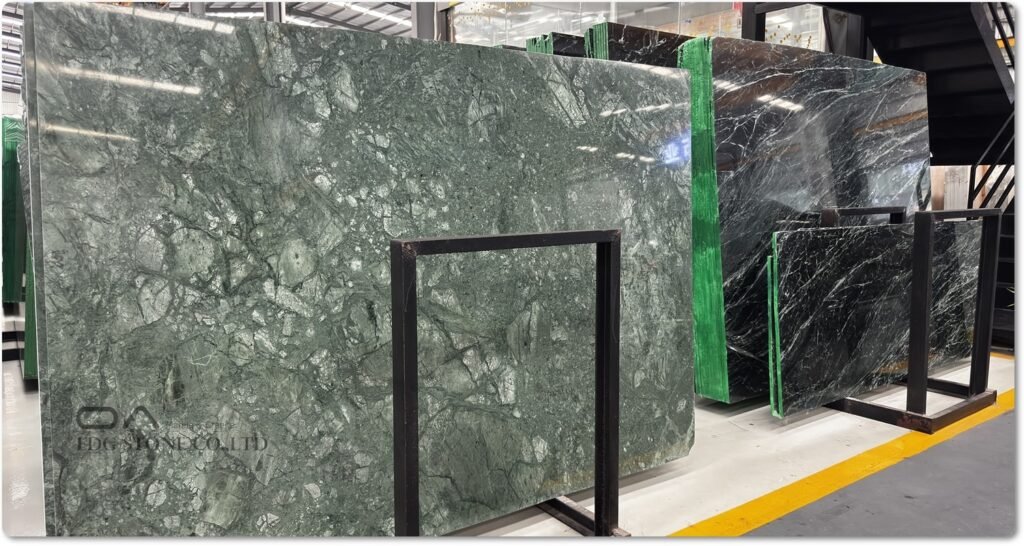
How Much Does Green Marble Cost?
Green Marble Price Factors
There is no universal “green marble price.”
Pricing depends on:
- Quarry origin
- Material rarity
- Block quality
- Slab size
- Thickness
- Color consistency
- Veining
- Cracks and fissures
- Resin treatment
- Finish
- Processing
- Quantity
- Packaging
- Shipping distance
- Fabrication complexity
- Project schedule
Therefore, searches such as green marble price, green marble slab price, or green marble price per square foot should be treated as starting points rather than fixed market prices.
A Better Procurement Formula
For international buyers:
Total Landed Cost = Stone + Processing + Packing + Inland Freight + Export Costs + Ocean Freight + Insurance + Import Charges + Local Delivery
For fabricated products:
Project Cost = Material + CAD + Cutting + Edge Processing + Cutouts + Finishing + QC + Packing + Freight + Installation
This is particularly important when comparing a local stone distributor against a direct green marble manufacturer or factory.
A lower slab price does not automatically mean a lower project cost.
How to Buy Green Marble Wholesale
Wholesale buyers should evaluate the supplier as carefully as the material.
Step 1: Define the Project
Prepare:
- Application
- Quantity
- Dimensions
- Thickness
- Finish
- Delivery location
- Required date
- Installation method
- Quality expectations
Step 2: Request Real Slab Photos
Ask for:
- Full slab photos
- Close-up photos
- Edge photos
- Wet photos where relevant
- Photos with measurement references
- Current stock information
Step 3: Request Technical Information
At minimum:
- Density
- Water absorption
- Compressive strength
- Flexural strength
- Abrasion resistance where relevant
- Finish
- Thickness tolerance
ASTM C97 provides test methods for absorption and bulk specific gravity of dimension stone, while ASTM C880/C880M-25 addresses flexural strength testing of dimension stone.
Step 4: Approve a Physical Sample
For large projects, the sample should represent the actual production lot whenever possible.
Step 5: Confirm Processing
For fabricated green marble, clarify:
- CNC cutting
- Waterjet cutting
- Sink cutouts
- Edge profiles
- Drilling
- Laminated edges
- Bookmatching
- Dry fitting
- CAD drawings
Step 6: Confirm Export Packaging
Stone is heavy and fragile.
A professional exporter should pay close attention to:
- A-frame packing
- Wooden crates where appropriate
- Moisture protection
- Edge protection
- Slab separation
- Container loading
- Weight distribution
- Photo records
- Packing lists
Green Marble Manufacturer, Factory, or Trading Supplier?
For large B2B projects, the sourcing model matters.
Green Marble Manufacturer
A manufacturer with fabrication capability can provide:
- Slabs
- Cut-to-size products
- Countertops
- Vanity tops
- Furniture
- Tiles
- Custom stone products
This can reduce the number of intermediaries.
Green Marble Factory
A factory is particularly relevant when the buyer requires:
- OEM products
- Large quantities
- Custom dimensions
- Repeated production
- Project-specific fabrication
- Export packing
- Container orders
Green Marble Wholesale Supplier
A wholesaler can be useful when buyers need:
- Mixed products
- Smaller quantities
- Stock materials
- Multiple origins
- Local inventory
For importers, the right sourcing model depends on order size, fabrication requirements, quality control and delivery schedule.
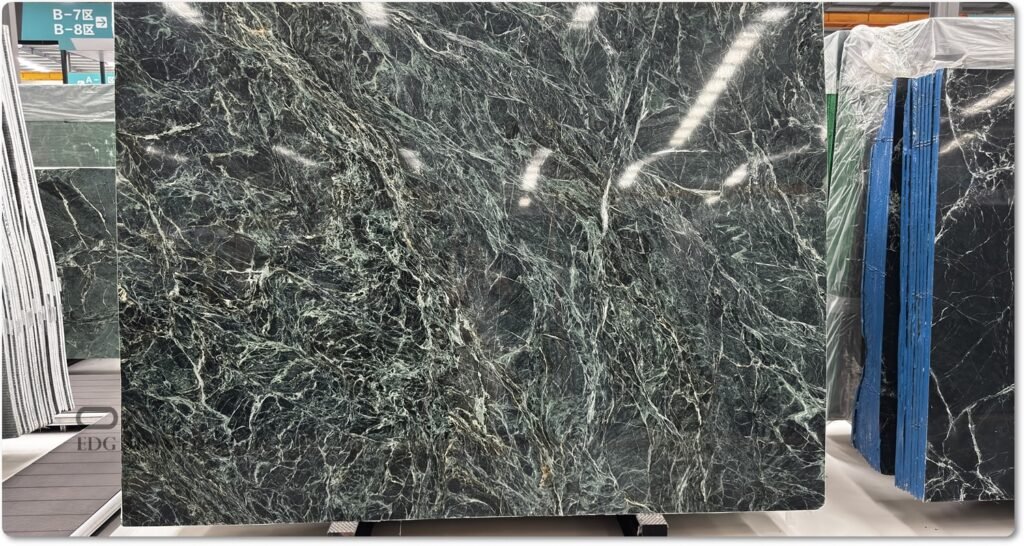
Why Source Green Marble from EDG Stone?
EDG Stone is a professional Chinese natural stone manufacturer and exporter specializing in natural stone slabs, countertops, vanity tops, and custom stone fabrication.
For international buyers, EDG Stone can support projects involving:
- Green marble slabs
- Green marble countertops
- Green marble vanity tops
- Green marble tables
- Green marble coffee tables
- Green marble side tables
- Green marble tiles
- Custom cut-to-size stone
- CNC fabrication
- Waterjet fabrication
- Bookmatched panels
- Custom stone furniture
- Export packaging
- Container loading
The advantage of working with a fabrication-oriented manufacturer is that procurement can move beyond buying raw slabs toward purchasing a finished specification.
For example, instead of ordering:
“20 green marble slabs”
a project buyer can specify:
“Green marble slabs, 20 mm polished finish, selected color range, minimum dimensions, matched production lot, export wooden packing, QC inspection and container loading.”
That is a much stronger procurement specification.
How to Evaluate Green Marble Quality
A useful professional inspection checklist includes five categories.
Visual Quality
Check:
- Color
- Pattern
- Veining
- Spots
- Fissures
- Repairs
- Resin
- Surface finish
Dimensional Quality
Check:
- Length
- Width
- Thickness
- Squareness
- Flatness
- Edge quality
Physical Performance
Check relevant:
- Water absorption
- Density
- Flexural strength
- Compressive strength
- Abrasion resistance
ASTM’s marble specification framework explicitly recognizes several of these properties as relevant to dimension marble selection.
Fabrication Quality
Inspect:
- Cutout accuracy
- Edge profiles
- Polishing
- Seam preparation
- CNC details
- Waterjet patterns
- Bookmatching
Packaging Quality
Inspect:
- Crate construction
- Internal protection
- Labels
- Packing list
- Slab separation
- Container loading
- Moisture protection
Green Marble Maintenance and Care
Marble maintenance starts with understanding the stone’s mineralogy.
The Natural Stone Institute recommends mild, non-acidic cleaning products for calcareous stones and warns that acids such as lemon and vinegar can etch marble.
Recommended basic practices include:
- Use a neutral stone cleaner.
- Avoid acidic household cleaners.
- Avoid abrasive powders.
- Wipe spills promptly.
- Follow the fabricator’s sealing recommendations.
- Use appropriate cutting boards and trivets.
- Test cleaning products before broad application.
What About “Green Marble Setting Spray”?
The phrase green marble setting spray may appear in search data, but it does not normally refer to architectural natural stone.
It may refer to a cosmetic, styling or unrelated consumer product containing “green marble” as part of its branding or description.
For architectural stone procurement, relevant searches are instead:
- green marble slabs
- green marble tiles
- green marble countertops
- green marble manufacturer
- green marble supplier
- green marble wholesale
- green marble price
This distinction helps search engines understand that the primary entity of this article is architectural natural green marble, not a cosmetic product.
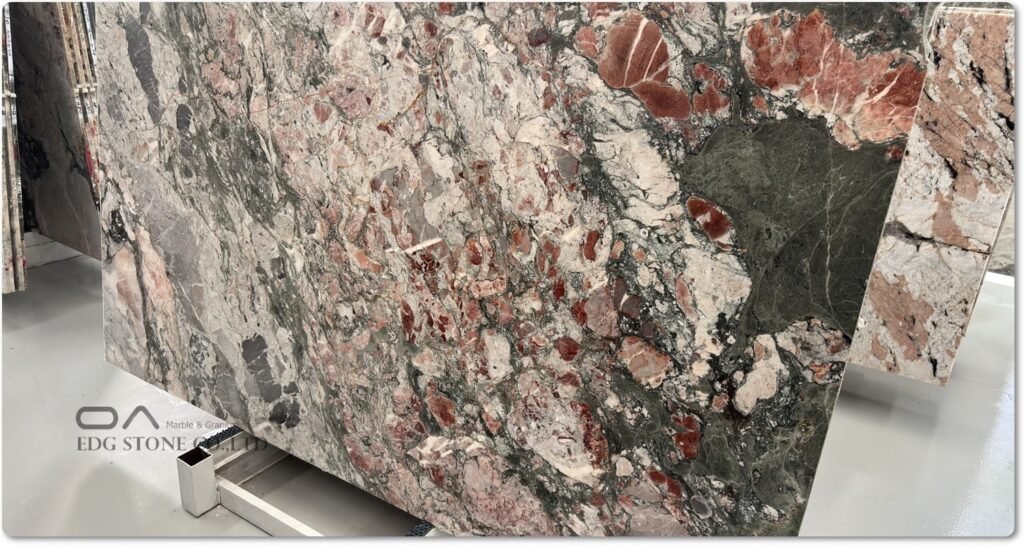
2026 Regulatory and Sustainability Considerations
The natural stone industry is increasingly influenced by documentation, traceability, environmental information, and worker-safety requirements.
EU Construction Products Regulation
One important development for European buyers is the revised Construction Products Regulation, Regulation (EU) 2024/3110.
The regulation entered into force on January 7, 2025, and its main provisions began applying from January 8, 2026. The European Commission identifies environmental sustainability, product information, digital product passports and environmental characteristics as important elements of the new framework.
However, buyers should not assume that every green marble product automatically requires CE marking under CPR-2024.
The European Commission explains that CPR obligations apply when a harmonised standard or European assessment document has been cited for the relevant product.
Therefore, European procurement teams should verify:
- Intended application
- Relevant product standard
- Declaration requirements
- CE marking applicability
- Environmental documentation
- Traceability requirements
- Importer responsibilities
Environmental Product Information
CPR-2024 is moving the construction sector toward more structured environmental information.
For stone suppliers, this increases the importance of maintaining accurate information about:
- Material origin
- Manufacturing process
- Product composition
- Environmental characteristics
- Production documentation
- Product identification
The European Commission states that environmental characteristics will form part of the Declaration of Performance and Conformity under CPR-2024 and are intended to support building carbon-footprint calculations.
Worker Safety and Stone Fabrication
Stone fabrication also requires attention to respirable crystalline silica.
OSHA states that cutting, sawing, grinding and drilling stone can generate respirable crystalline silica, and its July 2026 guidance specifically discusses risks in natural and engineered stone countertop fabrication and installation.
Although natural marble often has substantially less silica than engineered stone, the actual composition varies by material.
Professional factories should therefore use appropriate dust-control measures, including wet methods, local exhaust ventilation and process isolation where appropriate.
What Does the 2026 Green Marble Market Mean for Buyers?
The broader dimension-stone market remains highly competitive and internationally supplied.
The U.S. Geological Survey reported that the United States remained one of the world’s leading dimension-stone markets in 2025. USGS also estimated that U.S. dimension-stone imports increased in 2025 for the first time in five years.
This is relevant to international stone suppliers because procurement increasingly crosses borders.
At the same time, buyers are becoming more sophisticated.
The traditional purchasing question was:
“How much is the slab?”
The modern B2B question is closer to:
“What is the total delivered cost, quality consistency, fabrication capability, documentation package and project risk?”
This shift creates opportunities for manufacturers that can combine material sourcing, fabrication, quality control, and international logistics.
Green Marble Buyer’s Checklist
Before placing an order, confirm the following.
Material
Exact commercial name
Geological classification
Country and quarry origin
Color range
Vein direction
Slab photos
Sample approval
Technical
Slab dimensions
Thickness
Water absorption
Density
Strength data
Finish
Tolerance
Fabrication
CAD drawings
CNC requirements
Waterjet requirements
Sink cutouts
Edge profiles
Bookmatching
Dry layout
Commercial
Quantity
MOQ
Price basis
Production lead time
Payment terms
Inspection requirements
Replacement policy
Logistics
Export packing
Wooden crates
Container loading
Weight distribution
Packing list
Shipping documents
Destination port
FAQ: Common Green Marble Questions Buyers Ask in 2026
1. Is green marble good for countertops?
Green marble can be used for countertops, but suitability depends on the specific stone, mineral composition, absorption, finish and intended use. Calcite-based marble can be vulnerable to acid etching, so buyers should understand maintenance requirements before selecting it for high-use kitchen surfaces.
2. How much does green marble cost?
There is no single green marble price. Cost depends on origin, rarity, slab quality, dimensions, thickness, finish, processing, quantity, packaging and shipping, so professional buyers should request a project-specific quotation based on the actual material and specifications.
3. What is the most popular green marble?
There is no universally standardized “most popular” green marble because commercial names and regional preferences vary. Indian green marble, Baroda green marble, Udaipur green marble, dark green marble, emerald green marble, rainforest green marble and forest green marble are all commonly used search and specification terms.
4. Is green onyx the same as green marble?
No. Green onyx and green marble are different natural-stone categories. Onyx is known for its distinctive translucent properties, while true marble is a metamorphic stone; therefore, buyers should verify material classification before specifying either product.
5. Can I buy green marble directly from a manufacturer?
Yes. International buyers can source green marble slabs and fabricated products directly from a manufacturer or factory. Direct sourcing can be particularly useful for wholesale, hospitality, multifamily, luxury residential and custom-furniture projects that require consistent specifications, fabrication and export packaging.
Green Marble Buying Intelligence: What Should a Professional Buyer Consider in 2026?
What Makes Green Marble Different?
Green marble is not one standardized material. It is a commercial family of natural decorative stones whose appearance and performance depend on mineral composition, geological formation, quarry origin and processing.
How Should Buyers Choose Green Marble?
Choose by combining appearance and technical performance. Evaluate the actual slab, color consistency, vein movement, dimensions, thickness, finish, absorption, strength, fabrication requirements, maintenance expectations and project environment.
Why Is Slab Selection Important?
Large-format green marble is naturally variable. A small sample cannot fully represent the pattern, veining, fissures or color distribution of a complete slab. For high-value projects, slab photography, physical inspection and production-lot approval are therefore important procurement steps.
What Are the Main Green Marble Options?
Buyers commonly encounter Indian green marble, Baroda green marble, Udaipur green marble, dark green marble, light green marble, emerald green marble, rainforest green marble and forest green marble. Green onyx and green serpentine may look similar but should be evaluated as different material categories.
Where Is Green Marble Used?
Green marble is suitable for a wide range of architectural and decorative applications, including countertops, vanity tops, wall panels, flooring, tiles, fireplace surrounds, dining tables, coffee tables, side tables, trays, reception desks and custom furniture.
What Should International Buyers Consider?
International procurement should consider more than ex-factory stone price. The relevant commercial equation includes material quality, fabrication, QC, packaging, container utilization, freight, import requirements, installation conditions and potential replacement costs.
What Is Changing in the 2026 Stone Industry?
Stone procurement is becoming increasingly documentation-driven. European construction-product rules are introducing stronger requirements around environmental information and digital product information, while worker-safety requirements continue to emphasize dust and silica control during fabrication.
What Does This Mean for Green Marble Manufacturers?
A modern green marble manufacturer is increasingly expected to provide more than slabs. Buyers may require technical data, digital product information, CAD fabrication, quality control, traceability, project-specific packing and international logistics support.
Why Does the Supplier Matter?
Natural stone varies from block to block and quarry to quarry. A supplier capable of selecting suitable blocks, controlling fabrication, documenting production and packing the finished product for export can reduce procurement complexity for international buyers.
What Is the Practical Buying Principle?
The most reliable green marble procurement process is specification-led rather than name-led: define the intended application, verify the actual material, approve the appearance, confirm technical characteristics, establish fabrication tolerances, calculate landed cost and document the shipment before production begins.
Conclusion
Green marble offers one of the broadest visual ranges within natural decorative stone, from pale green and soft mineral patterns to dramatic dark green, emerald, rainforest and forest-style materials.
For homeowners and designers, the primary attraction is aesthetic.
For professional buyers, the decision is more comprehensive.
A successful green marble purchasing strategy considers:
Appearance + Mineralogy + Technical Performance + Fabrication + Quality Control + Packaging + Logistics + Regulatory Documentation + Total Landed Cost
Whether the requirement is for green marble slabs, green marble countertops, green marble tiles, green marble tables, green marble dining tables, green marble coffee tables, green marble side tables or custom stone furniture, buyers should evaluate the actual material rather than relying only on a commercial name.
For international projects, working with an experienced green marble manufacturer, factory, supplier and exporter can simplify the process from material selection through fabrication, QC and container loading.
For 2026 and beyond, the strongest procurement model is therefore not simply “find cheap green marble.”
It is:
Find the right stone → verify the material → control the fabrication → document the product → protect it during transportation → calculate the real landed cost → deliver consistently.
That is the foundation of professional green marble sourcing.
Sources and Technical References
- U.S. Geological Survey — Mineral Commodity Summaries 2026: Dimension Stone.
- U.S. Geological Survey — Dimension Stone Statistics and Information.
- European Commission — Construction Products Regulation / CPR-2024.
- European Commission — CPR Overview and Scope.
- European Commission — CE Marking and Declaration of Performance and Conformity.
- ASTM International — ASTM C503/C503M-23, Standard Specification for Marble Dimension Stone.
- ASTM International — ASTM C880/C880M-25, Standard Test Method for Flexural Strength of Dimension Stone.
- Natural Stone Institute — Marble, Onyx & Serpentine: Technical Data and Best Practices.
- Natural Stone Institute — Care & Cleaning of Natural Stone.
- OSHA — Respirable Crystalline Silica / Stone Fabrication Safety.