Quick Summary: How to Choose a Reliable Green Marble Supplier
Green Marble Supplier Selection: What Buyers Need to Know
Choosing a green marble supplier is fundamentally different from choosing a decorative stone based only on color or surface appearance. Green marble can vary substantially in background tone, veining, pattern, mineral structure, fissures, inclusions, and slab-to-slab appearance. For importers, distributors, fabricators, architects, contractors, hotel procurement teams, and furniture manufacturers, the real purchasing question is therefore not simply “Does this green marble look good?” but “Can this supplier repeatedly deliver the specified material at the required quality, quantity, tolerance, packaging standard, and delivery schedule?”
A professional green marble manufacturer should be able to demonstrate how the material is sourced, selected, processed, inspected, packed, documented, and exported. The supplier’s ability to manage these stages is particularly important when purchasing full containers, multiple slabs, cut-to-size components, vanity tops, countertops, tiles, furniture parts, or other fabricated products.
This guide provides a practical 12-point supplier evaluation framework for buyers looking for a green marble factory, green marble exporter, or green marble supplier in China.
Why Green Marble Supplier Selection Matters in B2B Procurement
Natural stone is not a mass-produced material with perfectly identical units. Even when slabs come from the same quarry or commercial material name, natural variation can occur between blocks and production batches.
For a residential sample order, a small visual difference may be manageable. For a hotel, multifamily development, retail project, luxury villa, or stone furniture program, uncontrolled variation can create much larger commercial problems.
Typical B2B risks include:
- Different green tones between production batches
- Unexpected veining or pattern changes
- Fissures, open veins, pits, or mineral inclusions
- Thickness variations affecting fabrication
- Insufficient usable slab yield
- Improper polishing or surface finishing
- Inadequate edge protection during transportation
- Slab breakage during container transportation
- Incorrect packing or loading orientation
- Late production caused by unavailable blocks or slabs
- Documentation problems during export
For this reason, procurement should evaluate the supplier as a supply-chain partner, not merely as a source of inexpensive slabs.
Supplier, Manufacturer, Factory and Exporter Are Not Always the Same
The terms supplier, manufacturer, factory, and exporter are often used interchangeably in the natural stone industry, but they can represent different business models.
| Business Type | Typical Capability | Buyer Consideration |
|---|---|---|
| Stone Supplier | Sourcing and trading different materials | Useful for broad material selection, but verify production control |
| Stone Manufacturer | Processing, fabrication, finishing and production | Important for custom fabrication and project orders |
| Stone Factory | Physical production facilities and equipment | Verify actual production capability and quality systems |
| Stone Exporter | International documentation, packing, and logistics | Important for container shipments and overseas projects |
For commercial procurement, a supplier capable of combining these functions can reduce communication gaps between sourcing, manufacturing, QC, and logistics.
12-Point Green Marble Supplier Evaluation Checklist
The following checklist can be used when comparing a green marble supplier, green marble factory, or green marble manufacturer.
1. Quarry and Source Transparency
The first question should be: Where does the material actually come from?
Buyers should request the commercial material name together with available information about origin, quarry or sourcing region, block source, and production batch.
This is particularly important because commercial stone names do not necessarily represent standardized geological classifications. A material marketed under a similar green marble name may have substantially different appearance or physical characteristics depending on source.
What to request
- Country and region of origin
- Quarry or source information where commercially available
- Block photographs
- Slab photographs
- Production batch information
- Material specification
Procurement principle: Never evaluate a large commercial order solely from a small polished sample when natural variation is a major part of the material’s appearance.
2. Material Identification and Technical Information
A professional supplier should clearly identify the material being sold and distinguish commercial trade names from technical information.
For projects requiring formal specifications, buyers may request relevant physical-property information such as water absorption, density or specific gravity, compressive strength, flexural strength, abrasion resistance, and dimensional tolerances, depending on the intended application.
ASTM standards such as ASTM C97/C97M are commonly referenced for absorption and bulk specific gravity testing of dimensional stone, while other standards may apply to specific physical or performance characteristics.
The appropriate testing program should always match the intended application and project specification rather than relying on a generic laboratory report.
3. Slab Inventory and Availability
A beautiful photograph does not necessarily mean the material is commercially available.
Before requesting a quotation, buyers should ask whether the supplier has:
- Finished slabs in stock
- Rough blocks available for processing
- Multiple matching slabs
- Bookmatched slabs
- Required thicknesses
- Future replenishment capability
For projects requiring dozens or hundreds of pieces, slab inventory and block availability can become more important than the initial sample price.
4. Block Selection Capability
Block selection directly affects the appearance and yield of finished slabs.
A professional natural green marble manufacturer should understand how block characteristics influence slab sequence, veining, color, fissures, and usable yield.
For premium architectural applications, buyers should consider requesting sequential slab photographs rather than isolated images.
Why sequential slabs matter
Sequential slabs allow buyers to evaluate how the pattern develops across the block. This is particularly important for feature walls, bookmatching, large islands, reception desks, hotel bathrooms, and other applications where visual continuity is important.
5. Color Consistency and Natural Variation
Color consistency should be defined before production.
“Green marble” is not one single visual category. Commercial materials may range from pale green and sage tones to darker forest, emerald, olive, or highly patterned varieties.
Buyers should define acceptable variation in writing rather than assuming that the supplier’s interpretation of “matching” is identical to the buyer’s.
For commercial projects, specify:
- Acceptable background color range
- Veining expectations
- Pattern intensity
- Acceptable natural fissures or inclusions
- Finish requirements
- Sample approval procedure
A signed-off reference sample or approved slab selection can significantly reduce disputes later in the production process.
6. Thickness Tolerance and Dimensional Control
Thickness is not simply a specification on a quotation sheet. It can affect installation, fabrication, edge profiles, weight, packaging, and compatibility with other construction components.
For fabricated products, buyers should define nominal thickness and acceptable tolerance before production.
Measurements should be taken using appropriate equipment at defined inspection points. For high-volume orders, the inspection plan should specify sampling frequency and acceptance criteria.
7. Surface Quality and Finishing
Surface finishing can substantially change the appearance and performance of green marble.
Common finishes may include polished, honed, brushed, leathered, sandblasted, or other project-specific treatments.
Buyers should evaluate:
- Gloss or visual uniformity
- Flatness
- Edge condition
- Polishing consistency
- Visible resin repairs where applicable
- Open fissures or holes
- Surface scratches
- Corner damage
For a large order, inspection should cover representative production rather than relying only on pre-production samples.
8. Fabrication Capability
A slab supplier may not be the right partner for a fabrication-intensive project.
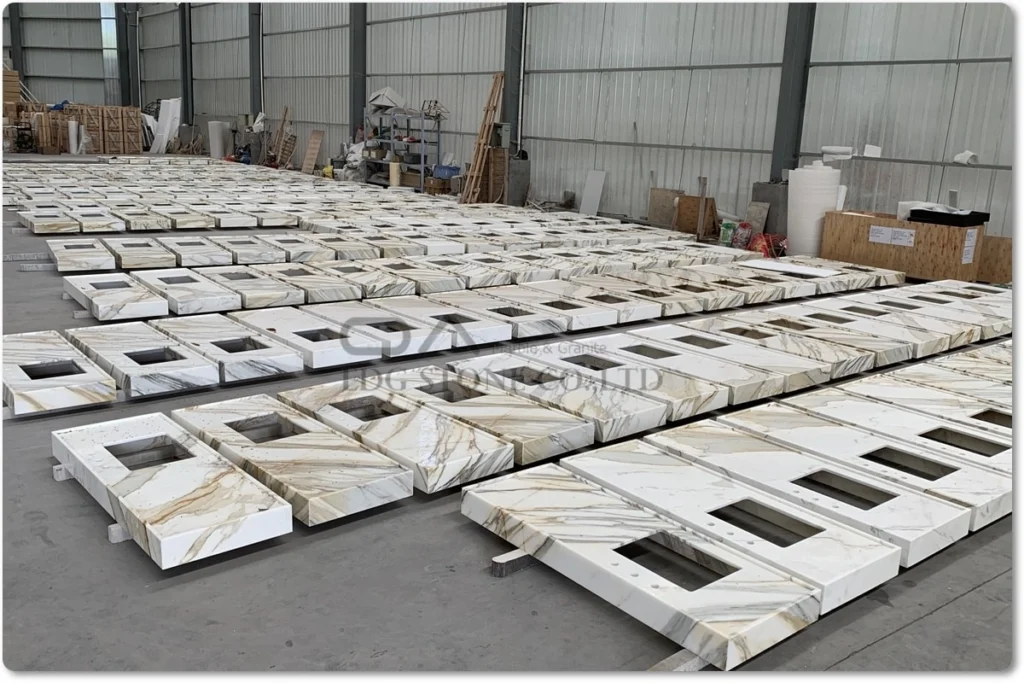
If the buyer requires countertops, vanity tops, stair components, tables, wall panels, sink cutouts, shower trays, or other custom stone components, the supplier should demonstrate relevant manufacturing capability.
Depending on the project, useful capabilities may include:
- CNC machining
- Waterjet cutting
- Cut-to-size production
- Edge profiling
- Sink cutouts
- Drilling
- CAD-based fabrication
- Bookmatching preparation
- Custom furniture fabrication
For custom fabrication, drawings and tolerances should be approved before production begins.
EDG Stone — Natural Green Marble Manufacturer & Exporter
EDG Stone combines natural stone sourcing with slab processing, custom fabrication, quality inspection, protective export packaging, and international shipment preparation. For green marble projects, the objective is to connect material selection with the final application rather than treating slab supply as an isolated transaction.
9. Quality Control System
A reliable supplier should be able to explain how quality is controlled, not simply state that the company provides “high quality.”
A practical green marble QC sequence
- Visual Inspection — check color, pattern, fissures, inclusions, and visible defects.
- Physical Testing — conduct relevant laboratory testing where required.
- Slab Inspection — inspect dimensions, thickness, finish, and surface condition.
- Fabrication Inspection — verify drawings, dimensions, edges, cutouts and tolerances.
- Packing Inspection — verify protection, labeling, stacking, and crate condition.
- Loading Inspection — verify loading sequence, securing, and container utilization.
This layered approach is more useful than a single final inspection because defects can be identified earlier in the supply chain.
EDG Stone’s QC approach
For commercial stone orders, EDG Stone can structure QC around material inspection, slab selection, dimensional checks, fabrication inspection, packing inspection, and container loading. The exact inspection criteria should be established according to the project specification, product type, and agreed order requirements.
10. Export Experience
International stone purchasing involves more than manufacturing.
An experienced green marble exporter should understand export documentation, packing requirements, container coordination, labeling, loading, shipping schedules, and communication with overseas buyers.
Buyers should ask:
- Which countries and markets does the supplier regularly serve?
- Can the supplier prepare export documentation?
- Does the supplier understand container loading?
- Can the supplier provide loading photographs?
- Can the supplier coordinate with the buyer’s forwarder?
- Can the supplier handle project-specific labeling?
11. Export Packaging
Packaging is a critical part of natural stone export procurement because slabs and fabricated products can be exposed to vibration, impact, moisture, shifting loads, and handling risks during international transportation.
Depending on product type, appropriate protection may include reinforced wooden structures, separators, edge protection, moisture protection, internal cushioning, securing systems, and external labeling.
For fabricated components, packaging should also prevent contact damage between finished surfaces.
A supplier’s packing photographs can provide useful evidence of actual export procedures.
12. Container Loading
Container loading should be treated as part of production quality rather than an afterthought.
For slab shipments, the loading plan should consider slab orientation, weight distribution, support, securing, and protection against movement.
For fabricated products, the supplier should consider the dimensions and fragility of each component when designing the loading sequence.
EDG Stone treats packaging and transportation as an important part of stone export execution. Before shipment, the supplier can coordinate packing, labeling, loading documentation, and container photographs so buyers have a clearer record of the shipment condition.
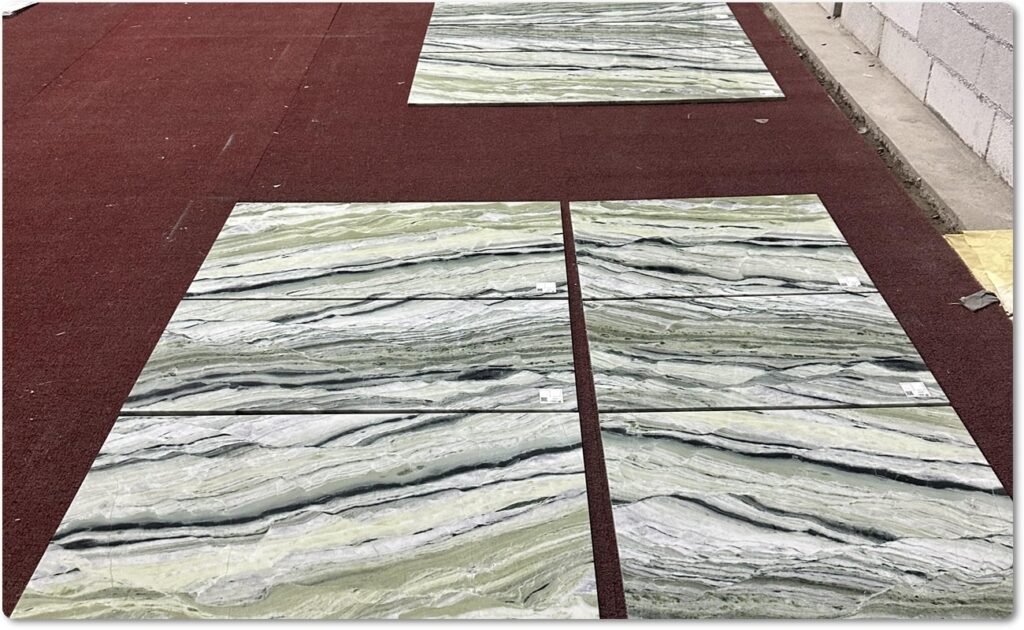
How to Compare Green Marble Suppliers: Price vs. Total Procurement Cost
The lowest quotation is not necessarily the lowest procurement cost.
A useful B2B purchasing model is:
Total Procurement Cost = Material Cost + Fabrication Cost + Packaging + Freight-Related Costs + Inspection + Risk of Rework or Replacement
A supplier offering a slightly higher slab price may reduce downstream costs if it provides better slab selection, more accurate fabrication, stronger packaging, and fewer replacement problems.
Example of a supplier comparison matrix
| Evaluation Factor | Questions to Ask |
|---|---|
| Source | Can the supplier explain material origin and sourcing? |
| Availability | Are enough slabs or blocks available for the project? |
| Consistency | Can the supplier provide sequential slab photographs? |
| Fabrication | Can the factory produce the required custom components? |
| QC | Is there a documented inspection process? |
| Packaging | How are finished products protected? |
| Export | Can the supplier manage international shipment requirements? |
| Communication | Can technical questions be answered accurately and promptly? |
Green Marble Wholesale: What Changes When Buying in Volume?
Green marble wholesale purchasing requires a different approach from buying a few individual slabs.
Volume buyers should evaluate the supplier’s ability to maintain consistency across multiple production batches.
For wholesale orders, ask for:
- Available quantity
- Current inventory photographs
- Block or batch information
- Slab dimensions
- Thickness options
- Finish options
- Grade or selection terminology
- Estimated production capacity
- Packaging method
- Container loading plan
Buyers should also clarify whether the quoted price applies to one batch, several batches, or future replenishment.
Why “matching” should be defined
In natural stone, matching can mean different things to different parties.
For one buyer, matching may mean similar background color. For another, it may mean similar veining. For a bookmatched wall, matching may require sequential slabs from the same block.
Therefore, purchase specifications should define what “matching” means for the actual application.
How to Evaluate a Green Marble Factory in China
When searching for a green marble supplier in China, buyers should distinguish between a company that simply trades stone and a manufacturer capable of controlling fabrication and export preparation.
Factory verification checklist
- Factory address and production facilities
- Stone processing equipment
- Slab processing lines
- CNC or waterjet equipment where required
- Fabrication area
- QC and inspection procedures
- Finished product storage
- Export packing area
- Container loading capability
- Previous project experience
Video calls, factory photographs, production videos, sample orders, third-party inspections, and loading photographs can all help buyers verify supplier capability.
For large projects, buyers may also consider an independent pre-shipment inspection where commercially appropriate.
EDG Stone — Natural Green Marble Manufacturer & Exporter
As a Chinese natural stone manufacturer and exporter, EDG Stone supports international buyers with natural stone sourcing, slab production, custom fabrication, QC coordination, export packaging, and container loading. The company works with project-oriented buyers who need more than a material photograph and a unit price.
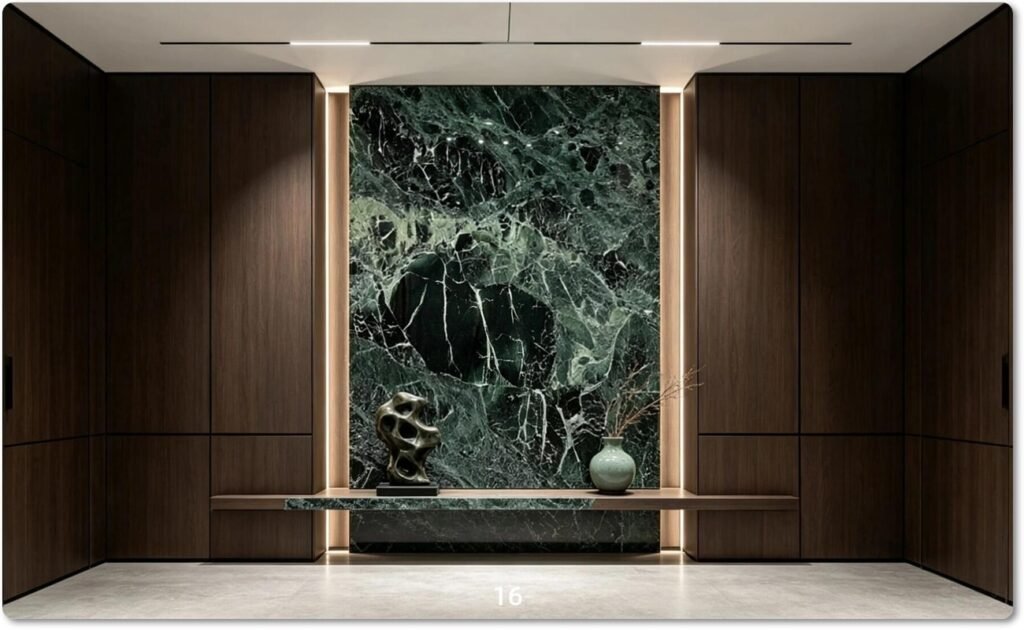
Green Marble Procurement for Hotels, Villas and Commercial Projects
Large architectural projects require a more formal procurement workflow because material appearance, quantity, timing, and fabrication all interact.
Recommended procurement sequence
Project Brief
↓
Material Shortlist
↓
Sample / Slab Review
↓
Technical Specification
↓
Quantity & Yield Calculation
↓
Production Planning
↓
QC Inspection
↓
Protective Packaging
↓
Container Loading
↓
International Shipment
This workflow helps convert a visually attractive stone selection into a controlled procurement process.
Green Marble Compliance and Documentation: What Buyers Should Check
International stone procurement is increasingly influenced by documentation, traceability, product declarations, environmental information, and destination-market requirements.
Requirements vary by country, project, product type, and intended use. Buyers should therefore distinguish between regulations that legally apply to a shipment and voluntary sustainability or project requirements.
Important areas to monitor
- Product and material documentation
- Country-of-origin information
- Customs classification
- Commercial invoices and packing lists
- Wood packaging requirements where applicable
- Project-specific environmental documentation
- Labor and responsible sourcing requirements
- Destination-market building requirements
For projects pursuing green-building certifications or environmental procurement standards, buyers may request additional information such as environmental product documentation, recycled content information where applicable, chain-of-custody information, or other project-specific declarations.
The important procurement principle is simple: do not assume that one document automatically satisfies every market or project requirement. Requirements should be confirmed according to destination, application, and contract specifications.
What Reliable Green Marble Suppliers Should Provide Before You Place an Order
Before confirming a commercial purchase, buyers should ideally have enough information to make the order technically measurable.
Recommended pre-order documentation
- Material name and origin
- Current slab photographs
- Available sizes
- Thickness
- Finish
- Quantity
- Fabrication drawings where applicable
- Technical data where required
- Inspection requirements
- Packaging specification
- Loading plan or loading photographs where applicable
- Commercial terms and delivery schedule
One important rule for natural stone
Approve the material that will actually be supplied whenever the visual character is critical.
A small sample can establish general color and finish, but it cannot always represent the full natural variation of an entire block or production batch.
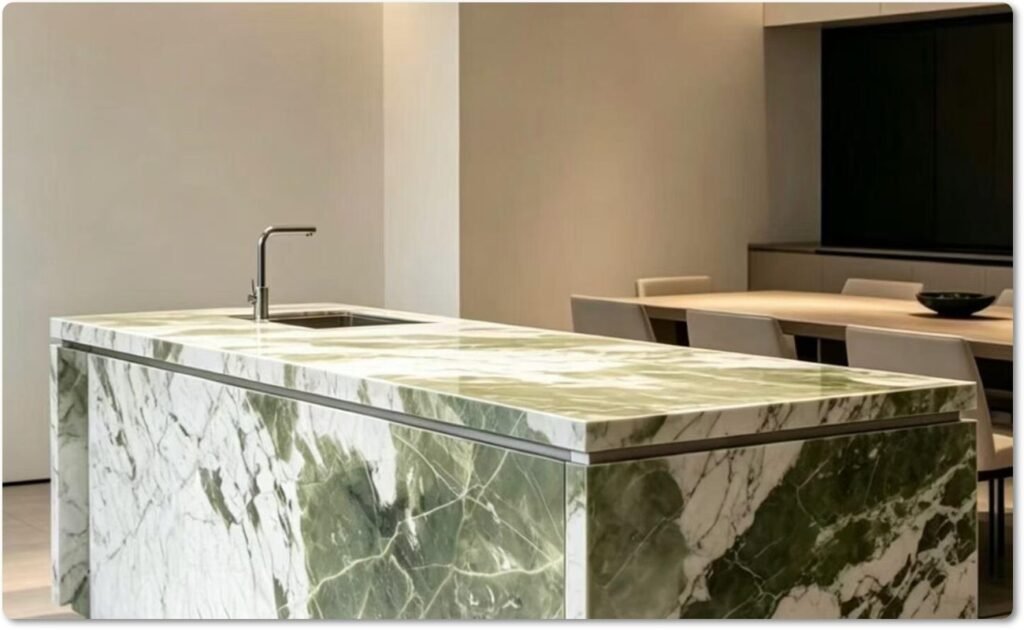
How to Avoid Common Green Marble Supplier Mistakes
Mistake 1: Choosing Only by Price
Low initial pricing can become expensive if the material has excessive waste, inconsistent appearance, fabrication defects, or inadequate packaging.
Mistake 2: Approving Only a Small Sample
A small sample does not necessarily represent an entire production batch.
Mistake 3: Not Defining Quality Terms
Words such as “premium,” “first grade,” “A grade,” or “commercial grade” can have different meanings between suppliers. Whenever possible, use measurable specifications and approved visual references.
Mistake 4: Ignoring Packaging
A good slab can become a damaged product if the export packing and loading process is inadequate.
Mistake 5: Treating Export Logistics as Someone Else’s Problem
International shipment coordination should be discussed before production, not after the goods are finished.
Mistake 6: Ordering Before Confirming Production Capacity
Large projects require realistic production scheduling. Buyers should confirm availability of blocks, slabs, fabrication capacity, and shipping windows before committing to a project schedule.
What Questions Should You Ask a Green Marble Supplier?
Before requesting a quotation, commercial buyers can send the following checklist to potential suppliers.
- What is the origin of this green marble?
- Do you have current slab photographs?
- Are the slabs from the same block or production batch?
- What thicknesses are available?
- What finishes are available?
- What is the expected usable yield?
- Can you provide sequential slab photographs?
- Can you fabricate cut-to-size products?
- Can you provide CAD-based fabrication?
- What QC process do you use?
- Can you provide technical test information where required?
- How will the products be packed?
- How will the container be loaded?
- Can you provide loading photographs?
- What is the estimated production lead time?
- What export markets do you regularly serve?
A supplier that can answer these questions clearly gives the buyer a stronger basis for comparing proposals.
Green Marble Supplier Selection: A Practical Decision Framework
The best procurement process is not about finding a supplier with the most impressive website or the lowest quotation. It is about establishing whether the supplier can consistently satisfy the technical, visual, manufacturing, quality, and logistics requirements of the actual project.
For small orders
Focus on material authenticity, sample quality, price, finish, packaging, and communication.
For wholesale orders
Add batch consistency, inventory availability, replenishment capability, yield, production capacity, and container planning.
For custom fabrication
Add CAD control, dimensional tolerance, machining capability, edge processing, inspection procedures, and protective packaging.
For hotel and commercial projects
Add formal specifications, sample approval, slab selection, production scheduling, inspection procedures, documentation, packaging, loading records, and contingency planning.
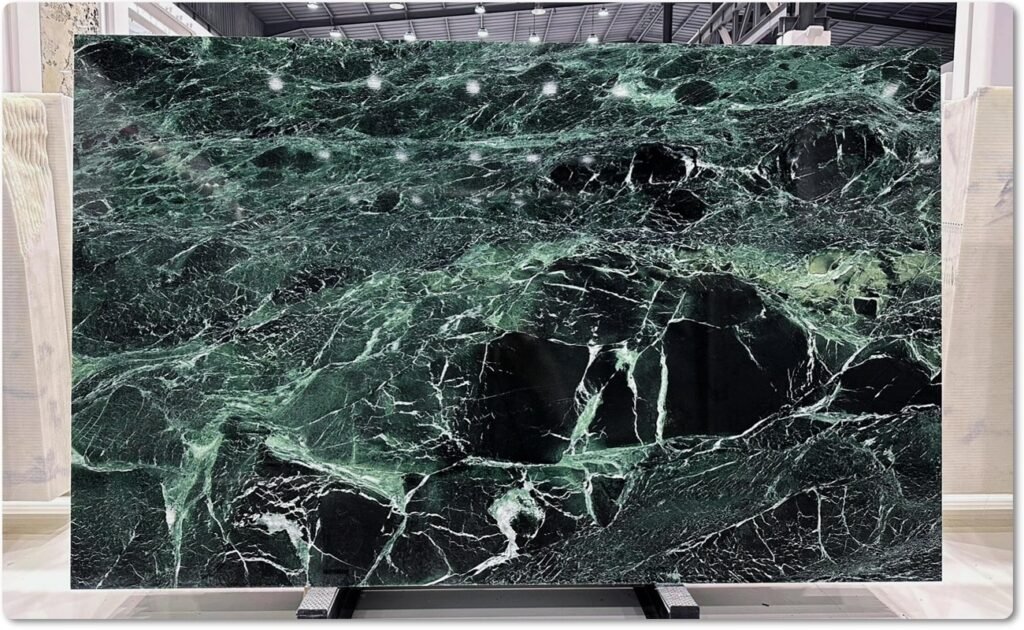
EDG Stone — Natural Green Marble Manufacturer & Exporter
For international buyers looking for a natural green marble manufacturer, EDG Stone provides an integrated approach covering material sourcing, slab processing, custom fabrication, quality control, export packaging, and container loading.
The focus is not simply to supply green marble, but to help buyers move from material selection → slab approval → fabrication → QC → packaging → international shipment with clearer communication at each stage.
For importers, distributors, architects, contractors, hospitality procurement teams, furniture manufacturers, and stone fabricators, the appropriate supply model depends on the project. Some buyers need slabs only; others require cut-to-size production or complete fabricated stone components.
The practical starting point is to define the required material, quantity, dimensions, finish, application, quality criteria, delivery destination, and inspection requirements before requesting a final quotation.
Semantic Insight: How to Build a Reliable Green Marble Supply Chain
What makes a green marble supplier reliable?
A reliable supplier is one that can demonstrate control over the complete purchasing chain: source identification, material selection, production, fabrication, inspection, packaging, documentation, and export coordination.
Why is supplier capability more important than a sample photograph?
A photograph shows appearance at one point in time. A commercial supplier must demonstrate the ability to reproduce acceptable quality across the quantity required by the buyer. For natural stone, this means managing natural variation rather than pretending that every slab will be identical.
How should buyers evaluate different supplier options?
Compare suppliers using the same technical and commercial criteria. Evaluate source transparency, availability, visual consistency, fabrication capability, QC, packaging, export experience, lead time, and total procurement cost instead of comparing unit prices alone.
What is the right procurement option for a large green marble project?
Large projects generally benefit from a documented material approval process. Depending on the project, this can include sample approval, sequential slab review, technical testing, fabrication drawings, inspection checkpoints, packing requirements, and loading records.
What should buyers consider before selecting a China green marble factory?
Buyers should verify that the company has genuine production and export capabilities relevant to the project. Factory verification should include processing equipment, fabrication capability, QC procedures, packing facilities, previous export experience, and the ability to communicate technical requirements accurately.
What is the broader industry direction?
The natural stone supply chain is moving toward greater documentation, traceability, specification-based procurement, environmental information, and more structured quality control. At the same time, AI-assisted search is making clearly structured technical content increasingly valuable because buyers can research materials and suppliers before contacting a manufacturer.
What is the most important consideration before placing a commercial order?
Define the acceptance criteria before production. The more clearly the buyer specifies material identity, appearance, dimensions, finish, acceptable natural characteristics, inspection method, packaging, and delivery requirements, the less room there is for disagreement after production.
Frequently Asked Questions About Green Marble Suppliers
1. How do I choose a reliable green marble supplier?
Evaluate the supplier’s source transparency, material availability, slab consistency, fabrication capability, quality control, export experience, packaging, and container loading procedures. For large projects, review actual slabs or production batches rather than relying only on small samples.
2. What is the difference between a green marble supplier and a green marble manufacturer?
A supplier may source products from different factories, while a manufacturer typically controls some or all of the processing and fabrication stages. Buyers should verify the actual business model and production capability rather than relying solely on the terminology used on a website.
3. Can I buy green marble wholesale from China?
Yes. Chinese stone companies can supply green marble slabs and fabricated products for international wholesale markets. Buyers should verify material availability, production capacity, quality standards, packaging, export experience, and shipping arrangements before placing a large order.
4. How can I verify the quality of green marble before purchasing?
Request current slab photographs, technical information where relevant, samples, sequential slab images, and clear quality specifications. For large or high-value projects, buyers can consider independent inspection or pre-shipment inspection according to the contract.
5. What should I ask a green marble exporter before ordering?
Ask about material origin, available quantity, slab dimensions, thickness, finish, fabrication capability, QC procedures, packaging, container loading, export documentation, production lead time, and delivery arrangements. These questions help distinguish a project-capable exporter from a supplier that only provides material quotations.
Conclusion: Choose a Green Marble Export Partner, Not Just a Stone Seller
Green marble procurement is ultimately a supply-chain decision.
The visual appeal of the stone matters, but successful B2B purchasing also depends on source transparency, material consistency, technical control, fabrication capability, quality inspection, packaging, container loading, documentation, and international export experience.
Whether you are searching for a green marble supplier, green marble manufacturer, green marble factory, green marble exporter, or green marble supplier in China, use a structured evaluation process before comparing quotations.
A reliable supplier should be able to answer one fundamental question:
“Can you consistently deliver the specified natural stone, in the specified quantity and quality, with the required fabrication, protection, documentation, and delivery execution?”
For commercial buyers, that question is more important than the lowest initial price.