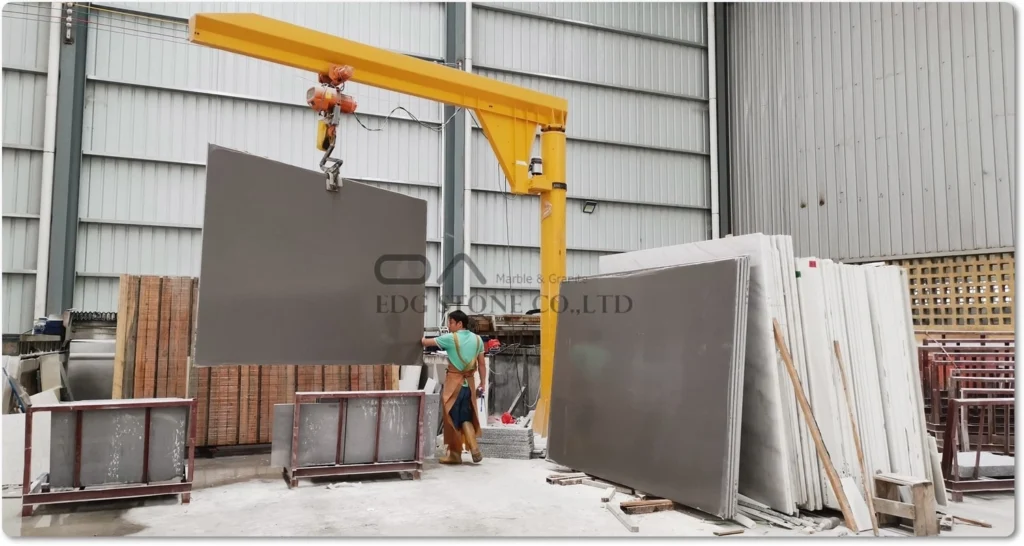
Marble countertops offer distinctive natural veining, timeless aesthetics, excellent design versatility, and the potential for long-term use. However, marble is a calcium-carbonate-based natural stone that is vulnerable to acid etching, surface scratching, and staining under certain conditions. Its suitability depends on the marble variety, mineral composition, porosity, finish, fabrication quality, and maintenance expectations. Marble is particularly suitable for luxury kitchens, bathroom vanities, hospitality projects, and premium residential interiors where natural appearance is a priority. Buyers should evaluate absorption, physical strength, slab consistency, surface treatment, fabrication tolerances,ces and total installed cost before purchasing. For importers and commercial buyers, choosing an experienced marble countertop manufacturer with documented material inspection and export packaging procedures is essential.
1. Executive Summary: Are Marble Countertops Worth It?
Marble countertops remain one of the most recognizable choices in luxury residential and commercial interior design. Their natural mineral patterns, distinctive veining, soft color variations, and geological character make them particularly attractive for kitchens, bathroom vanities, hotel interiors, reception counters, and premium residential developments.
However, marble is not a maintenance-free countertop material.
The main advantages of marble countertops are:
Natural beauty and distinctive geological patterns.
Wide selection of colors, veining styles, and material origins.
Excellent compatibility with traditional, contemporary, and luxury interior designs.
Ability to be customized through CNC machining, waterjet cutting, and edge profiling.
Natural stone composition without the polymer-resin matrix used in many engineered stone products.
Potential for long service life when appropriately selected, fabricated and maintained.
The main disadvantages are:
Sensitivity to acidic substances such as lemon juice, vinegar and wine.
Susceptibility to scratching and surface abrasion.
Potential staining depending on porosity and exposure conditions.
Greater maintenance requirements than many engineered surfaces.
Natural variation between slabs.
Possible additional costs associated with material selection, reinforcement, fabrication, and installation.
Who Should Choose Marble Countertops?
| Buyer Type | Suitability | Main Consideration |
|---|---|---|
| Luxury homeowners | High | Appearance and maintenance expectations |
| Interior designers | High | Veining, color, and finish selection |
| Hotel developers | Project-dependent | Maintenance and lifecycle requirements |
| Bathroom vanity manufacturers | High | Water exposure and cosmetic-product staining |
| Kitchen cabinet brands | Project-dependent | Customer usage and care instructions |
| Stone importers and distributors | High | Material consistency and supplier reliability |
| Commercial contractors | Project-dependent | Performance specifications and inspection |
Procurement conclusion: Marble is an excellent choice when natural aesthetics, material authenticity, and design flexibility are important. It is less suitable for buyers who require maximum resistance to acids, scratches, and everyday chemical exposure with minimal maintenance.
The correct purchasing decision should be based on the actual marble variety and intended application rather than the general reputation of marble as a material.
2. Scope and Definitions: Understanding Marble Countertops
2.1 What Are Natural Marble Countertops?
Natural marble is a metamorphic rock formed through geological processes involving heat, pressure, and the recrystallization of carbonate minerals.
Its principal mineral constituents are generally calcite and, in some varieties, dolomite.
Commercial marble countertops are manufactured from quarried natural stone blocks or slabs. The material is processed into finished countertop components according to project drawings and specifications.
Typical manufacturing operations include:
Quarry block selection.
Block cutting and slab production.
Surface polishing or honing.
Slab inspection and grading.
Digital measurement and template preparation.
CNC or bridge-saw cutting.
Sink and faucet cutouts.
Edge profiling.
Surface treatment and finishing.
Final inspection and protective packaging.
Unlike engineered quartz, natural marble is not manufactured by combining mineral particles with polymer resin to create a composite slab.
This distinction matters because the two products have different mineral structures, physical characteristics, maintenance requirements, and manufacturing processes.
2.2 Common Types of Marble Used for Countertops
Different marble varieties have different mineral compositions, geological structures, absorption characteristics, and visual appearances.
Common commercial selections include:
Carrara marble is traditionally associated with white and light-grey backgrounds with relatively soft grey veining. It is frequently selected for residential kitchens, bathroom vanities, and interior architectural applications.
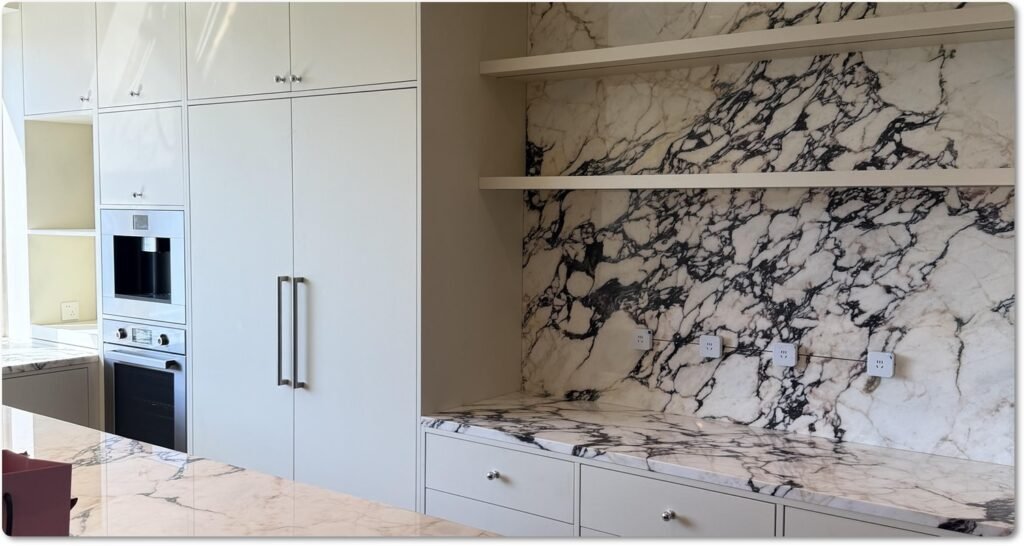
Calacatta varieties are known for dramatic veining and distinctive white backgrounds. They are often used in luxury kitchens, waterfall islands, and hospitality interiors.
Statuario is associated with premium white marble aesthetics and prominent grey veining. It is commonly specified for high-end architectural interiors.
Arabescato varieties feature complex, interconnected veining patterns that create strong visual movement.
Black marble varieties provide a contrasting aesthetic for kitchen islands, vanity tops, and feature counters.
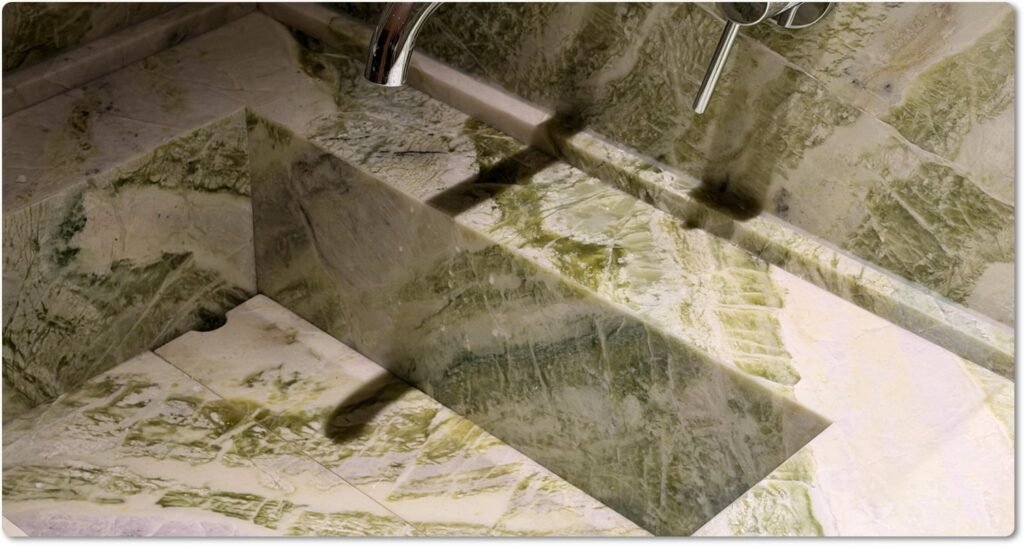
Green marble is used in distinctive interior applications, including luxury bathroom vanities, bars, reception desks, and decorative furniture.
Other selections include beige, brown, grey, pink, and multi-colored marble.
An important purchasing principle is that commercial names do not establish identical physical properties. Two slabs sold under similar market descriptions may have different geological characteristics.
2.3 What Is Included in a Marble Countertop Product?
A finished countertop project may include:
Marble slabs.
Countertop panels.
Kitchen island tops.
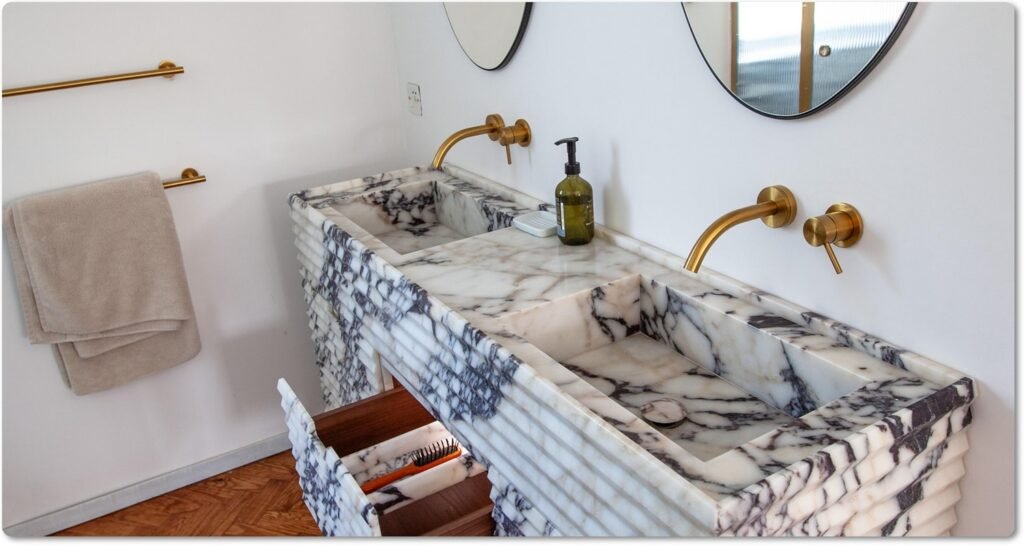
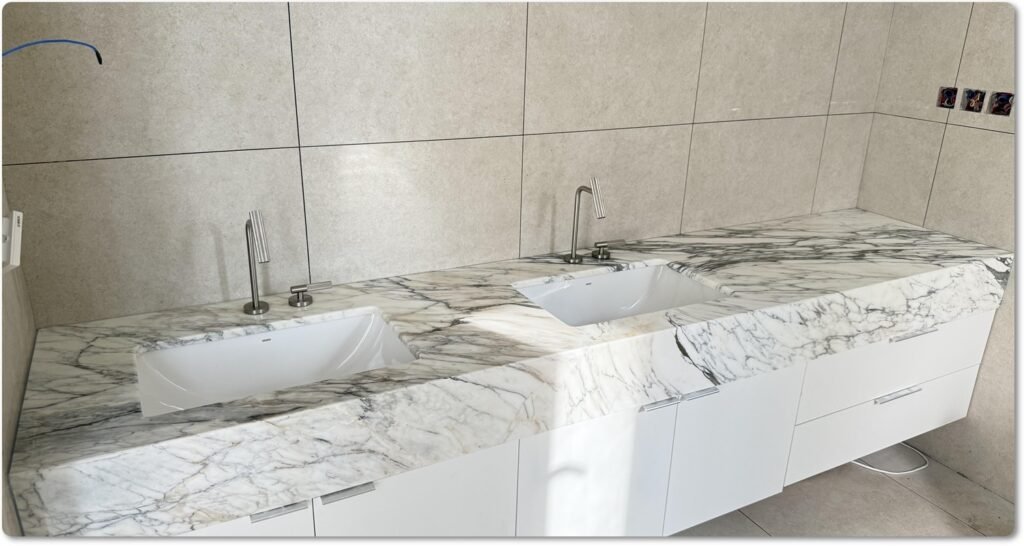
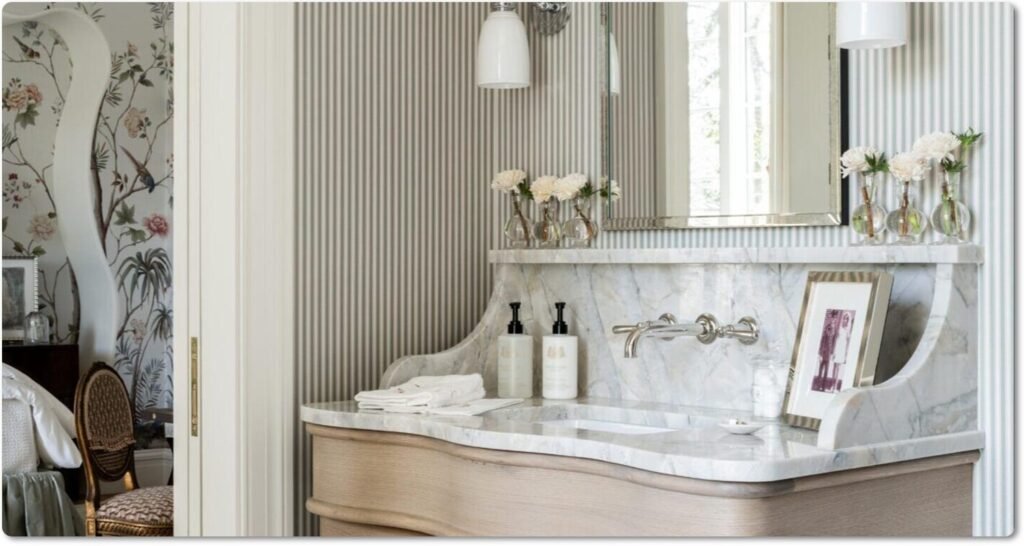
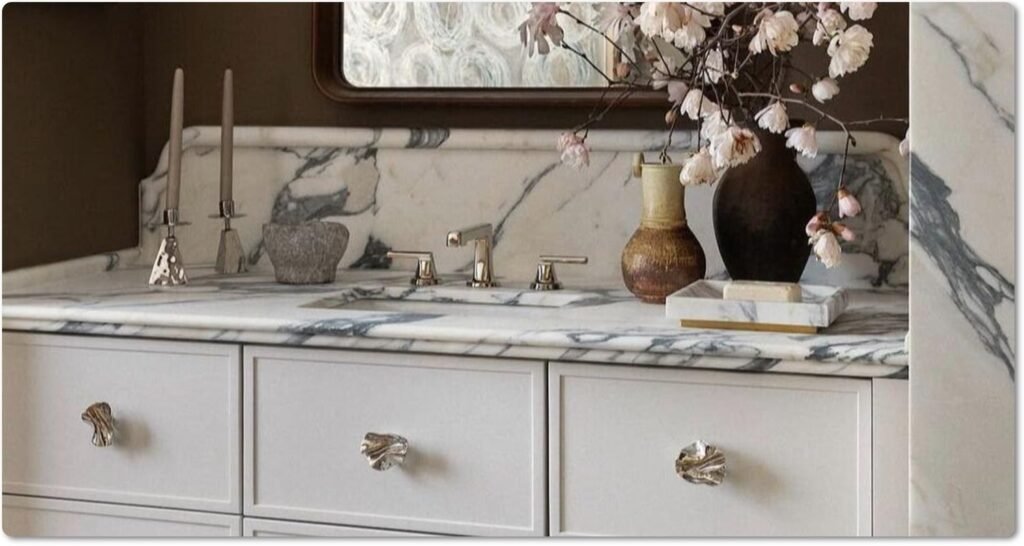
Bathroom vanity tops.
Backsplashes.
Waterfall edges.
Sink cutouts.
Faucet holes.
Edge profiles.
Apron fronts.
Custom-shaped components.
Support structures and installation accessories.
Buyers should distinguish between slab procurement and finished countertop procurement.
A slab supplier may only provide raw material, while a countertop manufacturer may provide drawing review, fabrication, edge processing, inspection, and export packaging.
This distinction affects pricing, lead time, responsibility allocation, and quality control.
3. Technical Evaluation: The Main Pros and Cons of Marble Countertops
3.1 Advantages of Marble Countertops
Advantage 1: Unique Natural Appearance
The most important advantage of marble is its natural visual character.
Marble develops its colors and patterns through geological processes. Mineral impurities, recrystallization, and geological deformation contribute to differences in color, veining, and texture.
Unlike printed surface patterns, natural marble has geological variation that makes individual slabs visually distinctive.
For designers, this provides several opportunities:
Matching countertop colors with cabinetry.
Creating dramatic kitchen islands.
Selecting bookmatched slab arrangements.
Designing continuous wall and countertop compositions.
Combining different finishes within the same interior.
For premium residential and hospitality projects, this aesthetic flexibility is a significant purchasing advantage.
Advantage 2: Wide Range of Colors and Designs
Marble is available in numerous commercial color families.
| Color Family | Typical Applications |
|---|---|
| White marble | Kitchens, bathrooms, luxury islands |
| Grey marble | Contemporary kitchens and commercial interiors |
| Black marble | Bars, reception counters and feature islands |
| Green marble | Luxury bathrooms and decorative counters |
| Beige marble | Hospitality and residential developments |
| Brown marble | Traditional and contemporary interiors |
The availability of different colors and patterns enables manufacturers to support multiple product collections.
For wholesalers and distributors, a carefully selected marble portfolio can also help create differentiated showroom offerings.
Advantage 3: Excellent Fabrication Flexibility
Marble can be processed using various stone fabrication technologies.
These include:
Bridge saw cutting.
CNC machining.
Waterjet cutting.
Edge profiling.
Sink cutouts.
Polishing and honing.
Custom curves and shapes.
Bookmatched fabrication.
This makes marble suitable for standard kitchen countertops as well as complex architectural and decorative projects.
A professional marble countertop factory can manufacture customized components based on CAD drawings, digital templates, and approved production specifications.
However, the achievable design depends on the specific stone’s structural characteristics and thickness.
Advantage 4: Suitable for Multiple Interior Applications
Marble is not limited to kitchen countertops.
It can also be used for:
Bathroom vanity tops.
Hotel reception counters.
Restaurant bars.
Luxury retail counters.
Residential islands.
Fireplace surrounds.
Decorative wall panels.
Custom stone furniture.
This versatility allows importers and project contractors to source multiple related products from one manufacturing partner.
Advantage 5: Long-Term Design Relevance
Natural marble has a long history in architecture and interior design.
Its visual appeal is not dependent on a single short-term surface-printing trend. Different colors, finishes, and fabrication styles can adapt to changing interior design preferences.
A properly selected marble countertop can remain visually relevant for many years, although its surface appearance may change through normal use.
3.2 Disadvantages of Marble Countertops
Disadvantage 1: Acid Etching
Acid sensitivity is one of the most important limitations of marble countertops.
Many marble varieties are predominantly composed of calcium carbonate.
When acidic substances contact the surface, they can react with the carbonate minerals and alter the polished surface.
Common household substances associated with etching include:
Lemon juice.
Vinegar.
Wine.
Tomato juice.
Certain soft drinks.
Acidic cleaning products.
Etching is different from staining.
A stain generally involves a substance entering the stone or depositing color on the surface. Etching is a chemical alteration of the stone’s surface.
It may appear as a dull spot, loss of gloss, or a visible surface mark.
Important: An impregnating sealer can reduce the rate of liquid absorption, but it does not make acid-sensitive marble immune to chemical etching.
For kitchen buyers, this distinction is essential.
Disadvantage 2: Surface Scratching
Marble can be scratched by abrasive materials and everyday kitchen activities.
Potential sources include:
Ceramic cookware.
Sand particles.
Metal objects.
Abrasive cleaning pads.
Direct knife contact.
The actual scratch resistance varies according to the mineral structure, finish, and material variety.
Using cutting boards, appropriate cleaning materials,s and protective kitchen accessories can reduce surface damage.
Disadvantage 3: Potential Staining
Some marble varieties have interconnected pores and may absorb liquids.
Potential staining substances include:
Cooking oil.
Coffee.
Tea.
Wine.
Cosmetics.
Certain household chemicals.
Absorption characteristics vary considerably among stone varieties.
An appropriate impregnating sealer may help reduce liquid penetration, but it cannot guarantee complete stain prevention.
Buyers should request material-specific absorption information rather than assuming all marble has the same porosity.
Disadvantage 4: Maintenance Requirements
Marble requires more attention than many nonporous engineered countertop materials.
Routine care generally includes:
Cleaning spills promptly.
Using pH-neutral stone cleaners.
Avoiding acidic cleaning products.
Avoiding abrasive cleaning pads.
Using cutting boards.
Evaluating sealer performance periodically.
Arranging professional refinishing when necessary.
Maintenance frequency depends on the stone variety, finish, usage intensity, sealer, and household cleaning practices.
Disadvantage 5: Natural Slab Variation
Natural variation is an advantage from a design perspective, but it can create procurement challenges.
Differences may occur in:
Background color.
Vein direction.
Vein density.
Mineral inclusions.
Natural fissures.
Surface texture.
Resin-filled areas.
For multi-unit developments, hotel projects, and wholesale orders, buyers should approve actual production slabs rather than relying exclusively on small samples.
3.3 Marble vs. Quartz vs. Granite
The comparison below focuses on general material behavior. Individual products must still be evaluated using their actual specifications.
| Evaluation Factor | Natural Marble | Engineered Quartz | Natural Granite |
|---|---|---|---|
| Material structure | Natural carbonate rock | Manufactured composite | Natural igneous rock |
| Natural variation | High | Product-dependent | High |
| Acid sensitivity | Generally high | Product-dependent | Generally lower |
| Scratch resistance | Moderate to limited | Generally good | Generally good |
| Heat tolerance | Generally good, but thermal shock remains possible | Resin matrix may be heat-sensitive | Generally good |
| Porosity | Variety-dependent | Usually low | Variety-dependent |
| Sealing | Often beneficial | Usually not required | Variety-dependent |
| Maintenance | Relatively high | Relatively low | Relatively low to moderate |
| Custom fabrication | Excellent | Excellent | Excellent |
| Main appeal | Natural veining and luxury aesthetics | Consistency and convenience | Durability and natural patterns |
Selection recommendation:
Choose marble when natural veining and premium aesthetics are the priority.
Choose engineered quartz when surface consistency and lower routine maintenance are more important.
Choose granite when a natural stone surface with generally better everyday scratch and acid resistance is preferred.
No material is universally superior. The appropriate choice depends on the actual product, project requirements, and owner expectations.
3.4 Technical Properties Buyers Should Evaluate
A professional procurement process should examine measurable material characteristics rather than relying on marketing descriptions.
| Property | Why It Matters | Relevant Test Method |
|---|---|---|
| Water absorption | Indicates liquid absorption behavior | ASTM C97/C97M |
| Bulk specific gravity | Helps characterize material density | ASTM C97/C97M |
| Compressive strength | Evaluates resistance to compression | ASTM C170/C170M |
| Modulus of rupture | Evaluates resistance to bending failure | ASTM C99/C99M |
| Flexural strength | Relevant to bending performance | ASTM C880/C880M |
| Abrasion resistance | Helps evaluate wear behavior | ASTM C241/C241M or C1353 |
| Petrographic characteristics | Helps identify mineral composition and structure | Appropriate petrographic examination |
ASTM C503/C503M-23 is the specification for marble dimension stone and provides a relevant framework for material characteristics and physical requirements.
However, it should not be treated as a complete kitchen countertop installation specification.
Buyers should additionally define thickness, unsupported spans, cutout reinforcement, edge details, installation support, and acceptance criteria.
3.5 Finish Selection: Polished vs. Honed Marble
Polished Marble
A polished finish creates a reflective surface and enhances the visual contrast of natural veins.
Advantages:
Strong visual impact.
Reflective appearance.
Highlights natural color variation.
Commonly selected for luxury interiors.
Limitations:
Etching and surface dullness may be more noticeable.
Scratches can affect visual consistency.
Honed Marble
A honed finish produces a matte or low-sheen appearance.
Advantages:
Softer visual character.
Suitable for contemporary interiors.
Minor surface marks may be less visually prominent.
Limitations:
Surface texture and absorption behavior still depend on the stone.
It does not eliminate acid sensitivity or staining.
Neither finish changes the fundamental mineral chemistry of marble.
4. Procurement Checklist: How to Buy Marble Countertops?
A professional buyer should follow a structured inspection and approval process.
Step 1: Define the Application
Identify whether the material will be used for:
Residential kitchens.
Bathroom vanities.
Hotel countertops.
Commercial bars.
Reception counters.
Multifamily developments.
Different applications require different acceptance criteria.
For example, a luxury bathroom vanity may prioritize appearance, while a hotel kitchen countertop may require more detailed maintenance and operational planning.
Step 2: Confirm Material Identification
Request the following information:
Commercial stone name.
Geological material identification where available.
Country of origin.
Quarry or block identification where traceable.
Slab dimensions.
Thickness.
Finish.
Available inventory.
Do not assume that a commercial name guarantees identical geological characteristics across different suppliers.
Step 3: Inspect Actual Slabs
Request high-resolution photographs or videos of the actual production slabs.
For larger projects, record:
Slab identification numbers.
Color consistency.
Veining direction.
Natural fissures.
Resin repairs.
Surface defects.
Proposed cutting layout.
For bookmatched applications, confirm the slab sequence before fabrication.
Step 4: Request Technical Test Reports
Where relevant, obtain:
Water absorption results.
Bulk specific gravity.
Compressive strength.
Flexural or bending strength.
Abrasion resistance.
Petrographic information.
Test results should identify the material tested, test method, specimen details, laboratory, and test date.
A generic report for a different marble variety is not sufficient evidence of the performance of the proposed material.
Step 5: Approve Fabrication Drawings
Before production, confirm:
Finished dimensions.
Thickness.
Edge profile.
Sink dimensions.
Faucet positions.
Backsplash height.
Waterfall edges.
Joint locations.
Support requirements.
Cutout tolerances.
All critical dimensions should be confirmed in an approved drawing.
Step 6: Approve Surface Quality
Establish written acceptance criteria for:
Cracks.
Open seams.
Chips.
Scratches.
Pits.
Resin repairs.
Color variation.
Polish consistency.
Edge quality.
Natural stone should not be inspected using the same visual expectations as homogeneous manufactured materials.
The buyer and supplier should agree on acceptable natural characteristics before production.
Step 7: Confirm Packing and Transportation
For international orders, request:
Protective surface materials.
Edge and corner protection.
Suitable crates or A-frames.
Moisture protection where appropriate.
Crate identification.
Packing photographs.
Container loading photographs.
Packing lists.
Shipping documentation.
Marble countertops are heavy and may contain vulnerable edges and cutouts. Proper support and handling are essential during transportation.
5. Cost and Risk Factors: What Affects Marble Countertop Prices?
The purchase price of marble countertops is determined by more than the material itself.
5.1 Material Cost
Important material cost factors include:
Marble variety.
Quarry origin.
Block availability.
Color and veining characteristics.
Slab dimensions.
Thickness.
Grade and selection.
Inventory availability.
Rare or visually distinctive marble varieties may involve higher sourcing and selection costs.
5.2 Fabrication Cost
Fabrication expenses may include:
Slab cutting.
CNC machining.
Waterjet processing.
Edge profiling.
Sink cutouts.
Polishing.
Resin treatment.
Dry fitting.
Inspection.
Protective packaging.
Complex shapes and multiple cutouts generally require more production time and technical coordination.
5.3 Installation Cost
The installed cost may include:
Transportation.
Site measurement.
Template preparation.
Delivery.
Installation labor.
Joint treatment.
Support structures.
Plumbing coordination.
Site finishing.
An ex-factory price should not be compared directly with a fully installed retail price.
5.4 International Procurement and Shipping Costs
For importers and wholesalers, total landed cost may include:
EXW or FOB product price.
Inland transportation.
Export documentation.
Ocean freight.
Cargo insurance.
Customs duties.
Import taxes.
Port handling.
Destination transportation.
Local warehousing.
Buyers should compare suppliers using the same commercial basis and Incoterms 2020 rules.
5.5 Main Procurement Risks
Risk 1: Material Substitution
The supplier may offer a visually similar marble that is not the originally approved material.
Mitigation: Record the approved material name, slab images, and identification details in the purchase contract.
Risk 2: Excessive Natural Variation
Production slabs may differ from the approved sample.
Mitigation: Approve actual slabs or a defined production batch before cutting.
Risk 3: Fabrication Errors
Incorrect measurements, cutout positions, or edge profiles can create installation problems.
Mitigation: Require signed production drawings and first-article approval.
Risk 4: Transportation Damage
Insufficient support or improper packing may result in broken edges, cracks, or damaged components.
Mitigation: Establish packing specifications and photographic inspection records.
Risk 5: Incorrect Performance Expectations
A customer may expect marble to behave like engineered quartz.
Mitigation: Provide written care instructions and disclose acid sensitivity, maintenance requirements, and natural variation before purchase.
5.6 Lifecycle Cost vs. Initial Purchase Price
The cheapest material is not necessarily the lowest-cost solution over the entire project lifecycle.
A complete evaluation should consider:
Initial material purchase.
Fabrication.
Installation.
Routine cleaning.
Sealer maintenance where applicable.
Repair and refinishing.
Replacement risk.
Expected service conditions.
For luxury residential applications, the aesthetic value of marble may justify additional maintenance.
For high-volume commercial applications, a more chemically resistant material may provide better operational value.
6. Supplier Evaluation: How to Choose a Marble Countertop Manufacturer?
Selecting the right marble countertop supplier is particularly important for importers, contractors, wholesalers, and large project buyers.
A professional manufacturer should demonstrate more than competitive pricing.
6.1 Manufacturing Capability
Evaluate whether the supplier has access to:
Marble slab sourcing.
Block and slab selection.
Bridge saw equipment.
CNC fabrication.
Waterjet cutting.
Edge polishing equipment.
Sink cutout processing.
Quality inspection.
Export packaging facilities.
Ask whether each production operation is performed in-house or outsourced.
6.2 Material Sourcing and Inventory Management
A reliable marble countertop factory should be able to explain:
Material sourcing channels.
Slab availability.
Batch identification.
Material reservation procedures.
Replacement material policies.
Production planning.
For large projects, material availability and batch consistency can be as important as the initial quotation.
6.3 Quality Control Documentation
Request:
Material inspection records.
Approved slab photographs.
Fabrication drawings.
Dimensional inspection reports.
Surface inspection records.
Repair and defect disclosures.
Packing inspection records.
The purpose is to establish traceability between the approved material, finished products, and shipped goods.
6.4 International Export Experience
For overseas buyers, evaluate whether the manufacturer can support:
Export documentation.
Commercial invoices.
Packing lists.
Shipping coordination.
Container loading.
Protective packaging.
Shipment identification.
An experienced export manufacturer should understand that damage prevention is an essential part of the delivered product quality.
6.5 Manufacturer vs. Trading Company
| Evaluation | Direct Manufacturer | Trading Company |
|---|---|---|
| Production control | Potentially direct | Depends on factory partners |
| Custom fabrication | Depends on factory capacity | Depends on subcontractors |
| Material sourcing | May have direct sourcing | May access multiple sources |
| Production communication | Often direct | Usually through intermediaries |
| Quality traceability | Can be managed internally | Depends on supplier coordination |
| Commercial flexibility | Supplier-dependent | Supplier-dependent |
Neither category is automatically superior.
The important issue is whether the supplier can demonstrate actual production control, quality responsibility, and transparent communication.
6.6 How EDG Stone Supports Marble Countertop Procurement?
EDG Stone is a Chinese natural stone products manufacturer and exporter serving international stone procurement requirements.
Its product and fabrication scope includes natural marble, granite, quartzite, and other stone materials, together with customized countertop and architectural stone processing.
For marble countertop projects, relevant manufacturing and procurement considerations include:
Natural marble material selection.
Slab inspection and visual approval.
Custom countertop fabrication.
CNC and waterjet processing.
Edge profiling.
Sink and faucet cutouts.
CAD drawing coordination.
Finished-product inspection.
Protective export packaging.
Container loading coordination.
EDG Stone supports different purchasing requirements, from individual customized stone components to larger residential, hospitality, and wholesale procurement programs.
Buyers should submit their material preferences, drawings, quantities, and delivery destination to establish the appropriate production and quotation scope.
7. Practical RFQ Template: Marble Countertops Manufacturer and Wholesale Supplier
The following template can be used by importers, distributors, contractors, cabinet manufacturers, and project procurement teams.
7.1 Marble Countertop RFQ Information
Project Information
| Field | Required Information |
|---|---|
| Company Name | |
| Contact Person | |
| Country / Destination | |
| Project Name | |
| Application | Kitchen / Bathroom / Hotel / Commercial |
| Order Type | Sample / Residential / Wholesale / Project |
| Estimated Quantity | |
| Required Delivery Date |
Material Specifications
| Field | Required Information |
|---|---|
| Marble Type | Carrara / Calacatta / Statuario / Other |
| Country of Origin Preference | |
| Color | |
| Finish | Polished / Honed / Other |
| Thickness | |
| Slab Dimensions | |
| Material Grade | |
| Sample Approval Required | Yes / No |
Fabrication Specifications
| Field | Required Information |
|---|---|
| Finished Dimensions | |
| Edge Profile | |
| Sink Cutouts | |
| Faucet Holes | |
| Backsplash | |
| Waterfall Edges | |
| Bookmatching | Yes / No |
| CAD Drawings | Attached / Pending |
| Special Processing |
Commercial Requirements
| Field | Required Information |
|---|---|
| MOQ | |
| Quotation Basis | EXW / FOB / CIF / Other |
| Packing Requirements | |
| Inspection Requirements | |
| Payment Terms | |
| Delivery Port | |
| Shipping Destination |
7.2 Quality Acceptance Checklist
| Inspection Item | Acceptance Requirement | Status |
|---|---|---|
| Material identification | Matches approved selection | |
| Slab appearance | Matches approved reference | |
| Thickness | Within agreed tolerance | |
| Length and width | Matches approved drawing | |
| Sink cutouts | Correct position and dimensions | |
| Edge processing | Matches approved profile | |
| Surface finish | Agreed polish or honing quality | |
| Cracks and defects | Meets agreed acceptance criteria | |
| Repairs | Disclosed and approved | |
| Packing | Meets agreed protection requirements | |
| Shipment records | Packing list and photographs available |
7.3 Recommended RFQ Email
Subject: RFQ – Natural Marble Countertops for Residential / Commercial Project
Dear Sales Team,
We are interested in sourcing natural marble countertops for our upcoming project.
Please provide your quotation based on the following requirements:
Marble type and preferred color:
Countertop dimensions:
Required thickness:
Surface finish:
Edge profile:
Quantity:
Sink and faucet cutouts:
Delivery destination:
Preferred shipping terms:
Required delivery schedule:
Please also provide:
Available marble slab photographs.
Material specifications and test reports, where available.
Fabrication capabilities.
MOQ and production lead time.
Packaging specifications.
Relevant manufacturing and export experience.
Please advise whether you can provide customized fabrication according to our CAD drawings.
We look forward to receiving your proposal.
Best regards,
Purchasing Department
8. Frequently Asked Questions: Marble Countertops Pros and Cons
8.1 What Are the Main Pros and Cons of Marble Countertops?
The main advantages are natural beauty, unique veining, color variety, customization flexibility and long-term design appeal. The disadvantages include acid sensitivity, potential scratching, staining, maintenance requirements and natural slab variation.
8.2 Are Marble Countertops Good for Kitchens?
Yes. Marble countertops can be suitable for residential kitchens, particularly where natural aesthetics are a priority.
However, homeowners should understand that acidic foods and beverages can etch marble. Cutting boards, prompt spill cleanup and appropriate stone cleaners are recommended.
8.3 Do Marble Countertops Need to Be Sealed?
Many marble varieties benefit from an appropriate impregnating sealer, particularly when liquid absorption is a concern.
However, sealing requirements depend on the specific material and its absorption characteristics.
Sealers do not make marble completely stain-proof or prevent acid etching.
8.4 Are Marble Countertops More Expensive Than Quartz?
The answer depends on the marble variety, quartz product, slab thickness, fabrication complexity and installation requirements.
Premium natural marble can be more expensive than standard engineered quartz products. However, some marble selections may be competitively priced.
Buyers should compare equivalent product specifications and total installed costs.
8.5 Do Marble Countertops Scratch Easily?
Marble is more vulnerable to scratching than many granite and engineered quartz surfaces.
The actual performance depends on the stone variety, mineral structure, finish and usage conditions.
Using cutting boards and avoiding abrasive cleaning products helps reduce surface damage.
8.6 Can Marble Countertops Be Used in Bathrooms?
Yes. Marble is widely used for bathroom vanity tops, wall panels and decorative surfaces.
Buyers should consider exposure to cosmetics, toiletries, acidic cleaning products and standing water.
Proper material selection, fabrication and maintenance are important.
8.7 How Long Do Marble Countertops Last?
There is no universal service-life figure for all marble countertops.
Actual longevity depends on material quality, installation, structural support, usage intensity, maintenance and repair practices.
Well-selected and properly maintained marble can remain in service for many years.
8.8 What Is the Best Marble for Kitchen Countertops?
There is no universally best marble variety.
Buyers should evaluate the actual slab’s absorption, structure, appearance and suitability for the intended use.
The final decision should balance visual preferences with practical maintenance expectations.
8.9 Can Marble Countertops Be Repaired?
Yes. Certain scratches, chips, dull areas and localized damage can be repaired by qualified stone restoration professionals.
Repair methods may include polishing, honing, filling and refinishing.
However, severe structural damage may require replacement.
8.10 What Should I Look for in a Marble Countertop Manufacturer?
Evaluate the manufacturer’s material sourcing, fabrication equipment, inspection procedures, drawing capabilities, slab selection process, packaging quality and international export experience.
For large projects, request sample approval, material identification, production records and shipment inspection photographs.
9. References: Industry Standards, Technical Guidance and Regulations
The following sources provide technical and regulatory references for marble countertop selection, testing, fabrication and procurement.
9.1 ASTM International Standards
ASTM C503/C503M-23 – Standard Specification for Marble Dimension Stone
Relevant to marble material characteristics, physical requirements and sampling.
https://store.astm.org/c0503_c0503m-23.html
ASTM C97/C97M-26 – Standard Test Methods for Absorption and Bulk Specific Gravity of Dimension Stone
Relevant to evaluating water absorption and bulk specific gravity.
https://store.astm.org/c0097_c0097m-26.html
ASTM C170/C170M – Standard Test Method for Compressive Strength of Dimension Stone
Relevant to compressive strength evaluation.
ASTM C99/C99M – Standard Test Method for Modulus of Rupture of Dimension Stone
Relevant to evaluating bending-related mechanical performance.
ASTM C880/C880M – Standard Test Method for Flexural Strength of Dimension Stone
Relevant to flexural performance evaluation.
ASTM C241/C241M and ASTM C1353 – Abrasion Resistance Testing
Relevant to evaluating resistance to abrasive wear.
Buyers should confirm the current edition and applicability of each standard before including it in contractual specifications.
9.2 Natural Stone Industry Guidance
Natural Stone Institute – Dimension Stone Design Manual
The Natural Stone Institute’s Dimension Stone Design Manual provides technical guidance on stone selection, application, design and construction.
The 2024 edition is an important industry reference.
https://www.naturalstoneinstitute.org/
Natural Stone Institute – Residential Stone Countertop Guidance
Provides background on natural stone countertop characteristics, including the chemical and abrasive vulnerabilities of marble.
https://www.naturalstoneinstitute.org/
9.3 Occupational Safety and Silica Regulations
OSHA and NIOSH – Worker Exposure to Silica during Countertop Manufacturing, Finishing and Installation
Publication No. 2026-101, February 2026.
This guidance discusses respirable crystalline silica exposure in countertop manufacturing, finishing and installation.
It identifies the importance of engineering controls, wet processing, exposure assessment, housekeeping, worker training and appropriate respiratory protection.
https://www.cdc.gov/niosh/publications/numbered/2026-101.html
An important distinction is that marble and limestone are generally calcium-carbonate-based stones with much lower crystalline silica content than many quartz-rich stones and engineered stone products.
The 2026 OSHA/NIOSH guidance identifies typical marble and limestone crystalline silica content as less than 5%, although actual mineral composition varies and should be verified when necessary.
Relevant US regulatory provisions include:
OSHA 29 CFR 1910.1053 – General Industry Silica Standard.
OSHA 29 CFR 1926.1153 – Construction Silica Standard.
California buyers and fabricators should additionally review applicable Cal/OSHA requirements.
https://www.osha.gov/silica-crystalline
https://www.dir.ca.gov/dosh/respiratory-silica-FAQ.html
9.4 European Construction Product Regulation
Regulation (EU) 2024/3110 – Construction Products Regulation
The revised Construction Products Regulation establishes a framework for construction product performance and conformity, including staged implementation requirements and provisions concerning environmental information and digital product passports.
Its application to a particular marble product depends on the product category, applicable harmonised technical specifications and transitional provisions.
Buyers should not assume that every marble countertop automatically requires CE marking under the same route.
Official legislation:
https://eur-lex.europa.eu/eli/reg/2024/3110/oj/eng
European Commission guidance:
Regulatory note: Standards and legislation should always be checked against the destination market, actual product classification, and current applicable editions. A technical standard is not automatically a mandatory legal requirement in every country or for every countertop application.
10. EDG Stone CTA: Source Marble Countertops Directly from a Chinese Manufacturer
Natural Marble Countertops for Residential, Hospitality and Wholesale Projects
Choosing marble countertops requires more than selecting an attractive stone color.
Material identification, slab selection, technical characteristics, fabrication accuracy, surface inspection, and export packaging all contribute to the final product quality.
EDG Stone provides natural stone products and customized fabrication services for international buyers seeking marble countertops, vanity tops, stone slabs, and project-specific stone components.
As a Chinese stone manufacturer and exporter, EDG Stone supports different procurement requirements, including customized production and larger-volume orders.
What Can You Source from EDG Stone?
Natural marble countertops.
Marble kitchen islands.
Marble bathroom vanity tops.
Marble backsplashes.
Waterfall countertop components.
Bookmatched marble panels.
Custom-cut marble products.
CNC and waterjet fabricated stone components.
Marble slabs and other natural stone materials.
What Information Should You Send for a Quotation?
To help evaluate your project, please provide:
Preferred marble type or reference photographs.
Project drawings or dimensions.
Required thickness and finish.
Estimated order quantity.
Edge profiles and cutout requirements.
Destination country and delivery port.
Target production and delivery schedule.
EDG Stone can review the requirements and advise on material availability, fabrication scope, and quotation arrangements.
Explore EDG Stone’s natural stone countertop manufacturing capabilities and request a customized quotation for your next residential, hospitality, or wholesale project.
Recommended internal links:
Stone Countertops Manufacturer in China:
/stone-countertops-manufacturer/Marble Countertops Manufacturer:
/marble-countertops-manufacturer-factory/Marble Countertops Wholesale Supplier:
/marble-countertops-wholesale-distributor/Marble Countertops OEM & ODM:
/marble-countertops-oem-odm/Marble Countertops Cost and Pricing Guide:
/marble-countertops-cost-pricing-guide/Marble Countertops Quality Inspection:
/marble-countertops-quality-inspection/Custom Stone Fabrication: Link to EDG Stone’s custom fabrication page.
11. Semantic Content Loop: Understanding the Real Value of Marble Countertops
How Should Buyers Evaluate Marble Countertops Beyond Appearance?
A professional marble countertop selection process should connect material characteristics with actual project conditions.
The correct evaluation begins with identifying the marble variety, understanding its mineral composition, and reviewing its physical properties.
Buyers should then examine how the stone will be used, what substances may contact its surface, how frequently it will be cleaned, and whether the intended environment creates additional performance requirements.
For residential kitchens, acid exposure and everyday abrasion are major considerations. For bathroom vanities, cosmetics, toiletries, and moisture management may be more relevant. For hospitality and commercial projects, maintenance procedures and replacement planning should also be included in the procurement decision.
The result is a material selection based on application-specific performance rather than appearance alone.
Why Does Natural Marble Remain Relevant in Modern Interior Design?
Marble provides a combination of natural mineral patterns, geological variation, and fabrication flexibility that is difficult to reproduce exactly with manufactured surfaces.
Its value is particularly evident in projects where material authenticity, visual continuity and premium design are important.
Large-format islands, waterfall edges, bookmatched panels and custom vanity tops demonstrate how a natural stone slab can become a major architectural feature.
Furthermore, marble’s natural variation enables designers to develop distinctive material collections rather than relying exclusively on standardized surface patterns.
However, these design advantages must be balanced against maintenance requirements and the specific performance characteristics of each stone.
What Makes One Marble Countertop Better Than Another?
There is no single specification that determines the quality of every marble countertop.
A high-quality purchasing decision combines several independent factors:
Material quality: Mineral composition, structural soundness, absorption and natural characteristics.
Visual quality: Color consistency, veining, finish and approved natural variation.
Fabrication quality: Dimensional accuracy, cutout positioning, edge finishing and structural support.
Surface quality: Polish consistency, acceptable repairs and the absence of unapproved defects.
Logistics quality: Proper packing, component identification, handling and transportation protection.
Supplier quality: Material traceability, manufacturing capability, technical documentation and communication.
These factors should be assessed together because excellent raw material cannot compensate for poor fabrication, and accurate fabrication cannot compensate for unsuitable material selection.
Which Marble Countertop Option Is Most Appropriate?
The appropriate choice depends on the buyer’s priorities.
For luxury kitchens, premium white marble with distinctive veining may offer strong visual value, provided the owner accepts its maintenance requirements.
For bathroom vanities, a wider range of marble colors and patterns can be considered because the usage conditions are different from those of a heavily used kitchen.
For hotels and multifamily developments, the decision should include cleaning procedures, maintenance budgets, replacement availability and consistency across multiple units.
For wholesalers and importers, product selection should also consider slab availability, repeat sourcing, processing efficiency, shipping costs and market demand.
A successful supplier relationship should therefore be based on the buyer’s complete procurement requirements, not just the lowest quoted price.
What Should Buyers Consider When Purchasing from a Marble Countertop Factory?
Factory selection should focus on verifiable manufacturing and quality-control capabilities.
Buyers should confirm whether the supplier can coordinate actual slab selection, production drawings, CNC fabrication, cutouts, edge processing, inspection and export packing.
For larger projects, the buyer should also establish:
Material reservation procedures.
Approved sample and slab references.
Production tolerances.
First-article inspection.
Defect classification.
Repair disclosure.
Packaging specifications.
Shipment documentation.
These controls help reduce misunderstandings between the buyer, manufacturer, installer and end customer.
How Are Regulations and Industry Practices Influencing the Stone Countertop Market?
The stone industry is increasingly required to demonstrate responsible production practices, occupational safety controls and more transparent product documentation.
One important development is the continued focus on respirable crystalline silica exposure in stone fabrication.
The 2026 OSHA/NIOSH hazard alert emphasizes that countertop manufacturing, finishing and installation operations require appropriate exposure controls. Although marble generally has substantially lower crystalline silica content than quartz-rich materials, employers must still assess the materials and work activities involved and comply with applicable occupational safety requirements.
Another development is the revised European Construction Products Regulation, Regulation (EU) 2024/3110.
Its phased framework introduces updated requirements for construction product performance and conformity, environmental information and digital product passport development. The specific obligations depend on the product and applicable technical specifications.
For international buyers, these developments reinforce the importance of requesting reliable technical information, supplier documentation, and traceable procurement records.
What Is the Long-Term Purchasing Outlook for Natural Marble Countertops?
Natural marble continues to serve a distinct market segment in premium residential interiors, luxury hospitality, architectural projects, and customized stone products.
Its competitive advantage is not based on being the most maintenance-free surface.
Instead, its value comes from natural appearance, geological authenticity, material diversity and the ability to create customized architectural components.
As project buyers become more focused on product documentation, lifecycle considerations, manufacturing transparency and reliable international logistics, professional stone manufacturers will need to demonstrate more than material availability.
They will need to connect sourcing, technical evaluation, fabrication, inspection and shipment into one coordinated procurement process.
Final purchasing insight: Marble countertops are most successful when the material is selected for the right application, its limitations are clearly understood, and the manufacturer provides documented control over material selection, fabrication and delivery. This is the foundation of a reliable marble countertop procurement strategy.