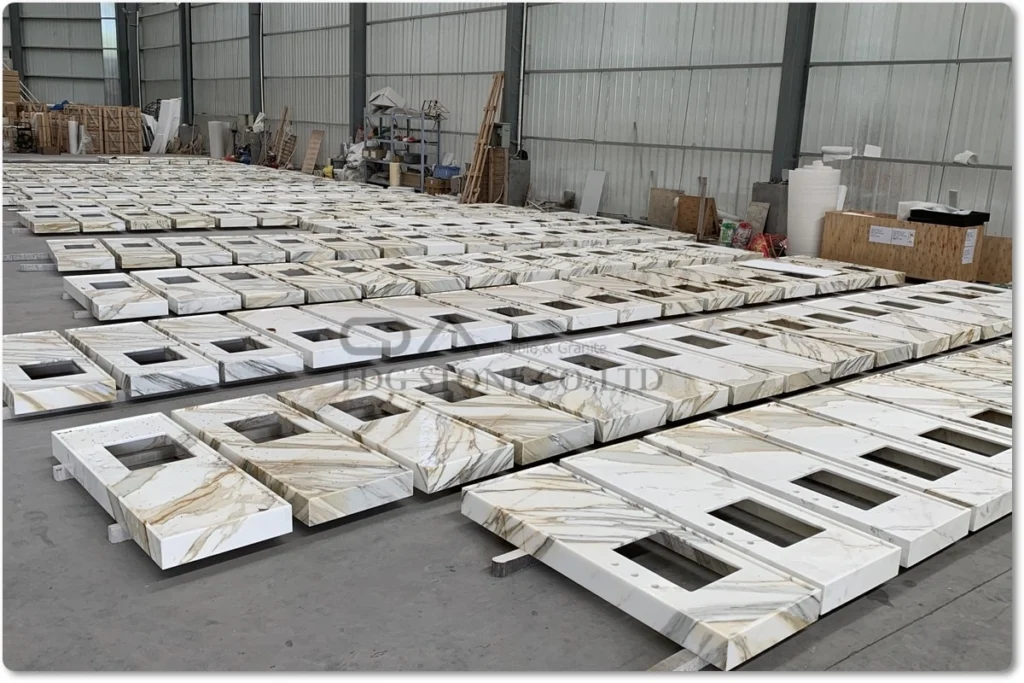

1. Executive Summary
Marble countertop procurement involves more than choosing a stone color and requesting a price. For importers, distributors, countertop fabricators, cabinet companies, hospitality procurement teams, and property developers, two questions are especially important:
What is the minimum order quantity (MOQ) for the required marble countertops?
How long will it take to manufacture the order and deliver it to the destination?
The answers depend on the product specification, the availability of suitable marble, the amount of customization, the production schedule, and the transportation plan.
Unlike mass-produced products made from uniform industrial materials, natural marble has inherent variation in color, veining, mineral composition, and appearance. Two slabs sold under the same commercial name may not provide an identical visual match. A project requiring carefully selected slabs, continuous veining, or bookmatched patterns may therefore need additional material selection and approval time.
The central procurement principle is to confirm MOQ and lead time against a defined product specification, an agreed approval process, and a clearly identified delivery milestone. A supplier’s general estimate is useful for initial planning, but it should not be treated as a guaranteed delivery date unless the relevant conditions have been agreed in writing.
This white paper explains how to evaluate marble countertops MOQ, establish a realistic production schedule, manage sample and drawing approvals, coordinate bulk orders, and reduce avoidable delays.
It is particularly relevant to:
Stone importers and wholesalers planning container orders.
Regional distributors managing multiple product SKUs.
Countertop fabricators purchasing semi-finished or finished components.
Cabinet manufacturers coordinating stone and cabinetry deliveries.
Hotel owners, contractors, and multifamily developers managing project milestones.
Private-label brands sourcing OEM or ODM marble countertop products.
EDG Stone can evaluate project-specific order arrangements based on the actual marble type, dimensions, quantity, fabrication requirements, packaging specifications, and destination. Applicable MOQ and lead-time conditions should be confirmed through a detailed quotation.
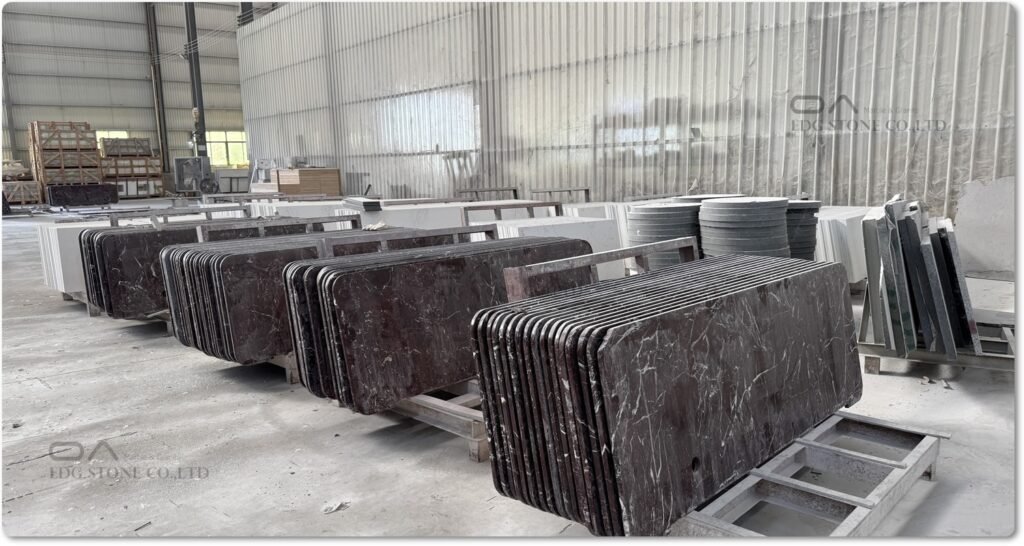
2. Scope and Definitions
2.1 What Does Marble Countertops MOQ Mean?
MOQ stands for minimum order quantity. In marble countertop procurement, it is the minimum quantity a supplier is willing or able to accept under specified commercial and production conditions.
MOQ is not necessarily the same for every product sold by the same marble countertops manufacturer.
Depending on the quotation, MOQ may be expressed as:
A minimum number of countertop pieces.
A minimum number of square meters or square feet.
A minimum number of slabs.
A minimum batch quantity for a particular material or finish.
A minimum order value.
A minimum quantity per color, SKU, or specification.
A minimum shipment quantity for a particular logistics arrangement.
For example, a buyer might request ten vanity tops in one marble color and five kitchen islands in another. The supplier may evaluate these as one combined order, two separate material batches, or multiple fabrication groups.
Whether the quantities can be combined depends on the factory’s material availability, production workflow, and commercial terms.
Consequently, buyers should not ask only, “What is your MOQ?” A more useful question is:
“What is the minimum order quantity for this specific marble, product specification, fabrication scope, and delivery arrangement?”
2.2 What Does Marble Countertops Lead Time Mean?
Lead time is the time between an agreed starting point and a defined completion milestone.
The term is often used inconsistently in international stone procurement. One supplier may quote the time required to manufacture the products, while another may quote the time until the order is ready for shipment.
A third may provide an estimated period extending to the destination, although international transportation and customs clearance may be outside the supplier’s control.
For accurate planning, distinguish four periods.
| Time category | Definition | Typical endpoint |
|---|---|---|
| Manufacturing lead time | Time allocated to production and associated factory operations | Products complete production |
| Shipment preparation time | Time for final inspection, packing, documentation, and loading coordination | Cargo ready for dispatch or shipment |
| International transit time | Time spent moving cargo through the agreed transportation route | Arrival at the designated port or terminal |
| Total delivery time | Combined elapsed time through the agreed final delivery milestone | Cargo delivered to the specified destination |
These periods may overlap in some supply chains. For example, export documentation can sometimes be prepared while final packaging is underway.
The quotation should therefore identify the actual start date, the expected milestone dates, and any overlapping activities rather than simply adding every duration together.
2.3 What Is Included in a Marble Countertop Order?
The word “countertop” can refer to several different product configurations:
Marble slabs supplied for local fabrication.
Rough-cut or dimensioned blanks.
Finished kitchen countertops.
Bathroom vanity tops.
Island countertops.
Countertops with sink or faucet cutouts.
Countertops with specified edge profiles.
Waterfall panels and matching splashbacks.
Bookmatched panels or coordinated architectural components.
Project-specific assemblies requiring additional fabrication or packing.
These products do not have identical production requirements.
A slab order may primarily involve material selection, inspection, and export packing. A finished countertop order may also require approved shop drawings, cutting, edge processing, cutouts, surface finishing, dimensional inspection, and protective packaging.
The quotation must define the supplied product rather than relying on the general label “marble countertops.”
2.4 Important Commercial Definitions
| Term | Meaning in procurement |
|---|---|
| MOQ | Minimum order quantity under specified commercial and technical conditions |
| RFQ | Request for quotation |
| Sample approval | Written acceptance of an agreed reference for color, appearance, finish, or workmanship |
| Material reservation | Supplier confirmation that identified material or an agreed quantity has been allocated to an order |
| Shop drawing | Technical drawing showing dimensions, cutouts, edges, and other fabrication details |
| Production release | Authorization to begin production after applicable requirements have been approved |
| Ex-works or EXW | An Incoterms® rule allocating specified delivery responsibilities to the buyer and seller |
| FOB | An Incoterms® rule generally used for sea or inland waterway transport, with delivery and risk transfer at the agreed shipment port |
| CIF | An Incoterms® rule under which the seller arranges and pays specified costs, insurance, and freight to the named destination port, while risk transfers earlier under the rule |
Incoterms® should be identified by the applicable rule, named place or port, and version where appropriate. For example, a quotation can specify “FOB [named port], Incoterms® 2020.”
Buyers should not assume that CIF means the seller is responsible for every expense or risk until the goods arrive at the buyer’s warehouse.
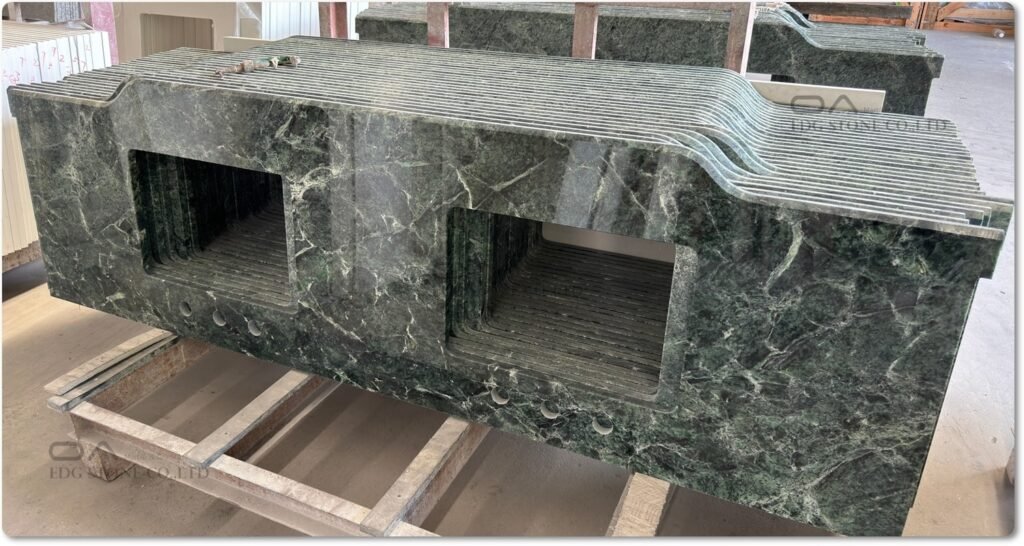
3. Technical Evaluation: What Determines MOQ and Lead Time?
3.1 Natural Marble Availability
Natural marble is quarried from geological formations, and commercially available blocks and slabs vary in appearance and usable yield.
A material described by one commercial name may have multiple visual selections, quarry sources, production batches, or grades. These differences can affect both the quantity available and the time needed to assemble a consistent order.
The relevant procurement questions include:
Is the requested marble available in the required quantity?
Are the slabs from the same source or an acceptable visual selection?
Is the desired thickness available?
Are the required slab dimensions suitable for the cutting plan?
Is the material already in stock, awaiting processing, or subject to additional sourcing?
Does the project require visual continuity across adjacent countertops?
Is a specific slab or batch subject to buyer approval?
When suitable material is available, production planning may be relatively straightforward. When a project requires a rare selection or a large quantity of closely matched slabs, the material preparation stage may become a critical scheduling constraint.
Practical implication: Confirm material availability and the selection criteria before committing to a production date.
3.2 Slab Yield and Cutting Optimization
MOQ and pricing can also be affected by cutting efficiency.
The relationship between the dimensions of the available slabs and the dimensions of the finished countertops determines how efficiently the material can be used.
A project requiring multiple large islands may consume slabs differently from a project requiring smaller vanity tops.
Factors include:
Slab length and width.
Finished countertop dimensions.
Vein direction and visual matching requirements.
Cutout positions and edge allowances.
Defects or areas excluded from use.
Thickness and finishing requirements.
Whether offcuts can be used for other components.
For example, a supplier may be able to manufacture several small vanity tops from available slabs but may need additional slabs for a smaller number of oversized islands.
This is why the number of finished pieces alone may not accurately describe the material requirement.
For project orders, provide a dimensioned cutting schedule or shop drawings so the factory can assess material yield before finalizing the quotation.
3.3 Fabrication Complexity
A marble countertop with straight edges and simple dimensions generally requires a different workflow from a custom component with multiple cutouts, complex edge profiles, curved sections, or coordinated wall panels.
Common fabrication requirements include:
Straight cutting and dimensioning.
Edge profiling and polishing.
Sink and faucet cutouts.
Corner radii and notches.
Waterfall edges.
Mitered joints.
Backsplashes and side splashes.
Surface finishing.
Bookmatching and vein coordination.
Protective treatment, where specified and compatible with the material.
Special crating or support structures.
Each additional operation may introduce equipment setup, programming, inspection, handling, or coordination requirements.
A high-volume order with a simple, repeatable specification may be easier to schedule than a smaller order containing many unique components.
The key variable is not quantity alone. It is the relationship between quantity, repeatability, material availability, and manufacturing complexity.
3.4 Standard Products Versus Custom-Fabricated Orders
Buyers should distinguish between products manufactured to an established specification and products requiring project-specific engineering or fabrication.
| Factor | Standard or repeatable products | Custom-fabricated products |
|---|---|---|
| Product dimensions | Established dimensions or repeatable patterns | Project-specific dimensions |
| Material selection | May use available stock | May require selected slabs or coordinated batches |
| Drawings | Existing specifications may be sufficient | Shop drawings usually require project review |
| Production setup | May involve repeatable processes | May require new programming or equipment setup |
| Approval | May use an established reference | May require sample, slab, and drawing approval |
| Quality inspection | Repeatable inspection criteria | May require component-specific measurements |
| Scheduling | Depends on stock and production capacity | Depends on material, approvals, and production complexity |
These are general tendencies, not universal rules. A standard product can still experience delays if its material is unavailable or the factory is fully booked.
Similarly, a custom order can proceed efficiently when drawings are complete, materials are reserved, and the production process is clearly defined.
3.5 Sample Approval and Material Reservation
Sample approval and material reservation are related but distinct activities.
A small sample may help the buyer assess the general color, finish, and workmanship. However, it cannot necessarily represent the full range of natural variation across a large quantity of marble slabs.
For visually sensitive projects, buyers should define what constitutes acceptable variation and whether approval requires photographs, videos, individual slab identification, physical samples, or an in-person inspection.
A sound approval process may include:
Confirming the commercial marble name and material specification.
Reviewing representative samples or available slab images.
Identifying any required color, veining, or visual-selection criteria.
Approving the surface finish and edge treatment.
Confirming whether a specific material batch or slab selection is reserved.
Recording approval in a traceable written format.
Material reservation should be documented separately when necessary. Approval of a sample does not automatically guarantee that the same slabs will remain available indefinitely.
The purchase order or quotation should state the reservation conditions, validity period if applicable, and consequences of changes to the approved material.
3.6 Drawing Approval and Revision Control
Shop drawing approval is one of the most important scheduling milestones for custom marble countertops.
A technically incomplete drawing can lead to incorrect cutouts, misaligned seams, installation conflicts, or expensive rework.
Before releasing production, confirm the following:
Overall dimensions and measurement units.
Slab thickness and finished thickness.
Edge profiles and corner details.
Sink model, cutout dimensions, and mounting method.
Faucet holes and accessory openings.
Backsplash and side-splash dimensions.
Seam positions and joint requirements.
Vein direction and matching requirements.
Finished surfaces and exposed edges.
Tolerances and inspection criteria.
Identification numbers for each component.
The parties should also agree on who has authority to approve drawings.
Once production has been released, a design revision may require new programming, replacement material, or the remanufacture of completed components. The resulting delay depends on the scope of the change and the stage at which it is introduced.
Recommended control: Use a drawing revision register that records the drawing number, revision, submission date, approval date, and written authorization for production.
3.7 Production Capacity and Scheduling Constraints
A marble countertops factory must coordinate equipment, labor, material handling, inspection, and packing.
A supplier’s nominal production capacity does not automatically indicate the earliest available production slot for a specific order.
Scheduling may be influenced by:
Existing confirmed orders.
The number and type of fabrication operations.
Availability of qualified operators.
Machine maintenance and equipment availability.
Material delivery and slab preparation.
Required quality-control checkpoints.
The number of unique components.
Rework or corrective production.
Seasonal or project-related demand fluctuations.
Buyers should ask whether the quoted schedule is based on current production capacity, a reserved production slot, or an indicative estimate that remains subject to confirmation.
For recurring orders, a rolling forecast can help the supplier plan material procurement and production capacity. A forecast, however, should not be confused with a binding purchase order unless the parties expressly agree otherwise.

4. Procurement Checklist: Building a Reliable Order Schedule
4.1 Order Cycle Breakdown
The following table presents a process model for planning marble countertop procurement. It is not a universal sequence, and some activities may overlap or occur in a different order depending on the project.
| Stage | Main activities | Factors that may affect timing |
|---|---|---|
| Inquiry and technical confirmation | Review material, quantities, dimensions, drawings, and delivery requirements | Incomplete information, missing measurements, repeated clarification |
| Sample approval | Confirm color, texture, finish, and workmanship | Sample preparation, international courier time, buyer review |
| Material preparation | Select slabs, source material, and reserve suitable stock | Stone availability, batch consistency, inventory, yield |
| Drawing approval | Confirm dimensions, cutouts, edges, and component identification | Revision cycles, missing technical details, delayed sign-off |
| Production scheduling | Allocate equipment, labor, and material | Existing orders, capacity, process complexity |
| Fabrication | Cutting, edge processing, cutouts, finishing, and related work | Unique components, setup time, material defects, rework |
| Quality inspection | Verify dimensions, appearance, workmanship, and agreed requirements | Inspection findings, corrective work, acceptance delays |
| Packing and export preparation | Protect products, prepare shipping documents, and coordinate loading | Packing design, crate availability, booking, documentation |
| International transportation | Arrange carriage, customs procedures, and destination delivery | Route, vessel or carrier schedules, port congestion, customs, local delivery |
The actual sequence should be confirmed with the supplier. For example, preliminary cutting plans may be developed before final material selection, while final production release may require both material and drawing approval.
4.2 Define the Start Point of Lead Time
The phrase “lead time: four weeks” is incomplete unless the start point is defined.
Possible start points include:
Receipt of the deposit.
Acceptance of the purchase order.
Completion of all technical information.
Written approval of the sample or material selection.
Approval of final shop drawings.
Confirmation of material availability.
Formal production release.
These events do not necessarily occur on the same day.
For a custom project, the most useful arrangement is to define the trigger explicitly.
For example:
Estimated manufacturing lead time begins after receipt of the agreed deposit, confirmation of material availability, and written approval of all production drawings, whichever contractual conditions apply to the order.
This wording is illustrative. The actual trigger should reflect the supplier’s commercial terms and the project’s approval requirements.
4.3 Distinguish Estimated, Confirmed, and Guaranteed Dates
These terms should not be used interchangeably.
Estimated date: A planning forecast based on current information and assumptions.
Confirmed date: A date accepted by the relevant parties after the applicable conditions have been reviewed.
Guaranteed date: A contractual commitment that may involve defined remedies or other obligations if the date is missed.
A supplier should not describe a preliminary forecast as a guaranteed delivery date without an appropriate contractual basis.
The buyer should also confirm what happens if the material becomes unavailable, the approved drawings change, or transportation schedules are disrupted.
4.4 Establish a Milestone Schedule
A practical order schedule should identify the principal milestones rather than relying on one final date.
| Milestone | Target date | Responsible party | Evidence of completion |
|---|---|---|---|
| RFQ information complete | To be agreed | Buyer and supplier | Complete specification package |
| Quotation accepted | To be agreed | Buyer | Accepted quotation or purchase order |
| Material selection approved | To be agreed | Buyer and supplier | Written approval or identified selection |
| Shop drawings approved | To be agreed | Authorized approver | Approved drawing revision |
| Production released | To be agreed | Supplier, subject to agreed conditions | Production release confirmation |
| Fabrication completed | To be agreed | Supplier | Production completion notice |
| Final inspection completed | To be agreed | Agreed inspection party | Inspection report or acceptance record |
| Packing completed | To be agreed | Supplier | Packing list and packing confirmation |
| Cargo dispatched | To be agreed | Party responsible for dispatch | Applicable shipping documentation |
| Final delivery | To be agreed | Party responsible under the contract | Delivery receipt or agreed proof of delivery |
The schedule should identify dependencies. For example, production may not begin until both material selection and shop drawings are approved.
4.5 Use a Schedule Buffer Without Inventing a Universal Rule
There is no single buffer percentage that is appropriate for every marble countertop order.
A repeat order using available material and approved drawings has a different risk profile from a project involving unusual stone, many unique pieces, or complex international logistics.
Instead of automatically adding a fixed number of days, identify the specific risks:
Uncertain material availability.
Multiple approval parties.
Unresolved dimensions.
Complex visual matching.
Limited production slots.
A fixed vessel departure date.
Destination customs or delivery constraints.
Assign a contingency based on the likelihood and consequences of each risk, and update the schedule when the relevant information changes.
For time-critical projects, the buyer should also identify the latest acceptable date for production completion, cargo readiness, port arrival, and final installation.
5. Cost and Risk Factors: MOQ, Lead Time, and Bulk Orders
5.1 Why Minimum Quantities Vary
MOQ may reflect production economics, material constraints, commercial policy, and logistics rather than a universal minimum for marble countertops.
The following factors can influence the applicable minimum.
Material-specific constraints
A rare marble selection may be available only in limited quantities. Obtaining a consistent larger batch may require additional sourcing or selection.
Cutting efficiency
Small pieces may be economical when they can be cut from available offcuts. Conversely, a small order requiring dedicated slabs can have a higher effective material cost.
Fabrication setup
Custom tooling, programming, and repeated changes between product configurations can increase setup effort.
Product diversity
An order containing many different sizes, finishes, and edge profiles may require more coordination than a larger order with standardized specifications.
Packaging requirements
Individual protective crates, unusual dimensions, or project-specific packing can affect the economics of a small shipment.
Transportation arrangements
A small order may be commercially feasible but less economical to transport internationally. A supplier may quote a product order separately from freight or recommend a consolidated shipment where practical.
The buyer should therefore request clarification on whether the MOQ applies to each product, material, finish, batch, total purchase order, or shipment.
5.2 How to Evaluate a Low-MOQ Offer
A low MOQ can be useful for market testing, showroom samples, replacement pieces, or pilot projects. However, it should not be evaluated on quantity alone.
Check whether the offer includes:
The required marble selection.
The specified thickness and finish.
Custom fabrication.
Sample or drawing approval.
Inspection and protective packaging.
Export documentation.
Freight or delivery charges, if quoted.
Repeat-order consistency requirements.
A supplier may accept a small order but charge more per unit because setup, material selection, handling, and export preparation are spread across fewer pieces.
Compare the complete landed-cost structure where possible, rather than assuming that the lowest MOQ or unit price is the most economical choice.
5.3 Common Causes of Delays
| Risk | Potential effect | Recommended mitigation |
|---|---|---|
| Material unavailable | Delayed production release | Confirm stock and reserve suitable material |
| Incomplete drawings | Approval delays or incorrect fabrication | Submit coordinated, dimensioned drawings |
| Late sample approval | Delayed material or production decisions | Assign an approver and target date |
| Uncontrolled revisions | Reprogramming and rework | Use formal revision control |
| Visual mismatch | Additional slab selection or replacement | Define acceptable variation before production |
| Quality defects | Repair, replacement, or reinspection | Agree on measurable acceptance criteria |
| Inadequate packaging | Damage risk and corrective action | Specify protection, support, and handling requirements |
| Missed transport booking | Delayed dispatch | Coordinate cargo readiness with the logistics provider |
| Customs or port disruption | Delayed arrival or delivery | Confirm documentation responsibilities and contingency plans |
5.4 Natural Stone Quality and Acceptance Risk
Natural marble is not a visually uniform manufactured surface. Veining, mineral bands, fossil features, and other geological characteristics may vary naturally.
The buyer should distinguish between:
Expected natural variation: Features consistent with the approved material selection and agreed visual criteria.
Workmanship defects: Problems such as incorrectly fabricated dimensions, damaged edges, or poorly executed cutouts.
Structural or functional concerns: Conditions that may affect the product’s suitability for its intended use and require technical assessment.
These categories should not be combined into a vague acceptance rule such as “no defects.”
Instead, the purchase order should define the relevant inspection criteria, including dimensional tolerances, visible-face requirements, edge quality, repair disclosure where applicable, and the procedure for handling disputed items.
For projects with strict aesthetic requirements, agree on a representative visual range and the approval method before mass production.
5.5 Transportation and Delivery Risk
A product can be finished on time yet arrive later than expected because production completion and final delivery are separate milestones.
Potential issues include:
Delayed cargo collection.
Changes to vessel or carrier schedules.
Port congestion.
Transshipment delays.
Customs inspections.
Missing or inconsistent shipping documents.
Destination terminal handling.
Inland transportation constraints.
Delivery appointment restrictions at the project site.
The quotation should identify the delivery point and the party responsible for each major logistics activity.
For international projects, buyers should also confirm whether the quoted lead time ends when the cargo is ready at the factory, loaded for shipment, available at the destination port, or delivered to the final address.
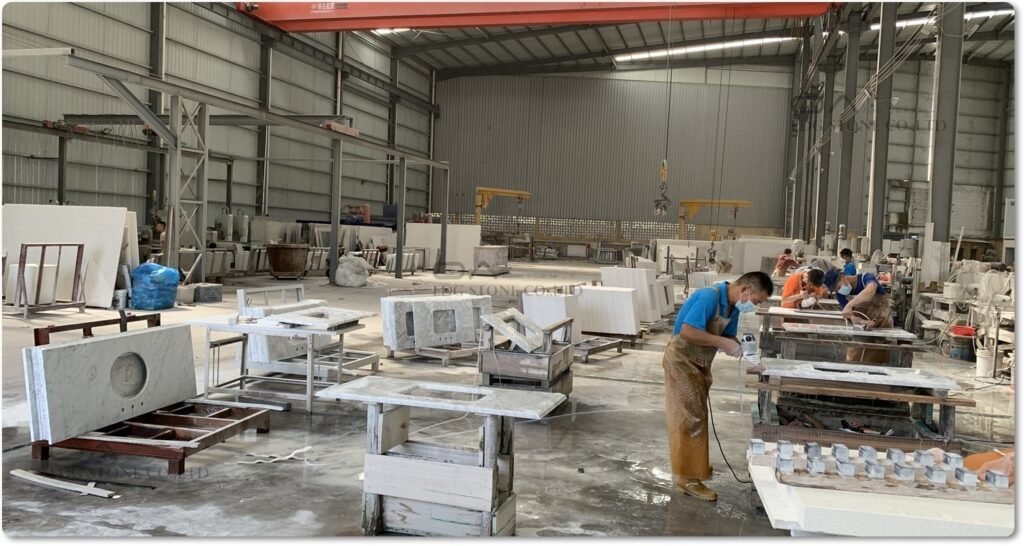
6. Supplier Evaluation: What Should a Reliable Marble Countertops Factory Provide?
6.1 Evidence of Material Availability
A credible supplier should be able to explain the basis for its material availability statement.
Depending on the project, useful evidence may include:
Current slab photographs or videos.
Identified slab numbers.
Available dimensions and thickness.
The stated material source or commercial selection.
Written confirmation of any reservation.
An explanation of whether replacement material may differ visually.
These documents help the buyer distinguish actual available material from a catalog image or a general statement that a particular marble is obtainable.
6.2 Production and Quality-Control Information
For custom orders, request information appropriate to the product and project scope.
This may include:
Fabrication drawings and revision history.
A component schedule.
Dimensional inspection records.
Photographs of completed products.
Agreed pre-shipment inspection arrangements.
Packaging photographs.
A packing list identifying components and quantities.
Procedures for reporting and resolving nonconformities.
The level of evidence should match the risk and value of the order. A small repeat order may not require the same documentation as a large hotel or multifamily development.
6.3 How to Assess Schedule Reliability?
A supplier’s schedule should be evaluated through evidence and process clarity, not merely through a short quoted lead time.
Ask whether the supplier can explain:
What starts the lead-time clock.
Which approvals remain outstanding.
Whether material is physically available.
Whether the production slot has been allocated.
Which operations control the critical path.
When inspection and packing will occur.
How changes are handled after production release.
How progress updates and delays are communicated.
A shorter estimate is not necessarily more reliable than a longer estimate. The more useful measure is whether the estimate is based on identifiable conditions and whether the supplier communicates changes promptly.
6.4 Supplier Comparison Matrix
Use the following matrix when comparing multiple marble countertop manufacturers, factories, or wholesale suppliers.
| Evaluation criterion | Questions to ask | Evidence to request |
|---|---|---|
| MOQ | Does the minimum apply per product, material, batch, or shipment? | Written quotation |
| Material availability | Is the required selection available in the needed quantity? | Current material evidence |
| Sample approval | What does approval cover? | Sample record and written criteria |
| Drawing approval | Which revision is authorized for production? | Approved shop drawings |
| Lead time | What is the start point and completion milestone? | Written production schedule |
| Capacity | Is the production slot confirmed or indicative? | Order schedule confirmation |
| Quality control | What will be inspected and recorded? | Inspection plan or report |
| Packaging | How are components protected and identified? | Packing specification and photographs |
| Shipping | Who books, documents, and arranges transport? | Agreed delivery terms |
| Communication | How are changes and delays reported? | Named contacts and update milestones |
EDG Stone can assess project requirements and provide a quotation based on the requested material, dimensions, quantity, fabrication scope, packaging, and destination. The applicable MOQ, production assumptions, and estimated shipping arrangements should be confirmed for each specific order rather than inferred from a general product description.

7. Practical RFQ Template: Marble Countertops MOQ and Lead-Time Inquiry
A complete request for quotation reduces uncertainty and helps the supplier provide a useful schedule estimate.
Buyers can copy the following template and adapt it to their project.
7.1 Copy-and-Use RFQ
Subject: RFQ — Marble Countertops MOQ, Manufacturing Lead Time, and Delivery Schedule
Dear Sales Team,
We are requesting a quotation for marble countertops for a wholesale order or project requirement. Please review the following specifications and confirm your applicable MOQ, pricing, production schedule, and delivery conditions.
A. Buyer and Project Information
Company name:
Contact person:
Project name or reference:
Destination country and city:
Intended application:
Required delivery milestone:
Target delivery date:
B. Material Specification
Commercial marble name:
Material source or selection, if specified:
Preferred color and veining:
Required thickness:
Surface finish:
Acceptable natural variation:
Material approval method:
Whether specific slabs or a coordinated batch are required:
C. Product and Fabrication Details
Product type: kitchen countertop / island / vanity top / other
Quantity of pieces:
Total estimated area:
Dimensioned drawings available: yes/no
Edge profile:
Sink cutouts:
Faucet holes:
Backsplash or side splash:
Waterfall or mitered edges:
Bookmatching or vein coordination:
Other custom fabrication:
Required dimensional tolerances:
Requested order quantity:
Can multiple sizes be combined under one MOQ?
Does MOQ apply per material, finish, product, batch, or shipment?
Is a sample order possible?
Are repeat orders subject to the same MOQ?
Are material reservation conditions applicable?
E. Schedule Requirements
Please specify:
Estimated sample preparation time, if required.
Sample delivery method and estimated transit time, if applicable.
Material availability and reservation status.
Estimated time for shop drawing preparation and approval.
Manufacturing lead time and its start point.
Estimated final inspection and packing time.
Estimated cargo-ready date.
Estimated shipping transit time, if available.
Estimated final delivery date, if available.
Conditions that could change the schedule.
Inspection criteria:
Required inspection reports or photographs:
Packaging and crate requirements:
Component labeling requirements:
Packing list requirements:
Export documentation requirements:
Procedure for handling nonconforming products:
G. Commercial and Logistics Terms
Quotation currency:
Payment terms:
Incoterms® rule and named place or port:
Freight included: yes/no
Insurance arrangements:
Quotation validity:
Warranty or claim procedure, if applicable:
Please provide a written quotation that separates product pricing, additional fabrication charges, packaging costs, and transportation charges where applicable. Please also identify any assumptions, exclusions, outstanding approvals, and conditions that must be satisfied before production can begin.
Thank you. We look forward to reviewing your proposal.
Best regards,
[Name]
[Company]
[Contact Information]
7.2 RFQ Review Checklist
Before comparing quotations, verify that each supplier has priced the same scope.
Material and selection are clearly identified.
Thickness and finish match the specification.
Piece quantities and dimensions are consistent.
Cutouts and edge profiles are included or excluded explicitly.
MOQ conditions are stated in writing.
Sample and material approval requirements are clear.
Drawing approval is identified as a production dependency where applicable.
Lead-time start point is defined.
Manufacturing and transportation periods are distinguished.
Packaging and inspection requirements are specified.
Incoterms® rule and delivery point are clear.
All important assumptions and exclusions are documented.
A complete RFQ makes it easier to identify whether price differences reflect actual supplier competitiveness or simply different assumptions about the product and delivery scope.
8. Frequently Asked Questions: Marble Countertops MOQ and Lead Time
1. What is the typical MOQ for marble countertops?
There is no universal MOQ for all marble countertops. The applicable minimum depends on the material, dimensions, fabrication complexity, order mix, production setup, and shipping arrangement. Some suppliers may accept small custom orders, while other products or commercial arrangements may require larger quantities. Request a project-specific quotation to confirm the minimum applicable to your requirements.
2. How long does it take to manufacture marble countertops?
Manufacturing lead time depends on material availability, drawing approval, order quantity, fabrication requirements, and the factory’s current production schedule. It should be quoted against a defined starting point and completion milestone. Packing, export preparation, international transit, customs clearance, and final delivery may require additional time beyond manufacturing.
3. Can I order custom marble countertops in small quantities directly from a factory?
Potentially, yes. Some factories accept small custom orders, but feasibility and pricing depend on the product specification, material availability, setup requirements, and logistics. Ask whether the MOQ applies per piece, product type, marble selection, batch, order value, or shipment.
4. Does sample approval affect marble countertop lead time?
Yes. Sample approval can influence material selection, reservation, and production release. International sample delivery and review can add elapsed time, especially when multiple decision-makers are involved. For natural marble, a small sample should not automatically be treated as a guarantee of identical veining across all finished pieces.
5. Does a quoted manufacturing lead time include shipping and final delivery?
Not necessarily. Manufacturing time generally refers to the factory production stage. Shipment preparation, international transit, customs clearance, and inland delivery may be separate. Always confirm the start point, endpoint, included activities, and exclusions in the quotation.
9. Semantic Closure: How to Plan Marble Countertops MOQ, Lead Time, and Delivery?
Marble Countertops Procurement Insights: MOQ, Production Planning, and Delivery Strategy
How should buyers determine the right MOQ?
The appropriate minimum order quantity depends on the relationship between material availability, cutting efficiency, fabrication setup, product variation, and shipping arrangements. Buyers should obtain a written MOQ for the specified marble, dimensions, finish, processing requirements, and order configuration rather than relying on a supplier’s general minimum.
Why does natural marble require a different planning approach?
Natural marble has geological variation, and commercially similar slabs may differ in color, veining, and other visual characteristics. Large or visually coordinated orders may require additional material selection, reservation, and approval. Early agreement on acceptable variation reduces uncertainty during production and inspection.
What is the most reliable way to calculate lead time?
Separate the order cycle into technical confirmation, material approval, drawing approval, production, inspection, packing, export preparation, international transportation, and final delivery. Identify the contractual start point, dependencies, estimated milestone dates, and exclusions. Some activities may overlap, so the schedule should reflect the actual production and logistics workflow.
What are the main options for managing small and bulk orders?
Buyers can consider standard products, customized fabrication, combined product orders, repeat-order arrangements, or consolidated shipments where commercially and operationally feasible. Each option has different implications for material yield, setup costs, quality control, and transportation efficiency. The preferred arrangement should be selected after comparing the complete order scope and delivered cost.
What should buyers consider before approving a supplier?
Evaluate material availability, sample and drawing controls, production capacity, inspection procedures, packaging, shipping responsibilities, and communication practices. A reliable supplier should explain the basis of its lead-time estimate, document outstanding approvals, identify scheduling assumptions, and provide a clear process for managing changes.
How do procurement requirements and regulations affect planning?
Technical specifications, building requirements, product suitability, and international trade terms should be addressed before production release. ASTM C503/C503M-23 provides a reference for relevant characteristics and physical requirements of marble dimension stone for general building and structural purposes. It does not replace project-specific engineering, fabrication, installation, or acceptance requirements. Buyers should verify applicable local codes and the current editions of relevant standards for their intended application.
What is the recommended procurement strategy?
Define the product, confirm the material, approve the drawings, document the MOQ, and establish milestone-based scheduling before production begins. This approach improves purchasing visibility, reduces preventable revisions, and gives both buyer and supplier a shared basis for evaluating schedule changes.
Procurement Insight: Why the Shortest Lead Time Is Not Always the Best Choice?
A supplier’s shortest quoted lead time should not be the sole basis for selecting a marble countertops factory.
A useful procurement decision considers three connected dimensions:
1. Schedule credibility
Is the estimated completion date supported by confirmed material availability, a defined production slot, and a clear approval process?
2. Product conformity
Can the supplier demonstrate that the material, dimensions, finish, edge details, and visual acceptance criteria are understood before manufacturing begins?
3. Delivery feasibility
Does the proposed schedule account for inspection, protective packaging, shipment arrangements, and the buyer’s actual delivery requirements?
A slightly longer but transparent schedule may be more useful than an aggressive estimate that excludes critical activities.
For importers and project managers, the objective should be to establish a dependable delivery plan rather than simply obtain the smallest quoted number of days.
Procurement Insight: How Digital Documentation Improves Order Control
Digital documentation can make international stone procurement more traceable.
Buyers and suppliers can use a shared project record to maintain:
The latest approved shop drawings.
Material selection photographs and slab identifiers.
Sample approval records.
Purchase order specifications.
Production milestone updates.
Inspection reports.
Packing photographs and packing lists.
Shipping documentation and delivery milestones.
Each document should have a clear status, date, and responsible party. Superseded drawings should be identified so they cannot be mistaken for the current production version.
For repeat orders, retaining the approved specification and inspection criteria can also make future quotations more consistent. However, previous approvals should not be treated as proof that newly sourced natural marble is visually identical to an earlier batch.
Procurement Insight: From Purchase Order to Repeatable Supply Chain
For a one-time renovation, the buyer may focus on completing a single order. For distributors, cabinet manufacturers, and multifamily developers, the more important goal may be a repeatable supply process.
A repeatable process typically includes:
Standardized product specifications.
Defined material-selection criteria.
Documented MOQ and pricing conditions.
Agreed sample and drawing approval procedures.
Forecasting and purchase order controls.
Consistent inspection and packaging requirements.
Shipment tracking and delivery records.
Post-delivery review and corrective action where necessary.
These controls help buyers distinguish between an isolated successful order and a supply arrangement that can be managed across multiple projects.
For a marble countertops wholesaler or distributor, repeatability can improve purchasing visibility and inventory planning. For a contractor or property developer, it can help coordinate stone procurement with cabinetry, installation, and handover milestones.
The precise benefits depend on the order frequency, product consistency, supplier capability, and logistics model.
10. References and Technical Resources
The following resources provide relevant technical and commercial context for marble procurement, dimension-stone specifications, international trade terms, and search visibility.
10.1 Natural Stone and Technical Standards
1. ASTM International — ASTM C503/C503M-23, Standard Specification for Marble Dimension Stone
Published in December 2023; ASTM identifies this edition as covering material characteristics, physical requirements, and sampling for marble dimension stone used for general building and structural purposes.
Official source: ASTM International, Standard Specification for Marble Dimension Stone, ASTM C503/C503M-23.
2. ASTM International — ASTM C97/C97M, Standard Test Methods for Absorption and Bulk Specific Gravity of Dimension Stone
Relevant to the testing of water absorption and bulk specific gravity. Buyers should identify the applicable edition and specify testing requirements according to the project.
Official source: ASTM International, Standard Test Methods for Absorption and Bulk Specific Gravity of Dimension Stone.
10.2 International Trade and Shipping
3. International Chamber of Commerce — Incoterms® 2020
Provides internationally recognized rules defining selected buyer and seller responsibilities, delivery obligations, costs, and risk allocation in commercial transactions.
Official source: International Chamber of Commerce, Incoterms® 2020.
4. U.S. International Trade Administration — Know Your Incoterms
Provides an explanatory overview of Incoterms® 2020 and the distinction between rules suitable for different modes of transportation.
Official source: U.S. Department of Commerce, International Trade Administration, Know Your Incoterms.
10.3 Search Visibility and Structured Content
5. Google Search Central — Google’s Guide to Optimizing for Generative AI Features on Google Search
Explains how established SEO practices, useful original content, technical accessibility, and content quality remain relevant to AI-powered search experiences.
Official source: Google Search Central, Optimizing Your Website for Generative AI Features on Google Search.
6. Google Search Central — Guidance on Generative AI Content
Guides accuracy, relevance, quality, and fact-checking for AI-assisted web content, including metadata and structured data.
Official source: Google Search Central, Guidance on Using Generative AI Content on Your Website.
Reference note: Standards can be revised, and applicability depends on the material and intended use. Confirm the current edition and the project’s contractual requirements before using a standard as a mandatory acceptance criterion. Shipping rules should likewise be identified by their named place or port and applicable version. The resources above provide technical and commercial context; they do not establish a universal MOQ or production duration.
11. EDG Stone: Request a Project-Specific MOQ and Lead-Time Estimate
Plan Your Marble Countertops Order with Clear Specifications
EDG Stone supplies natural stone products and provides project-oriented fabrication and export services. For marble countertops procurement, the appropriate order arrangement depends on the required material, product dimensions, order quantity, fabrication details, packaging requirements, and delivery destination.
Whether you are a stone importer, wholesaler, distributor, cabinet manufacturer, contractor, or project procurement manager, a detailed RFQ helps establish a more useful basis for pricing and scheduling.
When requesting a quotation, provide the following information:
Material: Marble name, preferred color, visual selection, and required thickness.
Quantity: Number of pieces, dimensions, and estimated total area.
Fabrication: Edge profiles, sink cutouts, faucet holes, backsplashes, waterfall edges, and other custom requirements.
Approval: Sample requirements, slab selection criteria, and shop drawings.
Quality: Inspection requirements, dimensional tolerances, and visual acceptance criteria.
Packaging: Individual protection, crate requirements, labeling, and packing list.
Destination: Country, city, preferred port, or final delivery address, as applicable.
Schedule: Target delivery date and any fixed installation or project milestones.
EDG Stone can assess these requirements to determine the applicable MOQ, quotation scope, material availability, production assumptions, and estimated delivery arrangements. Final conditions should be confirmed in the written quotation and purchase order.
Ready to plan your next marble countertops order?
Request a project-specific quotation that identifies the minimum order quantity, manufacturing lead time, approval milestones, and delivery assumptions.
CTA button: Your EDG Stone marble countertops manufacturer or custom fabrication inquiry page.