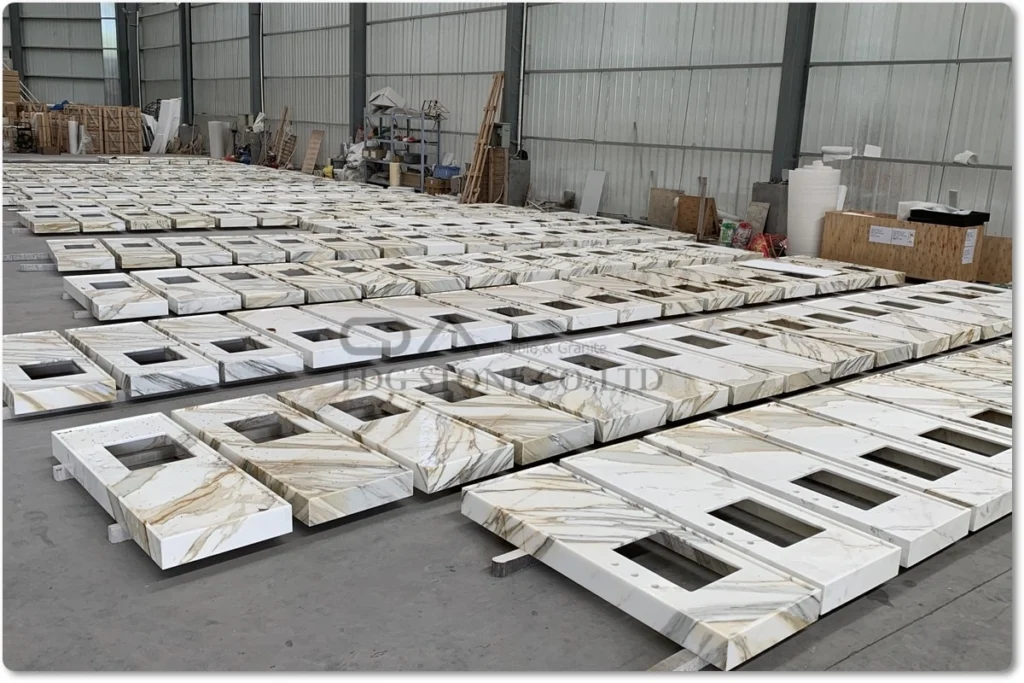
Selecting the right Marble Countertops Manufacturer is a strategic decision for businesses that purchase natural stone for resale, fabrication, residential developments, hotels, multifamily housing, and commercial interiors.
A supplier’s quoted price is only one part of the purchasing equation. Material consistency, fabrication accuracy, order coordination, packaging, and documentation can influence the actual cost of delivering an acceptable finished product.
For example, a low quotation may become expensive if the supplier cannot reproduce an approved edge profile, maintain sink-cutout dimensions, identify the correct marble batch, or protect finished countertops during international transportation.
The most effective sourcing strategy is therefore evidence-based: define the product requirements, verify the supplier’s actual role, assess its technical capabilities, and establish measurable acceptance criteria before placing a commercial order.
This guide provides a practical framework for evaluating a marble countertops factory, comparing wholesale suppliers, assessing production risks, and preparing a procurement-ready request for quotation (RFQ).
It also explains how EDG Stone can present its factory information, fabrication capabilities, quality documentation, and export experience to prospective B2B customers through verifiable evidence rather than unsupported marketing claims.

Scope and Definitions: Manufacturer vs. Factory vs. Supplier vs. Distributor vs. Dealer
Before evaluating quotations, buyers should establish what each prospective business actually does.
The terms manufacturer, factory, supplier, distributor, and dealer are frequently used interchangeably in commercial searches. However, they describe different business functions and do not necessarily indicate the same level of production control.
1. Marble Countertops Manufacturer
A Marble Countertops Manufacturer is a business that produces finished or semi-finished marble countertops through its own manufacturing operations or through an explicitly disclosed production arrangement.
Its activities may include:
Selecting and inspecting marble slabs.
Preparing production drawings.
Cutting slabs to specified dimensions.
Processing edges and profiles.
Producing sink and faucet cutouts.
Fabricating backsplashes and related components.
Inspecting finished products.
Preparing countertops for shipment.
Not every manufacturer performs every operation in-house. Some outsource specialized processes, so buyers should verify which activities are conducted directly and which are subcontracted.
What to request: Production photographs, equipment information, sample workpieces, process records, and evidence linking the proposed manufacturing operation to the legal selling entity.
2. Marble Countertops Factory
A Marble Countertops Factory refers primarily to the physical production facility where manufacturing or fabrication takes place.
A factory visit, live video inspection, or third-party audit can help buyers establish whether the claimed facility exists and whether its activities match the supplier’s description.
However, a factory building alone does not prove manufacturing competence. Buyers should assess the production workflow, equipment suitability, operator practices, inspection arrangements, and actual work-in-progress.
What to request: A facility overview, identifiable production areas, examples of recent work, and a demonstration of the processes relevant to the proposed order.
3. Marble Countertops Supplier
A Marble Countertops Supplier is a broader commercial term. A supplier may be a manufacturer, an exporter, a sourcing company, or an intermediary purchasing products from other factories.
Suppliers can provide valuable services, including material sourcing, supplier coordination, consolidation, export documentation, and project management.
The important question is not whether a supplier owns a factory. It is whether the supplier can consistently meet the buyer’s technical, commercial, and delivery requirements.
4. Marble Countertops Distributor
A Marble Countertops Distributor typically purchases products for resale through a distribution network.
Distributors may maintain local inventory, offer regional customer service, and provide shorter delivery times for stocked materials.
Buyers should verify inventory availability, replenishment arrangements, batch consistency, and the distributor’s responsibility for defective or incorrectly supplied products.
5. Marble Countertops Dealer and Vendor
A dealer or vendor generally refers to a business that sells products to customers. It may operate a showroom, manage customer orders, or coordinate products manufactured by another company.
These businesses can be suitable for smaller orders or local projects, but their technical capabilities should not be assumed.
A dealer may offer excellent service without operating a factory. Conversely, a factory may offer strong production capabilities but require the buyer to arrange local installation.
Manufacturer vs. Supplier: Which Is Better for B2B Procurement?
| Evaluation factor | Direct manufacturer | Trading or sourcing supplier | Distributor or dealer |
|---|---|---|---|
| Production visibility | Potentially high; verify access | Depends on factory disclosure | Often limited to upstream arrangements |
| Custom fabrication | Depends on actual capabilities | Depends on production partners | Depends on contracted fabricators |
| Product consolidation | May be limited to its own production scope | May coordinate multiple sources | May offer stocked products |
| Custom specifications | Suitable when technically equipped | Suitable when partners are capable | Depends on available supply chain |
| Inventory availability | Must be verified | Depends on sourcing arrangements | Potential advantage when stock is available |
| Communication | Direct technical communication may be possible | May provide centralized coordination | Often customer-facing |
| Main verification concern | Actual production capability | Control over subcontractors and factories | Product origin, stock, and accountability |
Procurement principle: Evaluate the operating model rather than the business label. A well-managed sourcing company may outperform a poorly controlled factory, while a qualified manufacturer may provide better visibility for complex custom orders.

Technical Evaluation: Factory Capabilities and Marble Fabrication
The next step is to determine whether the prospective supplier can produce the required countertops accurately, repeatedly, and within the agreed project specifications.
1. Verify the Factory’s Actual Production Scope
A supplier’s product catalogue may show countertops, vanity tops, backsplashes, islands, and custom components. However, the catalogue does not establish that every item can be manufactured at the same facility.
Ask the supplier to identify which operations are performed in-house.
Typical countertop fabrication processes include:
Slab inspection and material selection.
Digital measurement and cutting-layout preparation.
Bridge-saw or other suitable cutting operations.
CNC machining where appropriate.
Edge profiling and polishing.
Sink and faucet cutouts.
Draining grooves and other specified details.
Backsplash and upstand fabrication.
Surface finishing and final inspection.
Protective packaging and shipment preparation.
Equipment names alone are insufficient. A machine must be suitable for the material, thickness, dimensions, tolerances, and finish required by the project.
For example, a supplier may own CNC equipment but have limited experience producing large sink openings, narrow countertop sections, or repeated components with consistent edge profiles.
Practical test: Provide a representative drawing and ask the factory to explain its proposed manufacturing sequence, inspection points, tooling requirements, and foreseeable production risks.
2. Evaluate Marble Sourcing and Slab Traceability
Natural marble is a geological material. Color, veining, mineral composition, fissures, and other characteristics can vary between blocks and slabs.
Consequently, a photograph of one attractive slab cannot guarantee that a later shipment will have identical characteristics.
A professional sourcing process should establish a clear connection between the approved material and the slabs used in production.
Request the following information where applicable:
Commercial stone name and material description.
Slab photographs taken under documented lighting conditions.
Slab identification numbers or batch references.
Nominal thickness and dimensional information.
Known repairs, resin treatments, mesh backing, or other relevant treatments.
Material test reports when required by the project.
Approved samples or visual reference slabs.
Confirmation of the permitted natural variation.
For larger projects, slab selection and cutting layouts should be coordinated before production.
This is particularly important for bookmatched designs, prominent kitchen islands, hotel vanity programs, and projects requiring visual consistency across multiple rooms.
Why Material Traceability Matters?
Material traceability is not simply an administrative exercise.
It allows buyers to investigate whether an unexpected color difference, repair pattern, or material substitution resulted from a different slab batch, an undocumented change, or normal geological variation.
For repeat orders, buyers should establish whether the original material remains available and whether replacement slabs can meet the approved visual criteria.
Do not assume that the same commercial stone name guarantees an identical appearance across shipments.
3. Assess Cutting, Edge Processing, and Sink Cutouts
Finished countertops must conform to the approved dimensions and fabrication details.
The relevant requirements depend on the project drawing, installation system, material thickness, edge design, and sink specification.
Cutting Accuracy
Ask how the factory controls:
Overall length and width.
Finished thickness.
Squareness and straightness.
Cutout position.
Corner geometry.
Backsplash dimensions.
Joint locations.
Component identification.
The purchase specification should define the required tolerances for each critical dimension rather than relying on the vague promise of high precision.
Edge Profiles
Common edge treatments include eased, pencil, bevelled, bullnose, and other custom profiles.
Buyers should confirm the profile using a dimensioned drawing or an approved physical sample.
For projects with many identical units, the edge specification should include the relevant profile geometry, finish expectations, and inspection method.
Sink and Faucet Cutouts
Cutouts deserve special attention because errors can prevent installation or weaken critical sections.
The approved drawing should identify:
Sink model and installation type.
Cutout dimensions.
Position relative to finished edges.
Corner radii.
Faucet-hole locations and diameters.
Required clearances.
Any specified reinforcement or fabrication restrictions.
An undermount sink, for example, may require different edge finishing and dimensional control from a top-mounted sink.
Recommended control: Use the approved sink manufacturer’s template or verified dimensional drawing. Do not fabricate from an approximate opening measurement when a model-specific template is available.
4. Confirm Technical Drawings and Dimensional Control
A reliable marble countertops factory should be able to convert the buyer’s requirements into a controlled production document.
For custom projects, the drawing approval process should occur before cutting begins.
A complete production drawing may include:
Project name and drawing number.
Revision number and issue date.
Overall dimensions.
Finished thickness.
Edge profiles.
Sink and faucet openings.
Backsplash details.
Joint locations.
Surface finish.
Marble identification.
Grain or veining orientation, where applicable.
Quantity and component identification.
Critical tolerances.
Approval status.
Establish a Drawing Revision Procedure
One common procurement risk is manufacturing from an outdated drawing after the buyer has requested a change.
A controlled revision procedure should identify the current approved drawing and specify how changes affect cost, production status, and delivery.
The factory should acknowledge material revisions in writing.
Where a revision occurs after production has started, both parties should determine whether previously fabricated components remain usable and who bears the resulting costs.
5. Assess Quality Assurance and Inspection Records
A quality assurance system should establish how the supplier prevents defects, identifies nonconforming products, and verifies compliance before shipment.
A supplier’s statement that it conducts strict quality control is not sufficient evidence by itself.
Ask to review an anonymized inspection form or a sample report from a comparable product.
A useful finished-countertop inspection may cover the following areas.
| Inspection category | Suggested checks | Evidence |
|---|---|---|
| Material identity | Confirm approved marble and batch | Material record or slab references |
| Visual quality | Review color, veining, fissures, repairs, and agreed appearance criteria | Photographs and inspection records |
| Dimensions | Measure length, width, thickness, and critical openings | Recorded measurements |
| Edge processing | Check profile consistency, polishing, chips, and damage | Inspection checklist |
| Cutouts | Verify position, geometry, finish, and drawing compliance | Drawing-to-product comparison |
| Surface condition | Check stains, scratches, cracks, and finish uniformity | Final inspection report |
| Component identification | Match product marks to the project schedule | Labels and packing list |
| Packaging | Check protection, separation, bracing, and crate condition | Pre-shipment photographs |
Natural marble should not be evaluated as if it were a perfectly uniform manufactured sheet.
Buyers should distinguish acceptable geological variation from defects that violate the approved material standard.
Similarly, filled fissures, resin repairs, and mesh backing should be assessed against the material’s disclosed condition, the agreed acceptance criteria, and the product’s intended application.
Use Applicable Standards Correctly
ASTM C503/C503M-23, Standard Specification for Marble Dimension Stone, addresses material characteristics, physical requirements, and sampling for marble dimension stone used in general building and structural applications. The standard includes relevant physical properties such as absorption, density, compressive strength, abrasion resistance, and flexural performance. Its applicability to a specific countertop procurement should be established rather than assumed. See the official ASTM C503/C503M-23 specification.
ASTM C97/C97M covers test methods for water absorption and bulk specific gravity of dimension stone. ASTM lists a 2026 edition, ASTM C97/C97M-26, published in September 2026. Buyers specifying this test should confirm the applicable edition, laboratory method, sampling requirements, and contractual acceptance criteria. See ASTM C97/C97M-26.
These references are not interchangeable with a finished countertop inspection checklist. Material testing and product fabrication inspection address different questions.
For a project requiring laboratory-tested stone, specify the required tests, sampling arrangements, reporting format, and acceptance limits in the purchase documents.
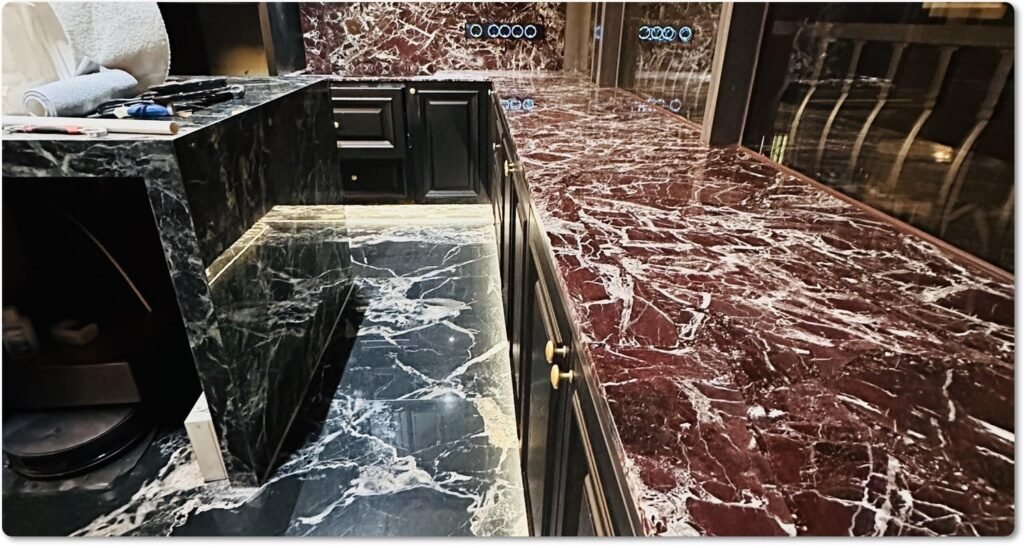
6. Verify Production Planning and Capacity
Production capacity should be evaluated against the actual order rather than an unsupported monthly output claim.
A factory may be suitable for a small custom batch but struggle with a large project requiring synchronized deliveries and consistent specifications.
Ask the supplier to explain its production plan for the proposed order.
Relevant questions include:
Is the approved marble available?
Does the order require additional sourcing?
Are drawings complete and approved?
Which fabrication stages determine the critical path?
Are any processes outsourced?
What inspection and rework allowances are included?
When will packaging materials be ready?
How are delays communicated?
What happens if the approved material becomes unavailable?
Assess Capacity Through Evidence
Instead of accepting an unverified production figure, request comparable evidence such as previous project schedules, anonymized production records, or a stage-by-stage capacity assessment.
The supplier should distinguish between theoretical machine capacity, available production time, and committed capacity after accounting for existing orders.
A realistic production schedule should identify milestones, dependencies, and approval deadlines.
The buyer should also recognize that the supplier’s production lead time is not the same as the total delivery time.
Material procurement, drawing approval, fabrication, inspection, packing, international transportation, customs clearance, and final delivery may all affect the project’s schedule.
Procurement Checklist: Export Packaging, Shipping, and Supplier Verification
7. Evaluate Export Packaging and Shipment Coordination
Finished marble countertops can be damaged by impact, vibration, improper restraint, moisture exposure, or inadequate separation during handling and transportation.
Packaging should therefore be designed around the dimensions, weight, fragility, finish, transport route, handling method, and destination requirements of the shipment.
For custom countertops, the packaging plan should address:
Surface protection.
Separation between finished pieces.
Protection of vulnerable edges and corners.
Appropriate internal support.
Secure restraint against movement.
Identification of components and crates.
Loading sequence and unloading considerations.
Container or vehicle loading arrangements, where applicable.
Photographic records before dispatch.
For heavy stone products, crate design and handling arrangements should be assessed for the actual load and expected transport conditions.
Buyers should not assume that a photograph of a wooden crate proves that the packaging is adequate. Ask how the supplier determines support points, restrains the products, and protects polished surfaces.
Confirm Shipment Documentation
The required documentation depends on the destination, product classification, transaction structure, transport method, and applicable customs rules.
Typical commercial and shipping documents may include:
Commercial invoice.
Packing list.
Transport document, such as a bill of lading where applicable.
Country-of-origin information or origin documentation when required.
Product specifications.
Insurance documents where applicable.
Additional documents required by the importer, customs broker, or destination authorities.
For U.S.-bound shipments, U.S. Customs and Border Protection explains that commercial invoice information includes an adequate merchandise description, quantities, values, and the applicable Harmonized Tariff Schedule subheading. Buyers should confirm the current requirements with their customs broker and the relevant official guidance. See CBP’s commercial invoice requirements.
The supplier and importer should agree on who prepares each document, who checks its accuracy, and when the final documents will be available.
8. Review Commercial Terms and Supplier Risk
A supplier’s quotation should allow the buyer to understand what is included, what is excluded, and which assumptions may change the final cost.
Compare quotations using the same product specification, material quality, fabrication scope, order quantity, packaging requirements, and delivery terms.
A useful quotation review covers:
Product scope
Marble name and material selection.
Dimensions, thickness, and quantity.
Edge profiles and cutouts.
Surface finish.
Accessories and additional components.
Commercial scope
Unit price and currency.
Tooling or setup charges, if applicable.
Sample and inspection costs.
Packaging charges.
Inland transportation.
Export handling.
Freight and insurance, if included.
Import duties, taxes, brokerage, and destination charges, as applicable.
Contractual scope
Payment schedule.
Drawing approval requirements.
Inspection and acceptance criteria.
Production and delivery milestones.
Procedures for changes and cancellations.
Defect reporting and corrective action.
Responsibility for damage and claims.
Warranty terms, if offered.
Dispute resolution and applicable law.
Understand Incoterms and Delivery Responsibility
When international shipping terms are used, the parties should identify the named place or port and the applicable Incoterms edition.
For example, FOB and CIF allocate certain costs and responsibilities differently from EXW. They should not be compared solely by looking at the headline price.
The contract should also address matters not automatically resolved by a shipping term, including product specifications, quality acceptance, payment obligations, and remedies for nonconformity.
Important: Confirm the responsibilities, costs, insurance arrangements, and transfer of risk under the specific agreed term. Do not assume that a supplier quoting CIF is responsible for every cost or risk until the goods reach the buyer’s warehouse.
Identify Common Supplier Risks
| Risk | Warning sign | Recommended control |
|---|---|---|
| Unverified factory claims | Refusal to identify the production location | Request verifiable business and facility evidence |
| Material substitution | Vague stone descriptions | Approve the material and define substitution rules |
| Dimensional errors | No approved production drawing | Require drawing approval and measured inspection |
| Hidden repairs | No material-condition disclosure | Establish repair disclosure and visual acceptance criteria |
| Delayed delivery | No milestone schedule | Agree on milestones and written delay notifications |
| Poor packaging | No packaging specification | Approve packaging requirements before production |
| Documentation errors | Unclear responsibility for shipping documents | Assign document ownership and review deadlines |
| Uncontrolled changes | Verbal instructions replace drawings | Use written change control and revision records |

Supplier Evaluation: The 100-Point Marble Countertops Factory Scorecard
The following weighted model is an illustrative internal purchasing tool, not an industry standard or an externally validated certification system.
Each buyer should adjust the weights according to the order’s value, complexity, risk, and intended use.
For example, a hotel project may prioritize dimensional consistency and repeatability, while a distributor may place greater emphasis on material selection, packaging, and the ability to consolidate orders.
Recommended Supplier Evaluation Matrix
| Evaluation dimension | Weight | Evidence to review |
|---|---|---|
| Business identity and legitimacy | 10 | Verifiable registration and business information |
| Manufacturing and product capability | 15 | Product range, samples, process records, and facility evidence |
| Material sourcing and traceability | 10 | Slab identification, material records, and approved samples |
| Fabrication and technical capability | 15 | Drawings, edge samples, cutout records, and relevant equipment |
| Quality assurance | 15 | Inspection forms, measurement records, and corrective-action examples |
| Production planning and delivery management | 10 | Comparable schedules, milestone plans, and delay procedures |
| Export packaging and shipment coordination | 10 | Packaging specifications, loading records, and relevant shipping documentation |
| Communication and change control | 5 | Quotation clarity, drawing confirmations, and written responses |
| Commercial transparency and risk management | 10 | Itemized pricing, payment terms, responsibilities, and contractual safeguards |
| Total | 100 |
How to Calculate the Score?
For each dimension, assign a performance rating from 0 to 5:
0 — No evidence: The supplier cannot substantiate the capability.
1 — Very weak: Significant gaps or unresolved concerns.
2 — Below expectations: Partial evidence, but important weaknesses remain.
3 — Acceptable: Evidence reasonably supports the stated capability.
4 — Strong: Clear, relevant evidence and a consistent process.
5 — Excellent: Comprehensive, relevant, and verifiable evidence.
Calculate the weighted score for each dimension as follows:
Weighted points = (Performance rating ÷ 5) × Dimension weight
Add all weighted points to obtain the supplier’s total score out of 100.
For example, a rating of 4 out of 5 in the 15-point quality assurance category earns 12 points.
Suggested Internal Decision Bands
These decision bands are proposed examples for a buyer’s internal procurement policy. They are not recognized industry benchmarks.
| Total score | Suggested interpretation | Recommended action |
|---|---|---|
| 85–100 | Strong candidate | Proceed to final technical and commercial validation |
| 70–84 | Potentially suitable | Resolve identified gaps before approval |
| 50–69 | Elevated procurement risk | Request additional evidence or consider alternatives |
| Below 50 | Weak evidence base | Do not approve without substantial reassessment |
A high score should not override a critical failure.
For example, an inability to verify the contracting entity, a material substitution that violates the specification, or a failure to meet a mandatory safety requirement may justify rejection regardless of the total score.
Likewise, a small factory should not automatically receive a low score simply because it has fewer machines. Its suitability depends on whether it can deliver the specified products at the required quality and schedule.
Supplier Audit Checklist: Questions to Ask Before Placing an Order
Use the following checklist during a remote audit, factory visit, or supplier qualification meeting.
Company and facility
Has the legal selling entity been identified?
Can the business information be independently verified?
Is the actual production location known?
Is the relationship between the seller and manufacturer documented?
Are subcontracted processes disclosed?
Materials
Is the marble identified by an unambiguous commercial description?
Are available slabs documented with photographs or references?
Have material variation and repairs been discussed?
Are test reports available when contractually required?
Is material substitution controlled?
Fabrication
Have the relevant cutting and edge-processing capabilities been demonstrated?
Are sink cutouts and other openings based on approved drawings?
Are critical tolerances documented?
Can the factory produce the required finish and edge profile?
Is a sample or first-piece inspection available where appropriate?
Quality
Is there a documented inspection process?
Are measurements recorded rather than merely described as acceptable?
Are nonconforming products identified and controlled?
Can the supplier explain its corrective-action process?
Are pre-shipment inspection photographs or reports available?
Production and logistics
Is there a written production schedule?
Are material procurement and drawing approval included in planning?
Are packaging specifications defined?
Are shipment-document responsibilities assigned?
Are delivery terms and the named destination or port clear?
Commercial and communication
Is the quotation itemized?
Are payment milestones and change procedures documented?
Are inspection and acceptance requirements contractually defined?
Is there a clear escalation process for delays or defects?
Are all material commitments recorded in writing?
Cost and Risk Factors: What Determines the True Cost of Factory-Direct Marble Countertops?
A factory-direct quotation may reduce intermediary costs in some sourcing arrangements, but it does not automatically guarantee the lowest delivered cost.
Buyers should compare the full procurement cost rather than focusing only on the ex-factory or unit price.
1. Material Selection and Slab Yield
The price of a marble countertop depends partly on the selected stone, slab availability, visual requirements, and cutting layout.
A project requiring large islands, prominent veining, or closely coordinated patterns may use slabs less efficiently than a project consisting of smaller standard components.
The buyer should ask how material selection and cutting yield affect the quotation.
2. Fabrication Complexity
Additional operations may increase labor, tooling, processing time, and inspection requirements.
Examples include:
Complex edge profiles.
Multiple sink openings.
Tight dimensional tolerances.
Custom drainage details.
Curved or irregular components.
Bookmatching and veining alignment.
Special surface finishes.
Detailed backsplash fabrication.
A meaningful quotation should distinguish the standard product cost from additional processing charges where practicable.
3. Quality and Rework
The cost of a defective countertop may extend beyond the replacement product.
Depending on the project, additional costs can include freight, handling, installation delays, removal, replacement installation, and disruption to other trades.
This is why inspection records and clear acceptance criteria are commercial controls rather than administrative overhead.
4. Packaging and Freight
Large or irregularly shaped countertops may require customized packaging and careful handling.
The final delivered cost depends on factors such as shipment dimensions, gross weight, packaging, freight rates, insurance, handling, customs charges, and final-mile delivery.
Buyers should request comparable quotations based on the same shipping assumptions and named delivery location.
5. Cost Comparison Formula
A useful internal comparison is:
Estimated total landed cost = Product price + Applicable fabrication charges + Packaging + Origin handling + Freight + Insurance + Import duties and taxes + Customs brokerage + Destination handling and delivery + Expected quality-related costs
This is a planning formula, not a universal accounting or customs valuation formula. The treatment of individual charges depends on the contract, applicable tax rules, customs valuation requirements, and the selected delivery terms.
The formula helps buyers identify omitted costs and compare quotations on a more consistent basis.
Practical RFQ Template: Marble Countertops Manufacturer and Factory
The following template can be copied into an email or procurement form when requesting a quotation from EDG Stone or another qualified manufacturer.
Project and Company Information
Buyer company:
[Company name]
Contact person:
[Name and role]
Destination country and city:
[Destination]
Project type:
[Residential / Hotel / Multifamily / Commercial / Distribution / Other]
Required quantity:
[Number of pieces, sets, or project units]
Target delivery date:
[Date or required delivery window]
Product Specifications
Product:
[Kitchen countertop / Vanity top / Island / Backsplash / Other]
Marble type and commercial name:
[Specify material]
Required dimensions:
[Length × width × thickness, including units]
Surface finish:
[Polished / Honed / Other]
Edge profile:
[Profile name and drawing reference]
Sink type and cutout:
[Model, template, dimensions, and location]
Faucet openings and accessories:
[Requirements]
Visual requirements:
[Color range, veining, matching, and acceptable natural variation]
Repairs and backing requirements:
[Disclosure and acceptance requirements]
Drawing attachment:
[File name and revision]
Quality and Inspection
Please confirm:
Whether the specified marble is available.
Whether representative slab photographs can be provided.
Whether a sample or first-piece approval is recommended.
Which dimensional and visual inspections will be recorded.
Whether material test reports are available if required.
How nonconforming products and corrective actions are handled.
Whether pre-shipment inspection photographs or reports can be supplied.
Commercial and Shipping Requirements
Please provide:
Itemized product pricing.
Fabrication and tooling charges, if applicable.
Packaging costs.
Quotation currency.
Minimum order quantity, if any.
Production lead time and its assumptions.
Payment terms.
Proposed Incoterm and named place or port.
Estimated freight, if requested.
Packaging method.
Available shipping documentation.
Warranty and claims procedures, if offered.
Supplier Capability Questions
Please also provide the following information, where applicable:
Legal company name and verifiable business details.
Actual manufacturing location.
Relevant production processes and equipment.
Examples of comparable countertop projects.
Sample inspection or quality records.
Packaging and loading photographs.
Details of subcontracted operations, if any.
References or other evidence that can be independently verified.
A supplier should not be expected to disclose confidential customer information. Anonymized records or redacted documents may be sufficient for initial qualification.
Recommended RFQ Evaluation Procedure
Step 1: Send the same technical specification to all shortlisted suppliers.
Step 2: Reject quotations that fail mandatory requirements or contain unresolved material substitutions.
Step 3: Score the remaining suppliers using the 100-point internal evaluation model.
Step 4: Compare total estimated landed cost, not just the quoted unit price.
Step 5: Approve the material, drawings, inspection criteria, and packaging requirements before production.
Step 6: Record the final commercial terms and change-control procedure in the purchase contract.
Step 7: Inspect the goods according to the agreed plan before shipment or at the contractually designated inspection stage.
This process creates a documented decision trail and reduces the risk of comparing suppliers on inconsistent assumptions.

EDG Stone: Evaluating a Marble Countertops Factory for Your Next Project
EDG Stone presents an opportunity for B2B buyers to discuss marble countertops, natural stone slabs, custom fabrication, and project-specific manufacturing requirements with a Chinese stone manufacturer and exporter.
For buyers evaluating EDG Stone, the most useful starting point is a technical conversation based on the actual product requirements.
Rather than relying exclusively on general company descriptions, prospective customers should request information relevant to their intended purchase.
What B2B Buyers Should Request from EDG Stone?
1. Factory and production information
Request current photographs or video showing the relevant production areas and fabrication processes. Where a process is subcontracted, ask for clarification about the manufacturing arrangement.
2. Marble material information
Provide the required marble type, preferred appearance, thickness, finish, and quantity. Ask for representative slab photographs and confirmation of material availability.
3. Custom fabrication capabilities
Submit drawings to establish whether the requested dimensions, edge profiles, cutouts, backsplashes, and other details can be produced.
4. Quality documentation
Ask which inspection records, dimensional measurements, material reports, and pre-shipment checks are available for the proposed order.
5. Packaging and export coordination
Discuss packaging requirements, shipment dimensions, loading arrangements, destination documentation, and delivery terms before finalizing the quotation.
6. Project-specific commercial terms
Request an itemized quotation based on the approved specifications, quantity, delivery destination, and required timeline.
Any claims concerning EDG Stone’s equipment inventory, factory size, production capacity, certifications, export destinations, or standard lead times should be supported by current, verifiable company records before publication.
This evidence-based approach allows buyers to assess the actual suitability of EDG Stone for a particular project without relying on unsupported generalizations.
Which Buyers Should Consider a Factory-Direct Discussion?
A factory-direct sourcing discussion may be particularly useful for:
Stone importers and wholesalers developing product ranges.
Countertop fabricators seeking an additional manufacturing partner.
Cabinet companies sourcing complementary stone products.
Contractors purchasing custom-fabricated components.
Hotel and multifamily procurement teams coordinating repeated units.
Private-label brands evaluating manufacturing arrangements.
Distributors comparing factory-direct and local inventory options.
The appropriate sourcing model depends on order volume, specification complexity, service requirements, and the buyer’s ability to manage transportation and installation.
Next step: Submit your material selection, drawings, quantities, destination, and required delivery window so the supplier can assess the project’s feasibility and prepare a relevant quotation.

Frequently Asked Questions: Marble Countertops Manufacturer and Factory
1. How do I choose a reliable marble countertops manufacturer?
Start by verifying the legal business entity and the actual manufacturing arrangement. Then review relevant fabrication capabilities, material traceability, approved drawings, quality inspection records, production planning, packaging, and commercial terms.
Compare suppliers using the same technical specification and a documented scoring matrix. A factory’s suitability should be established through evidence relevant to your order rather than its marketing claims alone.
2. Is buying directly from a marble countertops factory cheaper?
Factory-direct purchasing can reduce some intermediary costs, but it does not guarantee a lower total cost.
The final comparison should include material selection, fabrication, packaging, freight, insurance, customs charges, destination delivery, and potential quality-related costs. Local suppliers may offer advantages in stocked inventory, short lead times, installation coordination, or after-sales service.
3. What should I check before ordering marble countertops wholesale?
Confirm the marble type, slab appearance, dimensions, thickness, finish, edge profile, cutouts, quantity, and permitted natural variation.
Also verify the supplier’s production capability, inspection procedures, packaging plan, delivery terms, and documentation responsibilities. For large orders, consider first-piece approval, batch identification, and documented pre-shipment inspection.
4. What documents should a marble countertops supplier provide?
Depending on the project, useful documents include a detailed quotation, material specification, slab photographs or identification records, approved production drawings, inspection reports, packing lists, and commercial shipping documents.
Material test reports should be requested when required by the intended application or contract. Business registration, certification, and export documentation should be verified according to the specific supplier and destination requirements.
5. How can I verify a marble countertops manufacturer’s production capacity and lead time?
Request a production schedule that identifies material availability, drawing approval, cutting, edge processing, inspection, packaging, and dispatch milestones.
Ask for comparable project records or other evidence that supports the proposed schedule. Confirm which processes are outsourced and how delays will be communicated.
Treat lead time as a project-specific commitment rather than assuming that a supplier’s general estimate applies to every order.
References: Technical Standards and Official Guidance
The following sources support the technical and procurement principles discussed in this guide. Buyers should verify the applicable edition and contractual requirements before using a standard as an acceptance criterion.
1. ASTM International — ASTM C503/C503M-23, Standard Specification for Marble Dimension Stone
Scope: Material characteristics, physical requirements, and sampling for marble dimension stone.
Official source: https://store.astm.org/c0503_c0503m-23.html
2. ASTM International — ASTM C97/C97M-26, Standard Test Methods for Absorption and Bulk Specific Gravity of Dimension Stone
Scope: Test methods for evaluating water absorption and bulk specific gravity of dimension stone, excluding slate.
Official source: https://store.astm.org/c0097_c0097m-26.html
3. U.S. Customs and Border Protection — Commercial Invoice Requirements
Scope: Information required for U.S. customs entry documentation, including merchandise description, quantity, value, and tariff classification information.
Official source: https://www.help.cbp.gov/s/article/Article-1175?language=en_US
4. ASTM International — Committee C18, Dimension Stone
Scope: Technical committee resources and information about dimension stone standards.
Official source: https://www.astm.org/membership-participation/technical-committees/committee-c18.html
Reference note: Standards may be revised, and a test method does not automatically establish the acceptance limits for every countertop. The buyer should identify the applicable material specification, testing edition, sampling plan, and acceptance criteria in the purchase contract.
EDG Stone CTA: Request Factory Information and a Project Quote
Choosing the right marble countertops manufacturer starts with clear specifications and verifiable evidence.
If you are sourcing marble countertops for wholesale distribution, countertop fabrication, cabinet manufacturing, residential developments, hotels, or commercial construction, prepare your project requirements before requesting quotations.
Request the following information from EDG Stone:
Relevant factory and production information.
Available marble types and slab photographs.
Custom countertop fabrication options.
Technical drawing review and specification confirmation.
Quality inspection and packaging information.
Project-specific pricing and production scheduling.
Export and shipment coordination details.
To help assess your requirements, include the marble type, approximate dimensions, quantity, finish, edge profile, sink cutouts, destination, and target delivery date.
Request EDG Stone Factory Information and a Project Quote
Recommended CTA button: Request Factory Information & Get a Quote
Suggested supporting text: Share your drawings, material preferences, quantities, and destination. EDG Stone can review your requirements and discuss the relevant manufacturing, fabrication, and shipping arrangements.
Suggested internal links for EDG Stone:
Marble Countertops Manufacturer in China
Custom Stone Fabrication
Natural Marble Slabs
Stone Countertops and Slabs
Contact EDG Stone
Use the corresponding live EDG Stone URLs when publishing these links.
Semantic Closure: What Defines a Qualified Marble Countertops Manufacturer?
How Should Buyers Evaluate a Marble Countertops Factory?
How: Evaluate a marble countertops manufacturer through a documented process that connects material selection, technical drawings, fabrication capability, inspection, packaging, and commercial delivery. Request evidence for each stage rather than relying on a product catalogue or a general promise of quality.
Why: Natural marble varies in color, veining, mineral composition, and other characteristics. Custom fabrication also introduces dimensional and processing requirements. Without agreed material criteria, drawing control, and inspection procedures, buyers may encounter inconsistent products, avoidable rework, shipment damage, or installation delays.
What: A qualified supplier should explain its manufacturing arrangement, identify the applicable production processes, confirm how it controls specifications, and provide relevant evidence such as approved drawings, material records, inspection reports, and packaging documentation. The evidence required should match the complexity and risk of the order.
Options: Buyers may source from a direct manufacturer, a trading or sourcing supplier, a distributor, or a local dealer. Direct manufacturing may provide greater production visibility, while intermediaries may offer consolidation, broader sourcing options, or coordination services. The best choice depends on the buyer’s technical requirements, order quantity, service expectations, and total delivered cost.
Considerations: Before approving a supplier, confirm the legal selling entity, the actual production location, material availability, dimensional tolerances, inspection responsibilities, production milestones, export documentation, packaging, and agreed commercial terms. Mandatory requirements and critical risks should be treated separately from the weighted supplier score.
Industry direction: More disciplined B2B procurement depends on traceable decisions, documented specifications, evidence-based quality control, and clearer communication between manufacturers, importers, fabricators, and project teams. Digital drawings, structured inspection records, slab photographs, and standardized RFQ fields can make supplier comparisons more consistent. These practices improve procurement transparency but do not, by themselves, guarantee product quality or regulatory compliance.
Buyer insight: The strongest manufacturer is not necessarily the largest factory or the supplier offering the lowest quotation. It is the supplier whose verified capabilities, material controls, fabrication quality, production plan, and commercial commitments match the requirements of the project.
Recommended action: Prepare one standardized RFQ, request supporting evidence from shortlisted suppliers, score each candidate using an adjustable internal evaluation model, and approve the final material, drawings, inspection criteria, packaging requirements, and delivery terms in writing before production.
EDG Stone application: Buyers considering EDG Stone should begin with their actual project drawings, selected marble, required quantities, and destination. They can then evaluate factory information, available fabrication processes, quality documentation, and shipment arrangements against the specific order before making a commercial decision.
The central procurement principle is straightforward: verify the manufacturer, define the product, document the acceptance criteria, and evaluate the complete supply chain before committing to the order.
This approach gives importers, wholesalers, countertop fabricators, cabinet companies, and project procurement teams a repeatable framework for comparing marble countertop manufacturers and making better-informed purchasing decisions.