Quick Summary: How to Import Stone From China
Importing stone from China can be an attractive sourcing strategy for U.S. contractors, fabricators, distributors, kitchen-and-bath companies, home builders, designers, retailers, and commercial project buyers. China has a mature stone-processing industry capable of supplying marble, granite, quartzite, limestone, travertine, engineered stone, quartz, porcelain slabs, stone countertops, vanity tops, tiles, architectural stone, and custom fabrication.
However, successful importing is not simply a matter of finding a low factory price.
The real question is:
This guide explains the complete process from supplier selection to U.S. delivery and resale.
Why Import Stone From China in 2026?
China remains one of the world’s major manufacturing and processing centers, and the U.S. remains a major destination for Chinese-made goods. According to the U.S. Census Bureau, U.S. goods imports from China totaled approximately $308.4 billion in 2025, while total U.S.-China goods trade was approximately $414.7 billion.
For stone buyers, China’s advantages are not limited to labor costs.
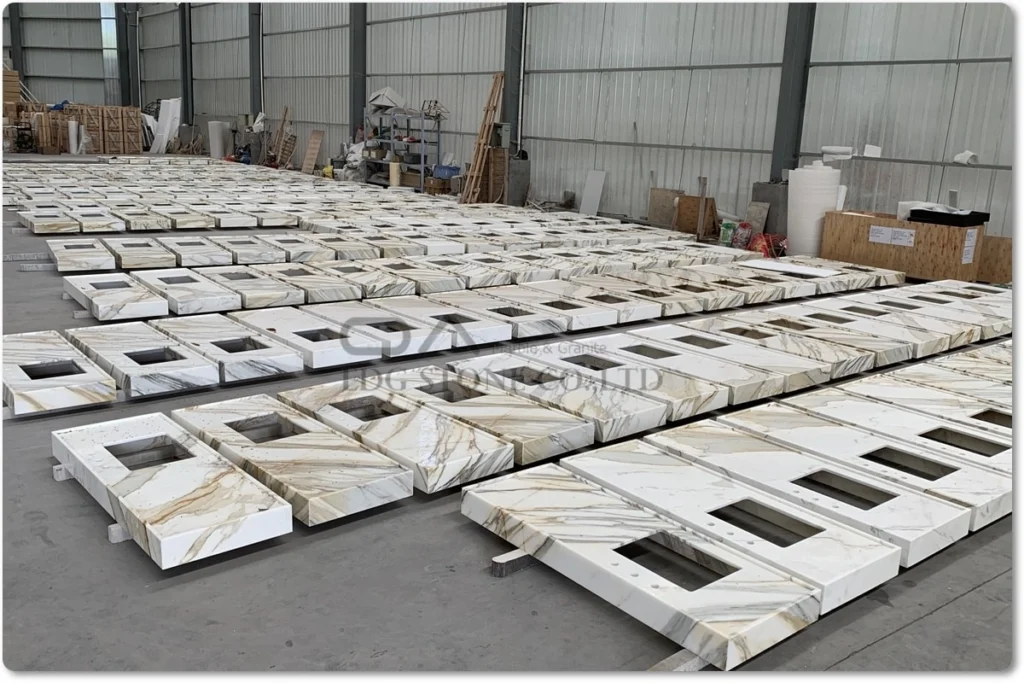
A capable Chinese stone factory can combine:
- Raw material sourcing
- Block cutting
- Slab production
- CNC fabrication
- Waterjet cutting
- Edge profiling
- Polishing and honing
- Bookmatching
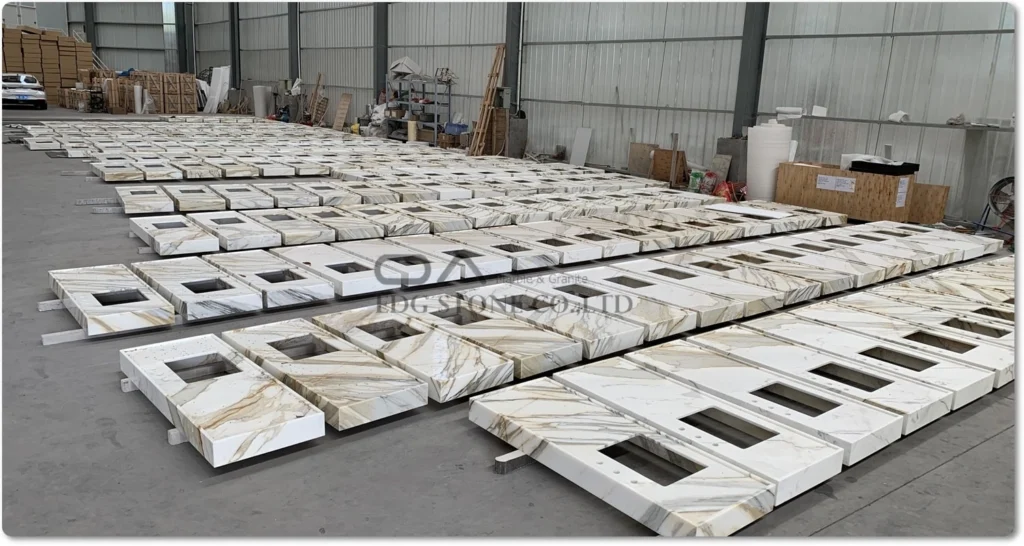
- Countertop fabrication
- Vanity fabrication
- Custom packaging
- Container loading
- Export documentation
This makes China particularly attractive for buyers who need custom stone products rather than standard slabs alone.
What Can You Import From China?
Common imported stone products include:
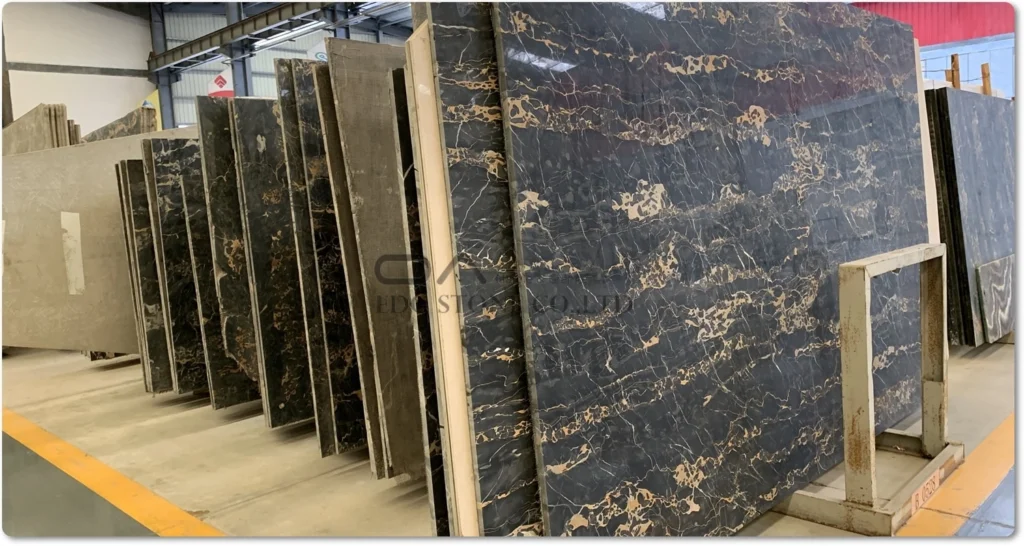
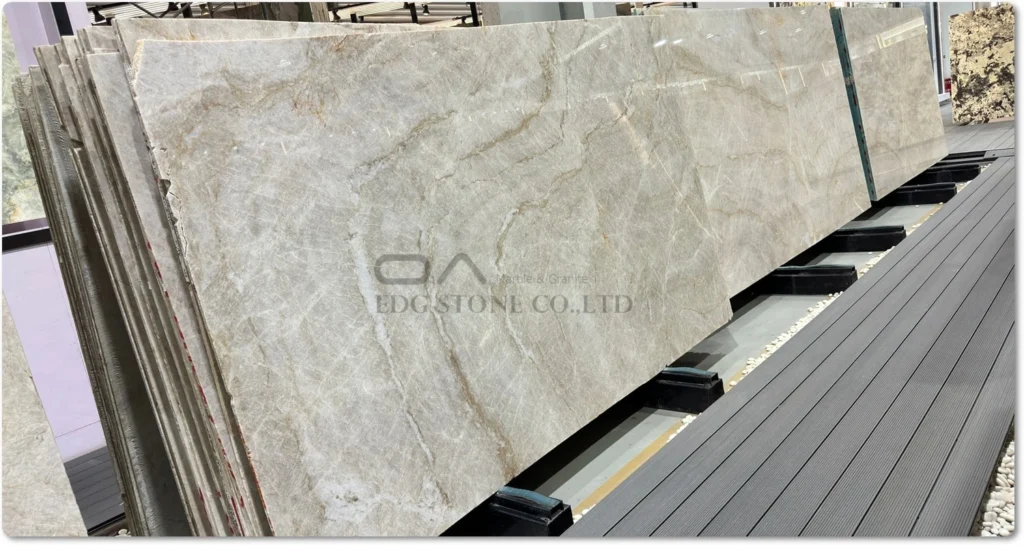
- Marble slabs
- Granite slabs
- Quartzite slabs
- Limestone
- Travertine
- Marble countertops
- Quartz countertops
- Vanity tops
- Shower bases
- Stone tiles
- Fireplace surrounds
- Marble tables
- Architectural stone
- CNC-carved stone
- Waterjet medallions
- Custom stone components
- Sintered stone and porcelain slabs
The best sourcing model depends on your business.
A small retailer may start with slabs or finished vanity tops. A contractor may purchase project-specific countertops. A distributor may import full containers of slabs. A commercial developer may work directly with a stone manufacturer and factory on a complete project package.
How to Import Stone From China to the USA: The 10-Step Process
Step 1: Define Your Stone Product and Specification
Before contacting a supplier, define exactly what you need.
For example:
Product: Taj Mahal quartzite countertop
Thickness: 20 mm or 30 mm
Finish: Polished
Edge: Eased edge
Application: Residential kitchen
Quantity: 100 pieces
Packaging: Individual reinforced crates
Destination: Los Angeles, California
For slabs, define:
- Slab dimensions
- Thickness
- Surface finish
- Color range
- Veining requirements
- Resin treatment if applicable
- Bookmatch requirements
- Quantity
- Inspection requirements
For countertops, also specify:
- CAD drawings
- Sink cutouts
- Faucet holes
- Edge profiles
- Backsplash
- Radius
- Thickness
- Packaging
- Installation tolerance
The more precise the specification, the easier it becomes to compare factories accurately.
Step 2: Find a Qualified Chinese Stone Manufacturer
One of the most important decisions is whether you are buying from a real manufacturer or from a trading company.
A qualified China stone manufacturer should be able to demonstrate:
- Factory location
- Production equipment
- Processing capabilities
- Quality-control procedures
- Export experience
- Product samples
- Packaging standards
- Previous project experience
- Production capacity
- International shipping experience
For B2B buyers, a factory capable of producing both slabs and fabricated products can often provide better control over customization.
This is where EDG Stone can serve as an example of the direct-factory sourcing model, particularly for buyers looking for natural stone, countertops, slabs, vanity tops, and custom stone fabrication.
Do not choose a supplier only because it has the lowest quotation.
A $1,000 lower factory price can become irrelevant if the shipment arrives with broken slabs, inconsistent colors, incorrect dimensions, poor polishing, or inadequate packaging.
Step 3: Request a Complete Stone Quotation
Ask the supplier to provide a quotation that clearly identifies:
- Product name
- Material
- Origin
- Thickness
- Size
- Finish
- Quantity
- Unit price
- Packaging
- Loading quantity
- Incoterm
- Port of loading
- Production lead time
- Payment terms
- Validity period
For example:
FOB Xiamen: $XX/m²
or
CIF Los Angeles: $XX/m²
Do not compare FOB and CIF quotations as if they were identical.
A lower FOB price does not necessarily mean a lower landed cost.
Step 4: Confirm the Correct HTS Classification
The Harmonized Tariff Schedule of the United States, or HTSUS, is critical when importing stone.
Natural stone products can fall under different HTS classifications depending on the material, degree of processing, dimensions, and final form.
Chapter 68 contains numerous natural-stone classifications, including products within heading 6802. USTR’s Section 301 guidance specifically instructs importers to identify the appropriate HTS subheading before determining whether a China-origin product is subject to an additional Section 301 duty.
Do not simply copy an HTS code supplied by a Chinese factory.
The importer and customs broker should verify the classification applicable to the actual product.
<h4>Why HTS Classification Matters</h4>
The HTS classification can affect:
- Base customs duty
- Additional China tariffs
- Section 301 treatment
- Other trade measures
- Customs documentation
- Statistical reporting
- Import compliance
USTR explains that Section 301 actions are identified by specific HTS subheadings and that importers should determine the applicable subheading and additional duty rate before importing.
Because tariff policies can change, always verify the current HTSUS treatment before paying the supplier or shipping the goods.
Step 5: Calculate Your Landed Cost
The factory quotation is not your final cost.
A practical landed-cost calculation is:
Landed Cost = Product Cost + Export Charges + Ocean Freight + Marine Insurance + U.S. Customs Duty + Applicable Additional Duties + Port Charges + Customs Brokerage + Domestic Transportation + Other Fees
For example:
| Cost Component | Example |
|---|---|
| Stone purchase | $30,000 |
| China export/local charges | $1,000 |
| Ocean freight | $5,000 |
| Insurance | $300 |
| Customs duties | Depends on HTS |
| Additional China duties | Depends on current trade measures |
| Customs broker | Variable |
| U.S. port charges | Variable |
| Trucking | Variable |
| Warehouse handling | Variable |
The actual numbers vary significantly by product, port, container size, season, and tariff classification.
Therefore, never calculate profitability from the supplier’s FOB quotation alone.
What U.S. Import Documents Are Needed for Stone?
A commercial stone shipment normally requires accurate documentation.
Typical documents include:
- Commercial invoice
- Packing list
- Bill of lading
- Entry documentation
- HTS classification
- Country of origin
- Importer of Record information
- Customs bond information where applicable
- Importer Security Filing for applicable ocean shipments
- Other agency documentation if applicable
For ocean cargo arriving in the United States, the Importer Security Filing (ISF) is an important requirement. CBP states that the ISF applies to cargo arriving by ocean vessel and generally requires specified information to be submitted before the cargo is laden aboard the vessel destined for the United States.
The ISF information can include the seller, buyer, importer of record number, consignee, manufacturer or supplier, ship-to party, country of origin, and HTSUS number.
Should You Use a Customs Broker?
For first-time importers, using a qualified U.S. customs broker is strongly recommended.
A broker can help with:
- HTS classification
- Entry filing
- Duty calculation
- ISF filing
- Customs communication
- Document review
- Customs bond requirements
- Cargo release
A customs broker does not eliminate the importer’s responsibility, however. The importer should still understand the transaction and review critical information.
China Stone Import Tariffs and 2026 Regulatory Considerations
This is one of the most important sections for anyone asking how to import from China to the USA in 2026.
China-origin stone can be affected by the normal HTS duty rate as well as additional trade measures depending on the exact product classification and policies in effect when the shipment enters the United States.
USTR maintains a Section 301 product search mechanism specifically for checking whether a particular HTS subheading is subject to Section 301 actions and the applicable additional duty rate.
Therefore, buyers should not publish or rely on a generic statement such as:
“Chinese stone has a tariff of X%.”
That statement may be inaccurate because the applicable rate depends on the exact product and current regulations.
2026 Import Strategy: Treat Tariffs as a Procurement Variable
The more professional approach is to treat tariffs as part of procurement planning.
Before placing an order:
- Identify the exact product.
- Determine the likely HTSUS classification.
- Ask a U.S. customs broker to verify classification.
- Check current China-specific additional duties.
- Calculate the landed cost.
- Compare China with alternative sourcing countries.
- Recalculate the margin before shipment.
This is particularly important for high-value natural stone projects.
How to Control Quality When Importing Stone From China
Quality control is arguably more important than negotiating another 2%–5% from the supplier.
Natural stone is a natural material, so color and veining can vary.
However, manufacturing defects should be controlled.
Pre-Production Approval
Before production, approve:
- Material photos
- Physical samples
- Color range
- Vein direction
- Finish
- Thickness
- Edge profile
- CAD drawings
- Packaging design
For bookmatched marble or quartzite, approve the actual slab sequence rather than relying solely on catalog images.
During-Production Inspection
For larger orders, consider an inspection at the factory before final packing.
Inspect:
- Dimensions
- Thickness
- Surface quality
- Color consistency
- Cracks
- Resin filling
- Edge finishing
- Cutouts
- Quantity
- Labeling
- Packaging
Final Pre-Shipment Inspection
Before the container leaves China, confirm:
Product + Quantity + Dimensions + Finish + Packaging + Documents
A final inspection is much cheaper than discovering a major production problem after a container reaches the United States.
How Should Stone Be Packed for International Shipping?
Stone is heavy and fragile.
Poor packaging can turn an excellent factory order into an expensive loss.
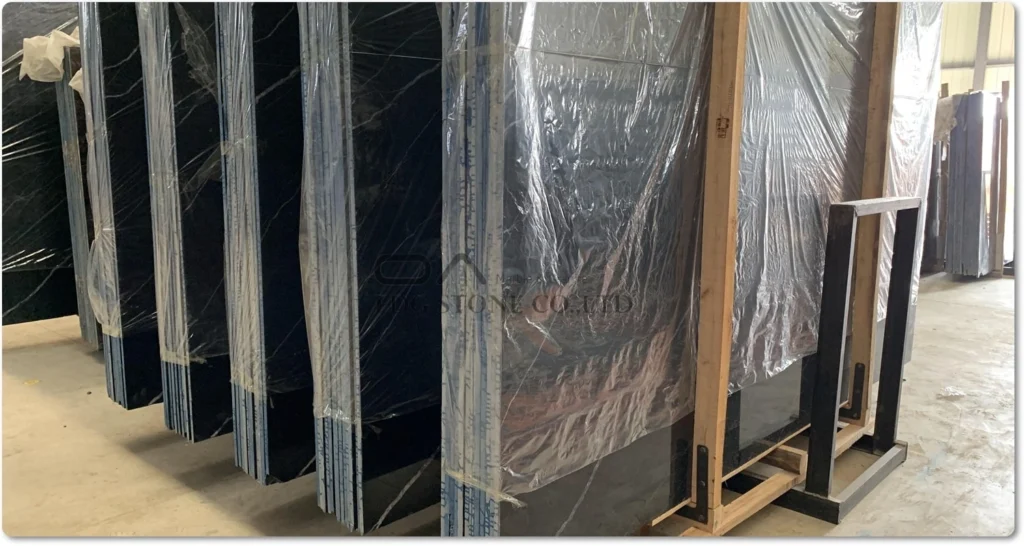
For slabs, common export packaging may include:
- Reinforced A-frame structures
- Wooden crates
- Protective separators
- Edge protection
- Moisture protection where appropriate
- Internal bracing
- Container restraints
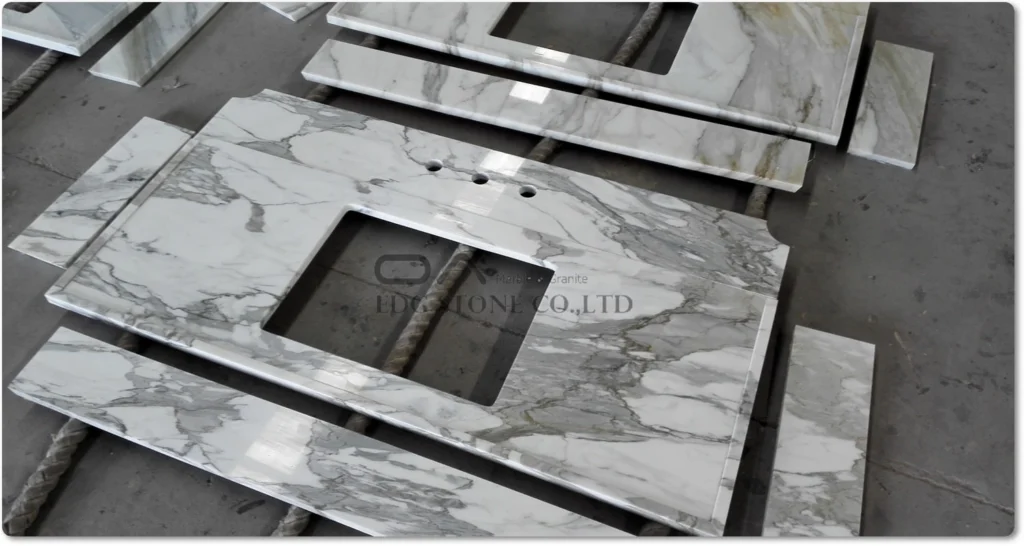
For countertops and vanity tops:
- Individual protective wrapping
- Foam protection
- Reinforced wooden crates
- Corner protection
- Custom supports
- Product identification labels
Packaging should be designed around the actual product and transportation route.
A container moving from a Chinese factory to a U.S. port and then by truck to an inland warehouse can experience repeated handling and vibration.
How to Ship Stone From China to the USA
For commercial quantities, ocean freight is usually the most practical transportation method because stone is dense and heavy.
The basic supply chain is:
Chinese Factory → Truck → Chinese Port → Ocean Vessel → U.S. Port → Customs Clearance → Truck/Rail → Warehouse or Jobsite
Common U.S. entry points can include major West Coast and East Coast ports depending on the supplier, freight route, destination, and current logistics conditions.
FCL vs. LCL for Stone
For heavy stone, FCL—Full Container Load—is often preferable when the order quantity is sufficient.
Advantages include:
- Better cargo control
- Less handling
- Lower breakage risk
- Better use of container capacity
- Easier project planning
LCL may make sense for samples or smaller shipments, but buyers should compare the total cost and handling risk rather than simply comparing ocean freight rates.
How to Import From China and Sell in the USA
If your objective is not simply importing stone for your own project but importing from China and selling in the USA, your business model needs another layer of planning.
You need to consider:
- Landed product cost
- Warehouse cost
- Local delivery
- Sales commissions
- Marketing
- Insurance
- Product liability
- Breakage
- Returns
- Inventory carrying costs
- Customer service
- Sales tax obligations
- State-specific business requirements
Example Wholesale Business Model
Suppose a U.S. distributor imports a container of marble slabs.
The calculation should not be:
Factory Price → Wholesale Selling Price
It should be:
Factory Price → Landed Cost → Warehouse Cost → Handling → Sales Cost → Margin → Wholesale Price
This distinction is critical.
A product that appears inexpensive at the factory can become uncompetitive after freight, tariffs, brokerage, domestic transportation, and inventory costs.
What About Lacey Act Requirements for Stone Imports?
The Lacey Act is primarily relevant to products containing plant material, rather than ordinary stone itself.
APHIS states that a Lacey Act declaration is required when the applicable conditions are met, including products containing plant material that fall under covered HTS codes and enter through applicable formal-entry processes.
Pure stone products that contain no plant material generally should not be treated as Lacey Act products merely because their HTS classification appears in a system that prompts for a declaration. APHIS specifically notes that products containing no plant material can use the applicable disclaimer when prompted.
However, this becomes relevant when a stone shipment includes products or packaging involving regulated wood or other plant material.
APHIS also states that regulated wood packaging material entering or transiting the United States must satisfy applicable treatment and certification requirements.
Therefore, importers should distinguish between:
Stone itself
and
wood packaging or other plant-derived materials associated with the shipment.
When uncertain, confirm the requirement with your customs broker and the relevant U.S. agency.
How Much Does It Cost to Import Stone From China?
There is no single import cost because every shipment is different.
The major variables are:
1. Product Price
Different materials have dramatically different factory prices.
A standard granite slab and a rare Brazilian quartzite slab should never be evaluated using the same cost assumptions.
2. Quantity
Larger orders may improve production and freight efficiency.
3. Shipping Method
FCL, LCL, air freight, and courier shipments have very different cost structures.
4. Port and Destination
Shipping to Los Angeles is different from shipping to New York, Chicago, Dallas, or Miami.
5. Tariffs and Duties
The applicable rate depends on classification and current U.S. trade measures.
6. Fabrication
Finished countertops usually require substantially more processing than raw slabs.
Therefore, when comparing suppliers, ask for both:
FOB factory/port pricing
and
Estimated landed cost to your U.S. destination.
Common Mistakes When Importing Stone From China
Mistake 1: Choosing the Cheapest Supplier
The cheapest quotation may come with inferior packaging, inconsistent quality, or poor communication.
Mistake 2: Ignoring HTS Classification
Do not assume the supplier’s tariff classification is automatically correct.
Mistake 3: Calculating Only FOB Cost
Always calculate the complete landed cost.
Mistake 4: Skipping Inspection
A pre-shipment inspection can identify problems before the container leaves China.
Mistake 5: Poor Packaging Instructions
Stone requires purpose-built export packaging.
Mistake 6: No Written Specification
Color, thickness, finish, dimensions, edge profile, cutouts, and tolerance should be documented.
Mistake 7: No Backup Supplier
For large U.S. projects, having a qualified backup factory can reduce supply-chain risk.
How to Choose the Best Stone Factory in China
A strong supplier evaluation should consider at least seven dimensions:
| Evaluation Factor | What to Check |
| Factory capability | Equipment, production lines, fabrication |
| Quality | QC system and inspection |
| Material sourcing | Quarry and slab/block sources |
| Customization | CNC, waterjet, countertops |
| Export experience | U.S. shipment history |
| Packaging | Container loading and protection |
| Communication | Drawings, specifications, and response time |
For professional buyers, the ideal supplier is not necessarily the largest factory.
It is the factory that can consistently meet your:
Specification + Quality + Quantity + Schedule + Documentation + Packaging + Budget
Why Work Directly With a China Stone Manufacturer?
Working directly with a manufacturer can provide several potential advantages:
- Better communication with production
- Greater customization
- More transparent specifications
- Better control over quality
- Easier sample development
- More efficient project coordination
- Potentially better wholesale pricing
For example, EDG Stone works across natural stone and architectural surface categories and can support products ranging from slabs to countertops and custom stone fabrication.
For a U.S. importer, the key question should not simply be:
“Can this supplier give me a cheap price?”
Instead ask:
“Can this factory become a reliable extension of my supply chain?”
That is a much better long-term procurement question.
How should a U.S. buyer approach stone sourcing from China?
The most reliable approach is to treat Chinese stone sourcing as a complete supply-chain project rather than a simple purchasing transaction. Start with a clearly defined product specification, verify the manufacturer’s factory capabilities, confirm the U.S. HTS classification and applicable trade measures, calculate landed cost, establish quality-control checkpoints, and use appropriate customs and freight professionals.
Why can importing stone from China still make sense despite tariffs and logistics costs?
China offers an integrated manufacturing ecosystem in which stone blocks or slabs can be processed, fabricated, finished, packaged, and exported through one supply chain. For customized countertops, vanity tops, architectural stone, and project-specific products, manufacturing capability can be more important than the nominal factory price.
What are the main options for a U.S. stone importer?
A buyer can purchase raw blocks, finished slabs, semi-finished products, fabricated countertops, or complete project-specific stone packages. The right option depends on whether the buyer prioritizes inventory flexibility, manufacturing control, customization, labor savings, or project consistency.
What should a buyer consider before placing an order?
The most important considerations are supplier reliability, product consistency, exact specifications, HTS classification, current tariff treatment, freight cost, packaging, customs documentation, inspection, lead time, and total landed cost. These factors should be evaluated together rather than separately.
What is changing in the stone-import business?
The direction of international stone procurement is moving toward greater documentation, tariff awareness, supply-chain transparency, factory verification, digital quality control, and total-cost analysis. U.S. importers increasingly need suppliers that can provide not only stone but also accurate technical information, production documentation, packaging control, and export support.
What makes a stone supplier valuable in the long term?
The strongest supplier is one that can consistently connect material sourcing, manufacturing, quality control, packaging, documentation, and international logistics. In other words, the future competitive advantage is not simply “cheap stone from China”; it is a predictable, documented, quality-controlled China-to-USA supply chain.

2026 Procurement Trend: From Cheap China Sourcing to Total Landed Value
The traditional sourcing model was:
Find the cheapest factory → place order → ship container.
The modern model is:
Verify factory → define specification → classify product → calculate tariff → calculate landed cost → inspect → ship → clear customs → deliver → measure actual margin.
This change matters because U.S.-China trade remains substantial even while trade flows and policy conditions continue to change. U.S. goods imports from China were approximately $308.4 billion in 2025, according to USTR, demonstrating that China remains a major U.S. sourcing market despite significant changes in trade policy and import volumes.
For stone companies, the implication is straightforward:
The competitive advantage is shifting from low purchase price toward reliable landed value.
A professional importer should therefore build relationships with factories that understand:
- U.S. specifications
- Container loading
- Stone protection
- Commercial documentation
- HTS classification support
- Quality inspection
- Project fabrication
- U.S. customer expectations
Final Takeaway: Is Importing Stone From China Worth It?
Yes—for the right products, supplier, volume, and business model, importing stone from China can be commercially attractive.
But successful importing requires much more than finding a Chinese supplier online.
The strongest strategy is:
1. Define the product precisely.
2. Find a verified China stone manufacturer or factory.
3. Request samples and technical specifications.
4. Confirm the HTS classification with a qualified U.S. customs professional.
5. Check current tariffs and China-specific trade measures.
6. Calculate the complete landed cost.
7. Establish written quality standards.
8. Inspect production before shipment.
9. Use appropriate export packaging.
10. Complete ISF and customs procedures correctly.
11. Track the shipment through U.S. customs and domestic delivery.
12. Measure actual landed margin after the first shipment.
For buyers looking for stone from China, the objective should not be simply to buy at the lowest factory price.
The objective is to build a reliable China-to-USA stone supply chain that delivers the right material, quality, quantity, documentation, and landed cost.
Frequently Asked Questions About Importing Stone From China
1. How do I import stone from China to the USA?
Start by selecting a qualified Chinese stone manufacturer, defining the product specifications, obtaining a quotation, verifying the HTS classification and current tariff treatment, calculating landed cost, arranging ocean freight, preparing commercial documents, filing the applicable ISF and customs entry, and completing U.S. customs clearance.
2. Can I import stone from China and sell it in the USA?
Yes. U.S. businesses can import stone for wholesale or resale, subject to applicable customs, tariff, product, business, and state requirements. The importer should calculate the complete landed cost before determining the resale price.
3. What is the best way to import stone from China?
For commercial quantities, a common approach is to purchase directly from a qualified manufacturer, ship by ocean freight in an appropriate container, use a U.S. customs broker, conduct pre-shipment inspection, and calculate total landed cost rather than relying on the factory price alone.
4. How much does it cost to import stone from China?
There is no universal import cost. It depends on the stone type, quantity, product form, factory price, container size, freight rate, port, HTS classification, applicable duties, brokerage, inland transportation, and other logistics costs.
5. Is importing stone from China profitable in 2026?
It can be profitable when the buyer has a reliable factory, sufficient order volume, controlled quality, efficient freight, and a clear understanding of current U.S. tariffs and landed costs. Profitability should always be calculated using the actual landed cost rather than the supplier’s factory quotation.