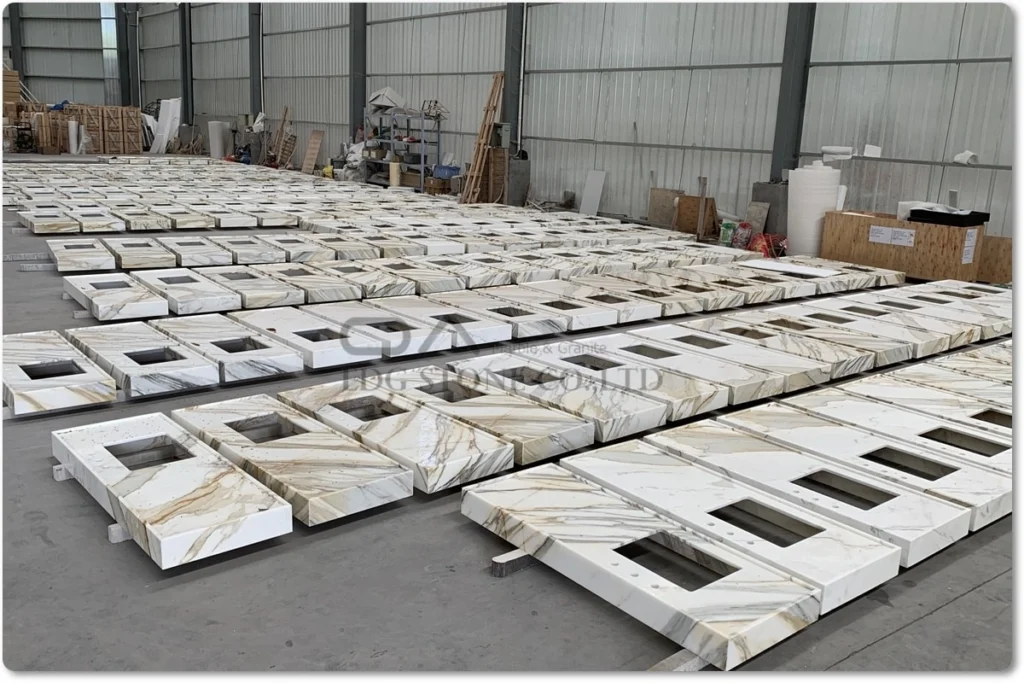
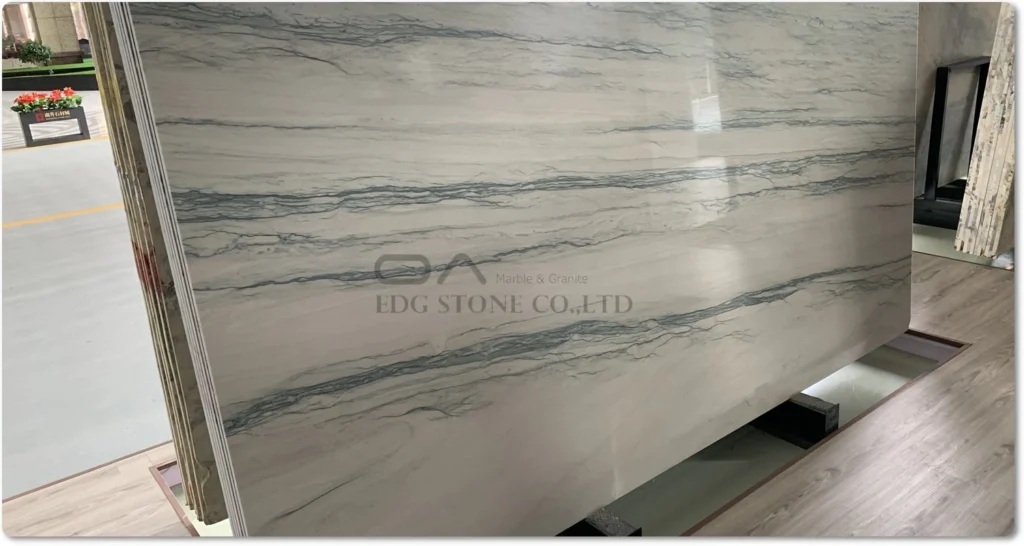
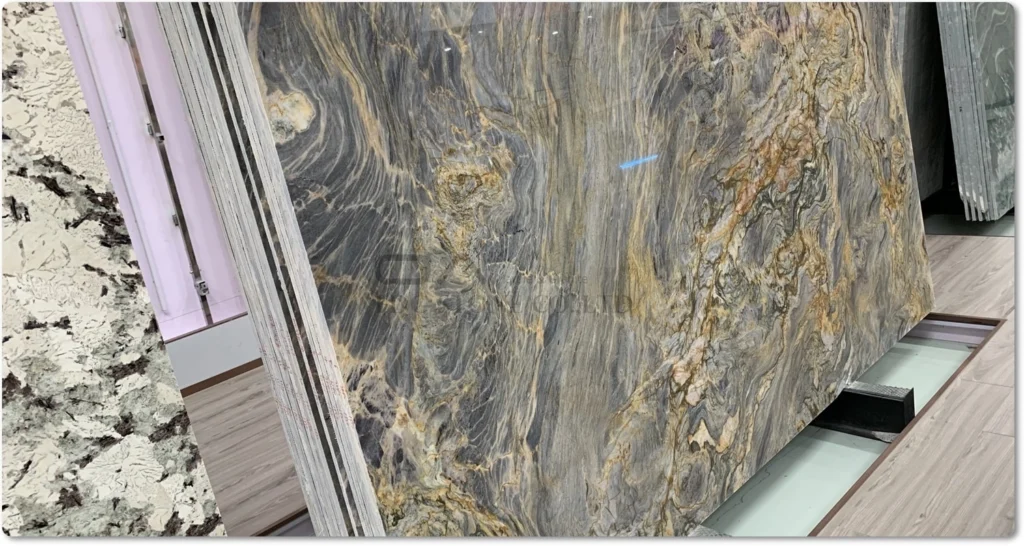
Quartzite has become one of the most desirable natural stone materials for premium kitchens, bathrooms, hospitality interiors, luxury residences, commercial countertops, islands, vanities, fireplaces, and custom furniture. Its combination of dramatic veining, natural variation, durability, and high-end appearance makes it an attractive alternative to marble and granite.
However, quartzite fabrication is not simply another version of granite fabrication.
True quartzite is a hard natural metamorphic rock formed from quartz-rich sandstone under heat and pressure. Its high hardness and abrasive character can dramatically increase the difficulty of cutting, drilling, profiling, polishing, and installing finished pieces. Industry fabrication references commonly place true quartzite around Mohs hardness 7 or higher, although actual behavior varies by geological composition.
For a quartzite manufacturer, quartzite factory, fabricator, importer, distributor, or wholesale buyer, understanding these problems before production begins can reduce material waste, tooling costs, production delays, breakage, and installation callbacks.
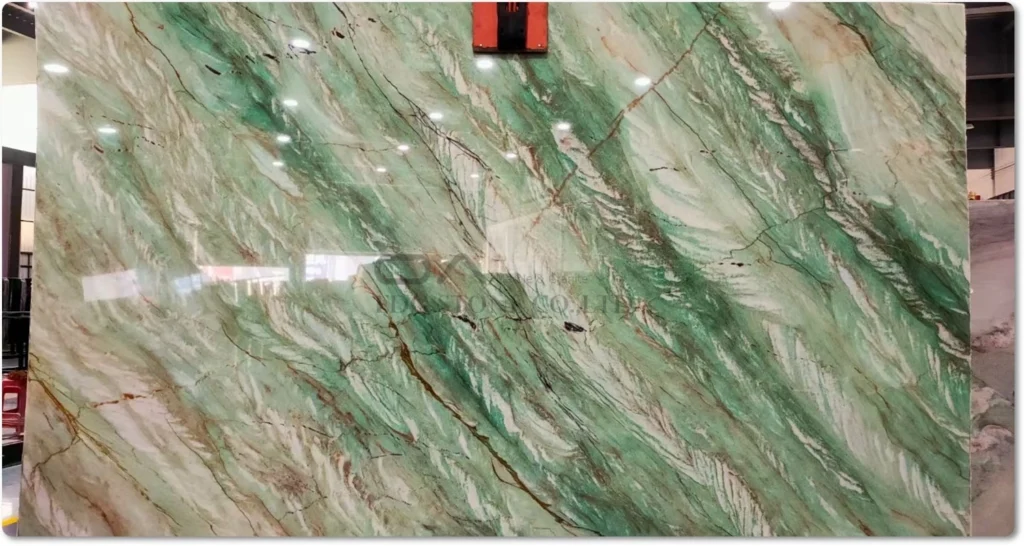
Why Is Quartzite Fabrication More Difficult Than Other Natural Stones?
Quartzite creates a unique fabrication challenge because several properties occur simultaneously:
- High hardness
- High abrasiveness
- Dense mineral structure
- Natural fissures and veins
- Variable internal strength
- Potentially translucent or crystalline areas
- High tooling consumption
- Difficult drilling
- Demanding polishing requirements
- High material replacement costs
The same characteristics that make quartzite attractive as a countertop material can make it difficult to manufacture.
A marble fabricator may be able to cut a slab relatively quickly using conventional diamond tooling. Quartzite may require different blade specifications, lower feed rates, greater attention to cooling, more frequent tool inspection, and more careful handling.
This is one reason why quartzite fabrication costs can be significantly higher than buyers initially expect.
Quartzite vs. Granite vs. Marble Fabrication
| Property | Marble | Granite | True Quartzite |
|---|---|---|---|
| Typical hardness | Lower | High | Very high |
| Cutting difficulty | Moderate | High | Very high |
| Tool wear | Moderate | High | Very high |
| Chipping risk | Moderate | Moderate | High if improperly cut |
| Drilling difficulty | Moderate | High | Very high |
| Polishing difficulty | Moderate | High | High |
| Material sensitivity | High | Medium | High |
| Fabrication experience required | Medium | High | Very high |
The table is a general fabrication comparison rather than a laboratory classification because natural stone varies considerably from quarry to quarry and even from slab to slab.
1. The Most Common Quartzite Fabrication Problems
1.1 Diamond Blade Wear and Glazing
One of the biggest problems in the quartzite fabrication process is accelerated diamond-tool wear.
Quartzite’s hard, quartz-rich structure can rapidly consume conventional diamond blades. If the blade bond is not properly matched to the material, the cutting efficiency may decline dramatically.
A blade can become glazed, meaning that the cutting segments no longer expose diamonds efficiently.
Typical symptoms include:
- Cutting speed decreases
- Excessive heat develops
- Cutting becomes noisy
- The machine requires more force
- Edge quality deteriorates
- Blade life becomes unpredictable
- Production time increases
For a professional quartzite manufacturer, blade selection is therefore not a minor purchasing decision. It is part of the production engineering system.
1.2 Edge Chipping
Edge chipping is another major quartzite fabrication problem.
Chipping can occur when:
- Feed speed is too high
- Blade condition is poor
- Blade selection is incorrect
- The slab is inadequately supported
- Cutting direction is unsuitable
- Vibration occurs
- Water flow is insufficient
- A weak natural structure is encountered
The problem becomes particularly visible around:
- Sink cutouts
- Cooktop cutouts
- Faucet holes
- Narrow strips
- Outside corners
- Mitered edges
- Waterfall edges
A small chip on a large slab may be repairable. A chip in a highly visible vein-matched island can potentially compromise the entire visual effect.
1.3 Micro-Cracking
Not every quartzite fabrication failure produces an immediately visible crack.
Some damage appears initially as micro-fracturing around:
- Cutouts
- Corners
- Drilled holes
- Narrow sections
- Miter joints
- Unsupported overhangs
The piece may leave the factory looking acceptable but fail during transportation or installation.
This is why professional fabrication should not stop at visual inspection. Fabricators should examine high-stress areas under appropriate lighting and, where necessary, use additional inspection techniques.
1.4 Sink Cutout Breakage
Sink cutouts are among the highest-risk operations in fabricating quartzite countertops.
A sink opening introduces a large geometric interruption into the slab. Sharp internal corners concentrate stress, while drilling and routing remove material from an area that may already contain natural veins or fissures.
Best practice includes:
- Accurate digital templating
- Rounded internal corners
- Appropriate diamond tooling
- Controlled drilling
- Multiple-pass machining where required
- Full slab support
- Careful finishing around the opening
- Reinforcement when engineering conditions require it
The goal is not simply to produce the correct hole size. The goal is to create a cutout that maintains structural integrity.
1.5 Drilling Problems
Quartzite is particularly demanding when fabricating:
- Faucet holes
- Soap dispenser holes
- Water filtration holes
- Pop-up outlets
- Small plumbing penetrations
Core drills must maintain appropriate pressure and cooling.
Excessive pressure can generate localized stress. Insufficient cooling can increase heat and accelerate tool deterioration.
Experienced fabricators therefore treat drilling as a controlled machining operation rather than simply “making a hole.”
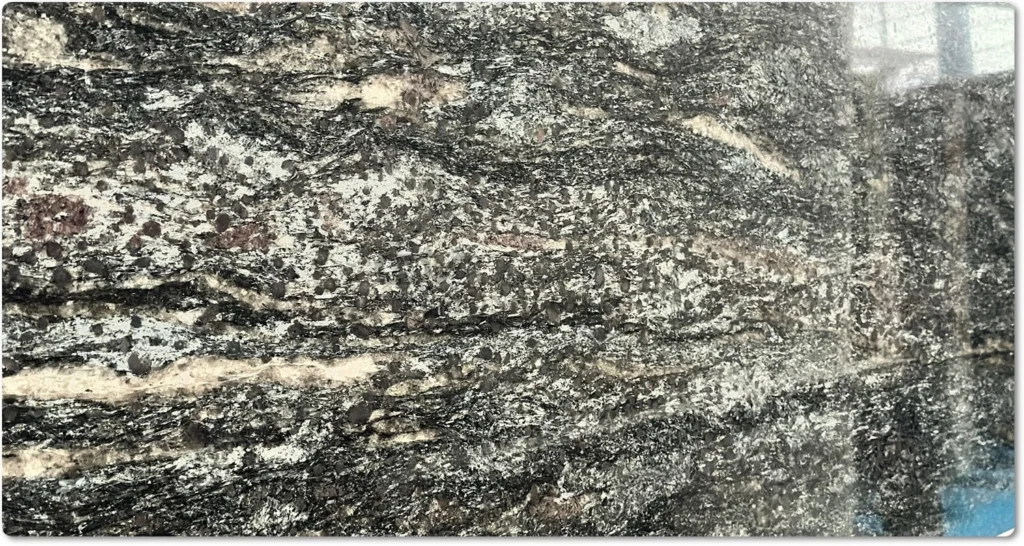
2. Quartzite Fabrication Process: From Slab Inspection to Finished Countertop
A professional quartzite fabrication process normally includes several stages.
Step 1: Slab Identification and Inspection
Before cutting, the fabricator should identify:
- Stone type
- Slab thickness
- Dimensions
- Vein direction
- Fissures
- Natural pits
- Repairs
- Resin treatment
- Color variation
- Translucent zones
- Weak areas
This step is especially important because commercially marketed “quartzite” is not always mineralogically identical.
Some stones sold in the marketplace under quartzite names may behave more like marble or dolomitic stone. Material testing and supplier documentation can therefore prevent major fabrication errors.
Step 2: Digital Templating and Layout
Accurate templating is critical for high-value quartzite.
The digital layout should account for:
- Overall dimensions
- Sink position
- Cooktop
- Faucet holes
- Backsplash
- Seam locations
- Vein direction
- Bookmatching
- Overhang
- Edge profile
- Waterfall panels
- Structural support
The fabricator should optimize the layout not only for material yield but also for appearance and structural performance.
A low-waste layout that produces a poor vein match is not necessarily a successful layout.
Step 3: Diamond Cutting
Bridge saws, CNC machines, and waterjet systems can all play a role depending on project requirements.
Quartzite cutting generally benefits from:
- Material-specific diamond blades
- Controlled feed rate
- Continuous water cooling
- Stable slab support
- Correct RPM
- Proper blade dressing
- Accurate machine calibration
Wet cutting is particularly important from both quality and worker-safety perspectives.
OSHA identifies cutting, grinding, drilling, polishing, and other stone-processing activities as potential sources of respirable crystalline silica exposure.
Step 4: CNC Machining and Cutouts
CNC equipment can provide repeatable machining for:
- Sink cutouts
- Cooktops
- Drainboards
- Faucet holes
- Edge profiles
- Custom shapes
- Radius corners
However, CNC automation does not eliminate the need for technical expertise.
The machine must still use suitable tooling and machining parameters for the specific quartzite.
Step 5: Edge Profiling
Common quartzite countertop edge profiles include:
- Eased edge
- Pencil edge
- Half bullnose
- Full bullnose
- Ogee
- Dupont
- Waterfall edge
- Custom laminated edge
The harder the stone, the more important tool condition and polishing sequence become.
Step 6: Polishing and Surface Finishing
Quartzite polishing can be technically demanding.
Potential problems include:
- Uneven gloss
- Cloudy areas
- Visible swirl marks
- Over-polishing
- Under-polishing
- Uneven edge color
- Resin or filler visibility
- Inconsistent transition between surface and edge
The polishing sequence must be matched to the mineral composition and requested finish.
Step 7: Reinforcement and Assembly
Depending on design and engineering requirements, quartzite countertops may require reinforcement around:
- Sink openings
- Narrow sections
- Long spans
- Seams
- Overhangs
- Waterfall connections
The objective is to distribute stress rather than concentrate it in vulnerable areas.
Step 8: Final Quality Control
Before packing, a professional quartzite factory should inspect:
- Dimensions
- Thickness
- Cutout dimensions
- Edge profile
- Surface finish
- Color consistency
- Vein alignment
- Seam preparation
- Visible cracks
- Chips
- Reinforcement
- Packaging condition
A final inspection checklist can significantly reduce installation-site problems.
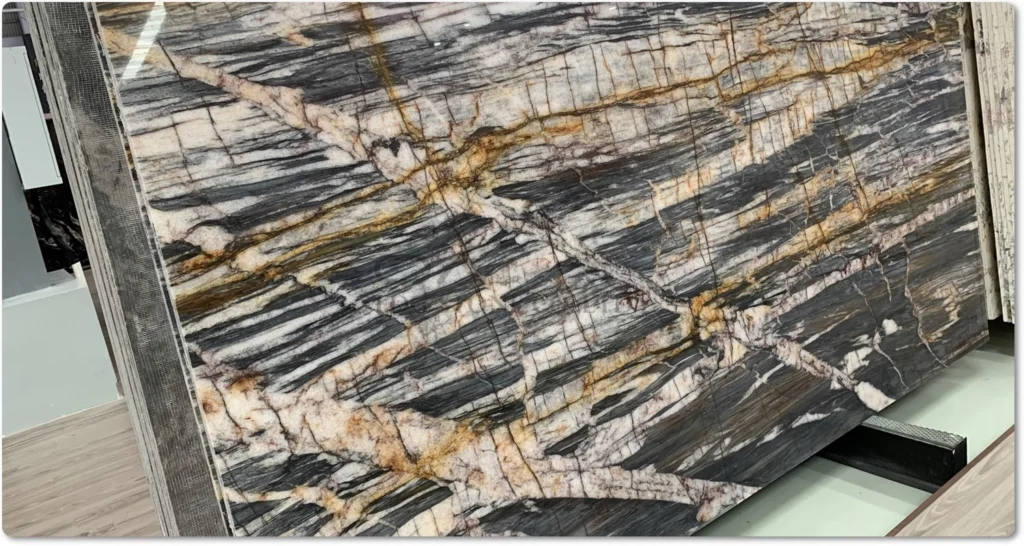
3. Why Do Quartzite Countertops Crack During Fabrication?
Cracking usually results from a combination of material characteristics and process conditions rather than one single cause.
Common Causes
Natural Fissures
Quartzite is a natural stone. A slab may contain geological discontinuities that are not obvious from the polished surface.
Excessive Mechanical Stress
Aggressive cutting or drilling can transfer excessive force into the slab.
Poor Slab Support
A long slab must be adequately supported during machining and handling.
Poor Cutout Geometry
Sharp corners can create stress concentrations.
Improper Transportation
A correctly fabricated slab can still fail if it is transported incorrectly.
Excessive Overhang
Large unsupported overhangs increase structural stress.
The key lesson is that quartzite fabrication quality and installation engineering are connected.
4. Quartzite Fabrication Costs: What Actually Determines the Price?
One of the most searched commercial questions is “How much does quartzite fabrication cost?”
There is no single universal price because fabrication cost depends on project complexity, location, equipment, stone characteristics, and labor.
A practical cost model is:
Quartzite Fabrication Cost = Material + Cutting + Tooling + CNC/Waterjet + Edge Work + Cutouts + Polishing + Reinforcement + Packaging + Transportation + Installation
Major Cost Drivers
Material Yield
A complex layout may consume substantially more slab than a simple rectangular countertop.
Tool Consumption
Quartzite can consume diamond blades, CNC bits, core drills, and polishing abrasives faster than softer stones.
Cutout Complexity
A simple rectangular opening is generally easier than a complex undermount sink with multiple radii and accessories.
Edge Profile
A basic eased edge requires less machining than an elaborate custom profile.
Vein Matching
Bookmatching and vein alignment can increase material requirements and fabrication time.
Thickness
Thicker slabs may require different tooling and machining procedures.
Finishing
Polished, honed, leathered, brushed, or specialty finishes require different processing.
Quality-Control Requirements
High-end commercial projects may require dimensional documentation, sample approval, inspection photographs, and packaging protocols.
This is why buyers should avoid evaluating quartzite suppliers solely by slab price.
A supplier offering a lower material price may ultimately produce a higher total project cost if fabrication yield, breakage, tooling, packaging, or installation performance is poor.
5. How to Reduce Quartzite Fabrication Problems
Use Material-Specific Tooling
Quartzite should not automatically be processed using the same tooling parameters used for marble or standard granite.
Control Cutting Speed
Aggressive feed rates can increase chipping, heat, vibration, and blade wear.
Maintain Continuous Cooling
Water management is important for both cutting performance and dust control.
Support the Slab Properly
Support should be designed around the slab geometry and machining sequence.
Round Cutout Corners
Where the design permits, rounded corners reduce stress concentration.
Inspect Incoming Slabs
Do not wait until after cutting to discover a structural problem.
Optimize the Layout
A good layout should balance:
material yield + visual appearance + structural integrity + fabrication risk
Use Digital Production Drawings
Detailed CAD drawings can reduce misunderstandings between buyer, fabricator, and installer.
Establish a Final QC Protocol
Quality control should be measurable rather than subjective.
6. Quartzite Manufacturing Process vs. Quartzite Fabrication
These two terms are frequently confused.
Quartzite manufacturing process generally refers to quarrying and processing natural quartzite into commercial slabs or other stone products.
Quartzite fabrication refers to transforming those slabs into finished products such as:
- Kitchen countertops
- Bathroom vanities
- Island tops
- Table tops
- Wall panels
- Fireplace surrounds
- Shower components
- Custom architectural pieces
This distinction is important for SEO as well as procurement.
A quarry may produce excellent slabs but have limited countertop fabrication capability.
Conversely, a countertop fabricator may provide excellent machining but have no direct control over quarry selection.
For large projects, buyers should understand the entire supply chain.
7. Natural Quartzite vs. Engineered Quartz: Why the Distinction Matters
The words quartzite and quartz are often confused.
Natural Quartzite
Natural quartzite is quarried stone. It is cut and processed into slabs without being manufactured from crushed quartz and resin into an engineered slab.
Engineered Quartz
Engineered quartz is a manufactured material made using mineral aggregates and binders.
The distinction has become especially important because silica regulations increasingly focus on engineered-stone fabrication.
OSHA’s current silica guidance states that workers manufacturing, finishing, or installing countertops containing crystalline silica can be exposed during cutting, grinding, drilling, and polishing.
8. 2026 Silica Regulations and What They Mean for Quartzite Fabrication
This is one of the most important developments for the stone fabrication industry.
OSHA’s current framework includes a respirable crystalline silica permissible exposure limit of 50 μg/m³ as an 8-hour time-weighted average, with an action level of 25 μg/m³ under the applicable standards. OSHA also identifies wet methods, local exhaust ventilation, enclosure, HEPA-filtered cleanup, exposure assessment, and related controls as important protective measures.
California has moved particularly aggressively.
As of August 2026, California is pursuing emergency rulemaking concerning engineered stone containing more than 1% crystalline silica. The May 2026 Standards Board action initiated the process, and Cal/OSHA has been conducting advisory work on the proposal.
Importantly, the current California proposal concerns engineered/artificial stone, not a blanket prohibition on natural quartzite.
California’s own evaluation distinguishes quarried natural stone—including quartzite—from artificial stone products that are reconstituted using binders and silica-containing materials.
However, California’s regulatory discussion is highly relevant to quartzite fabricators because the state is also evaluating whether high-silica natural stones, including quartzite, require additional consideration.
California’s current silica rules already identify cutting, drilling, grinding, polishing, abrading, and related operations involving certain silica-containing natural stone as High-Exposure Trigger Tasks when the applicable silica threshold is exceeded.
What Does This Mean for the Industry?
The direction of regulation is clear:
The future of stone fabrication will increasingly require documented dust-control engineering, not simply PPE.
Professional factories should therefore prioritize:
- Wet cutting
- Local exhaust ventilation
- Enclosed processes where feasible
- HEPA filtration
- Exposure assessment
- Safe housekeeping
- Worker training
- Written exposure-control procedures
- Appropriate respiratory protection
- Equipment maintenance
- Recordkeeping
The European Union also sets an occupational exposure limit of 0.1 mg/m³ for respirable crystalline silica dust under Directive 2017/2398, demonstrating that silica control is not only a U.S. issue but a broader international workplace-safety concern.
For exporters and international quartzite manufacturers, compliance documentation is therefore becoming part of supplier credibility.
9. What Should Buyers Ask a Quartzite Manufacturer or Factory?
If you are purchasing quartzite countertops wholesale, slabs, vanity tops, or fabricated stone components, ask the supplier:
Material Questions
- Is the material genuine natural quartzite?
- What quarry does it come from?
- What is the slab thickness?
- Are there known fissures?
- Has the slab been resin-treated?
- Can the supplier provide slab photos?
Fabrication Questions
- What equipment is used?
- Is cutting performed with wet methods?
- Do you use CNC or waterjet equipment?
- How are sink cutouts reinforced?
- How are seams prepared?
- What edge profiles are available?
Quality Questions
- Is there a pre-production inspection?
- Is there a final dimensional inspection?
- Are production photos available?
- How are finished pieces packaged?
- What happens if a piece arrives damaged?
Commercial Questions
- What is included in the quotation?
- Is fabrication priced separately?
- Are tooling and cutout charges included?
- What is the minimum order quantity?
- Can the supplier provide wholesale pricing?
- Can the supplier produce custom CAD drawings?
These questions help distinguish a simple stone trader from a capable quartzite manufacturer and fabrication factory.
10. How EDG Stone Approaches Quartzite Fabrication
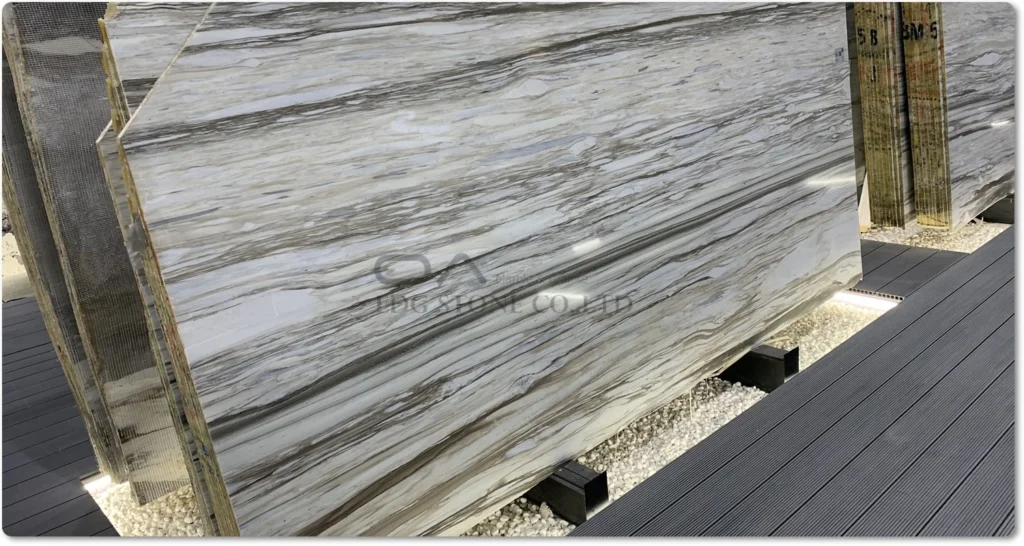
For a professional stone supplier such as EDG Stone, quartzite fabrication should be treated as a combination of material sourcing, manufacturing engineering, quality control, and international logistics.
A strong supplier model should connect:
Quarry Selection → Slab Inspection → Digital Layout → Cutting → CNC/Waterjet → Edge Profiling → Polishing → Reinforcement → QC → Export Packaging
This integrated approach is particularly valuable for wholesale buyers and commercial projects because the buyer is not simply purchasing a slab.
The buyer is purchasing a finished stone solution.
For large projects, fabrication capability can determine whether a quartzite material remains profitable after production, packing, shipping, breakage, installation, and warranty costs are considered.
11. Future Trends in Quartzite Fabrication
The quartzite fabrication industry is moving toward several major trends.
11.1 More Automation
CNC machining, robotic polishing, digital templating, automated bridge saws, and waterjet technology will increasingly improve repeatability.
11.2 More Material Testing
As quartzite becomes more expensive and projects become more complex, material identification before production will become increasingly important.
11.3 Higher Documentation Requirements
International buyers increasingly expect:
- Material specifications
- QC reports
- CAD drawings
- Packing photographs
- Production photographs
- Compliance documentation
- Traceability
11.4 Safer Fabrication Systems
Silica regulations are pushing manufacturers toward wet processing, ventilation, enclosure, exposure monitoring, and safer housekeeping practices. OSHA’s July 2026 guidance continues to emphasize wet methods, local exhaust ventilation, and enclosure as core controls.
11.5 More Interest in Natural Stone
As regulatory scrutiny increases around engineered-stone fabrication, natural stone products may gain additional attention from architects, designers, fabricators, and buyers.
But natural stone should not be treated as automatically risk-free. Quartzite can contain substantial crystalline silica, and its machining still requires appropriate exposure controls.
12. Quartzite Fabrication Problems: Professional Checklist
Before approving a quartzite fabrication order, verify:
- Material identity
- Slab condition
- Slab dimensions
- Vein direction
- Fissure locations
- Layout
- Cutout positions
- Cutout corner radius
- Edge profile
- Machine selection
- Diamond tooling
- Water cooling
- Slab support
- CNC parameters
- Polishing sequence
- Reinforcement
- Dimensional QC
- Surface inspection
- Packaging
- Transportation method
- Installation requirements
- Silica-control procedures
The most expensive quartzite fabrication problems are often preventable problems.
A small amount of engineering and inspection before production can prevent a major material loss later.
Frequently Asked Questions About Quartzite Fabrication
1. What is the biggest problem with fabricating quartzite?
The biggest challenge is the combination of extreme hardness, abrasiveness, and natural structural variation. Quartzite can accelerate diamond-tool wear while increasing the risk of edge chipping, drilling difficulty, micro-cracking, and polishing problems. Proper tooling, cooling, support, and machining parameters are essential.
2. Is quartzite harder to fabricate than granite?
Generally, yes. True quartzite is commonly around Mohs 7 or higher and can be highly abrasive. This can require specialized diamond tooling, slower or optimized cutting parameters, careful cooling, and more frequent tool maintenance. Actual difficulty varies according to the specific stone composition.
3. How much does quartzite fabrication cost?
Quartzite fabrication costs depend on slab thickness, project dimensions, cutouts, edge profiles, CNC work, waterjet cutting, polishing, reinforcement, material yield, tooling consumption, packaging, and installation. A simple countertop and a complex bookmatched island can have very different fabrication costs.
4. Why does quartzite chip when cutting?
Chipping can result from excessive feed speed, incorrect blade selection, worn tooling, inadequate cooling, vibration, poor slab support, or natural weaknesses in the stone. Sink and cooktop cutouts are especially sensitive because they interrupt the structural continuity of the slab.
5. Is quartzite fabrication affected by silica regulations?
Yes. Natural quartzite can contain significant crystalline silica, so cutting, grinding, drilling, polishing, and similar operations can generate respirable crystalline silica. OSHA and state regulators require applicable exposure controls, and California has introduced additional protections and is evaluating further regulatory action. The current California proposal regarding a >1% crystalline-silica threshold is specifically aimed at engineered/artificial stone, not a blanket ban on natural quartzite.
Quartzite Fabrication: How, Why, Options, Considerations, and Industry Outlook
How should quartzite be fabricated?
Quartzite should be fabricated using material-specific diamond tooling, controlled wet cutting, accurate digital templating, stable slab support, carefully engineered cutouts, appropriate CNC or waterjet machining, controlled edge profiling, and a suitable polishing sequence. High-value slabs should undergo inspection before cutting and final QC before packing.
Why is quartzite fabrication expensive?
Quartzite is expensive to fabricate because its hardness and abrasiveness can increase diamond-tool consumption, machining time, drilling difficulty, polishing requirements, and breakage risk. Complex layouts, bookmatching, waterfall edges, large islands, sink cutouts, and custom profiles further increase production requirements.
What are the main fabrication options?
Depending on the project, a fabricator may combine bridge-saw cutting, CNC machining, waterjet cutting, diamond core drilling, automated edge profiling, hand finishing, and specialized polishing. The correct combination depends on stone characteristics, geometry, tolerances, finish, and production volume.
What should buyers consider when selecting a quartzite manufacturer or wholesale supplier?
Buyers should evaluate not only slab price but also quarry source, material consistency, fabrication equipment, technical drawings, QC procedures, tooling capability, packaging, export experience, production capacity, silica-control procedures, and the supplier’s ability to manage the complete process from slab selection to finished product.
What is changing in the quartzite fabrication industry?
The industry is moving toward higher automation, digital templating, better material characterization, stronger quality documentation, safer wet-processing systems, improved ventilation and dust control, and greater regulatory scrutiny of silica-generating fabrication activities. In 2026, California’s regulatory developments around engineered stone are particularly significant, while natural quartzite remains a separate material category under the current proposal.
What is the core procurement insight?
Quartzite should be evaluated as both a natural material and an engineered production challenge. The best supplier is not necessarily the one offering the lowest slab price. The stronger procurement decision is the supplier capable of controlling material selection, fabrication accuracy, tooling consumption, structural risk, worker-safety procedures, QC, packaging, and delivery as one integrated system.
Final Takeaway
The fundamental principle of quartzite fabrication is simple:
The harder and more valuable the stone, the more important process control becomes.
A professional quartzite manufacturer or factory should therefore combine geological material knowledge, specialized fabrication equipment, experienced technicians, digital production planning, quality control, safe silica-management practices, and reliable international packaging.
For wholesale buyers, contractors, architects, designers, distributors, and stone importers, evaluating these capabilities before placing an order can reduce hidden costs and improve the final project result.
Quartzite remains one of the most premium natural stone options available. Its fabrication challenges are real—but with the right process, equipment, expertise, and quality-control system, those challenges can be managed systematically.