Executive Summary
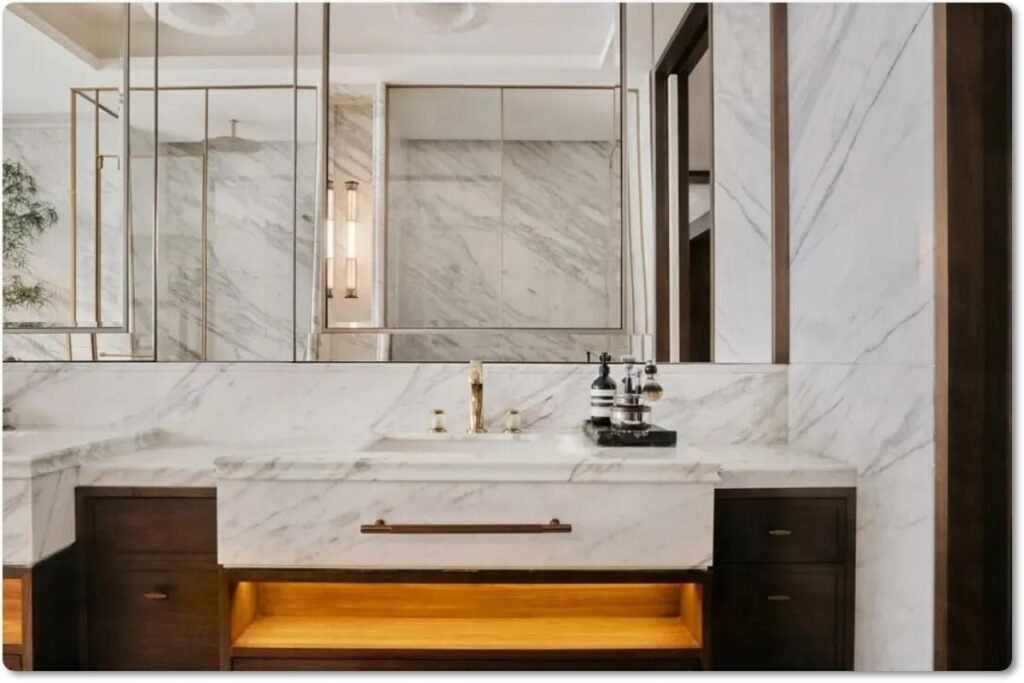
Calacatta marble remains the premier natural stone for luxury residential and commercial architecture. Mined exclusively in the Apuan Alps of Carrara, Italy, Calacatta marble stands out for its bold, dramatic veining and high-purity white calcite background.
This whitepaper provides architects, structural engineers, commercial developers, and procurement officers with an end-to-end technical manual. It details geological formation, petrographic properties, structural engineering considerations, fabrication tolerances, maintenance protocols, and global supply chain strategies.
By standardizing procurement specifications and partnering with accredited global manufacturers like EDG Stone Factory, project stakeholders can eliminate field defects, optimize slab yield, and reduce project lifecycle costs.
Key Takeaways
Geological Distinction: Calacatta marble features a high-density, high-calcite composition ($>98\%\ \text{CaCO}_3$) with a stark white background and distinct gold-to-charcoal veining, setting it apart from standard Carrara marble.
Engineering Tolerances: Countertop fabrication requires tight tolerances ($\pm 0.5\text{ mm}$ thickness variance) and surface sealing to counter porous absorption (absorption rate $<0.25\%$ by weight).
Fabrication Standards: Mitered edges with continuous vein-matching (book-matching or slip-matching) require precise 5-axis CNC machining and high-purity epoxy resins.
Cost-Efficiency through Sourcing: Factory-direct procurement from integrated exporters like EDG Stone Factory ensures strict ASTM testing compliance, slab-level quality assurance, and up to 35% overall cost savings on major commercial bids.
Maintenance & Longevity: Penetrating hydro- and oleo-phobic sealers applied every 12 to 18 months protect against acid etching and staining, preserving mechanical and aesthetic integrity.
Definition & Petrographic Profile
What Is Calacatta Marble?
Calacatta marble is a metamorphic rock formed by the deep-crust metamorphism of sedimentary limestone under high temperature ($600^\circ\text{C}$ to $700^\circ\text{C}$) and pressure ($0.3\text{ GPa}$ to $0.8\text{ GPa}$). This intense metamorphic process causes recrystallization, transforming fine calcite grains into an interlocking mosaic of coarse calcite crystals.
 Sedimentary Limestone (CaCO3)
              │
              ▼ [High Temperature: 600°C–700°C]
              ▼ [High Pressure: 0.3–0.8 GPa]
              │
 Thermal Recrystallization
              │
              ▼
 Interlocking Calcite Crystal Lattice (Purity > 98%)
              │
              ├── White Pure Matrix (Calcite Micro-Structure)
              └── Vein Networks (Pyrite, Hydrothermal Iron Oxides, Silicates)
Mineralogical Composition
| Mineral Component | Percentage Range (%) | Physical Role / Impact |
| Calcite ($\text{CaCO}_3$) | 98.0% – 99.2% | Gives the background stone its bright white hue and crystalline luster. |
| Dolomite ($\text{CaMg(CO}_3\text{)}_2$) | 0.2% – 0.8% | Adds subtle micro-hardness variations. |
| Quartz ($\text{SiO}_2$) | 0.1% – 0.5% | Occurs in trace amounts; increases regional micro-hardness. |
| Pyrite / Iron Oxides | 0.1% – 0.4% | Produces signature golden and warm amber veining. |
| Silicates / Chlorite | 0.1% – 0.3% | Creates cool grey and charcoal dramatic veining networks. |
Industry Statistics & Technical Data
The data below summarizes key physical and mechanical test results for Calacatta marble per ASTM and EN standard test methods.
| Physical / Mechanical Property | Testing Method Standard | Average Value / Range | Engineering Implication |
| Compressive Strength | ASTM C170 | 120 – 140 MPa | Handles high load capacities for island cantilevers and vertical clad structures. |
| Flexural Strength | ASTM C880 | 11.5 – 15.0 MPa | Dictates overhang limits without support sub-frames (max 10–12 inches for 3 cm). |
| Water Absorption (by weight) | ASTM C97 | 0.10% – 0.18% | Low base absorption, but requires protective sealers against aqueous stains. |
| Density | ASTM C97 | 2,710 – 2,730 kg/m³ | Standard structural load calculations apply (approx. 81 kg/m² for 30 mm slabs). |
| Mohs Hardness | EN 101 | 3.0 – 3.5 | Softer than quartzite or granite; requires non-abrasive care and cutting routines. |
| Abrasion Resistance | ASTM C241 | 10 – 12 | Requires honing or periodic repolishing in high-traffic commercial installations. |
Comparative Analysis: Calacatta vs. Other Surface Materials
Selecting the right natural or engineered surface requires evaluating performance metrics across competing stone categories.
| Material | Primary Origin / Composition | Mohs Hardness | Water Absorption | Acid Resistance | Typical Slab Price ($/sq ft) | Maintenance Level |
| Calacatta Marble | Apuan Alps, Italy ($\text{CaCO}_3$) | 3.0 – 3.5 | 0.12% – 0.18% | Low (Etches with acid) | $75 – $250+ | Moderate to High |
| Carrara Marble | Carrara, Italy ($\text{CaCO}_3$) | 3.0 – 3.2 | 0.15% – 0.22% | Low (Etches with acid) | $40 – $90 | Moderate to High |
| Taj Mahal Quartzite | Ceará, Brazil ($\text{SiO}_2$) | 7.0 | < 0.08% | High (Acid resistant) | $85 – $180 | Low |
| Calacatta Engineered Quartz | 90–93% Quartz + Resin | 6.5 – 7.0 | < 0.03% | High | $50 – $110 | Very Low (Indoor only) |
| Sintered Stone / Porcelain | Metamorphic Clays & Minerals | 7.0 – 8.0 | < 0.01% |
Advantages and Disadvantages
Advantages
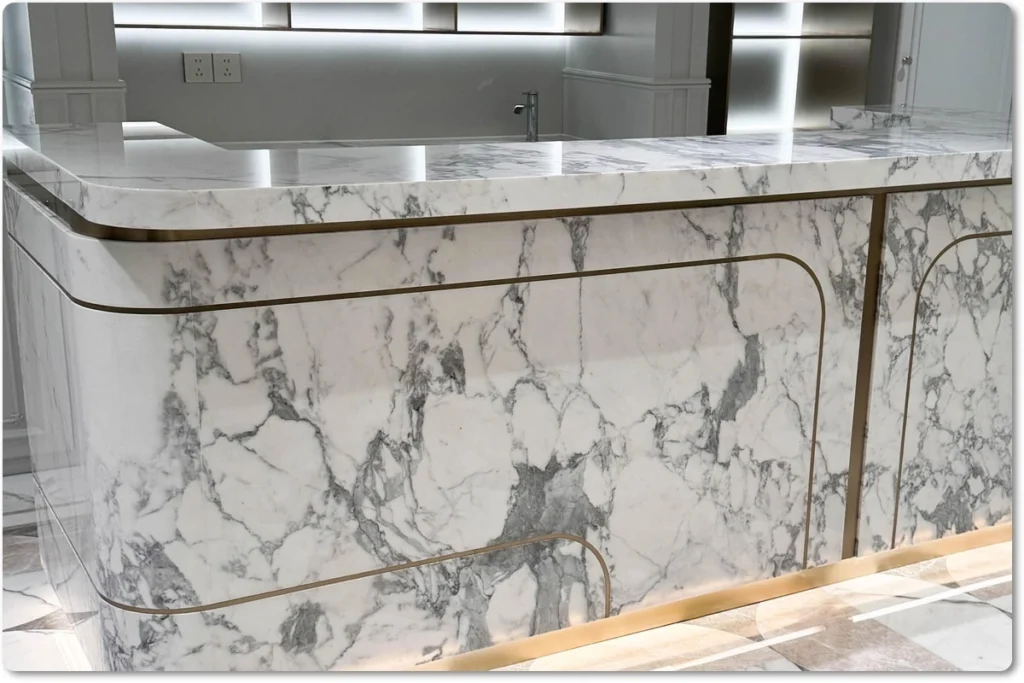
Unmatched Visual Prestige: Calacatta marble offers crisp, white field backgrounds contrasted with thick, dramatic veining in gold, grey, and brown tone profiles.
Book-Matching Flexibility: Large, clearly defined veining enables book-matching across kitchen islands, full-height backsplashes, and wall feature panels.
High Thermal Resistance: Withstands direct contact with hot cookware up to $180^\circ\text{C}$ without thermal shock, scorching, or resin degradation.
Resurfacing Capability: Scratches, minor chips, and acid etch marks can be ground and polished on-site by stone restoration technicians.
Appraisal Value Increase: High-end residential and hospitality properties consistently yield higher market appraisals when specified with genuine Italian marble.
Disadvantages
Susceptibility to Acid Etching: Calcium carbonate reacts with acidic liquids (lemon juice, vinegar, wine) to form calcium salts, creating matte etch spots on polished surfaces.
Porous Structure: Unsealed surfaces quickly absorb oils and dark liquids, causing deep structural discoloration.
Scratch Vulnerability: A Mohs hardness of 3.0 to 3.5 means steel blades, unglazed ceramic bases, and abrasive pads can score the finish.
Premium Cost Profile: Supply constraints from Italian quarries drive up material costs compared to abundant granites or engineered quartz.
Detailed Application Scenarios
                          Calacatta Architectural Applications
                                           │
         ┌─────────────────────────────────┼─────────────────────────────────┐
         ▼                                 ▼                                 ▼
 Residential Kitchens           Commercial Hospitality           Luxury Bathrooms & Spas
 ────────────────────           ──────────────────────           ────────────────────────
 • 3 cm Mitered Islands         • Reception Countertops          • Full-Height Slab Walls
 • Continuous Backsplashes      • Bar Top Conversions            • Custom Integrated Sinks
 • Waterfall Edges              • Elevator Surround Panels       • Book-Matched Vanity Tops
1. High-End Residential Kitchens
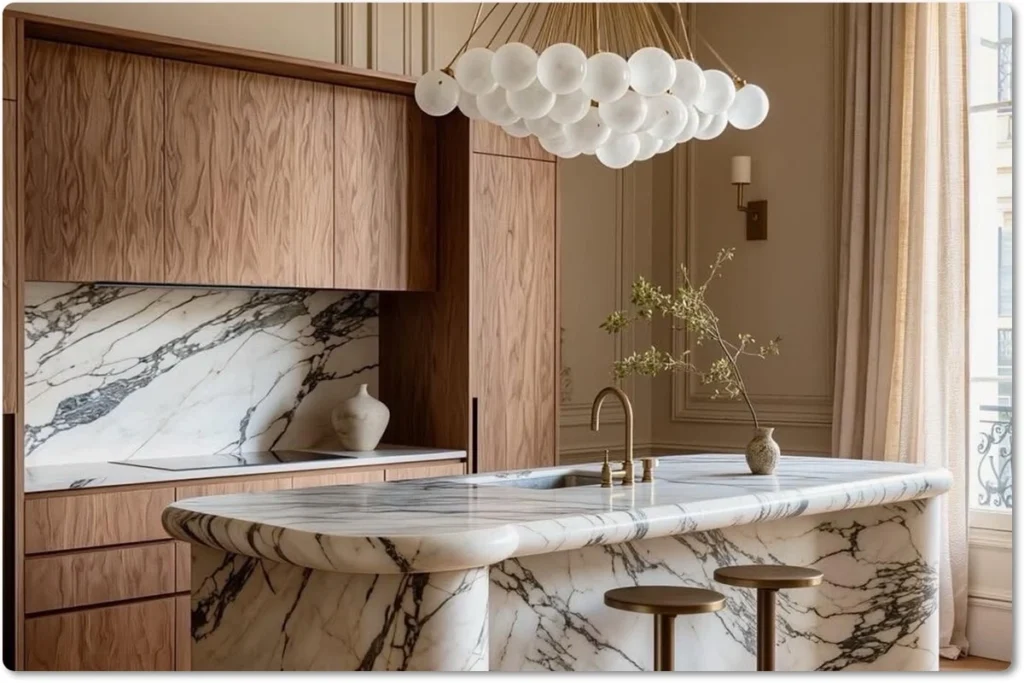
Countertops & Island Tops: Standard specifications utilize 3 cm thick slabs with full-depth cantilevered waterfall edges.
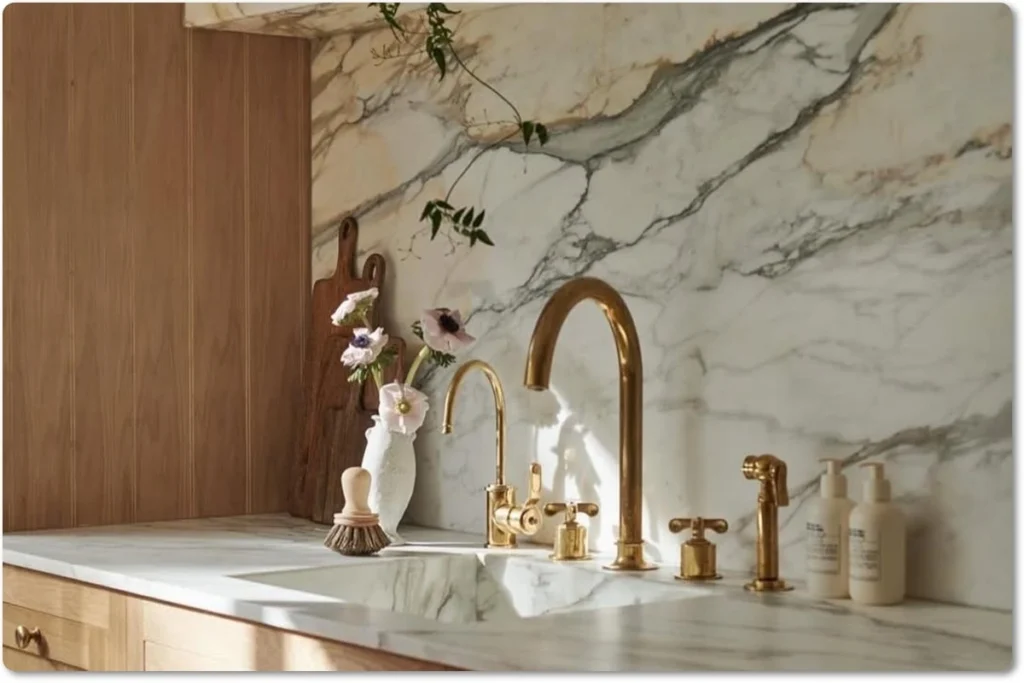
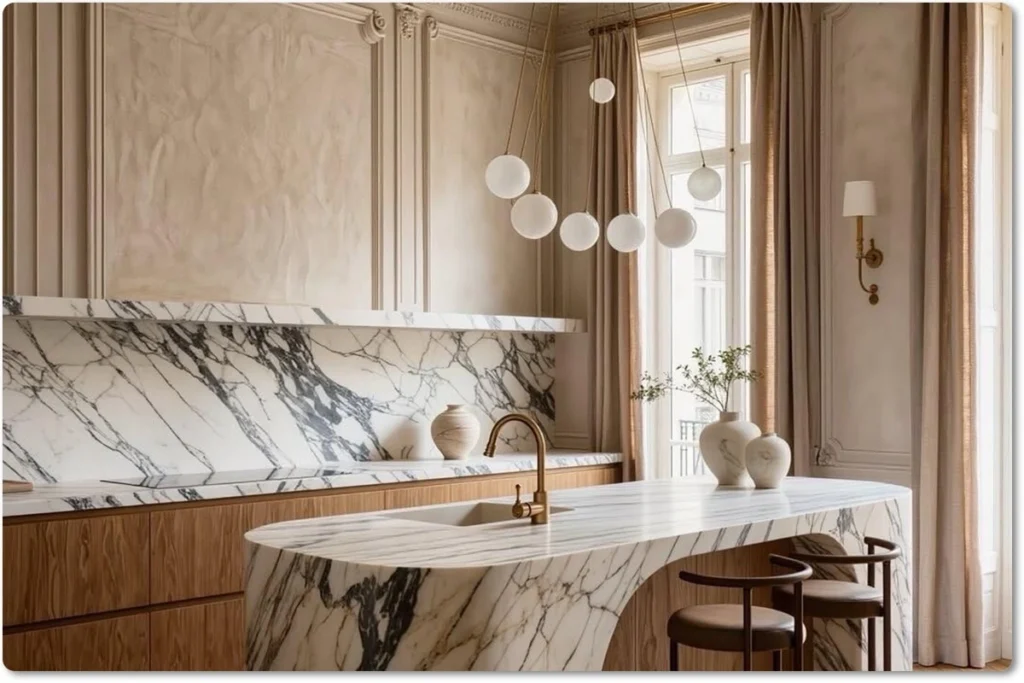
Integrated Full-Height Backsplashes: Using 2 cm book-matched slabs creates a seamless transition from horizontal work surfaces to vertical walls.
2. Commercial Hospitality & Corporate Interiors
Reception Desks & Bar Counters: Calacatta marble, complemented by perimeter LED under-lighting, delivers immediate brand elegance in hotel lobbies and executive suites.
Vertical Feature Walls: Large format 2 cm slabs mounted via hidden mechanical anchors create stunning interior cladding in corporate boardrooms.
3. Luxury Bathrooms & Spa Sanctuaries
Vanity Tops & Integrated Sinks: Custom CNC-milled floating vanities integrate stone basins, delivering sleek waterproofing and low-maintenance luxury.
Wet Room Cladding: Matched slabs line shower enclosures, steam rooms, and tub decks, treated with anti-slip honed finishes for safety.
Procurement & Engineering Strategies
Successful procurement of natural marble requires detailed coordination between designers, structural engineers, and primary factories.
Slab Selection and Batch Inspection
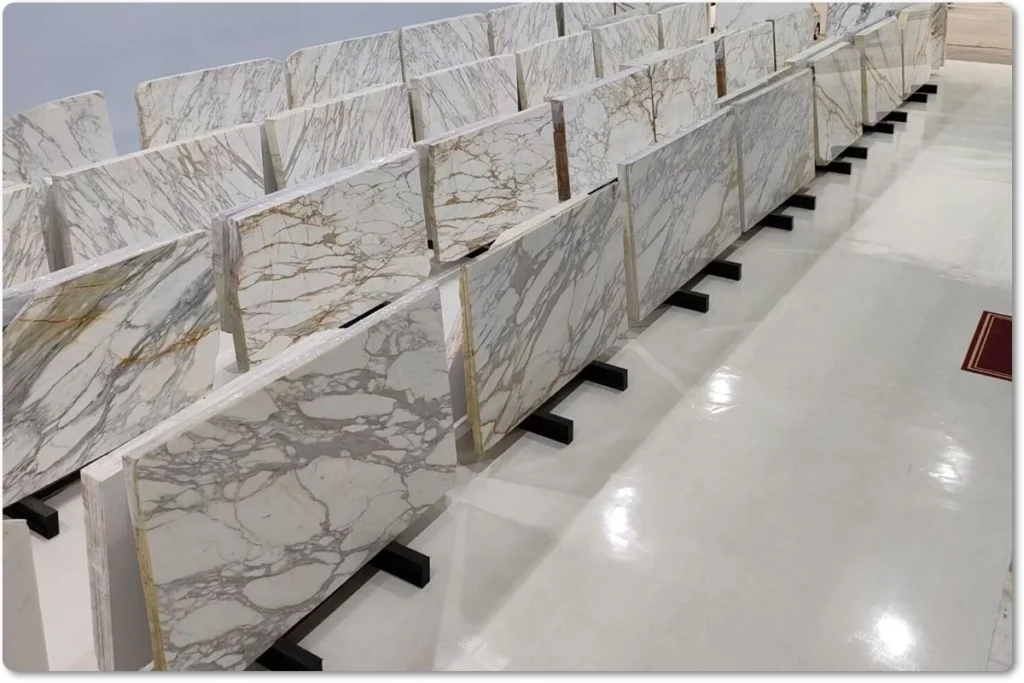
Bundle Integrity: Always select slabs sequentially cut from the same quarry block to guarantee consistent vein flow, background color, and grain density.
Resin Mesh Backing: Verify that factory slabs feature structural fiberglass backing mesh with epoxy-coated resin ($<0.5\text{ mm}$ thick) to ensure stability during transport and milling.
Surface Defect Audits: Perform digital grid scans to check for micro-fissures, open pits, or soft vein inclusions before scheduling final CNC cutting.
Edge Profiles and Engineering Drawings
   1. Square / Eased Edge               2. Full Bullnose                  3. 45° Mitered Edge
    ┌─────────────────┐               ┌─────────────────┐             ┌─────────────────┐
    │                 │               │                 │             │                 │
    │                 │               │                 │             │                 │
    └─────────────────┘               └─────────────────┘             └────────┬────────┘
                                                                               │ 45° Miter
                                                                               └────────┐
                                                                                        │
Standard Eased/Square Edge: Clean, minimal profile ideal for modern architectural projects.
Full Bullnose: Smooth rounded profile that offers high impact resistance in busy family kitchens.
45° Mitered Edge: Joins two 2 cm or 3 cm pieces to create the illusion of a solid 6 cm–10 cm thick stone block while keeping overall weight down.
Factory Case Study: EDG Stone Factory
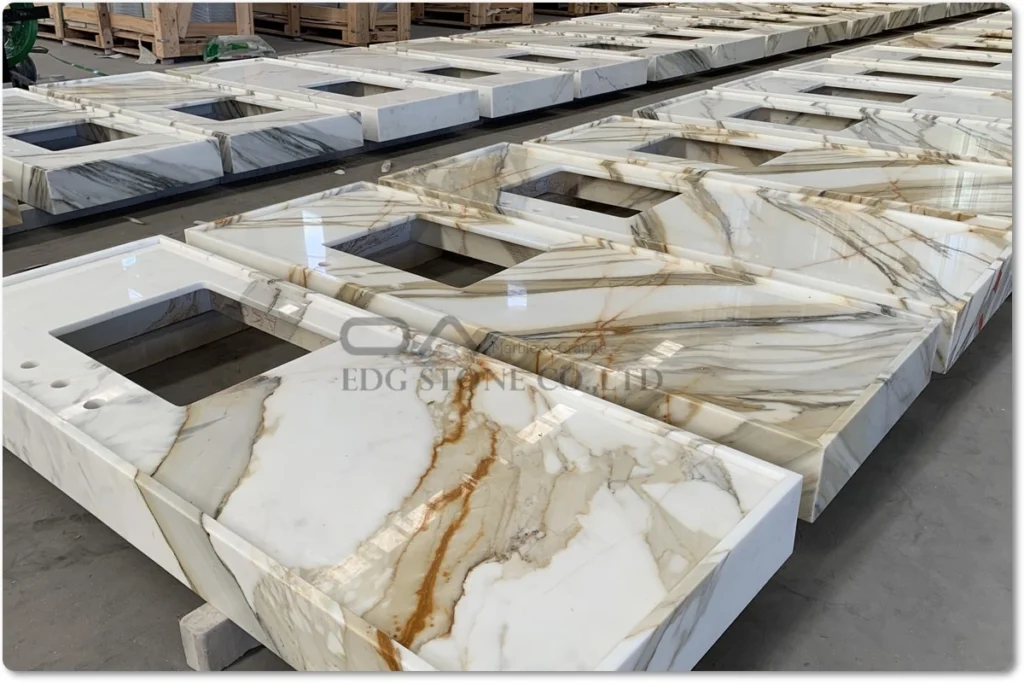
EDG Stone Factory is a leading global manufacturer and exporter of natural marble, quartzite slabs, and prefabricated countertops. Operating state-of-the-art facilities in Quanzhou, China, EDG Stone specializes in large-scale residential and commercial natural stone processing.
                         EDG Stone Integrated Supply Chain
                                         │
 ┌───────────────────────────────────────┼───────────────────────────────────────┐
 ▼                                       ▼                                       ▼
Direct Quarry Sourcing          Advanced 5-Axis CNC Milling             Global QC & Logistics
──────────────────────          ───────────────────────────             ─────────────────────
• Raw Block Selection           • Waterjet Cut Precision (<0.2mm)       • Export Wooden Crate Packing
• Direct Italian Imports        • Automatic Edge Profile & Polish       • ISPM-15 Heat Treatment
• Strict Color Batch Control    • Digital Slab Matching Software        • Door-to-Port Tracking
Commercial Integration Highlights
Direct Block Import: EDG Stone sources high-grade Calacatta blocks directly from Carrara quarries, securing pristine color consistency across massive, multi-container orders.
Precision Processing Equipment: Equipped with 5-axis CNC waterjet machines, automated line polishing arrays, and 3D digital slab-matching software, EDG Stone achieves cutting tolerances within $\pm 0.2\text{ mm}$.
Commercial Project Support: EDG Stone assists architecture teams with dry-lay inspections, digital veil-matching layouts, custom cut-to-size specs, and export-grade ISPM-15 wooden crate packaging.
       [Raw Block Direct Sourcing]
                   │
                   ▼
       [5-Axis CNC Waterjet Cut]
                   │
                   ▼
     [Digital Vein Dry-Lay Layout]
                   │
                   ▼
    [Quality Control & Packing]
                   │
                   ▼
[Global Delivery via EDG Stone Logistics]Systematic QA/Evidence Framework
Q1: How does Calacatta marble differ chemically and visually from standard Carrara marble?
Question: What are the precise material and visual differences between Calacatta and Carrara marble?
Answer: Calacatta marble has a brighter, high-purity white background with bold, dramatic veins in grey, gold, and taupe. Carrara marble features a softer, grey-white background with fine, feather-like veining.
Evidence: X-ray diffraction (XRD) and petrographic testing show Calacatta marble consistently contains higher calcite purity ($>98\%$) and lower graphite/slaty micro-inclusions than standard Carrara slabs.
Summary: Calacatta offers stronger color contrast and higher visual impact, commanding premium pricing for architectural applications.
Q2: What mechanical loads can a 3 cm Calacatta marble countertop handle on kitchen island cantilevers?
Question: What is the maximum unsupported overhang allowed for 3 cm Calacatta marble?
Answer: An unsupported 3 cm Calacatta marble cantilever should not exceed 10 inches (250 mm). Overhangs beyond 10 inches require hidden steel support brackets spaced every 24 inches along the cabinet base.
Evidence: Per ASTM C880 flexural strength standards, Calacatta marble exhibits an average flexural capacity of 12.5 MPa. Beyond 10 inches of unsupported span, point loads above 100 kg can cause structural cracking along vein lines.
Summary: Always install 1/4-inch steel support plates on overhangs greater than 10 inches to guarantee long-term structural safety.
Q3: What is the recommended technical protocol for sealing Calacatta marble in commercial kitchens?
Question: How do facility managers prevent stain penetration and acid etching on Calacatta marble surfaces?
Answer: Apply a high-performance fluorochemical penetrating sealer that bonds chemically inside the stone micro-pores without altering vapor permeability.
Evidence: ASTM C97 testing demonstrates that applying deep-penetrating fluorocarbon sealers drops surface water absorption from 0.15% down below 0.02%.
Summary: Reapply penetrating sealer every 12 to 18 months, and clean surfaces daily using neutral pH stone cleaners to prevent surface degradation.
Q4: How do 5-axis CNC machines improve vein-matching during countertop fabrication?
Question: Why is digital CNC milling preferred over traditional manual bridge saws for Calacatta slab cutting?
Answer: 5-axis CNC machines combine high-resolution digital slab photographs with CAD vector paths, enabling exact vein alignment along mitered edges and wall joints.
Evidence: Dimensional audits across major commercial projects demonstrate that 5-axis CNC waterjets maintain cut tolerances within $\pm 0.2\text{ mm}$, reducing manual joint filling by over 80%.
Summary: Digital slab matching guarantees seamless vein flow across complex waterfall edges, maximizing visual value and reducing slab waste.
Maintenance and Preservation Protocols
To keep Calacatta marble countertops in peak condition throughout their service life, maintenance staff should adhere to this preventive schedule:
                          Daily Maintenance Routine
                      (pH-Neutral Cleaner + Microfiber)
                                      │
                                      ▼
                         Quarterly Etch Audits
                     (Check Surface for Dulled Spots)
                                      │
                                      ▼
                      Annual Hydrophobic Resealing
                (Fluoro-Chemical Deep Penetrating Sealer)
Daily Cleaning: Wipe down surfaces using soft microfiber cloths paired with neutral pH stone cleaners. Avoid dish soap, acidic solutions, or ammonia-based sprays.
Immediate Spill Mitigation: Blot spills immediately (especially coffee, wine, oil, or citrus juices) using absorbent paper towels. Do not wipe laterally, as wiping spreads liquids into surrounding stone pores.
Etch Repair: Address light etch marks using fine marble polishing powders ($1200+$ grit) and soft felt buffers. For deep etching or scratch damage, hire accredited stone restoration professionals.
Periodic Sealing Inspections: Splash water droplets onto the countertop. If the water stops beading and soaks into the surface within 5 minutes, clean thoroughly, dry fully, and reapply penetrating sealer.
Expert Opinions and Architectural Insights
“Calacatta marble represents the absolute pinnacle of stone architecture. When specifying Calacatta for high-end residential interiors, the primary technical goal is managing vein continuity across all horizontal and vertical plane changes. Partnering with a skilled manufacturer like EDG Stone Factory allows designers to inspect complete digital dry-lay layouts before making a single cut, mitigating slab wastage and eliminating field layout errors.”
— David Vance, AIA, Principal Architectural Engineer, Global Interior Structures Journal
References & Standardizations
ASTM C97 / C97M-18: Standard Test Methods for Absorption and Bulk Specific Gravity of Dimension Stone. ASTM International, West Conshohocken, PA.
ASTM C170 / C170M-17: Standard Test Method for Compressive Strength of Dimension Stone. ASTM International.
ASTM C880 / C880M-18: Standard Test Method for Flexural Strength of Dimension Stone. ASTM International.
Natural Stone Institute (NSI): Dimension Stone Design Manual, Version 2023. Natural Stone Institute Technical Publications.
EN 12407: Natural stone test methods – Petrographic examination. European Committee for Standardization.
EN 14617-1: Agglomerated stone – Test methods – Part 1: Determination of apparent density and water absorption.