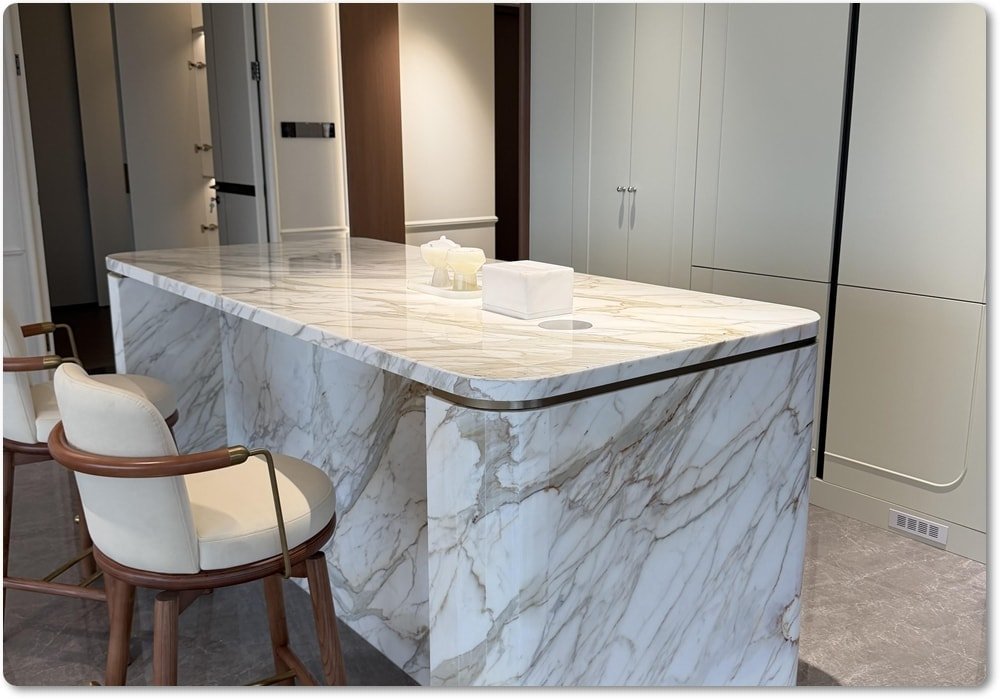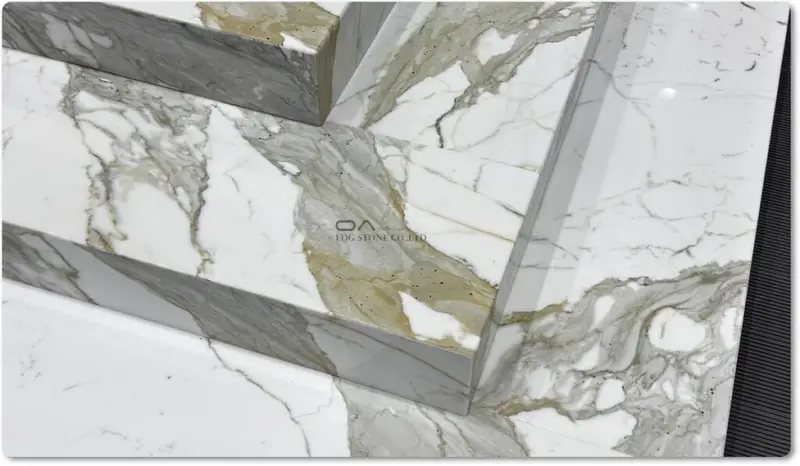
Introduction
If you are searching for how to make smooth quartz slabs, the answer is not only “more polishing.” In modern quartz slab manufacturing, surface smoothness is the result of precise raw material selection, stable resin distribution, controlled curing, multi-step polishing, and strict inspection at every stage.
For fabricators, importers, distributors, and project buyers, a smooth quartz slab is more than a visual feature. It affects gloss consistency, scratch visibility, slab flatness, edge performance, and long-term customer satisfaction. In other words, surface finishing is both a technical process and a quality promise.
This whitepaper-style guide explains the manufacturing logic behind smooth quartz surfaces, the polishing technologies used in factory production, and the QC standards that separate premium slabs from ordinary ones. It is written for buyers and project teams who need reliable, publish-ready technical content about quartz slab quality, including factory-direct positioning from manufacturers such as EDG Stone.
What Determines Quartz Surface Smoothness?
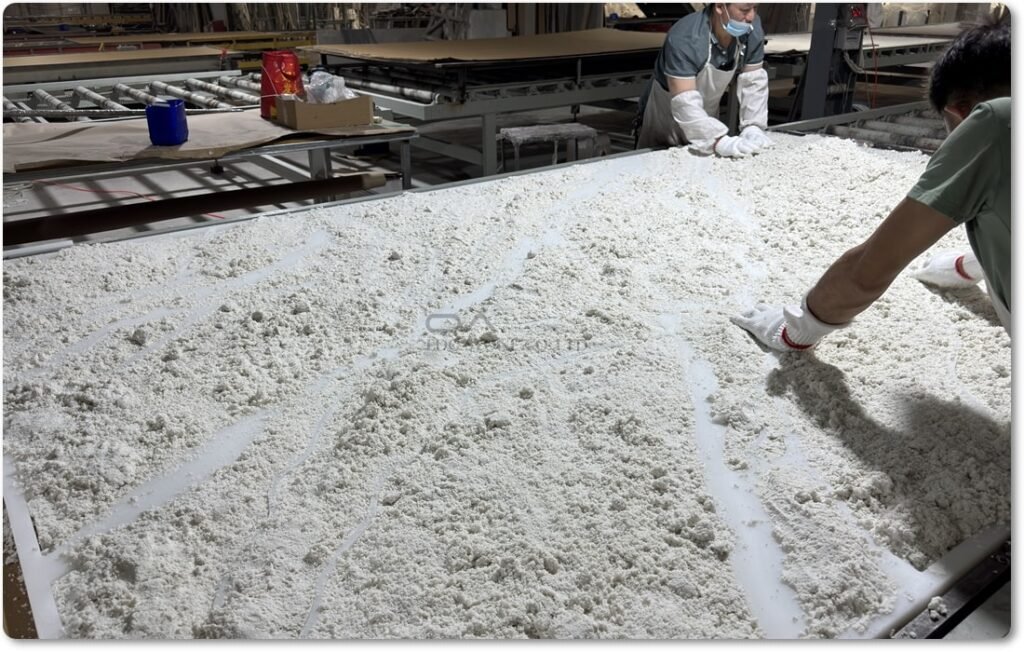
Quartz surface smoothness starts long before polishing. The final result depends on how well the slab is engineered from the inside out.
The most important factors are raw quartz purity, particle grading, resin content, pigment dispersion, slab compaction, curing temperature, and surface calibration. If these variables are unstable, even the best polishing line cannot fully correct the defect.
A smooth quartz slab should feel even to the touch, reflect light consistently, and show minimal waviness or pitting under inspection. In practical manufacturing terms, smoothness means the surface has been calibrated to a stable plane and finished with a fine, uniform abrasive sequence that removes micro-scratches without creating new ones.
Internal Structure Matters More Than People Think
Quartz slabs are a composite product. That means the surface quality is influenced by the internal density of the slab. If the resin is unevenly distributed, some zones will polish faster than others. If quartz particles are poorly graded, the surface may develop micro-voids or “open points” after grinding.
A premium slab should have:
- Uniform particle packing
- Controlled resin-to-stone ratio
- Low void content
- Stable curing across the full slab thickness
- Minimal internal stress
This is why smoothness is not only a polishing issue. It begins in the mixing, pressing, and curing stages.
Resin Distribution & Material Density
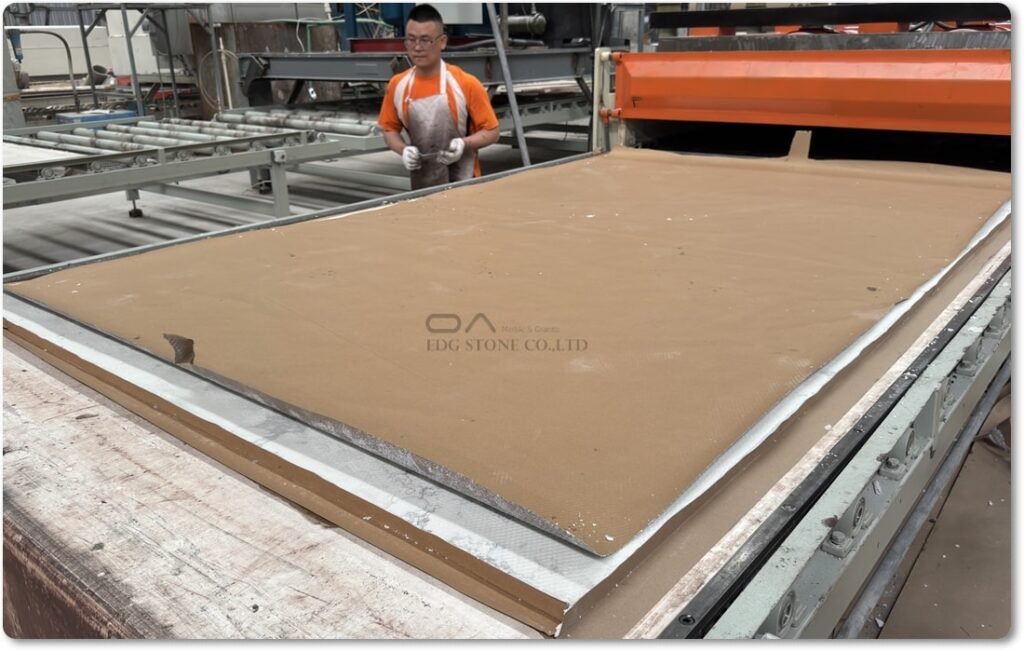
Resin is the binding matrix that holds quartz particles together. Its distribution directly affects how the slab behaves during polishing and inspection.
Too little resin can expose micro-holes and make the surface look dry or sandy. Too much resin can reduce hardness and create a slightly “plastic” finish that may show swirl marks or polishing haze. The best result comes from balance: enough resin to bind the particles tightly, but not so much that it compromises abrasion resistance.
Density is equally important. A dense slab usually supports better edge stability and surface uniformity. When density is uneven, the polishing machine may remove material at different rates across the same slab, producing a visually inconsistent gloss.
What Factories Monitor?
Quality-focused factories check:
- Resin mixing uniformity
- Batch consistency
- Powder moisture content
- Pressing pressure
- Curing stability
- Surface calibration before polishing
When these controls are stable, the surface is easier to finish, and the slab is more likely to pass final QC without rework.
Automated Polishing Lines
Modern quartz slab finishing depends on automated polishing lines rather than manual polishing alone. Automation improves repeatability, reduces human error, and helps maintain consistent gloss across large production runs.
A typical line uses multiple abrasive heads in sequence, gradually moving from coarse grinding to fine finishing. Each stage removes scratches from the previous stage until the surface reaches the target smoothness.
Why Automation Improves Smoothness?
Automated lines help manufacturers control:
- Pressure consistency
- Head alignment
- Abrasive progression
- Feed speed
- Water cooling
- Surface temperature
If the polishing sequence is too aggressive, the slab may lose flatness or develop uneven gloss. If it is too weak, the surface may remain cloudy or show visible micro-scratches. The goal is controlled material removal, not aggressive grinding.
A Good Polishing Sequence Usually Includes
- Calibration
- Pre-grinding
- Medium grinding
- Fine grinding
- Honing
- High-gloss polishing
For leathered or matte finishes, the final step differs, but the early-stage calibration and smoothing process still matters. Even a low-gloss slab needs a uniform base surface.
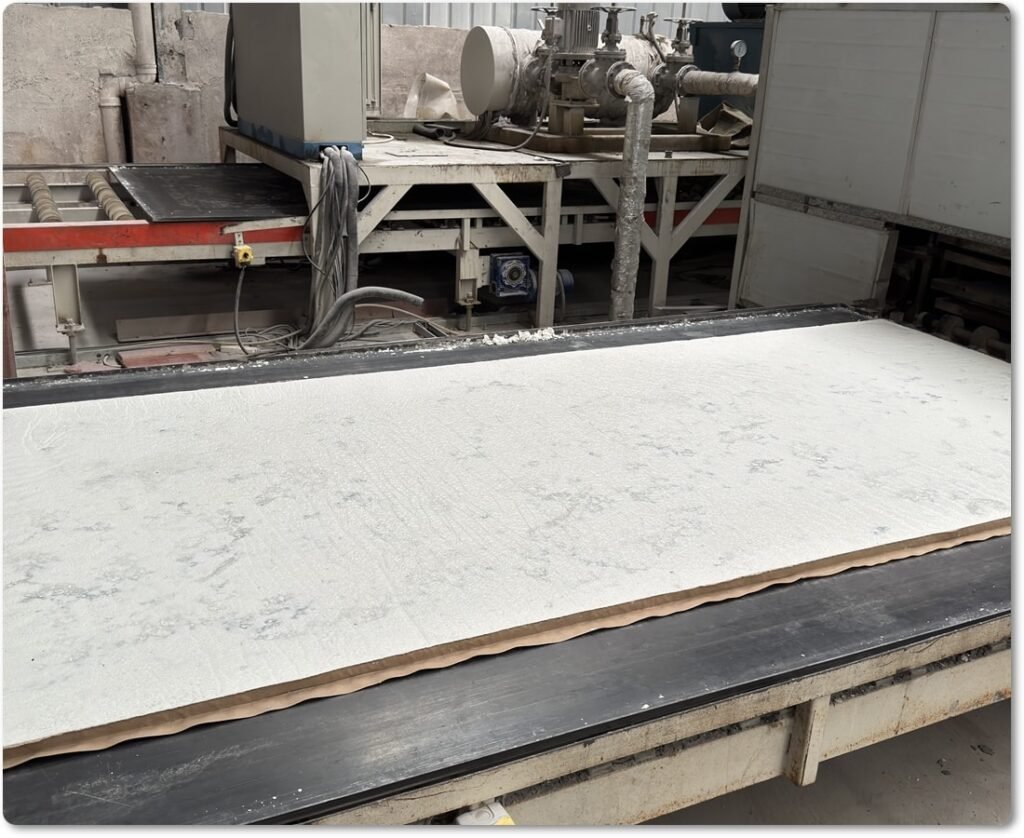
Gloss Meter Standards
Gloss is one of the clearest measurable indicators of quartz surface finishing quality. A gloss meter measures how much light is reflected from the surface at a given angle, usually at 60 degrees for general surface comparison.
High gloss does not automatically mean high quality, but it does indicate that the surface was polished evenly and can reflect light consistently. More importantly, gloss readings help factories maintain batch-to-batch stability.
What Buyers Should Look For?
A reliable manufacturer should be able to provide:
- Gloss consistency across multiple slabs
- Stable readings within the same production batch
- No abrupt dull spots or cloudy areas
- Repeatable results after polishing
In factory QC, gloss is typically checked at multiple points on the slab, not just in one area. A slab may look fine in the center but still show weaker reflectivity near the corners or edges. That is why multiple-point testing is essential.
Gloss Alone Is Not Enough
A slab can be shiny but still defective. Surface smoothness also requires:
- Flatness
- Scratch resistance
- No polishing haze
- No pinholes
- No resin streaks
- No edge-to-center variation
This is why a complete inspection system must combine gloss reading with visual and tactile analysis.
Leathered vs Polished Finishes
When discussing how to make smooth quartz slabs, it is important to distinguish between polished and leathered finishes. They are not the same quality target.
Polished Finish
A polished quartz slab is designed to be highly reflective, smooth to the touch, and visually bright. It requires a more refined abrasive process and tighter QC standards because defects are easier to see under direct lighting.
This finish is common in kitchens, bathrooms, retail interiors, and commercial spaces where clean reflection and premium appearance matter.
Leathered Finish
A leathered finish is intentionally textured. It is softer in appearance, less reflective, and often more forgiving in terms of visible fingerprints and glare.
However, leather does not mean low quality. The slab still needs to be flat, stable, and evenly finished. If the texture is irregular, the finish may look patchy or inconsistent.
Choosing the Right Finish
Polished quartz is ideal when clients want:
- Mirror-like reflectivity
- Bright interior appearance
- Modern luxury design
Leathered quartz is ideal when clients want:
- Lower glare
- Softer visual tone
- A more natural stone-like feel
The smoothness standard changes by finish type, but consistency remains essential in both cases.
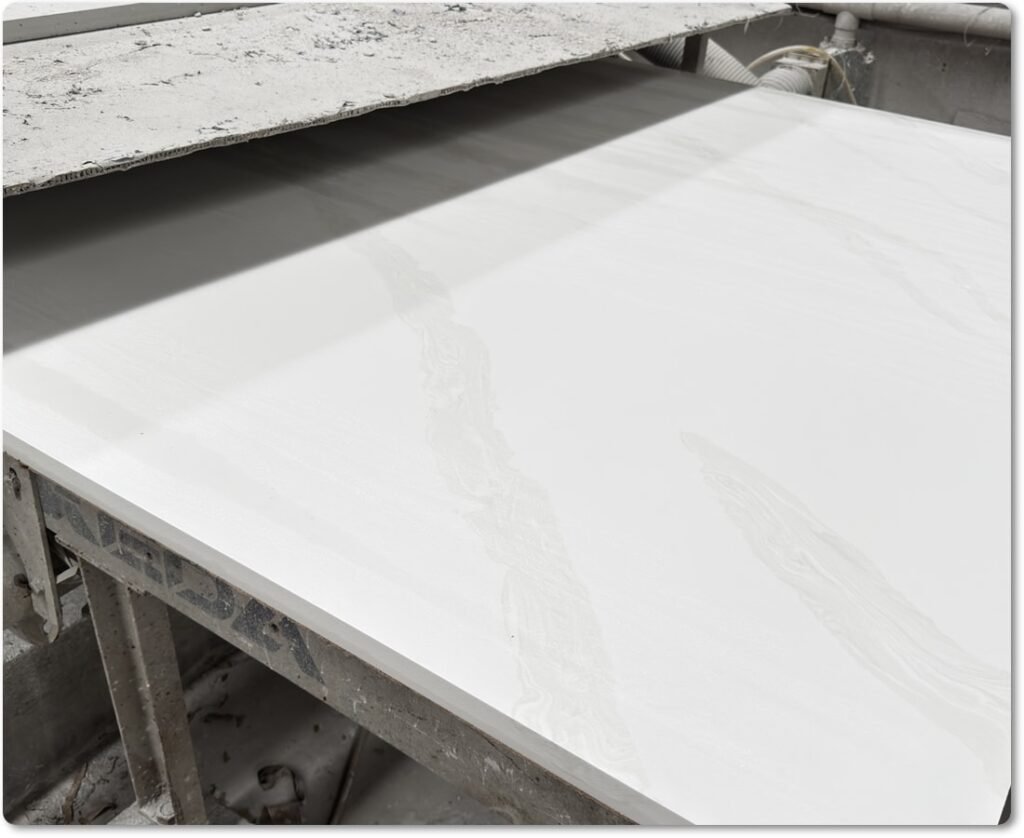
Surface Flatness Tolerances
A smooth quartz slab must be both visually even and physically flat. Surface flatness is critical for installation, seam quality, and long-term performance.
If a slab is not flat, fabricators may face problems during cutting, joining, and installation. Even a small wave or bow can create visible seams, unstable support, or uneven countertop edges.
Why Flatness Matters?
Flatness affects:
- Seam alignment
- Adhesive bonding
- Cabinet contact
- Water flow behavior
- Finished countertop appearance
A slab that looks glossy but has poor flatness will still fail in real-world projects. That is why premium manufacturers use calibration machines and inspection gauges before packing.
Key Flatness Risks
- Uneven curing shrinkage
- Poor pressing balance
- Inconsistent resin flow
- Grinding pressure imbalance
- Thermal distortion during production
The best factory quality systems control flatness before the polishing stage, then verify it again after finishing.
Scratch Visibility Analysis
One of the most important tests for smooth quartz is scratch visibility under light. A slab may look fine from a distance, but scratches become obvious when inspected at an angle or under strong lighting.
Why Scratches Appear More Clearly on Quartz?
Quartz surfaces are often used in bright interiors, showrooms, kitchens, and commercial spaces with LED lighting. These environments make minor defects easier to see. That means the polishing standard must be high enough to pass real-world lighting conditions, not just factory-floor inspection.
Common Scratch Sources
- Coarse abrasive residue
- Poor polishing sequence
- Dirty rollers or handling equipment
- Packaging friction
- Warehouse stacking damage
- Fabrication errors after production
A good manufacturer controls scratches in two ways: by preventing them during processing and by inspecting them before shipment.
Practical Inspection Method
Factories often use a combination of:
- Visual inspection from multiple angles
- Oblique lighting
- Hand touch evaluation
- Surface reflection checks
A slab that passes only direct-front inspection may still fail under side lighting. For this reason, high-quality factories inspect under conditions that simulate real installation environments.
Nano-Coating Technologies
Nano-coating is sometimes used as a surface enhancement technology for quartz slabs. It does not replace core polishing, but it can improve stain resistance, cleanability, and perceived smoothness.
What Nano-Coating Can Do?
A high-quality coating may help:
- Reduce surface energy
- Improve wipe-clean performance
- Minimize liquid penetration on the top layer
- Enhance initial touch smoothness
What Nano-Coating Cannot Do?
It cannot fully correct:
- Poor polishing
- Uneven gloss
- Surface waviness
- Deep scratches
- Structural density problems
In other words, nano-coating is a finishing improvement, not a rescue solution. If the base slab is poorly made, the coating will not transform it into premium quality.
Factories should position coating as an optional enhancement, especially for luxury residential, hospitality, and high-use commercial applications.
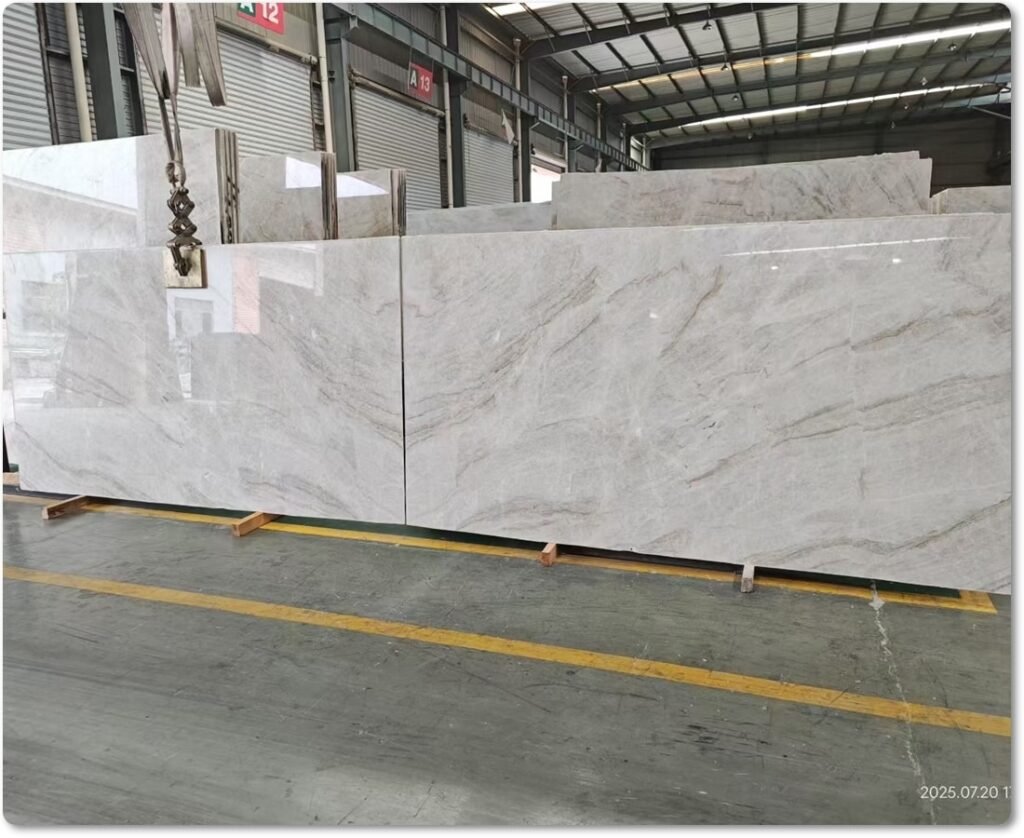
Lighting-Based Surface Inspection
Lighting-based inspection is one of the most effective ways to evaluate smooth quartz slabs before shipment. The surface may look acceptable under normal ambient light, but reveal issues when placed under a controlled inspection lamp.
What Lighting Reveals?
Proper lighting inspection can expose:
- Micro-scratches
- Polishing streaks
- Cloudy zones
- Resin variation
- Dimensional waviness
- Surface contamination
Best Practice in QC Rooms
High-end factories use a dedicated inspection area with controlled light intensity and viewing angles. This helps inspectors identify defects that may otherwise be missed during fast production checks.
A useful inspection standard includes:
- Multiple lighting angles
- Close-range visual scan
- Uniform background
- Repeatable viewing distance
- Surface touch confirmation
This step is especially important for export orders, where clients expect consistent slabs across large quantities.
Factory Quality Control Systems
The best quartz slab manufacturers treat quality control as a chain, not a single final step. Each stage protects the next one.
Core QC Stages
A strong QC system should include:
- Raw material testing
- Mixing ratio verification
- Pressing and curing inspection
- Calibration and thickness control
- Polishing line monitoring
- Surface gloss and flatness testing
- Lighting-based visual inspection
- Packaging and loading inspection
Why End-to-End QC Matters?
If a slab fails at one stage and the issue is not corrected, the defect becomes more expensive to fix later. For example, a poor resin batch may create polishing haze, and a poor calibration stage may create a wave that no finishing line can fully remove.
That is why manufacturers like EDG Stone emphasize factory control from raw material selection to final packaging. For importers and project buyers, this means fewer claims, fewer rejections, and more predictable project outcomes.
Export Buyers Should Ask for
- Batch photos
- Gloss test records
- Thickness tolerance data
- Packing method details
- Pre-shipment inspection reports
This level of transparency is especially valuable for global buyers in the United States, Canada, Australia, Europe, and the Middle East, where project specifications are often strict.
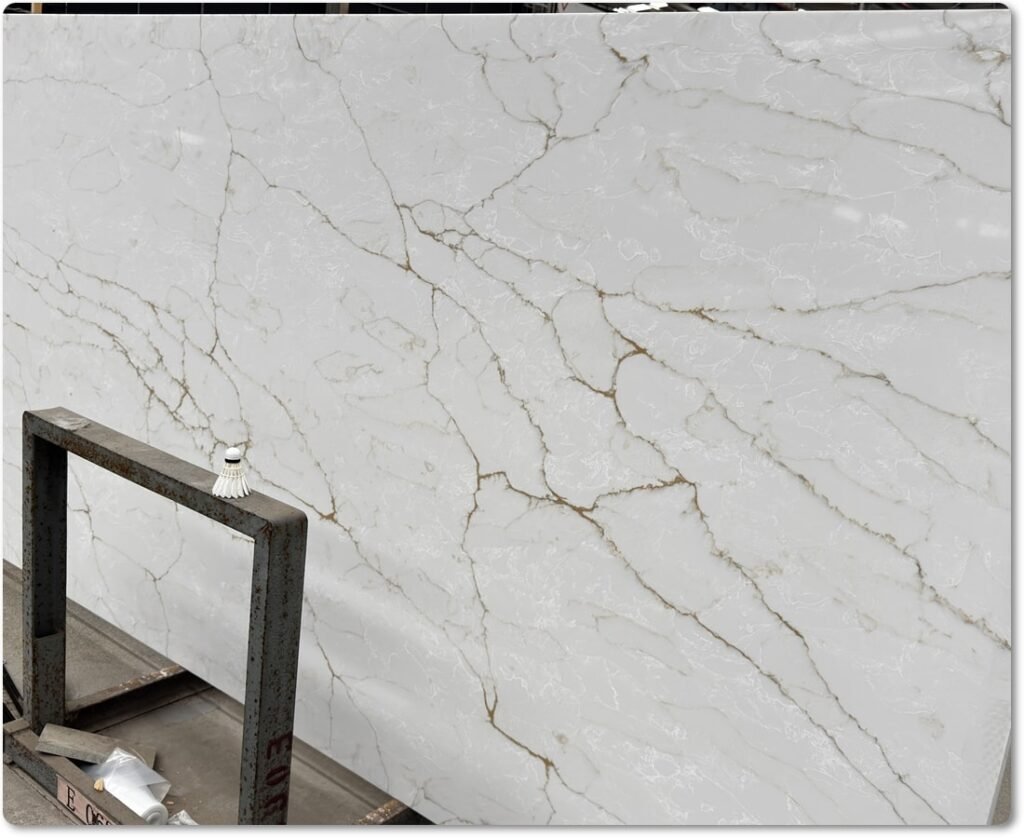
Whitepaper Positioning
This guide can be positioned as a technical whitepaper for SEO, GEO, and B2B lead generation because it solves a real manufacturing and sourcing problem: buyers want to know how smooth quartz slabs are made, how quality is measured, and how to judge supplier consistency.
To maximize search performance, the content should target both technical intent and commercial intent. That means using phrases such as:
- How to make smooth quartz slabs
- quartz slab polishing standards
- surface finishing technology
- quartz slab QC system
- polished quartz slabs manufacturer
- factory-direct quartz slabs
- export-grade quartz surfaces
For GEO optimization, the article should also mention international buyer markets, application types, and factory supply capability. This helps search engines understand that the content is relevant not only to one city or one country, but to global sourcing audiences looking for reliable quartz slab manufacturers.
If the goal is lead generation, the conclusion should guide readers toward factory consultation, sample requests, or technical specification review.
Conclusion
Making smooth quartz slabs is a controlled engineering process, not a simple polishing step. The final surface quality depends on resin distribution, material density, automated polishing lines, gloss consistency, surface flatness, scratch control, and disciplined factory inspection.
A truly smooth quartz slab should be visually uniform, physically flat, easy to inspect under lighting, and stable enough to perform in kitchens, bathrooms, hospitality spaces, and commercial interiors. For buyers, the safest way to evaluate quality is to look beyond appearance and ask for QC proof across the full production chain.
For manufacturers, this is where premium positioning begins. A factory that can consistently produce smooth, polished, and inspection-ready slabs stands out in both domestic and export markets.
FAQ
What is the best way to make quartz slabs smooth?
The best method is a controlled process that combines accurate material mixing, stable curing, calibration, and multi-stage automated polishing. The slab must also pass gloss, flatness, and lighting-based inspection.
Is a higher gloss always better?
Not always. High gloss is important for polished finishes, but the real goal is consistency, flatness, and defect-free reflection. A slab can be shiny and still have quality problems.
Can nano-coating make a rough slab smooth?
No. Nano-coating can improve stain resistance and cleanability, but it cannot fix poor polishing, uneven flatness, or internal structural defects.
What should buyers check before ordering quartz slabs?
Buyers should check surface gloss consistency, flatness tolerance, scratch visibility under light, QC reports, packing quality, and the factory’s polishing and inspection process.