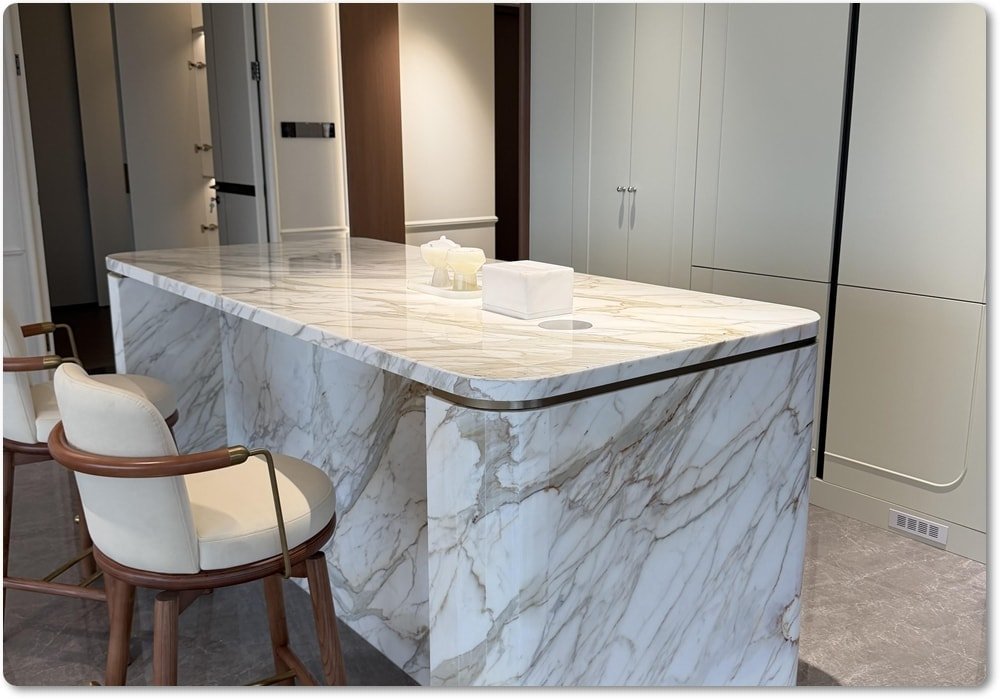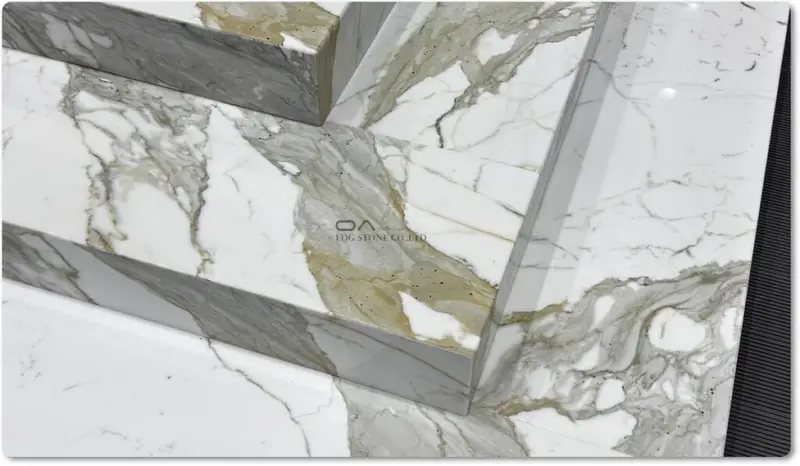
Quartz stone slabs have become one of the most important materials in modern interior design, commercial construction, and luxury residential projects. Their popularity comes from a combination of visual appeal, durability, low maintenance, and production consistency. But behind every polished surface is a precise manufacturing process that transforms raw quartz into high-performance engineered quartz slabs and artificial quartz slabs.
For buyers, distributors, designers, and project specifiers, understanding how quartz stone slabs are manufactured is more than a technical curiosity. It helps explain product quality, color stability, surface performance, and long-term reliability. It also reveals why some slabs perform better than others in kitchens, bathrooms, hospitality spaces, retail counters, and large-scale projects.
This whitepaper-style guide explains the complete production workflow, from quartz raw material selection to final surface inspection, while also showing how a professional factory controls consistency at every stage.
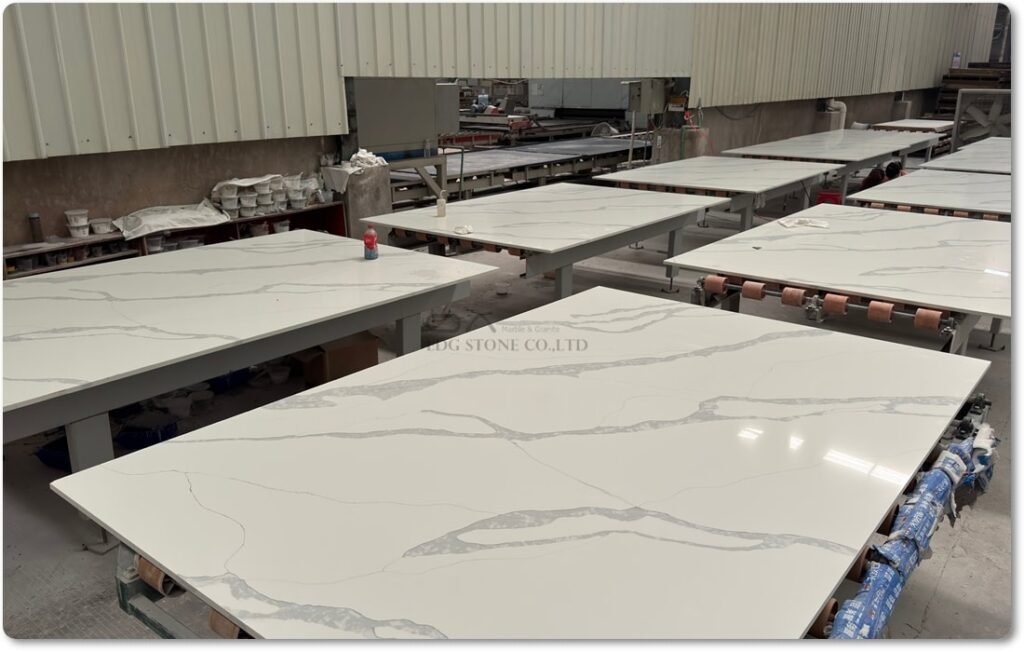
Why Quartz Stone Slabs Are Manufactured, Not Just Mined?
Unlike natural stone, quartz stone slabs are engineered products. They are designed to deliver repeatable color, controlled veining, stable dimensions, and predictable performance. Natural quartz is one of the hardest minerals on earth, but raw quartz alone cannot become a finished slab. It must be processed, graded, mixed with resins and pigments, compressed, cured, and polished into a stable surface.
That engineered nature is what makes quartz slabs so attractive to global buyers. The product can be standardized for large projects, matched across multiple shipments, and customized for specific applications. In today’s market, architects and importers often prefer engineered quartz slabs because they reduce installation risk and simplify procurement planning.
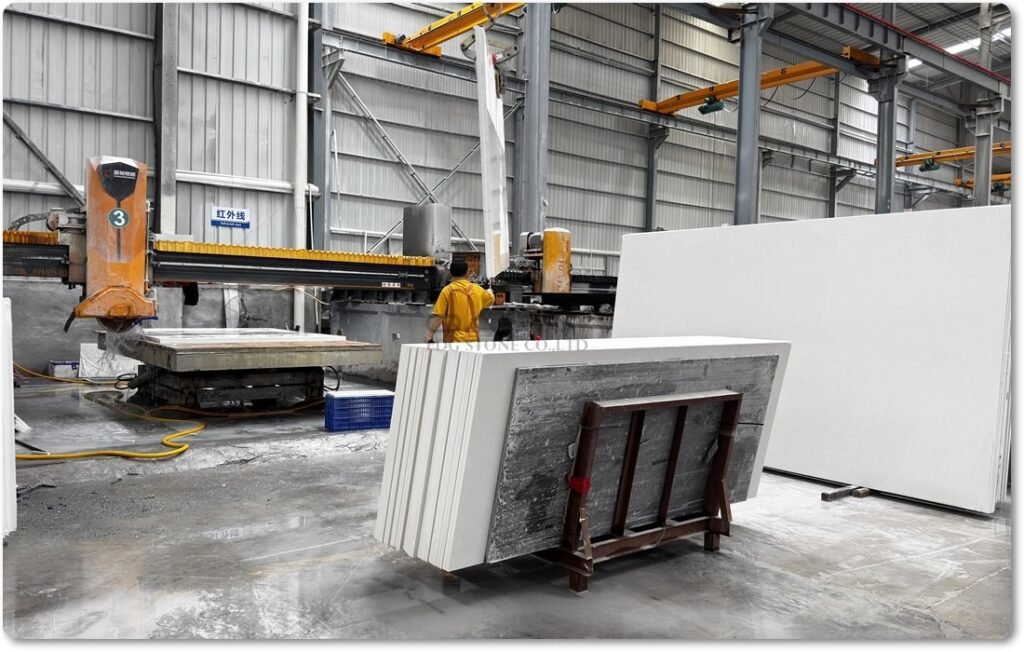
Quartz Raw Material Selection
The manufacturing process begins with raw quartz selection. This step determines the foundation of the finished slab.
High-quality quartz stone slabs typically use carefully selected quartz aggregates with controlled purity, hardness, and particle distribution. The raw quartz must be clean, stable, and free from excessive clay, iron contamination, or soft mineral inclusions. Even small impurities can affect color uniformity, translucency, and surface strength.
A professional factory evaluates raw quartz by origin, mineral composition, whiteness level, impurity content, and particle size potential. Different quartz grades may be used for different product lines. For example, premium white quartz slabs usually require cleaner, brighter quartz materials, while darker or textured designs may allow broader raw material variation.
This stage is also where consistency starts. If the incoming quartz feedstock is uneven, the finished engineered quartz slabs will show tone variation, uneven sparkle, or unpredictable surface behavior.
Crushing, Grading & Purification
After selection, the quartz is crushed into smaller particles and separated into controlled size ranges. This is a critical stage because particle grading directly affects slab density, surface texture, and visual uniformity.
Crushing
Quartz rocks are mechanically reduced into granules and powder-like fragments. The goal is not simply to make them smaller, but to prepare a material structure suitable for slab compaction and resin bonding.
Grading
The crushed quartz is then sorted into different particle sizes. A balanced mix of coarse and fine particles helps the slab achieve compact packing, better strength, and a more natural visual effect. Poor grading can create voids, weak points, or an overly plastic-looking finish.
Purification
Purification removes dust, iron particles, and other contaminants. This is particularly important for white and light-colored artificial quartz slabs, where impurities become highly visible in the final product. Some factories use washing, magnetic separation, screening, and drying systems to improve purity.
A well-controlled crushing and grading system helps ensure that every batch supports consistent slab performance. This is one of the biggest differences between a professional production line and a low-grade operation.
Resin Mixing Technology
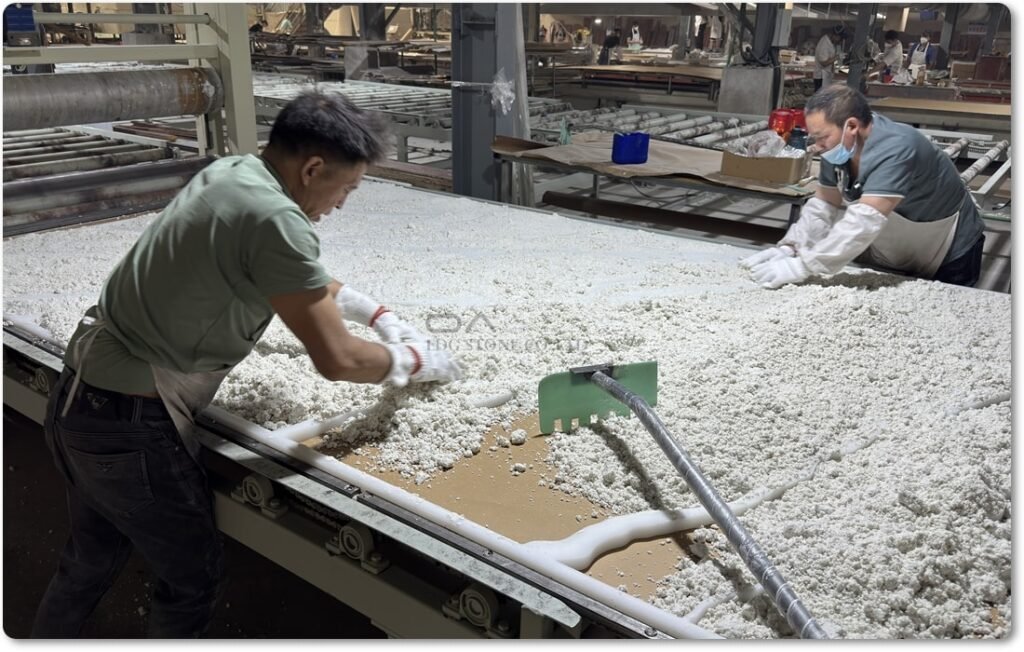
Quartz alone cannot form a slab. It must be combined with resin and pigments to create a stable engineered material.
The resin is the binding system that holds the quartz particles together. It influences flexibility, impact resistance, adhesion, and stain resistance. Pigments provide the final color tone, while special additives may improve UV performance, aging resistance, and processing behavior.
Why Resin Formula Matters?
The resin formula affects:
- mechanical strength
- surface gloss retention
- resistance to staining
- thermal stability
- color consistency
- long-term aging performance
If the resin content is too high, the slab may become less natural in appearance and more vulnerable to heat-related issues. If it is too low, the slab may lose integrity and become difficult to press into a dense structure. The right balance is essential.
Mixing Precision
Professional quartz stone slabs production uses controlled weighing and blending systems to ensure each batch receives the same formula. Quartz particles must be coated evenly with resin and pigment so the final slab has a uniform distribution.
This step is especially important for marble-look or veined engineered quartz slabs, where visual design depends on precise material dispersion. Uneven mixing can lead to streaks, blotches, or weak zones.
Vacuum Vibrocompression Systems
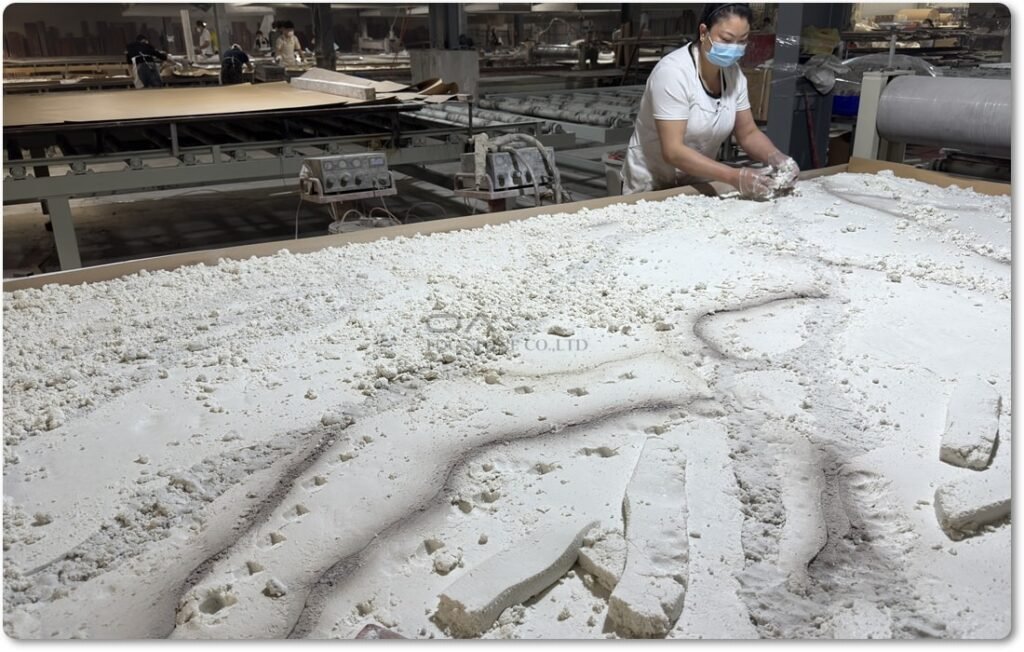
Once the quartz mixture is ready, it is transferred into molds and processed through vacuum vibrocompression. This is one of the most important technologies in modern quartz slab manufacturing.
The purpose of vacuum vibrocompression is to remove air from the mixture while compacting it under vibration and pressure. Air pockets inside the slab can reduce strength, increase porosity, and create visible surface defects. Vacuum technology helps the material become dense, uniform, and structurally reliable.
What does the system do?
Vacuum vibrocompression typically performs three functions at once:
- removes trapped air
- arranges quartz particles into a tighter structure
- prepares the slab for high-pressure pressing
This process helps artificial quartz slabs achieve the low porosity and high density that buyers expect from premium surfaces. It also improves edge stability, scratch resistance, and the ability to polish the slab evenly.
Why It Matters for Buyers?
A slab produced without proper vacuum control may look acceptable at first glance, but can show hidden quality problems later. These may include pinholes, internal voids, resin-rich zones, or weak bonding areas. For large projects, these issues can create expensive installation and warranty problems.
Slab Pressing Technology
After vacuum vibrocompression, the quartz mixture is pressed into a slab shape. This stage sets the thickness, flatness, and internal density of the finished product.
The pressing system must deliver consistent force across the full slab area. Uneven pressure can lead to warping, density gradients, or thickness variation. Since quartz stone slabs are often used in precision applications such as countertops and wall panels, dimensional control is essential.
Key Pressing Outcomes
A good pressing process helps achieve:
- stable slab thickness
- high density
- low water absorption
- improved flexural strength
- consistent internal structure
For buyers comparing engineered quartz slabs, this step is one of the best indicators of factory capability. Facilities with advanced slab pressing technology can maintain tighter tolerances and more uniform product quality across batches.
Kiln Curing & Thermal Stabilization
After pressing, the slab must be cured in a kiln or thermal stabilization system. This step hardens the resin, locks the structure in place, and improves mechanical performance.
Curing temperature and time must be carefully controlled. If the process is too fast, the slab may cure unevenly. If it is too slow, productivity drops, and output may become inconsistent. A professional factory uses calibrated thermal systems to ensure that slabs cure completely without internal stress.
Why Curing Is Important?
Proper curing improves:
- hardness
- dimensional stability
- bond strength
- surface durability
- resistance to deformation during transport and fabrication
Thermal stabilization also reduces the likelihood of future performance issues. For engineered quartz slabs, this stage is essential to ensuring the product remains stable under real-world installation conditions.
Surface Polishing Systems
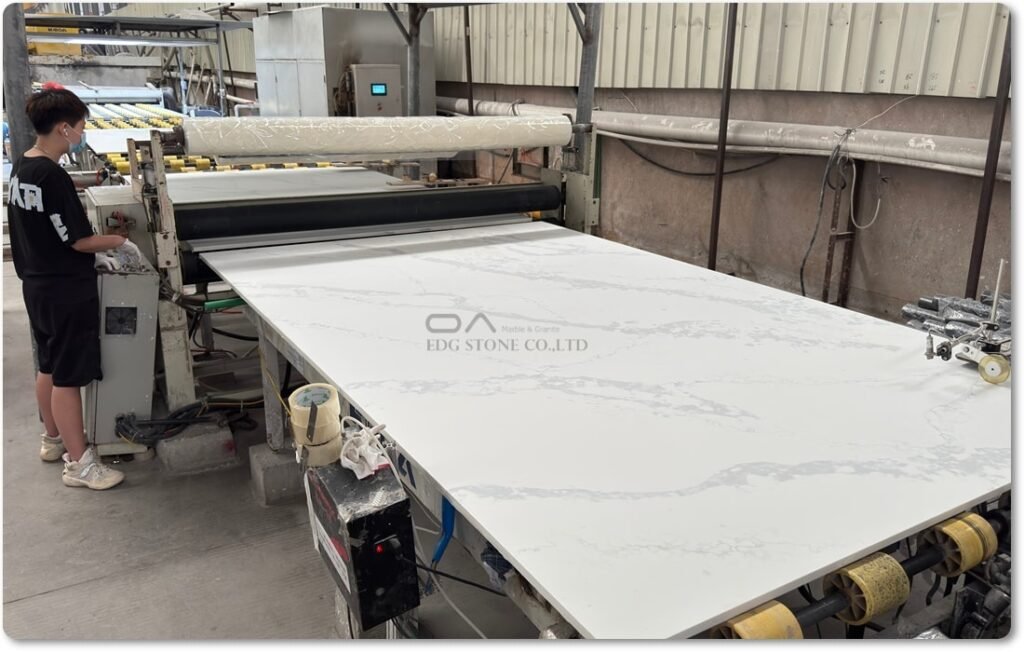
Once the slab is cured, it is trimmed, calibrated, and polished.
Polishing transforms the slab from a functional material into a premium finished product. The polish level affects both visual appearance and the customer’s perception of quality. A high-end quartz stone slab should have a smooth, even, and reflective surface without haze, drag marks, or inconsistent gloss.
Polishing Goals
The polishing process aims to:
- create a uniform gloss level
- remove surface irregularities
- reveal color and pattern clarity
- improve tactile smoothness
- Prepare the slab for fabrication and installation
Different quartz products may use different surface finishes. High-gloss polished surfaces are popular for kitchens and luxury interiors, while matte or soft-touch finishes are increasingly used in contemporary design. Some factories also produce special textures that mimic natural stone more closely.
A professional polishing line is not only about appearance. It also reflects how stable the slab surface is after compaction and curing.
Quality Inspection Standards
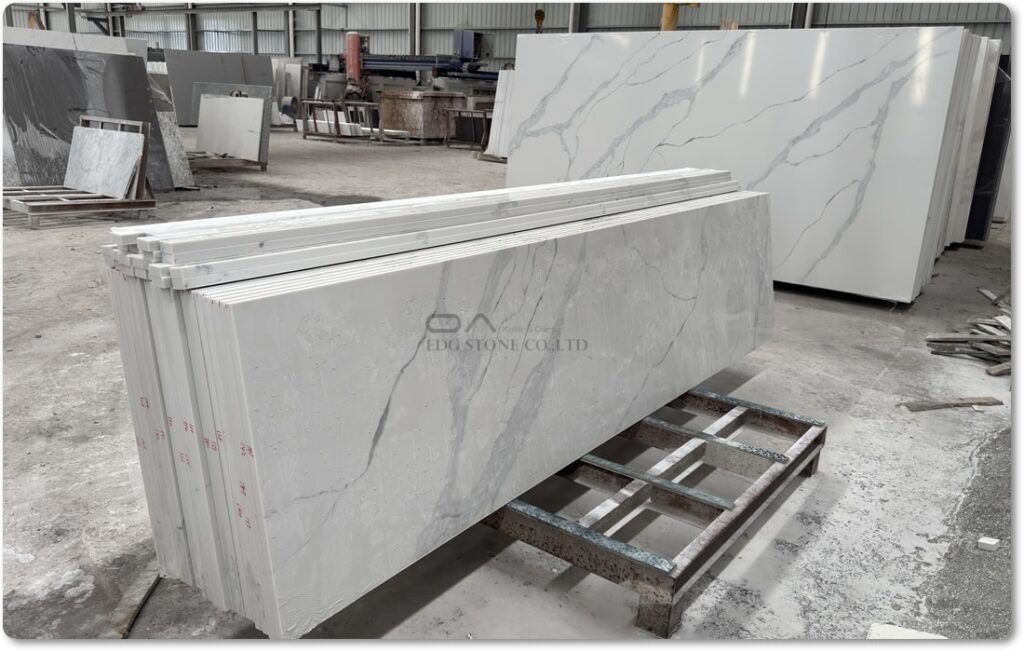
Quality inspection is where manufacturing discipline becomes visible. A good factory does not wait until the end of the line to find problems. It builds inspection into every stage of production.
What Inspectors Check?
Inspection for quartz stone slabs usually includes:
- thickness tolerance
- surface flatness
- gloss consistency
- color uniformity
- edge condition
- resin distribution
- visible bubbles or pinholes
- cracks, chips, and contamination
Some factories also conduct mechanical and performance testing, such as flexural strength, water absorption, wear resistance, and stain resistance. These tests help verify that the slab performs as expected in the marketplace.
For importers and project buyers, inspection standards are especially important because appearance alone does not guarantee quality. A slab may look beautiful in a showroom and still fail in fabrication if it is unstable internally.
Defect Classification in Quartz Slabs
Even with strong process control, defects can still occur. The key difference between an average factory and a professional one is how defects are identified, classified, and managed.
Common Defect Types
Typical defects in quartz stone slabs include:
- air bubbles or pinholes
- resin streaks
- color variation
- poor particle distribution
- surface scratches
- calibration issues
- edge chipping
- internal voids
- gloss inconsistency
- foreign material contamination
Why Defect Control Matters?
Defect classification helps factories determine whether a slab can be reworked, downgraded, or rejected. This protects both the manufacturer and the buyer. It also helps production teams improve root causes over time.
For global buyers of artificial quartz slabs, defect management is just as important as production volume. A factory that knows how to identify and control defects can deliver more reliable shipments and fewer after-sales problems.
How does EDG Stone Factory control production consistency?
Production consistency is what separates a supplier from a true manufacturing partner.
EDG Stone Factory controls consistency by standardizing the full workflow, from raw quartz selection through final inspection. That means each batch is produced under controlled parameters rather than subjective judgment.
Core Consistency Controls
A professional system like EDG Stone Factory typically focuses on:
- stable raw material sourcing
- controlled particle grading
- precise resin and pigment formulation
- vacuum and compression monitoring
- curing temperature control
- surface calibration and polishing accuracy
- multi-stage quality inspection
- defect traceability by batch
This kind of process discipline is especially valuable for overseas buyers, distributors, and project contractors who need repeatable color and size performance across multiple orders.
When a customer orders quartz stone slabs for a chain project, hotel, apartment development, or retail rollout, they need confidence that today’s shipment will match the next one. That is where factory-level consistency becomes a real commercial advantage.
Why Manufacturing Knowledge Helps Buyers Make Better Decisions?
Understanding how engineered quartz slabs are made gives buyers a serious advantage. It helps them evaluate suppliers more intelligently and avoid common sourcing mistakes.
Instead of comparing only price, buyers can ask better questions:
- How is raw quartz selected and graded?
- What resin system is used?
- Does the factory use vacuum vibrocompression?
- How is curing controlled?
- What inspection standards are applied?
- How are defects classified and handled?
These questions reveal whether a supplier truly understands quartz production or only trades finished goods. In B2B sourcing, that difference matters.
Applications of Quartz Stone Slabs in Modern Projects
Because quartz stone slabs combine beauty and technical reliability, they are used in a wide range of applications.
Common Applications
- kitchen countertops
- bathroom vanity tops
- shower walls
- hotel reception desks
- retail display counters
- office worktops
- wall cladding
- commercial interior surfaces
For these applications, the slab must perform consistently under use, cleaning, fabrication, and installation pressure. That is why production quality is so important.
Conclusion
The quartz stone slabs manufacturing process is a carefully engineered sequence designed to transform raw quartz into durable, beautiful, and reliable surfaces. From raw material selection and particle grading to resin mixing, vacuum vibrocompression, pressing, curing, polishing, and inspection, every stage contributes to the final product.
For buyers and project specifiers, understanding this workflow makes it easier to evaluate quartz suppliers and choose products that offer real value. For manufacturers, the process is proof that quality is not created at the polishing stage alone. It begins with raw quartz selection and continues through every controlled step of production.
In a competitive market, the most successful engineered quartz slabs are not just attractive. They are consistent, traceable, and built with factory discipline from the start.
FAQs
What are quartz stone slabs made of?
Quartz stone slabs are engineered surfaces made from natural quartz particles, resin binders, pigments, and additives, all compressed and cured into a solid slab.
Are engineered quartz slabs the same as artificial quartz slabs?
Yes. In common industry usage, engineered quartz slabs and artificial quartz slabs usually refer to the same type of manufactured quartz surface.
Why is vacuum vibrocompression important?
It removes trapped air and compacts the quartz mix into a dense, strong, and uniform slab with fewer internal defects.
What affects quartz slab quality the most?
Raw material purity, resin formula, pressing accuracy, curing control, and quality inspection all have a major impact on slab quality.
Why do some quartz slabs have defects?
Defects can come from poor raw material control, uneven mixing, insufficient compaction, unstable curing, or weak inspection procedures.